

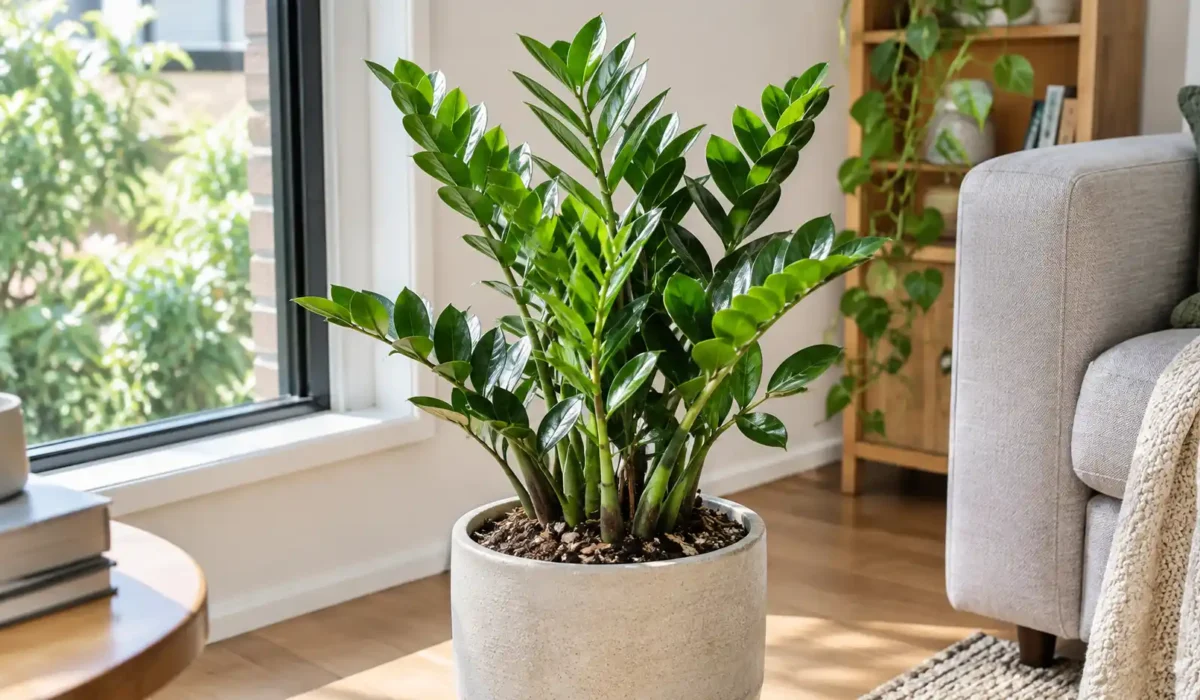
Zanzibar Gem Care: Watering, Light, Problems & Australian Growing Guide
Zanzibar Gem care is surprisingly simple: give your ZZ plant (Zamioculcas zamiifolia) bright, indirect light, use a free-draining potting mix, and wait for the root-zone mix to dry substantially before watering again. The plant stores water in thick underground rhizomes, which is why it tolerates neglect better than many houseplants, but those same water reserves make persistent wet soil a major root-rot risk. In Australia, the main additional issue is climate: Zanzibar Gems are frost-sensitive and are most reliable outdoors only in warm, frost-free tropical or subtropical locations. For most of Victoria, Tasmania, South Australia and cooler inland areas, growing it as an indoor or moveable container plant is the safer choice.
Quick Summary
- Water a Zanzibar Gem only after the potting mix has dried substantially through the root zone. A typical indoor plant may need watering roughly every 2–4 weeks, with longer intervals in cooler southern winters.
- Bright, indirect light produces stronger growth, although ZZ plants tolerate surprisingly low light. Avoid harsh, prolonged direct sun.
- The plant is drought-tolerant because its rhizomes store water, but repeatedly wet soil can lead to root rot.
- Chewing the plant can cause irritation because it contains insoluble calcium oxalate crystals. Pet exposures usually cause mouth and gastrointestinal irritation rather than systemic poisoning, but significant swelling or breathing difficulty needs urgent veterinary or medical attention.
- Outdoors, Zanzibar Gems are most dependable in frost-free tropical and subtropical Australia. In temperate, cool or frost-prone districts, keep them in pots so they can be protected from cold.
What Is a Zanzibar Gem? (Meet the ZZ Plant)
A Zanzibar Gem is the common Australian name for Zamioculcas zamiifolia, usually shortened to ZZ plant. It belongs to the Araceae family, the same broad plant family that includes pothos, philodendrons and peace lilies. Kew currently accepts Zamioculcas zamiifolia as the species’ botanical name and gives its native range as Kenya, Tanzania, Malawi, Mozambique, Zimbabwe and KwaZulu-Natal.
The plant has upright fleshy leaf stalks carrying rows of glossy leaflets. Underground, it develops thick rhizomes that act as water-storage organs. That structure is central to successful care: a ZZ can cope with periods of dryness, but it cannot use water quickly enough to compensate for a pot that stays saturated.
The names can also cause confusion. Zanzibar Gem, ZZ plant and zuzu plant are commonly used for the same species. “Zanzibar fern” is not a botanical identity for a true fern; despite some older common names referring to it as a fern, the plant is an aroid in the Araceae family.
The name “Zanzibar Gem” is therefore a common horticultural name, not an indication that the species is a fern.
Is a Zanzibar Gem a Good Indoor Plant?
Yes. A Zanzibar Gem is particularly well suited to apartments, offices and homes where watering may occasionally be forgotten.
Its main advantages are its combination of:
- Low-light tolerance
- Drought tolerance
- Slow growth
- Relatively modest maintenance requirements
- Ability to cope with ordinary indoor humidity
- Long periods between waterings
UF/IFAS notes that ZZ plants can maintain themselves in low-light interiors, while commercial production research has demonstrated their ability to continue producing new leaves under very low interior light levels.
That does not mean a dark room is ideal. Low light is primarily a survival tolerance. Brighter indirect light normally produces better growth and helps prevent the long, widely spaced stems that gardeners describe as leggy.
For broader indoor-plant troubleshooting, the Leafy Heaven plant problems and troubleshooting guide is useful when you are not sure whether a symptom is caused by watering, light, pests or another environmental issue.
Claims that ZZ plants dramatically purify household air should also be treated cautiously. Laboratory studies on houseplants do not automatically translate into meaningful air-quality improvements in normal occupied homes, so Zanzibar Gem care should be based on its horticultural properties rather than exaggerated air-purification promises.
Watering a Zanzibar Gem the Right Way (Australia-Specific)
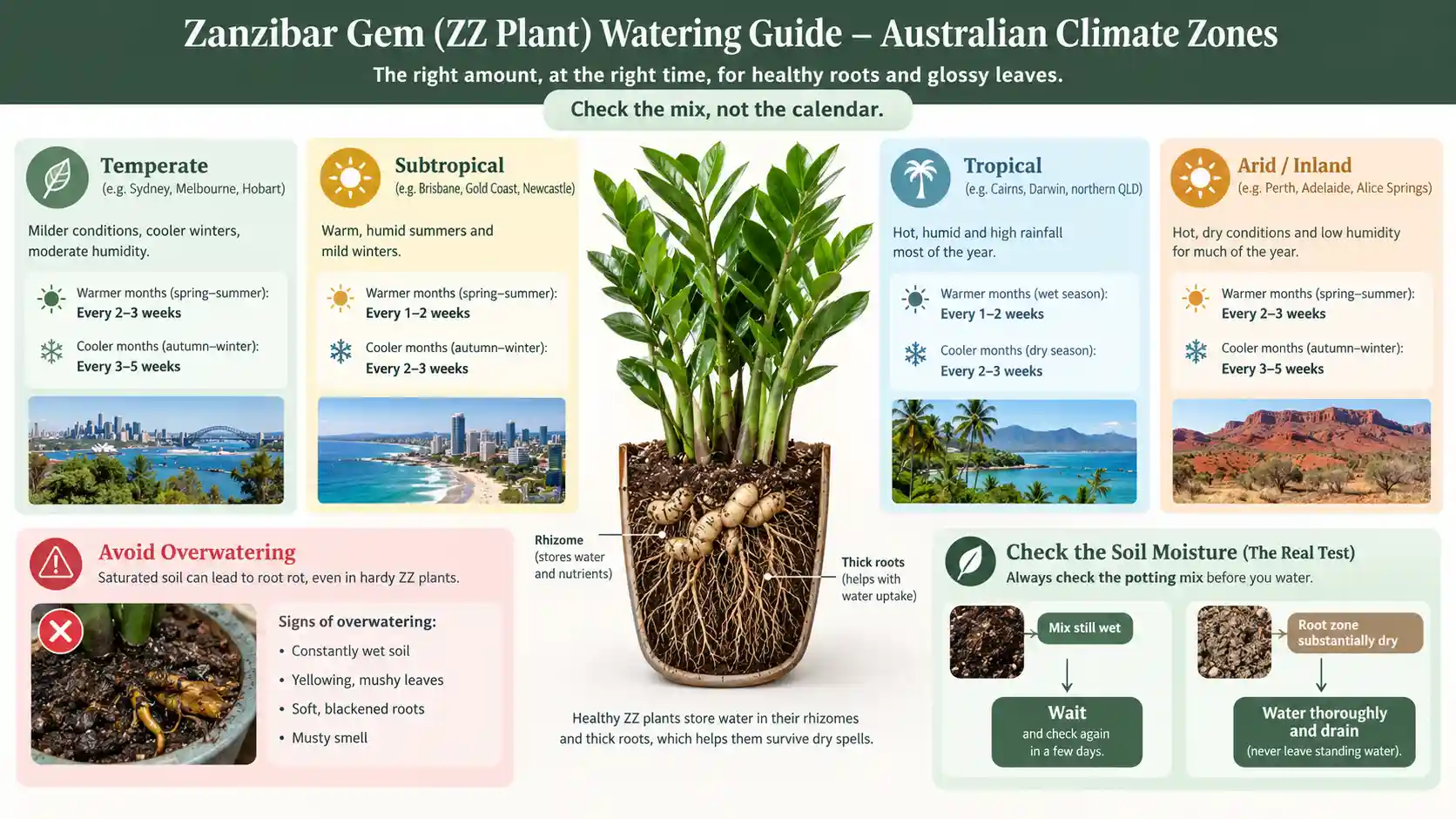
The most important watering rule is simple: do not water on a fixed calendar if the potting mix is still wet.
Instead, check the mix and the weight of the pot. A free-draining ZZ in bright indirect light may need water every couple of weeks, while one in lower light, a cool room or a large container may go considerably longer.
ABC Gardening Australia specifically identifies Zanzibar Gem as a plant that can go weeks without water because of its underground water-storage organs. UF/IFAS likewise recommends allowing the growing medium to dry between waterings and warns against keeping the roots in water.
Australia-specific watering starting points
| Australian climate | Warmer/growing period | Cooler/winter period | Main rot-risk warning |
| Temperate: VIC, TAS, SA, southern NSW | About every 2–4 weeks | About 4–6+ weeks | Low indoor light and cool temperatures can leave the mix wet for too long |
| Subtropical: SE QLD, coastal/northern NSW | About every 1–3 weeks | About 2–4 weeks | Warm, humid conditions do not justify watering if the mix remains wet |
| Tropical: FNQ, Top End, northern WA | About every 1–2 weeks | About 2–3 weeks during cooler/drier periods | High rainfall or humid conditions matter outdoors; containers still need fast drainage |
| Arid/inland Australia | About every 2–4 weeks, depending on indoor heat and light | About 3–5+ weeks | Hot air can dry pots quickly, but cold nights can sharply reduce water use |
These are starting ranges, not fixed prescriptions. Pot size, pot material, mix structure, window exposure, air conditioning, heating and plant size can shift watering substantially. The correct signal is the dryness of the root zone, not the calendar.
When watering, soak the mix thoroughly until excess water drains from the bottom, then empty the saucer. Do not let the pot sit in collected water.
Signs of overwatering vs underwatering
Overwatering is more likely when the mix stays wet for days, leaves turn yellow, stems become soft or unstable, and roots are brown or mushy. Poor drainage and excessive water are well-established pathways to root problems in ZZ plants.
Underwatering usually produces a genuinely dry, lightweight pot, dry or curling foliage and increasing leaf drop or limpness. The important distinction is that an underwatered plant has dry roots, whereas an overwatered plant can look thirsty because damaged roots can no longer absorb water properly.
That distinction is particularly useful when diagnosing yellowing, wilting and brown foliage on indoor plants, because the same visible symptom can have opposite causes.
Light, Temperature & Position
The ideal indoor position is bright, indirect light. An east-facing window, filtered north-facing light or a bright room away from harsh afternoon sun can work well.
ZZ plants tolerate low light, but prolonged low light commonly means slower growth and longer, less compact stems. ABC Gardening Australia notes that a ZZ becoming long and lanky is a sign that it is not receiving enough light.
Avoid strong direct afternoon sun through glass, especially in Australian summer. Intense exposure can scorch the foliage.
Temperature
Warm conditions are preferable. UF/IFAS gives a warm growing range and notes that chilling injury can occur below about 10°C, while freezing temperatures are not tolerated. RHS guidance for ZZ plants also recommends protecting them from extreme cold and drafts.
A practical Australian rule is:
Keep the plant comfortably warm, protect it from prolonged temperatures below about 10°C, and never expose it to frost or freezing conditions.
Normal household humidity is generally sufficient. You do not need to mist a ZZ routinely to make it healthy; good light, drainage and sensible watering matter more.
Can a Zanzibar Gem Grow Outside in Australia?
Yes, but the climate matters more than the postcode.
A Zanzibar Gem can be grown outdoors as a garden plant in warm, frost-free tropical and subtropical regions, particularly in filtered light or part shade. In colder Australian climates it is better treated as a container plant that can be moved indoors or into a protected area.
Indoor vs outdoor care comparison
| Condition | Indoor Zanzibar Gem | Outdoor Zanzibar Gem |
| Light | Bright indirect light | Part shade or filtered light |
| Watering | Usually infrequent | Rainfall can dramatically change requirements |
| Frost | Easy to protect | Major limiting factor |
| Sun | Avoid harsh direct sun | Protect from intense afternoon exposure |
| Temperature | Easier to control | More exposed to cold snaps and heat |
| Potting mix | Free-draining indoor mix | Free-draining garden soil or container mix |
| Best Australian use | All states and territories with suitable indoor conditions | Frost-free tropical/subtropical districts |
Far North Queensland, the Top End and warm northern Western Australia: outdoor cultivation can be practical in a sheltered, partly shaded location.
South-east Queensland and northern New South Wales: outdoor cultivation can work in genuinely frost-free positions, but a pot gives more control in inland or unusually cold locations.
Melbourne, Adelaide, Tasmania and southern NSW: keep the plant in a container and protect it from cold. Outdoor permanence is unreliable.
Cool/highland areas and frost-prone inland sites: treat the plant as an indoor or moveable patio specimen.
A useful rule is “outdoors only where frost is not a normal risk.” Do not confuse tolerance of a cool room with tolerance of Australian winter frost.
Soil, Potting Mix & Fertiliser (Australian Product Guide)
The best mix for a Zanzibar Gem is free-draining but not completely inert. The root system needs both moisture and access to air.
Quality indoor potting mixes are preferable to ordinary garden soil in containers because they are designed to balance drainage and water retention. Yates explains the importance of choosing potting mixes that drain properly while still holding enough moisture for container plants.
Named Australian options include:
- Yates Thrive Indoor Plants Potting Mix
- Scotts Osmocote Premium Potting Mix for Indoor Plants
- Seasol Indoor Potting Mix
Scotts’ indoor mix combines coir, sphagnum peat and perlite and includes controlled-release fertiliser designed for indoor plants. Seasol’s indoor mix also includes drainage-supporting materials and slow-release nutrients.
If your plant is repeatedly suffering from wet soil, moving to a more open, faster-draining mix is usually more useful than adding more fertiliser.
Fertilising
ZZ plants are slow growers and do not need heavy feeding.
Feed during active growth rather than pushing fertiliser through a cool, low-light winter. Yates Thrive Indoor Plants Liquid Plant Food is specifically formulated for indoor plants and should be diluted according to its current label directions.
Seasol can be useful around repotting and establishment, while PowerFeed Indoor & Potted Plants is a separate fertilising option intended for indoor and container plants. Its manufacturer currently recommends application to the soil rather than foliage.
Do not combine several fertilisers simply because more products seem to promise faster growth. A slow-growing ZZ is easier to damage through excessive feeding than to accelerate dramatically through heavy fertilisation.
Zanzibar Gem Size & Growth Rate
A typical indoor Zanzibar Gem is commonly around 45–90 cm tall, although mature plants can become larger depending on cultivar, rhizome mass, container size, light and growing conditions.
Missouri Botanical Garden gives an outdoor-grown size of roughly 60–90 cm, while UF/IFAS commercial production information describes finished interior plants around 40–81 cm, with larger specimens capable of substantially more spread.
ZZ plants are slow-growing, particularly indoors. Commercial production research also describes the plant as slow-growing even under favourable conditions.
There is no verified Leafy Heaven long-term measured dataset supplied for this article, so a precise figure such as “X centimetres per year” should not be presented as site-tested evidence.
For new growth, watch for a tightly rolled new shoot emerging from the base. Bright indirect light, adequate nutrition, warmth and correctly timed watering support the production of new shoots.
Repotting a Zanzibar Gem
Repot when the plant is genuinely outgrowing its container rather than simply because the calendar says it is time.
Signs include:
- Rhizomes visibly pressing against or distorting the container
- Roots densely circling the pot
- Water passing through unusually quickly because the root mass has filled most of the container
- A pot becoming unstable under the weight of the plant
- Potting mix breaking down and remaining wet for too long
Choose a pot only slightly larger than the existing root system. A dramatic jump into a very large container creates a much larger mass of wet mix around a relatively small root system, increasing the risk of prolonged moisture.
Spring and warmer active-growth periods are generally the easiest time to repot.
After repotting, water thoroughly once and allow excess water to drain. Then return to the normal dry-between-waterings routine.
Propagating a Zanzibar Gem (Methods Compared)
Zanzibar Gems can be propagated from leaves, stem material or rhizome division. Division is the fastest way to obtain an already-established plant because the new section retains part of the existing rhizome and root system.
Australian Gardening Australia specifically lists Zanzibar Gem among indoor plants that can be propagated by division, while UF/IFAS documents leaf-cutting propagation in detail.
| Method | Approximate speed | Difficulty | Success-rate evidence | Practical verdict |
| Rhizome division | Fastest | Easy–moderate | No universal percentage; established rhizomes give the strongest starting point | Best choice for a larger, faster new plant |
| Leaf cuttings | Slow | Easy | Published guidance confirms the method, but no single reliable home-gardening success percentage applies | Excellent for multiplying plants if you can wait |
| Stem cuttings | Slow–moderate | Moderate | No standard percentage verified for Australian home conditions | Useful, but slower than division |
| Water propagation | Unpredictable | Moderate | No reliable comparative success percentage verified | Not the preferred standard method; moist propagation mix is more dependable |
With leaf propagation, the original leaflet does not simply become a miniature finished plant. A new rhizome and roots need to form before a new shoot develops, which is why the process can feel extremely slow. UF/IFAS documents this rhizome-forming process from leaflets.
For propagation, use a clean, free-draining propagation mix and keep the medium lightly moist rather than saturated.
Does a Zanzibar Gem Flower?
Yes, but flowering is not the main reason people grow the plant.
The flower structure is a small spadix enclosed by a spathe, typical of an aroid. Missouri Botanical Garden describes the bloom as a white spadix surrounded by a green spathe.
Indoor ZZ plants may flower infrequently, particularly when light levels are low. UF/IFAS notes that plants are unlikely to bloom under low-light indoor conditions but can produce inflorescences under more favourable conditions.
If your ZZ never flowers indoors, that is not a sign that the plant is unhealthy.
Common Zanzibar Gem Problems & How to Fix Them
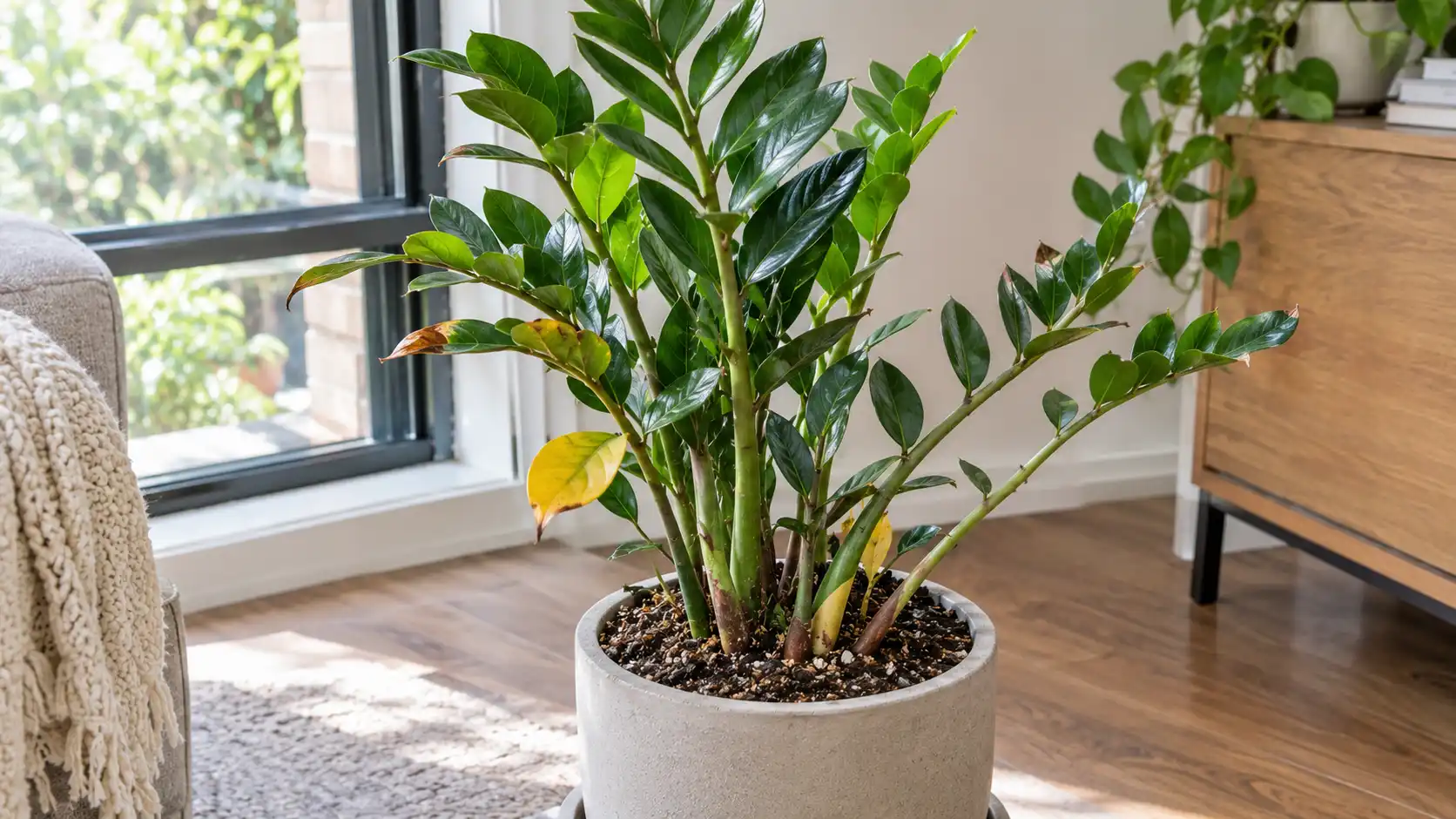
Most Zanzibar Gem problems can be traced back to watering, light, temperature, potting conditions or pests rather than a need for complicated treatments.
Yellow leaves
Likely causes: overwatering, poor drainage, root damage, insufficient light or natural ageing of older leaves.
If several leaves are yellow while the mix is staying wet, check drainage first. Persistent saturation can damage roots and create the same “thirsty” appearance that often leads owners to water even more.
Fix: stop watering until the mix has dried substantially, inspect the roots if the plant is declining rapidly, and repot into a properly draining mix if rot is present.
Prevention: never use a fixed weekly watering schedule without checking moisture.
Leafy Heaven’s broader plant troubleshooting guide also distinguishes overwatering from underwatering by checking the actual root-zone condition rather than relying on leaf colour alone.
Drooping/floppy stems
A drooping ZZ is not automatically underwatered.
Check:
- Is the potting mix bone dry?
- Is it instead saturated?
- Are the lower stems soft?
- Has the plant recently been moved?
- Is the plant exposed to cold or very low light?
Wet soil combined with limp stems is particularly concerning because root damage can prevent the plant from taking up water.
Fix: correct the underlying watering or root problem rather than simply adding more water.
Brown leaf tips
Brown tips can result from inconsistent watering, prolonged dryness, accumulated fertiliser salts or environmental stress. Very dry indoor air can contribute to browning in some plants, but ZZ plants generally do not require high humidity.
Check the soil first. If the plant is repeatedly fertilised, flush the pot thoroughly with clean water occasionally and make sure drainage is unobstructed.
Also check whether direct sunlight is burning the foliage.
Leggy growth / no new shoots
Leggy growth usually means not enough light.
A ZZ can survive in a dark corner, but surviving and growing strongly are different things. Move it closer to a bright window with filtered light, increasing exposure gradually rather than suddenly placing it into hot full sun.
A plant that remains healthy but produces almost no new shoots may simply be growing too slowly because light levels, temperature or nutrition are limiting active growth.
To make a ZZ bushier, improve light first. A fuller clump is also naturally associated with having multiple rhizomes and shoots in one container; dividing a large clump and keeping several healthy rhizomes together can produce a fuller presentation more reliably than repeatedly cutting stems.
Pests in Australian conditions
ZZ plants are relatively trouble-free, but indoor plants can still encounter spider mites, mealybugs and scale.
Spider mites often produce fine webbing and pale stippling. Mealybugs look like small white cottony clusters, while scale appears as small fixed bumps on stems or leaf bases. UC IPM recommends inspecting plants regularly, isolating infested plants and using physical removal, washing or properly labelled horticultural treatments where appropriate.
For a broader Australian reference, our Garden Pest Identification Guide covers identification clues and common pest groups.
Start by isolating the plant. Wash accessible pests from the foliage, remove heavily infested material and only use an insecticidal soap, horticultural oil or other pesticide when it is labelled for that purpose and suitable for the plant.
Is a Zanzibar Gem Toxic to Pets, Children or Cats?
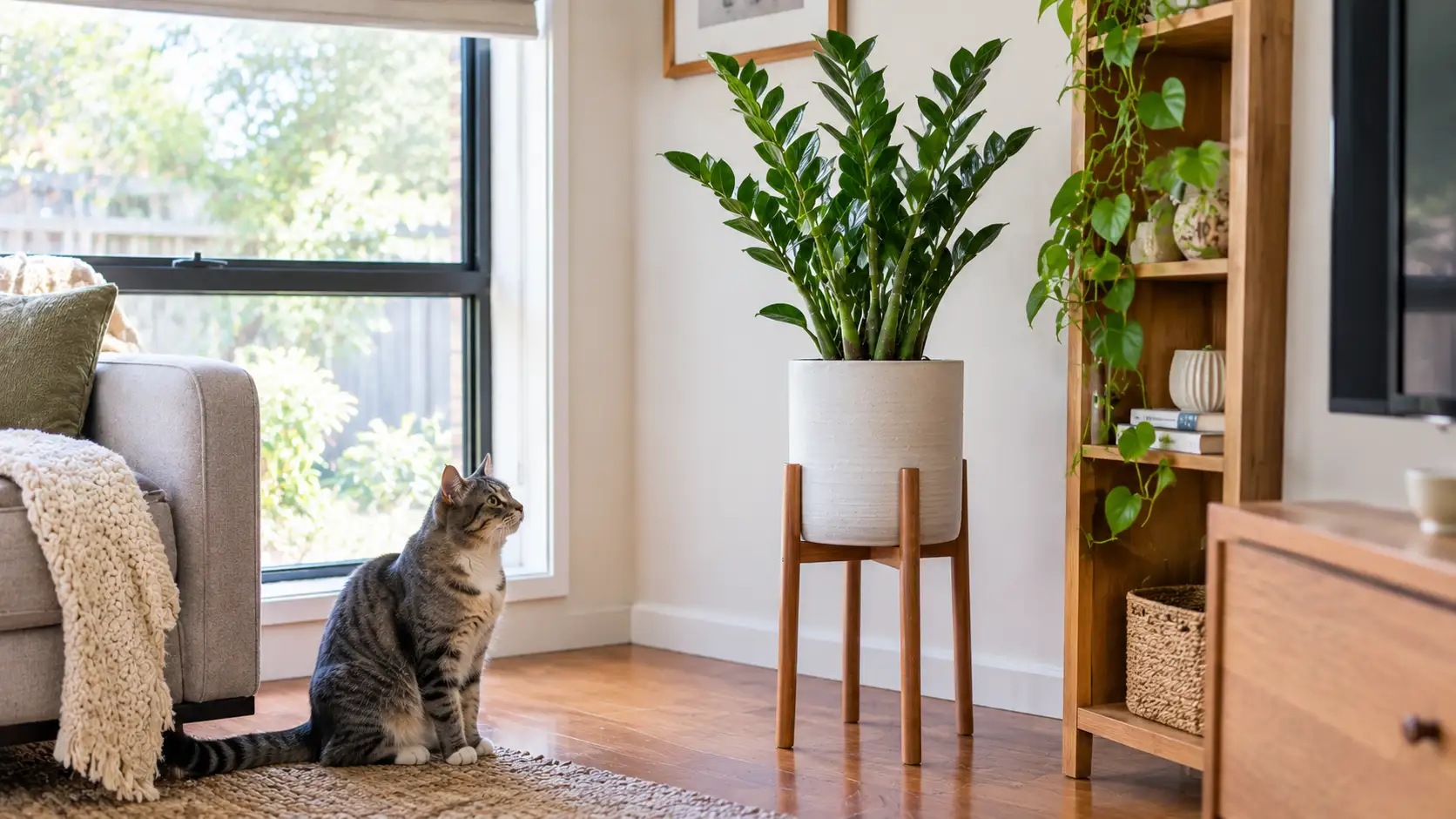
Yes. A Zanzibar Gem should be treated as an inedible, irritating plant and kept away from chewing pets and young children.
The important toxic principle is insoluble calcium oxalate, which occurs as microscopic needle-like crystals. Pet Poison Helpline includes ZZ plant among insoluble calcium oxalate plants and describes the crystals as causing oral pain, drooling, vomiting and changes in the voice rather than systemic poisoning.
Symptoms & first-aid steps
After chewing the plant, signs can include:
- Burning or pain in the mouth
- Excessive drooling
- Irritation or swelling of the lips and tongue
- Difficulty swallowing
- Vomiting
- Hoarseness or voice changes
More serious swelling affecting swallowing or breathing requires urgent medical attention.
For Australian human exposures, healthdirect’s poisoning guidance recommends contacting the Poisons Information Centre on 13 11 26 and says not to induce vomiting. If the person collapses, stops breathing, has a seizure or develops a severe emergency, call 000.
The safest immediate response to a chewed plant is to remove remaining plant material from the mouth and seek poison-information advice rather than attempting home treatments based on internet recipes.
Cats and dogs specifically
Cats and dogs can be affected by insoluble calcium oxalates in ZZ plants. The mechanism is primarily local irritation of the mouth and gastrointestinal tract.
ASPCA explains that insoluble calcium oxalate exposure from comparable aroid houseplants can cause oral irritation, drooling, vomiting and swallowing difficulty, and that severe swelling affecting breathing is uncommon but possible.
For pets, contact your veterinarian promptly after suspected ingestion, particularly if there is repeated vomiting, marked drooling, difficulty swallowing, weakness or breathing difficulty.
Zanzibar Gem vs Other Easy-Care Indoor Plants
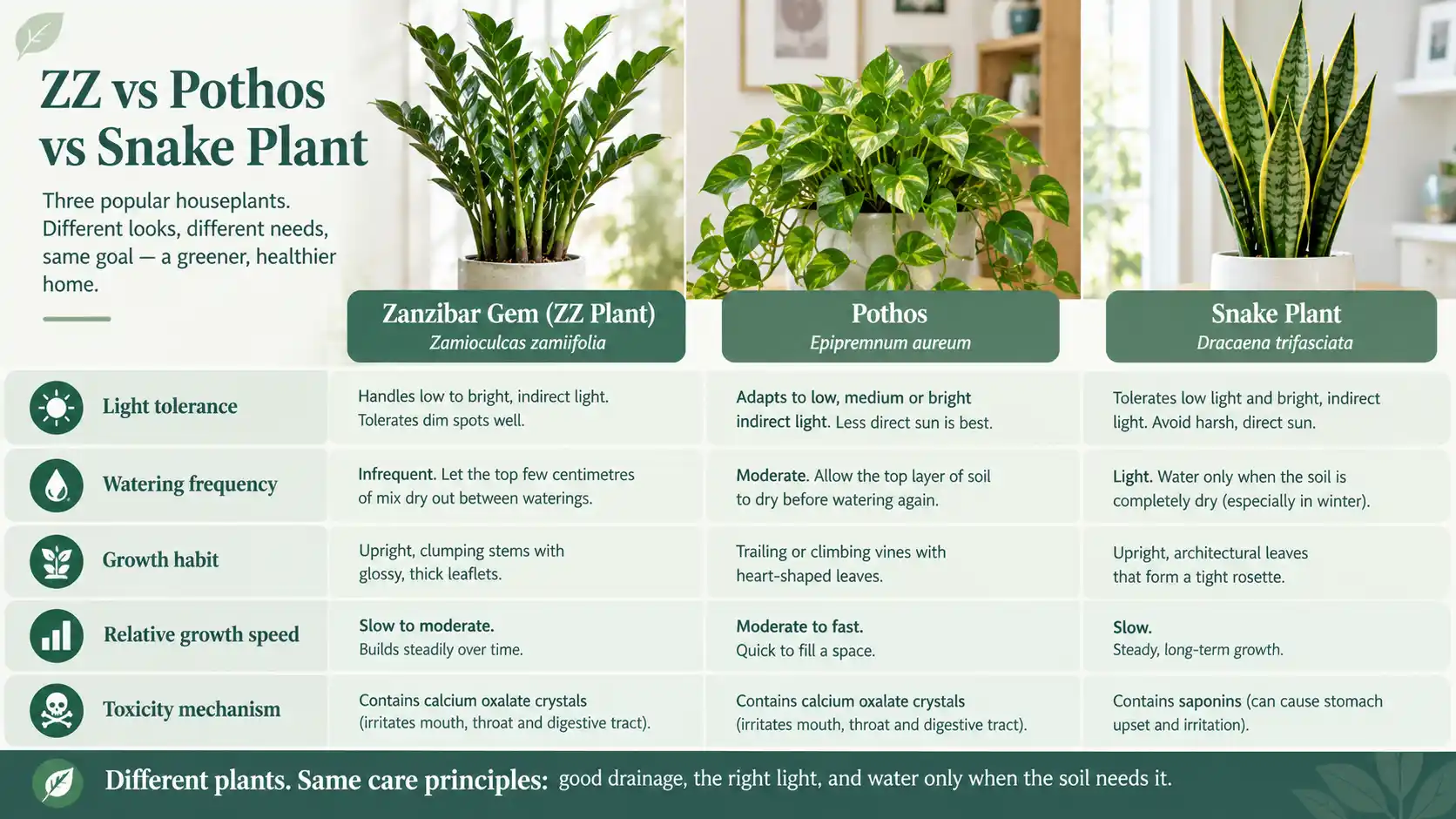
ZZ plants are often compared with pothos and snake plants because all three tolerate less-than-perfect indoor care, but they behave differently.
| Feature | Zanzibar Gem | Pothos | Snake Plant |
| Botanical name | Zamioculcas zamiifolia | Epipremnum aureum | Dracaena trifasciata |
| Light | Low to bright indirect | Low to bright indirect | Low to bright light |
| Watering | Very infrequent | More frequent than ZZ | Very infrequent |
| Growth | Slow | Faster | Slow–moderate |
| Main water-storage feature | Rhizomes | Less specialised than ZZ | Thick leaves/rhizomes |
| Pet toxicity | Insoluble calcium oxalates | Insoluble calcium oxalates | Saponins |
| Typical form | Upright clumping stems | Trailing/climbing vine | Upright rigid leaves |
Pothos is listed by ASPCA as toxic to cats and dogs because of insoluble calcium oxalates. Snake plant is toxic to cats and dogs through different compounds, principally saponins.
For a more detailed comparison of another drought-tolerant indoor option, see our snake plant care and benefits guide.
ZZ is particularly useful when the gardener wants slow growth, an upright silhouette and long intervals between waterings. Pothos is better suited to a trailing or climbing display and generally grows much faster.
Snake plant can tolerate similarly dry conditions but has a distinctly vertical leaf form. Its toxicity profile is also different.
Zanzibar Gem Varieties You Might See in Australia
Raven ZZ
Raven ZZ is the dark-leaved cultivar commonly sold for its deep green to almost black mature foliage. RHS identifies the plant as Zamioculcas zamiifolia ‘Raven’ and recommends the same basic dry-between-waterings approach as green ZZ plants.
New leaves are typically greener and darken as they mature.
Zenzi ZZ / Dwarf ZZ
Zenzi ZZ is a compact, dwarf-style cultivar marketed for its shorter, more compact growth habit. It suits shelves, desktops and smaller rooms where a full-sized ZZ could eventually become too large.
Variegated ZZ
Variegated ZZ selections have cream, yellow or pale green patterning through the foliage. Because variegated tissue contains less chlorophyll, brighter indirect light can be particularly important for maintaining strong growth.
Cultivar availability varies considerably between Australian nurseries, so check the botanical or cultivar name rather than relying only on a retailer’s common-name label.
Beginner Mistakes to Avoid
Overwatering out of habit
The biggest mistake is treating the ZZ as though every indoor plant needs weekly watering. Its rhizomes store water, so repeated watering while the mix is still wet creates unnecessary rot risk.
Choosing a pot that is too large
A huge pot can hold a large amount of wet mix around a relatively small root system. Step up gradually instead.
Putting it into direct Australian sun
Low-light tolerance does not mean it wants harsh afternoon sun. Give it bright filtered or indirect light instead.
Fertilising during a dark winter
If growth has slowed because of shorter days and cooler temperatures, heavy feeding is unlikely to solve the underlying limitation. Resume stronger feeding only when active growth and suitable light return.
Using humidity as a substitute for drainage
A ZZ does not need a tropical misting regime indoors. Improving drainage and light is more important than increasing humidity.
Cutting healthy stems repeatedly to make it branch
ZZ plants do not behave like branching shrubs. New shoots emerge from the rhizome. To create a fuller display, encourage new shoots with suitable light or maintain several healthy rhizomes together.
Conclusion
Successful Zanzibar Gem care comes down to a remarkably short formula: bright indirect light, free-draining mix, thorough but infrequent watering, and protection from cold.
Let the root-zone mix dry substantially before watering again rather than following a rigid weekly schedule. In southern Australia, that interval can become much longer through winter; in tropical or subtropical conditions, the plant may use water faster, especially in bright, warm positions. Its underground rhizomes explain both its drought tolerance and its vulnerability to persistent wet soil.
For outdoor growing, keep the distinction clear: warm, frost-free tropical and subtropical areas can support outdoor ZZ plants, while temperate and frost-prone areas are better served by container growing and seasonal protection.
And remember the safety point: this attractive indoor plant is not edible. Keep it away from pets and children who may chew the leaves, and treat any significant exposure as a poison or veterinary question rather than attempting to diagnose the severity yourself.
FAQs
Is a Zanzibar Gem the same as a ZZ plant?
Yes. Zanzibar Gem and ZZ plant are common names for Zamioculcas zamiifolia, a rhizomatous aroid native to parts of eastern and southern tropical Africa.
How often should I water my Zanzibar Gem across an Australian summer vs winter?
Start by checking the pot rather than the calendar. As a general indoor starting point, about 2–4 weeks in warmer conditions and 4–6+ weeks in a cool southern winter can be reasonable, but the mix must be substantially dry before you water. Bright light, small pots and warm rooms shorten the interval; low light, cool rooms and large containers lengthen it.
Why is my Zanzibar Gem drooping?
Check whether the pot is dry or waterlogged. Dry mix suggests underwatering, while wet mix combined with limp stems can indicate root damage from overwatering. Low light, cold temperatures and recent environmental changes can also cause drooping.
Can a Zanzibar Gem grow outdoors in Queensland or the NT?
Yes, particularly in warm, frost-free tropical and subtropical districts. Give it filtered light or part shade and protect it from harsh direct sun. In colder inland or frost-prone areas, keep it in a moveable container.
Is a Zanzibar Gem safe around cats and dogs?
No. The plant contains insoluble calcium oxalates that can irritate the mouth and gastrointestinal tract if chewed. Keep it inaccessible to pets and contact a veterinarian after suspected ingestion, particularly if significant symptoms occur.
How do I make my Zanzibar Gem grow bushier?
Give it brighter indirect light, maintain sensible watering and feed lightly during active growth. New shoots arise from the rhizomes, so keeping multiple healthy rhizomes together or dividing and regrouping a mature clump can create a fuller appearance. Pruning individual stems does not work like pruning a branching shrub.