

Crepe Myrtle Varieties Australia: Size, Colour & Best Picks
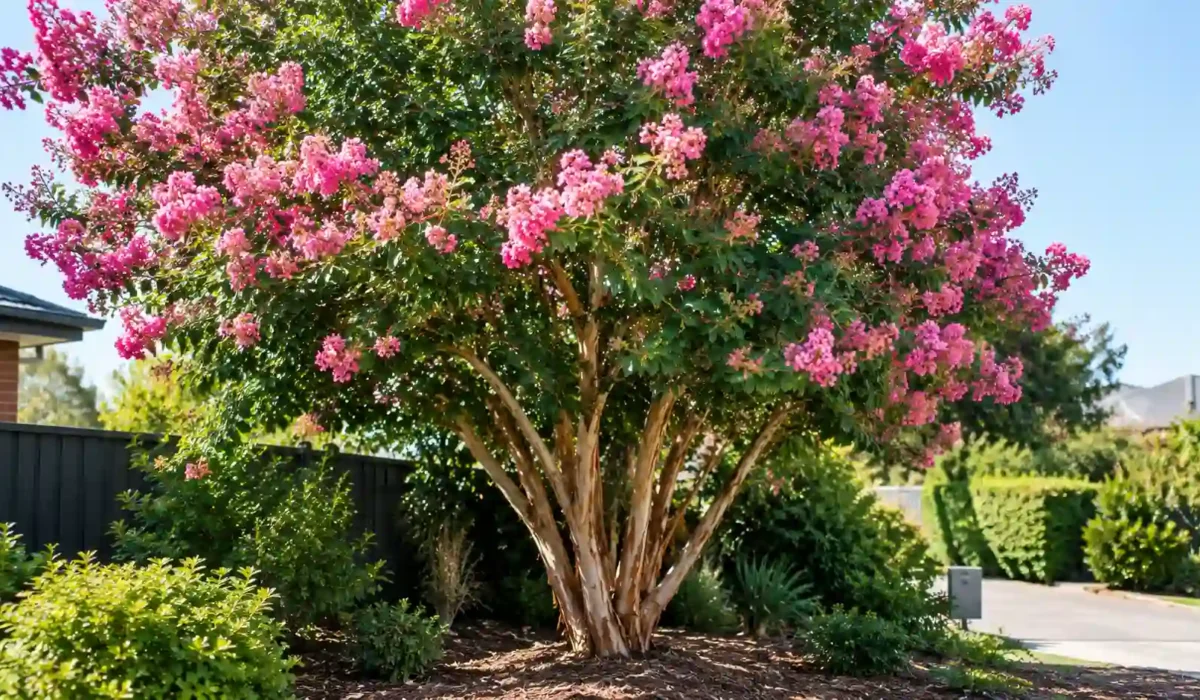
Crepe myrtle varieties in Australia range from low-growing plants around 60–70 cm to trees capable of reaching 6–8 m or more, so flower colour should not be your first buying decision. The genus Lagerstroemia includes deciduous flowering shrubs and trees valued for summer blooms, autumn foliage and peeling bark. For Australian gardens, the safest approach is to choose mature height and spread first, then consider climate and mildew pressure, and only then select flower colour. Modern cultivars include compact plants for courtyards as well as larger trees for driveways and avenues.
Quick Summary
- Choose mature size first, then climate, then flower colour.
- Published heights can differ substantially because pruning, growing conditions and nursery conventions affect final dimensions.
- Powdery mildew is more important in humid conditions, while modern hybrids offer improved resistance rather than absolute immunity.
- Australia has a native crepe myrtle taxon historically known as Lagerstroemia archeriana, currently accepted by Kew as Lagerstroemia engleriana.
What Counts as a Crepe Myrtle Variety in Australia?
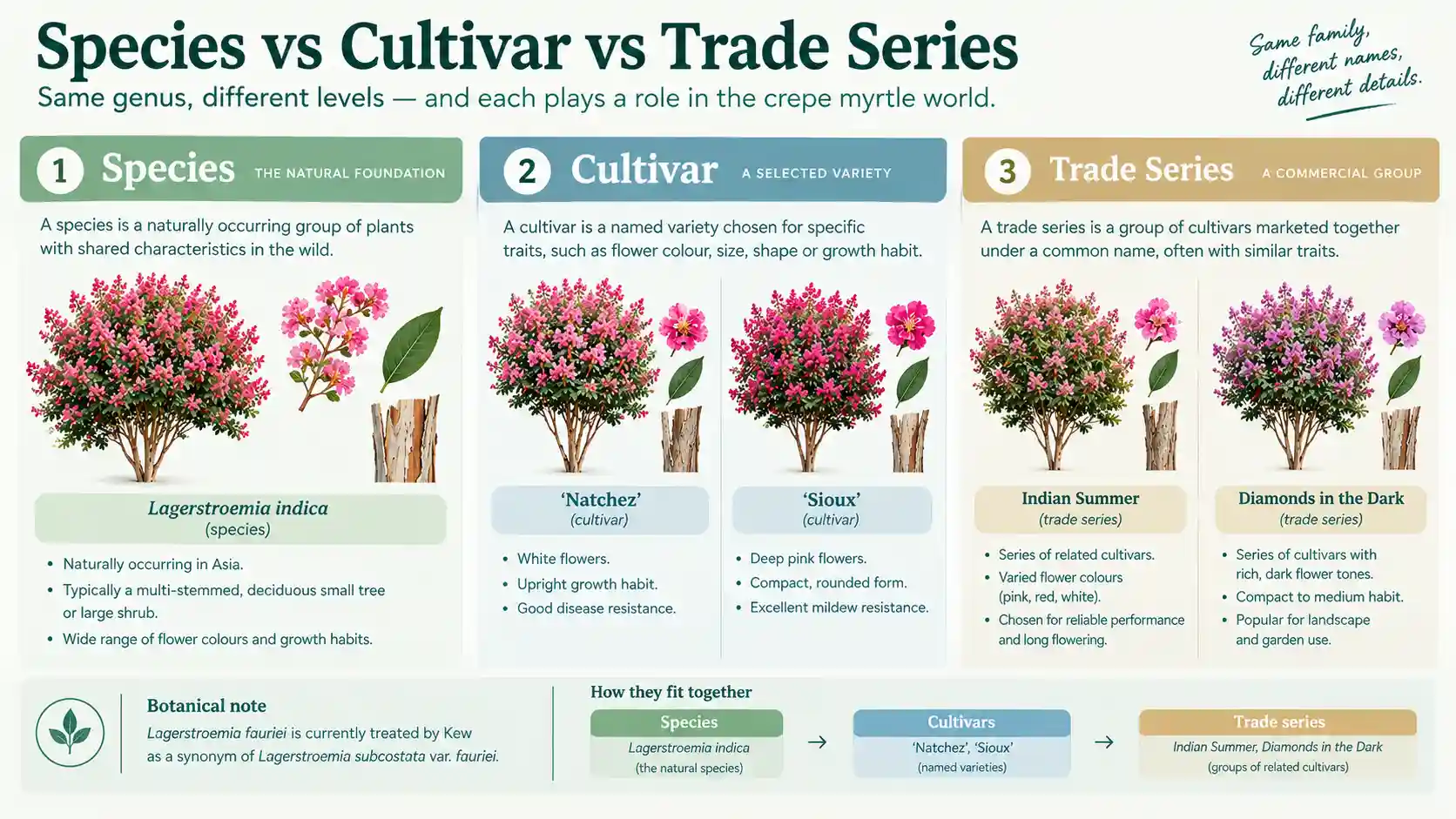
Australian nursery labels can mix species, cultivars and trade series, and these terms are not interchangeable. A species such as Lagerstroemia indica describes the botanical species; a cultivar such as ‘Natchez’ or ‘Sioux’ is a named cultivated selection; and a series such as Indian Summer or Diamonds in the Dark groups cultivars marketed together.
The common horticultural shorthand Lagerstroemia fauriei also needs care: Kew currently treats that name as a synonym of Lagerstroemia subcostata var. fauriei.
Species vs cultivar vs trade series
| Term | What it means | Example | What it tells you |
| Species | Botanical species | L. indica | Natural taxonomic identity |
| Cultivar | Named cultivated selection | ‘Natchez’, ‘Sioux’, ‘Hopi’ | Specific size, colour and habit |
| Trade series | Commercial grouping of cultivars | Indian Summer, Diamonds in the Dark | Marketing/breeding group, not a substitute for the cultivar name |
Many mildew-resistant modern cultivars came from breeding involving L. indica and L. fauriei material. The U.S. National Arboretum was important in this breeding history, including cultivars such as ‘Natchez’.
How Big Do Crepe Myrtles Grow? Reconciled Sizes and Growth Rate
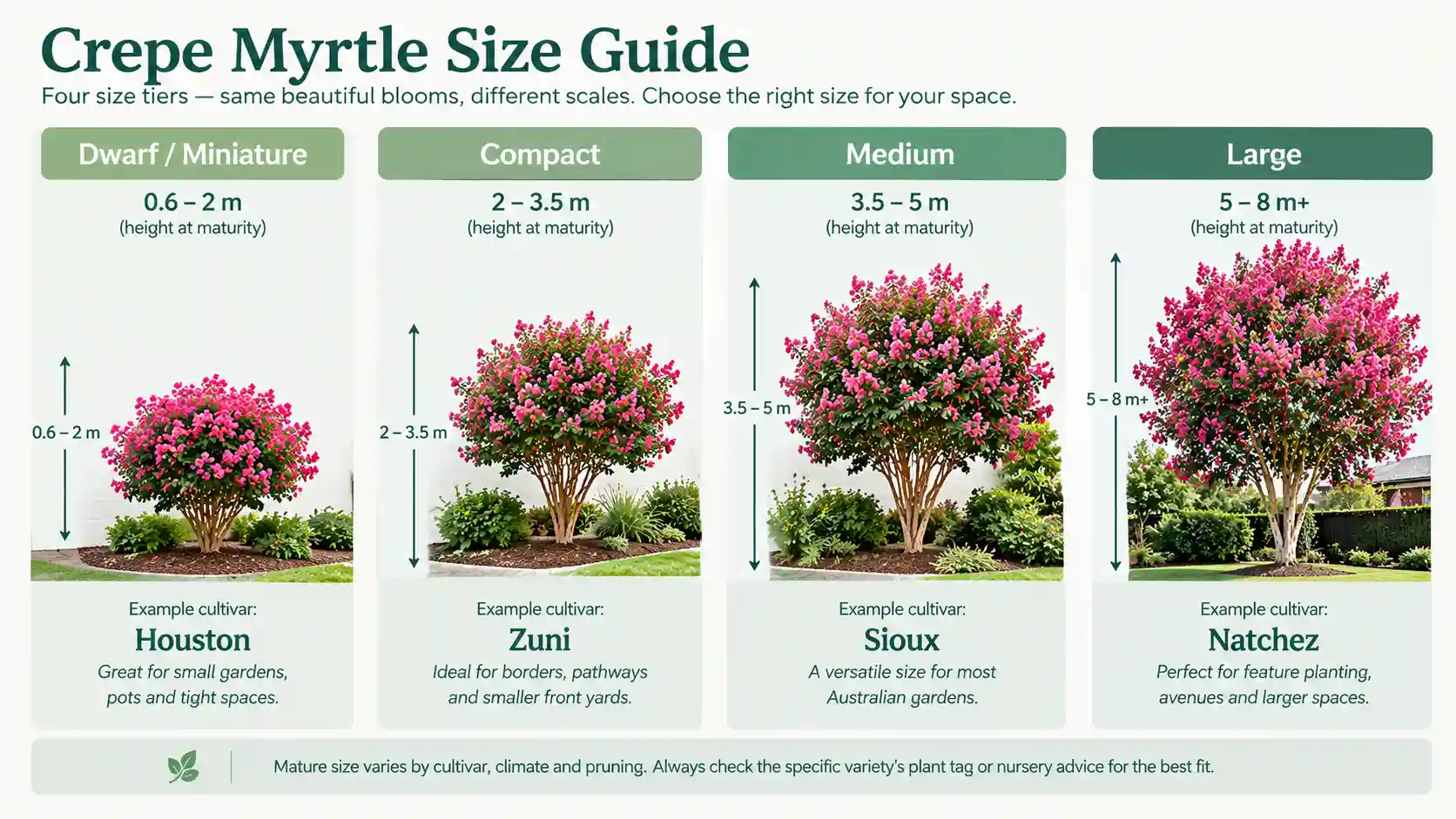
There is no single mature-height figure that applies to every crepe myrtle. Current Australian nursery sources place compact selections around 2–3 m, mid-sized cultivars around 3.5–5 m, and larger selections around 5–8 m. ‘Natchez’, for example, is listed around 6–8 m by several Australian sources, while ‘Sioux’ is commonly listed around 4–5 m elsewhere and up to 5–7 m by broader nursery collections.
Why the same variety has three different sizes.
Differences can come from pruning, climate, soil, age, whether a source describes a breeder’s potential size or a garden-grown specimen, and whether the plant is maintained as a shrub or tree. For long-term planning, use the upper end of a credible range rather than assuming a heavily pruned specimen represents the plant’s natural size.
| Tier | Typical mature height reported | Unpruned vs pruned | Example varieties |
| Dwarf/miniature | ~0.6–2 m | Natural size can be very small; pruning can maintain a lower form | ‘Houston’, ‘Pixie White’ |
| Compact | ~2–3.5 m | Usually manageable without severe pruning | ‘Acoma’, ‘Zuni’, ‘Hopi’ |
| Medium | ~3.5–5 m | Light structural pruning can control shape | ‘Comanche’, ‘Tonto’, ‘Sioux’ |
| Large | ~5–8 m+ | Needs enough space even when selectively pruned | ‘Miami’, ‘Tuscarora’, ‘Natchez’ |
One Australian nursery reports roughly 30–50 cm of annual growth once established, but that should be treated as a rough growing-guide figure rather than a guaranteed rate. Climate, water and establishment strongly affect speed.
How fast and how long to full size.
There is no reliable Australia-wide number of years to full size because a crepe myrtle can be managed very differently from one garden to another. Think in terms of years rather than a fixed planting-to-maturity timetable. As a general horticultural reference, RHS lists L. indica as taking roughly 20–50 years to reach maturity, but that figure is not an Australia-specific prediction.
Which Crepe Myrtle Suits Your Space? Pots, Courtyards, Hedges and Street Trees
Start with the amount of space the plant will have after maturity, not the size of the nursery pot. Compact cultivars such as Acoma, Zuni and Hopi are suited to smaller gardens and containers, while mid-sized cultivars work better as feature trees. Large forms such as Natchez need substantially more vertical and lateral space.
Dwarf and miniature crepe myrtles.
Very small selections such as ‘Houston’, reported at roughly 60–70 cm high, are useful where a shrub-like form is wanted. ‘Pixie White’ is another low-growing option, reported around 2 m.
Crepe myrtle in pots.
Compact cultivars are the practical choice. Nursery guidance currently identifies Acoma, Zuni, Hopi and some Diamonds in the Dark selections as suitable for large containers, including around 60 cm pots. Container plants still require adequate drainage, watering and root space as they mature.
Small, medium and large varieties.
| Use | Practical tier | Examples | Main consideration |
| Pot/courtyard | Compact | Acoma, Zuni, Hopi | Container size and watering |
| Small garden | Compact–medium | Zuni, Sioux, Tonto | Mature spread |
| Feature tree | Medium–large | Sioux, Tuscarora, Miami | Canopy space |
| Avenue/street planting | Large | Natchez, Tuscarora | Clearance and mature spread |
For broader Australian tree selection, our tree-with-pink-flowers identification guide provides useful context on mature size, flowering season and alternative pink-flowering trees.
Which Varieties Suit Your Climate? Frost, Humidity and Mildew
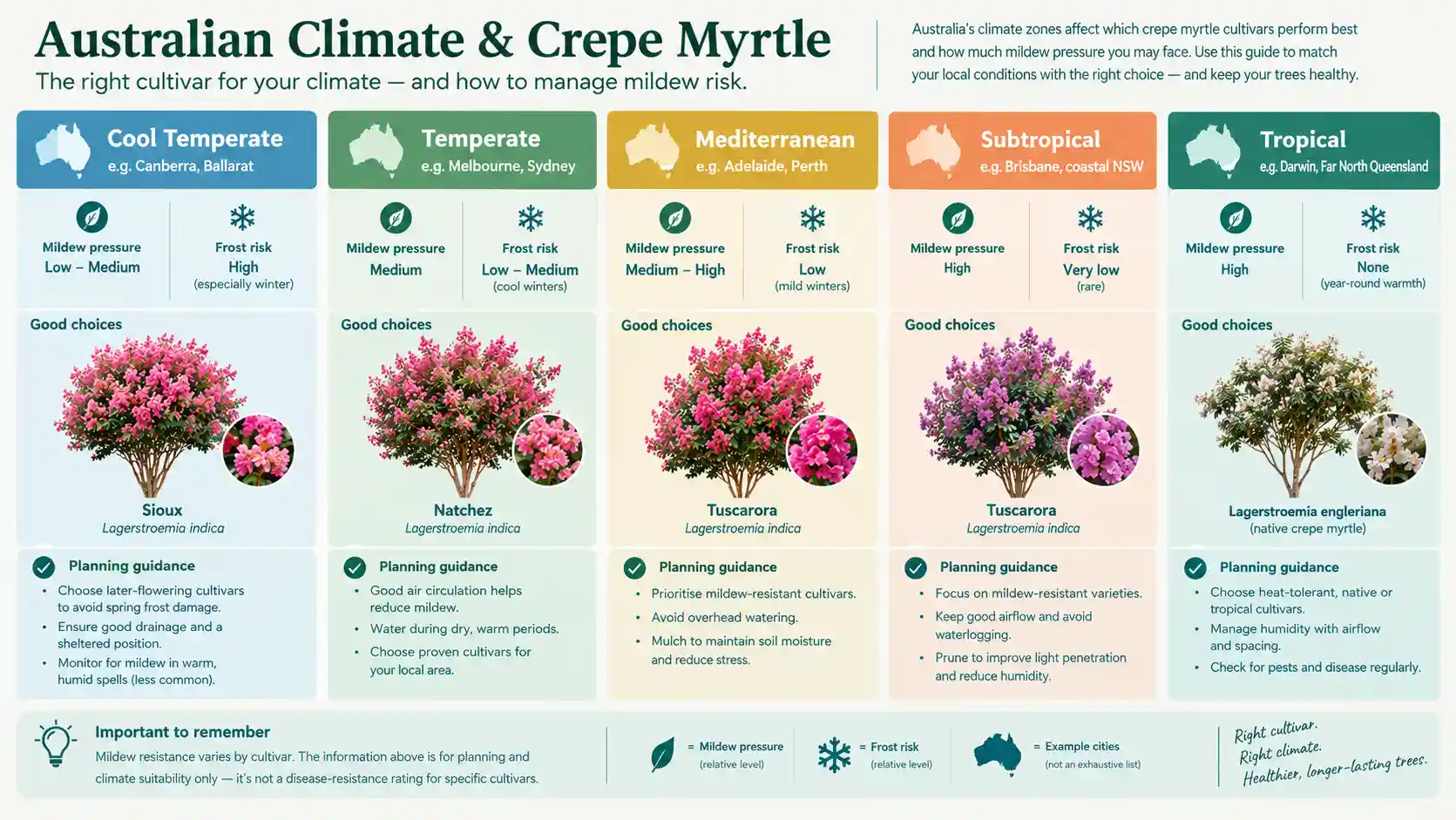
Climate should be treated as a combination of winter cold, summer heat, humidity and flowering-season conditions rather than one hardiness number. Crepe myrtles generally perform well in Australian conditions, particularly where summers are warm and sunny, while humid conditions can increase fungal-disease pressure. Gardening Australia also notes that modern hybrids were developed partly to improve powdery-mildew resistance.
| Climate | Example cities | Mildew pressure | Suggested picks | Watch-outs |
| Cool temperate | Canberra, Ballarat, inland Victoria | Low–moderate | Sioux, Natchez, suitable hardy hybrids | Frost and short summers |
| Temperate | Melbourne, Adelaide, Sydney | Moderate | Sioux, Zuni, Natchez | Check local winter exposure |
| Mediterranean | Perth, Adelaide | Generally lower | Natchez, Sioux, Tuscarora | Heat, irrigation during establishment |
| Subtropical | Brisbane, coastal NSW | Moderate–high | Sioux, Tuscarora, mildew-resistant hybrids | Humidity and airflow |
| Tropical | Darwin, Far North Queensland | Higher | Native L. engleriana where appropriate; selected ornamentals with caution | Humidity and less reliable flowering |
This matrix is a planning guide, not a cultivar resistance test. No crepe myrtle should be described as completely mildew-proof.
For a broader Australian flowering-tree comparison, our guide to flowering plants for different Australian climates is useful when the site or climate makes crepe myrtle a marginal choice.
Colour, Bark, Autumn Tones and Flowering Time
Once the size is right, flower colour becomes the easier decision. Crepe myrtles range through white, pink, red, lavender and purple shades, while peeling bark and autumn foliage add interest after flowering. Most commonly grown garden forms are deciduous rather than evergreen.
Flowering is generally a summer to early-autumn event in Australia, with Australian nursery guidance placing the main period around December to March and noting that timing shifts by location.
Which varieties bloom longest.
There is not enough consistent Australian evidence to name one universal longest-blooming cultivar. Cultivar labels and local flowering observations can differ, so treat claims of a single “longest flowering” variety cautiously.
White crepe myrtles.
‘Natchez’ is a major tall white-flowered option, while Acoma and ‘Pixie White’ provide smaller forms. Diamonds in the Dark also includes white-flowered selections. ‘Natchez’ is commonly reported around 6–8 m, making it a poor choice for a small courtyard despite its attractive white flowers.
| Colour | Example varieties | Height tier | Bark or autumn note |
| White | ‘Natchez’, Acoma, ‘Pixie White’ | Compact–large | Peeling bark; autumn foliage |
| Pink | ‘Sioux’, ‘Tuscarora’, ‘Miami’ | Medium–large | Strong summer display |
| Red | ‘Grande Red’, some Diamonds in the Dark | Compact–large | Darker flowers and seasonal foliage |
| Lavender/purple | ‘Yuma’, ‘Lipan’ | Compact–medium | Often paired with ornamental bark |
Is There an Australian Native Crepe Myrtle?
Yes, but the name requires a taxonomic note. The plant long documented in Australia as Lagerstroemia archeriana is currently accepted by Kew as Lagerstroemia engleriana, with a native range that includes Queensland and Western Australia as well as parts of Southeast Asia and the Pacific region. Flora of Australia records the historical L. archeriana name and describes plants reaching up to about 15 m. Kew’s Plants of the World Online profile for Lagerstroemia engleriana confirms that Lagerstroemia engleriana is the accepted name and records its native range as including Queensland and Western Australia.
It occurs in northern Australian tropical environments, including gallery and monsoon-forest habitats, so it should not be treated as a cool-climate substitute for the familiar ornamental crepe myrtles.
The available evidence supports its Australian nativity, but it would be misleading to assign one blanket Australian weed status without checking the current jurisdiction-specific listings.
Common Crepe Myrtle Problems and Disadvantages: Causes and Fixes
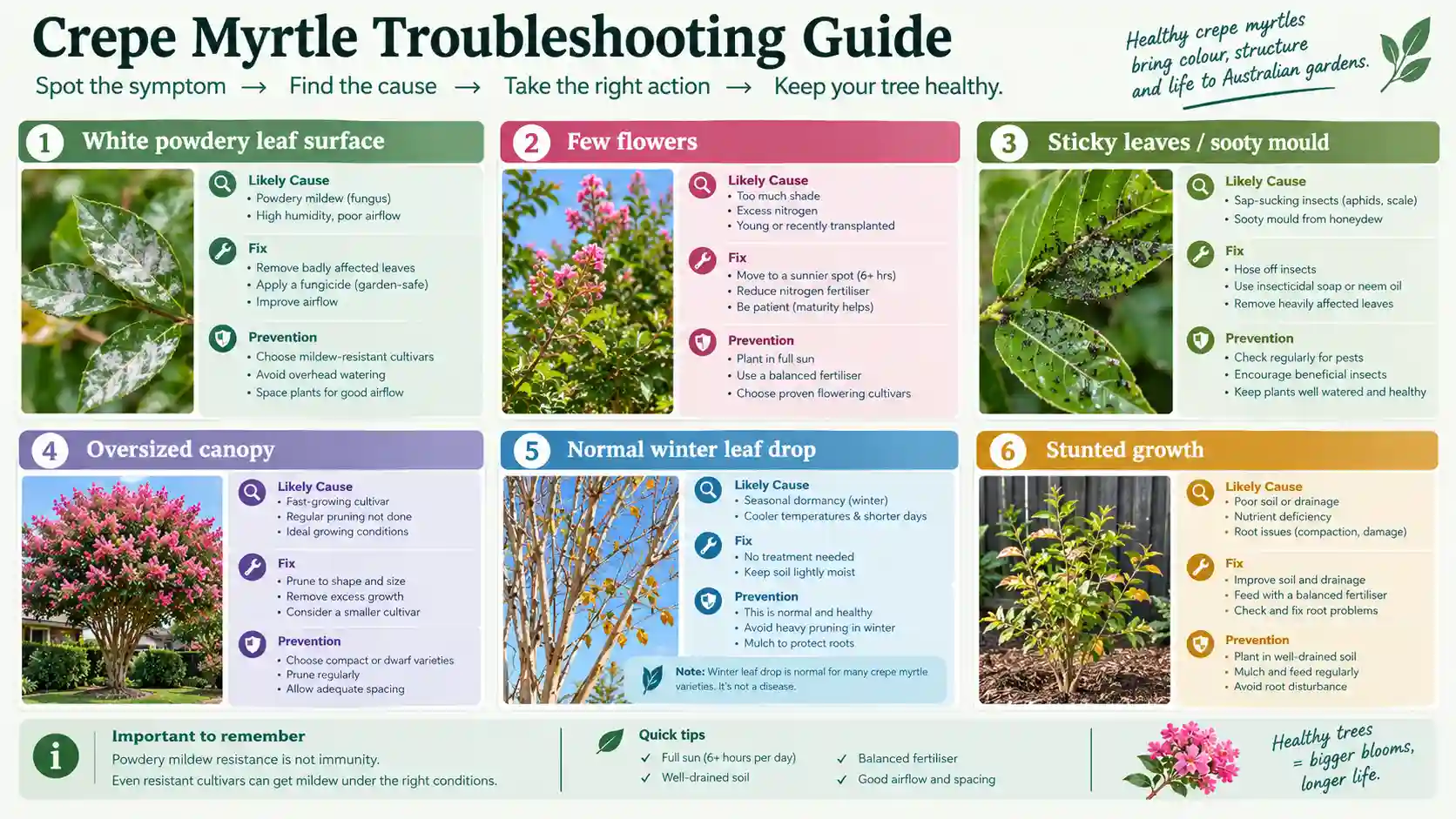
Most problems trace back to the wrong variety, unsuitable position or inappropriate pruning. Powdery mildew and other fungal problems become more relevant in humid, poorly ventilated conditions, while aphids can contribute to sooty mould through honeydew production.
| Symptom | Likely cause | Fix | Prevention |
| White powder on leaves | Powdery mildew | Improve airflow and site exposure; use appropriate disease control if required | Full sun and resistant cultivars |
| Few flowers | Insufficient sun, stress or excessive pruning | Improve light and avoid unnecessary severe cutting | Select a sunny site |
| Sooty mould/sticky foliage | Aphids or other sap-feeders | Address the insect source | Monitor new growth |
| Too big for the spot | Wrong cultivar | Selectively reduce where appropriate or replace with compact form | Check mature dimensions before planting |
| Leaf drop in winter | Normal deciduous dormancy | Allow the plant to rest | Do not mistake dormancy for disease |
| Stunted growth | Root stress, poor drainage or environmental stress | Check soil and root conditions | Good drainage and suitable establishment care |
Before diagnosing a symptom from appearance alone, Leafy Heaven’s plant-problem troubleshooting guide provides a broader symptom-first process.
Disadvantages to weigh before buying.
Crepe myrtles are deciduous, so they become largely bare in winter. Flower litter, leaf fall and final canopy size may matter in paved or tightly confined sites. Humid gardens also need more attention to airflow and mildew risk than hot, dry sites.
Planting, Care and Pruning
The fundamentals are straightforward: full sun, good drainage, adequate establishment water and restrained pruning. Gardening Australia recommends establishing newly planted specimens with plenty of water before they become drought tolerant, while Australian nursery guidance recommends full sun and free-draining soil.
Water deeply during establishment rather than relying on frequent shallow watering. Once established, reduce irrigation according to rainfall, soil and seasonal demand.
For soil and fertiliser decisions, our Australian garden soil and fertiliser guide provides the broader framework rather than treating fertiliser as a cure-all.
Pruning mistakes to avoid
- Cutting large branch stubs repeatedly at the same height.
- Pruning simply because the plant is a crepe myrtle.
- Planting a large cultivar in a small position and trying to control it forever with severe pruning.
- Removing too much canopy when selective structural pruning would achieve the same result.
For a detailed horticultural explanation, University of Georgia Extension’s crape myrtle pruning guide explains that aggressive pruning is unnecessary for flowering and recommends limited or no pruning for a more natural tree form.
There is also no universal “best month” for every Australian garden. Winter is a practical planting period for deciduous plants in many southern areas, while warmer regions can have different establishment windows. Gardening Australia’s advice specifically discusses transplanting crepe myrtles from pots or as bare-root plants in winter.
If you do not trim a crepe myrtle, it simply develops more of its natural form. Pruning can be used to manage structure, clearance and size, but severe annual topping is not a biological requirement.
Coffee grounds are not a special crepe-myrtle treatment. Rather than adding an unverified amendment, base fertilising and soil correction on plant needs and, where appropriate, soil testing.
Myths and Beginner Mistakes
Myth: every variety is mildew-proof. No. Modern selections can have much better resistance, but resistance is not immunity.
Myth: every crepe myrtle needs hard pruning each winter. No. Natural growth and flowering are possible without severe pruning.
Myth: one frost-hardiness number fits every climate. No. Frost intensity, duration, plant age and local exposure all matter.
Myth: blue crepe myrtles are established varieties. Flower colours commonly described in authoritative horticultural references are white, pink, red, lavender and purple; genuinely blue flowers should therefore be treated sceptically.
A common beginner mistake is buying by pot size or flower colour while ignoring mature width. To identify an existing plant, check its cultivar label, flower colour, mature form, bark and foliage rather than relying on one characteristic.
Conclusion
Crepe myrtle varieties in Australia range from tiny shrubs to 6–8 m trees, so mature size should come before colour. Match the cultivar to your space, climate and mildew pressure, then choose the flower colour and pruning style you prefer. The size table and climate matrix above are the safest starting points for choosing a long-term fit.
Frequently Asked Questions
Which crepe myrtle is best in Australia?
There is no single best cultivar for every garden. Compact forms suit small spaces, while larger cultivars such as ‘Natchez’ suit larger landscapes; climate and humidity should also influence the choice.
How big do crepe myrtles grow?
Depending on species and cultivar, they can range from roughly 60–70 cm to 6–8 m or more.
Are crepe myrtles native to Australia?
A native Australian taxon exists, historically called Lagerstroemia archeriana and currently accepted by Kew as L. engleriana. Most familiar ornamental cultivars are introduced garden plants.
When do crepe myrtles flower?
They generally flower in summer into early autumn, with Australian nursery guidance placing the broad period around December to March depending on location.
What is the best month to plant a crepe myrtle?
There is no single Australia-wide month. Winter is a practical period for planting many deciduous crepe myrtles, particularly in southern regions, provided the soil is not frozen or waterlogged.
What happens if you don’t prune a crepe myrtle?
It generally develops a more natural canopy and still flowers. Pruning is mainly for structure, clearance, form or size control rather than being mandatory for flowering.
How long does a crepe myrtle live?
Well-established plants can live for decades; extension guidance reports specimens exceeding 50 years, although lifespan varies with cultivar and conditions.
Do coffee grounds help crepe myrtles?
There is no established reason to treat coffee grounds as a special crepe-myrtle fertiliser. Use appropriate soil and fertiliser practices instead.