

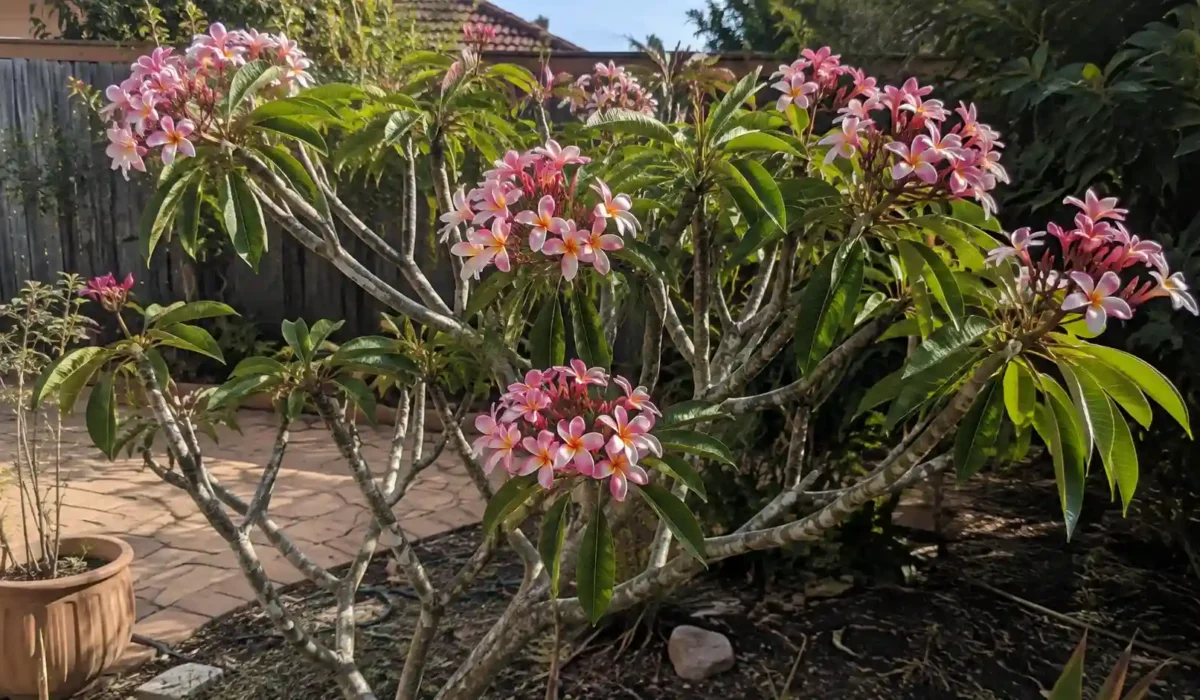
Frangipani Tree Care Australia: Growing, Pruning & Problems
Frangipani tree care Australia mainly means matching Plumeria to warmth, strong sunlight, fast drainage and a dry winter rest. Most commonly grown frangipanis are deciduous, so autumn and winter leaf drop is usually dormancy rather than tree death. Problems begin when cold roots stay wet, frost damages fleshy stems, rust strips foliage, or a tree receives too little sun to flower well. Plumeria rubra is frost-tender, while compact Plumeria forms can be more practical in containers.
Quick Summary
- Most frangipanis are deciduous; bare winter branches can be completely normal.
- Give frangipanis full sun, excellent drainage and little winter watering.
- Flowering commonly runs from late spring through autumn, with timing affected by climate, sunlight and plant maturity.
- The milky sap can irritate skin and eyes, so wear gloves when pruning or taking cuttings.
Is Your Frangipani Dormant, Struggling or Dead?
Autumn-to-winter leaf drop is usually normal for a deciduous frangipani. Before assuming the tree has died, check the stems: healthy living wood should remain firm rather than soft and collapsing. Frost-damaged sections can later decay, so a dead-looking tip after a cold event needs closer inspection rather than immediate removal of the whole branch.
A useful home check is to make a very shallow scratch on a small stem section; living tissue underneath should be moist and greenish, while dead wood is dry and brown. New growth normally returns when warmth and spring growth conditions return, but the exact date varies by climate.
Why “Evergreen Frangipani” Is Misleading
The common frangipani types grown in Australia are generally deciduous, but some forms associated with Plumeria obtusa are described as evergreen in warm tropical conditions. Even these can lose foliage or perform less reliably when exposed to cool conditions. Seasol specifically describes P. obtusa evergreen forms as requiring tropical conditions for their best performance.
So “evergreen frangipani” should be treated as a cultivar/species and climate description, not proof that every frangipani should keep leaves through winter.
Which Frangipani Do You Have? Plumeria vs the Native Frangipani
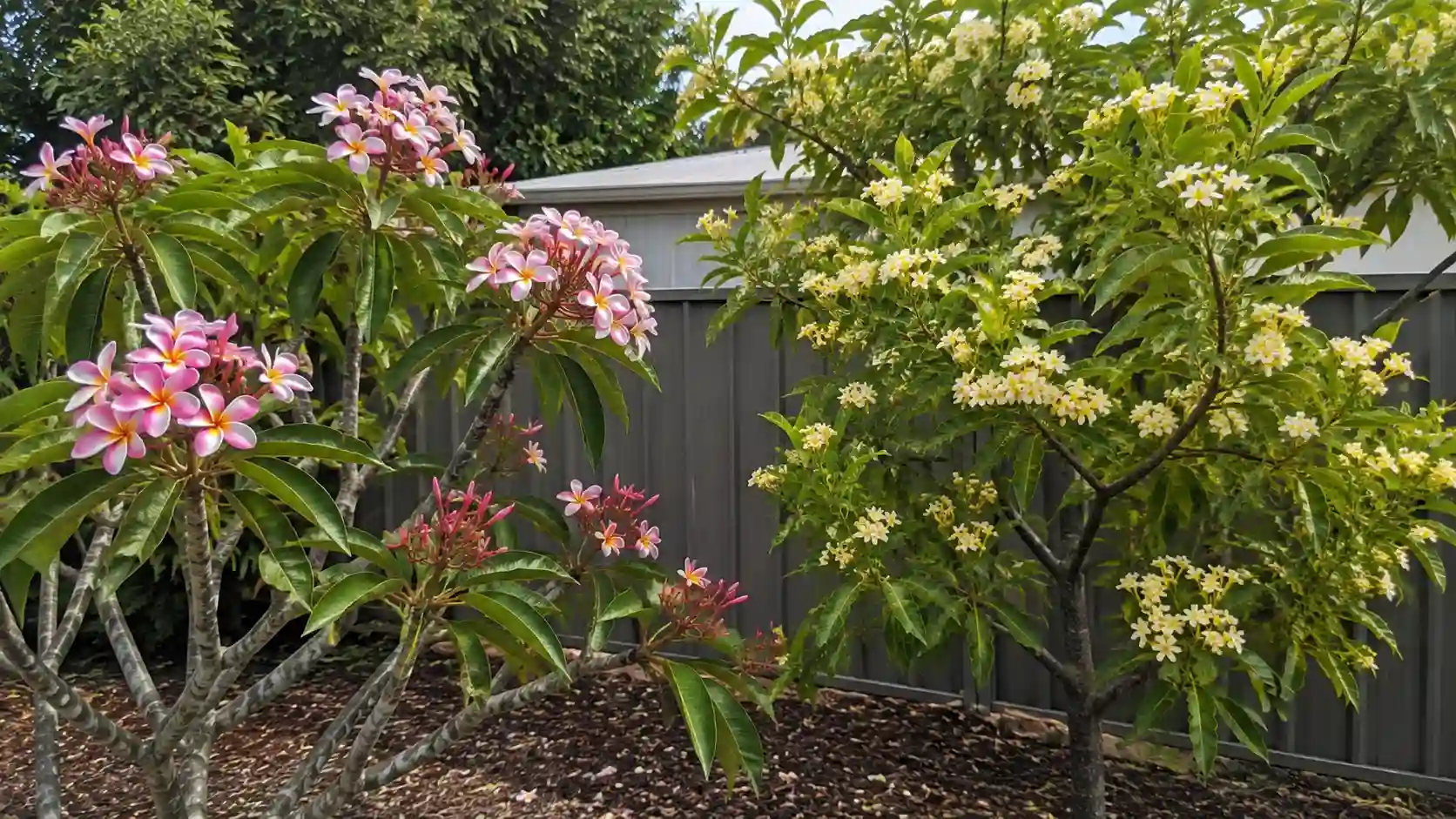
Tropical frangipani (Plumeria) and Australia’s native frangipani (Hymenosporum flavum) are unrelated trees with different families, origins and care requirements. Plumeria belongs to the Apocynaceae family, while native frangipani belongs to Pittosporaceae.
| Feature | Tropical frangipani | Native frangipani |
| Main botanical group | Plumeria | Hymenosporum flavum |
| Family | Apocynaceae | Pittosporaceae |
| Australian status | Introduced ornamental | Australian native |
| Leaf habit | Usually deciduous | Evergreen, although occasional partial deciduousness occurs |
| Frost tolerance | Frost tender | Established plants tolerate moderate frost |
| Sap | Copious milky sap; skin/eye irritant | Different species; do not apply Plumeria care assumptions |
| Typical cultivated height | Commonly around 5–8 m, depending on species/cultivar | Often about 6–10 m in cultivation |
Native frangipani naturally occurs in eastern Australia and has fragrant cream-to-yellow flowers in spring and early summer.
Dwarf and Compact Types
Dwarf frangipani cultivars are useful for courtyards and containers because some compact forms stay around 2 m rather than reaching the 5–8 m scale of larger street-tree types. Gardening Australia notes that smaller forms have restricted root systems and are particularly suited to pots.
For broader Australian tree-selection context, see our guide to the best trees and shrubs for Australian gardens.
Frangipani Growing Conditions by Australian Climate Zone
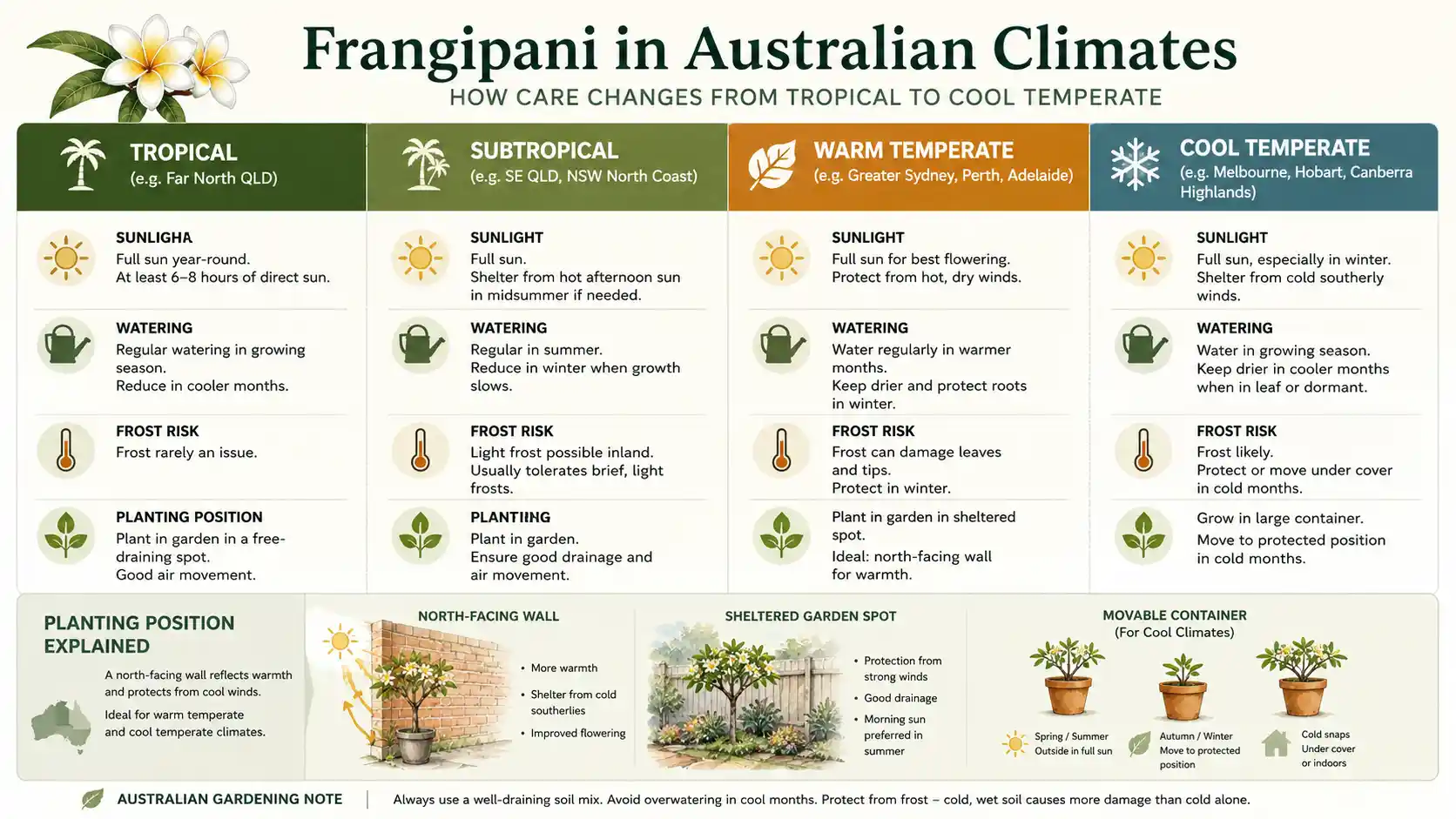
The basic formula is simple: full sun + warmth + free drainage + frost protection. Frangipanis have fleshy stems and are poorly suited to prolonged waterlogging. Gardening Australia specifically recommends freely draining soil and notes that frost can damage stems and lead to decay.
| Australian climate zone | Watering pattern | Frost risk | Best planting position |
| Tropical | Water during prolonged dry periods; reduce during wetter periods | Low in frost-free districts | Open sun with excellent drainage |
| Subtropical | Regular water during active growth, less in winter | Low to moderate locally | Full sun, protected from cold wet spots |
| Warm temperate | Water during dry growing periods; keep winter soil comparatively dry | Moderate | Warm, sunny position with drainage |
| Cool temperate | Minimal winter moisture; use containers where practical | High | North/north-west wall, sheltered courtyard or movable pot |
There is no single reliable “frangipani frost temperature” that applies to every tree and cultivar. Frost damage depends on duration, plant maturity, exposure and acclimation. In Melbourne and other cool areas, Gardening Australia recommends pots and warm north or north-west-facing positions because frost can seriously damage fleshy stems and cold wet roots.
For more Australian tree-selection context, see flowering trees guide.
Do Frangipanis Like Full Sun? Can They Grow in Shade?
Frangipanis are sun lovers. Full sun produces stronger growth and more reliable flowering, while part shade may keep a plant alive but commonly reduces flowering and can produce a less compact canopy.
Where to Plant and How Big the Roots Get.
Frangipani roots are not generally treated as one of the highly aggressive landscape-root systems, but mature trees still need adequate soil volume and clearance. Avoid squeezing a full-size tree into a narrow strip simply because the nursery specimen looks small.
For practical planting decisions, consider mature canopy width, paving, pools, walls and underground services rather than relying on current pot size. growth, root-spread and plant-sizing guide provides a broader framework for evaluating mature tree placement.
Frangipanis work particularly well as feature trees in courtyards, warm coastal gardens and open lawns where their sculptural branches and summer fragrance can be appreciated.
Watering and Feeding Through the Year
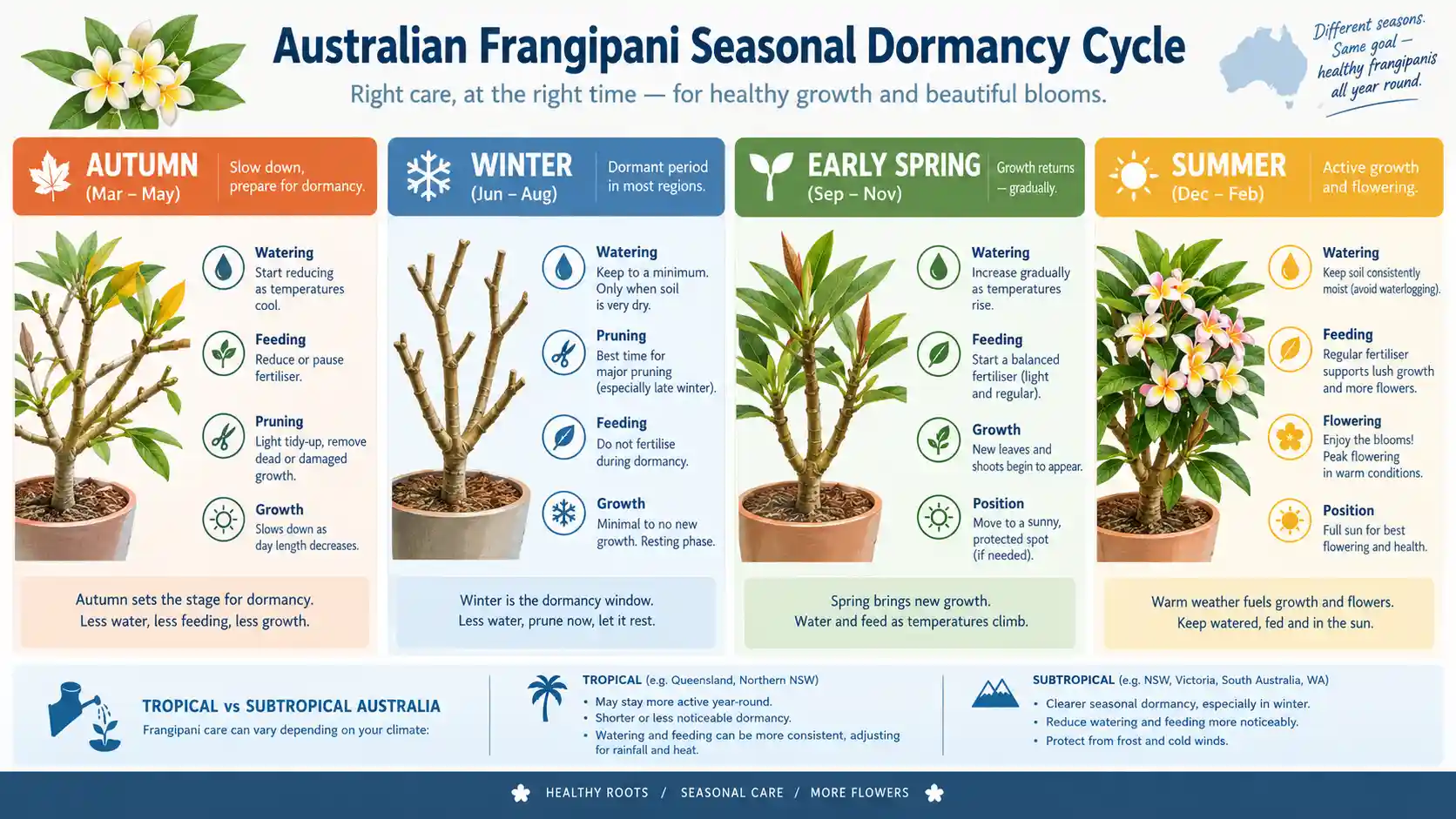
Water more while the plant is actively growing and flowering, then sharply reduce irrigation as the tree becomes dormant and leafless. The goal is not to keep the root zone continuously wet during winter.
| Australian period | Watering | Feeding | Pruning/cuttings |
| Autumn | Reduce as leaves fall | Finish active-season feeding | Usually leave structural pruning until late winter |
| Winter | Very little for established, leafless trees | None routinely | Main pruning window toward late winter |
| Early spring | Increase as new growth starts | Resume active-growth feeding | Good time for pruning and propagation |
| Late spring–summer | Water during prolonged dry spells | Feed according to product label | Monitor flowering, pests and rust |
This is a baseline rather than a rigid monthly prescription. Tropical or unusually warm regions may have a shorter dormancy, while cool southern gardens may need an even drier winter approach.
What Helps Frangipanis Grow and What Fertiliser Suits.
Avoid repeatedly pushing a frangipani with high-nitrogen fertiliser if flowers are the goal. A balanced or flowering fertiliser used during active growth is more sensible than trying to force soft leafy growth. Gardening Australia’s 2026 pruning guidance recommends feeding after pruning and placing fertiliser out toward the drip line.
Do not assume extra phosphorus automatically creates more flowers; use the product according to its label and avoid unnecessary nutrient loading.
When Do Frangipanis Flower in Australia (and Why Yours May Not)
Frangipanis generally flower from late spring through summer and into early autumn, although warm tropical districts may start earlier and cooler climates may flower later or for a shorter period. Gardening Australia gives November to May as a broad flowering period for warm Australian conditions.
Common reasons for no flowers include:
- Too much shade.
- Excessive nitrogen-driven leafy growth.
- A young tree or recently rooted cutting.
- Cold or wet winter conditions.
- Pruning that removes developing flowering wood.
- A short growing season in a cool climate.
Fragrance is usually sweet and strongest when flowers are open in the evening.
For related identification and flowering-season comparisons, see Australian pink-flowering tree guide.
Diagnosing Common Frangipani Problems
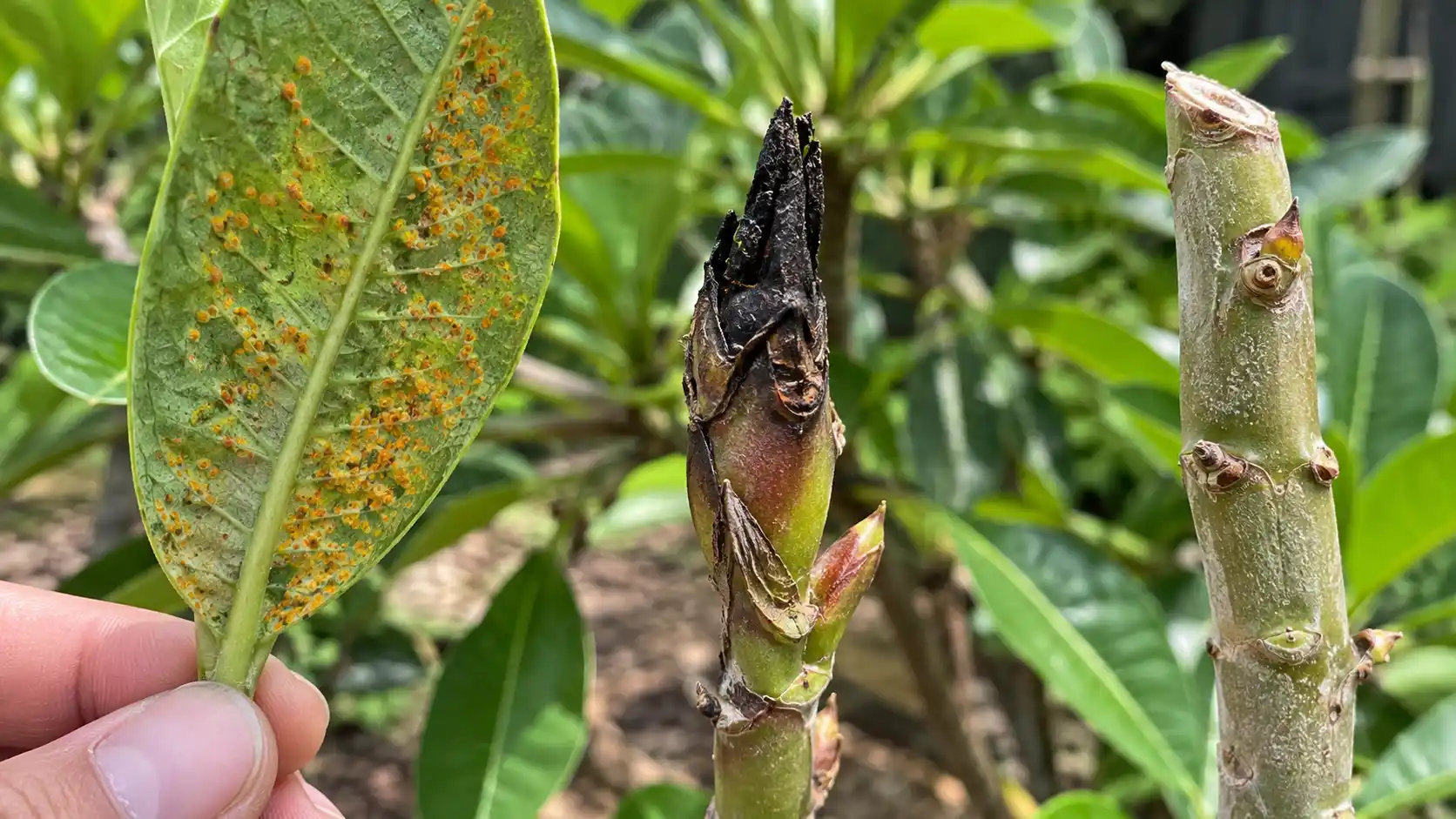
Most frangipani problems can be narrowed down by asking four questions: Is it cold? Is the root zone staying wet? Is airflow poor? Is the plant actively growing or dormant?
| Symptom | Likely cause | Fix | Prevention |
| Leaf drop in autumn/winter | Normal dormancy | Reduce watering; check stems | Learn the normal seasonal cycle |
| Yellowing leaves | Wet roots, ageing foliage or stress | Check drainage and season | Avoid chronic overwatering |
| Orange rust spots | Frangipani rust | Remove infected/fallen leaves; improve airflow | Keep foliage dry and clean debris |
| Black tip dieback | Frost/cold damage or tip decay | Cut back to firm healthy tissue | Protect from frost and cold wet weather |
| Soft or rotting stem | Rot following cold/wet or damaged tissue | Remove affected material | Sharp drainage; avoid damaged tissue |
| No flowers | Shade, immaturity, cold, excess nitrogen | Increase sun and correct seasonal care | Match cultivar and climate |
| Pest damage | Caterpillars, scale or mealybugs | Identify pest before treatment | Inspect foliage and stems regularly |
For a wider symptom-first approach across Australian plants, use Leafy Heaven’s plant problems and troubleshooting guide.
Frangipani Rust: What the Evidence Says About Treatment
Frangipani rust, Coleosporium plumeriae, causes yellow-orange rust pustules, usually on leaf undersides. Australian Gardening Australia guidance has long recommended removing infected and fallen leaves because the disease is usually cosmetic rather than fatal to established trees. Before recommending any fungicide for frangipani rust, check the APVMA PubCRIS database for registered chemical products because registration depends on the approved host, pest and label directions.
The treatment advice online is contradictory because a fungicide can be registered for rust on an ornamental plant without being registered for frangipani rust on Plumeria. APVMA states that PubCRIS identifies the host, pest and approved label directions for registered chemical products.
Therefore, do not present a generic copper, myclobutanil, azoxystrobin or similar product as legally registered for frangipani rust unless the current Australian product label specifically permits that host/pest use. For a home garden, sanitation, airflow and avoiding wet foliage remain the low-risk foundation.
Black Tip Dieback and Stem Rot.
Frost injury can turn into progressive dieback because damaged tissue decays back toward healthy wood. Gardening Australia advises cutting frost-damaged material back to clean, healthy wood. Soft, spongy or discoloured stems are also warning signs of decay and should not be left attached to the tree.
Do not repeatedly prune healthy wood just because a branch looks bare in winter; first distinguish dormant firm tissue from genuinely dead or rotting tissue.
How and When to Prune Frangipani
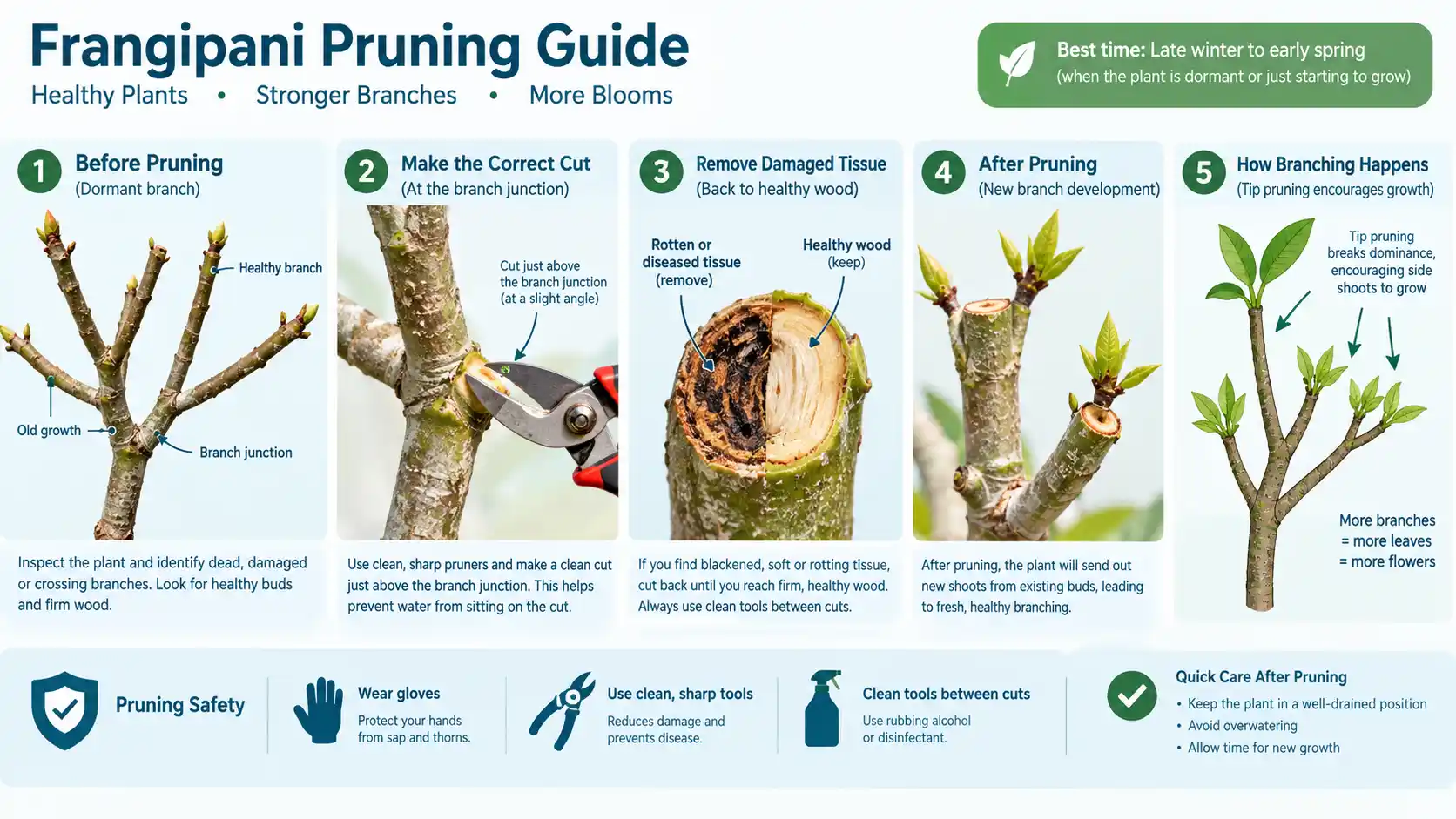
Late winter to early spring, while the plant is still dormant or just beginning new growth, is the preferred pruning window in much of Australia. Gardening Australia’s August 2026 guidance specifically recommends this timing because the structure is visible and thinning the canopy can improve airflow. Late winter to early spring is a practical pruning window while frangipanis are dormant and leafless. Gardening Australia’s frangipani pruning guidance explains how to open the canopy, make clean cuts at branch junctions and remove diseased wood to improve tree health.
- Use clean, sharp tools.
- Wear gloves because the sap can irritate skin and eyes.
- Cut cleanly at branch junctions rather than leaving awkward stubs.
- Remove diseased or rotting sections back to healthy wood.
- Allow cuttings to callus before planting.
For propagation, Gardening Australia describes taking substantial sections of stem and allowing the cut end to callus before planting.
Making a Frangipani Branch More
Tip pruning can encourage branching. Instead of repeatedly shortening every branch, make deliberate cuts during the appropriate pruning window and allow new shoots to develop.
Do not promise that every cut will produce exactly two new branches; branching response varies with cultivar, position, plant vigour and the number of dormant buds available.
Pruning Timing for Perth.
Perth’s dry summer and cooler, wetter winter pattern makes late winter to early spring a practical pruning period, but the safest trigger is the end of the main cold/frost risk and the approach of active spring growth, not a single calendar date.
Frangipani in Pots, Indoors and Cold Zones
Frangipanis can perform very well in containers, particularly compact cultivars. Pots are especially useful in Melbourne and other cool districts because the plant can be moved into a sheltered position for winter. Gardening Australia recommends warm north or north-west aspects and shelter from cold air.
- Choose a container with generous drainage holes.
- Use a coarse, free-draining growing mix rather than a moisture-retentive mix.
- Avoid an oversized pot that stays wet for long periods.
- Repot during active growth rather than when the plant is cold and dormant.
- Indoors, give it the brightest possible position; a dim room is a poor substitute for outdoor sun.
Size, Growth Rate and Lifespan
Large Australian-grown frangipanis can reach roughly 5–8 m, with some references putting Plumeria rubra around 8 m and approximately 4.5 m spread. Compact cultivars can remain around 2 m.
Growth is best described as moderate and strongly seasonal: rapid during warm active growth and essentially paused during dormancy. A USDA species profile reports approximately 30 years for P. rubra, but lifespan is not a fixed Australian guarantee and varies with climate, rot, frost damage and general care.
The main benefits are fragrant flowers, sculptural form and drought tolerance once established; disadvantages include winter leaf litter, irritating sap, frost sensitivity and rust.
Are Frangipanis Poisonous? Sap, Flowers, Pets and Skin
Frangipani sap is a genuine irritant. Queensland Poisons Information Centre describes Plumeria as potentially toxic and says the milky sap can irritate skin and eyes and cause vomiting or diarrhoea if sap or bark is ingested.
- Wear gloves when cutting.
- Keep sap away from eyes and mouth.
- Prevent pets and children from chewing stems or leaves.
- Seek veterinary or poisons advice after a significant ingestion or concerning symptoms.
Frangipani’s milky sap can irritate skin and eyes and may cause illness if swallowed. The Queensland Poisons Information Centre’s frangipani guidance provides Australian safety information for exposure and ingestion.
Conclusion
Good frangipani tree care Australia is mostly about respecting the plant’s seasonal cycle: strong sun, sharp drainage, active-season watering and feeding, then a much drier winter rest. Leaf drop does not automatically mean death, while cold wet roots, frost damage and poor airflow can cause genuine decline. Match your care to your climate zone and season, and check the stems before removing a supposedly “dead” tree.
Frequently Asked Questions
How long do frangipani trees typically live?
A USDA species profile gives Plumeria rubra an approximate lifespan of 30 years, but that figure should not be treated as a fixed Australian lifespan. Healthy trees can vary considerably depending on cultivar, climate, frost exposure, drainage, disease and pruning history.
Do frangipani trees have large, invasive roots?
Frangipanis are not generally regarded as having the aggressive root behaviour associated with some large landscape trees. However, mature roots still need adequate growing space, and planting directly beside paving, walls or pipes is poor practice. Plan around mature canopy size and actual site conditions rather than assuming roots will stay within the original pot footprint.
What does frangipani smell like?
Frangipani flowers are strongly fragrant, usually with a sweet floral perfume that can become particularly noticeable in the evening. Fragrance varies between cultivars, so two frangipani trees can smell noticeably different. Gardening Australia describes fragrance as one of the plant’s defining attractions and notes that the scent intensifies at night.
How do you make a frangipani grow more branches?
Prune the growing tip or selected branch during the appropriate late-winter to early-spring pruning period to encourage new shoots from dormant buds. Make clean cuts at suitable branch junctions and avoid excessive pruning. The number and position of new branches will vary with cultivar, plant age, health and where the cut is made.
Are frangipanis fast growing?
Frangipanis are usually considered moderate growers rather than uniformly fast-growing trees. Growth is strongest during warm, sunny months and slows dramatically or stops during dormancy. Warm tropical and subtropical climates generally provide a longer active growing season than cool southern areas, where frost and low temperatures can shorten the growth period.
How long does a frangipani take to reach full size?
There is no single Australian maturity time because cultivar, climate, starting size, root volume and growing conditions all affect the result. A large Plumeria may eventually reach around 5–8 m, while dwarf cultivars can remain close to 2 m. Allow for years rather than expecting nursery-sized plants to reach mature dimensions quickly.
Why has my frangipani lost all its leaves in winter?
Most common frangipanis are deciduous, so complete winter leaf loss can be normal. First check whether the stems remain firm and healthy. If they are firm rather than soft, black or collapsing, dormancy is more likely than death. Frost damage, rot or severe stress require a closer inspection before deciding what to prune.