
Jacaranda Tree Australia: Climate, Bloom Time & Problems
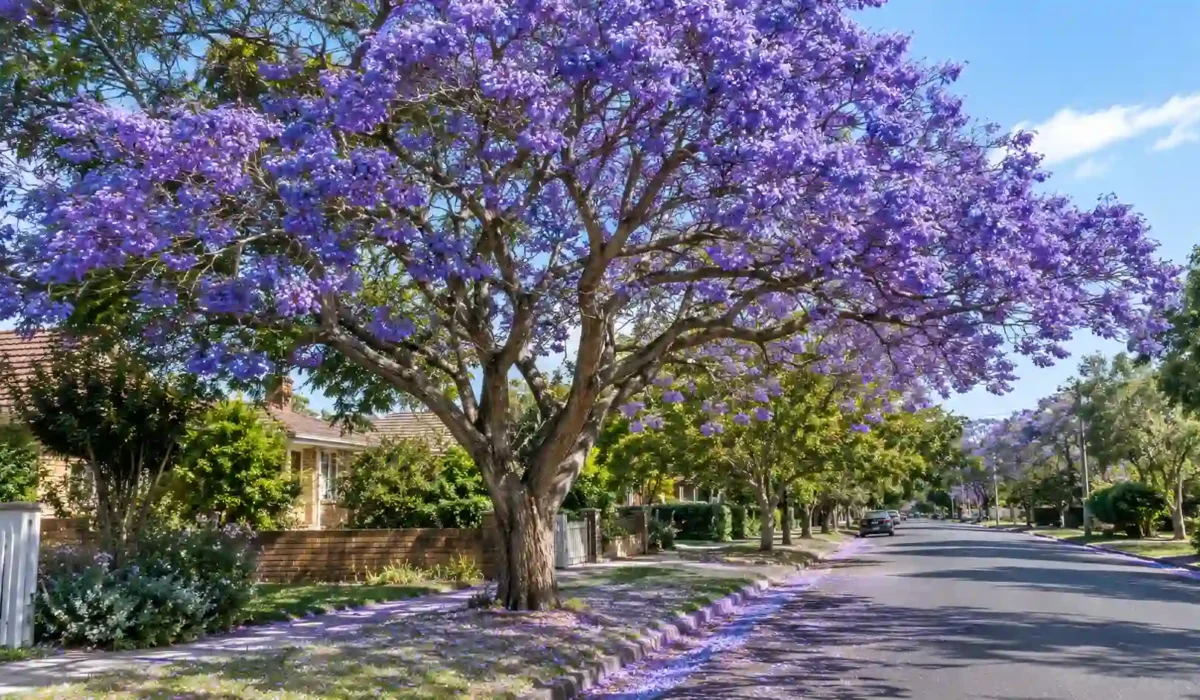
The jacaranda tree Australia gardeners know as the blue jacaranda is Jacaranda mimosifolia, a South American ornamental tree famous for its fern-like foliage and masses of blue-purple trumpet flowers in spring. It can grow to about 15 metres and is much more climate-sensitive than its popularity suggests. In Australia, it performs most reliably in warm-temperate and subtropical areas, while frost-prone districts need more care. The real planting questions are therefore simple: will your climate support it, do you have enough room, and are you prepared for leaves, flowers and seed pods?
Quick Summary
- Jacarandas are not native to Australia. Jacaranda mimosifolia comes from South America and is naturalised in parts of Queensland and New South Wales; Brisbane City Council currently treats it as Council Pest Vegetation.
- The tree suits warm-temperate to subtropical climates. Melbourne is around its southern practical limit and is frost-tender; Canberra, Tasmania and inland frost-prone areas are considerably more challenging.
- Flowering is generally a spring event, commonly from September/October in warmer areas through November and into December farther south. Young trees may take several years to flower; grafted nursery trees can flower much earlier than seedlings.
- Give it full sun, room to reach 10 m or more, and no heavy nitrogen fertiliser if you want flowers.
Will a Jacaranda Grow Where You Live?
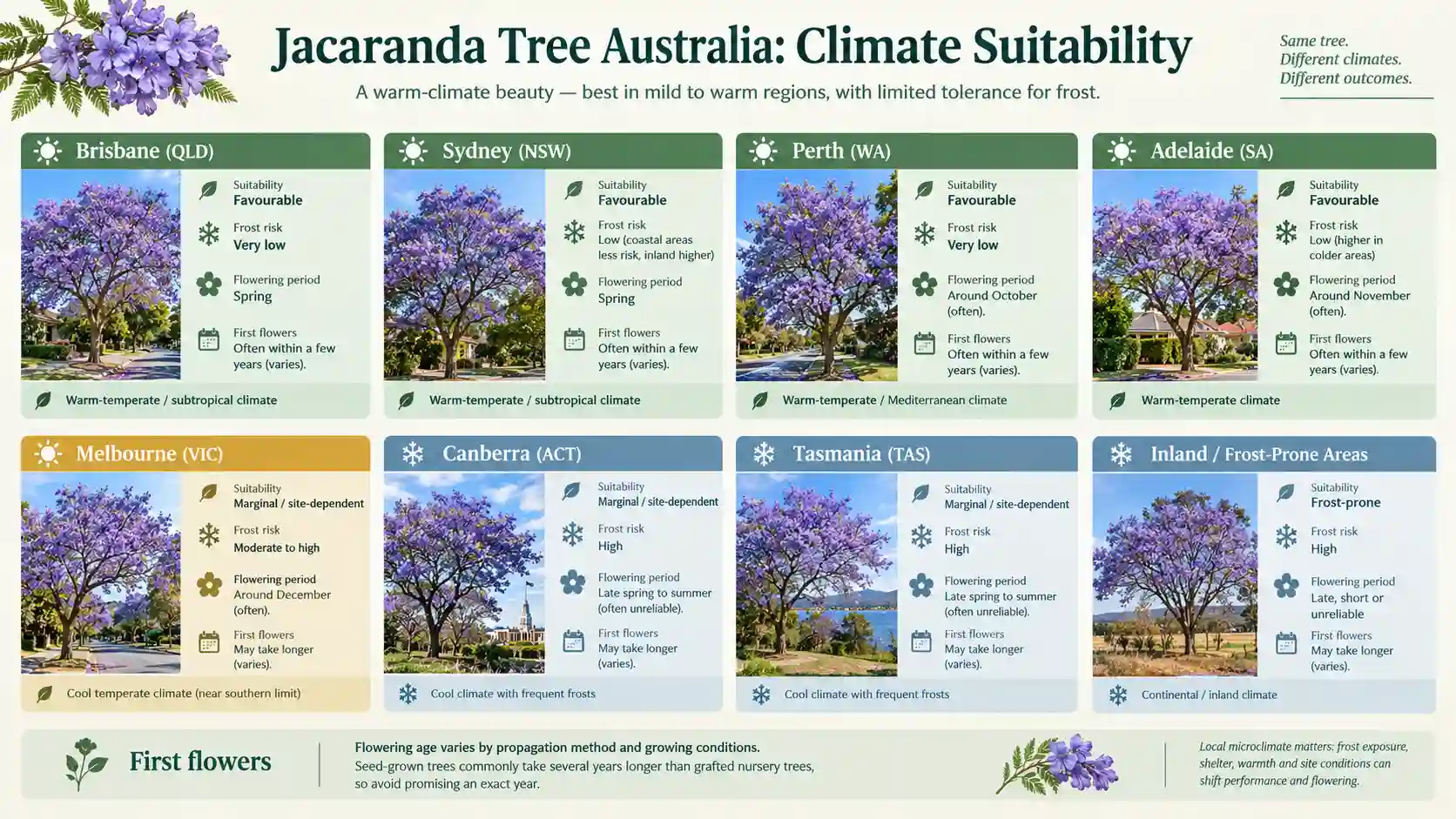
Warm-temperate to subtropical climates provide the most dependable conditions because jacarandas need warmth for active growth and flowering, while young trees are particularly vulnerable to frost. Royal Botanic Gardens Victoria describes J. mimosifolia as a warm-climate tree and notes that Melbourne represents its southern limit in Australia, where it is frost-tender.
For more botanical detail, the Royal Botanic Gardens Victoria jacaranda profile is a useful reference when comparing mature size, foliage and seasonal behaviour.
Table 1: Climate-Suitability Matrix
| City or region | Suitability | Frost risk | Typical bloom window | First-flower expectation |
| Brisbane | Strong fit | Low | Sep–Nov | 2–3 years grafted; 5–8+ years seed-grown |
| Sydney | Strong fit | Low–moderate | Oct–Nov | 2–3 years grafted; 5–8+ years seed-grown |
| Perth | Strong fit | Low in coastal areas | Mid-Oct–late Nov | 2–3 years grafted; 5–8+ years seed-grown |
| Adelaide | Good fit in suitable sites | Moderate in colder pockets | Nov–Dec | 2–3 years grafted; 5–8+ years seed-grown |
| Melbourne | Marginal | Moderate–high for young trees | Late Nov–early Dec | Often slower or less reliable |
| Canberra | Difficult | High | Late spring if flowering | Potentially much longer and variable |
| Tasmania | Difficult | High | Unreliable | Often unreliable |
| Inland frost-prone areas | Difficult | High | Unreliable | Highly variable |
The flowering dates above are indicative rather than fixed city calendars. ClimateWatch records spring flowering around September–October in North Queensland and November in NSW, while long-term observations found the timing and peak varied substantially between Melbourne, Perth and Sydney.
Growing zones in Australia
Think in terms of warm-temperate and subtropical conditions, not simply postcode. Coastal Queensland and NSW are naturally favourable. Perth also supports established jacarandas well, while Adelaide can produce strong displays in appropriate sites. Melbourne can grow jacarandas, but the margin for error is smaller. Mountainous and regularly frosted areas are much less dependable.
Marginal climates
In Melbourne, Canberra or Tasmania, site selection becomes critical. A north-facing position, protection from cold winds, good drainage and a warm urban microclimate can improve the odds. Young trees need particular protection because frost damage can kill soft new growth even when an older tree is established enough to cope.
Is the Jacaranda Native to Australia, and Is It a Weed?
No. The blue jacaranda is an introduced South American tree, not an Australian native. PlantNET records Jacaranda mimosifolia as native to Argentina and Bolivia and notes that it is naturalised in NSW and Queensland.
The distinction between cultivated ornamental tree, naturalised plant and legally declared weed matters. Brisbane City Council currently lists jacaranda as Council Pest Vegetation under its Natural Asset Local Law and describes it as an environmental weed in parts of Queensland and NSW. However, an Ipswich Council weeds booklet states that it is not listed under the Biosecurity Act, so “environmental weed” should not automatically be read as “statewide declared weed”.
Table 2: Weed status by state and council
| Area | Verified position |
| Queensland | Naturalised; regarded as an environmental weed in parts of the state |
| Brisbane City Council | Listed as Council Pest Vegetation |
| Ipswich | Environmental weed profile; booklet says not listed under Biosecurity Act |
| New South Wales | Naturalised; regarded as an environmental weed in parts of NSW |
| Victoria | Widely cultivated; no comparable statewide weed declaration established from the sources reviewed |
| Western Australia | Widely cultivated, especially Perth; no comparable statewide weed declaration established from the sources reviewed |
| ACT / Tasmania / SA | Local legal status should be checked before planting; no statewide status is asserted here |
The most useful pre-purchase check is the local council or state weed database rather than a generic internet label. The Brisbane City Council weed profile is particularly relevant for South East Queensland.
Why Australia has so many jacarandas
The species became deeply embedded in Australian streetscapes through ornamental and street-tree planting over many decades. Brisbane developed prominent plantings, while Grafton became nationally associated with jacarandas through its extensive avenues and annual festival. Historical sources also document the strong use of jacarandas in NSW and Queensland urban landscapes.
Reconciling “trouble-free” with “environmental weed”
A jacaranda can be easy to grow in a garden while still creating ecological problems outside managed landscapes. Brisbane City Council notes that seedlings can establish beneath planted trees and spread into nearby woodland and grassland, particularly around waterways. That is why good garden performance and environmental risk are not contradictory statements.
Which town is famous for jacarandas?
Grafton, NSW is the standout Australian jacaranda town. Visit NSW currently lists its Jacaranda Festival as an annual event based around the flowering of more than 1,000 jacarandas, with the 2026 festival scheduled for late October into early November.
When Do Jacarandas Bloom, and What Happens in Winter?
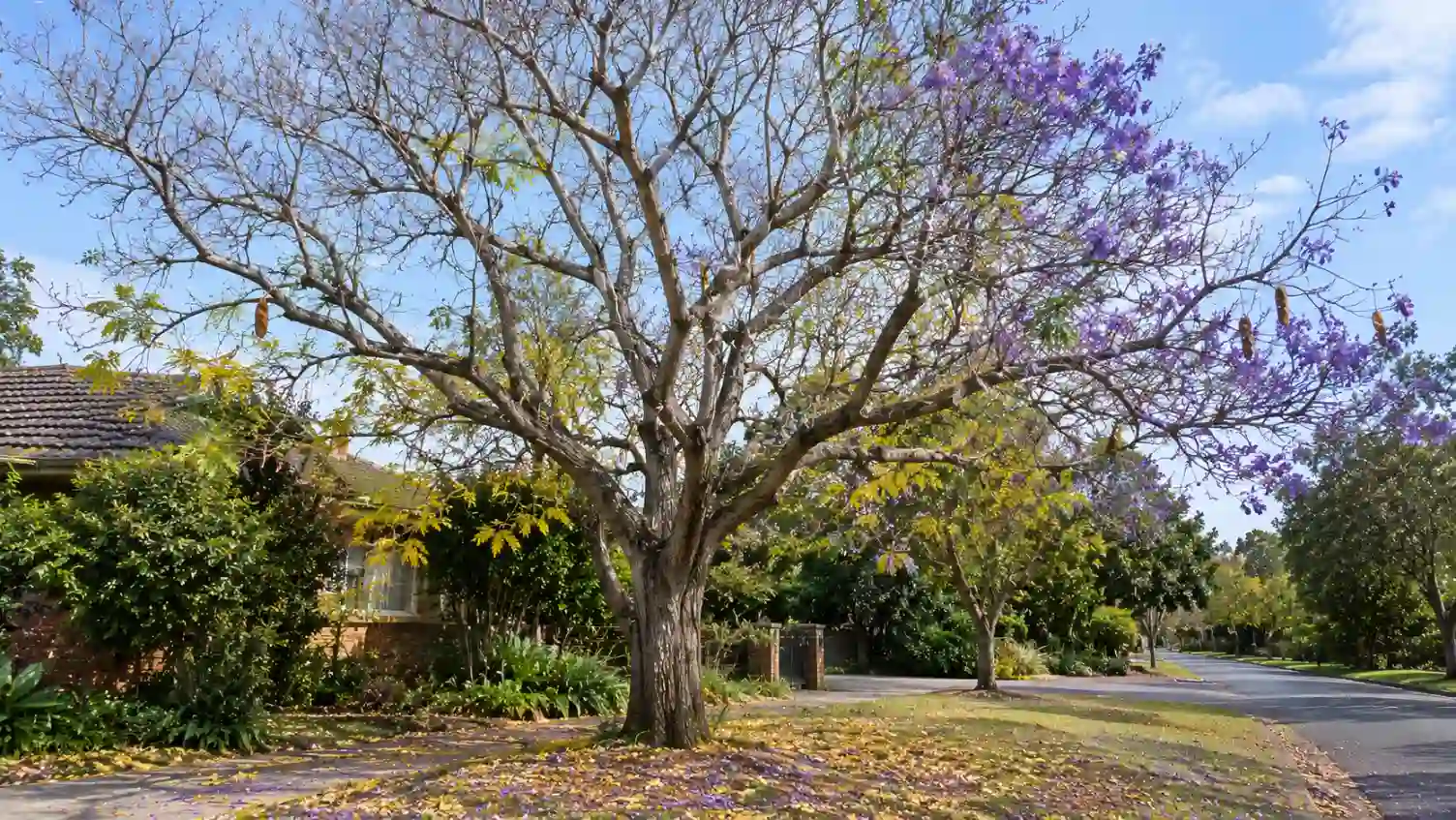
Jacarandas are primarily a spring-flowering tree in Australia, although the exact timing shifts with climate and season. ClimateWatch records flowers in spring, including September–October in North Queensland and November in NSW. A long-term ClimateWatch study also found meaningful differences between Perth, Sydney and Melbourne.
Table 3: Bloom and leaf calendar by city
| City/region | First flowers | Peak | Leaf drop | New leaves |
| Brisbane | Sep–Oct | Oct–Nov | Late winter–spring | After flowering |
| Sydney | Oct | Oct–Nov | Late winter–spring | Spring |
| Perth | Mid-Oct | Oct–Nov | Late winter–spring | Spring |
| Adelaide | Nov | Nov–Dec | Late winter–spring | Spring |
| Melbourne | Late Nov | Late Nov–Dec | Late winter–spring | Nov–Dec |
| Canberra | Late spring, variable | Variable | Winter–spring | Spring |
| Tasmania | Unreliable | Unreliable | Winter–spring | Spring |
These are practical seasonal windows, not guaranteed flowering dates. The ClimateWatch jacaranda field guide is particularly useful because it tracks first flower, full flowering, leaf emergence, leaf colour and leaf drop.
Are jacarandas deciduous?
They are generally described as deciduous or semi-deciduous, depending on source and climate. In cooler or drier conditions, foliage loss can be quite obvious. In warmer areas, leaf retention can be less dramatic. PlantNET describes it as deciduous in early spring, while ClimateWatch records the leaves turning yellow before falling.
Jacaranda in winter
A winter jacaranda may look surprisingly empty. Yellowing foliage is followed by leaf loss, leaving a thinner or bare framework. The woody, flattened seed capsules can remain after flowering and persist for months. New foliage generally follows the flowers in spring.
Do jacarandas flower twice a year?
Not as a reliable garden cycle. The normal ornamental display is the spring flowering season. Occasional out-of-season flowers can occur, but an autumn flush should be treated as an exception rather than a dependable second crop.
How Big Does a Jacaranda Get, and How Fast?
Plan for a large landscape tree, not a small ornamental. Royal Botanic Gardens Victoria records trees to about 15 m, while the City of Cockburn lists jacaranda at approximately 15 m high × 10 m wide for street-tree planning.
Size is strongly affected by soil, moisture, root space, climate and whether the tree is allowed to develop naturally. Your existing site should therefore be planned around the mature tree, not the nursery pot.
Growth rate and time to flower
Jacarandas are generally moderate to fast growers in favourable warm conditions. Flowering age is much more variable. Australian nursery guidance commonly reports seed-grown trees taking roughly 5–8 years or longer, while grafted trees can flower within a few years. A University of Florida horticultural guide likewise notes that seedlings may take a long time to bloom and that grafted or cutting-grown trees are preferred when earlier flowering matters.
For broader planning around trunk size, root space and mature dimensions, see growth, roots and sizing guide.
Lifespan
There is no single dependable lifespan figure that applies to every jacaranda. They are capable of living for many decades, and Australian sources document very old specimens. The sensible planning assumption is therefore a long-lived tree whose mature structure needs to work on the site for decades, not just for the first five years.
Why Isn’t My Jacaranda Flowering?
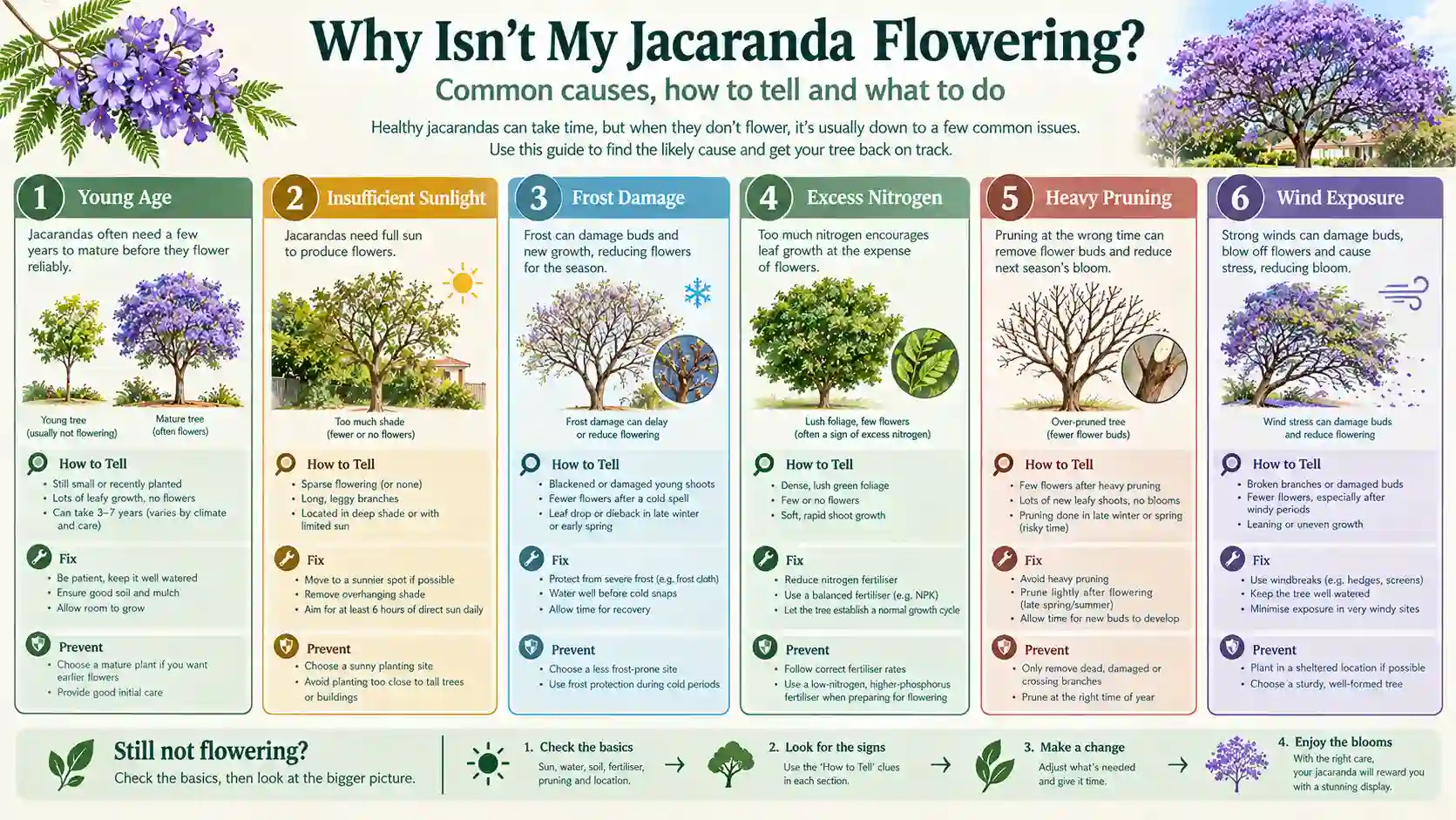
When a jacaranda is healthy but refuses to bloom, age and site conditions are usually more useful clues than simply adding more fertiliser.
Table 4: Flowering diagnostic
| Cause | How to tell | Fix | Prevention |
| Too young | Vigorous tree, no flowers | Wait; check propagation method | Buy grafted stock if early flowers matter |
| Too little sun | Dense green growth, shaded canopy | Move young tree or improve exposure | Plant in full sun |
| Frost damage | Blackened or dead new growth | Remove damaged material once growth resumes | Shelter young trees |
| Excess nitrogen | Very lush leafy growth | Stop high-N feeding | Keep lawn fertiliser away from root zone |
| Heavy pruning | Lots of vigorous shoots, few blooms | Allow canopy to recover | Use light formative pruning |
| Coastal wind/exposure | Damaged new shoots or poor canopy development | Increase shelter | Plant in a protected position |
| Waterlogging | Weak growth, yellowing, decline | Improve drainage | Avoid persistently wet soil |
Full sun is particularly important for flowering. Excessive shade can allow a tree to survive while reducing flowering performance.
For Australian feeding guidance, soil and fertiliser guide provides a useful companion reference, particularly when lawn fertiliser is being applied near ornamental trees.
Beginner mistakes
The common traps are straightforward: planting in shade, feeding a tree heavily because it is not flowering, pruning it hard to “make it bushier”, or assuming a young seed-grown tree should bloom immediately.
How do I get my jacaranda to flower?
Give it full sun, good drainage, adequate establishment water, shelter from damaging frost and wind, patience, and restrained feeding. Avoid hard pruning and avoid turning the surrounding lawn into a high-nitrogen fertiliser zone. If the tree is young and seed-grown, time may simply be the missing ingredient.
Common Jacaranda Problems: Roots, Litter and Placement
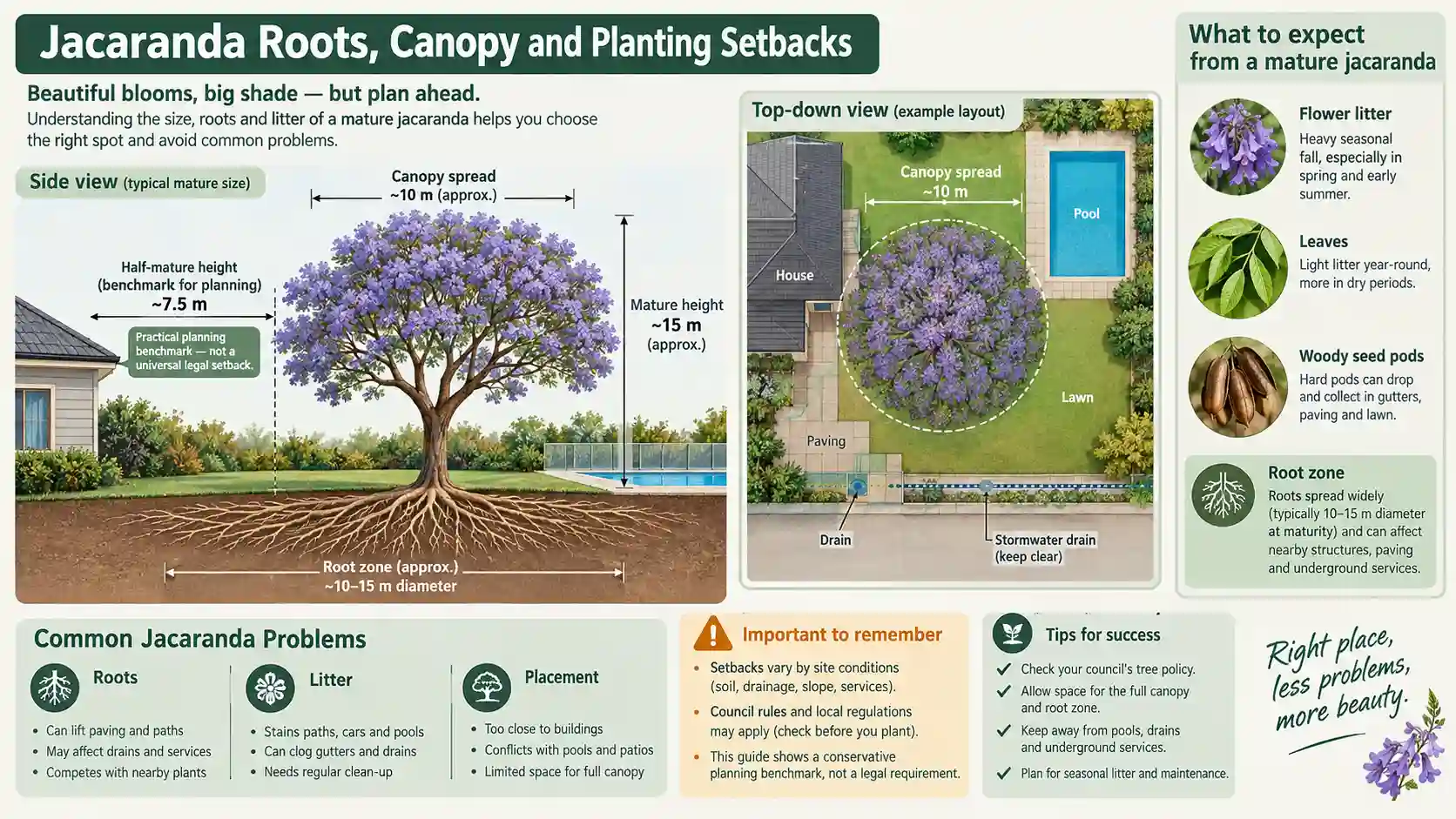
Jacarandas are not accurately described simply as having “invasive roots”. A better description is that they can develop extensive, laterally spreading roots, and problems become more likely when a large tree is confined beside paving, walls, drainage infrastructure or pools. ABC’s horticultural coverage notes that the roots can be extensive and may damage paths and fences in some situations.
Table 5: Root and setback comparison
| Guidance/source | Distance or dimension | Important limitation |
| Campbelltown Council tree guide | 3 m from a house | Generic home-tree guidance, not jacaranda-specific |
| Cockburn Council | Jacaranda about 15 m × 10 m | Shows the scale and verge-space requirement |
| Georgetown Council tree policy | At least half mature height from a building for large trees | General large-tree fall-risk guidance |
| Practical jacaranda planning | About 7.5 m from a building for a 15 m full-size tree | Derived from the half-mature-height rule; not a statutory jacaranda setback |
| Pools, major drains, fragile paving | Prefer more space where practical | Site, utilities and soil conditions vary |
There is no single universal jacaranda setback number. Campbelltown’s generic home-tree guidance says 3 m, while Georgetown’s large-tree policy uses half mature height. For a jacaranda capable of reaching 15 m, a rough 7.5 m building setback is a conservative planning benchmark where space allows, rather than a legally prescribed figure.
The City of Cockburn’s street-tree guidance is useful for understanding why the canopy matters just as much as the roots.
For additional root-planning context, Poinciana root-system guide provides a useful comparison with another large Australian landscape tree.
Do jacarandas have invasive roots?
They can have extensive surface or lateral roots, but “invasive” is too absolute. The risk depends on where the tree is planted, soil conditions and what infrastructure is nearby. Existing drains, pools, retaining walls and shallow paving deserve more caution than an open lawn or garden bed.
Litter management
Jacaranda litter comes in three main waves: leaves, flowers and woody seed pods. Fallen flowers can become slippery when wet, while pods can accumulate around lawns, gutters and paved areas. ClimateWatch notes that the seed pods can remain on the tree for several months.
A simple management routine is to keep gutters clear, sweep high-traffic paving during flowering, collect fallen pods before they accumulate, and position the canopy so the heaviest flower fall lands on garden beds rather than around a pool or entrance.
Where not to plant a jacaranda
Avoid cramped courtyards, directly over pools, immediately beside major drains or septic infrastructure, over delicate paving, and in exposed frost pockets. Also avoid sites where mature canopy clearance from buildings, power infrastructure or neighbouring properties cannot be achieved.
Other common problems
Pests such as aphids and scale can occur, and the honeydew they produce may lead to sooty mould. Poor drainage can also contribute to root or collar problems.
Planting, Care and Pruning
Plant in full sun and well-drained soil, with generous root space. Water deeply during establishment rather than giving frequent shallow drinks; current Gardening Australia material recommends weekly watering while establishing trees in a featured planting context.
When to plant
In warm climates, autumn through spring can work well provided the site is not experiencing heat or waterlogging. In frost-prone districts, spring planting after the coldest period is generally easier for establishment because young growth is vulnerable to frost.
Can you prune a jacaranda to keep it small?
Only to a point. Light formative pruning can improve structure and remove damaged or crossing branches, but hard reduction is a poor strategy for turning a large jacaranda into a permanently small courtyard tree. Heavy cuts can produce vigorous upright shoots and destroy the natural spreading form.
For a small block, choosing a smaller tree is usually more sustainable than repeatedly fighting the mature dimensions of a jacaranda.
Jacaranda Varieties and Alternatives for Small Yards
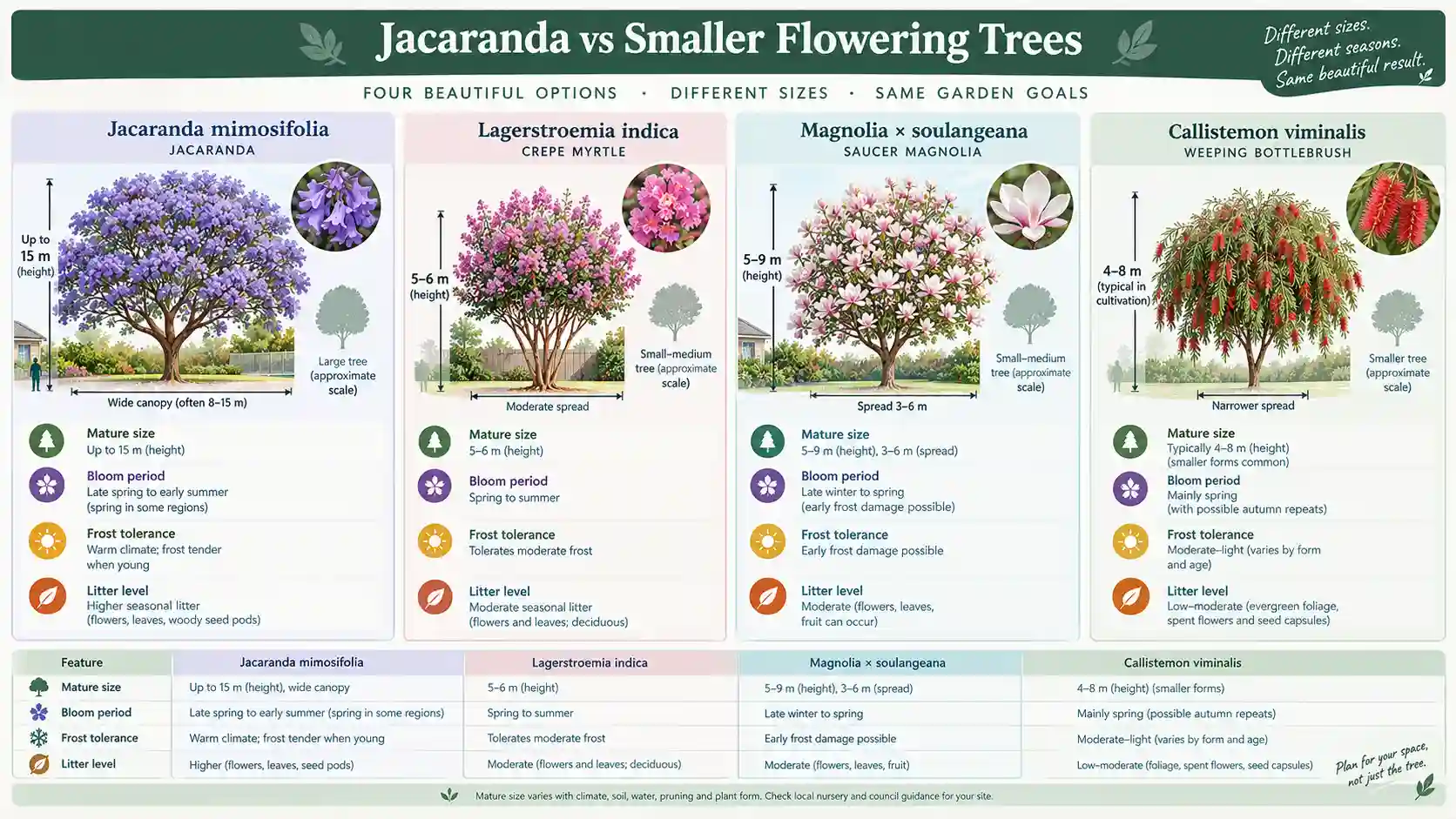
There is no widely recognised true dwarf form of the standard blue jacaranda that turns J. mimosifolia into a genuinely small courtyard tree. White-flowered forms such as J. mimosifolia ‘Alba’ and ‘White Christmas’ change the flower colour, not the basic space requirement.
Table 6: Jacaranda vs alternatives
| Tree | Approx. mature size | Flowering time | Frost tolerance | Litter |
| Jacaranda | 10–15 m × 8–12 m | Spring to early summer | Young trees frost-tender | High |
| Crepe Myrtle | Commonly 2–8 m depending on cultivar | Summer | Better suited to cool-temperate gardens | Moderate |
| Magnolia × soulangeana | About 4–6 m | Early spring | Good in cool climates | Moderate |
| Smaller Australian flowering shrub/tree options | Often under 5 m | Varies | Depends on species | Usually lower |
For smaller garden designs, pink flowering tree guide covers compact alternatives and the trade-offs between mature height, flowering season and climate.
A related guide to pink flowering shrubs is also useful when a garden needs colour without committing to a 10–15 m canopy.
Yellow jacaranda tree
The common name “yellow jacaranda” can be misleading. Brisbane City Council uses that name for Tipuana tipu, a completely different species in the pea family. Its yellow flowers distinguish it from the blue-purple flowers of Jacaranda mimosifolia.
Conclusion
A jacaranda tree Australia gardeners plant is a spectacular choice when the site is warm, sunny and spacious enough for a mature 10–15 m tree. Flowering depends on climate, age, sunlight and restrained pruning more than on heavy feeding. Before planting, check local weed information and plan setbacks around the eventual canopy and root zone, not the size of the nursery tree.
For gardeners who already have a non-flowering jacaranda, diagnose age, sun, frost, nitrogen and pruning before assuming the tree is unhealthy. For gardeners worried about litter or roots, the clearest solution is often better placement—or a smaller flowering tree.
FAQs
Is the jacaranda tree native to Australia?
No. Jacaranda mimosifolia is native to South America, with PlantNET recording Argentina and Bolivia as its native range. It has been widely planted across Australia and is now naturalised in parts of NSW and Queensland. Brisbane City Council also treats it as Council Pest Vegetation, demonstrating that popularity and native status are separate issues.
What month do jacaranda trees bloom in Australia?
There is no single national flowering month. Northern Queensland can begin in September or October, NSW is commonly around October–November, Perth generally flowers from mid-October into November, and Melbourne tends to be later, around late November or early December. Weather and local conditions can shift flowering from year to year.
How quickly does a jacaranda tree grow?
Jacarandas can grow moderately quickly in warm, favourable conditions, but annual growth varies with climate, water, soil and available root space. More important for gardeners is flowering age: seed-grown plants can take roughly five to eight years or longer to flower, while grafted nursery trees may flower after only a few years.
Do jacarandas flower twice a year?
Not reliably. The main flowering event is the spring display. An occasional out-of-season flush can occur, but it should not be treated as a normal second flowering season. If a tree flowers weakly outside spring, environmental conditions and the tree’s normal seasonal cycle are more useful explanations than assuming it has developed a second annual bloom.
Do jacaranda trees have invasive roots?
Jacarandas can develop extensive lateral roots, particularly when growing into open soil, and they can cause problems where they are planted close to paving, walls or other shallow infrastructure. “Invasive roots” is too broad a label, however. Good site selection matters more than relying on one universal distance for every property.
What is the English name for a jacaranda tree?
The common English names include jacaranda, blue jacaranda and fern tree. Brisbane City Council also lists names such as blue jacaranda and fern tree. The botanical name is Jacaranda mimosifolia. The term “blue jacaranda” helps distinguish it from unrelated trees that may be marketed with colour-based common names.
What is the lifespan of a jacaranda tree?
There is no single scientifically reliable lifespan figure that applies to every jacaranda because longevity depends on site, climate, damage and management. Australian horticultural sources describe the tree as long-lived, and old Australian specimens show that it can remain a major landscape tree for many decades. For planting decisions, plan around a mature tree that may occupy the site for generations.