

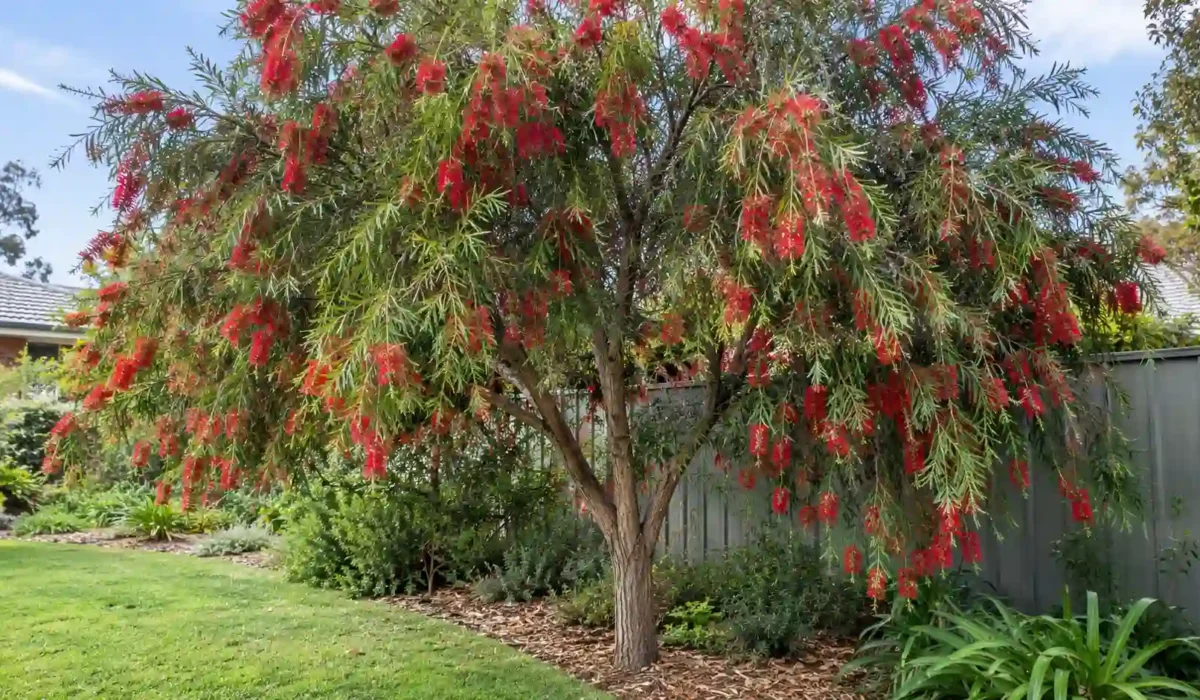
Bottlebrush Tree Australia: Types, Size, Flowering & Care
Which bottlebrush will grow as a tree in an Australian garden, and why is yours flowering poorly? A bottlebrush tree Australia gardeners can grow successfully depends on the species or cultivar, climate and how it is trained. Most bottlebrushes are shrubs, but forms such as weeping bottlebrush (Callistemon viminalis) and willow bottlebrush (Callistemon salignus) can develop into small trees. Full sun, suitable soil, reliable establishment watering and pruning after flowering are the key foundations for good growth and repeat flowering.
Quick Summary
- Most bottlebrushes are shrubs; selected species and cultivars form small trees.
- Mature size varies with genetics, climate, soil, water and pruning.
- Full sun generally gives the strongest flowering.
- Prune after flowering rather than removing developing flowering shoots.
- Young plants need regular deep watering; established plants are tougher.
Is a Bottlebrush a Tree or a Shrub?
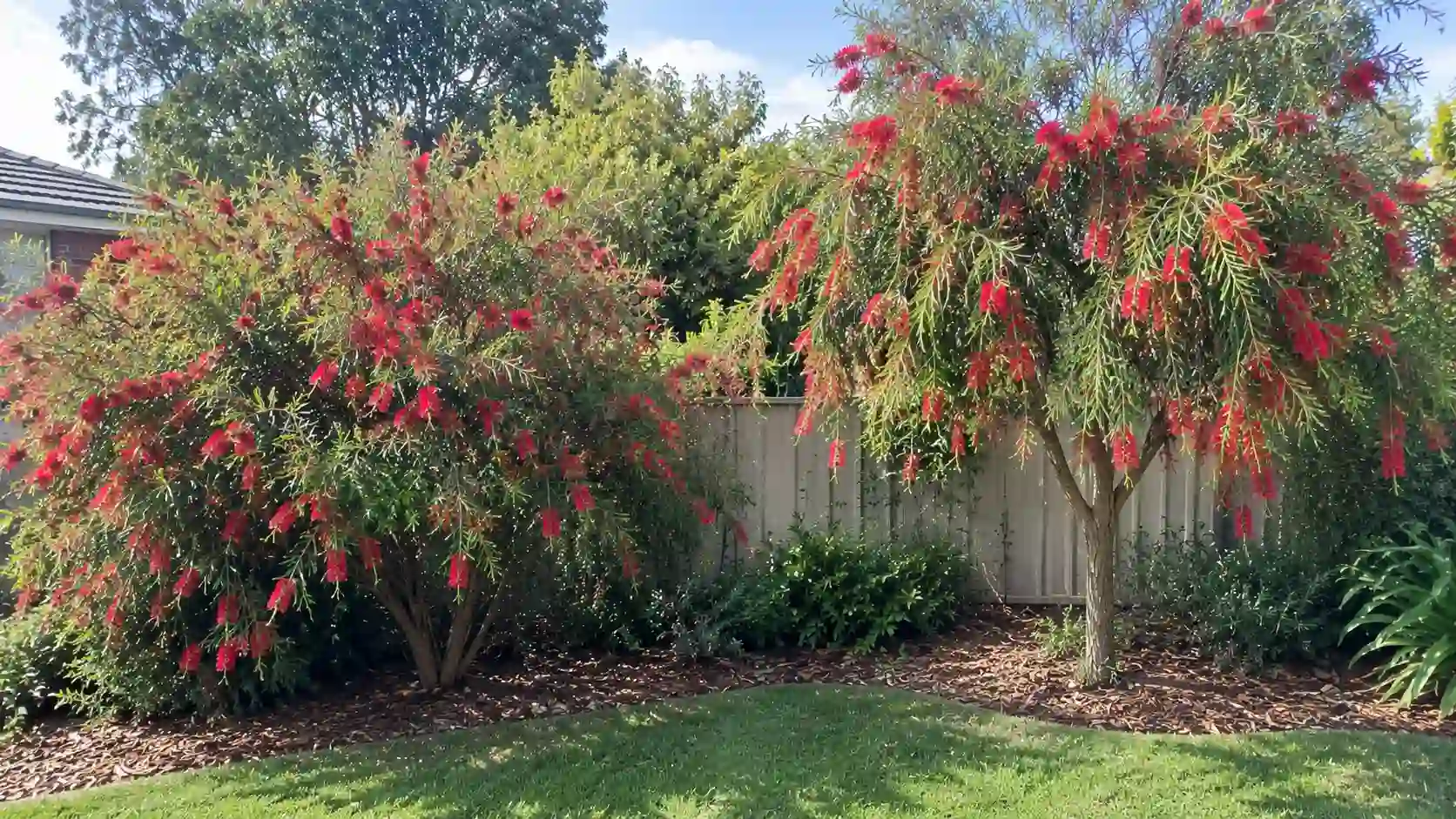
Most bottlebrushes are shrubs, but some become genuine small trees. Callistemon viminalis is one of the clearest examples: it is typically a small tree with pendulous foliage and can reach about 10 m in its natural habitat, although cultivated plants are often smaller. Callistemon salignus, the willow bottlebrush, is also recognised as a small tree, with Australian references giving mature heights from roughly 5 to 12 m depending on conditions.
The final form also depends on training. A young plant can be developed towards a single trunk by retaining one strong leader and removing lower competing stems gradually. Callistemon sieberi, for example, is specifically noted as capable of being trained into a small tree in this way.
Callistemon or Melaleuca? Which name is correct
You may see the same bottlebrush listed under both Callistemon and Melaleuca. The reason is taxonomic rather than a gardening difference. Some authorities have transferred Callistemon species into Melaleuca, while ANPSA follows the Australian Plant Census treatment and retains Callistemon as a separate genus. Kew’s Plants of the World Online currently treats Callistemon viminalis as a synonym of Melaleuca viminalis.
For Australian gardeners, nursery labels using Callistemon remain common, so both names can appear in plant searches and catalogues. Some state herbaria have moved bottlebrushes into Melaleuca, but the Australian Native Plants Society keeps Callistemon as a separate genus, which is why most plant labels still say Callistemon.
Bottlebrush tree vs bottlebrush bush
| Feature | Tree form | Bush form |
| Structure | One main trunk or trained leader | Multiple stems from the base |
| Height | Often 3–10 m depending on selection | Often under 5 m |
| Canopy | Raised crown | Dense from ground level |
| Pruning | Structural training may be needed | Mainly shaping and flower maintenance |
| Best use | Feature tree, street planting, larger garden | Hedge, screen, border or small garden |
Do not confuse an Australian bottlebrush with bottlebrush buckeye (Aesculus parviflora). They are unrelated plants.
Types of Bottlebrush Trees for Australian Gardens
The best tree-form choices are the weeping and willow types, together with selected cultivars bred or maintained at a manageable size.
| Species or cultivar | Form | Approx. mature size | Flower colour | Best fit |
| C. viminalis | Weeping small tree | Up to ~10 m naturally | Red | Warm-temperate to subtropical |
| ‘Dawson River Weeper’ | Weeping tree/shrub | Up to ~5 × 5 m | Dark crimson | Larger gardens |
| ‘Hannah Ray’ | Weeping shrub/small tree | ~4 × 2 m | Scarlet-red | Feature planting |
| C. salignus | Willow-like small tree | ~5–12 m | Cream/white; coloured forms exist | Temperate/subtropical |
| ‘Harkness’ | Small tree | ~3–4 × 2–3 m | Red | Smaller tree spaces |
| ‘Little John’ | Dwarf shrub | ~0.5–1 m | Red | Pots, borders and small gardens |
Australian National Botanic Gardens material lists C. viminalis cultivars such as ‘Dawson River Weeper’, ‘Hannah Ray’ and ‘Prolific’ as larger forms, while ‘Little John’ is a dwarf cultivar.
Callistemon colours
Bottlebrush flowers are not limited to the familiar bright red. Depending on species and cultivar, Australian gardens can contain red, crimson, cream, white, pink, mauve or purple flowers, with some yellowish or greenish forms.
That is why searches such as crimson bottlebrush, lemon bottlebrush, purple bottlebrush tree and pink bottlebrush can describe quite different plants rather than one standard species.
Dwarf and compact types
For a small garden, Callistemon ‘Little John’ is a much more realistic choice than forcing a true tree-form plant into a tight space. Plant Selector+ lists it at about 0.5–1 m high and wide, with full-sun flowering and moderate frost tolerance.
How Big Does a Bottlebrush Tree Grow, and How Fast?
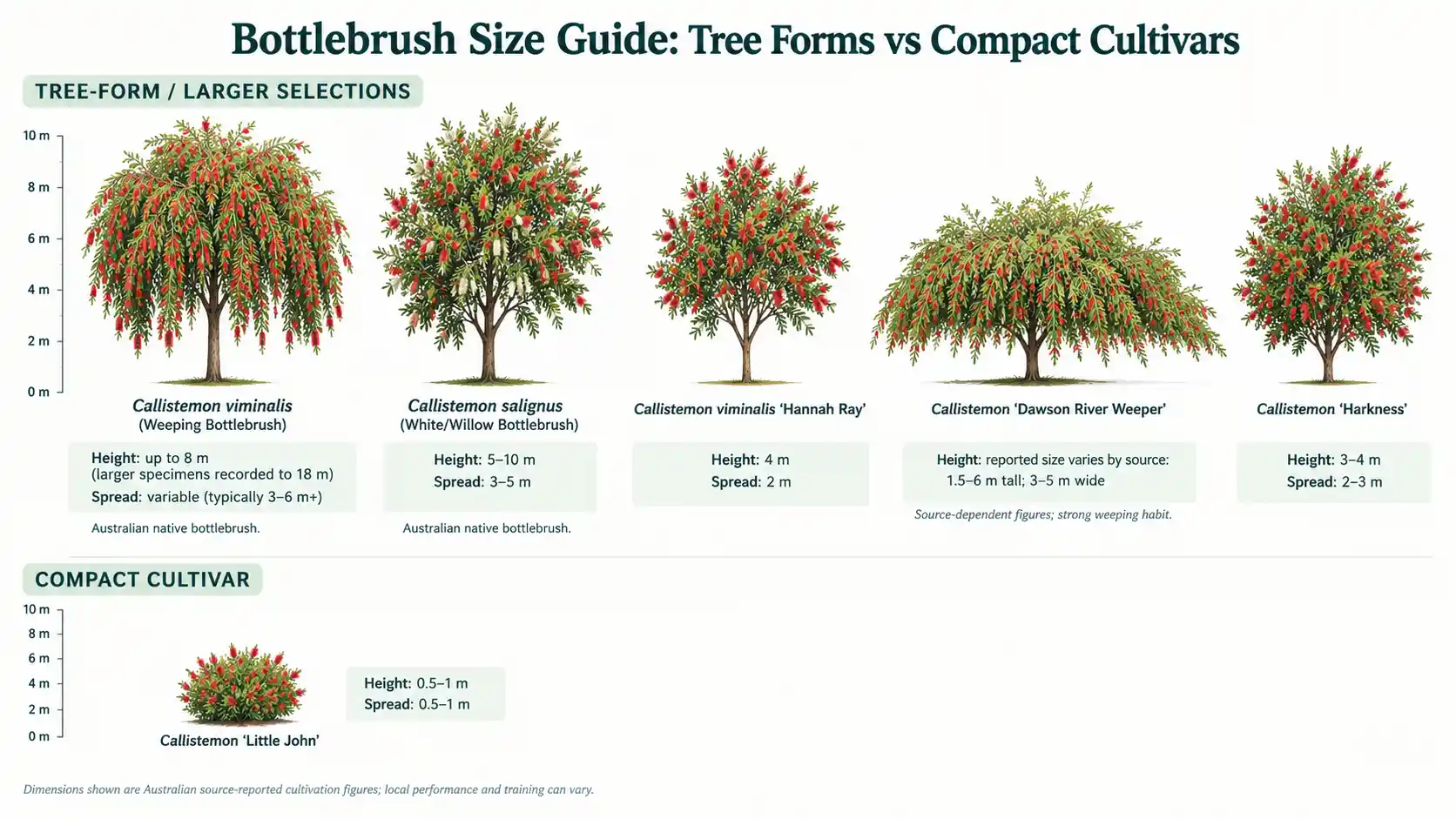
There is no single mature size for a bottlebrush tree. A cultivated weeping form might remain around 4–6 m, while C. viminalis can approach 10 m in favourable conditions, and willow bottlebrush can reach considerably higher. Published heights vary because species differ, and the Australian National Botanic Gardens gives 5–12 m for willow bottlebrush and 5–7 m for weeping bottlebrush.
| Size driver | Effect on mature growth |
| Cultivar | Often the biggest determinant |
| Climate | Warm, suitable climates can support stronger growth |
| Water | Reliable moisture during establishment improves growth |
| Soil | Good structure and drainage support healthy roots |
| Pruning | Can maintain a smaller canopy or alter its form |
Growth rate
Some bottlebrushes are genuinely quick-growing. Brisbane City Council describes bottlebrushes as quick growers, while Australian references for C. viminalis list individual cultivars ranging from compact shrubs to fast-growing small trees.
Spring is generally an important growth period, particularly when warmth, sunlight and moisture are available.
Lifespan
Burke’s Backyard describes bottlebrushes as long-lived and commonly capable of living for around 20–40 years under suitable climatic and growing conditions. Longevity varies with species, drainage, water stress, climate and general care.
Where Bottlebrush Trees Grow Best
Bottlebrushes generally perform best in a sunny position with reasonable drainage, although individual species differ considerably. C. viminalis naturally occurs in areas including eastern Queensland and north-eastern New South Wales and can tolerate dry periods once established, but frost can be a limiting factor.
| Australian setting | Useful direction |
| Tropical north | Choose warm-climate species and provide establishment water |
| Subtropical Brisbane | Many bottlebrushes perform well in sunny, moist but drained soil |
| Temperate Sydney | Weeping and willow forms are widely used |
| Cool-temperate Victoria/Tasmania | Check local frost performance before choosing a tall form |
| Tablelands | Frost tolerance becomes a major selection factor |
| Drier inland areas | Select drought-tolerant species/cultivars and irrigate during establishment |
Brisbane City Council lists bottlebrush among suitable medium shrubs for local gardens, while councils in New South Wales also use weeping and willow bottlebrush as street-tree selections.
Roots, spacing and siting
Bottlebrushes are not generally treated as one of Australia’s notorious invasive-root trees, and Central Coast Council specifically lists bottlebrush among plants considered suitable near sewer infrastructure. However, roots can still exploit leaking or accessible water sources, so planting location matters.
As a conservative household rule, allow about 3 m from a house for a developing tree unless local arboricultural or council guidance indicates otherwise. Campbelltown City Council uses 3 m as its general tree-planting guideline for houses.
Do not plant directly over underground services without checking their location first. Compact cultivars are much more practical for pots than large tree forms.
Advantages and disadvantages
Bottlebrushes can provide nectar for birds and insects, strong seasonal colour and useful screening. Councils and Australian gardening sources regularly identify bottlebrush as a wildlife-friendly native planting choice.
The trade-offs are mature size, woody seed capsules, occasional pest problems and the possibility of a sparse form when plants are grown in unsuitable light or left unmanaged.
When Do Bottlebrush Flower in Australia?
Most bottlebrushes flower mainly from spring into early summer, although flowering can extend into autumn and vary by species and climate. ANPSA records spring flowering for C. citrinus with a possible second autumn flush, while C. viminalis commonly flowers in spring and may flower again in autumn.
| Species/form | Main flush | Possible second flush |
| C. viminalis | Spring | Autumn |
| C. citrinus | Spring | Autumn |
| ‘Harkness’ | Spring | Autumn |
| Some cultivars | Spring–summer | Varies |
That means how many times a year a bottlebrush blooms depends on both genetics and growing conditions rather than a fixed number.
Why Isn’t My Bottlebrush Flowering?
Start with the simplest checks: light, pruning, age and nutrition. Bottlebrushes generally flower best in sun; excessive shade reduces flowering performance. Late or heavy pruning can also remove the developing shoots needed for the next display. ANPSA and Gardening Australia both recommend pruning after flowering rather than treating all natives as plants that should never be pruned.
| Symptom | Likely cause | Fix | Prevention |
| Lots of leaves, few flowers | Too much shade | Increase sun exposure where practical | Check site before planting |
| Flowers disappear after pruning | Pruned too hard/late | Wait for the next growth cycle | Prune after flowering |
| Young plant has no flowers | Immaturity | Give it time to establish | Buy a suitable mature cultivar |
| Very soft leafy growth | Excessive feeding, especially nitrogen | Reduce feeding | Use modest native-plant feeding |
| Plant stays sparse | Low light or poor growing conditions | Improve site and care | Match cultivar to location |
Bottlebrush Care Guide: Water, Feeding and Pruning
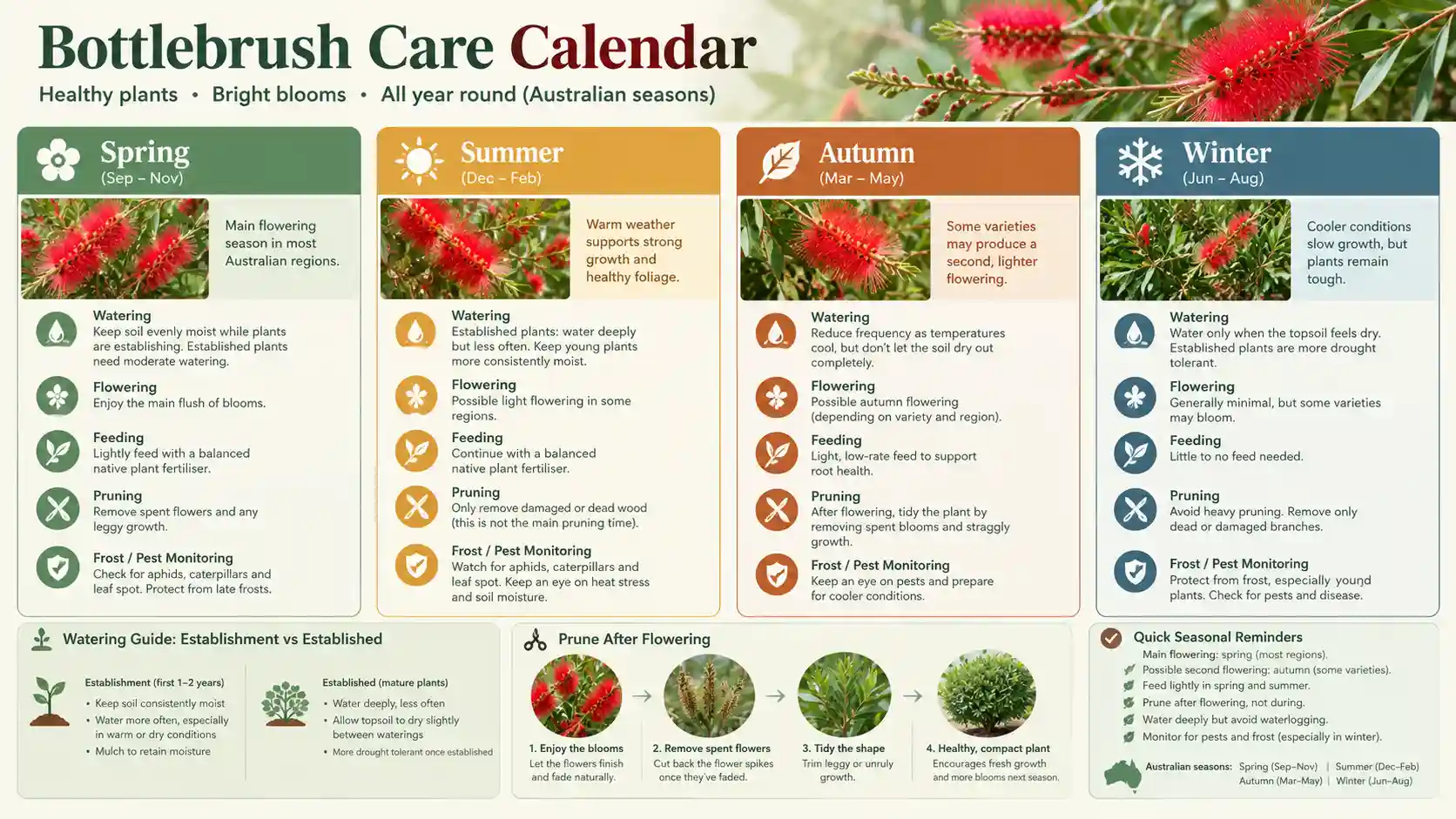
Bottlebrushes are tougher once established, but young plants need consistent moisture. Gardening Australia recommends a good soak less often rather than frequent light watering for establishing native plants.
Watering and soil
Aim for moist, well-drained soil during establishment rather than constantly wet roots. Several bottlebrush references note that many species tolerate less-than-perfect drainage but generally perform better when drainage is reasonable and water is available when needed.
For broader Australian soil and feeding guidance, see the Australian Garden Soil & Fertiliser Guide.
Best fertiliser for bottlebrushes
A native-plant fertiliser with modest phosphorus is a sensible default, particularly where the product is designed for Australian plants. Bottlebrushes are not as phosphorus-sensitive as some Proteaceae such as banksias and grevilleas, so avoid turning the low-phosphorus rule into an absolute prohibition on phosphorus.
Feed lightly after flowering rather than chasing rapid leafy growth.
Pruning
The safest general rule is light pruning after flowering. Gardening Australia specifically recommends trimming bottlebrushes after flowering, including cutting below spent flower stems to encourage fresh shoots and a fuller next display.
For a tree shape, establish the trunk gradually: retain the desired leader, remove competing basal stems and keep cuts clean. Avoid repeatedly hacking a tree-form plant back into old bare wood unless you are deliberately undertaking rejuvenation pruning.
For general diagnosis before cutting, our Plant Problems & Troubleshooting guide provides a broader symptom-to-cause framework.
| Season | Watering | Feeding | Pruning | Watch for |
| Spring | Increase as growth begins | Feed after flowering where appropriate | Light shaping after bloom | Main flowering |
| Summer | Deep watering in prolonged heat | Usually little extra feeding | Remove damaged growth only | Sawfly and heat stress |
| Autumn | Water as conditions require | Light post-flowering feed if due | Prune after a finished flush | Possible second flowering |
| Winter | Reduce unless dry | Usually minimal | Avoid unnecessary heavy pruning | Frost damage |
Common Bottlebrush Problems and How to Fix Them
Common issues include sawfly damage, yellowing leaves, dieback and a sparse or leggy habit. The first step is diagnosis rather than immediately reaching for a spray. Our Garden Pest Identification Guide for Australian Gardens can help distinguish chewing pests from other causes of leaf damage.
Sawfly larvae
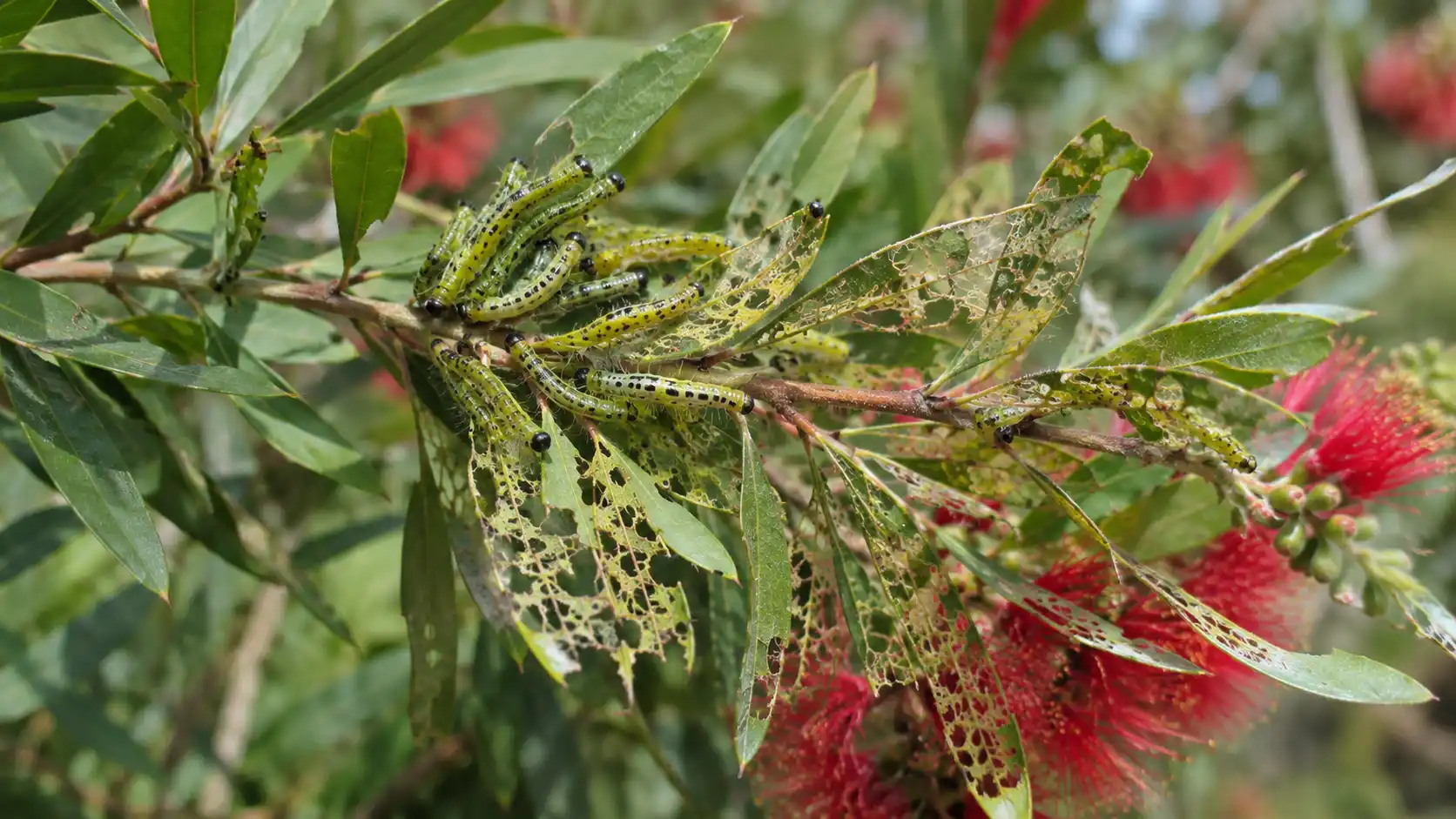
Sawfly larvae can skeletonise foliage and may appear in clusters. ANPSA notes that narrow-leaved C. pinifolius appears more resistant to sawfly attack than broader-leaved types. Narrow-leaved types such as pine-leaved bottlebrush seem more resistant to sawfly larvae than broad-leaved species.
If larvae are concentrated on small branchlets, Gardening Australia recommends carefully removing the affected growth and disposing of it rather than automatically spraying the whole plant.
Yellow leaves, dieback and leggy growth
Yellowing can follow excess moisture, root stress, poor nutrition or other environmental problems, while dieback deserves a closer inspection of drainage, damaged roots and branch health. A leggy plant is often a light and pruning problem rather than simply a fertiliser deficiency.
Growing More Bottlebrush: Cuttings or Seed?
For named bottlebrush cultivars, cuttings are the reliable option because they preserve the parent plant’s characteristics. Seed-grown plants can vary, particularly because bottlebrush cultivars may produce variable seedlings.
- Take firm, suitable current-season growth.
- Remove lower leaves.
- Place cuttings into a clean, free-draining propagation medium.
- Keep them evenly moist while roots develop.
Conclusion
A successful bottlebrush tree Australia planting starts with choosing the right form for your climate and available space. C. viminalis and C. salignus are genuine tree-form candidates, while cultivars such as ‘Little John’ suit smaller gardens. Give bottlebrush plenty of sun, establish it with deep watering, feed modestly and prune after flowering. Good drainage and early pest detection will help keep it productive for years.
FAQs
Do bottlebrush trees grow fast?
Some do. Brisbane City Council describes bottlebrushes as quick growers, but growth speed varies substantially between species, cultivars and growing conditions.
What is the lifespan of a bottlebrush tree?
Around 20–40 years is commonly cited under suitable conditions, although individual plants can vary with climate, drainage, water and general care.
How many times a year does a bottlebrush tree bloom?
Many flower mainly in spring and may produce another autumn flush. The exact pattern depends on species, cultivar, climate and pruning timing.
Is the bottle brush plant anti-mosquito?
Laboratory research has found repellent activity from C. viminalis essential oil, but that does not establish that planting bottlebrush repels mosquitoes around an Australian garden.
Do bottlebrush trees have deep roots?
Their root behaviour varies with site and species. They are not generally classed with highly invasive-rooted trees, but plant away from structures and underground services as a precaution.
Can bottle brush trees grow in pots?
Compact cultivars can. A true large tree form is generally unsuitable as a permanent container plant because its mature size and root requirements quickly exceed a normal pot.
Do bottlebrush trees need a lot of water?
Young plants need regular deep watering while establishing. Established bottlebrushes are generally tougher and can tolerate dry periods, depending on species and climate.
What are the disadvantages of bottle brush trees?
Potential drawbacks include mature size, spent woody capsules, sparse growth in poor light, frost sensitivity in some forms and pests such as sawfly larvae.
1 Comment