

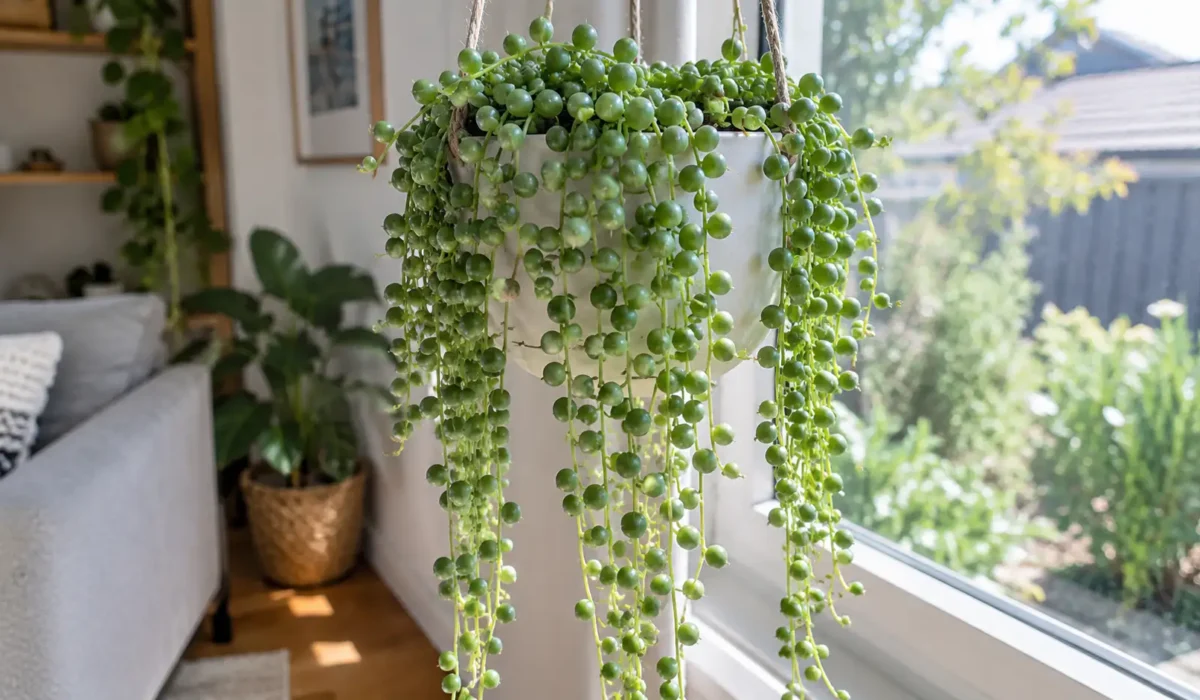
String of Pearls Plant Care Australia: Watering, Problems & Growing Guide
A string of pearls plant is a trailing succulent that is usually easy to keep once you get two things right: bright filtered light and a watering routine based on completely dry soil rather than a calendar. The plant’s current accepted botanical name is Curio rowleyanus, while Senecio rowleyanus is the older name you will still see on nursery labels and Australian retail listings. It is native to southern Africa and stores water in its distinctive pea-shaped leaves.
That matters because most failures are not caused by neglect. They happen when a gardener sees shrivelled pearls and keeps watering, when the pot stays wet for too long, or when an outdoor plant is exposed to harsh afternoon sun or cold conditions. The guide below takes the practical route: identify the symptom, narrow down the cause, fix the problem, then prevent it from returning.
Quick Summary
- Water only when the growing mix is fully dry. As a starting point, many Australian container plants need roughly every 1–2 weeks during warm active growth and about monthly in cooler conditions, but tropical humidity, rainfall, pot size and indoor conditions can change this substantially. Bunnings gives a similar warm-weather fortnightly/cool-weather monthly starting point.
- Shrivelled but firm green pearls usually point to dehydration; mushy, translucent or blackened pearls point toward rot. Check the soil and stems before adding more water.
- Bright filtered light is safest indoors, while gentle morning sun or part shade suits many Australian outdoor positions. Harsh direct afternoon sun can scorch the foliage.
- String of pearls is not a pet- or child-safe plant to eat. The plant is considered poisonous if ingested, and its sap can irritate skin. North Carolina Extension identifies pyrrolizidine alkaloids as the toxic principle and notes vomiting, diarrhoea and skin irritation among possible effects.
What Is a String of Pearls Plant?
String of pearls is a small, trailing succulent in the daisy family, Asteraceae. Its stems creep or trail while carrying small, rounded leaves that resemble green peas or pearls. The leaves have a translucent longitudinal area, often called an epidermal window, which allows light to penetrate into the leaf interior.
The plant can form a mat when growing along the ground and can also cascade from hanging baskets or containers. Australian nursery and retail descriptions commonly give a trailing length around 60–90 cm or more under good conditions, although the final display depends heavily on light, pruning, age and growing conditions.
Curio rowleyanus or Senecio rowleyanus — which name is correct?
Both names refer to the same plant, but Curio rowleyanus is the current accepted name.
The species was first described as Senecio rowleyanus by H. Jacobsen in 1968. Paul V. Heath published the combination Curio rowleyanus in 1999, and current Kew and IPNI records treat Curio rowleyanus as the accepted name and Senecio rowleyanus as a synonym.
For a general botanical overview, Curio rowleyanus on Wikipedia also records Senecio rowleyanus as the species’ former name and summarises its description, habitat and cultivation.
So what should Australian gardeners search for?
Use “Curio rowleyanus” when you want the current botanical name. Also search “Senecio rowleyanus” when buying plants, checking old care labels or comparing older horticultural references. Australian retailers still commonly use the older name; Plantmark, Bunnings and specialist nurseries all show examples of this naming overlap.
For a deeper explanation of why plant names change, our plant problems and troubleshooting guide is also useful when symptoms and labels become difficult to reconcile.
Native habitat and why it matters for your plant
Kew records Curio rowleyanus as native to the Cape Provinces of South Africa, while botanical descriptions place it in dry, rocky environments where it can grow in mats and among rocks or shrubs.
That background explains several of its care requirements.
The spherical leaves store water, so the plant can tolerate dry periods. At the same time, it is not adapted to sitting permanently in saturated potting mix. Its natural form also explains why bright light matters without meaning that a pot sitting in the strongest Australian afternoon sun is automatically ideal.
The leaves are small — generally around 5–8 mm across in botanical descriptions — and the trailing stems are thin and delicate.
Common String of Pearls Problems, Diagnosed
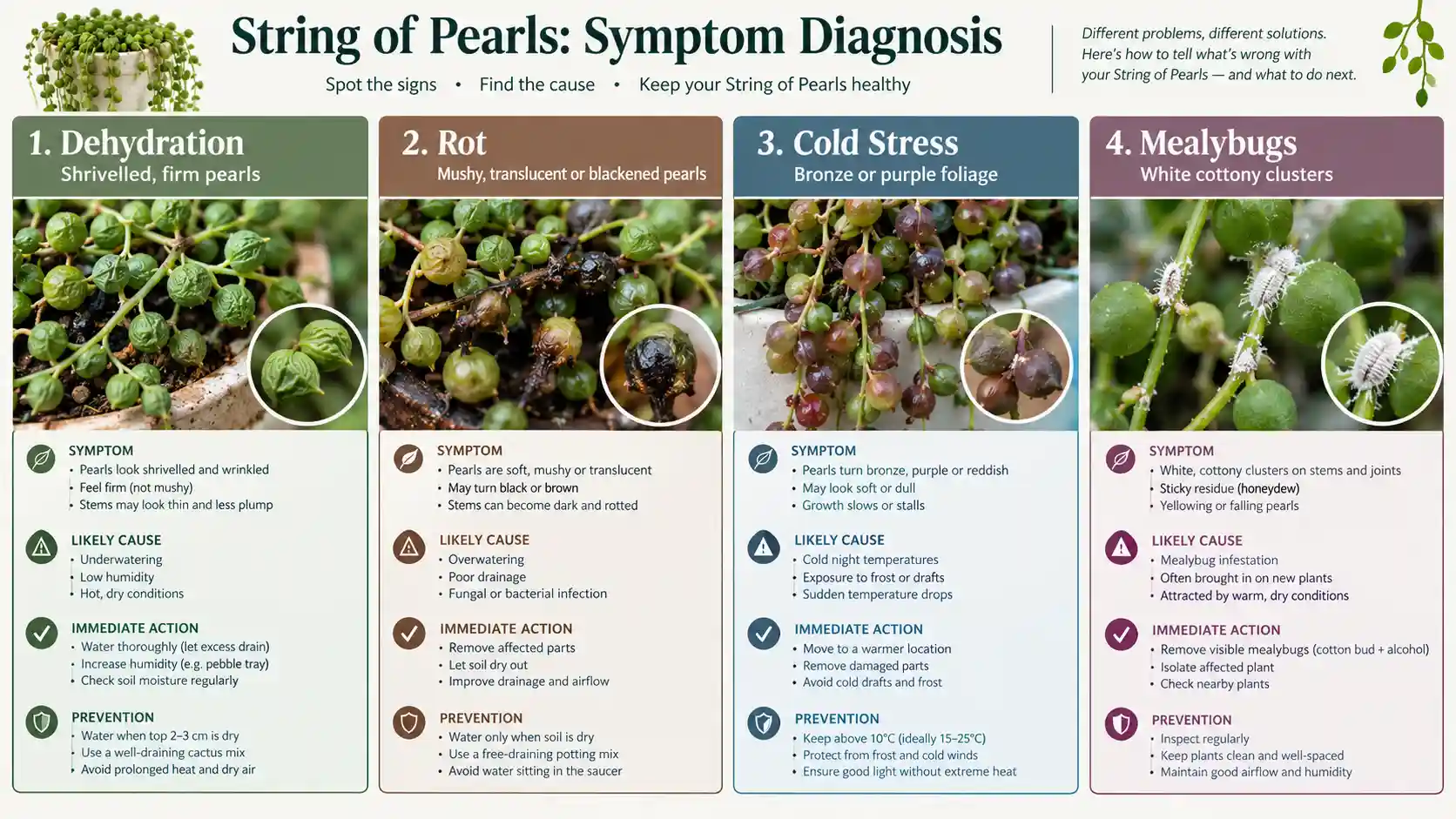
The quickest way to save a declining plant is to stop treating every shrivelled pearl as a request for more water.
| Symptom | Likely Cause | Fix | Prevention |
| Shrivelled, wrinkled, still green and firm | Underwatering/dehydration | Check that the mix is fully dry, then water thoroughly and let excess drain away | Check soil dryness before every watering |
| Mushy, blackened, translucent pearls or soft stems | Root/stem rot from excessive moisture or poor drainage | Remove the plant, cut away rotten tissue and re-root healthy sections if necessary | Free-draining mix, drainage holes and dry-down periods |
| Sudden pearl drop with little colour change | Physical disturbance, transplant stress, cold draught or root stress | Stabilise the plant and avoid further movement while checking soil and roots | Avoid repeatedly moving, repotting or disturbing the plant |
| Bronze, purple or reddish colour after a cold night, especially with soft patches | Cold stress or tissue damage | Move under cover, keep dry and remove dead tissue once damage is clear | Protect from frost and cold exposure |
| Fine white cottony clusters around joints and stems | Mealybugs | Isolate the plant, physically remove visible insects and use an appropriate labelled treatment | Inspect new plants before placing them with other houseplants |
The important distinction is between dry tissue and rotting tissue. Bunnings similarly warns that a shrivelled appearance can indicate a need for water while excessive moisture can cause the plant to decline.
LeafyHeaven’s broader Plant Problems & Troubleshooting guide uses the same diagnostic principle: soil condition and stem/root condition are often more informative than the symptom alone.
For mealybugs, our Garden Pest Identification Guide for Australian Gardens can help distinguish cottony mealybugs from other sap-sucking pests before treatment.
Watering by Australian Climate Zone
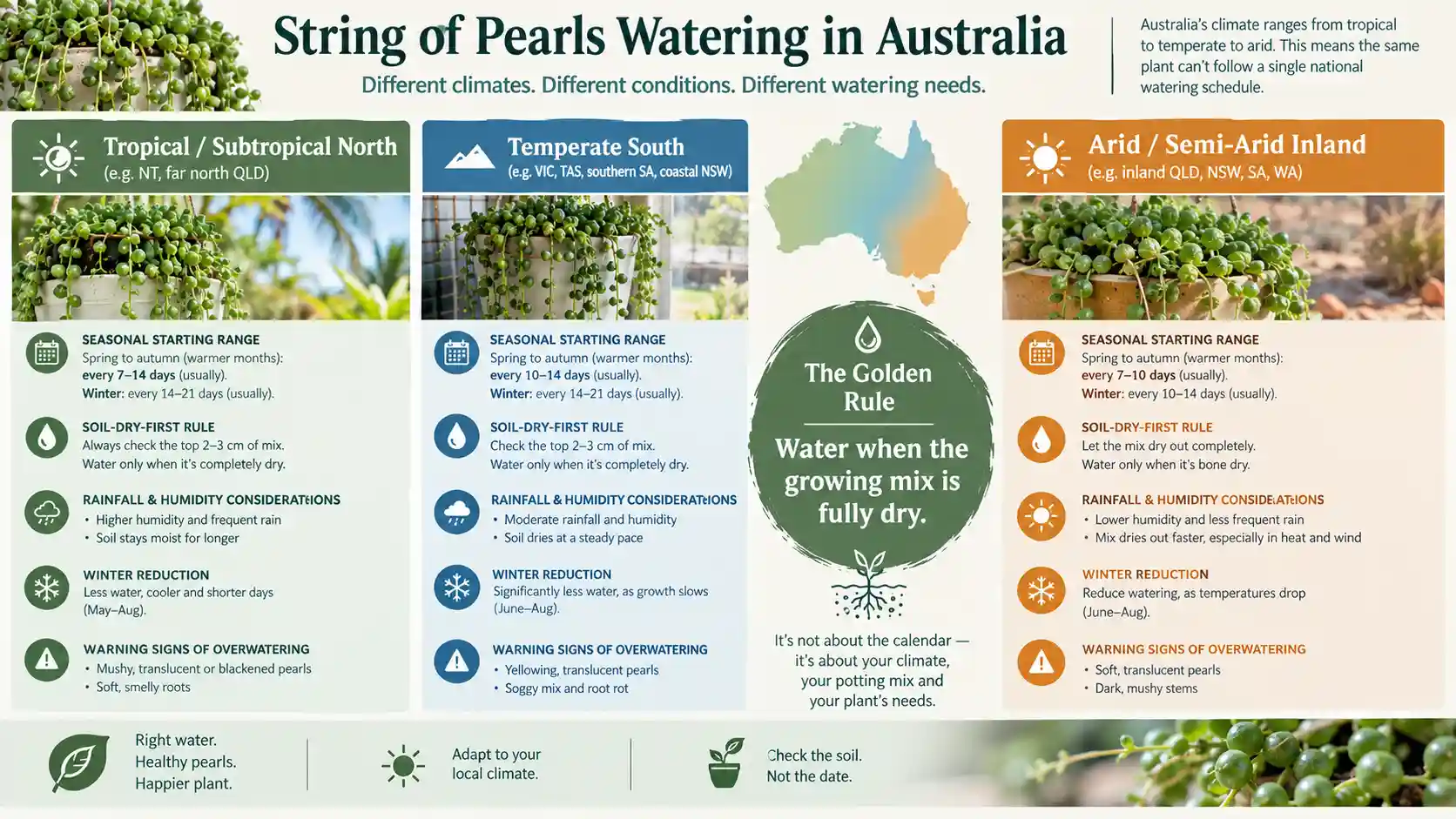
String of pearls care becomes much easier when you stop looking for one national watering calendar.
A plant hanging under cover in humid Brisbane is not drying at the same rate as one in an air-conditioned Melbourne room or a pot exposed to dry inland heat.
Seasonal/climate-zone table
| Australian conditions | Spring–summer starting point | Autumn–winter starting point | What to watch |
| Tropical/subtropical north, including much of Qld and northern NT/WA | Check frequently, but water only when the mix has dried; sheltered pots may need watering roughly every 1–2 weeks during active growth | Reduce sharply when growth slows; outdoor plants may need little supplemental water during wet periods | High humidity, rainfall, poor airflow and slow drying |
| Temperate southern areas, including southern NSW, VIC, SA and southern WA | Often around weekly to fortnightly depending on pot size, light and heat | Monthly or less can be enough in cool, low-growth periods | Cold, short daylight and wet soil |
| Arid/semi-arid inland | Check more frequently during extreme heat because small pots dry quickly | Reduce substantially during cool weather | Do not compensate for heat by watering soil that has not dried |
These are starting ranges, not rules. Bunnings recommends about fortnightly watering during warmer months and about monthly watering during cooler periods, while RHS recommends allowing the growing medium to dry between waterings and watering very sparingly in winter.
The correct question is therefore:
“Is the growing mix dry enough to water?”
—not:
“Is it Tuesday?”
That distinction is particularly important in humid parts of Queensland, where warm weather can tempt gardeners into frequent watering even though evaporation and root-zone drying are controlled by shade, airflow, rainfall and the potting mix.
Top or bottom watering?
Both methods can work.
With top watering, apply water slowly and thoroughly to the potting mix, then allow excess water to drain completely. Do not leave the pot sitting in a saucer of water.
Bottom watering can wet the root zone while keeping the crown and surface foliage relatively drier, but it is not a cure for poor drainage. If the mix remains saturated after bottom watering, the plant is still being overwatered.
The most useful method is therefore whichever makes it easiest for you to soak the root zone and then allow the mix to dry properly.
Quick underwatered-vs-overwatered check
- Underwatered: soil dry; pearls wrinkled but often still firm; stems remain reasonably firm.
- Overwatered/rotting: soil stays wet; pearls become soft or translucent; stems may darken or collapse; an unpleasant smell may develop.
- Cold damaged: discolouration or soft tissue may appear after exposure to unusually low temperatures even when watering has been correct.
Light, Soil & Position
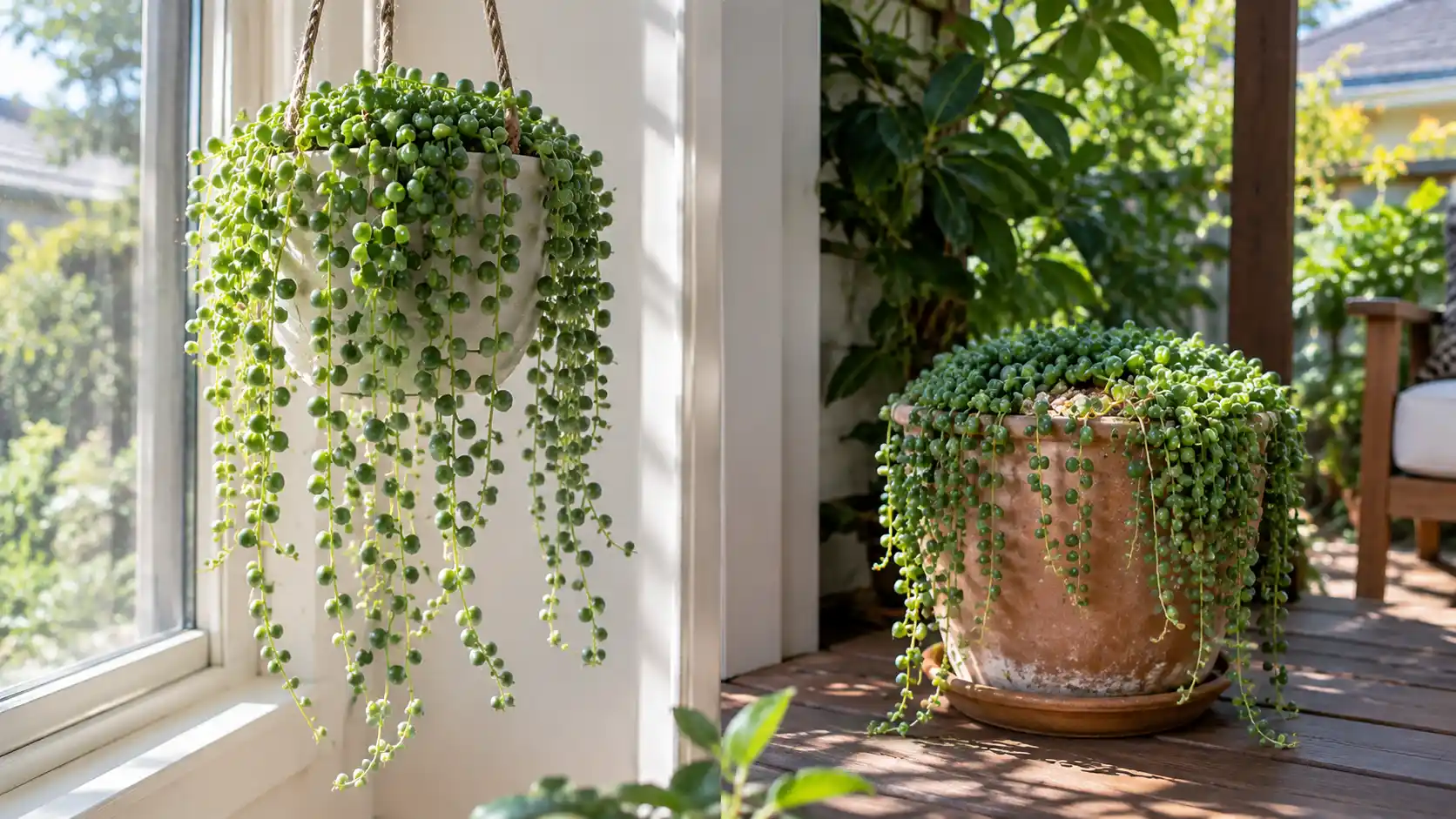
Light
Indoors, place string of pearls in bright filtered or indirect light. A bright window with protection from the strongest direct afternoon rays is generally easier to manage than a dark corner.
Outdoors, gentle morning sun and part shade are useful starting points. Bunnings notes that some direct sun is tolerated but excessive direct exposure can burn the plant.
A plant that continually produces long gaps between pearls and weak, stretched stems is usually asking for more light.
Soil
Use a fast-draining cactus or succulent mix rather than a heavy, moisture-retentive general potting mix. North Carolina Extension specifically recommends cactus mix or a potting mix amended with sand or perlite.
A practical container setup is:
- succulent/cactus potting mix;
- a gritty amendment such as coarse mineral material or perlite where needed;
- a pot with a genuine drainage hole.
Avoid decorative containers that have no drainage outlet unless the plant is still sitting in a removable nursery pot that can be taken out for watering.
Indoors vs outdoors in Australia
In frost-free or very mild warm areas, string of pearls can be grown outdoors in a sheltered position. In cooler inland, highland and frost-prone areas, container growing gives you much better control because the plant can be moved under cover during cold weather.
RHS classifies the plant as tender and advises protection from cold conditions; North Carolina Extension likewise describes it as frost-intolerant.
In practical Australian terms, treat nights around 7–10°C as a warning zone, with frost being a clear reason to move the plant under cover rather than testing its limits. The exact damage point varies with exposure, duration, plant condition and acclimatisation.
Repotting, Root-Bound Behaviour & Feeding
String of pearls can tolerate a relatively snug container, so there is no need to move it into a much larger pot simply because it has been in the same container for a while.
Repot when the roots have substantially filled the container, the mix has degraded, drainage has deteriorated, or the plant is clearly becoming restricted. For many healthy specimens, this may be only every couple of years rather than annually.
When repotting, the main goal is not a huge new pot. It is a fresh, free-draining growing medium with enough room for the existing root system to function.
Feeding should also be restrained. A dilute liquid fertiliser during active spring and summer growth is sufficient for most home-grown plants. Avoid heavy feeding when the plant is cold, dormant or already stressed by root problems.
Pruning & Getting a Leggy Plant to Fill Out
A leggy plant is usually a light problem before it is a pruning problem.
Move the plant into brighter filtered light, then trim excessively long or weak stems. Rather than throwing healthy cuttings away, lay suitable sections back onto the surface of the growing mix so nodes can make contact with the medium and root.
This lets you turn one thin trailing strand into several rooted sections over time.
Avoid cutting everything back at once. A more useful approach is gradual pruning and propagation while the plant is actively growing.
Is String of Pearls Safe Around Pets, Kids & Wildlife?
String of pearls should not be treated as an edible or pet-safe plant.
North Carolina Extension lists Curio rowleyanus as toxic to humans and pets and identifies pyrrolizidine alkaloids as the toxic principle; reported effects include gastrointestinal upset and irritation from the sap.
RHS likewise warns that its sap can irritate the skin and that the plant is poisonous if ingested.
The practical Australian household approach is straightforward:
Keep hanging baskets, trailing stems and fallen plant material away from curious toddlers, cats and dogs. Do not allow children or pets to chew the plant, and wear gloves when handling large amounts of damaged tissue if you are sensitive to plant sap.
For suspected ingestion, contact your veterinarian or an appropriate Australian poisons service rather than relying on an online plant-care article. The precise response depends on the person or animal involved, the amount consumed and symptoms.
Propagation: Growing New Plants From Cuttings
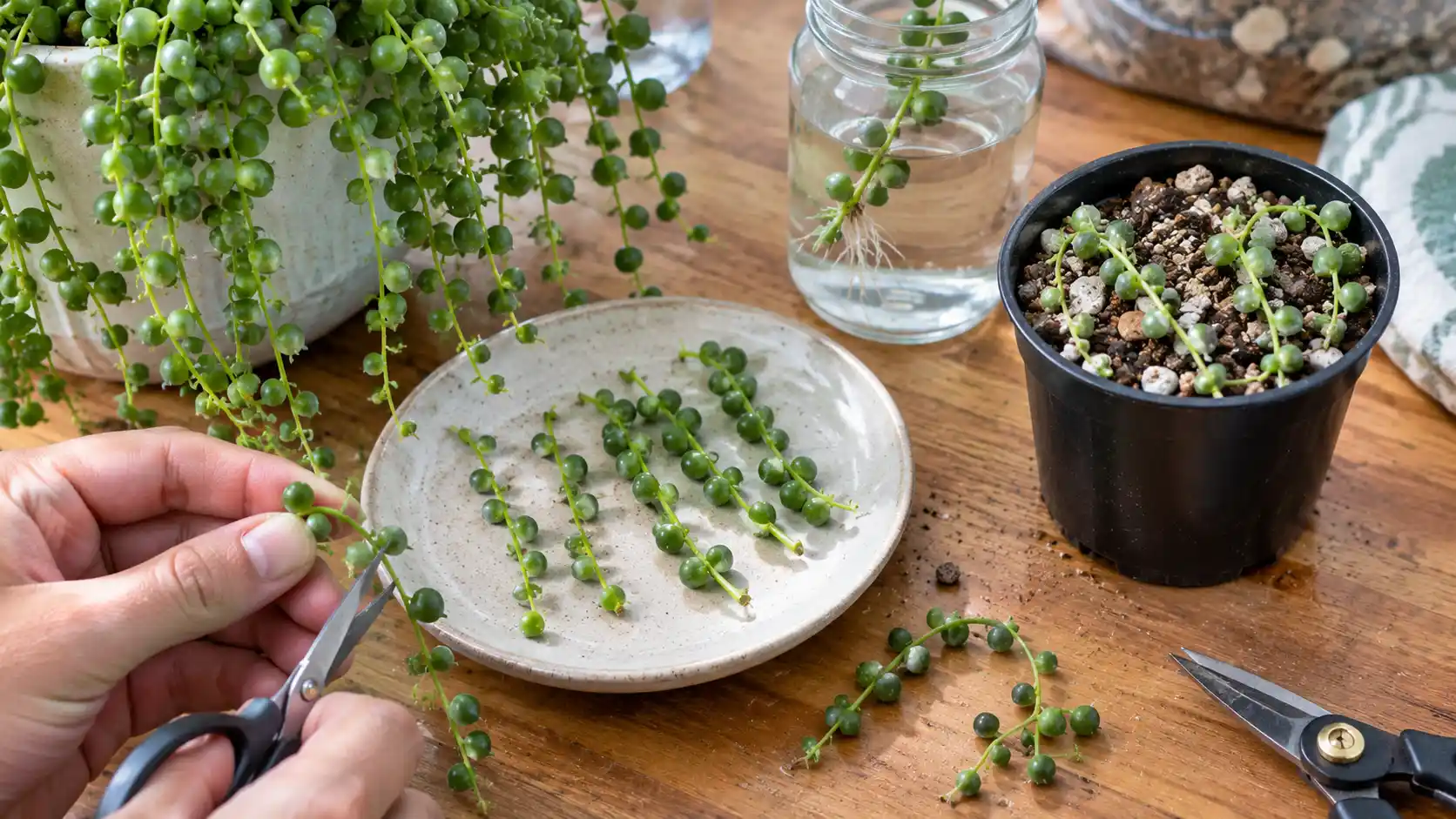
String of pearls is particularly useful for propagation because healthy stems can produce roots from nodes.
A straightforward soil method is:
- Take a healthy stem cutting.
- Remove enough lower pearls to expose several nodes.
- Allow the cut end to dry briefly — around 24–48 hours is a commonly used preparation period.
- Place the cutting onto or just into a free-draining succulent mix.
- Keep the medium lightly managed rather than continuously wet.
- Give the cutting warmth and bright filtered light.
Australian horticultural data from HortData records stem cuttings of roughly 50–100 mm with multiple nodes, a 24–48 hour callusing period, and rooting around 3–4 weeks under controlled nursery conditions. Home propagation can be slower or faster depending on season and temperature.
Bunnings also recommends stem cuttings planted directly into cactus and succulent mix.
Soil propagation is generally the simplest option for this succulent because it avoids repeatedly moving delicate new roots. Water propagation can make root development visible, but submerged succulent tissue also creates an easy environment for rot if conditions stay too wet.
A useful expectation is roughly 2–5 weeks for early root development under favourable conditions, rather than assuming every cutting roots on the same timetable.
Does String of Pearls Flower? What It Means
Yes. Healthy string of pearls can produce small white to cream flowers with a noticeable fragrance. RHS describes the flowers as white/cream and fragrant, while botanical descriptions record discoid flower heads.
Flowering is generally associated with good growing conditions and seasonal growth. Outdoors, the trigger is usually easier to achieve than in a dim indoor room.
The flowers are not a requirement for health.
A plant that never flowers indoors can still be completely healthy. Strong growth, firm green pearls, healthy roots and compact stems are more useful indicators than flowering alone.
String of Pearls Look-Alikes: How to Tell Them Apart
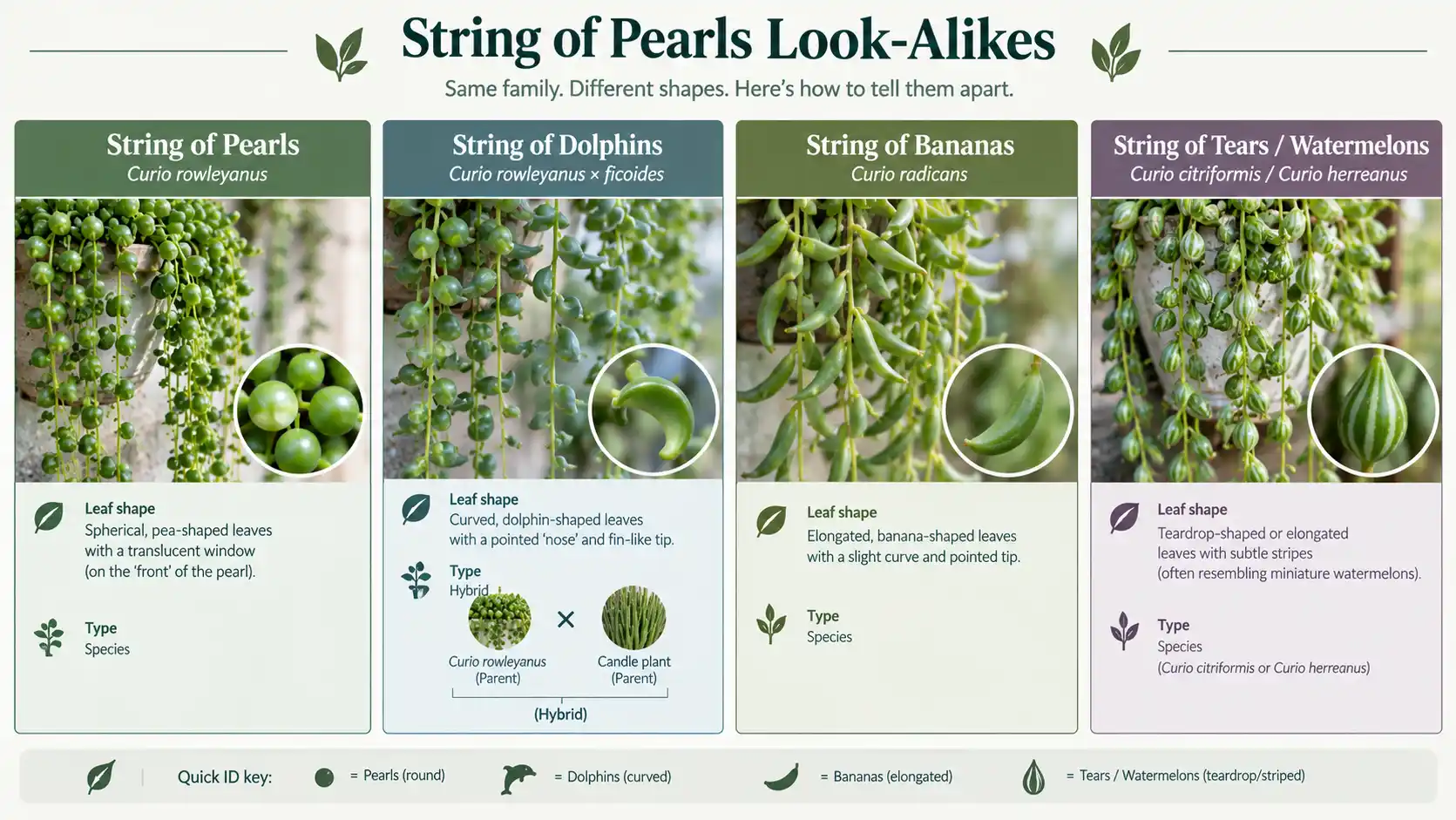
Several plants are sold under similar “string of” names, but their leaf shapes are noticeably different.
| Plant | Botanical name | Leaf shape | Parentage/origin | Key care difference |
| String of pearls | Curio rowleyanus | Spherical, pea-like | Species native to southern Africa | Needs excellent drainage and careful dry-down |
| String of dolphins | × Bacurio delphinatifolius; often sold under Curio × peregrinus or Senecio peregrinus | Curved, dolphin-like with pointed lobes | Hybrid involving Curio rowleyanus and the candle plant Curio/Baculellum articulatum | Treat as a trailing succulent; avoid assuming it is the same species as pearls |
| String of bananas | Curio radicans | Curved, elongated, banana-shaped | Separate southern African species | Similar succulent principles, but foliage is elongated rather than spherical |
| String of tears / watermelons | Curio citriformis / Curio herreanus | Teardrop/lemon-shaped or elongated with distinct markings | Separate southern African species | Similar bright-light, free-draining approach, but leaves are not spherical pearls |
Kew currently accepts Curio radicans, Curio citriformis and Curio herreanus as separate species.
The “dolphins” name is more complicated. Kew currently accepts the hybrid × Bacurio delphinatifolius, with Curio × peregrinus among its synonyms, and gives its hybrid formula as Baculellum articulatum × Curio rowleyanus.
That means nursery labels such as “Senecio peregrinus”, “Curio × peregrinus” and “String of Dolphins” can point to the same commonly traded hybrid rather than a separate natural species.
Is String of Pearls a Weed Risk in Australia?
This needs a measured distinction between naturalisation records, weed declaration and ordinary garden escape.
Older Australian horticultural references have included Senecio rowleyanus in discussions of introduced/naturalised Senecio taxa. However, an important limitation is that the currently accessible VicFlora record for the genus Senecio does not by itself establish that Curio rowleyanus is a currently declared or prohibited weed in Australia. VicFlora does, however, document naturalised introduced species within the broader genus.
So the practical message should not be “this is a major Australian weed”.
It is:
Do not deliberately release string-of-pearls cuttings into bushland, waterways or unmanaged areas.
The plant can root from stem sections where suitable nodes contact growing medium, so unwanted cuttings are better disposed of through an appropriate green-waste, composting or rubbish pathway than dumped outdoors.
This distinction matters. A record of naturalisation is not the same thing as a declaration that a species is prohibited, invasive or legally controlled everywhere in Australia.
Common Beginner Mistakes
- Watering on a fixed schedule: a calendar cannot see what is happening inside the pot. Check the mix first.
- Treating every shrivelled pearl with more water: dehydration is one possibility, but cold stress and root loss can produce similar symptoms.
- Using harsh afternoon sun: bright light is helpful; intense summer exposure through a western-facing position can scorch or dehydrate the plant.
- Using a pot with no drainage hole: this makes it much harder to recover from accidental overwatering.
- Repotting every time the plant looks unhappy: stressed plants usually benefit more from diagnosis than another move.
- Ignoring the roots: when foliage and watering history do not make sense, inspect the root and stem condition.
Conclusion
String of pearls is a relatively low-maintenance succulent once the fundamentals are matched to Australian conditions.
The most useful rule is simple: let the growing mix dry before watering again, provide bright but sensible light, and protect the plant from prolonged cold and frost.
When something goes wrong, diagnose before watering. Firm, wrinkled green pearls suggest dehydration; soft or translucent tissue with dark stems points much more strongly toward rot; cold exposure can create a completely different pattern; and cottony clusters around the stems suggest mealybugs.
The plant’s current accepted name, Curio rowleyanus, may be unfamiliar, but the older Senecio rowleyanus name remains extremely common in Australian nurseries. Once you understand both the name and the plant’s dry-climate biology, keeping a full, healthy cascade becomes considerably more predictable.
FAQs
1. How do you care for a string of pearls plant?
Give it bright filtered light, a free-draining succulent mix and a container with drainage holes. Water thoroughly only after the growing medium has dried, then allow excess water to drain away. Reduce watering during cooler periods.
2. Where is the best place to put a string of pearls?
Indoors, choose a bright position with filtered or indirect light. Outdoors in Australia, gentle morning sun or part shade is usually safer than harsh afternoon exposure. Protect it from frost and cold draughts.
3. How hard is it to keep string of pearls alive?
It is not inherently difficult, but it is less forgiving of constantly wet soil than many conventional houseplants. Most problems become easier to avoid once you stop watering automatically and start checking soil dryness and drainage.
4. How do you get string of pearls to fill out?
Give the plant adequate light, prune excessively long stems and place healthy cuttings back onto the growing medium so additional nodes can root. Repeating this during active growth can create a fuller surface.
5. What are the common problems with string of pearls plants?
The main problems are underwatering, overwatering and rot, insufficient light, sun scorch, cold stress and mealybugs. A symptom table is more useful than assuming every problem has the same cause.
6. Should you water string of pearls from the top or bottom?
Either can work. The important part is that the root zone receives enough water and then has time to dry, while excess water drains away. Bottom watering is not a substitute for a free-draining mix.
7. Can you revive a dead or dying string of pearls?
Sometimes. If healthy stems remain, cut away rotted tissue and propagate the healthy sections. A plant with completely dead, collapsed stems and no viable tissue cannot be revived, but surviving cuttings may still produce new plants.
8. Do strings of pearls do better inside or outside in Australia?
Neither is universally better. Warm, frost-free outdoor conditions with suitable light can work very well, while indoor growing gives gardeners in Melbourne, Canberra, Adelaide Hills and other cooler areas much better control over temperature and winter protection.
9. Does string of pearls like to be root bound?
It tolerates a snug container and does not require frequent repotting. Repot when the roots have filled the pot, the mix has broken down or drainage has become poor rather than automatically increasing the pot size every year.
10. How do I know if my string of pearls is happy?
Look for firm, evenly coloured pearls, healthy trailing stems, good root condition, compact growth and no persistent wetness around the crown. New growth is a stronger sign of health than flowering alone.