
Grass Tree Australia: Species, Growth Rate, Care & Legal Guide
Is a grass tree Australia gardeners can grow reliably, and how do you stop one dying after planting? Grass trees are Australian-native Xanthorrhoea plants that grow slowly and are usually easiest to keep alive in full sun, sharply drained soil and a position where their roots will not be disturbed. The genus currently contains 28 accepted species, ranging from small trunkless plants to tree-like forms several metres tall. They are neither true grasses nor trees. The biggest garden risks are waterlogging, root disturbance during transplanting and Phytophthora dieback. Choosing a species suited to your region and buying legally sourced nursery stock matters more than feeding or watering heavily.
The older common name “black boy” still appears in historical and commercial material, but many people now regard it as offensive. This article uses grass tree, balga, or the botanical name instead.
Quick Summary
- Xanthorrhoea is an exclusively Australian genus with 28 currently accepted species; different species suit different parts of the country.
- Grass trees generally prefer sun, excellent drainage, low-nutrient conditions and minimal root disturbance.
- Mature plants can be difficult to transplant because their roots have important mycorrhizal relationships and are easily damaged.
- Do not assume a grass tree “needs fire” to survive. Fire can stimulate flowering in many species, but responses vary and some species can be damaged by intense or poorly timed burning.
- Wild collection is regulated differently in each Australian jurisdiction. Buy nursery stock from a legitimate source and keep any required tags or provenance documentation.
What Is a Grass Tree, and Is It Native to Australia?
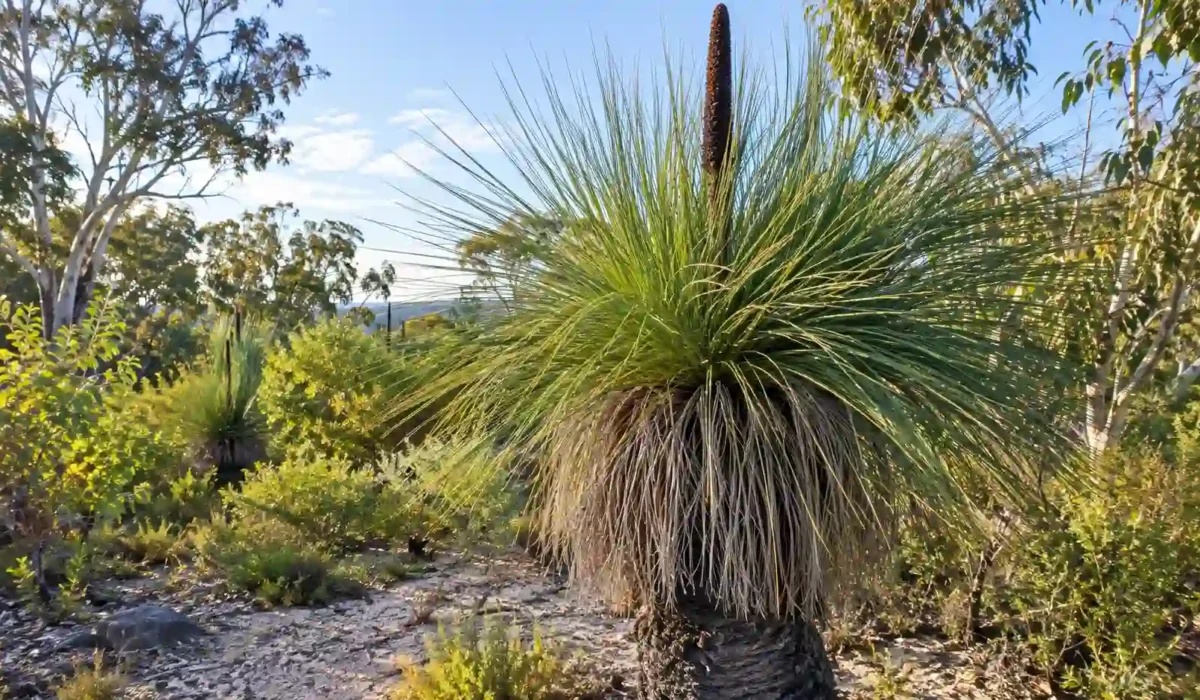
Yes. Grass trees are native only to Australia. They belong to the genus Xanthorrhoea, a group of flowering monocots in the family Asphodelaceae. Kew’s current Plants of the World Online treatment recognises 28 accepted species, with native distributions covering all Australian states and territories. Kew’s *Xanthorrhoea* taxonomic profile
They look like grasses because their leaves form dense crowns of long, narrow, stiff blades. Species that develop a trunk-like structure create it largely from old leaf bases held together by resin rather than by a conventional woody trunk. That is why a mature grass tree can look like a tree while remaining a monocot. The Botanic Gardens of Sydney likewise describes Xanthorrhoea as neither grass nor tree and notes that the plants occur across Australia.
The scientific spelling is Xanthorrhoea. Garden searches sometimes produce “xanthorea”, but that is simply a misspelling, not another genus.
Key facts
- Scientific genus: Xanthorrhoea
- Family: Asphodelaceae
- Native range: Australia only
- Accepted species: 28 in Kew’s current taxonomy
- Growth form: trunkless or tree-like, depending on species
- Leaves: long, narrow and grass-like
- Trunk: usually a mass of old leaf bases and resin in trunk-forming species
- Resin: produced by the plant and historically used by Aboriginal peoples for adhesives and other purposes
The exact species matters. “Grass tree” is a broad common name covering plants with very different natural distributions and growth forms.
Which Grass Tree Species Suit Which Australian Climates?
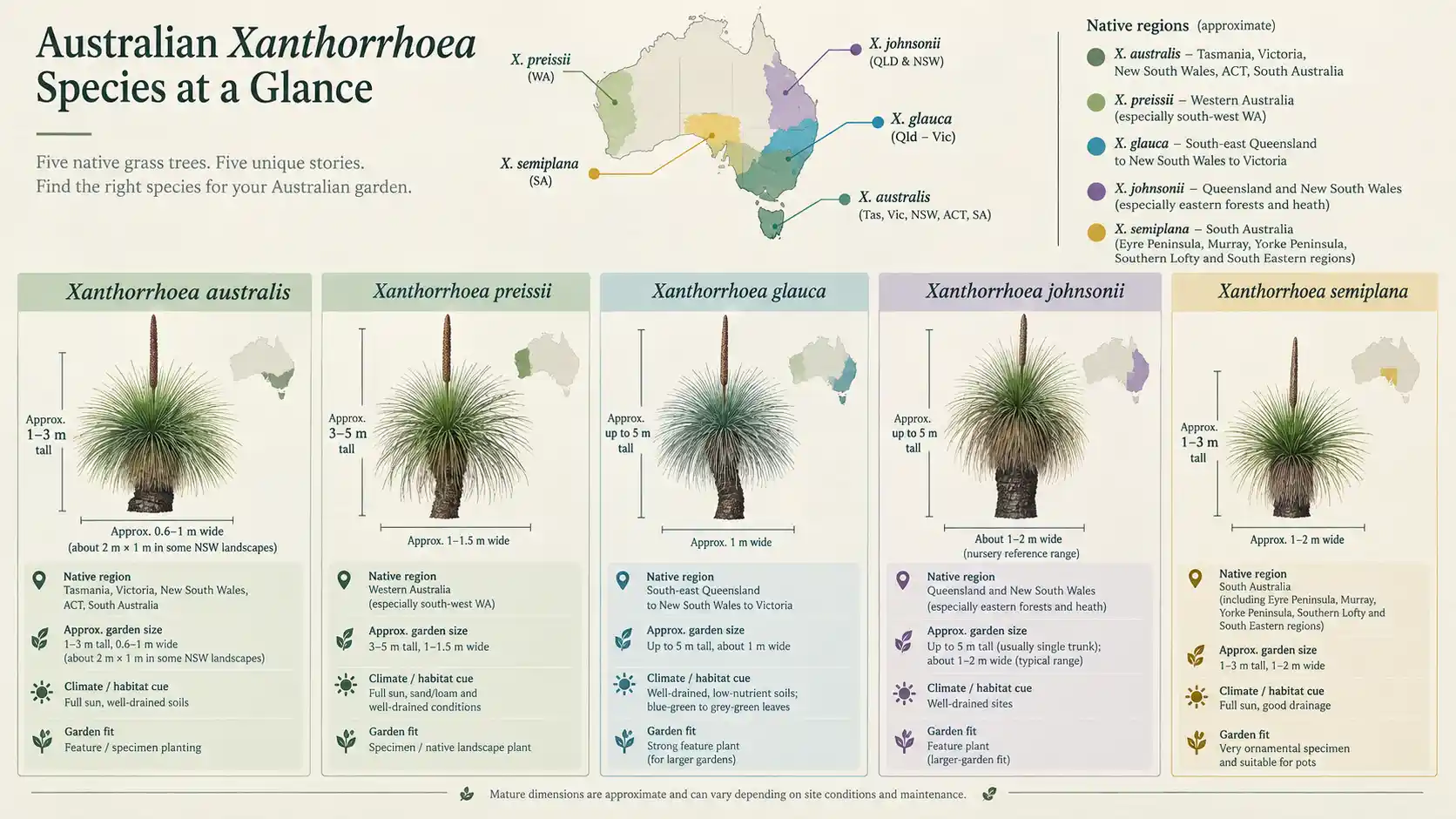
The safest approach is to match the species to its natural region rather than treating every grass tree as interchangeable. Xanthorrhoea australis, for example, is a south-eastern Australian species, while X. preissii is restricted to south-west Western Australia and X. johnsonii occurs naturally in Queensland and New South Wales.
For broader plant-selection planning, our Australian Plants Guide: Indoor Houseplants & Garden Design can be used alongside this species-specific advice.
| Species | Native range | Approximate mature size | Climate/garden fit | Pot suitability |
| Xanthorrhoea australis | NSW, Vic, SA, Tas. and ACT region | Up to about 3–4 m; form varies | South-eastern temperate, cool-temperate and suitable southern gardens | Possible when young or kept as a smaller specimen, but long-term root space matters |
| Xanthorrhoea preissii | South-west WA | Up to about 5 m; trunk can exceed 3 m | Perth and south-west WA; Mediterranean-type conditions | Possible when young; large mature specimens need substantial space |
| Xanthorrhoea glauca | Eastern Australia | About 5 m; commonly quoted around 1 m spread in cultivated references | Eastern Australia; well-drained sunny sites | Possible in a large, deep-draining container |
| Xanthorrhoea johnsonii | Qld and NSW | Around 5 m, with some nursery references giving greater potential | Warm-temperate to subtropical eastern Australia | Possible in large containers, particularly while young |
| Xanthorrhoea semiplana | South Australia and south-east Australia | About 1–3 m; 1–2 m spread for ssp. semiplana | South Australia and comparable southern conditions | One of the more practical species for container culture |
The size figures above should be treated as species-level guides rather than guaranteed garden dimensions. Plant form varies with age, soil, rainfall, fire history and whether a source describes the plant itself or the trunk plus crown. For example, the South Australian Plant Selector gives X. semiplana subsp. semiplana at about 1–3 m tall and 1–2 m wide, while its X. preissii entry gives 3–5 m tall and 1–1.5 m wide.
Kew describes X. preissii as a tree-like plant reaching up to 5 m and restricted to south-west Western Australia, while the Australian National Botanic Gardens describes X. glauca as a species of well-drained, low-nutrient soils and notes its fire-associated flowering response.
Species Comparison: Blue vs Southern vs Balga
Blue grass tree — Xanthorrhoea glauca
The blue/grey-green foliage is one of its most recognisable features. The Australian National Botanic Gardens describes leaves about 0.5–1 m long and a tree-like plant up to about 5 m tall.
Southern or Austral grass tree — Xanthorrhoea australis
This south-eastern species commonly develops a rough, sometimes branched trunk. Royal Botanic Gardens Victoria records stems up to 3 m and bluish, glaucous leaves, with flowering typically from July to December in Victoria.
Balga — Xanthorrhoea preissii
Balga is a south-west Western Australian grass tree. Kew describes a tree-like plant up to 5 m tall, with thick green leaves and trunks that can exceed 3 m.
Those differences matter more than labels such as “hardy grass tree”. A plant can be perfectly adapted to a dry Perth sandplain and still struggle in a poorly drained Brisbane clay garden.
How Fast Do Grass Trees Grow, and Why Do Sources Disagree?
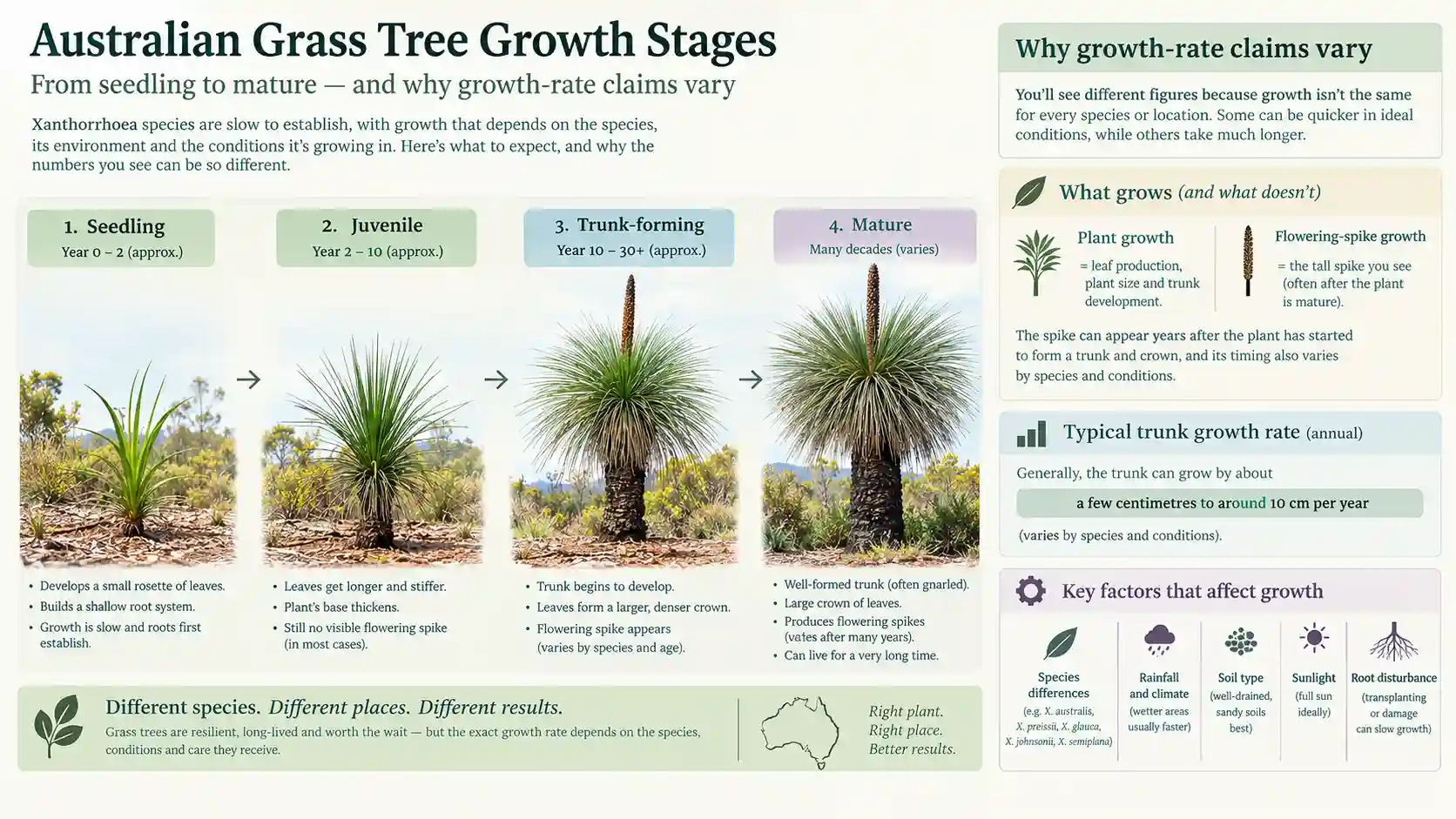
Grass trees are very slow growing, but there is no single universal annual growth rate. Bush Heritage Australia reports trunk-height increases in some tall species of roughly 0.8–6 cm per year, depending on environmental conditions. The Australian National Botanic Garden’s X. glauca profile gives a more specific figure of around 1–2 cm per year.
That explains why online claims ranging from about 1 cm to 2 cm, 3 cm or more per year can all appear plausible without necessarily referring to the same thing.
The variables include:
- species and genetic differences
- whether the plant is grown from seed or sold as established tubestock
- rainfall and irrigation
- soil drainage and aeration
- sunlight
- root disturbance
- whether the measurement refers to trunk growth, total plant height or flowering-spike growth
A commonly repeated claim that a grass tree may take roughly 20 years to form a visible trunk is plausible for some trunk-forming plants, but it should not be treated as a universal timetable. Gardening Australia has noted that some species take decades to develop a trunk and that others remain trunkless.
A practical growth timeline
| Stage | What you may see | What it means |
| Seedling | Small leaf rosette | Growth is slow but establishment is underway |
| Juvenile | Increasing leaf mass without obvious trunk | The plant may remain trunkless for years |
| Trunk-forming | Old leaf bases begin stacking above ground | Species and conditions allow an above-ground stem to develop |
| Mature | Large crown, trunk where characteristic, occasional tall flower spike | Final size remains strongly species- and site-dependent |
Some grass trees can live for hundreds of years. The National Arboretum Canberra notes several-hundred-year lifespans for X. glauca, while nursery and ecological sources similarly describe individual plants as extremely long-lived.
This is why “how old are grass trees?” cannot be answered reliably from trunk size alone. Trunk height is useful evidence, but age estimates require knowledge of species, growth conditions and historical disturbance.
For comparison, our Tuckeroo tree growth-rate guide illustrates why mature size and growth rate should be considered together when choosing a permanent Australian garden plant.
Fire, Black Trunks and Flower Spikes: What Actually Happens
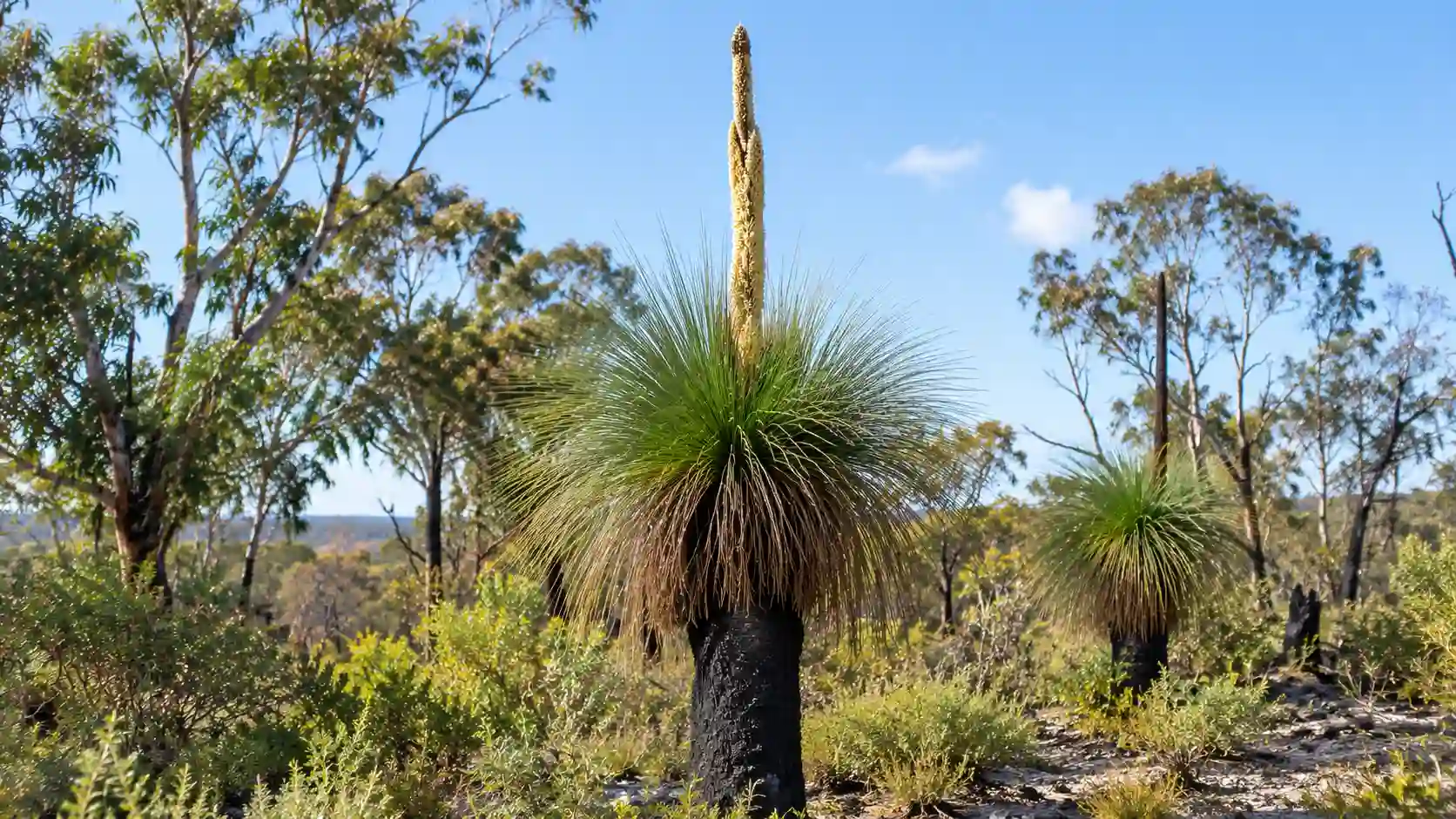
Grass trees are adapted to fire, but they do not simply “need fire to live”.
Fire can remove the old leaf skirt, blacken the trunk-like structure and stimulate flowering in many species. The protected growing point sits within the plant’s crown, helping some grass trees survive burns that would kill less fire-adapted plants. The Botanic Gardens of Sydney and Gardening Australia both describe fire-associated flowering and fire adaptation in Xanthorrhoea.
A black trunk does not automatically mean that a grass tree is dead. In natural populations, blackened outer tissue is often associated with previous fire. But a black or collapsing plant in a garden can also be a symptom of serious decline, so colour alone should never be used as a health diagnosis.
Flowering spikes can become spectacular features, often carrying masses of small cream or white flowers. They can attract nectar-feeding birds and insects; the Botanic Gardens of Sydney specifically notes invertebrates using grass-tree flowers, while NSW environmental information records honeyeaters, bees and other insects visiting flowers.
After flowering, the plant produces seed capsules. Whether flowering occurs every year varies by species and condition.
Myth-check: “Grass trees need fire”
Not as a gardening rule. A healthy grass tree does not require you to burn it. Fire is a natural ecological process that can stimulate flowering in some species, but responses differ. ANPSA’s Queensland growing notes, for example, report that X. latifolia can flower better after fire while X. glauca can actually be damaged by fire and may flower irregularly.
Do not deliberately burn a garden specimen simply to force a flower spike. Fire intensity, fuel load, weather, nearby structures and local fire regulations make that an inappropriate substitute for normal garden care.
Care Guide: Sun, Soil, Drainage and Pots
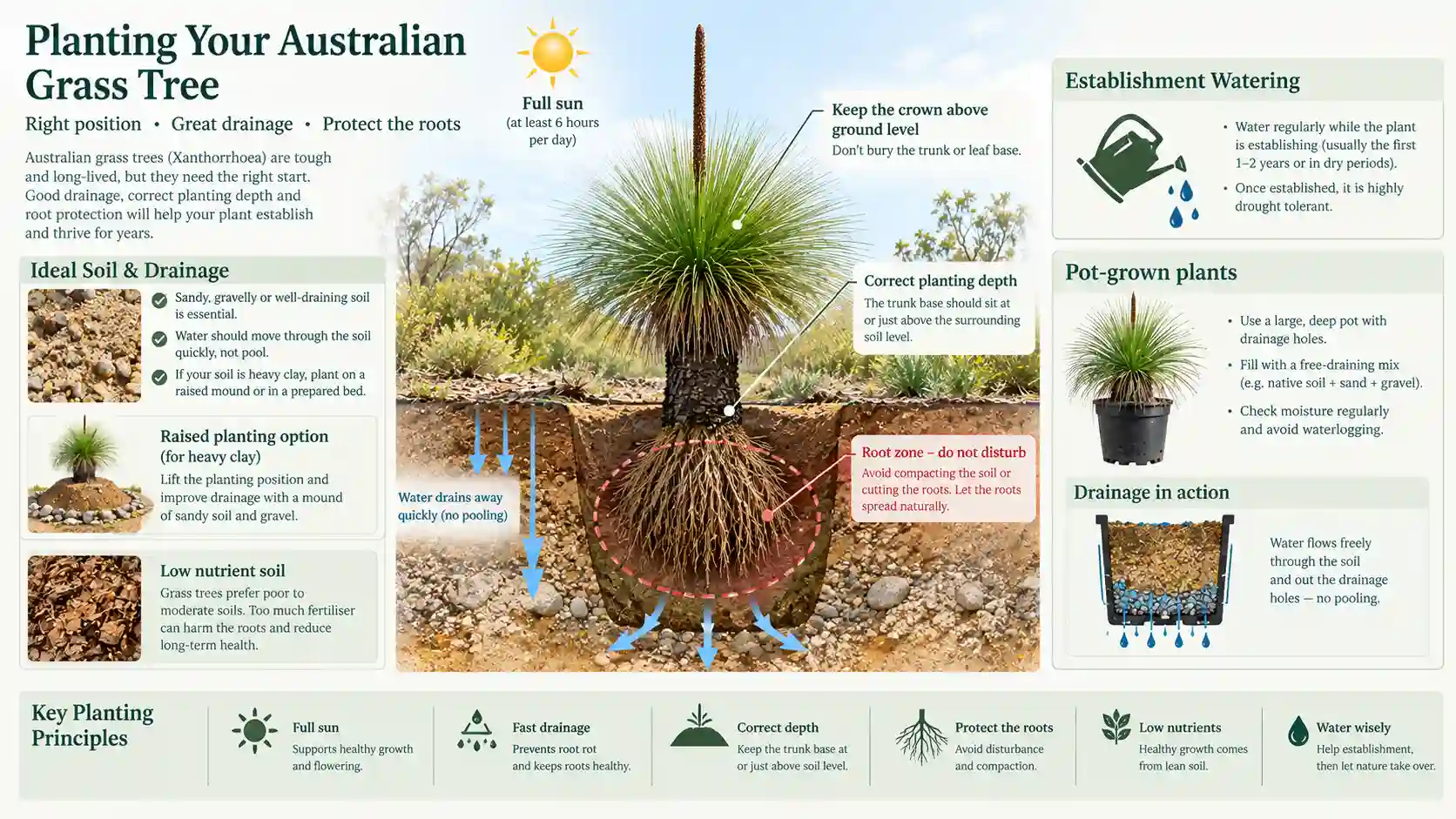
A grass tree’s basic requirements are surprisingly simple: sun, drainage, restrained watering after establishment and minimal root disturbance.
For soil preparation and Australian fertilising principles, Leafy Heaven’s Australian Garden Soil & Fertiliser Guide is a useful companion resource.
Light
Most commonly grown grass trees perform best in full sun, although some species can tolerate some dappled or partial shade. The South Australian Plant Selector lists X. australis, X. preissii and X. semiplana for full sun, while ANPSA notes that some Queensland species tolerate sun or dappled shade.
If a plant is gradually acclimatised to outdoor conditions, increasing exposure to direct sun is generally preferable to placing a sun-loving specimen permanently in heavy shade.
Soil and drainage
The critical word is drainage.
Natural grass-tree habitats commonly include sandy, rocky or otherwise well-aerated soils that are relatively low in nutrients. Gardening Australia recommends free-draining, low-nutrient soil, while the Australian National Botanic Gardens describes X. glauca as thriving in well-drained, aerated and low-nutrient soils.
Heavy clay is therefore a bigger challenge than poor soil fertility. On a clay site, improving drainage or planting on a raised, sharply draining mound can be more important than adding fertiliser.
Watering
Newly planted grass trees need enough water to establish, but constant wet soil is not a sign of good care.
A practical approach is to water deeply during establishment, then extend the interval as roots become established. The exact schedule depends on season, soil and rainfall. A plant in free-draining sand in a Perth summer will need a different approach from one planted into a cool Melbourne garden after winter rain.
Fertiliser
Grass trees generally do not need heavy feeding. Their natural adaptation to relatively nutrient-poor soils is one reason excessive fertiliser is unnecessary.
Avoid treating a slow-growing plant as though slow growth means nutrient deficiency. The Leafy Heaven soil and fertiliser guide explains why correcting the growing medium is more useful than automatically increasing fertiliser.
Grass tree in a pot
Container growing can work surprisingly well with suitable species. Gardening Australia notes that grass trees can be successfully grown in pots using a native potting soil with substantial sand for improved drainage.
Use a container with:
- ample drainage holes
- a free-draining Australian-native potting mix
- enough depth for long-term root development
- a position with strong light
- minimal repotting and root disturbance
The small grass tree Xanthorrhoea minor is particularly interesting for pots. ANPSA describes it as a trunkless, slow-growing plant that makes an excellent container specimen and can flower after several years from seed.
Planting and establishment
For an in-ground specimen:
- Select the final position before digging.
- Ensure water will not pool around the root zone.
- Handle the root ball carefully.
- Avoid unnecessary teasing, pruning or washing of roots.
- Plant at the appropriate depth rather than burying the crown.
- Water thoroughly to settle the soil.
- Keep competing weeds away while the plant establishes.
- Do not compensate for transplant stress with constant irrigation or heavy fertilising.
The key is plant once and disturb as little as possible.
Grass tree roots: deep or invasive?
There is no single “grass tree root depth” figure that can safely be applied to every species.
Grass trees have fibrous monocot root systems, and some species have contractile roots associated with downward movement of the plant’s growing point. Kew specifically documents contractile roots in X. preissii.
Land for Wildlife South East Queensland describes the roots as fibrous and notes that the growing apex can remain below the surface for long periods.
The important practical point is that grass-tree roots are sensitive rather than notorious for aggressive, invasive damage to structures. Do not trench through the root zone simply because the plant looks small above ground.
Why Grass Trees Die, and How to Fix It (Symptom-Diagnosis)
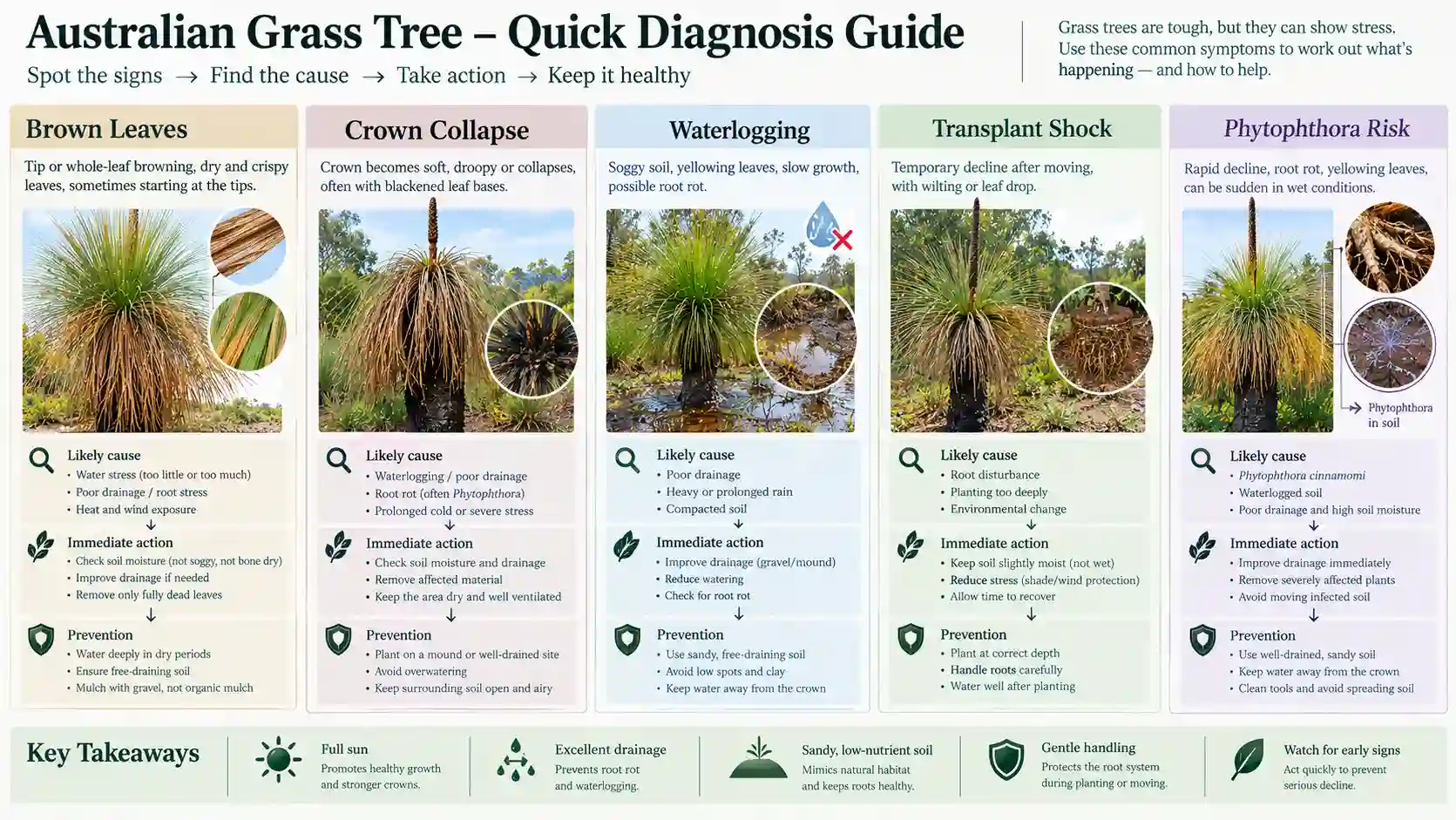
A grass tree that looks as though it has “suddenly died” may have been declining for months or even years. Gardening Australia notes that a grass tree can take up to two years to die after serious decline becomes apparent.
The most useful diagnostic approach is to look at the symptom, the growing conditions and the root zone together.
| Symptom | Likely cause | Fix | Prevention |
| Leaves gradually turn brown from the outside | Water stress, establishment stress or root damage | Check moisture and drainage before adding water | Plant correctly and avoid root disturbance |
| Leaves yellow and plant looks increasingly weak | Waterlogging, root failure or disease | Improve drainage; investigate roots and site history | Never leave the root zone saturated |
| Crown begins collapsing | Severe root stress, rot or dieback | Stop routine watering and investigate the root zone | Use free-draining soil and hygienic planting practices |
| Plant declines after moving | Transplant shock and root disturbance | Maintain sensible establishment care; avoid further disturbance | Buy appropriately grown nursery stock and plant it once |
| Base stays wet after rain | Poor drainage | Redirect water or improve the planting position | Choose a naturally draining site or use raised planting |
| Whole plant declines in a known dieback area | Possible Phytophthora cinnamomi | Seek specialist diagnosis; do not move contaminated soil around | Prevent contaminated soil and water movement |
Phytophthora dieback
This is one of the most important disease risks to understand.
Phytophthora cinnamomi is a soil-borne water mould that damages roots and can kill susceptible plants. WA’s Department of Biodiversity, Conservation and Attractions says more than 40% of native plant species in south-west WA are considered susceptible, including grass trees.
DBCA also explains that Phytophthora spreads through soil, water and infected roots, and that people can move infested soil from one place to another.
Tasmania has also documented severe impacts: NRE Tasmania reports that grass trees can collapse dramatically in P. cinnamomi-infested areas and that large numbers have died in affected parts of the state. In south-west Western Australia, Phytophthora cinnamomi is a serious threat to susceptible native vegetation, including grass trees, and the pathogen can be spread through contaminated soil and plant material. DBCA’s Phytophthora dieback guidance
This makes hygiene important. Avoid moving soil from a known dieback site into an unaffected garden, and be cautious about planting material of uncertain provenance.
Myth-check: Brown sugar
The brown-sugar treatment should not be presented as established science.
Gardening Australia has published the old recommendation of watering grass trees with brown sugar dissolved in water to stimulate mycorrhizal microbes.
That is evidence of the tip being published, not proof that the treatment reliably saves transplanted plants. I would therefore classify brown sugar as an unproven traditional gardening tip, not a treatment for transplant shock or Phytophthora.
Myth-check: “Any grass tree can be transplanted”
No. Mature grass trees are notoriously difficult to transplant because their root systems are sensitive and closely associated with mycorrhizal fungi. Bush Heritage Australia describes the chance of successful translocation as fraught, while Gardening Australia explains the importance of preserving the original root environment.
A legally sourced nursery-grown plant that has been raised for cultivation is a much safer proposition than trying to move an established wild specimen.
Pruning and Tidying
You generally do not need to “shape” a healthy grass tree like a conventional shrub.
Remove genuinely dead material when needed, but avoid cutting into the living crown or damaging the growing point. The hanging skirt of old leaves is part of the plant’s natural appearance and can also contain useful ecological information about fire history. Bush Heritage notes that skirt length can indicate the period since the last fire.
After flowering, leave the spike while it is still contributing to the plant’s seed cycle. Once it is completely spent, removal can be treated as a tidying choice rather than a routine health requirement.
Is It Legal to Dig Up or Buy a Grass Tree? (State-by-State)
The safest nationwide rule is simple: do not dig a grass tree from the bush for your garden.
The legal framework differs substantially between jurisdictions. Buying legitimate nursery stock is different from taking a wild plant, and some states regulate tagging, licensed harvesters, private-land collection or trade rather than banning every form of cultivated grass-tree sale.
| State/Territory | Current regulatory position | Permit/licence and tagging considerations |
| NSW | Xanthorrhoea species are listed in the state’s protected-plant licensing system. | Whole plants are Group 2: approved harvester or grower licence. Premium BHR tags apply to grass trees over 1 m; tags trace lawful origin. |
| Queensland | Native plants are protected under the Nature Conservation Act framework; additional restrictions apply to restricted plants and high-risk harvesting situations. | Restricted whole plants in trade have record, label and official-tag requirements. Do not assume an untagged wild specimen is lawful. |
| Victoria | Grass trees are declared protected flora, classified as restricted-use protected flora. | Permits can be required for take for sale or personal use, especially on public land; special conditions and tagging rules can apply to grass-tree trade. |
| South Australia | Native plant collection is regulated, especially on public land and where native vegetation is cleared or substantially damaged. | A permit is required for native-plant collection from public land; private-land collection still requires landowner consent and may be subject to native-vegetation clearance controls. |
| Western Australia | Flora taking on Crown land is licensed; private-land taking is subject to landowner permission and vegetation-clearing controls. | Commercial supply requires the appropriate flora licence. Threatened flora has additional controls. |
| Tasmania | Species-specific protection is important; Xanthorrhoea arenaria is Vulnerable and X. bracteata is Endangered under Tasmania’s threatened-species framework. | Permits are required to take listed threatened flora, regardless of land tenure; other public-land collection also has approval requirements. |
| ACT | Native plants are protected under the Nature Conservation Act 2014. | Licensing applies to specified activities involving native plants, including taking and selling; removing native plants from reserves is controlled. |
| Northern Territory | Native plants are regulated as protected wildlife under the Territory Parks and Wildlife framework. | A permit is required to take or interfere with wildlife, including plant harvesting; parks also prohibit taking plants without authority. |
The exact status of a plant can depend on species, land tenure, source and purpose of the collection, so this table should not be treated as a substitute for a regulator’s site-specific decision.
For a buyer, a sensible check is:
- ask what species you are buying
- ask whether it is nursery-grown, salvaged or wild-sourced
- check any required tag or trade label
- keep the invoice or provenance information
- be suspicious of a large “old” grass tree with no credible source history
This also helps explain why grass trees can be expensive. Slow growth means commercially sized plants take time, while legal sourcing and regulated trade add compliance and production costs.
Aboriginal Names and Traditional Uses
Grass trees have a long and diverse history of use by Aboriginal peoples across Australia. Names and practices vary by Country and language group, so they should not be presented as though one tradition applies uniformly across the continent.
The Botanic Gardens of Sydney records the cultural importance of grass trees and notes their use for weapons, implements and food.
The Australian National Botanic Gardens’ Aboriginal Plant Use resource records several uses, including:
- nectar collected from flowering spikes
- flower stems used as spear shafts and for fire-making implements
- resin collected from the plant and used as an adhesive
- edible parts of the leaf base and, in some regions, roots
The State Library of Queensland documents further examples, including the use of the flowering stem as a lightweight spear shaft, resin as glue or waterproofing material, and the flowering scape being soaked in water to make a sweet drink. It also documents continuing Wujal Wujal use of grass-tree resin in spear making.
A particularly important lesson is that these uses are place-specific cultural knowledge. Where Indigenous names are used, they should be tied to the relevant language group or Country rather than presented as a universal “Aboriginal name for grass tree”.
Conclusion
A grass tree can be an outstanding Australian garden specimen, but it rewards a different mindset from a fast-growing ornamental tree. Choose the species for your region, give it sun and exceptionally good drainage, water sensibly during establishment, and disturb the roots as little as possible.
The genus Xanthorrhoea is native only to Australia and currently contains 28 accepted species, so “grass tree Australia” is not one plant with one care schedule. X. australis suits a very different natural region from WA’s balga, X. preissii, while X. glauca, X. johnsonii and X. semiplana have their own geographic and horticultural characteristics.
The biggest practical mistakes are usually waterlogging, unnecessary root disturbance and poor sourcing, with Phytophthora adding a serious disease risk in susceptible landscapes. Buy legitimate nursery stock, retain its source documentation and plant it where you want it to stay.
FAQs
Are grass trees native to Australia?
Yes. Xanthorrhoea is an Australian-endemic genus: its natural range is Australia and nowhere else. Kew currently recognises 28 accepted species, distributed across Australia’s states and territories. Individual species have much narrower ranges, however, so a species native to south-west WA may not be the best choice for a different region.
How fast do grass trees grow?
Grass trees are very slow growing, but rates vary by species and conditions. Bush Heritage reports trunk growth of roughly 0.8–6 cm per year in some tall species, while the National Arboretum Canberra gives about 1–2 cm per year for X. glauca. A quoted growth rate should therefore always be tied to the species and measurement used.
Do grass trees like sun or shade?
Most commonly grown grass trees perform best in full sun, particularly when grown in well-drained soil. Some species tolerate dappled or partial shade, but heavy shade is generally a poor choice for a specimen selected for its strong architectural form. Local climate and the species’ natural habitat should guide the final position.
Should you cut the flower off a grass tree?
Not routinely. Flower spikes are part of the plant’s reproductive cycle and provide nectar for wildlife. Let a spike develop and finish naturally unless there is a specific reason to remove it. Once completely spent, cutting can be treated as a tidying decision, but avoid damaging the central growing crown.
Is it illegal to dig up grass trees?
In practice, you should not dig a wild grass tree for home planting. The legal rules differ by state, but Australia generally regulates native-flora collection, especially on public land, and several jurisdictions have specific controls on grass trees. NSW, Victoria, Queensland and the ACT all have current native-plant regulatory frameworks that can apply to grass-tree collection or trade.
How deep are the roots of a grass tree, and are they invasive?
There is no single root-depth measurement for every species. Grass trees have fibrous roots, and some species have contractile roots that change position as the plant develops. Their main garden concern is sensitivity to disturbance rather than a reputation for aggressively damaging infrastructure. Avoid trenching or repeated digging through the root zone.
What did Aboriginal people use grass trees for?
Uses varied by Country and language group. Authoritative Australian sources record nectar collection, spear shafts made from flower stems, resin used as an adhesive, fire-making implements and some edible plant parts. These practices should be described regionally rather than treated as one uniform Aboriginal tradition.
What kills grass trees?
Common serious problems include poor drainage, root disturbance after transplanting and Phytophthora cinnamomi dieback. A plant can also decline after environmental stress without showing an obvious problem immediately. In known dieback areas, preventing movement of contaminated soil and water is particularly important.