


Best Plants for Dry Shade in Australia: What Actually Grows Under Trees?
Introduction
The best plants for dry shade in Australia are those that tolerate limited sunlight, competing tree roots and periods of low soil moisture. Suitable options include Lomandra, Dianella, Australian Bugle, Kidney Weed, Clivia and Cast Iron Plant, depending on the local climate and how dry the soil becomes. Growing plants beneath established trees can be challenging because dense canopies restrict sunlight while extensive roots compete for available water and nutrients. However, the right combination of native ground covers, hardy foliage plants and shade-tolerant shrubs can transform these difficult areas into attractive garden spaces. The key is choosing plants that suit the actual conditions rather than trying to change the environment completely.
Quick Summary
- Best native options: Lomandra, Dianella, Slender Velvet-bush and Lomatia are worth considering for suitable Australian gardens.
- Best ground covers: Kidney Weed and Australian Bugle suit some dappled or dry-shade situations, while Native Violet prefers more consistent moisture.
- Best foliage plants: Clivia and Cast Iron Plant provide attractive foliage in sheltered shaded areas.
- Important consideration: Newly planted specimens still require regular watering while their roots establish.
- Best planting approach: Avoid disturbing major tree roots, improve conditions carefully and use mulch to help conserve moisture.
What Is Dry Shade and Why Is It Difficult for Plants?
Dry shade is an area that receives limited direct sunlight and has relatively little available soil moisture. It commonly occurs underneath mature evergreen trees, large eucalyptus trees and established ornamental trees with extensive root systems.
Unlike ordinary shade, where soil may remain reasonably moist, dry shade combines low light with competition for water.
Shade vs Dry Shade
Not all shaded garden areas have the same growing conditions.
| Growing condition | Characteristics | Planting difficulty |
|---|---|---|
| Light shade | Bright indirect light with occasional sunlight | Generally easier |
| Dappled shade | Sunlight filters through tree foliage | Suitable for many ground covers |
| Deep shade | Little or no direct sunlight | Limited plant selection |
| Dry shade | Shade combined with limited soil moisture | Particularly challenging |
Understanding the difference helps prevent a common mistake: choosing plants simply because their labels say they tolerate shade.
How Mature Tree Roots Compete for Water
Established trees have extensive root systems that absorb water and nutrients from surrounding soil. Smaller plants growing beneath them must compete for those resources.
This is particularly noticeable beneath eucalyptus, poinciana and other large established trees.
The problem can become more severe when the soil is compacted, rainfall is limited or the tree has a dense evergreen canopy.
How Tree Canopies Reduce Rainfall Reaching the Soil
Tree foliage intercepts some rainfall before it reaches the ground. Water can evaporate from leaves and branches, while other rainfall runs towards the canopy edges.
Consequently, the soil immediately beneath a mature tree may receive less effective rainfall than an exposed garden bed.
For practical examples of planting beneath established trees, see this Australian guide to planting beneath trees.
Best Ground Cover Plants for Dry Shade in Australia

Ground covers are useful when grass struggles beneath established trees. They can soften exposed soil, cover bare patches and create a more natural-looking garden.
However, not every shade-tolerant ground cover can tolerate prolonged dryness.
1. Kidney Weed (Dichondra repens)
Kidney Weed is a low-growing Australian native ground cover with rounded, kidney-shaped leaves. It can form a dense carpet in suitable shaded conditions, particularly where light is filtered through tree foliage.
Why consider it:
- Attractive, spreading foliage.
- Suitable for dappled shade.
- Useful as a lawn alternative in low-traffic areas.
- Native to Australia.
Growing consideration: It performs best where some soil moisture remains available. It is not a reliable choice for extremely dry ground without supplementary watering.
2. Australian Violet (Viola hederacea)
Australian Violet is a delicate native ground cover recognised by its rounded foliage and small purple-and-white flowers.
It can spread through suitable shaded garden areas and works particularly well in woodland-style planting.
Why consider it:
- Attractive flowering ground cover.
- Suitable for shaded garden beds.
- Provides a softer appearance beneath trees.
- Useful for filling spaces between larger plants.
Growing consideration: Australian Violet prefers moist, well-drained soil. Reserve it for shaded positions that receive occasional watering rather than severely dry root zones.
3. Australian Bugle (Ajuga australis)
Australian Bugle is a native perennial herb with attractive foliage and upright spikes of purple-blue flowers.
It is particularly useful for gardeners wanting a flowering ground cover rather than another foliage-only plant.
Why consider it:
- Tolerates semi-shaded positions.
- Can withstand extended dry periods once established.
- Produces attractive seasonal flowers.
- Suitable for naturalistic garden beds.
Growing consideration: It requires suitable drainage and some moisture during establishment. Its performance depends on local conditions.
4. Dwarf Mondo Grass (Ophiopogon japonicus)
Dwarf Mondo Grass is a compact, clumping ornamental ground cover with narrow, grass-like leaves.
Although it is not an Australian native, it is a useful option for structured planting around shaded garden edges and beneath suitable trees.
Why consider it:
- Compact, low-growing habit.
- Attractive evergreen foliage in suitable climates.
- Useful for edging and filling small spaces.
- Tolerates shaded conditions.
Growing consideration: It establishes more successfully in soil with some moisture and organic matter. Do not assume it will thrive in completely dry, compacted soil.
Best Native Plants for Growing Under Trees
Australian native plants can provide excellent options for difficult garden conditions. However, choosing species suited to the local climate and soil is more important than selecting a plant simply because it is native.
1. Lomandra (Lomandra longifolia)
<em>Lomandra longifolia</em>, commonly known as Spiny-headed Mat-rush, is one of the more versatile Australian native plants for challenging garden positions.
It produces clumps of long, narrow foliage and can grow in a range of light conditions, including dense shade.
Why consider it:
- Tolerates a range of growing conditions.
- Suitable for many Australian gardens.
- Provides attractive architectural foliage.
- Can cope with dry periods once established.
It is particularly useful for planting beneath large trees where lawn struggles to survive.
2. Dianella (Flax Lily)
Dianella is a group of Australian native plants valued for their strap-like foliage, flowers and decorative berries.
Different species and cultivars offer different growth habits, making them useful for ground-level planting and larger garden borders.
Why consider it:
- Several species tolerate partial shade.
- Attractive foliage throughout the year.
- Useful for naturalistic Australian landscaping.
- Some varieties tolerate dry conditions once established.
Choose a species suited to your region rather than assuming all Dianella varieties have identical requirements.
3. Rasp Fern (Doodia aspera)
Rasp Fern is an attractive Australian native fern with distinctive copper-coloured new growth that gradually develops into green foliage.
It can tolerate periods without rainfall, although it benefits from additional moisture during warm weather.
Why consider it:
- Attractive new foliage.
- Suitable for sheltered garden positions.
- Adds texture to native planting combinations.
- Provides a different appearance from conventional grasses and shrubs.
Growing consideration: This is a conditional choice rather than a plant for the driest possible shade. Provide supplementary moisture when conditions become particularly hot and dry.
4. Slender Velvet-bush (Lasiopetalum baueri)
Slender Velvet-bush is a low, spreading Australian native shrub with attractive foliage and pink flowers during spring.
It is particularly interesting for gardeners wanting a larger native plant beneath suitable established trees.
Why consider it:
- Naturally spreading growth habit.
- Attractive foliage.
- Seasonal pink flowers.
- Performs well in suitable dry-shade positions.
It is worth considering where you want something more substantial than a low-growing ground cover.
For more native plant ideas, explore our Australian native plants guide.
Best Shrubs and Larger Plants for Dry Shade
Some shaded garden areas need more structure than ground covers can provide. Larger foliage plants and shrubs can fill these spaces while creating different heights and textures.
1. Cast Iron Plant (Aspidistra elatior)
Cast Iron Plant is a hardy ornamental foliage plant known for its broad, dark-green leaves.
It is particularly useful in sheltered garden positions where many flowering plants struggle because of limited sunlight.
Why consider it:
- Tolerates deep shade.
- Attractive evergreen foliage.
- Suitable for sheltered planting.
- Relatively low maintenance once established.
Although it tolerates challenging light conditions, it still needs suitable soil moisture and drainage.
2. Clivia (Clivia spp.)
Clivias are attractive flowering plants with broad, strap-like leaves and clusters of orange, yellow or red-toned flowers, depending on the variety.
They are particularly useful beneath suitable evergreen trees where the garden receives limited direct sunlight.
Why consider them:
- Excellent foliage for shaded garden beds.
- Attractive seasonal flowers.
- Suitable for sheltered positions.
- Can tolerate relatively dry conditions once established.
Avoid exposing frost-sensitive varieties to severe cold, particularly in inland and elevated regions.
3. Lomatia (Lomatia silaifolia)
Lomatia silaifolia, commonly known as Parsley Bush, is an Australian native shrub with finely divided green foliage.
It can tolerate dry shade or full sun when grown in suitable, well-drained conditions.
Why consider it:
- Adaptable growing habit.
- Attractive divided foliage.
- Suitable for native garden designs.
- Can be pruned to maintain a denser appearance.
This is a useful choice for gardeners wanting something larger than a ground cover without planting a substantial tree.
4. Renga Renga Lily (Arthropodium cirratum)
Renga Renga Lily is a clumping ornamental perennial with broad, arching leaves and delicate white flowers.
It is particularly suitable for shaded garden borders and woodland-style planting.
Why consider it:
- Attractive foliage.
- Seasonal flowering.
- Suitable for sheltered garden positions.
- Useful for adding structure beneath larger plants.
It is best treated as an option for moderately dry or occasionally watered shade rather than extremely dry conditions.
Best Dry Shade Plants for Different Australian Climates
Australia’s climate varies considerably, so a plant that performs well in Brisbane may struggle in an exposed Melbourne or Adelaide garden.
Use local conditions, rather than city names alone, to guide plant selection.
| Australian region | Plants worth considering | Important consideration |
|---|---|---|
| Brisbane and subtropical gardens | Lomandra, Dianella, Clivia, Renga Renga Lily | Humidity, summer heat and drainage |
| Sydney and coastal gardens | Lomandra, Dianella, Australian Bugle, Slender Velvet-bush | Coastal exposure and variable rainfall |
| Melbourne and temperate gardens | Lomandra, Dianella, Clivia, Cast Iron Plant | Winter cold and frost exposure |
| Adelaide Hills and cooler regions | Lomandra, Dianella, Australian Bugle, suitable Lomatia | Frost, drainage and summer dryness |
These are starting points, not guaranteed planting combinations. Local species selection, aspect, frost exposure and the amount of available moisture will determine the final choice.
Brisbane and Subtropical Gardens
Brisbane gardeners can consider Lomandra, Dianella and Clivia for suitable shaded positions.
The main challenge is often combining summer heat with competition from established tree roots.
Choose plants with suitable drainage and provide additional water while they establish.
Sydney and Coastal Gardens
Sydney gardens can experience different conditions depending on whether they are close to the coast, inland or in elevated suburbs.
Lomandra, Dianella and Australian Bugle can be useful options where their moisture and drainage requirements are met.
Melbourne and Temperate Gardens
Melbourne gardeners should consider winter temperatures and frost exposure before selecting subtropical foliage plants.
Lomandra and suitable Dianella varieties can provide more adaptable options.
Adelaide Hills and Cooler Regions
In the Adelaide Hills, colder winter conditions and dry summers create additional challenges.
Choose locally suitable native species and consider frost protection for plants that are sensitive to cold.
How to Plant Successfully Under Established Trees
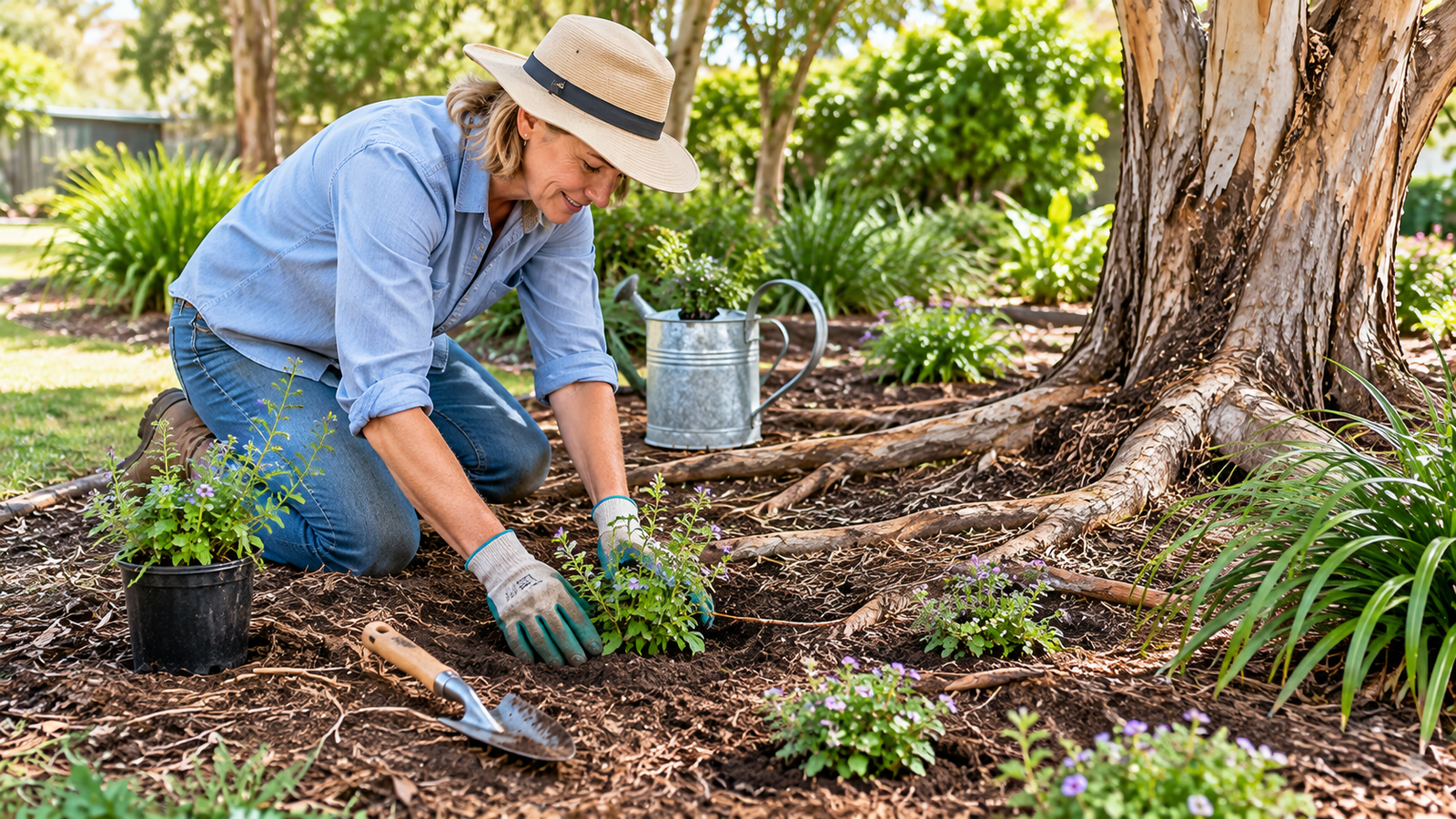
Choosing the right plant is only part of the process. The planting method can also influence whether new plants survive beneath established trees.
Avoid Damaging Major Tree Roots
Before digging, inspect the ground for visible surface roots.
Avoid cutting large roots or digging deep planting holes through the tree’s root zone. If major roots are present, choose smaller plants that can be fitted into existing spaces or use containers instead.
Where a mature or valuable tree is involved, seek advice from a qualified arborist before disturbing its root zone.
Improve Planting Conditions
Do not attempt to turn the entire area beneath a mature tree into a conventional garden bed.
Instead:
- Remove weeds carefully without disturbing major roots.
- Assess the existing soil and drainage.
- Add suitable organic matter only where it can be incorporated without damaging roots.
- Avoid raising the soil level significantly around the trunk.
- Select plants with compact root systems where possible.
For more detailed guidance on soil types and amendments, see our Australian Garden Soil & Fertiliser Guide.
Mulching and Watering
Mulch helps reduce moisture loss from the soil surface and can make shaded garden beds easier to maintain.
Use an appropriate organic mulch and keep it away from direct contact with the tree trunk and plant crowns.
New plants need regular watering while establishing. Even drought-tolerant species can fail if they are planted into dry soil and left without sufficient moisture.
Water deeply enough to moisten the new plant’s root zone, adjusting frequency according to rainfall, temperature and soil conditions.
Establishing New Plants
Start with a small number of plants rather than filling the entire area immediately.
Observe how they respond over the first growing season. If they establish successfully, gradually expand the planting using repeated groups of the same species.
This approach reduces unnecessary planting costs and helps identify which plants genuinely suit the microclimate.
Common Mistakes When Planting in Dry Shade
Even suitable plants can struggle when the growing conditions are misunderstood.
Common mistakes include:
- Choosing plants based on shade tolerance alone: A plant that likes shade may still require consistently moist soil.
- Ignoring tree root competition: Large trees can absorb available water before smaller plants establish.
- Planting too deeply: Deep planting holes can damage established roots.
- Adding excessive soil: Raising ground levels around mature trees can affect their health.
- Skipping establishment watering: Drought-tolerant plants still need moisture while developing new roots.
- Using unsuitable species: Plants selected for cool, moist gardens may struggle in hot, dry Australian conditions.
- Planting too many varieties: A simpler planting scheme often produces a more cohesive and manageable garden.
Understanding these problems before planting can save considerable time and money.
Frequently Asked Questions
1. What are the best plants for dry shade in Australia?
Lomandra, Dianella, Australian Bugle, Clivia and Cast Iron Plant are useful options, depending on local conditions. The best choice depends on soil moisture, light levels, climate and tree root competition.
2. What grows under trees where the soil is dry?
Plants such as Lomandra, Dianella and suitable Clivia varieties can grow beneath established trees where soil moisture is limited. They still need adequate watering while establishing.
3. Which Australian native plants tolerate dry shade?
Lomandra, Dianella, Slender Velvet-bush and Lomatia silaifolia are worth considering. Suitability varies between species and local growing conditions.
4. Can ground covers grow under large trees?
Yes. Kidney Weed and Australian Bugle can grow in suitable shaded conditions. However, very dry soil and dense root competition may limit establishment. Some ground covers need occasional supplementary watering.
5. How do you improve dry soil under established trees?
Start by reducing weed competition, checking drainage and applying suitable mulch. Avoid deep digging, cutting major roots or significantly raising the soil level around the tree.
6. What plants survive under eucalyptus trees?
Lomandra, Dianella, Correa and suitable native ground covers are worth considering beneath eucalyptus trees. Select species adapted to the local climate and provide additional water during establishment.
Final Thoughts
Finding the best plants for dry shade in Australia is about understanding the conditions beneath established trees rather than simply choosing plants labelled as shade-tolerant. Lomandra, Dianella, Australian Bugle, Clivia and other suitable species can help transform difficult garden spaces into attractive, low-maintenance planting areas.
Start by assessing the amount of sunlight, available soil moisture and competition from tree roots. Choose plants suited to your region, avoid disturbing established roots and provide sufficient water while new plants establish.
With thoughtful selection and careful planting, even a challenging space beneath a mature tree can become a productive and attractive part of an Australian garden.