

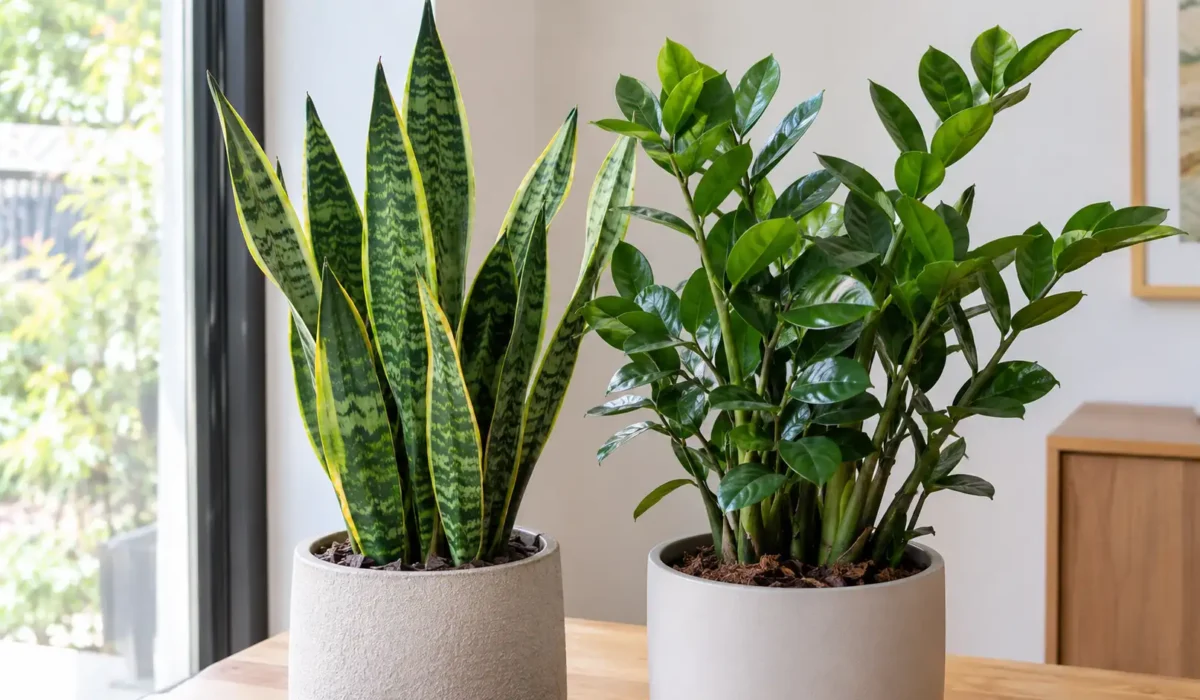
Snake Plant vs ZZ Plant: Which Is Better in Australia?
Snake plant vs ZZ plant: which is better for your Australian home? The snake plant (Dracaena trifasciata, formerly Sansevieria trifasciata) suits people who want upright, architectural foliage and a plant that tolerates dry conditions. The ZZ plant (Zamioculcas zamiifolia) is an excellent alternative for people who prefer glossy foliage and infrequent watering. Both tolerate lower indoor light, but neither thrives in complete darkness. Your best choice depends on the room’s natural light, winter temperatures, watering habits and whether pets or young children can reach the leaves.
Quick Summary
- Choose a snake plant for upright foliage, brighter indoor positions and a striking, narrow footprint.
- Choose a ZZ plant for a dimmer room and longer gaps between waterings, provided the plant remains warm and adequately lit.
- Keep both away from pets and young children who might chew them. Both can cause problems if eaten.
- Neither is a proven household air purifier. Correct watering, drainage and suitable placement matter more than advertised benefits.
Snake Plant vs ZZ Plant: Which Should You Choose?
For most beginners, either plant is a sensible choice. The ZZ plant has the advantage when watering is frequently forgotten, while the snake plant is better for someone who wants tall, upright leaves without a bulky canopy. Both are drought-tolerant, low-maintenance houseplants, but persistent wet soil can damage either plant.
The main structural difference explains their care requirements: snake plants store water in thick leaves, while ZZ plants store water in underground rhizomes. Both structures help the plants tolerate dry periods, but neither makes them immune to root rot.
Quick Decision Guide by Room and Household
| Situation | Best choice | Why |
| Bright north-facing room | Snake plant | Upright leaves create a strong architectural display. |
| Dim office with some natural light | ZZ plant | Tolerates low light and grows slowly. |
| Rental or small apartment | Either | Both suit containers and relatively simple care routines. |
| Home with curious pets | Neither within reach | Both are toxic if chewed or eaten. |
| Frequently forget to water | ZZ plant | Its water-storing rhizomes help it withstand dry periods. |
| Cool southern bedroom | Snake plant, cautiously | It is the more conservative choice, but still needs protection from cold draughts and chill. |
A windowless office needs special consideration: neither plant can remain healthy indefinitely without a usable light source. A suitable grow light is preferable to relying on ordinary room lighting.
For other room-by-room ideas, see Leafy Heaven’s Australian plants guide to indoor houseplants and garden design.
Side-by-Side Comparison
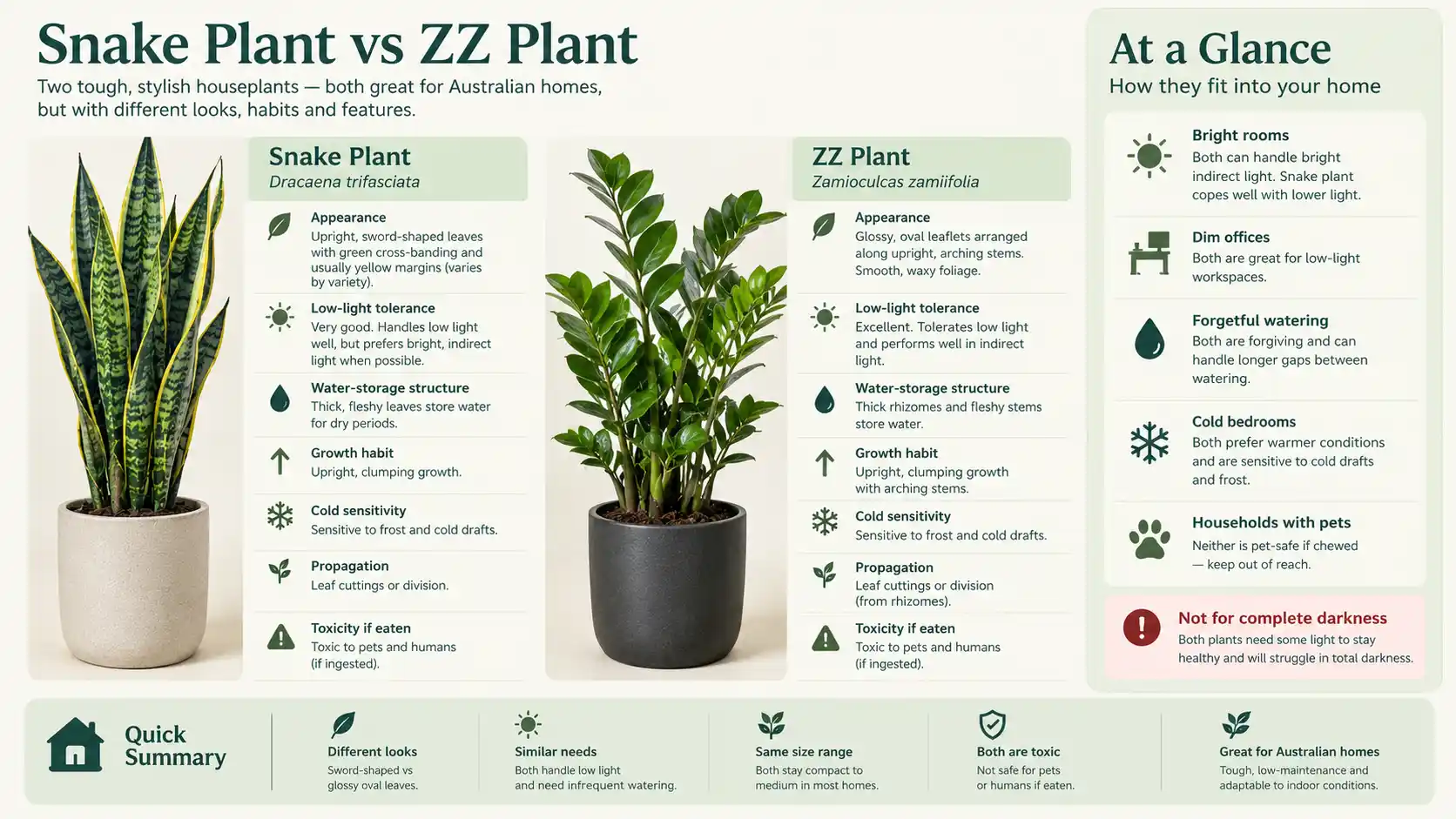
| Feature | Snake plant | ZZ plant |
| Botanical name | Dracaena trifasciata | Zamioculcas zamiifolia |
| Preferred light | Bright, indirect light; tolerates lower light | Bright, indirect light; tolerates very low light |
| Watering | Allow the mix to dry completely | Allow the mix to dry substantially through the root zone |
| Cold tolerance | Protect from prolonged cold and frost | Particularly important to protect from chilling and frost |
| Typical indoor height | Common forms can reach roughly 60–120 cm | Often around 45–90 cm, sometimes taller |
| Growth rate | Slow to moderate, depending on conditions | Generally slow |
| Toxicity | Saponins; harmful if eaten | Insoluble calcium oxalate crystals; irritating if chewed |
| Lifespan | Can live for many years with good care | Can live for many years with good care |
| Propagation | Division or leaf cuttings | Rhizome division or leaf cuttings |
| Typical cost | Varies by cultivar, pot size and retailer | Varies by cultivar, pot size and retailer |
The sizes above are useful planning estimates, not limits for every cultivar. The Royal Horticultural Society describes the snake plant as a clump-forming perennial that can reach around 1–1.5 metres, while North Carolina State Extension describes the ZZ plant as a slow grower that can reach around 60–120 cm tall and wide.
The snake plant is now commonly classified as Dracaena trifasciata. Kew recognises Sansevieria trifasciata as a synonym, explaining why both names remain common in nurseries and gardening articles.
For a broader overview of the genus and other indoor varieties, see Leafy Heaven’s Dracaena plant guide.
Which Copes Better With Low Light?
The ZZ plant generally has the advantage in a dim room, although both plants tolerate lower light than many popular indoor species. Low-light tolerance means survival, not necessarily strong growth. With insufficient light, either plant may produce little new growth; the ZZ can become stretched, while snake plants may gradually lose vigour.
There is no reliable universal lux threshold that establishes when one of these plants will outperform the other in every Australian home. Without matched light-meter readings and a controlled comparison, publishing an exact number would create false precision.
Instead, choose a position with natural daylight, even if it is indirect. Brighten the position gradually if growth becomes weak or stretched, and avoid moving a plant from deep shade directly into harsh summer sunshine. North Carolina State Extension confirms that both species tolerate low light but grow better with appropriate indirect light.
How Often to Water Each Plant Across Australian Climates
Water according to the condition of the potting mix, not a fixed calendar. Snake plants should generally dry out completely between waterings, while ZZ plants should be allowed to dry substantially through the root zone. Both need free drainage, and both require less frequent watering during cooler, darker periods.
The rhizomes of a ZZ plant give it a notable advantage during dry spells. However, water can remain trapped around its roots in a poorly draining pot, leading to yellow leaves and collapsing stems.
Seasonal Watering and Climate Table
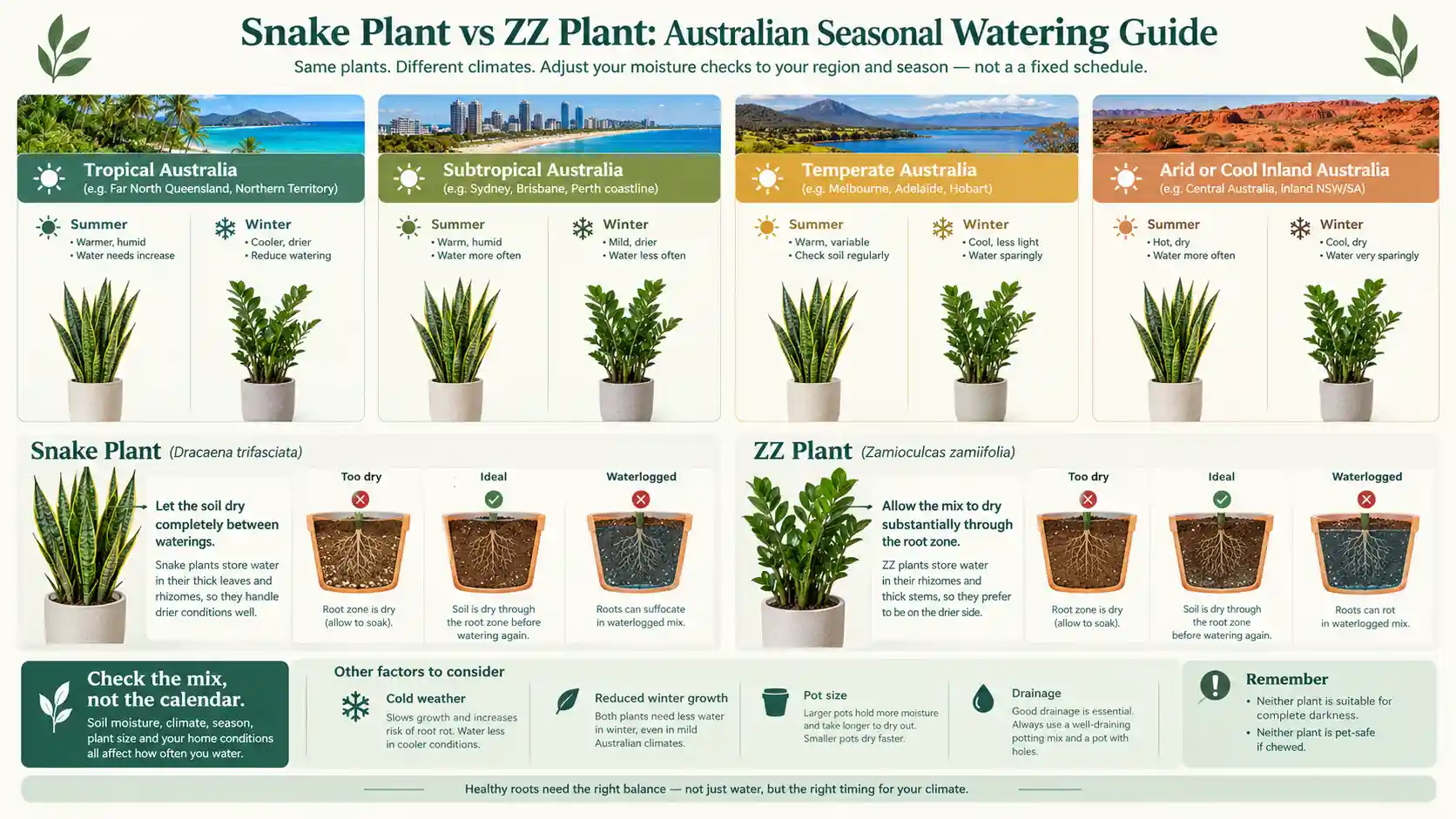
The following table gives inspection guidance, not tested watering intervals. Check moisture regularly, then water only when the plant’s root zone has dried sufficiently.
| Australian climate | Summer approach | Winter approach |
| Temperate: Melbourne, Sydney, Hobart | Check weekly during warm weather; water only when dry | Check every week or two; reduce watering as growth slows |
| Subtropical: Brisbane, coastal NSW | Check weekly and assess drainage during humid weather | Check every one to two weeks; do not water just because the surface looks dry |
| Tropical: Far North Queensland, Top End | Monitor moisture and rainfall carefully, especially outdoors | Recheck during cooler or drier periods; avoid persistently wet mix |
| Arid or inland: Adelaide, Perth, inland NSW | Check more frequently during hot, dry spells | Extend the interval when temperatures and light levels fall |
| Cool or frost-prone inland areas | Water when dry during active growth | Water sparingly and protect both plants from cold and waterlogged soil |
Pot size, terracotta versus plastic, growing medium, window exposure and air conditioning all affect how quickly a pot dries. These variables make calendar-based advice unreliable.
For more detailed ZZ care, including Australian climate-specific guidance, read the Zanzibar Gem watering, light and problems guide.
Cold Snaps and Air-Conditioned Rooms
Neither plant is frost-hardy. ZZ plants need protection from chilling, and snake plants should also be kept away from cold, draughty positions. In Melbourne, Hobart and Canberra, avoid leaving either plant pressed against a cold window or exposed to an open winter window overnight.
Air conditioning is not automatically harmful, but a pot placed directly beneath a cold vent can experience repeated temperature changes. Keep both plants away from direct cold-air streams and hot heaters.
For outdoor cultivation, ZZ plants are most reliable in warm, frost-free settings; in cooler parts of Australia, a movable container is the safer choice.
Size, Growth Rate and Lifespan Compared
Snake plants grow in upright clusters, making them suitable for narrow corners and small floor areas. ZZ plants form broader clumps of glossy leaflets, so they may need more horizontal room as they mature. Both are relatively slow-growing indoors, especially in dim conditions or during winter.
Both are perennial plants capable of living for many years with suitable care, but there is no dependable universal lifespan figure that applies to every indoor specimen.
Propagation is possible with both. Snake plants can be divided or grown from leaf cuttings; ZZ plants can be multiplied through division of their rhizomes or from leaf cuttings. Division is generally the more practical option when you want an established new plant rather than waiting for a cutting to develop.
Neither plant has a guaranteed annual growth rate. Light, temperature, water and the maturity of the plant all affect new growth.
Are They Safe for Pets, Kids and Bedrooms?
Both plants should be treated as toxic if chewed or eaten. The American Society for the Prevention of Cruelty to Animals lists snake plants as toxic to cats and dogs, with saponins associated with nausea, vomiting and diarrhoea. ZZ plants contain insoluble calcium oxalate crystals, which can cause immediate oral irritation if chewed.
Neither plant is a good choice within reach of a pet that regularly chews foliage or a young child who explores plants by mouth.
Touching vs Eating: What Actually Happens
Simply touching an intact leaf is not the same as ingesting the plant. The main established concern is chewing or swallowing plant material. During pruning, propagation and repotting, wear gardening gloves as a precaution and wash your hands afterwards.
With ZZ plants, avoid transferring plant material or residue from cut surfaces to your eyes or mouth. If irritation occurs, rinse the affected area and seek appropriate medical advice if symptoms persist.
Pet and Child First Aid
If a child bites or swallows either plant, remove any remaining plant material from the mouth, do not induce vomiting, and call the Australian Poisons Information Centre on 13 11 26 for advice. If the person collapses, has a seizure or develops serious breathing difficulty, call 000.
If a pet chews a plant, move the plant out of reach, keep a photograph or sample for identification, and contact your veterinarian. In Australia, the Animal Poisons Helpline operates 24 hours a day on 1300 869 738. Do not attempt home treatment without veterinary advice.
Bedroom, Air Purification and “Bad Luck” Myths
- Air purification: The NASA Clean Air Study investigated pollutant removal in enclosed experimental conditions. A later review found that ordinary potted plants do not remove volatile organic compounds quickly enough to meaningfully improve air quality in typical buildings. Ventilation remains more important.
- Oxygen at night: Snake plants use a form of photosynthesis adapted to dry conditions, but one plant should not be treated as a way to meaningfully oxygenate a bedroom.
- ZZ plants and cancer: The claim that keeping a ZZ plant causes cancer is unsupported. Its established hazard is irritation from its calcium oxalate crystals if chewed or ingested, not a demonstrated cancer risk.
- Bad luck: Beliefs about snake plants and ZZ plants vary across cultural and feng shui traditions. They are cultural interpretations, not scientifically established effects.
Both plants can be suitable bedroom decorations for most adults when correctly placed, but neither should be advertised as an effective air-quality treatment.
For a broader discussion of what indoor greenery can and cannot do, see Leafy Heaven’s guide to the benefits of indoor plants.
Disadvantages of Each Plant
| Snake plant | ZZ plant |
| Toxic if eaten by pets or children | Toxic if chewed or eaten |
| May rot if watered too frequently | Can develop root rot and sudden stem collapse in persistently wet soil |
| Sensitive to frost and prolonged cold | Needs protection from chilling and frost |
| Tall leaves can become awkward in tight spaces | Slow growth may frustrate gardeners wanting quick results |
| Can become an environmental weed in some Australian regions | Can become leggy in very dim conditions |
| Can be slow to produce new growth in low light | Established or larger specimens may cost more, depending on cultivar and pot size |
One Australian-specific disadvantage deserves particular attention: snake plants can become environmental weeds in some regions. Brisbane City Council lists mother-in-law’s tongue as Council Pest Vegetation and describes it as an environmental weed in Queensland, New South Wales and the Northern Territory, and a potential sleeper weed elsewhere. Agriculture Victoria reports that it is not known to be naturalised in Victoria. This is not a blanket declaration that it is a prohibited weed throughout Australia; check local requirements before outdoor planting, particularly near bushland.
The practical fixes are simple: use well-drained potting mix, avoid overwatering, protect both plants from cold, and choose a location that supplies enough natural light. For outdoor snake plants, consider local weed guidance before planting or disposing of unwanted material.
What Going Wrong Looks Like
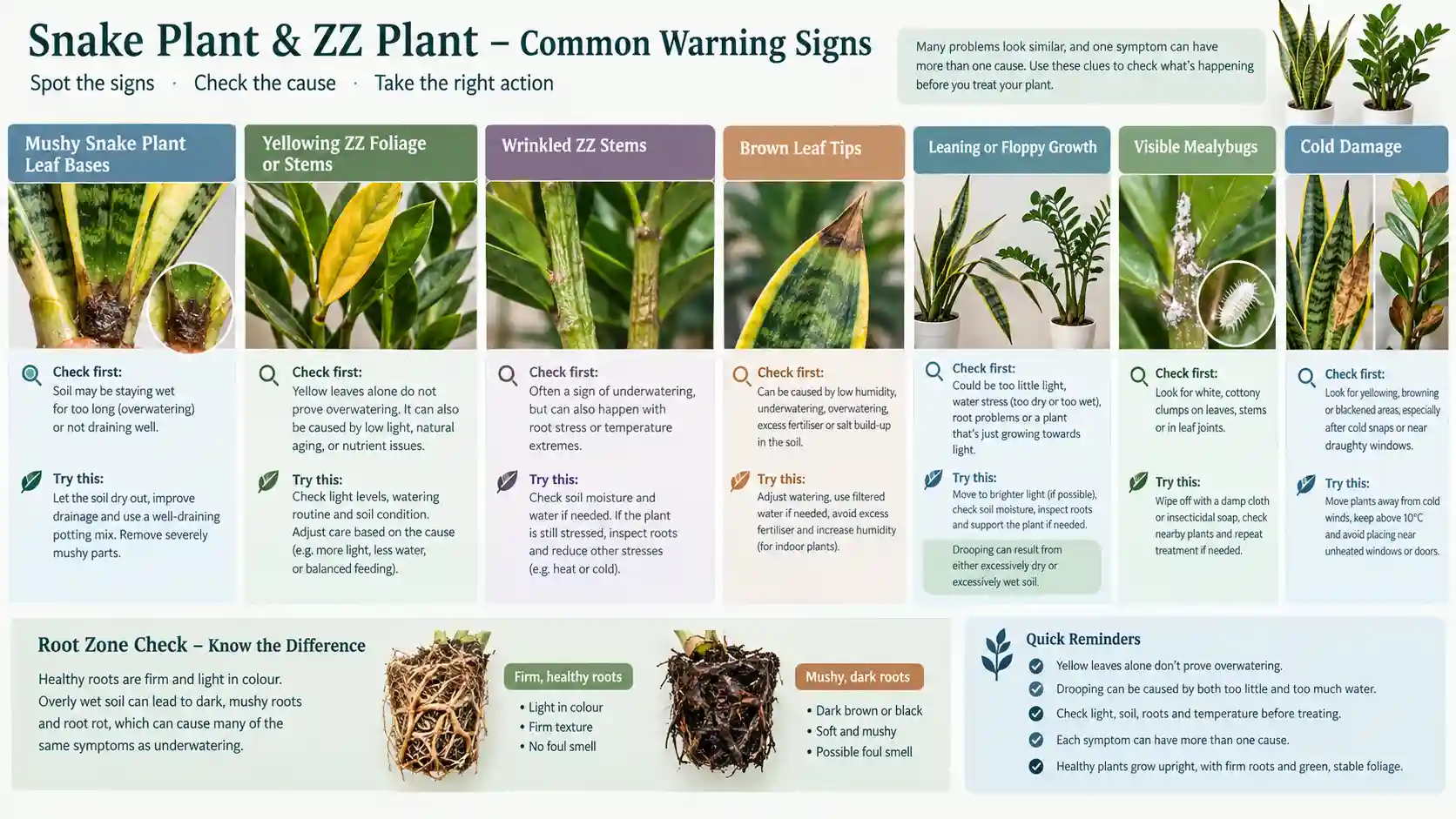
The two plants show different warning signs, but the potting mix and root condition are often more useful than leaf colour alone.
| Symptom | Plant | Likely cause | Fix and prevention |
| Mushy leaf base | Snake plant | Overwatering or rot | Remove affected material, check roots and improve drainage |
| Yellowing stems or leaves | ZZ plant | Often overwatering or root stress; older foliage can also age naturally | Check moisture before watering again |
| Wrinkled or shrivelled stems | ZZ plant | Possible underwatering, but root damage can mimic thirst | Check whether the mix is dry or saturated before adding water |
| Brown leaf tips | Either | Environmental stress, inconsistent watering or accumulated salts | Check watering, light and fertiliser use |
| Leaning or floppy growth | Either | Insufficient light, root problems or structural crowding | Improve light gradually and inspect the roots if decline continues |
| Cottony patches or small insects | Either | Possible mealybugs or other sap-feeding pests | Isolate the plant and identify the pest before treatment |
| Sudden decline after cold exposure | Either | Chilling or cold damage | Move to a warm, sheltered position and avoid saturating the mix |
A snake plant can remain upright while rot develops around its base, so check firmness where the leaves emerge from the soil. A ZZ plant may show yellowing or collapsing stems when root damage is already advanced. If the plant declines quickly, inspect the roots rather than assuming it simply needs more water.
For more help identifying symptoms and separating watering problems from other causes, use Leafy Heaven’s plant problems and troubleshooting guide.
Where to Place Them and What to Pair Them With
Choose a position based on the actual light and temperature, not just the appearance of the room. Neither plant should be placed somewhere with no usable light or left in standing water.
Where Not to Place a Snake Plant
Avoid placing a snake plant:
- In a cold draught or directly beneath an air-conditioning vent.
- Immediately beside a hot heater.
- In a windowless room without supplemental plant lighting.
- Where pets or toddlers can chew the leaves.
- Outdoors in a region where local authorities identify it as a pest plant.
A bright position with indirect light and adequate drainage offers a better balance than a dark corner chosen purely for decoration.
Growing Them Together and Choosing Companions
A snake plant and ZZ plant can be displayed together, and both have a preference for drying between waterings. However, grouping separate pots is easier to manage than planting both in the same pot.
Their growth forms and root systems differ, and a shared container can make it harder to judge moisture and manage root crowding. If you do combine them, use a free-draining mix, a container with drainage holes and a watering routine that never leaves the root zone persistently wet.
When Neither Is Right: Cast Iron Plant
If pet safety is the priority, consider the cast iron plant (Aspidistra elatior) instead. It tolerates low-light conditions and is listed by the ASPCA as non-toxic to cats and dogs. It still needs suitable watering and care, but it provides an alternative when either of the two plants being compared would be within easy reach of a curious pet.
Conclusion
The best choice in the snake plant vs ZZ plant comparison depends on the room and household. Choose a snake plant for upright foliage and a relatively narrow footprint, or a ZZ plant for glossy leaves and greater tolerance of long dry periods. Both need drainage, protection from cold and safe placement away from pets and young children who might chew them.
FAQs
Is a ZZ plant poisonous to touch?
Simply touching an intact ZZ plant is not the same as eating it. The primary established concern is calcium oxalate irritation if plant material is chewed. Wear gloves during propagation, avoid touching your face and wash your hands after handling.
Is touching a snake plant toxic?
Touching an intact snake plant is generally low risk. Its established toxicity concern is ingestion, which can cause nausea, vomiting or diarrhoea. Wash your hands after handling it, and keep leaves away from pets and children who might chew them.
Is a ZZ plant safe in a bedroom?
A ZZ plant can be kept in a bedroom by most adults, provided it receives some natural or suitable supplemental light. Keep it out of reach of children and pets, because chewing the foliage can cause irritation.
What is the lifespan of a snake plant?
A snake plant can live for many years when it receives suitable light, careful watering and well-drained soil. There is no single reliable lifespan figure for every cultivar or indoor growing environment, so avoid treating a specific number of years as guaranteed.
Is a snake plant bad luck for the home?
Bad-luck associations are cultural beliefs rather than scientifically demonstrated effects. Some feng shui traditions associate snake plants with protection or positive energy, while other interpretations differ. Choose one for its appearance and suitability for your home.
Can I plant a ZZ plant with a snake plant in the same pot?
Yes, provided the container drains well and both plants have enough room. However, separate pots grouped together are usually easier to manage because root crowding and different drying rates can complicate watering.
What is the healthiest plant to have in your bedroom?
There is no single plant proven to be the healthiest for every bedroom. Choose one that suits your light, care routine and household safety needs. Neither snake plants nor ZZ plants replace ventilation or reliably purify ordinary indoor air.