

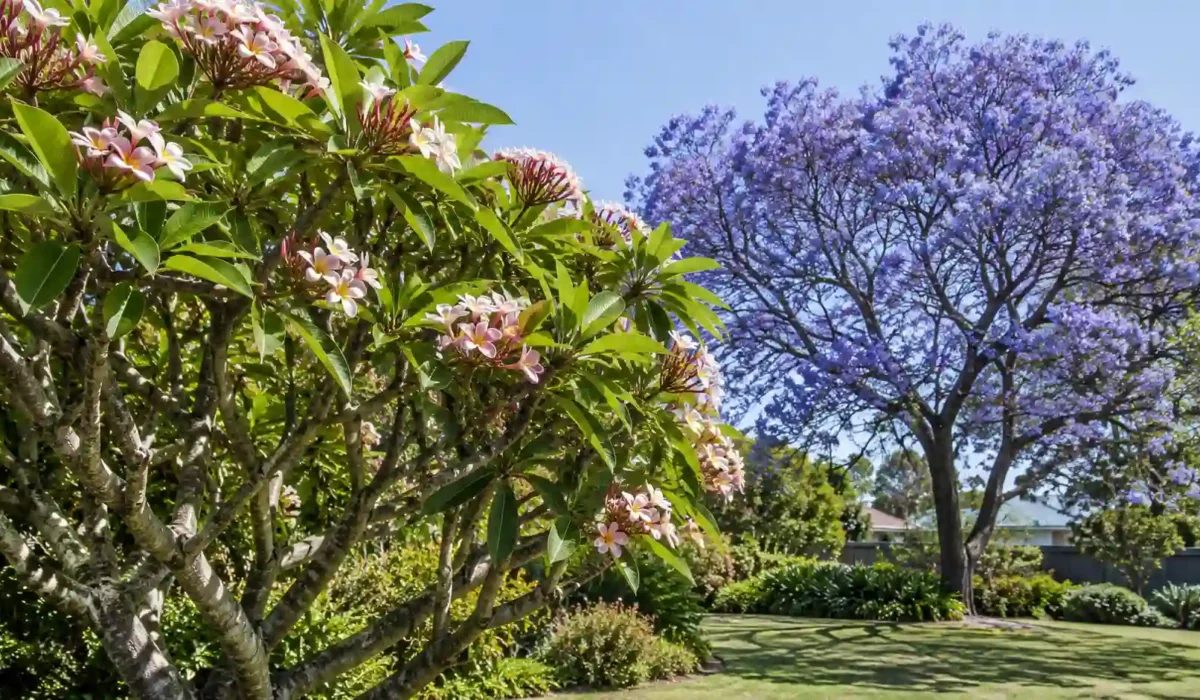
Frangipani vs Jacaranda: Which Suits Your Australian Garden?
Frangipani vs jacaranda is a choice between a relatively compact, summer-flowering tree and a much larger tree known for its spring display of purple-blue flowers. Common frangipani (Plumeria), Australian native frangipani (Hymenosporum flavum) and jacaranda (Jacaranda mimosifolia) are three different plants. The right choice depends on your climate, available space, nearby pipes, tolerance for fallen flowers and leaves, and whether you want a tree that flowers reliably in your yard.
Quick Summary
- Choose common frangipani for a smaller feature tree in a warm, sunny, frost-free or mildly frost-prone garden with excellent drainage.
- Choose jacaranda if you have space for a large canopy and can accommodate its roots, fallen flowers, leaves and pods.
- Consider native frangipani for a fragrant, evergreen Australian tree with cream-to-yellow flowers.
- Check frost risk, underground services, local weed guidance and your tree’s mature dimensions before planting.
Which “Frangipani” Do You Actually Mean?
The first decision is identifying the plant. The name “frangipani” can refer to two unrelated trees, while jacaranda is a third species with a very different growth habit.
Plumeria (common frangipani)
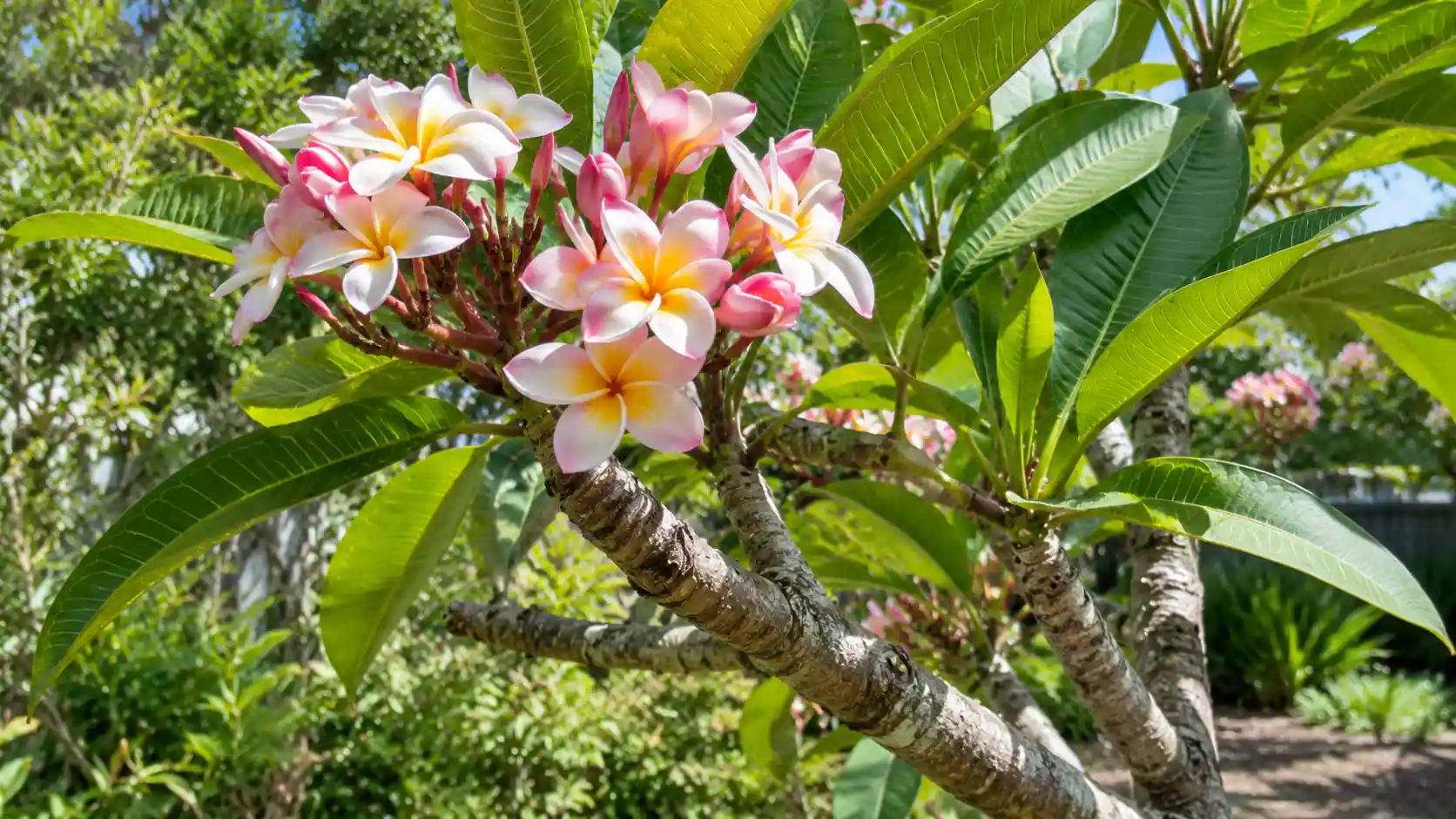
Common frangipani belongs to the genus Plumeria, in the dogbane family, Apocynaceae. It originates in tropical and subtropical regions of the Americas and is grown for its fragrant flowers, thick branches and relatively manageable garden size.
Plumeria rubra and its garden hybrids include flowers in white, yellow, pink and red combinations. In Australia, flowering commonly extends through the warmer months, although timing depends on local conditions.
For planting, pruning, winter dormancy and disease management, see LeafyHeaven’s frangipani tree care guide.
Native frangipani (Hymenosporum flavum)
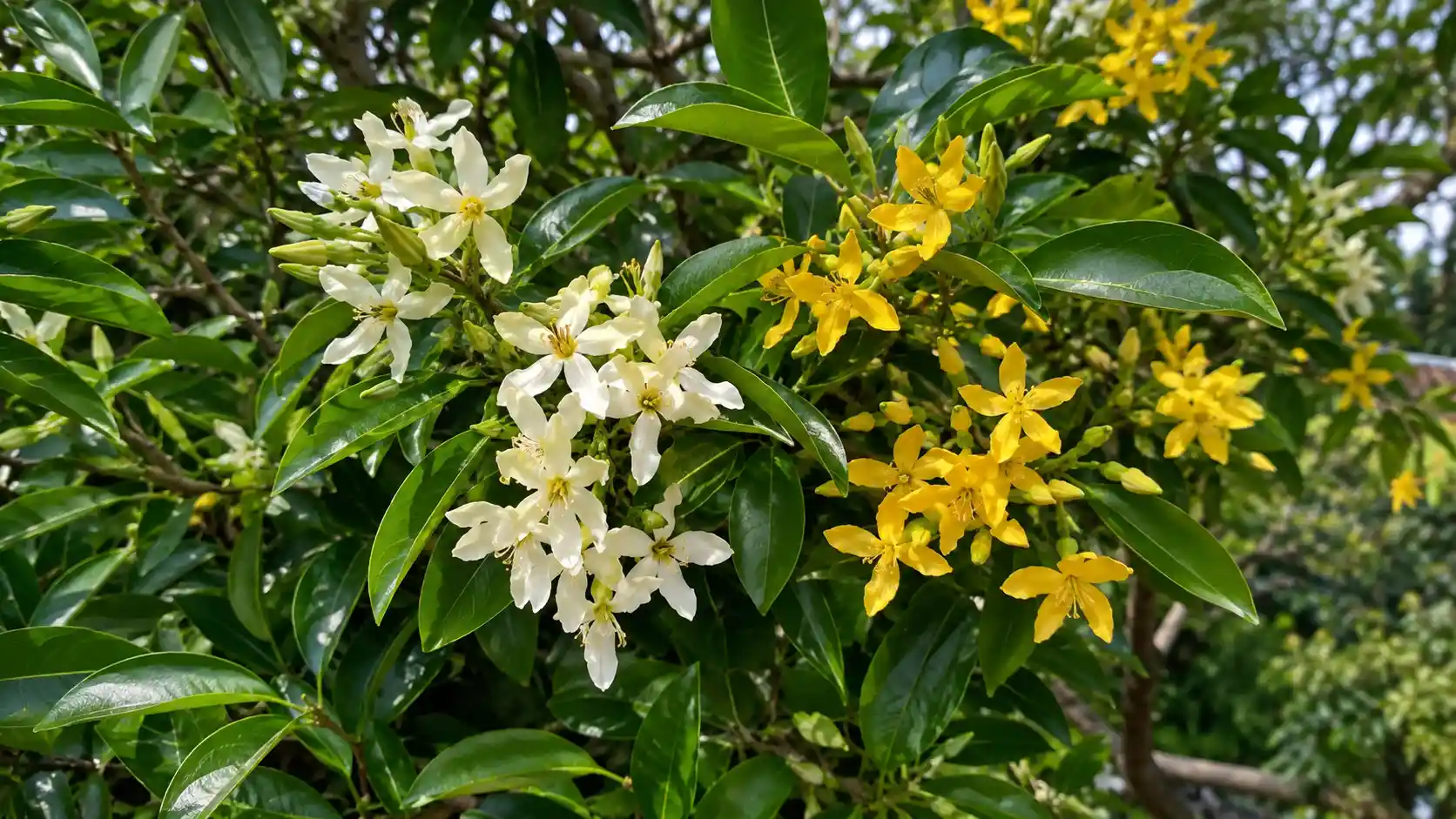
Native frangipani is a separate Australian rainforest tree found naturally in Queensland and New South Wales, as well as New Guinea. It belongs to the Pittosporaceae family, not the Plumeria family.
Its fragrant flowers open cream-coloured and gradually become yellow. Unlike common frangipani, it is evergreen, although it can shed some dry foliage and other litter.
The Royal Botanic Garden Sydney’s native frangipani profile describes its distribution, foliage and preference for well-drained soil. Despite the shared common name, it is not botanically related to Plumeria.
Jacaranda (Jacaranda mimosifolia)
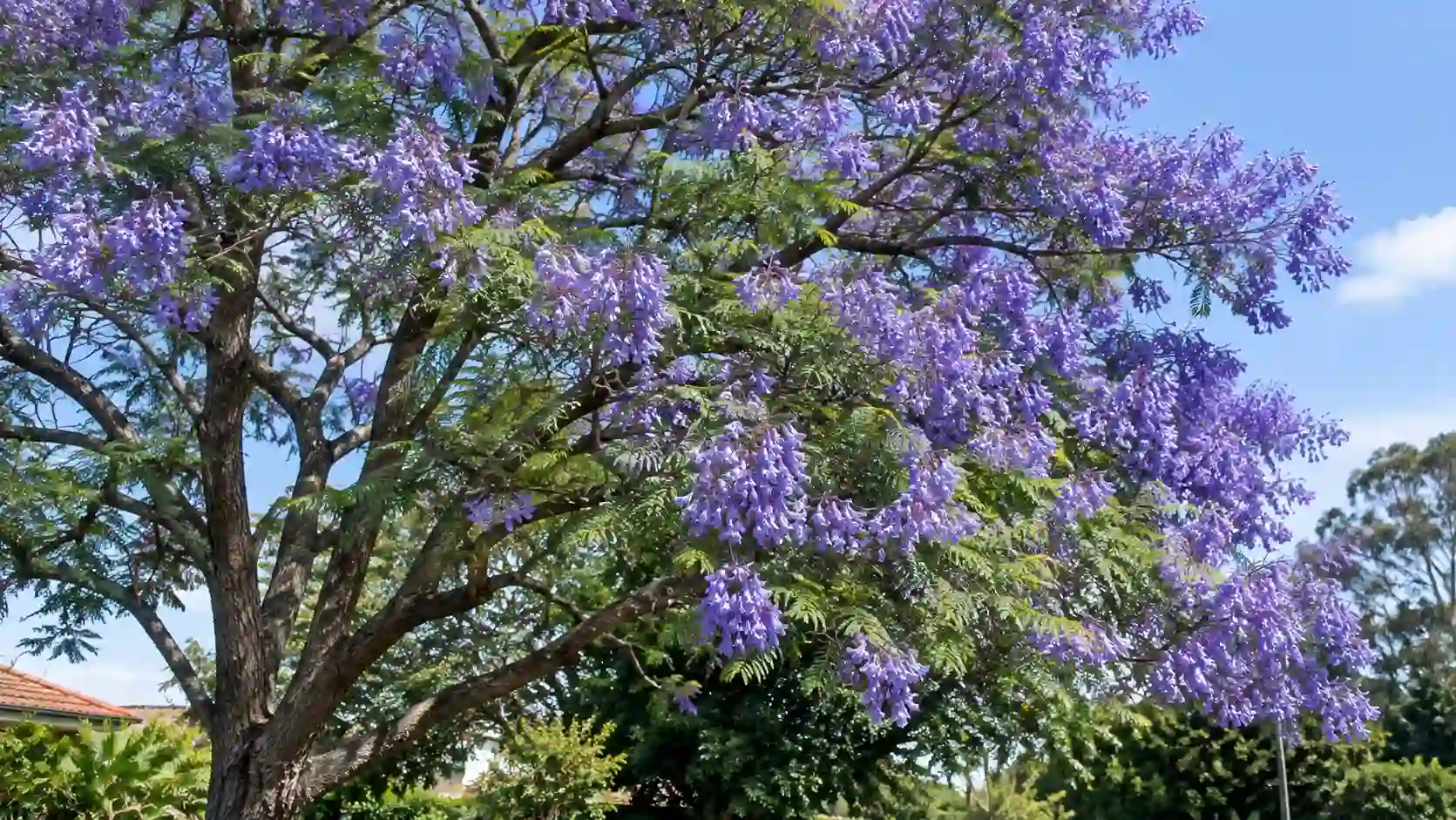
Jacaranda is a South American tree, commonly associated with Brazil, with finely divided foliage and clusters of violet-blue flowers. It is deciduous, and its large, spreading crown makes it more suitable for spacious gardens than compact urban yards.
The Royal Botanic Gardens Victoria’s jacaranda profile identifies it as a warm-climate tree that reaches about 15 metres and is frost-tender near the southern limit of its Australian cultivation.
A frangipani vine (Chonemorpha species) is another plant encountered under a similar common name. It is not one of the trees compared here.
Table 1. Identify the three plants
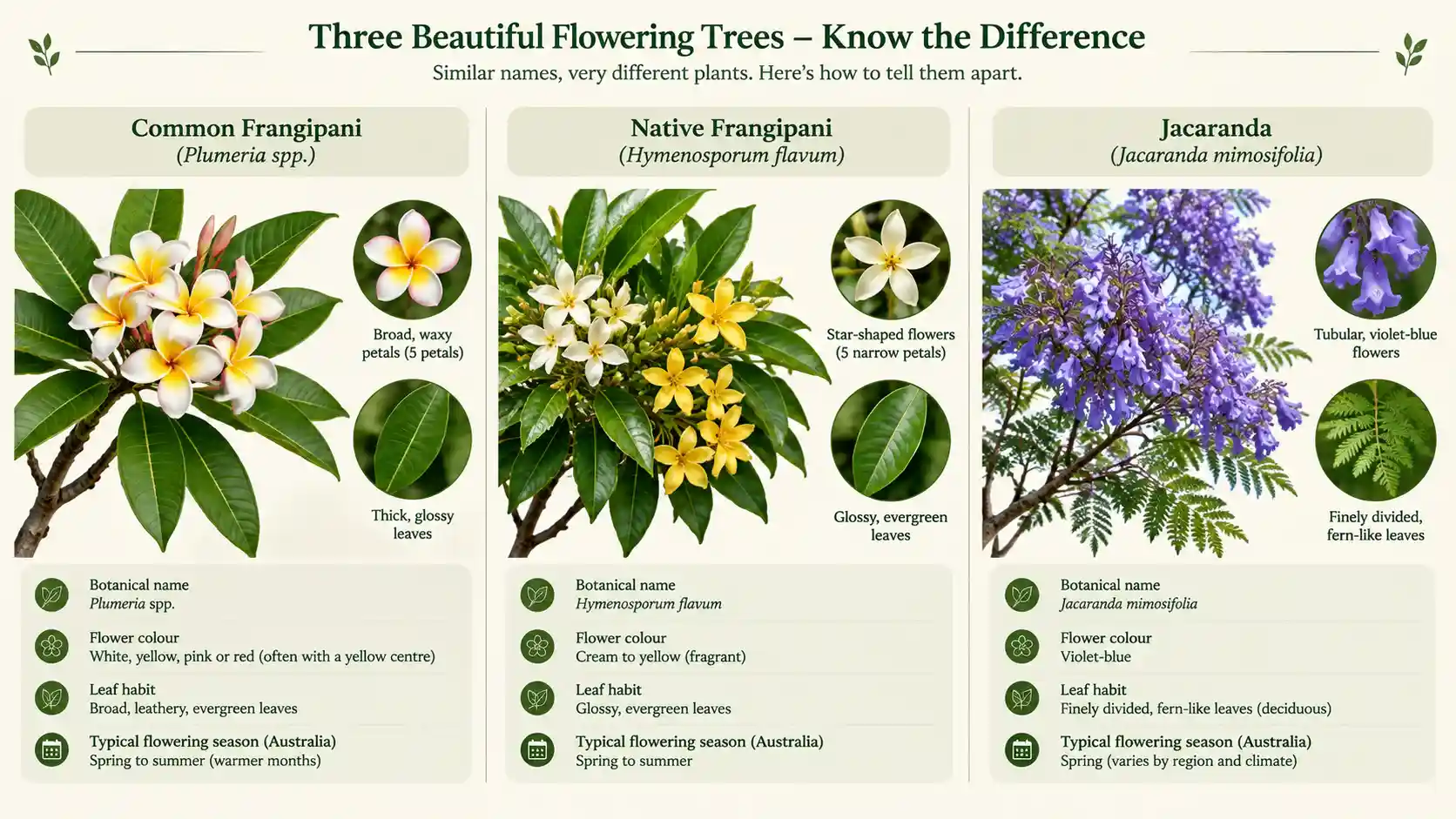
| Feature | Common frangipani | Native frangipani | Jacaranda |
| Botanical name | Plumeria spp. | Hymenosporum flavum | Jacaranda mimosifolia |
| Origin | Tropical Americas | Australia and New Guinea | South America |
| Family | Apocynaceae | Pittosporaceae | Bignoniaceae |
| Leaf habit | Deciduous or seasonally leafless | Evergreen | Deciduous |
| Flower colour | White, yellow, pink or red combinations | Cream turning yellow | Violet-blue |
| Typical flowering period in Australia | Warmer months, often November–May | Spring to early summer | Spring to early summer, depending on location |
Frangipani vs Jacaranda at a Glance
Table 2. Side-by-side verdict
| Consideration | Common frangipani (Plumeria) | Jacaranda |
| Mature size | Often around 6 m tall and 5 m wide, with variation between sources and cultivars | Can reach about 10–15 m tall, with a broad canopy |
| Growth rate | Variable; depends on cultivar, climate and growing conditions | Described as fast-growing in suitable conditions |
| Flowering time | Mainly the warmer months | Spring to early summer |
| Frost tolerance | Frost-tender; cold damage can be serious | Frost-sensitive, particularly when young |
| Roots and services | Do not assume a fixed safe setback | Some councils classify it as a high-risk species near sewer pipes |
| Litter | Seasonal leaf drop, particularly in winter | Flowers, leaves and seed pods |
| Pet considerations | Sap is an irritant; prevent chewing | Do not assume pet safety without species-specific advice |
| Weed status | No comparable environmental-weed listing established in the sources checked | Environmental weed in parts of NSW and Queensland |
| Maintenance | Generally manageable in a suitable climate | More planning, space and litter management |
| Best fit | Sunny, smaller gardens in mild climates | Large gardens and open spaces with room for a mature tree |
These are planning comparisons rather than guarantees. The figures and practical risks are explained in the sections below.
How Big Will Each Tree Get in 10 Years?
The mistake to avoid is choosing a tree according to the size it has at the nursery rather than the space it will eventually occupy.
Mature height and spread
Common frangipani is the smaller of the two main feature trees. Published Australian descriptions vary: ABC Gardening Australia’s frangipani guide gives a height of about 8 metres and a spread of up to 4.5 metres, while other Australian gardening guidance gives figures around 6 metres high and 5 metres wide. Treat these as approximate planning dimensions, not a guaranteed maximum.
A jacaranda can reach approximately 15 metres in height, with a broad crown. The South Australian botanic gardens’ jacaranda plant profile gives a typical height and spread of 8–10 metres for its planting guidance.
Native frangipani is not necessarily a tiny alternative: a cultivated tree may reach roughly 6–10 metres or more, depending on growing conditions. Its narrower, evergreen form can nevertheless suit some sites where a broad jacaranda crown would be unsuitable.
A pot can restrict the size of a common frangipani, but it does not remove its need for sunlight, drainage and suitable winter protection.
Growth rate and the 10-year footprint
There are no defensible, universal year-by-year heights and spreads for all three trees in the sources checked. Plant age at purchase, cultivar, climate, water, soil and pruning make a substantial difference.
Table 3. Planning the footprint at years 3, 5 and 10
| Tree and stage | Height and spread planning | Litter and pruning considerations |
| Frangipani, year 3 | Measure the purchased plant; growth varies by cultivar and site | Seasonal leaf drop; remove damaged or diseased material |
| Frangipani, year 5 | Allow room for a widening canopy rather than relying on its current size | Winter leaf drop continues; avoid unnecessary hard pruning |
| Frangipani, year 10 | Plan around the mature dimensions of the selected variety | Allow for branches, seasonal leaves and possible rust management |
| Jacaranda, year 3 | Treat it as a juvenile tree that still needs room to develop | Litter generally becomes more noticeable as the canopy matures |
| Jacaranda, year 5 | Assess the developing crown against nearby buildings, services and paving | Flowers, leaves and seed pods need consideration |
| Jacaranda, year 10 | Allow for a potentially substantial canopy; it may still be growing towards mature size | Greater canopy size means a larger area affected by falling flowers, foliage and pods |
These are planning stages, not measured growth predictions. Do not publish exact three-, five- or ten-year heights without reliable measurements of comparable trees.
Root spread, pipes and pools
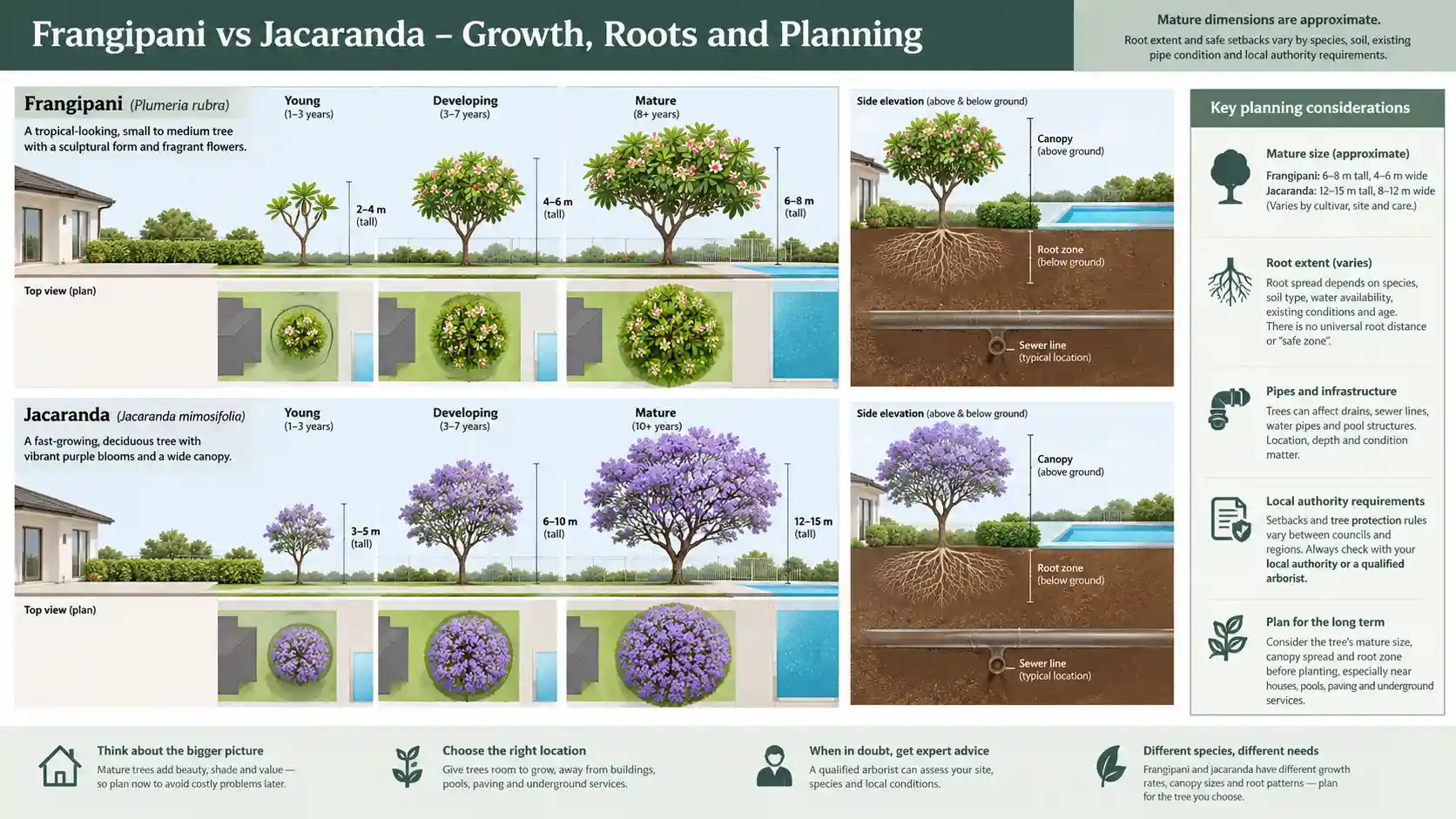
Neither tree should be planted simply because its roots are assumed to be harmless. Tree roots exploit available moisture and can enter existing cracks or faulty joints in underground pipes.
The distinction matters for jacaranda: Queanbeyan-Palerang Regional Council’s sewer-root fact sheet rates Jacaranda mimosifolia as Very High for potential sewer-pipe damage. This is a local risk classification, not proof that every jacaranda will damage every pipe.
There is no single verified distance that guarantees safety across all Australian properties. Pipe material, condition, soil, tree size and local requirements matter. South Australian botanic gardens also gives a species-specific sewer setback for jacaranda under its local guidance, illustrating why local rules must be checked rather than applying one figure nationally.
Before planting, locate underground services, contact your water authority and consult Before You Dig Australia. Allow adequate room from pools, foundations, retaining walls and paving. Frangipani should not automatically be treated as root-safe simply because it is smaller.
Will It Flower Where You Live? Climate Zones and Bloom Calendar
The best flowering tree is the one that can grow well in your actual climate. A tree that survives is not necessarily a tree that will flower reliably.
Climate-zone verdict table
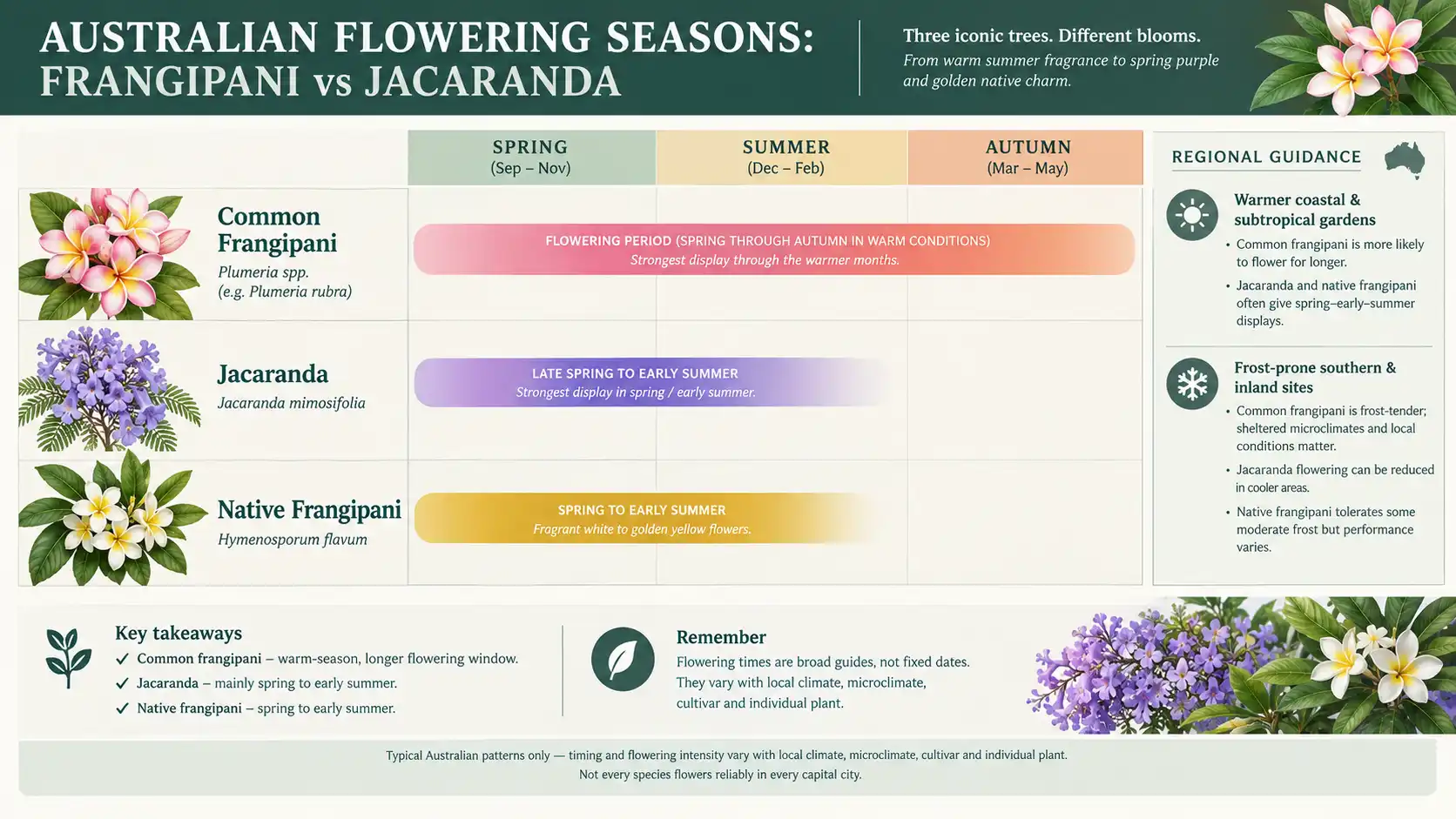
The following is a practical starting point, not a guarantee of performance. Site exposure, frost pockets, drainage and the individual plant can change the result.
| City or region | Common frangipani | Jacaranda | Native frangipani |
| Darwin | Well suited to warm conditions | Not a reliable choice for a strong flower display; it does not generally flower in Darwin | Potential option for suitable sites |
| Brisbane | Very good in sunny, well-drained positions | Excellent choice where there is room | Well suited to many gardens |
| Sydney | Good in sunny, sheltered coastal gardens | Very well suited to many suburbs | Suitable in appropriate soils and positions |
| Perth | Good in warm, protected sites | Suitable in many gardens with establishment care | Possible, with site-specific selection |
| Adelaide | Best in a warm, protected position | Suitable on appropriate sites; consider litter and services | Suitable, with some frost tolerance |
| Melbourne | Generally safer in a protected pot or frost-free position | Marginal; requires a favourable microclimate | Can grow well in suitable urban sites |
| Canberra | Best protected from winter cold | Poor choice for dependable flowering in frost-prone positions | More challenging; protect young trees |
| Hobart | Protected cultivation is preferable | Not a dependable choice for flowering | Requires careful site selection and frost consideration |
The La Trobe University account of jacaranda flowering in Australia notes that jacarandas do not generally flower in Darwin and that Hobart is relatively cold for them.
For a broader view of suitable feature trees, see LeafyHeaven’s guide to flowering trees in Australia.
Bloom calendar
| Tree | Typical Australian flowering period | What to expect |
| Common frangipani | Often November–May | Fragrant flowers during warm weather, with local variation |
| Jacaranda | Spring to early summer | Purple-blue display, generally later in cooler southern regions |
| Native frangipani | Spring to early summer | Fragrant cream flowers that become yellow |
Flowering dates shift with temperature and local conditions. Keep your own annual notes if exact bloom timing matters in your garden; a general calendar cannot predict the first flower on a particular tree.
Why Won’t My Jacaranda or Frangipani Flower?
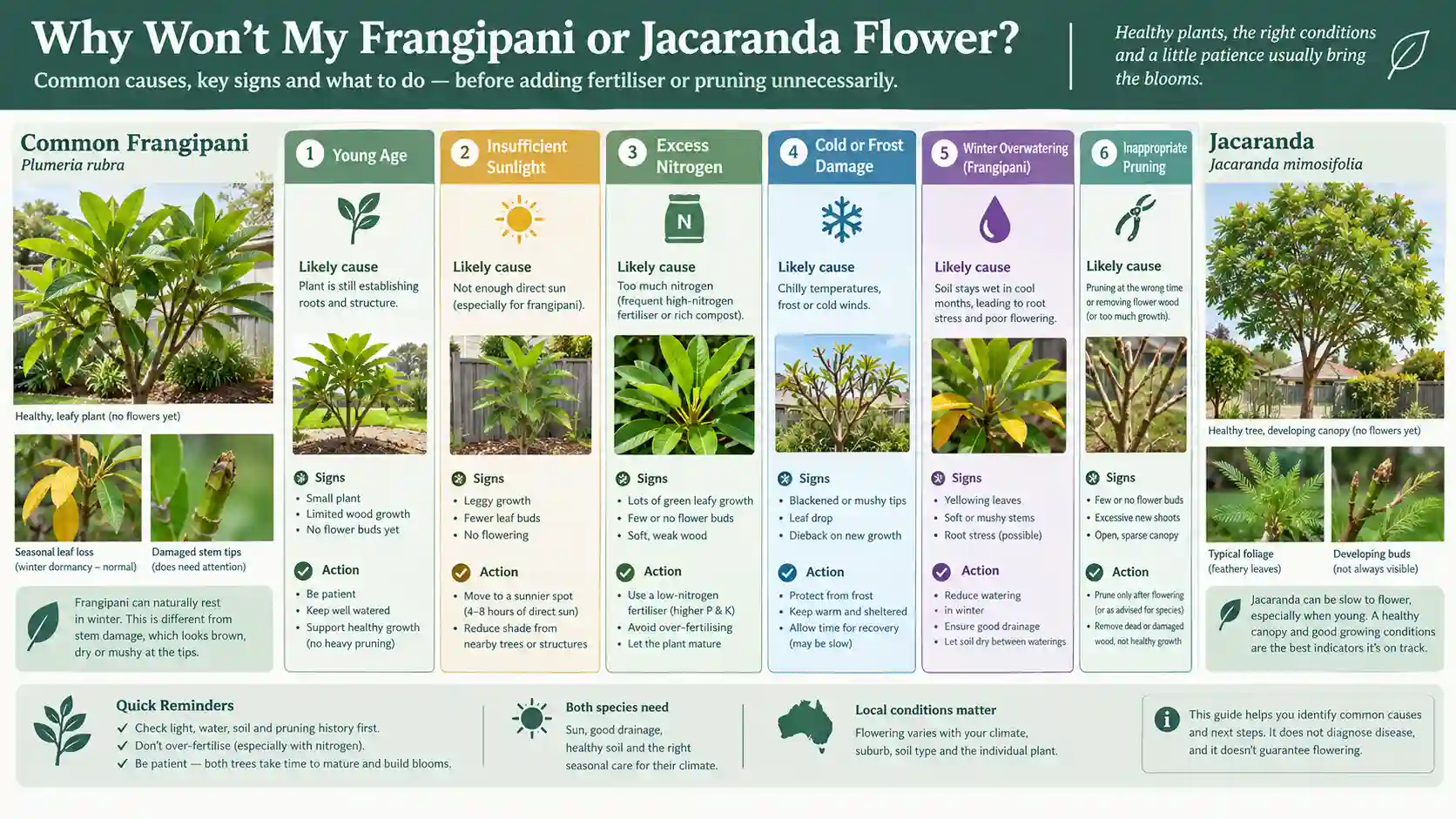
A tree that has not flowered is not necessarily diseased. Age, sunlight, winter conditions, fertiliser and pruning can all affect flowering.
| Possible cause | Common clue | Practical fix |
| Tree is too young | Healthy foliage but no flowers | Allow time for maturity; ask the nursery whether the plant was raised from seed or cutting |
| Too much shade | Weak growth or a canopy shaded for much of the day | Choose a sunnier site where practical |
| Excess nitrogen | Vigorous leafy growth with few flowers | Avoid unnecessary high-nitrogen fertilising |
| Cold damage | Damaged growth after cold weather | Protect frangipani and young jacarandas from frost where needed |
| Winter overwatering | Frangipani is leafless but its soil remains wet | Reduce watering during dormancy and improve drainage |
| Poor pruning timing | Flowering tips or developing branches were removed | Avoid unnecessary pruning and learn the flowering habit before cutting |
Seed-grown common frangipani may take three to four years to bloom, according to the Missouri Botanical Garden’s Plumeria guidance. That is a general estimate, not a promise for every plant. A comparable, universally reliable first-flower timeline for jacaranda was not established in the sources checked.
For common frangipani, also check whether poor drainage or cold weather has damaged the stems. For jacaranda, give the tree room to develop in an open, sunny position and avoid excessive feeding or heavy pruning intended to force flowers.
Pets, Pools and Litter: What Will You Regret?
Pets and sap
Common frangipani sap can irritate skin. The University of Florida’s Plumeria growing guidance also recommends considering pets and children when selecting a planting site.
Avoid chewing or ingestion, and seek veterinary advice if a pet eats the plant or develops symptoms. Evidence available here is not sufficient to provide a definitive pet-safety ranking for all three species. Do not assume jacaranda or native frangipani is harmless simply because a particular toxic-plant list does not mention it.
Litter and pools
Jacaranda’s flowers can drop heavily during flowering, followed by leaves and seed pods. A tree beside a pool, driveway or high-use path may create frequent cleanup.
Common frangipani typically loses its leaves in the cooler months. Native frangipani is evergreen, but evergreen does not mean litter-free: flowers, dry leaves and seed capsules may still fall.
Common problems
Frangipani rust causes orange pustules on the undersides of leaves and may lead to premature leaf drop. Remove infected foliage and dispose of it appropriately rather than leaving it around the plant. Avoid applying fungicides unless the product is suitable and its label permits the intended use.
Jacaranda’s flowers, leaf drop and seed pods are often maintenance concerns rather than evidence of disease. Choose the planting location with these seasonal changes in mind.
Is Jacaranda a Weed? Planting Rules in Your Area
Jacaranda is widely cultivated in Australia but is also regarded as an environmental weed in parts of New South Wales and Queensland. The Lucid Central environmental weeds profile describes its naturalisation in warmer parts of eastern Australia, including areas near waterways and open woodland.
An environmental-weed assessment is not the same as a blanket planting ban. Local rules and recommended planting lists can differ, so check with your council before buying a tree—especially if your property adjoins bushland, a creek or another sensitive natural area.
Common frangipani and native frangipani do not have a comparable environmental-weed listing established in the sources checked here. That should not be treated as a guarantee that every species, cultivar or local planting situation is unrestricted.
Avoid placing a large jacaranda where its mature crown, roots, flowers or pods will conflict with pipes, pools, buildings or frequently used paths.
Which Tree Should You Choose? A “Pick This If…” Decision Guide
Pick common frangipani if you have a sunny, warm garden, limited space for a feature tree and well-drained soil. It is also a practical choice if you prefer fragrant summer flowers and can accommodate winter dormancy.
Pick jacaranda if your garden is spacious, your climate is suitable and you can manage its broad canopy and seasonal litter. Check underground services and local weed guidance before planting.
Pick native frangipani if you want a fragrant, evergreen Australian tree with cream-to-yellow flowers and have space for its mature height. It is not a miniature tree, so check the eventual dimensions.
Decision matrix
| Your priority | Best starting option | Important qualification |
| Smaller feature tree | Common frangipani | Allow room for its mature canopy |
| Spring display of purple-blue flowers | Jacaranda | Not reliable in all climates |
| Evergreen foliage and fragrant flowers | Native frangipani | Can still reach medium-tree size |
| Frost-prone yard | Native frangipani may be worth investigating | Young trees still need appropriate protection |
| Pool or underground pipes nearby | Consider a smaller, site-appropriate species | Confirm services and local requirements before choosing any tree |
| Low seasonal litter | Compare other species before deciding | None of these trees is completely litter-free |
For more options matched to the size and conditions of your property, consult LeafyHeaven’s guide to the best trees and shrubs for Australian gardens.
If Neither Suits: Better Alternatives
Native frangipani offers an evergreen alternative, while crepe myrtle (Lagerstroemia) can provide a summer flower display in a more compact form. For a purple-flowering alternative to a large jacaranda, ask a local nursery about a suitable tree-form tibouchina for your climate.
Compare cultivars and mature dimensions before buying. Explore LeafyHeaven’s guide to crepe myrtle varieties in Australia.
Before You Plant: A Short Checklist
- Check frost risk, drainage, council guidance and underground services.
- Allow for mature height, spread, roots and seasonal litter.
- Avoid over-fertilising, winter overwatering of frangipani and heavy, unnecessary pruning.
Conclusion
For the frangipani vs jacaranda decision, common frangipani generally suits smaller, warmer gardens, while jacaranda needs considerably more room and careful site selection. Native frangipani offers an evergreen Australian alternative, but still requires space. Choose for your garden’s eventual conditions and the tree’s mature footprint—not just the flowers you see at the nursery.
FAQs
Is frangipani the same as plumeria?
Yes. Common frangipani is the usual name for Plumeria species and garden hybrids. Native frangipani is a separate tree, Hymenosporum flavum.
Is native frangipani related to jacaranda or Plumeria?
No. Native frangipani belongs to the Pittosporaceae family, common frangipani to Apocynaceae, and jacaranda to Bignoniaceae.
Which has more invasive roots, frangipani or jacaranda?
Jacaranda is rated very high for potential sewer-pipe damage by one NSW council. There is no universal safe distance, and neither tree should be assumed root-safe near faulty pipes.
How long does a jacaranda take to flower?
It can take years, and there is no dependable universal timeline for every seed-grown or nursery-grown jacaranda. Ask the nursery about propagation method and flowering maturity.
Is frangipani poisonous to dogs?
Its sap is an irritant, and chewing or ingestion should be prevented. Contact a veterinarian if your dog eats the plant or develops symptoms.
Is jacaranda a weed in Australia?
It is regarded as an environmental weed in parts of NSW and Queensland, but local status and restrictions vary. Check your council’s current guidance.
Can you grow frangipani or jacaranda in Melbourne or Hobart?
Common frangipani generally needs winter protection. Jacaranda is frost-tender and its flowering is less reliable in cooler regions. Native frangipani may be a better option on an appropriate sheltered site.