
Pothos vs Philodendron: How to Tell Them Apart (Australia)
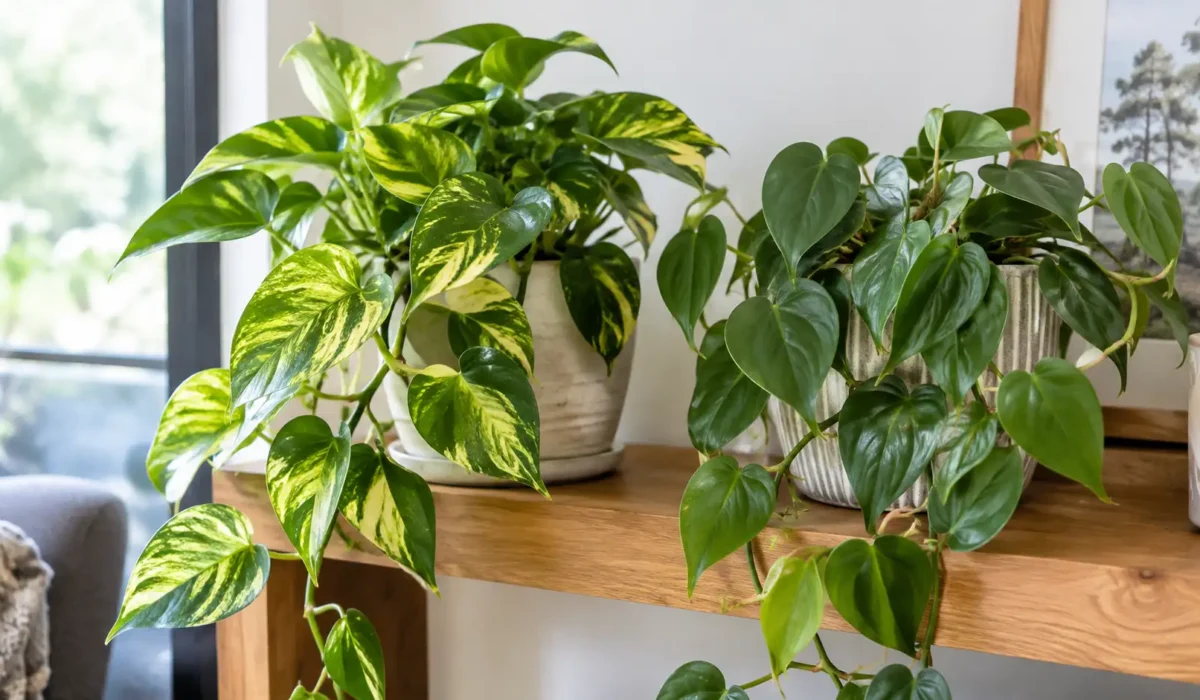
If you have a trailing vine with heart-shaped leaves, the quickest way to answer pothos vs philodendron is to inspect the new growth and leaf stalk—not just leaf colour. Pothos usually means Epipremnum aureum, also called golden pothos or devil’s ivy; the common heartleaf philodendron is Philodendron hederaceum. They belong to the same plant family, Araceae, but are different plants. Pothos often has thicker, glossier leaves and a grooved petiole, while heartleaf philodendron usually has softer leaves and a papery sheath around emerging foliage. Both are toxic if chewed by pets, and pothos needs particular care outdoors in warm, humid parts of Australia.
Quick Summary
- Inspect new growth and the petiole: a papery cataphyll favours heartleaf philodendron; a grooved stalk favours pothos.
- Use several clues together because cultivars can look alike.
- Both plants are toxic to cats and dogs if chewed.
- Keep pothos contained and check local weed guidance before growing it outdoors.
How to Tell Pothos from Philodendron in 30 Seconds
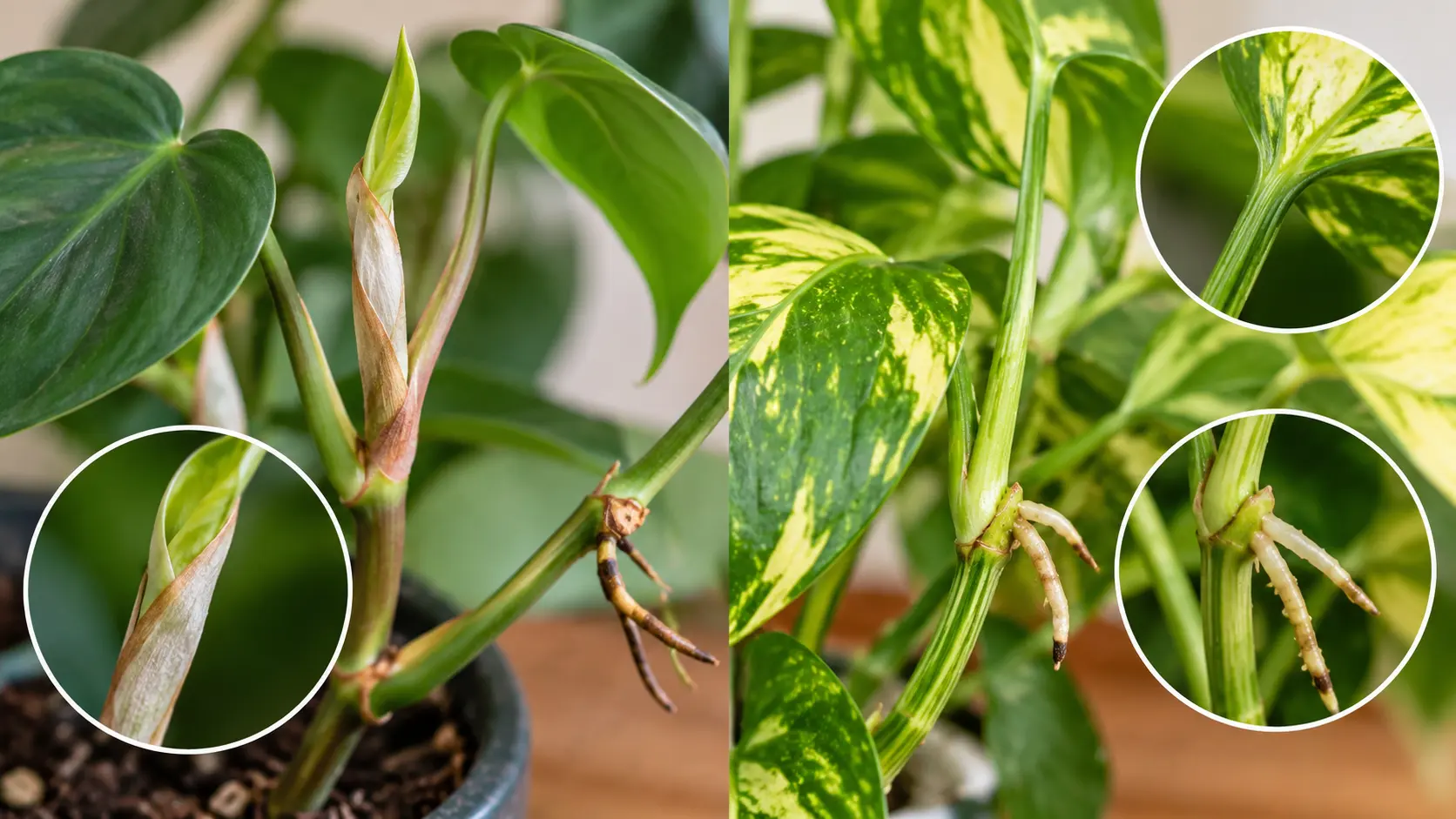
Start with the newest leaf, then inspect the petiole—the stalk connecting a leaf to the vine. These clues are more reliable than colour alone. The North Carolina State University Extension profile of heartleaf philodendron describes the smoother petiole and conspicuous new-growth sheaths that help distinguish it from pothos.
Step-by-step identification flow
- Look at new growth. Heartleaf philodendron commonly produces a new leaf inside a thin, papery sheath called a cataphyll. It dries and falls away. Pothos usually unfurls leaves without the same prominent, free sheath.
- Check the petiole. A groove along the upper surface points towards pothos; a smoother, rounded stalk points towards heartleaf philodendron.
- Inspect the nodes. Both vines form aerial roots. Pothos often has fewer, sturdier roots at a node; philodendron may have several finer roots. Treat this as a supporting clue, not a definitive test.
- Compare leaf texture and shape. Pothos leaves are often thicker and waxier. Heartleaf philodendron leaves are usually softer, thinner and more distinctly heart-shaped.
- Check more than one feature. If the clues conflict, photograph a new leaf, petiole and stem node and compare them with a reliable botanical reference.
Printable ID checklist
- I checked how a new leaf emerges.
- I looked for a groove along the petiole.
- I compared leaf texture and the shape of the leaf base.
- I checked aerial roots at more than one node.
- I used several clues, not colour alone.
| Feature | Pothos (Epipremnum aureum) | Heartleaf philodendron (Philodendron hederaceum) | How to check |
| New leaf emergence | Usually unfurls without a prominent free cataphyll | Often emerges inside a papery cataphyll that later dries | Inspect the newest leaf and stem behind it |
| Petiole | Typically grooved | Typically smoother and not distinctly grooved | Look along the upper side of the leaf stalk |
| Aerial roots | Often fewer, sturdier roots at a node | Often several finer roots at a node | Compare multiple stem nodes |
| Leaf texture | Usually thicker, waxier and glossier | Usually thinner and softer | Compare healthy leaves of similar age |
| Leaf shape | Often broad or spade-like, with a shallower heart-shaped base | Often more distinctly heart-shaped | View the base of a mature leaf |
| New growth colour | Varies by cultivar: green, gold, cream or lime | Also varies, including green, lime and variegated forms | Use colour only after structural clues |
Why mature pothos leaves fool you
Pothos allowed to climb can develop much larger, differently shaped leaves than the small foliage seen on a hanging basket. Therefore, leaf size or a split-looking mature leaf is not enough to rule pothos out. For typical indoor vines, start with new growth and the petiole; for mature climbing plants, confirm several botanical features together.
Names, Genera and Label Mix-Ups: What You Might Actually Be Holding
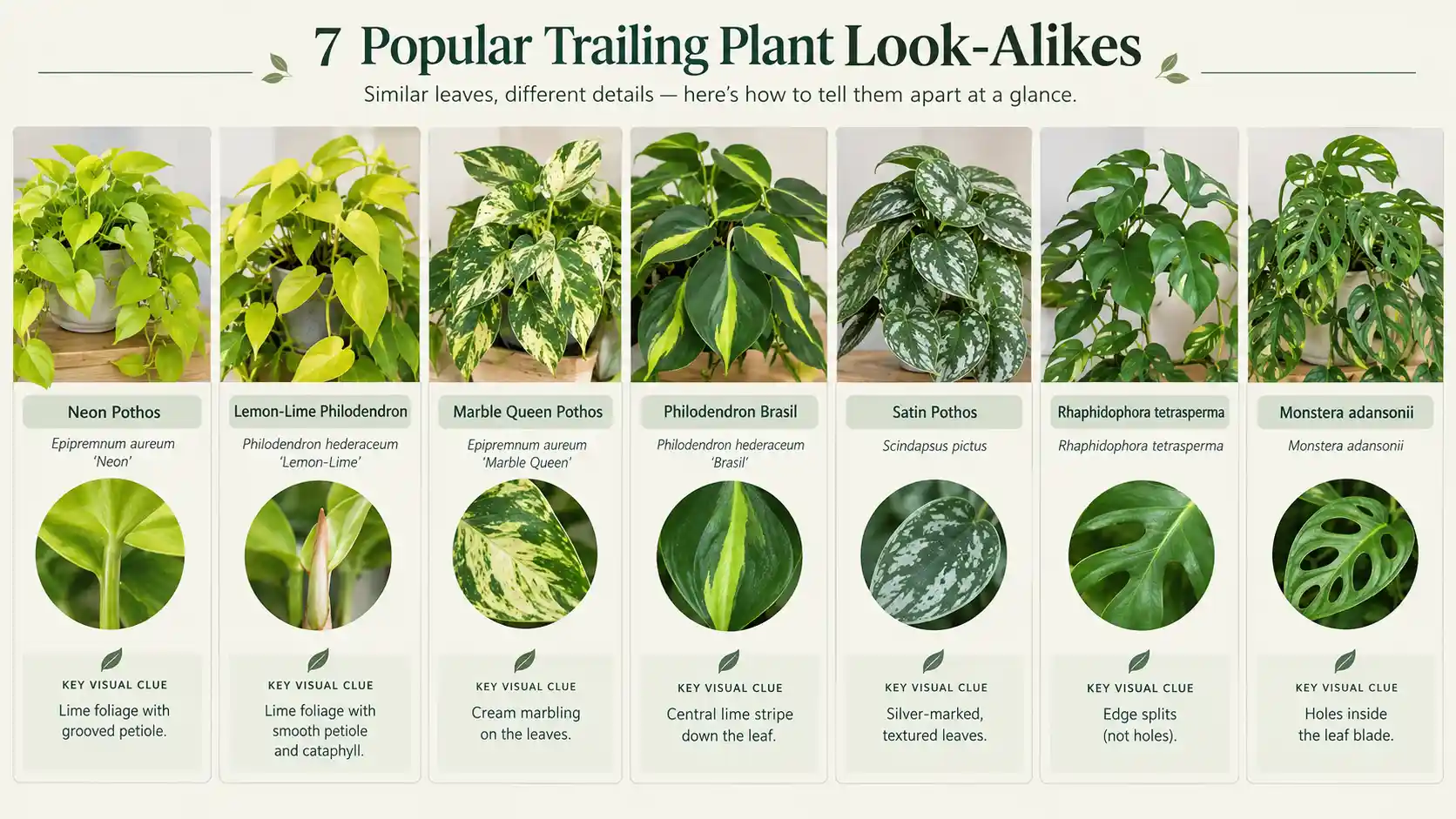
Pothos and philodendron are different genera, even though common nursery labels can blur the difference. Kew’s Plants of the World Online entry for Epipremnum aureum treats that as an accepted species name; older references may use other combinations, so check the botanical name rather than the label alone.
| Common name | What it really is | Giveaway feature |
| Neon pothos | Epipremnum aureum ‘Neon’ | Bright chartreuse leaves; petiole is still typically grooved |
| Lemon-lime philodendron | A lime-coloured Philodendron hederaceum cultivar | Similar colour, but typically a smoother petiole and a new-growth cataphyll |
| Marble Queen pothos | Epipremnum aureum ‘Marble Queen’ | Cream or white marbling over green leaves |
| Philodendron Brasil | A variegated Philodendron hederaceum cultivar | Often a lime or yellow-green central stripe with greener margins |
| Satin pothos | Scindapsus pictus, not Epipremnum | Silver markings and textured leaves |
| Rhaphidophora tetrasperma | A different climbing aroid, often called mini monstera | Mature leaves develop splits from the edges |
| Monstera adansonii | A Monstera species | Holes form within the leaf blade |
Pothos vs philodendron vs monstera vs scindapsus
Satin pothos is a Scindapsus, while Monstera adansonii is recognised by holes within the leaf blade. Rhaphidophora tetrasperma develops edge splits as it matures. The “prettiest pothos” is subjective: Golden has yellow variegation, Marble Queen has cream-and-green marbling, and Neon offers bright lime foliage. In Australia, “philodendron” can also refer to upright landscape plants, not just trailing heartleaf vines; do not apply heartleaf philodendron care advice to every plant sold under that common name.
Pothos vs Philodendron Care in Australian Conditions
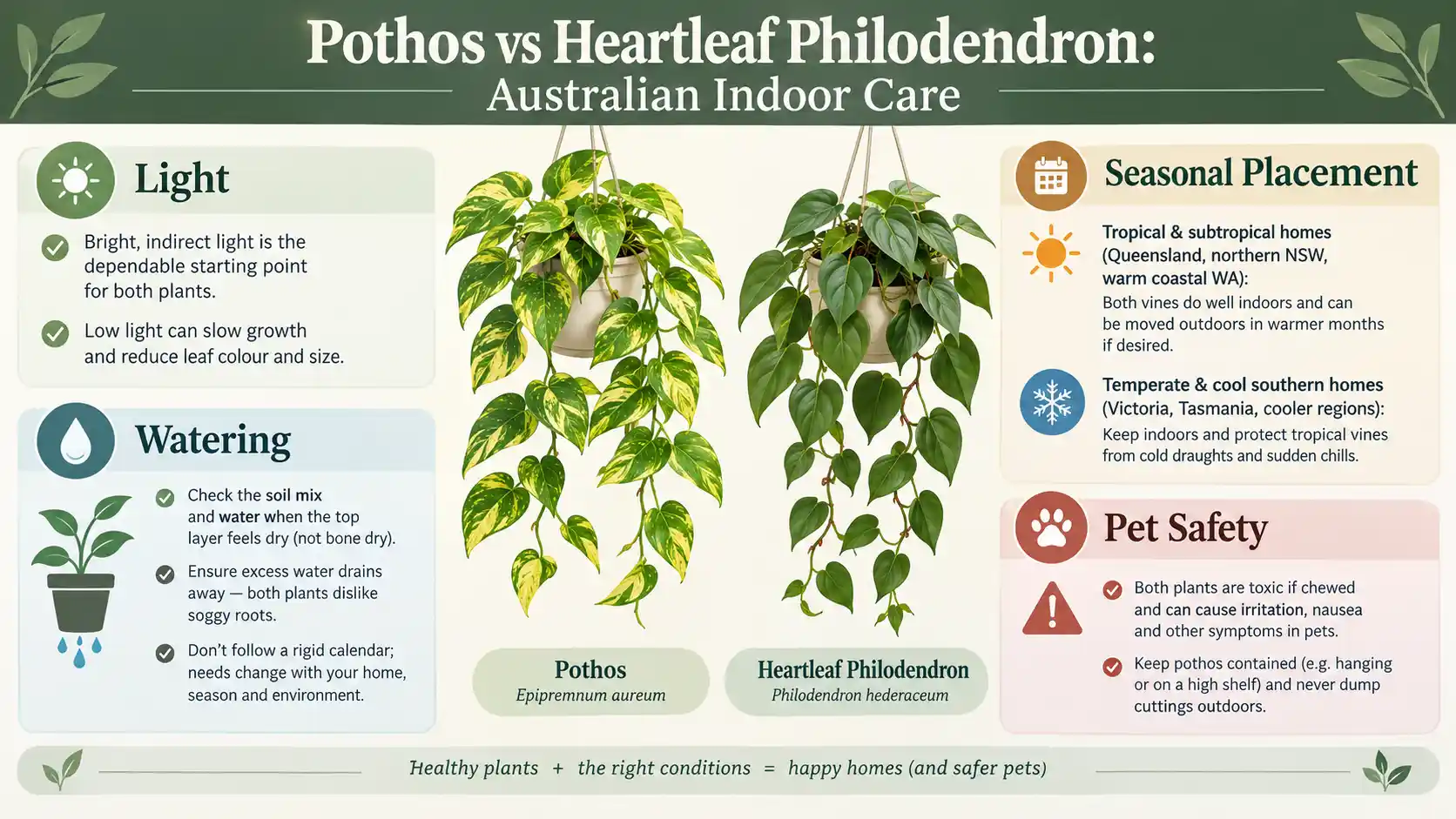
Both are tropical aroids that can grow well indoors with suitable indirect light, a free-draining potting mix and watering matched to how quickly the pot dries. Pothos is often forgiving of a missed watering, but it is not drought-proof; heartleaf philodendron is also adaptable. There is no universal light or growth-rate winner for every cultivar and room.
For species-specific watering, cultivars and propagation, see Leafy Heaven’s Pothos Care Guide Australia. For broader indoor-plant selection, visit the Australian Plants Guide to indoor houseplants and garden design.
Light requirements
- Bright, indirect light: a dependable starting point for both. Protect foliage from intense afternoon sun, especially behind hot glass.
- Low light: both may survive in dimmer rooms, but growth slows and vines can become sparse. Strongly variegated pothos generally needs better light to retain its pattern. No houseplant thrives in complete darkness.
- A little direct sun: gentle morning light may be tolerated after gradual acclimatisation, but harsh Australian sun can scorch foliage.
- Climbing or hanging: either vine can trail from a basket or climb a support. Climbing may encourage larger mature foliage when light and growing conditions are suitable.
Watering, temperature and humidity by region and season
Check the potting mix before watering instead of following a fixed calendar. Water thoroughly when the mix has dried sufficiently for the plant and container, then allow excess to drain. A small pot in a bright Brisbane room may dry much faster than a large pot in a dim Melbourne room.
| Australian setting | Watering approach | Placement and seasonal watch-outs |
| Tropical north | Check the mix frequently in warm weather but do not rewater while it remains wet | Use filtered light and airflow; humid air does not prevent root rot in saturated soil |
| Subtropical coast, including Brisbane | Expect faster drying in warm periods and slower drying in cooler weather | Protect from intense afternoon sun and inspect dense foliage for pests |
| Temperate south, including Melbourne and Adelaide | Reduce watering when winter light and growth decline | Keep away from cold glass, chilly draughts and heater vents |
| Cool-temperate or inland rooms | Let the mix—not outdoor temperature alone—guide watering | Heating and air conditioning can alter drying and make foliage edges brown |
Growth rate, size and propagation
There is no reliable universal winner for “which grows faster”. Cultivar, light, warmth, root health, pot size and season affect both plants. Each can be propagated from a viable stem cutting that includes a node. Root a cutting in clean water or place the node into a lightly moist, free-draining mix; keep most leaves above the water or soil and provide indirect light. A leaf without a node usually will not produce a new vine.
Compact care checklist
- Potting mix: use a quality indoor mix that drains freely and a pot with drainage holes.
- Fertiliser: feed modestly during active growth according to the product label; do not use extra fertiliser to compensate for poor light.
- Pruning: cut above a healthy node to control length and encourage a fuller pot; healthy cuttings can be propagated.
- Climate: protect both from cold draughts and frost. Do not assume a tropical houseplant is suitable for planting outside.
Are Pothos and Philodendron Safe for Cats and Dogs?
No. The ASPCA lists both golden pothos and heartleaf philodendron as toxic to cats and dogs. Their insoluble calcium oxalate crystals can cause mouth pain and irritation, swelling of the lips or tongue, drooling, vomiting and difficulty swallowing. See the ASPCA listings for golden pothos and heartleaf philodendron; philodendron is not the pet-safe alternative.
Touching an intact leaf is not the same as chewing it, although sap or plant material may irritate sensitive skin or eyes. Wash hands after pruning and keep cuttings away from children and pets. If a person chews the plant, remove remaining pieces, rinse the mouth and do not induce vomiting. Contact the Queensland Poisons Information Centre on 13 11 26 for Australian advice; breathing or swallowing difficulty needs urgent help. If a pet chews either plant, contact a veterinarian promptly and avoid home treatments unless advised.
Common Problems and Beginner Mistakes
Most problems relate to watering, low light, cold draughts, dry indoor air or pests. A yellow leaf does not identify the cause by itself: check soil moisture and the pattern of symptoms before changing the routine. The plant-problem troubleshooting guide gives a broader symptom-first method. For pest pictures and identification, use Leafy Heaven’s Garden Pest Identification Guide for Australian Gardens.
| Symptom | Likely cause(s) | What to do | Prevention |
| Yellow leaves | Overwatering, underwatering, weak light, root stress or normal ageing | Check soil moisture and drainage; inspect roots if decline spreads | Water based on mix condition |
| Brown or crispy tips | Dry mix, dry air, excess salts or too much direct sun | Check moisture and fertiliser; move away from harsh sun or vents | Keep care steady and avoid strong fertiliser solutions |
| Leggy growth and small leaves | Insufficient light or an unpruned vine | Move into brighter indirect light and trim long stems | Rotate the pot and prune selectively |
| Fading variegation | Light too low for the cultivar or reversion | Improve indirect light and monitor new leaves | Give strongly variegated forms a brighter position |
| Leaf drop after a cold draught | Temperature change or root stress | Move to a stable spot and check the mix | Keep tropical vines away from cold windows and vents |
| Mealybugs or spider mites | Sap-sucking pests | Isolate the plant, inspect leaf undersides and use a labelled control if needed | Inspect new plants and foliage regularly |
| Fungus gnats | Persistently damp potting mix | Allow suitable drying and consider sticky traps for adults | Avoid permanently wet mix and ensure drainage |
What are the disadvantages of pothos?
Pothos is easy to grow, but it is toxic if chewed, can become leggy in dim rooms, and may lose variegation when light is inadequate. In warm, humid places it can also escape cultivation if cuttings root or vines spread into outdoor vegetation. Keep it contained and prune it responsibly.
Which Should You Choose? A Scenario-Based Verdict
Choose based on the room and household rather than the claim that one plant is always easier. Identify it first, consider the light available, and keep both away from pets that chew foliage.
| Scenario | Better pick | Why |
| Low-light room | Neither has a guaranteed advantage; try a solid-green form | Both tolerate some lower light, but growth slows when it is very dim |
| Cats or dogs that chew plants | Neither | Both are toxic if chewed; choose a confirmed pet-safe plant |
| Hanging basket | Either | Both trail well; choose by foliage and available light |
| Beginner or frequent traveller | Often pothos | It is generally forgiving of a short watering delay, but still needs soil checks |
| Warm, humid northern home | Either indoors, with controlled watering | Both like warmth; prevent waterlogging and outdoor escape |
| Cooler southern home | Either in a warm, bright indoor spot | Protect from cold draughts and reduce watering as growth slows |
| Rental or small apartment | Either | Both can be kept manageable in a draining pot with occasional pruning |
Can you plant them together in one pot or basket?
Yes, if the container drains well and both plants receive similar light and watering. However, one vine may crowd the other, and mixed planting makes identification and pruning harder. If pet safety matters, consider a confirmed non-toxic option such as broadleaf lady palm instead of combining two toxic vines.
Pothos Outdoors in Australia: Weed Risk and Responsible Growing
Keep pothos contained, particularly in warm, wet regions where cuttings may root and vines can spread into surrounding vegetation. Queensland records flag devil’s ivy as a potential environmental weed in some locations, and ABC Gardening Australia advises checking local conditions before planting it. Queensland’s WildNet taxon record is a starting point for checking the current local entry, but match the name carefully: Kew recognises Epipremnum aureum and Epipremnum pinnatum as separate accepted species, while some older or local records may use another combination for cultivated pothos.
| State or territory | Responsible growing advice |
| Queensland | Check the current WildNet record and council guidance; treat escape into warm, humid vegetation as a concern. |
| New South Wales | Check state weed resources and council advice, especially near bushland, wetlands and waterways. |
| Victoria | Check current state and council guidance before outdoor use; contain plants and cuttings. |
| South Australia | Check local advice before outdoor planting; indoor containment is the conservative option. |
| Western Australia | Check state and local guidance; keep vines and discarded cuttings away from natural areas. |
| Northern Territory | Keep pothos contained and verify local advice before outdoor planting. |
| Australian Capital Territory | Keep it indoors and check local advice before outdoor planting or disposal. |
| Tasmania | Grow indoors in a protected position and check local guidance before outdoor cultivation. |
This is a responsible-growing guide, not a definitive statement of each jurisdiction’s current statutory weed classification. A plant can pose environmental risk without being declared or prohibited everywhere, and legal lists can change. Never dump potted plants, cuttings or potting mix in bushland, drains or waterways; follow council green-waste advice and ensure discarded vine pieces cannot regrow.
Conclusion
The pothos vs philodendron question comes down to new-leaf emergence, the petiole and aerial roots—not colour alone. Both suit many Australian indoor spaces with indirect light and soil-based watering, and both are toxic if chewed. Keep pothos contained outdoors, especially in warm, humid regions, and check local weed guidance before planting it outside.
FAQs
1. Are pothos and philodendron the same plant?
No. Pothos usually means Epipremnum aureum, while heartleaf philodendron is Philodendron hederaceum. They are related aroids but different genera, with different identifying features.
2. How do I tell if I have a pothos or philodendron?
Check new growth and the leaf stalk. Heartleaf philodendron often has a papery cataphyll around a new leaf, while pothos typically has a grooved petiole. Leaf texture and aerial roots offer supporting clues.
3. Do pothos or philodendron grow faster?
There is no universal winner. Growth depends on cultivar, light, warmth, watering, root health and season. Pothos can be vigorous in favourable conditions, but compare plants grown in similar environments rather than relying on fixed growth claims.
4. Can I put philodendron and pothos together?
Yes, if the pot drains well and both receive suitable light and watering. The vines can crowd each other, and mixed planting makes identification and pruning harder. Keep them away from pets that chew plants.
5. Why is pothos called devil’s ivy?
The name reflects pothos’s reputation for surviving less-than-ideal indoor conditions and growing readily from cuttings. It does not mean the plant can grow in complete darkness; low light limits growth and can reduce variegation.
6. Are pothos plants poisonous to touch?
Touching an intact leaf is not the main poisoning risk, but sap or plant material may irritate sensitive skin or eyes. Chewing can cause painful mouth irritation. Wash hands after pruning and keep cuttings away from children and pets.
7. Is pothos low-maintenance?
Generally, yes. Pothos is forgiving, but it still needs indirect light, drainage, soil checks and occasional pruning. It is not pet-safe, and it should be kept contained outdoors.