
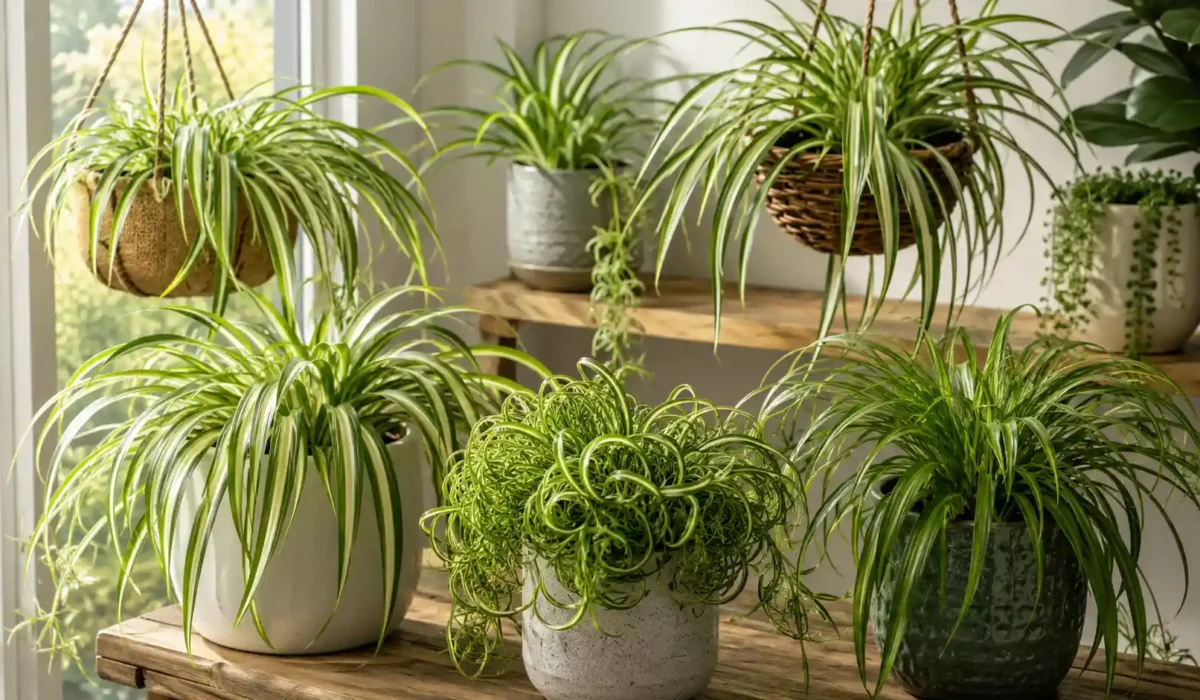
Types of Spider Plants: Varieties & Care Guide
Introduction
Types of spider plants refer to the different named cultivars and forms of Chlorophytum comosum, a popular indoor plant known for its arching leaves and easy care. Although there is only one main species commonly grown as a houseplant, there are more than 200 named cultivars that differ mainly in leaf colour, variegation patterns, and growth habits. Popular varieties include Vittatum, Variegatum, Bonnie, Zebra, Hawaiian, Ocean, and Fire Flash. This guide explains how to identify spider plant varieties, understand their differences, and choose the right type based on appearance, space, and growing conditions. Beyond their attractive foliage and easy-care nature, spider plants are also valued for their decorative appeal and potential indoor benefits. Learn more about spider plant benefits, care requirements, and indoor uses in our detailed guide.
Quick Summary
- There are more than 200 named spider plant varieties, but only around 10–15 are commonly available commercially.
- Most differences between varieties come from leaf patterns, including white stripes, cream edges, and curly growth.
- Popular types include Vittatum, Variegatum (Reverse), Bonnie, Zebra, Hawaiian, Ocean, and Fire Flash.
- All true Chlorophytum comosum varieties have similar basic care requirements.
- Choosing the best variety depends mainly on light conditions, available space, and preferred appearance.
What Is a Spider Plant? (Chlorophytum Comosum Explained)
The spider plant (Chlorophytum comosum) is a long-lived evergreen perennial from the Asparagaceae family, recognised for its narrow arching leaves and small plantlets that grow on long stems. The species is native to southern and tropical Africa but has become naturalised in many warm regions, including parts of Australia.
The spider plant scientific name is Chlorophytum comosum, while its botanical name is also written as Chlorophytum comosum. It is commonly called the airplane plant, spider ivy, ribbon plant, or spider plant because of the small baby plants that appear on hanging stems and resemble tiny spiders.
Spider plants are popular indoor plants because they tolerate a wide range of conditions and adapt well to homes, offices, hanging baskets, and shaded outdoor areas in suitable climates.
Key botanical details:
| Feature | Information |
| Scientific name | Chlorophytum comosum |
| Plant family | Asparagaceae |
| Native range | Southern and tropical Africa |
| Common names | Spider plant, airplane plant, ribbon plant |
| Growth type | Evergreen perennial |
Although many spider plants look different, most commercially sold varieties belong to the same species. Their differences come from selective breeding and natural mutations affecting leaf colour, stripe placement, and leaf shape.
How Many Types of Spider Plants Are There?
There are more than 200 named spider plant varieties, but only a smaller selection is commonly grown and sold. The large number includes registered cultivars, regional names, and variations that are rarely available in nurseries.
When people search for “what are all the types of spider plants,” they usually want to know about the practical varieties they can buy. In Australia, most garden centres and online plant sellers offer around 10–15 commonly recognised types.
The main differences between spider plant varieties include:
- Leaf variegation: The location and colour of white, cream, or yellow markings.
- Growth habit: Straight arching leaves compared with compact or curly forms.
- Plant size: Some varieties remain small, while others develop longer leaves.
- Stem colour: Certain types, such as Fire Flash, have distinctive orange stems.
Although there are many spider plant species in the broader Chlorophytum genus, the typical houseplant varieties discussed by gardeners are mainly forms of Chlorophytum comosum.
Main Types of Spider Plants (With Descriptions)
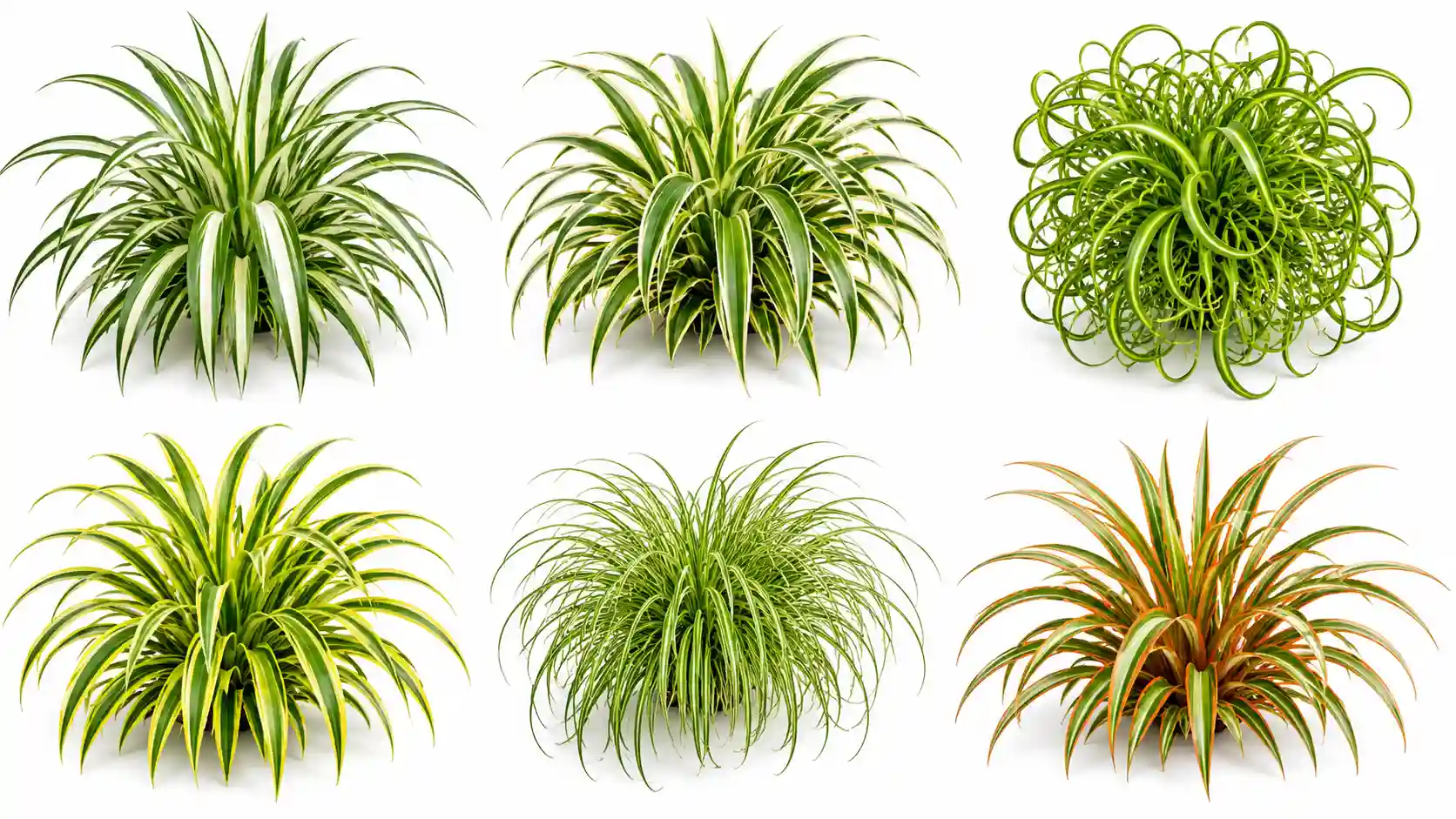
Vittatum (Classic Variegated Spider Plant)
Vittatum is the most recognised and widely grown spider plant variety. It has long green leaves with a broad white or cream stripe running through the centre of each leaf.
This classic appearance is often considered the standard spider plant look and is commonly found in homes, offices, and hanging baskets.
Identifying features:
- Green outer leaf edges
- White or cream central stripe
- Long arching leaves
- Moderate growth rate
A mature Vittatum spider plant usually reaches around 30–45 cm in height and width, depending on light, pot size, and growing conditions.
Variegatum / Reverse Spider Plant
Variegatum, often called the reverse spider plant, has the opposite colour pattern to Vittatum. Instead of a white stripe in the middle, it has cream or white edges surrounding a green central stripe.
The term reverse variegated spider plant refers to this reversed leaf pattern.
Reverse spider plant vs spider plant comparison:
- Vittatum: white centre stripe with green edges
- Variegatum: cream edges with green centre
Variegatum generally grows slightly more compactly than Vittatum, making it suitable for smaller indoor spaces.
Bonnie (Curly Spider Plant)
Bonnie is a curly spider plant variety known for its twisted, curled leaves. It is not a separate species but a growth-habit variation of Chlorophytum comosum.
The curled leaves give Bonnie a fuller and more compact appearance compared with traditional straight-leaved spider plants.
Identifying features:
- Curly or spiralled leaves
- Green and cream striping
- Compact growth habit
- Suitable for shelves and small spaces
A typical Bonnie spider plant grows around 20 cm tall, although trailing stems can extend further.
Zebra Spider Plant
The Zebra spider plant is recognised for its bright-edged leaves, usually featuring strong white or yellow markings along the margins.
It is sometimes confused with other striped Chlorophytum plants, and botanical references may associate similar forms with species such as Chlorophytum capense or Chlorophytum laxum depending on classification.
Zebra spider plants are less common in nurseries compared with Vittatum or Bonnie.
Identifying features:
- Bright white or yellow leaf edges
- Compact spreading growth
- Wider leaves than many traditional forms
They usually remain smaller, often around 15–20 cm tall, making them useful for hanging baskets.
Hawaiian Spider Plant
The Hawaiian spider plant is often sold under names such as “Golden Glow.” It has attractive golden-green colouring and a compact growth habit.
A less commonly discussed point is that some horticultural sources suggest Hawaiian spider plants may represent an unstable juvenile form of Variegatum rather than a completely fixed cultivar. This means colour patterns may change as the plant matures.
Identifying features:
- Golden-green leaves
- Compact shape
- Variable colour expression
Typical size ranges from 15–30 cm indoors.
Ocean Spider Plant
Ocean spider plant is a compact variety with fine cream margins and slightly wavy leaves.
It is valued for its smaller size and neat appearance, making it suitable for desks, shelves, and small decorative pots.
Identifying features:
- Thin cream leaf edges
- Slightly wavy foliage
- Compact growth
It generally reaches around 15–20 cm in height.
Fire Flash (Chlorophytum orchidastrum)
Fire Flash is often grouped with spider plants but is technically a different species: Chlorophytum orchidastrum.
Unlike traditional spider plants, it has broad dark green leaves and striking orange petioles (leaf stems), creating a tropical appearance.
Identifying features:
- Bright orange stems
- Broad green leaves
- Upright growth habit
Fire Flash usually grows around 20–30 cm tall and is often chosen as a statement indoor plant.
Solid Green / All-Green Spider Plant
The solid green spider plant has no white or cream variegation. Although it represents a more natural-looking form, it is less common in commercial plant sales because variegated varieties are more popular.
It typically has:
- Fully green leaves
- Strong growth ability
- Classic spider plant structure
Less common types include Bichetii Grass and Capense, which are related Chlorophytum plants sometimes sold alongside spider plants in Australia.
Spider Plant Colour Guide
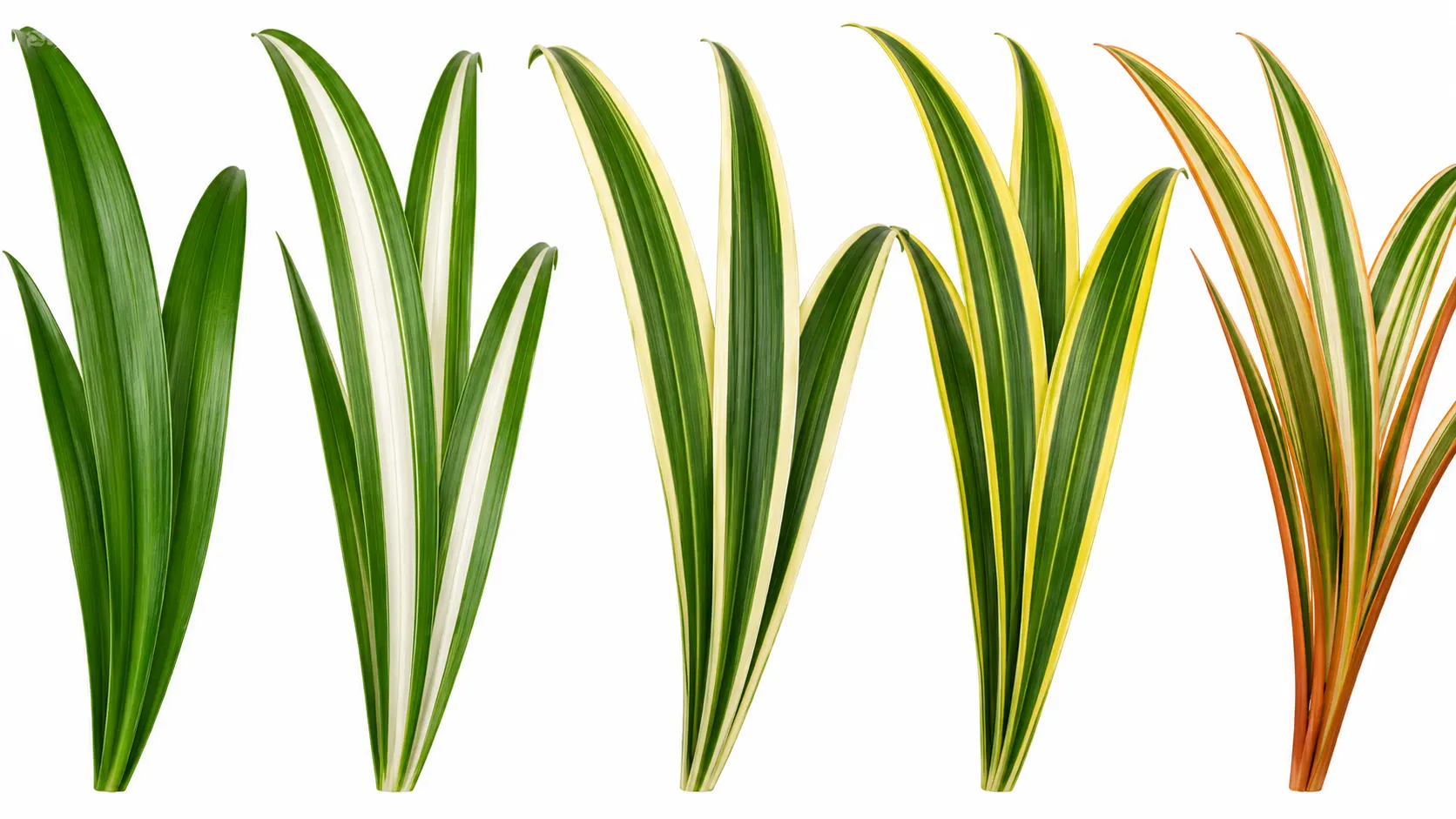
Spider plant colours are one of the easiest ways to identify different varieties. Most colour differences come from leaf variegation, which describes where green and lighter pigments appear on the leaves. True spider plants do not naturally develop purple foliage, despite searches for “purple spider plant” being common online.
Common spider plant colour patterns include:
- Green spider plant: Solid green leaves without variegation.
- White or cream-striped spider plant: Usually Vittatum or similar cultivars with central stripes.
- Cream-edged spider plant: Common in Variegatum (Reverse).
- Yellow-edged spider plant: Often associated with Zebra-type forms.
- Orange-stemmed spider plant: Fire Flash (Chlorophytum orchidastrum).
- Purple spider plant: Not a recognised standard spider plant colour; plants advertised this way are usually misidentified or unrelated species.
Leaf colour can also change depending on growing conditions. Low light may reduce variegation, causing some plants to produce greener leaves. This process is called reversion, where a variegated plant produces less-variegated growth to increase photosynthesis.
Popular Spider Plant Varieties at a Glance
| Variety | Leaf Pattern | Growth Habit | Approx. Size | Best For |
| Vittatum | Green leaves with white centre stripe | Arching | 30–45 cm | Beginners |
| Variegatum (Reverse) | Cream edges with green centre stripe | Arching | 25–35 cm | Contrast displays |
| Bonnie | Curled striped leaves | Compact, curly | Around 20 cm | Small spaces |
| Zebra | Yellow/white edges | Wide, low growth | 15–20 cm | Hanging baskets |
| Hawaiian | Golden-green colouring | Compact | 15–30 cm | Colour variation |
| Ocean | Fine cream margins | Wavy, compact | 15–20 cm | Petite pots |
| Fire Flash | Solid green leaves with orange stems | Upright | 20–30 cm | Statement plants |
Curly Spider Plant vs Straight Spider Plant
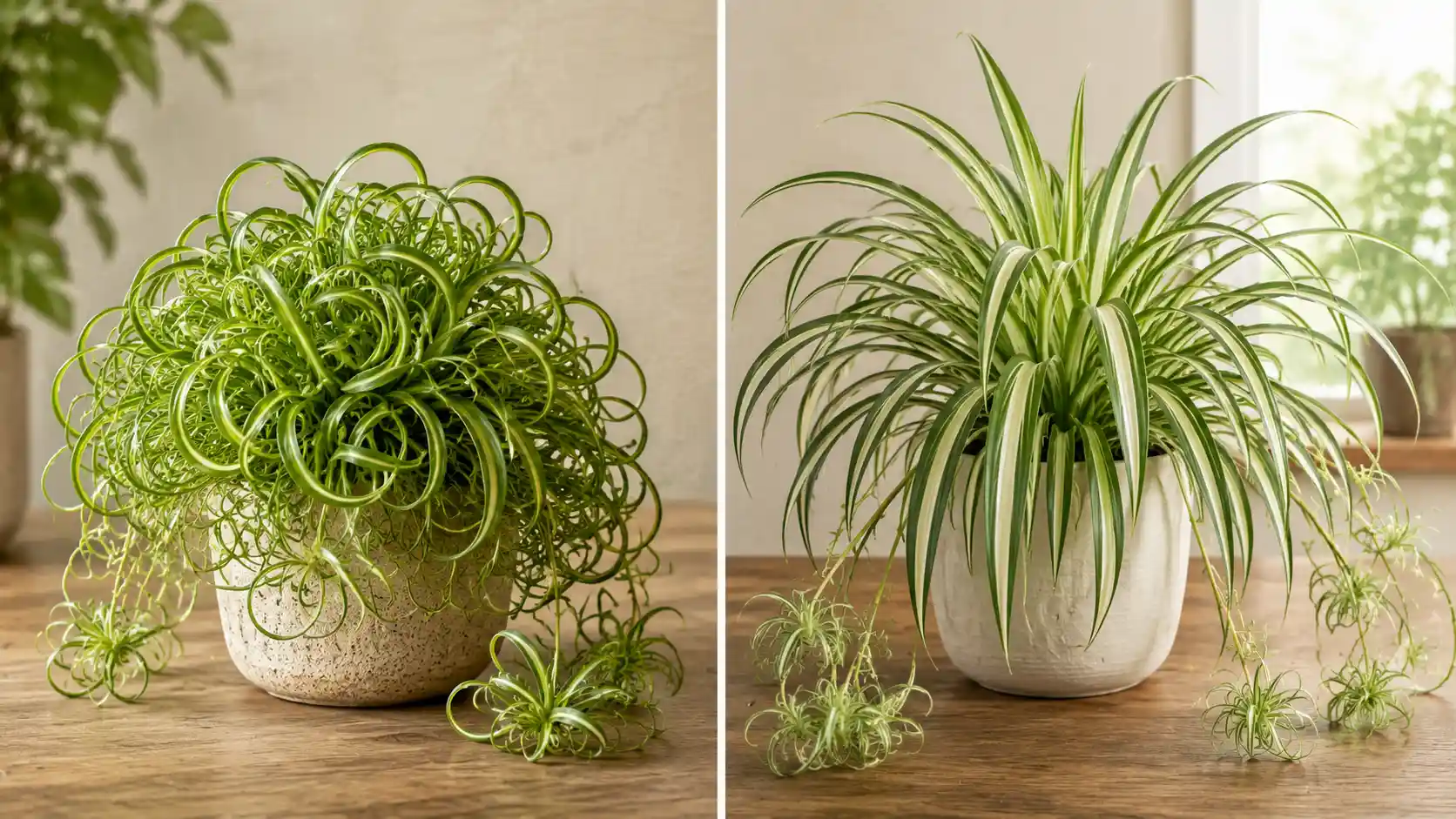
The difference between a curly spider plant and a regular spider plant is mainly the leaf shape, not the species. Bonnie is the best-known curly spider plant and is a cultivated form of Chlorophytum comosum with naturally twisted leaves.
A straight spider plant, such as Vittatum, produces long arching leaves that grow outward and downward. Curly varieties grow more compactly because their leaves twist and overlap.
| Feature | Curly Spider Plant (Bonnie) | Straight Spider Plant (Vittatum) |
| Leaf shape | Twisted and curled | Long and arching |
| Species | Usually Chlorophytum comosum | Chlorophytum comosum |
| Growth style | Compact | Trailing and spreading |
| Best location | Shelves, desks, small pots | Hanging baskets |
In our experience growing spider plants indoors, Bonnie often appears fuller in smaller containers, while Vittatum creates a more traditional cascading display.
The care requirements are almost identical. Both need bright indirect light, well-draining soil, and careful watering.
What Plant Is Often Mistaken for a Spider Plant?
Several plants look similar to spider plants because they have narrow, arching leaves or striped foliage. However, they belong to different plant groups. Another popular indoor plant that is sometimes confused with spider plants is Dracaena. Learn about Dracaena Marginata benefits, care needs, and indoor growing requirements to understand how these plants differ.
Common spider plant lookalikes include:
Dracaena Varieties
Variegated dracaenas are often mistaken for spider plants because they have long striped leaves. However, dracaenas usually grow from a central stem or cane, while spider plants form a clump of leaves emerging directly from the soil.
Key differences:
- Dracaena: upright stem growth
- Spider plant: grass-like clumping growth
- Dracaena leaves are usually thicker and more rigid
Spider Lily
Spider lilies are unrelated flowering plants that share a similar common name. They belong to different genera and are not types of spider plants.
Spider lilies typically produce larger flowers and broader leaves compared with Chlorophytum comosum.
Variegated Ornamental Grasses
Some ornamental grasses have similar striped leaves but usually lack the spider plant’s long runners that produce baby plants.
A simple identification method is to look for plantlets on long stems. This feature is one of the strongest indicators that a plant is a true spider plant.
Which Spider Plant Variety Is Best? (Choosing the Right One)
The best spider plant variety depends on the growing environment rather than one variety being universally superior. Choosing the right indoor plant depends on your home environment, available light, and design goals. Our Australian plants guide covering indoor houseplants and garden design provides more ideas for selecting suitable greenery.
For beginners, Vittatum is often the most common and reliable choice because it grows quickly and handles a range of indoor conditions.
Choose based on your needs:
- For beginners: Vittatum or Variegatum
- For small spaces: Bonnie or Ocean
- For hanging baskets: Vittatum or Zebra
- For unusual foliage: Fire Flash
- For compact displays: Bonnie or Hawaiian
When choosing a spider plant for indoors, consider:
- Available light levels
- Pot size
- Whether you prefer trailing or upright growth
- Household pets and placement areas
Elemo Baker recommends selecting the variety based on your room conditions first, then choosing the appearance you prefer. A healthy plant in suitable light will usually outperform a variety placed in unsuitable conditions.
Plant Size
Spider plant size varies slightly between varieties, but most indoor plants remain relatively compact.
Typical mature sizes:
- Vittatum: 30–45 cm tall and wide
- Variegatum: 25–35 cm
- Bonnie: Around 20 cm, with trailing stems
- Zebra: 15–20 cm
- Fire Flash: 20–30 cm
Indoor plants usually remain smaller because of limited root space and controlled conditions. Outdoor spider plants grown in warm Australian climates may spread wider and produce more plantlets.
Factors affecting size include:
- Pot size
- Light availability
- Watering consistency
- Soil quality
- Temperature
In warm-temperate and subtropical parts of Australia, spider plants can grow outdoors in shaded areas protected from harsh afternoon sun.
Growth Rate
Spider plants are generally moderate-to-fast growers when provided with suitable conditions. During active growing seasons, they can produce new leaves and baby plants regularly.
Growth patterns:
- Spring and summer: Fastest growth period
- Autumn: Growth gradually slows
- Winter: Reduced growth, especially indoors in cooler areas
Varieties may grow at slightly different rates. Vittatum and common green forms often grow faster than compact types like Zebra or Ocean.
Factors that encourage healthy growth include:
- Bright indirect light
- Regular but controlled watering
- Nutrient-rich soil
- Adequate root space
Spider plants commonly produce “babies” or plantlets once mature, especially when receiving good light and consistent care.
Care Guide for Spider Plant Varieties
All true spider plant varieties share similar care needs because most belong to the same species, Chlorophytum comosum.
Watering
Spider plants prefer evenly moist soil but do not tolerate constantly wet roots.
Best practice:
- Water when the top few centimetres of soil feel dry.
- Reduce watering during cooler months.
- Avoid leaving water sitting in drainage trays.
Overwatering is one of the most common beginner mistakes.
Light
Spider plants grow best in bright indirect light.
Ideal conditions:
- Filtered sunlight
- Bright indoor rooms
- Protection from strong afternoon sun
Too much direct sunlight can scorch leaves, while very low light can reduce variegation.
Soil
Use a loose, well-draining potting mix.
A suitable mix should contain:
- Quality indoor potting soil
- Organic matter
- Materials that improve drainage
Good drainage prevents root problems.
Fertilising
Spider plants benefit from light feeding during the growing season.
A balanced indoor plant fertiliser applied during spring and summer can support leaf production and plantlet growth.
Avoid excessive fertiliser because salt buildup can cause brown leaf tips.
Pruning
Pruning helps maintain appearance and removes damaged foliage.
Remove:
- Brown leaf tips
- Yellowing older leaves
- Excess plantlets if the plant becomes crowded
Climate Tolerance for Australian Conditions
Spider plants prefer moderate temperatures and perform well indoors across most Australian regions.
They tolerate:
- Warm indoor environments
- Humidity changes
- Shaded outdoor areas in suitable climates
Protect them from:
- Frost
- Extreme heat
- Strong direct sunlight
As of July 2026, indoor gardening recommendations continue to favour well-draining soil and controlled watering as the most reliable methods for maintaining healthy spider plants.
Do Spider Plants Really Purify the Air? (Myth vs Fact)
Spider plants are often promoted as natural air-purifying plants, but the claim that they remove 78% of airborne mould is not supported by modern scientific evidence. This percentage comes from a misunderstanding of the 1989 NASA Clean Air Study, which tested how certain plants interacted with volatile organic compounds (VOCs) in sealed laboratory chambers, not how they remove mould spores in normal homes.
The NASA study showed that plants could absorb some airborne chemicals under controlled conditions. However, real homes have much larger air volumes, ventilation systems, and many other factors that make the effect much smaller. While spider plants should not replace proper ventilation or air filtration, indoor plants can still contribute to a healthier and more enjoyable living environment. Explore the benefits of indoor plants and the science behind indoor greenery.
A later analysis by researchers including Cummings and Waring (2020) found that typical houseplant numbers are unlikely to produce meaningful indoor air-quality improvements compared with normal ventilation.
Spider plants can still provide benefits, including:
- Adding greenery and visual appeal to indoor spaces
- Supporting a connection with nature
- Increasing humidity slightly through natural water release
- Encouraging indoor gardening habits
The accurate takeaway is that spider plants are excellent decorative houseplants, but they should not replace ventilation, filtration systems, or proper mould prevention methods.
Common Spider Plant Problems Across Varieties
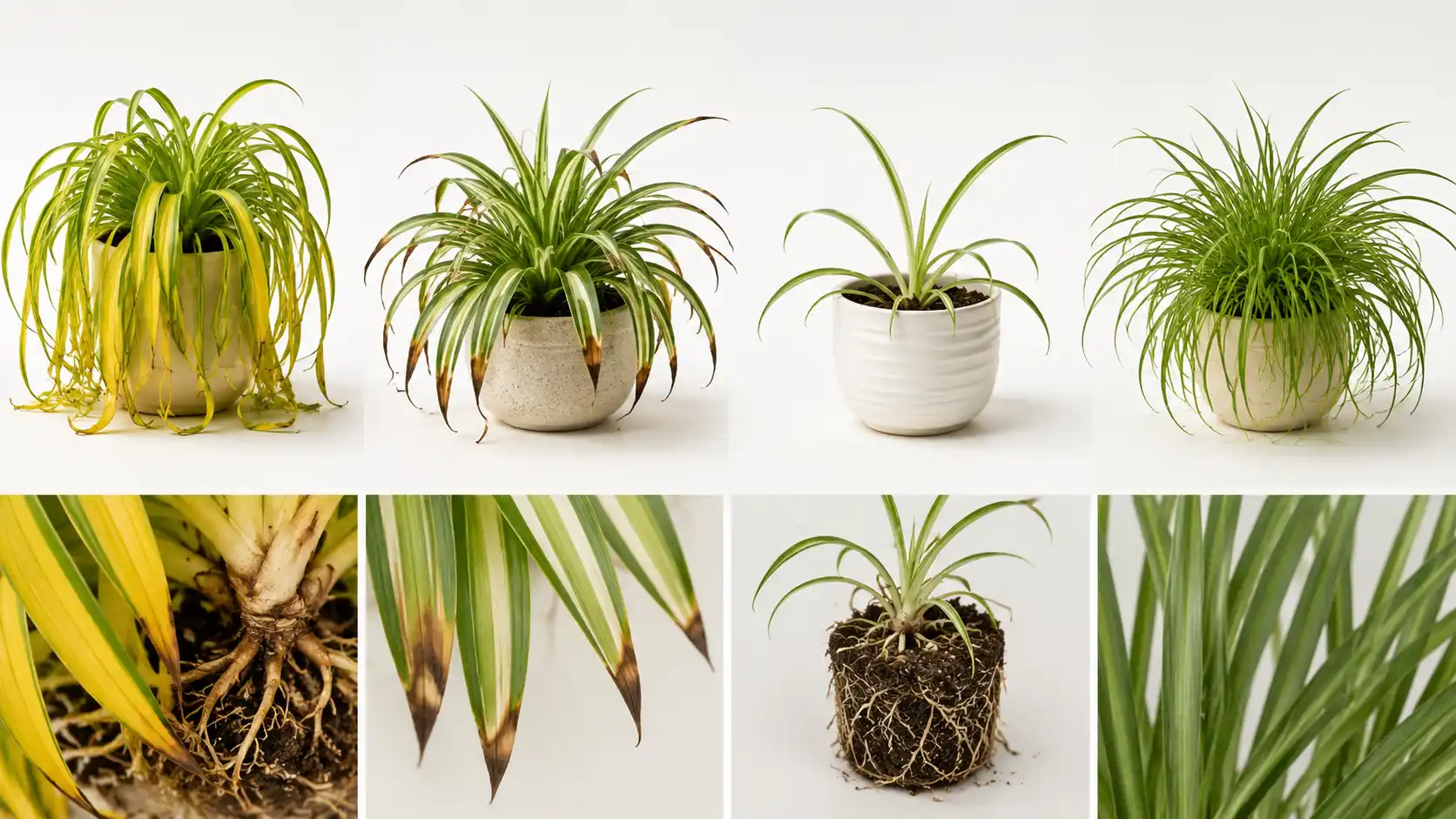
Although spider plant varieties differ in appearance, most problems are caused by the same environmental issues. Identifying the cause early helps prevent permanent damage.
Yellowing Leaves
Yellow leaves are usually caused by overwatering, poor drainage, or natural ageing of older leaves.
Common causes:
- Soil staying wet for too long
- Containers without drainage holes
- Reduced light levels
- Older leaves naturally declining
How to fix it:
- Allow the soil to dry slightly between watering.
- Check that excess water can drain freely.
- Move the plant to brighter indirect light if growth is weak.
How to prevent it:
Use a well-draining potting mix and avoid watering on a fixed schedule when the soil is still moist.
Brown Leaf Tips
Brown tips are one of the most common spider plant issues, especially in varieties such as Vittatum.
Possible causes include:
- Fluoride sensitivity from tap water
- Chlorine buildup
- Low humidity
- Excess fertiliser salts
How to fix it:
- Trim damaged leaf tips with clean scissors.
- Use filtered, rain, or rested water if tap water causes repeated problems.
- Flush the soil occasionally to remove mineral buildup.
How to prevent it:
Avoid overfertilising and maintain consistent watering habits.
Slow Growth or No Plantlets
A spider plant that stops growing or fails to produce baby plants may not be receiving enough energy.
Common reasons:
- Insufficient light
- Root-bound conditions
- Lack of nutrients
- Seasonal dormancy
How to fix it:
- Move the plant to brighter indirect light.
- Repot if roots are tightly crowded.
- Feed lightly during active growth periods.
A mature spider plant usually produces more plantlets when it has adequate light and stable growing conditions.
Loss of Variegation
Some variegated spider plants may gradually produce greener leaves. This is known as reversion.
Why it happens:
- Low light encourages the plant to produce more chlorophyll.
- Green growth can photosynthesise more efficiently.
How to fix it:
- Increase bright indirect light.
- Remove completely green shoots if maintaining variegation is important.
Variegated varieties such as Vittatum and Variegatum need enough light to maintain their characteristic patterns.
Beginner Mistakes When Choosing or Growing Spider Plant Varieties
Many spider plant problems begin with incorrect expectations about varieties. Although most types have similar care requirements, their appearance and growth habits can influence how they perform in a home. Variegated foliage is highly valued among indoor plant collectors, but maintaining colour patterns requires suitable growing conditions. Similar challenges can be seen with other variegated houseplants such as Monstera Albo Variegata.
Common beginner mistakes include:
Assuming All Varieties Need Identical Light Levels
While all spider plants prefer bright indirect light, variegated types often need slightly brighter conditions to maintain strong colouring.
For example:
- Vittatum may lose contrast in low light.
- Variegatum may become greener.
- Compact varieties may grow slowly in dark rooms.
Overwatering Drought-Tolerant Varieties
Spider plants can tolerate occasional dryness because their thick roots store water. However, this does not mean they should remain constantly wet.
A common mistake is watering frequently without checking soil moisture.
Signs of overwatering include:
- Yellow leaves
- Soft roots
- Slow growth
Expecting Purple or Unusual Leaf Colours
Searches for “purple spider plant” are common, but true Chlorophytum comosum varieties do not naturally produce purple foliage.
Most authentic spider plant colours include:
- Green
- White
- Cream
- Yellow
- Orange stems in Fire Flash
Plants advertised with unusual colours may be incorrectly labelled or may belong to another species.
Choosing Appearance Over Growing Conditions
A plant variety should match the available environment.
For example:
- A trailing Vittatum may suit a hanging basket.
- Bonnie may work better on a shelf.
- Fire Flash may need a location where its orange stems can be appreciated.
Matching the plant to the space usually leads to better long-term growth.
Conclusion
Spider plant varieties differ mainly in their leaf patterns, colours, and growth habits rather than their basic care requirements. The most popular types of spider plants include Vittatum, Variegatum, Bonnie, Zebra, Hawaiian, Ocean, and Fire Flash, each offering a different appearance for indoor plant collections.
The easiest way to identify a spider plant variety is to look at the leaf pattern first, including stripe placement, edge colouring, and leaf shape. After identification, match the plant with suitable light, pot size, and growing conditions.
Whether choosing a classic striped spider plant, a curly Bonnie variety, or a colourful Fire Flash, these adaptable plants remain among the easiest indoor plants for beginners and experienced growers alike.
FAQs: Types of Spider Plants
How many types of spider plants are there?
There are more than 200 named spider plant varieties, but only around 10–15 are commonly available commercially. Most differences involve leaf colour, variegation patterns, and growth habits rather than major care requirements.
What is the most common spider plant variety?
The most common spider plant variety is Vittatum (Chlorophytum comosum). It is recognised by its green leaves with a central white or cream stripe and is widely sold as a beginner-friendly indoor plant.
What’s the difference between a curly spider plant and a regular spider plant?
A curly spider plant, usually called Bonnie, has twisted and curled leaves, while regular spider plants such as Vittatum have long straight arching leaves. Both are generally forms of Chlorophytum comosum and require similar care.
Do all spider plant varieties need the same care?
Most spider plant varieties need similar care because they belong to the same species. They prefer bright indirect light, well-draining soil, moderate watering, and protection from extreme temperatures.
Why do spider plants lose their white stripes?
Spider plants lose white stripes when they receive insufficient light or when green reversion occurs. Increasing bright indirect light can help maintain stronger variegation in many cultivars.
Is the Hawaiian spider plant a true separate variety?
The Hawaiian spider plant is sold as a distinct type, but some horticultural sources suggest it may be an unstable form related to Variegatum rather than a completely separate fixed cultivar. Its colour pattern can vary as it matures.