

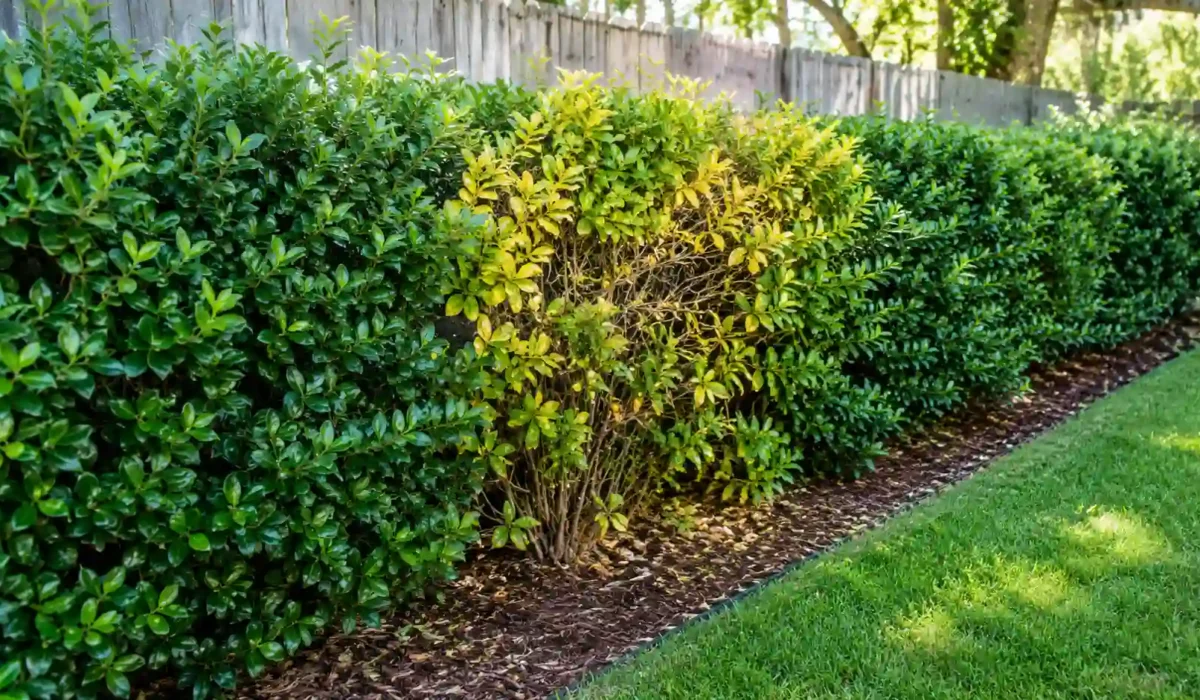
Murraya Hedge Problems in Australia: Causes & Fixes
Yellow leaves, bare patches and dead plants are among the most frustrating murraya hedge problems because several different causes can produce similar symptoms. Murraya (Murraya paniculata), also called mock orange or orange jasmine, can suffer when soil stays wet, becomes too dry, nutrients become unavailable, roots are damaged, or pests attack new growth. The quickest way to narrow it down is to look at the pattern of damage first, then test the soil, roots and foliage before reaching for fertiliser. That matters because adding feed will not repair waterlogging, chemical injury or serious root loss.
Quick Summary
- One plant, one section or the whole hedge? Where damage occurs often narrows the cause faster than yellow colour alone.
- Common possibilities include water stress, poor drainage, nutrient problems, root damage and pests such as scale or leaf miners.
- Replacement plants often fail because the original soil, drainage or root problem was never corrected.
- Murraya is a favoured host of Asian citrus psyllid, an exotic pest not currently established in Australia.
Where Is the Problem Showing Up? A Quick Triage
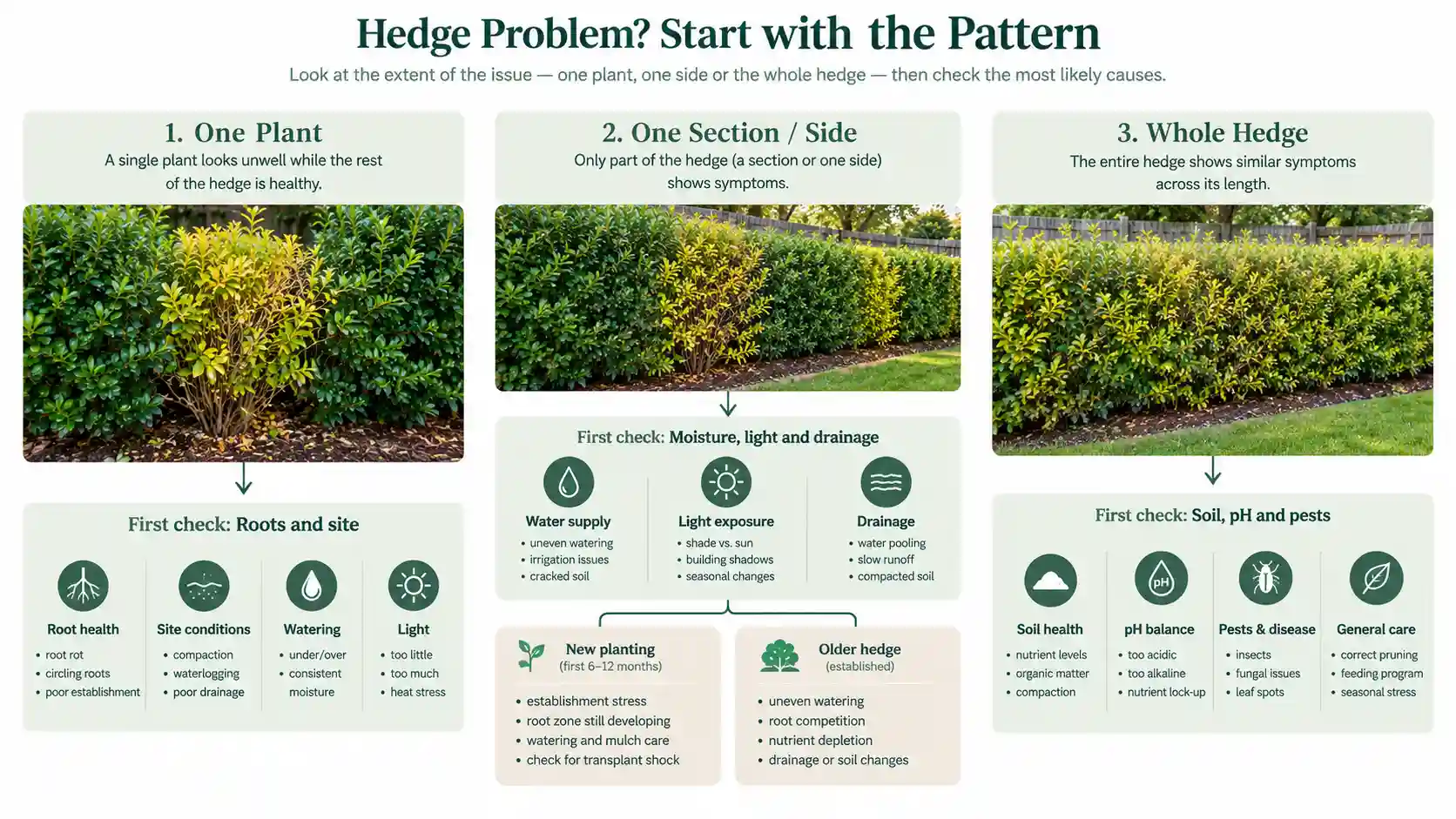
Before treating anything, step back and map the damage. A problem affecting one plant often points to a local site issue, while a uniform decline across the hedge raises watering, nutrition or pest questions.
| Pattern | Likely causes | First check |
| One plant | Poor root establishment, rubble, drainage pocket, chemical exposure | Dig beside the root ball and compare it with a healthy neighbour |
| One side or aspect | Sun/heat exposure, runoff, uneven moisture | Compare light, soil moisture and drainage with the healthy side |
| Whole hedge | Watering, nutrition, soil pH, widespread pests | Check soil moisture, pH and new growth |
| New planting, under 2 years | Transplant stress, shallow roots, poor soil, watering errors | Check planting depth, roots and moisture |
| Older hedge | Root competition, pruning stress, pests, declining soil conditions | Inspect stems, roots and the hedge interior |
These are diagnostic scenarios, not first-hand Leafy Heaven cases. A recent Bunnings discussion, for example, described more than 70 new Murraya plants growing well on east and north-east sides while a north-facing section yellowed and died; the discussion focused on differences in soil, moisture and heat exposure rather than assuming a fertiliser shortage.
One plant or one section
Start with the root zone. Check for compacted soil, buried rubble, poor drainage, root damage or a plant that never established properly. Chemical runoff is also worth considering when the damaged area follows a sprayed edge.
For a broader pattern-first diagnostic method, see the Leafy Heaven plant problems and troubleshooting guide.
One side or low spot
A low section of the garden can remain wet longer after rain. The opposite problem can occur beside a hot wall or exposed fence where soil dries rapidly. Compare the failing section with a healthy one rather than treating the entire hedge identically.
Whole hedge
When nearly every plant looks pale, review watering, soil condition, pH and feeding history before assuming disease. High-pH soils can reduce the availability of several micronutrients, while wet soil can also interfere with nutrient uptake.
Why Are My Murraya Leaves Turning Yellow?
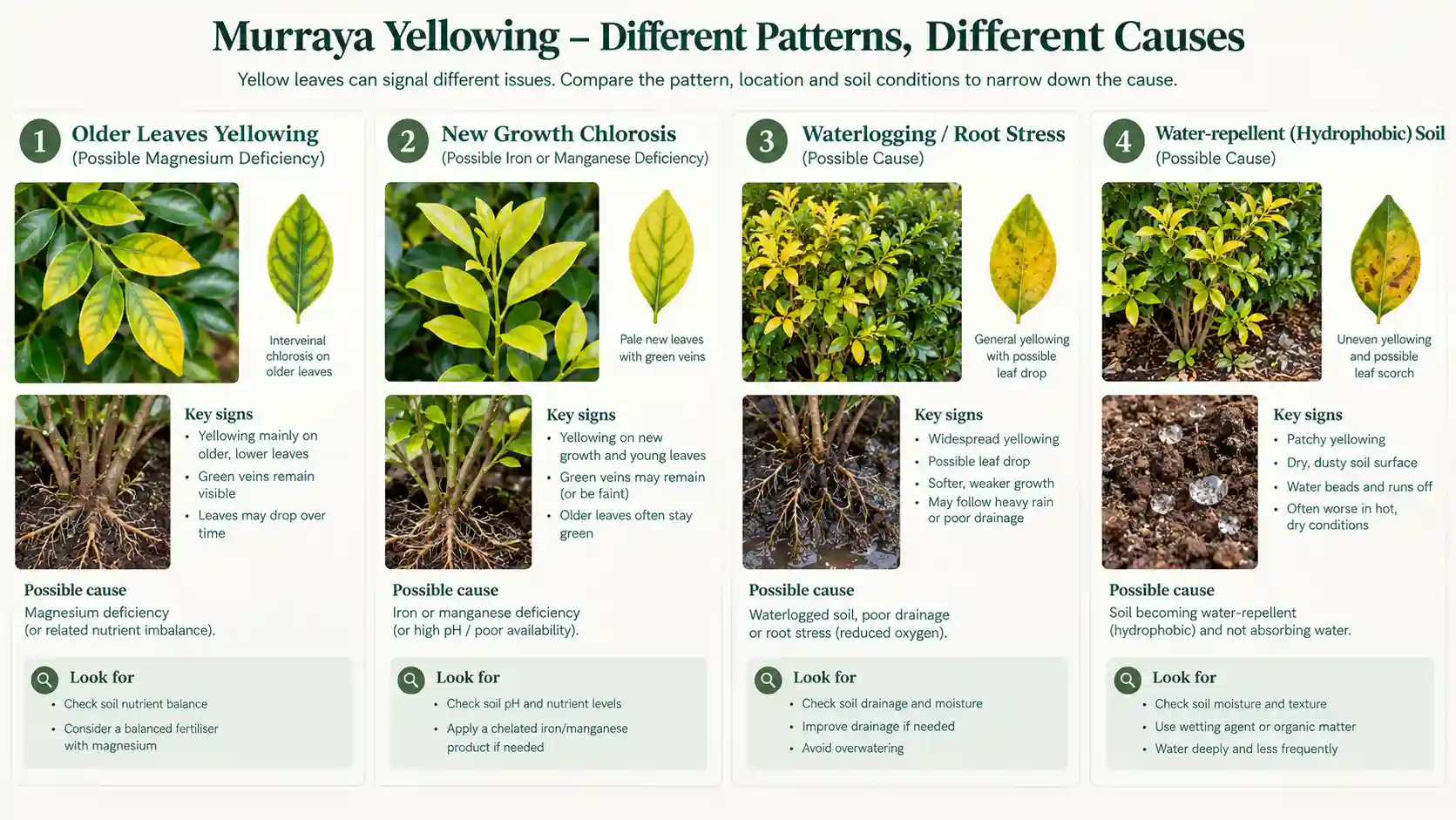
Yellow Murraya leaves can result from water stress, nutrient problems, high soil pH or damaged roots. The pattern matters: older leaves and new leaves do not point to exactly the same problem.
Nitrogen and magnesium are relatively mobile within plants, so deficiency symptoms tend to appear first on older foliage. Iron is relatively immobile, so iron deficiency is more likely to show on younger leaves. Waterlogging can complicate the picture because saturated soil reduces normal root function and nutrient uptake.
| What you see | Likely cause | Confirming test | Fix |
| Older leaves yellowing, especially toward tips/edges | Possible magnesium deficiency | Check pattern and soil test | Correct confirmed deficiency rather than guessing |
| Older foliage pale and growth stunted | Possible nitrogen deficiency | Soil/feed history and test | Correct nutrition if deficiency is confirmed |
| Young leaves yellow with greener veins | Possible iron or manganese availability problem | Soil pH test | Correct the soil condition and use appropriate trace nutrition |
| Yellow leaves plus soggy soil | Waterlogging/root stress | Dig 20–30 cm down | Improve drainage and adjust irrigation |
| Water beads on dry soil | Water-repellent soil | Pour water onto bare soil and observe infiltration | Re-wet and improve soil condition rather than simply adding more fertiliser |
| Brown spots plus yellowing | Leaf spot or another foliar problem | Inspect lesion shape, spread and leaf undersides | Remove affected material if appropriate and confirm the cause |
The distinctive older-leaf pattern associated with magnesium deficiency is well documented in Australian citrus guidance, while iron deficiency typically affects younger leaves and becomes more likely as pH rises above about 7. Water-repellent soils can also produce uneven infiltration, particularly in sandy Australian soils.
The 30-minute hedge check
Do four simple checks before buying another fertiliser:
- Dig 20–30 cm into the root zone and feel whether the soil is dry, evenly moist or persistently wet.
- Test soil pH rather than assuming it is suitable.
- Pour a small amount of water onto dry soil and watch whether it infiltrates or beads and runs away.
- Turn over several leaves and inspect the undersides, young tips and stems for insects, honeydew or unusual damage.
For Australian soil and feeding principles, the Leafy Heaven soil and fertiliser guide is a useful companion.
Why fertiliser alone often fails
Fertiliser can correct a genuine nutrient deficiency, but it cannot fix root loss, prolonged waterlogging, poor drainage, unsuitable pH or chemical injury. A Bunnings case also illustrates the problem: controlled-release fertiliser did not stop yellowing in two of three Murraya hedges, prompting a closer look at soil and growing conditions.
Why Is My Murraya Dying or Dropping Leaves?
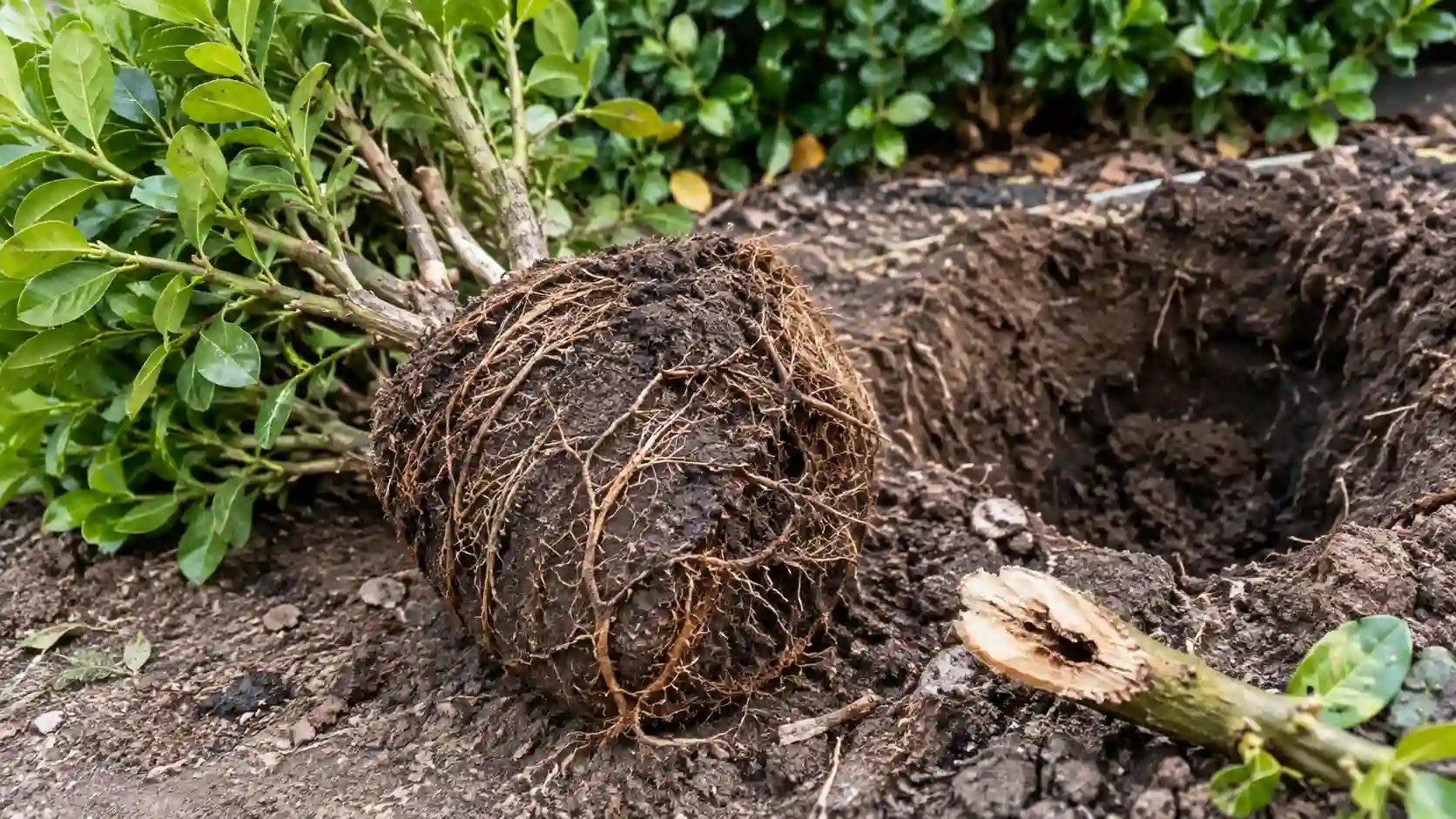
Sudden leaf drop and dieback should make you check the roots, drainage and recent chemical exposure before assuming the hedge simply needs feeding. Severe root stress can produce yellowing, wilting and dieback above ground. Phytophthora root disease in other woody plants is strongly associated with wet or poorly drained soil, and replacement plants can fail when the same wet conditions remain.
Root and stem check on a dead plant
Remove one failed plant if practical. Look for badly circling roots, dark or soft decayed roots, compacted soil, buried construction debris or insect damage. On stems, inspect for holes, galleries or unusual bark damage.
Murraya borer and dieback
A borer beetle can tunnel through Murraya stems and outer bark, causing localised branch dieback. When only a few branches die while the rest of the hedge remains green, stem damage becomes more plausible. Confirm the pest species and appropriate treatment locally before using an insecticide.
Herbicide and chemical damage
If the dead or brown section follows a lawn-treatment zone, sprayed path or recently weed-controlled area, chemical injury belongs high on the diagnostic list. The shape and timing of the damage can be more informative than the leaf colour itself.
Why Do Replacement Murraya Plants Keep Dying?
Replacing the plant before fixing the site is one of the easiest ways to repeat the same failure.
- Correct drainage and compaction at the gap first.
- Check whether nearby roots are competing for water and nutrients.
- Remove ground coverings where they are interfering with inspection, watering or soil condition.
- Do not automatically replant into soil associated with a repeated disease problem.
- Match the replacement cultivar to the available space and local growing conditions.
Can murraya grow from a cutting?
Yes. Murraya can be propagated from stem cuttings. A 2026 study reported rooting of softwood cuttings under a specific treated propagation regime, but that result should not be treated as a guaranteed home-garden strike rate.
Murraya Pests and Diseases, Ranked by Likelihood
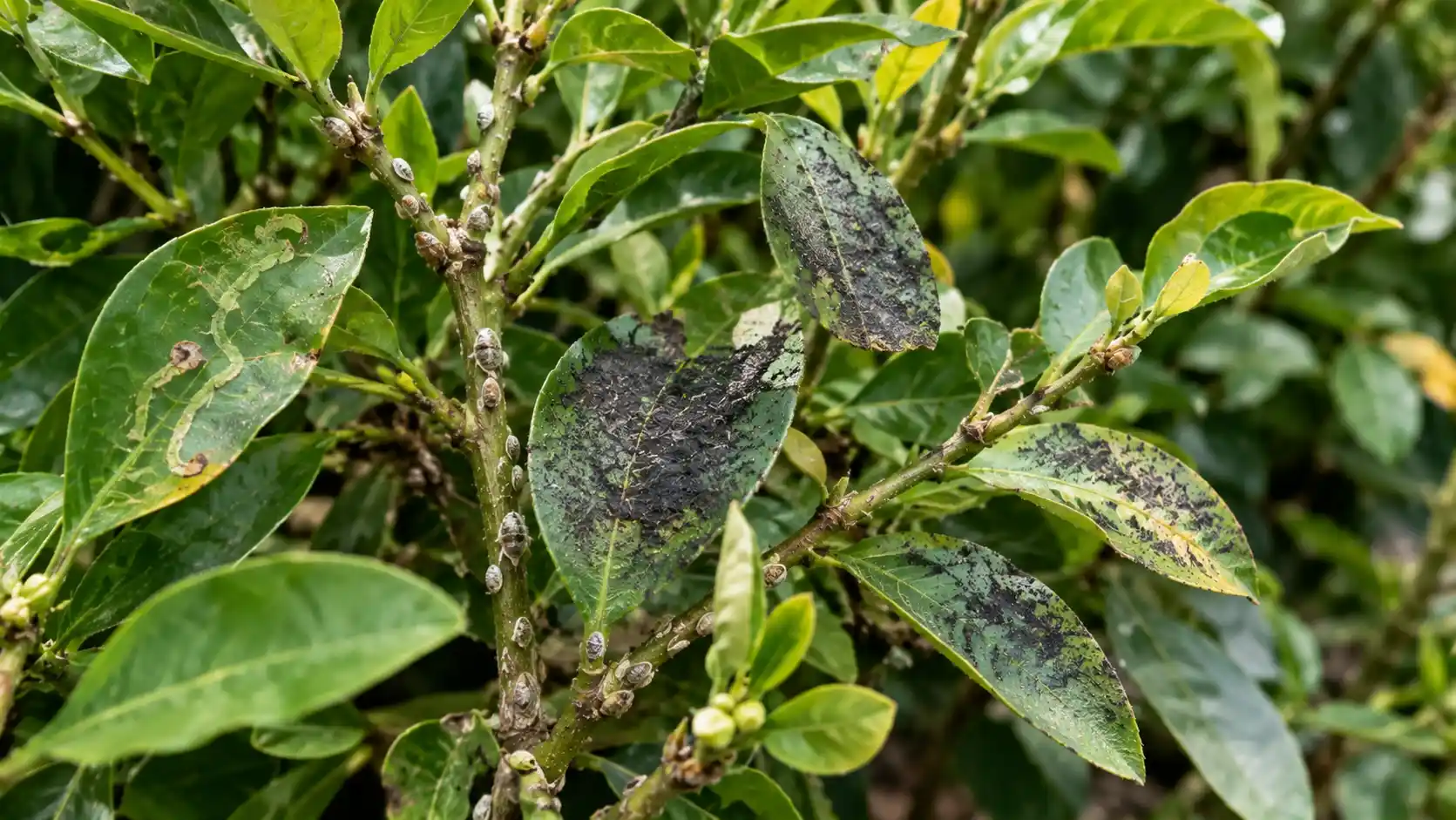
A practical checking order is more useful than pretending there is a precise Australia-wide prevalence ranking. Start with the pests whose signs are easiest to confirm visually.
| Pest or disease | Sign | Cosmetic or act now | Treatment |
| Scale + sooty mould | Scale on stems/leaves, sticky honeydew, black mould | Usually monitor early; act if widespread | Identify the scale first, then use an appropriately registered option |
| Leaf miner | Pale or silvery winding trails in young leaves | Usually cosmetic on established plants | Remove badly affected leaves and monitor new flush |
| Sap-sucking pests | Sticky residue, distorted new growth | Act if new growth is being affected | Confirm pest before spraying |
| Citrus swallowtail caterpillars | Chewed leaves and caterpillars on foliage | Usually cosmetic unless severe | Hand removal may be practical on small hedges |
| Leaf spot | Discrete brown lesions, sometimes with yellowing | Monitor mild cases; act if spreading | Improve airflow and confirm diagnosis before treatment |
Sooty mould is usually a symptom of honeydew-producing sap suckers, not the underlying pest itself. Leafy Heaven’s Australian garden pest identification guide provides a broader visual framework for separating scale, aphids, mealybugs and other insects.
One special warning matters: Asian citrus psyllid nymphs can be mistaken for soft scale. Government guidance recommends close inspection of young flush because the nymphs produce distinctive waxy secretions. If you see tiny nymphs on new growth, check them against Business Queensland’s identification guide, because psyllid nymphs can be mistaken for soft scale insects.
Always check current APVMA registration, label directions and state requirements before applying a pesticide.
Bare Bases, Leggy Growth and Slow Growth: Pruning, Height and Spacing
Bare bases can develop when the lower growth is heavily shaded, repeatedly cut back without enough light, or allowed to become woody and open. Slow growth can likewise reflect crowding, poor soil, inadequate light or root stress.
Murraya paniculata is commonly grown as a medium to large shrub. NSW WeedWise lists it at up to about 4 m, while South Australia’s Plant Selector gives a typical garden range of 2–4 m.
When and how to prune
For a flowering hedge, a light trim after the main flowering flush is a sensible starting point. Keep the hedge slightly wider at the base than the top, so the lower foliage receives enough light to stay dense.
Sun and shade
Murraya can tolerate a range of light conditions, but a dense hedge is easier to maintain where plants receive useful sunlight. Shaded sides commonly grow more slowly and may become thinner, with less impressive flowering.
Making a hedge grow faster
Fix the limiting factor first. More fertiliser will not compensate for waterlogged roots, deep shade or unsuitable soil. Feed after the basics are right, not instead of fixing them.
What Hedge Owners Should Know About the Asian Citrus Psyllid
Murraya is a favoured host of Asian citrus psyllid (Diaphorina citri), an exotic pest that Australia is currently considered free of after the historical detection near Darwin was eradicated. Government guidance highlights young flush, distorted shoots, honeydew, sooty mould and the tiny nymphs as signs worth checking.
In NSW the pest is notifiable and suspected detections must be reported within one working day. The national Exotic Plant Pest Hotline is 1800 084 881; Queensland also lists Biosecurity Queensland on 13 25 23.
Most yellow Murraya leaves are not evidence of Asian citrus psyllid. Treat the pest as a biosecurity identification question, not the default explanation for ordinary yellowing.
Is Murraya Invasive? Types and Cultivars Compared
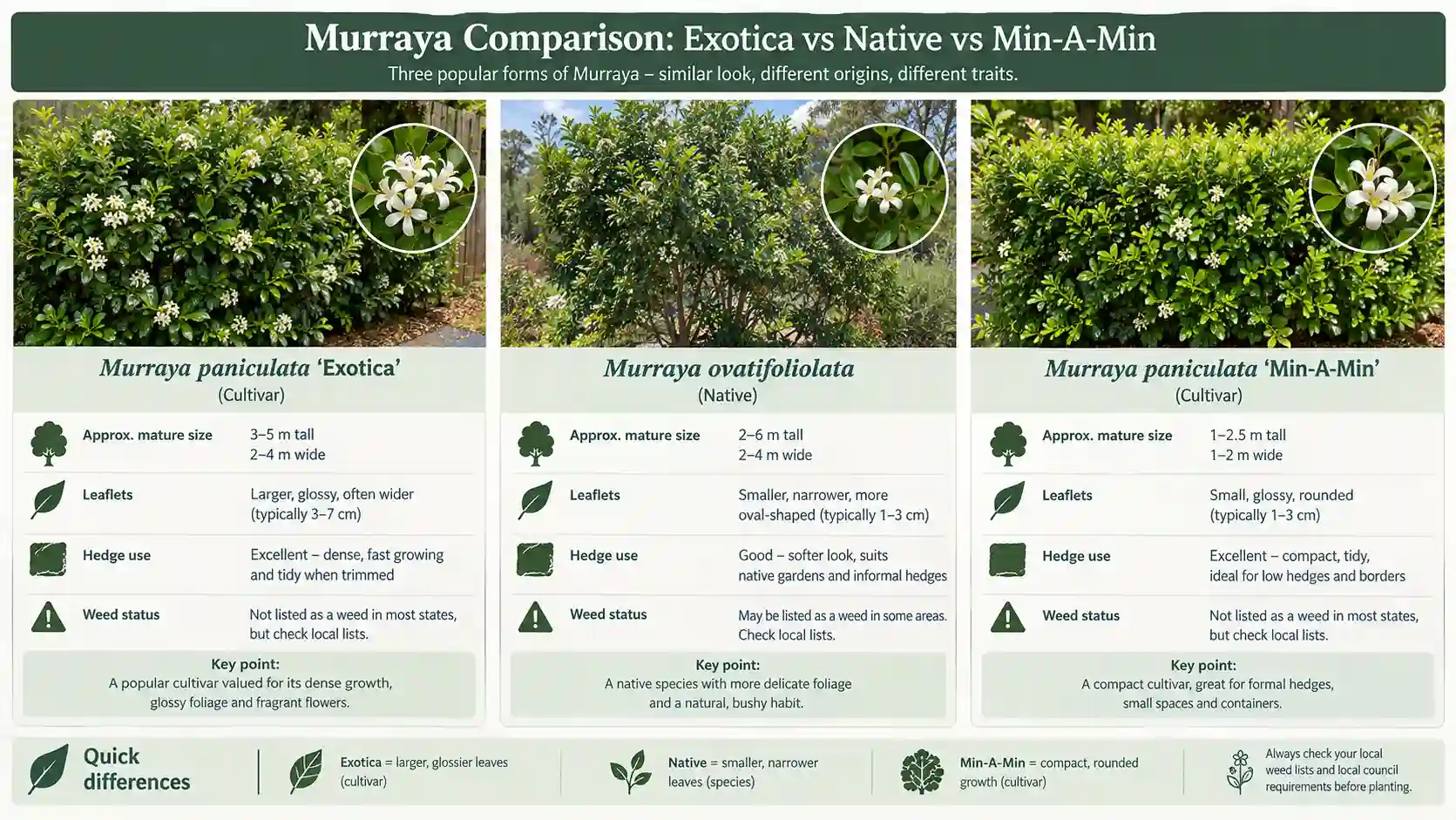
Not every Murraya form carries the same weed status. The distinction matters when choosing a hedge near bushland or in a region with local environmental weed concerns.
| Type | Leaflet size | Height | Weed status | Hedge suitability |
| Murraya paniculata ‘Exotica’ | Larger than native form; introduced leaves can reach about 9 cm | Up to about 4 m | Environmental weed in parts of NSW and Queensland | Excellent formal hedge, but weed risk must be considered |
| Native mock orange, M. ovatifoliolata | About 2.5–10 cm in Flora of Australia records | Can become a large shrub/tree | Australian native | Suitable where its eventual size fits the site |
| M. paniculata ‘Min-A-Min’ | Smaller foliage than standard forms | About 1 m | Cultivar-specific; check local lists | Good for low hedges and borders |
NSW WeedWise identifies M. paniculata ‘Exotica’ as an environmental weed in parts of NSW and notes that some hybrid Murraya cultivars are sterile. Brisbane City Council likewise lists ‘Exotica’ among invasive plants of south-east Queensland. The Australian Flora account recognises M. ovatifoliolata as native to northern Australia, while ‘Min-A-Min’ is a compact form around 1 m high. The NSW WeedWise profile for murraya says the ‘Exotica’ cultivar has become an environmental weed in parts of NSW, with seeds spread by birds and dumped garden waste. Choosing a sterile or dwarf form lowers that risk.
Do murrayas make a good hedge?
Yes, in suitable climates they can make a dense, fragrant and easily clipped hedge. The weak points are poor performance in unsuitable cold conditions, recurring problems on badly drained sites, and environmental weed concerns for some forms. Check your state and local council weed information before buying, particularly for ‘Exotica’.
For gardeners considering a different evergreen screen, Ficus Hillii ‘Flash’ is another Leafy Heaven hedge guide worth comparing.
Revive or Replace? A Simple Decision Rule
Revive if most of the hedge is green, the cause has been identified and the roots are still viable.
Replace if decline continues despite correcting the site, major root damage is present, or the chosen Murraya form is a poor fit for the location or carries an unacceptable environmental risk.
The rule is simple: fix the cause before buying the replacement.
Preventing Murraya Hedge Problems Through the Year
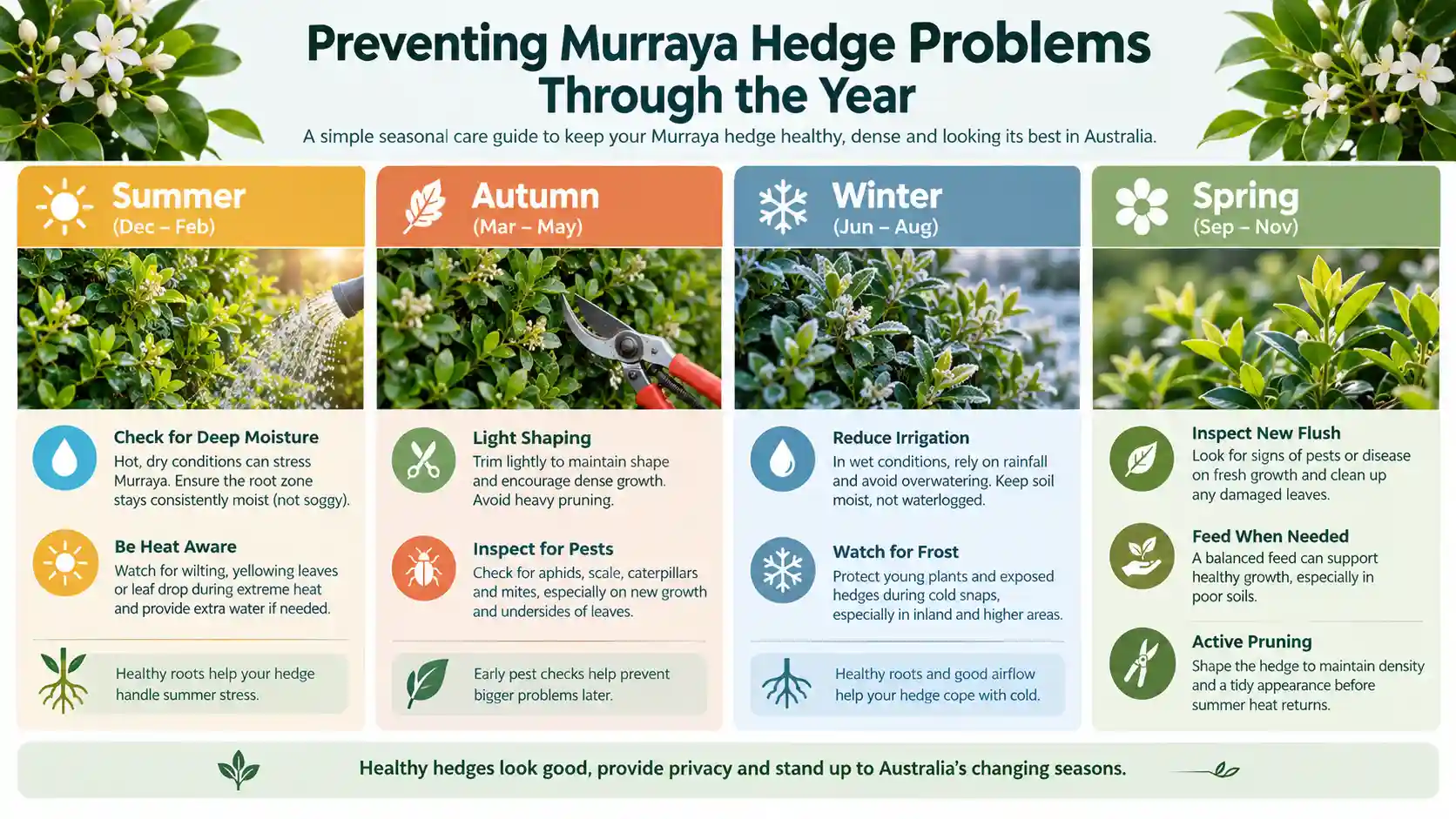
Good drainage, steady moisture and light seasonal maintenance prevent more trouble than routine fertilising alone.
| Season | Task | Common problem avoided |
| Summer | Check soil moisture deeply; protect young plants from severe heat | Heat stress, shallow watering |
| Autumn | Lightly shape after flowering where appropriate; inspect pests | Leggy growth, missed pest buildup |
| Winter | Reduce irrigation where soil stays wet; protect young plants from frost | Winter root stress and frost damage |
| Spring | Inspect new flush; feed if needed; resume active pruning | Nutrient shortages, pest buildup, weak new growth |
For established hedges, water according to soil and weather rather than a fixed calendar. Murraya performs best in well-drained soil with reliable moisture, and controlled-release fertiliser is a common low-maintenance feeding approach.
Mulch can help moderate soil moisture and temperature, but keep it away from stems. The practical goal is not “more water” or “more fertiliser”; it is stable root-zone conditions.
For a broader alternative to Murraya, Lemon Myrtle as a hedge or screen shows how another Australian evergreen can be used in screening.
Conclusion
Most murraya hedge problems become easier to solve once you stop treating yellow leaves as a fertiliser problem by default. Check where the damage is occurring, what the soil is doing and whether the roots or foliage show confirming signs. Test before treating, fix the cause before replanting, and use cultivar choice as part of prevention. A pattern-first diagnosis can save both the hedge and the money spent replacing it.
FAQs
Why are my murraya leaves turning yellow?
Usually start by checking water stress, soil condition, nutrient availability and roots. Yellowing on older versus newer leaves can help separate possible causes.
Why is my murraya dying?
Root stress from poor drainage, waterlogging, chemicals, physical root damage or stem pests can cause progressive dieback. Inspect the root zone before fertilising.
How do I revive a murraya?
Identify the cause first, remove dead wood where appropriate, correct drainage or watering, then provide suitable nutrition once the root system is functioning properly.
Is murraya invasive in Australia?
Some forms are. Murraya paniculata ‘Exotica’ is recognised as an environmental weed in parts of NSW and Queensland. Check current local weed information before planting.
How fast does murraya grow?
Murraya is generally regarded as a relatively fast-growing hedge plant in suitable warm conditions, but there is no single Australia-wide annual growth rate that applies to every cultivar, climate and pruning regime.
What fertiliser is best for murraya?
There is no universal “best” product. A controlled-release fertiliser suitable for shrubs and hedges is a practical option when nutrition is actually limiting, applied according to the label and soil condition.
Can murraya grow in full shade?
It can tolerate shade, but full shade is not the position to choose when the goal is dense hedge growth and strong flowering. More useful light generally produces better hedge density.
When should I cut back murraya?
A light trim after flowering is a reliable general approach. In colder Australian districts, avoid assuming that heavy winter pruning will recover as quickly as a cut made during active growth.