

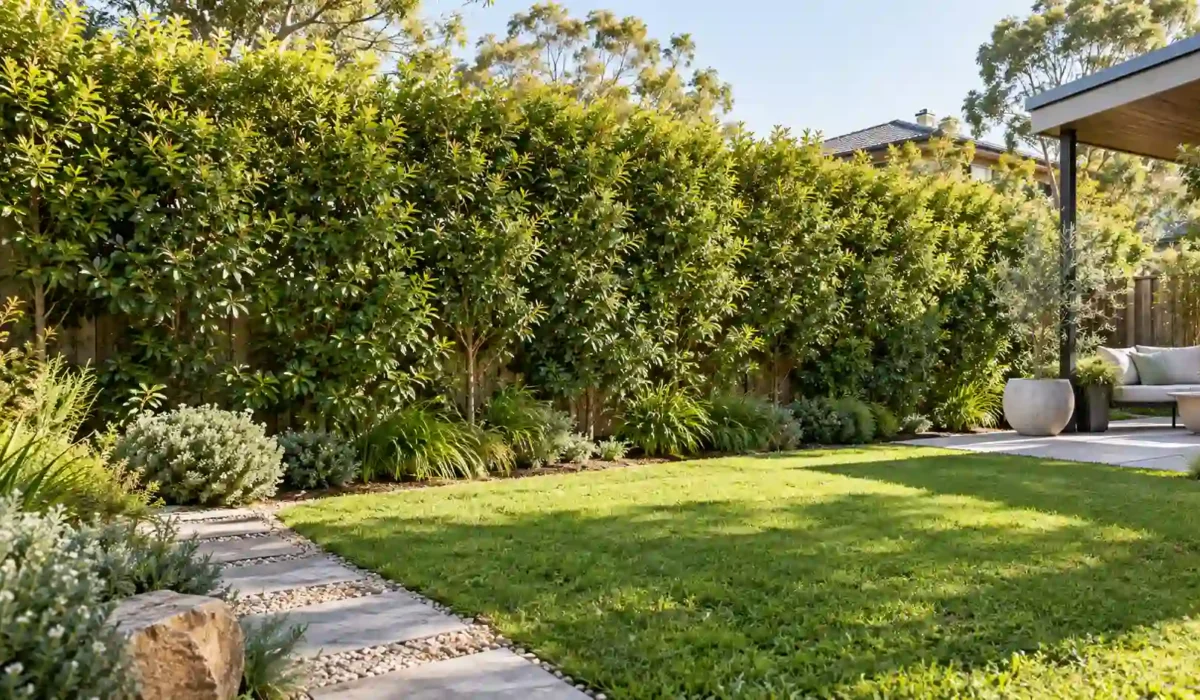
Screening Plant Varieties Australia | Best Privacy Plants
Choosing the right screening plant varieties in Australia starts with your garden, not the fastest-growing plant at the nursery. The best choice depends on how much privacy you need, the space available, your local climate and how often you can maintain the plants.
A lilly pilly may suit a suburban backyard, while a narrow-growing cultivar or trellis could work better beside a driveway. Some plants provide privacy quickly but eventually become too large for their planting area.
This guide compares popular screening plants by size, growing conditions, maintenance and potential problems, helping you choose a variety that will provide lasting privacy without unnecessary work.
Quick Summary
- Best overall approach: Choose screening plants according to mature height, mature width, climate, sunlight and maintenance needs.
- For narrow gardens: Look for naturally upright cultivars, suitable clumping bamboo or climbers supported by a trellis.
- For year-round privacy: Evergreen plants are usually more reliable than deciduous varieties.
- For faster screening: Consider growth rate and starting plant size, but remember that fast growers may require more pruning.
- Before planting: Check root behaviour, weed status, soil conditions and any applicable boundary requirements.
Start With Your Privacy Problem, Not the Plant
Before buying plants, work out exactly what you want to hide. A neighbour’s upstairs window requires a different screen from a street-facing fence or an exposed patio.
Measure the height you need, the planting width available and the sunlight reaching the site. Then decide whether you want a neatly clipped hedge or a more natural screen.
How Tall Does the Screen Actually Need to Be?
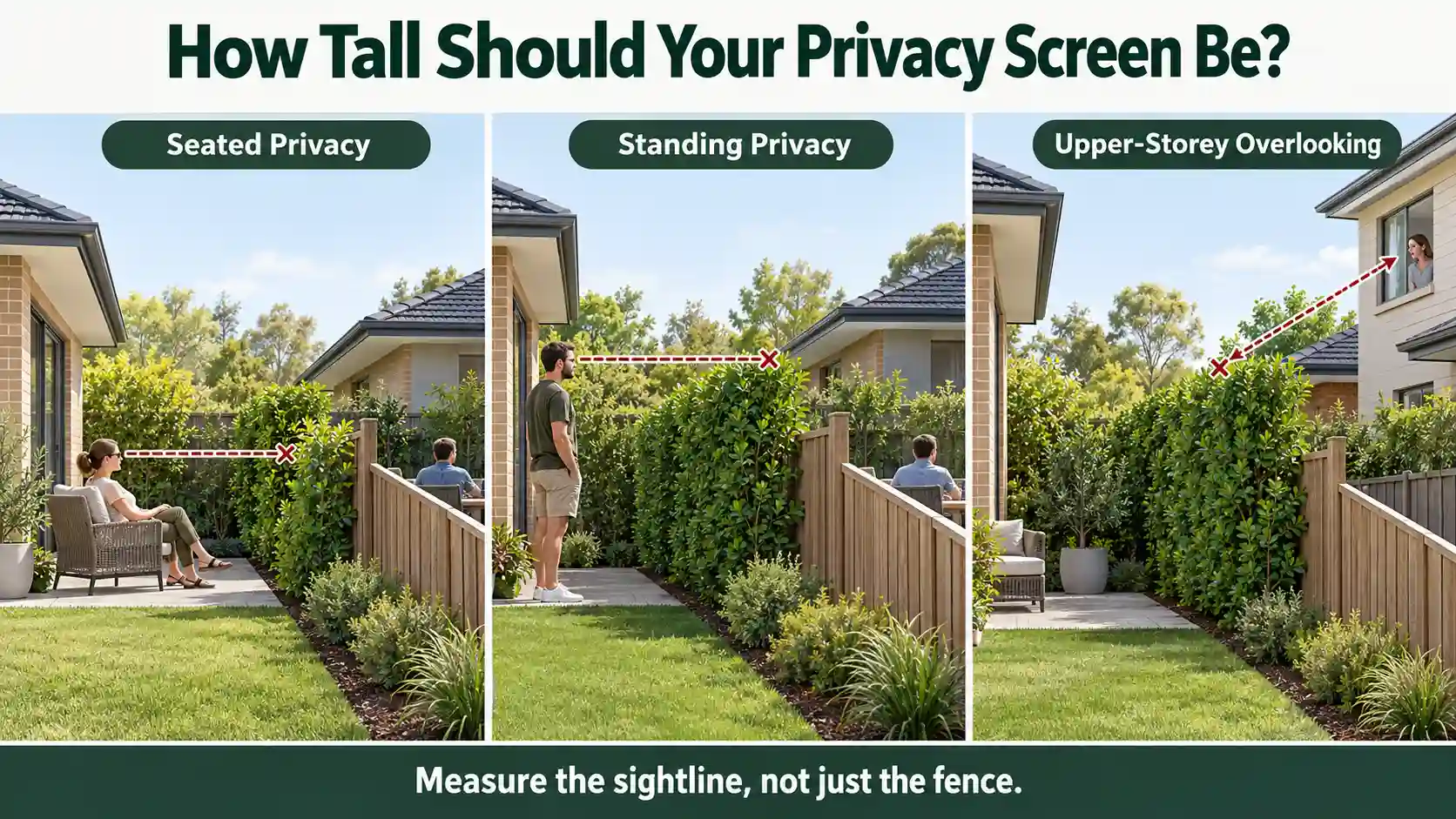
A privacy screen should interrupt the view into the area you want to protect. It does not always need to grow taller than the neighbouring building.
Stand or sit where privacy matters most, such as your outdoor dining area, and look towards the overlooking window or balcony. Check the sightline from that position.
A screen between approximately 2 and 3 metres tall may be suitable for some suburban privacy problems. However, an elevated balcony or sloping property may require considerably more height.
Also consider the plant’s ultimate height. A tree capable of growing much taller than your target screen may need repeated pruning to remain manageable.
How Much Width Can You Spare?
A plant that looks narrow in a nursery pot may eventually spread across a path or driveway.
Measure the entire planting bed, including space needed for pruning, access and maintaining nearby structures.
For example, a bed measuring 80 cm across cannot comfortably accommodate a shrub with an unpruned mature width of several metres unless the plant tolerates the necessary long-term clipping.
Where space is extremely limited, a naturally columnar cultivar or suitable climbing plant may be more practical than a broad shrub.
How Much Maintenance Are You Willing to Do?
Formal hedges require regular trimming to maintain their shape. Natural screens may need less pruning when their mature size matches the available space.
Growth rate also matters. A vigorous plant may provide privacy sooner but continue growing well beyond the height you need.
Think about whether you can realistically manage seasonal trimming, watering during establishment and occasional pest inspections.
Selecting a plant that stays close to your intended size is usually easier than continually reducing a much larger species.
Screening Plant Varieties at a Glance
Australia has many useful screening plants, but they differ considerably in growth habit, mature size and climate tolerance.
The table below compares common choices. The height column describes their possible landscape use when properly selected and maintained, not a guaranteed mature height. Actual dimensions depend on the species or cultivar.
| Screening plant | Typical maintained screening role | Mature width | Growth class | Time to useful screening | Pruning demand | Climate fit | Best use | Main caution |
| Lilly pilly (Syzygium spp.) | Low to tall, depending on cultivar | Highly variable | Moderate to fast | Depends on cultivar, starting size and conditions | Moderate | Many Australian regions, cultivar dependent | Evergreen hedges and privacy | Psyllids, mature size |
| Murraya (Murraya paniculata) | Medium | Can become broad | Moderate to fast in warmth | Site dependent | Moderate | Warm, sheltered gardens | Fragrant formal hedges | Frost and drainage |
| Viburnum | Medium to tall | Often broad | Moderate to fast | Site dependent | Moderate | Depends on species | Dense green hedges | Oversizing and pruning |
| Pittosporum | Medium to tall | Cultivar dependent | Moderate | Site dependent | Moderate | Selected temperate and coastal sites | Upright evergreen screening | Species and site differences |
| Photinia (Photinia × fraseri) | Medium to tall | Often broad | Moderate to fast | Site dependent | Moderate to high | Many temperate areas | Colourful hedging | Leaf spot and width |
| Clumping bamboo | Medium to tall | Clump expands with age | Variable, often vigorous in warmth | Strongly species and climate dependent | Moderate | Species dependent | Tall screening in restricted spaces | Spread, height and maintenance |
| Ficus hillii ‘Flash’ | Tall | Substantial without pruning | Vigorous in suitable conditions | Site dependent | High if tightly controlled | Warm to mild areas | Large privacy screens | Root and size management |
| Waterhousea floribunda | Tall | Broad unless maintained | Moderate to fast | Site dependent | Moderate to high | Suitable mild and warm regions | Tall evergreen screening | Space and mature dimensions |
| Lemon myrtle | Medium to tall | Tree-sized where unpruned | Variable | Site dependent | Moderate if maintained as hedge | Warm, sheltered sites | Native fragrant screening | Mature size and frost sensitivity |
| Magnolia ‘Teddy Bear’ | Medium to tall | Compact relative to some magnolias, but not tiny | Slow to moderate | Usually a longer-term choice from small stock | Low to moderate | Suitable temperate sites | Structural evergreen screening | Soil, space and establishment |
| Rhaphiolepis ‘Oriental Pearl’ | Low to medium | Approximately 1–1.2 m in typical guides | Slow to moderate | Depends on starting size | Low to moderate | Suitable mild, coastal and warm sites | Low privacy hedge | Insufficient height for tall privacy |
| Box (Buxus spp.) | Low to medium | Variety dependent | Generally slow | Longer-term from small stock | Moderate for formal shape | Species and cultivar dependent | Neat formal hedges | Disease and clipping |
| Westringia | Low to medium | Variety dependent | Slow to moderate | Depends on cultivar | Low to moderate | Many dry and coastal sites | Native informal hedges | Limited height in compact forms |
Important: These are selection guidelines, not guaranteed plant specifications. Obtain cultivar-specific mature dimensions and local growing advice before buying.
For taller privacy, upright lilly pilly cultivars, selected viburnums and some clumping bamboos are worth comparing. For low formal hedges, box, Rhaphiolepis and compact Westringia are more suitable.
Do not choose a plant solely because its species is advertised as fast-growing. The mature dimensions of the exact cultivar will usually be more useful for your decision.
Best Screening Plant Varieties by Available Space
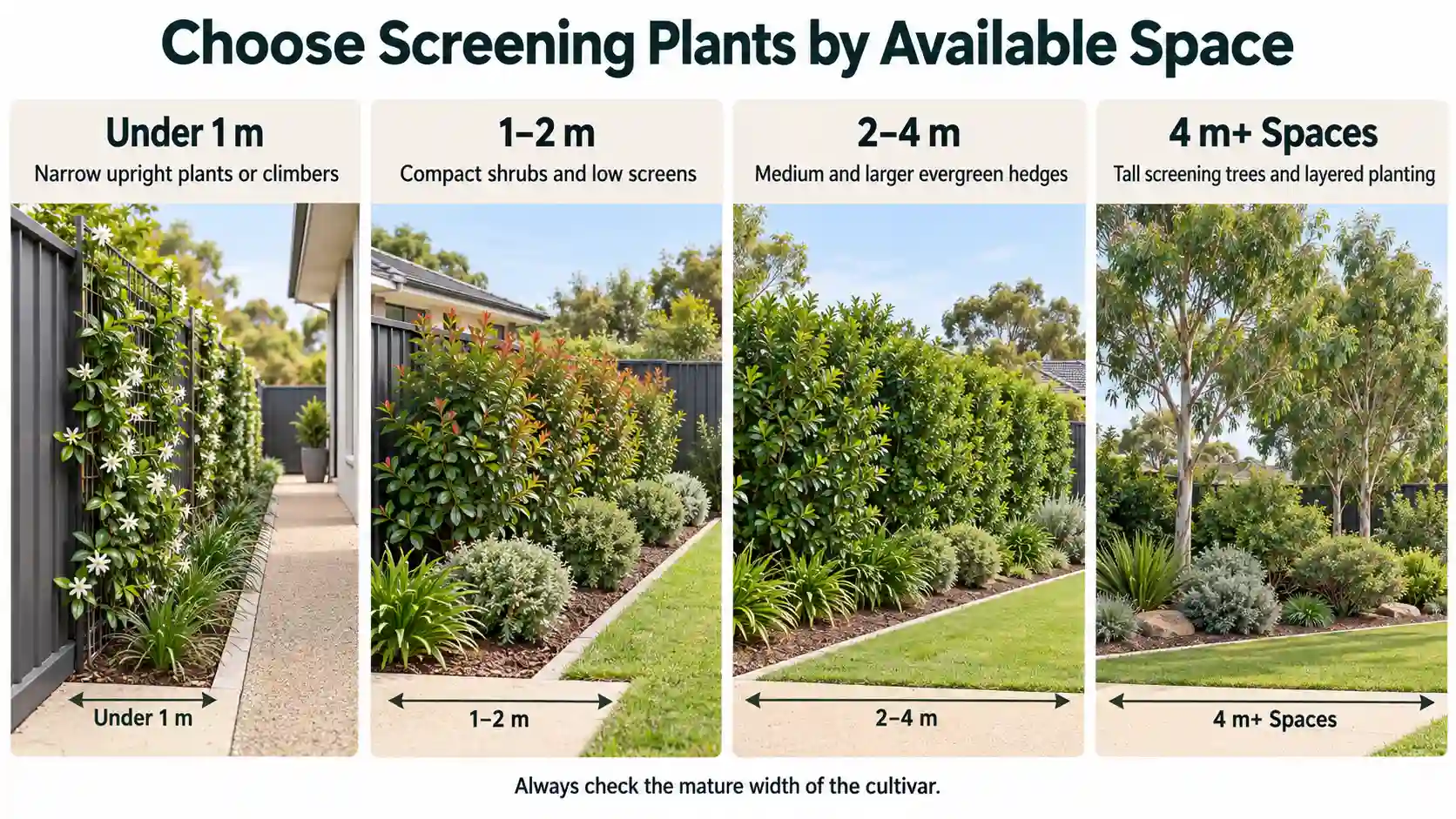
Planting width is one of the most effective ways to narrow your choices. It helps rule out plants that would require excessive pruning or eventually crowd nearby structures.
Screening Plants for Narrow Spaces Under 1 m Wide
A narrow bed needs a plant with a genuinely upright growth habit. A broad shrub repeatedly cut back to a thin shape may develop poor foliage density or become difficult to maintain.
Some columnar lilly pilly cultivars can provide upright evergreen coverage, although their actual mature widths still need checking.
Selected clumping bamboos are another possibility. Their suitability depends on the species, final clump diameter, height and access for thinning.
Before choosing bamboo, read the guide to clumping bamboo for narrow screening. It explains the important differences between clumping and running forms.
Where even compact plants cannot fit comfortably, a trellis with a suitable evergreen climber may offer a more practical solution.
Screening Plants for 1–2 m Wide Beds
These beds provide more options for low and medium-height screening.
Compact lilly pillies can provide evergreen foliage, while selected Murraya and Viburnum cultivars may work where climate and pruning requirements are suitable.
Rhaphiolepis is useful when you want a lower screen rather than a tall privacy wall.
For example, ‘Snow Maiden’ is generally a smaller cultivar than ‘Oriental Pearl’. The Snow Maiden and Oriental Pearl comparison explains their differences in mature size and use.
Westringia is another option for sunny beds where a softer, less formal appearance is preferred.
Screening Plants for 2–4 m Wide Beds
Wider planting areas can accommodate larger screening shrubs and more natural growth.
Depending on climate and soil, suitable candidates include lilly pilly, Viburnum, Pittosporum, Photinia and Magnolia.
These plants can provide substantial privacy, but their maintenance requirements vary.
Consider whether you want one continuous row or a layered planting with shrubs of different heights.
A mixed arrangement can be particularly useful when privacy is needed at several levels. It can also reduce the visual impact of losing one plant to disease or damage.
Tall Screening Plants for 4 m+ Spaces
Large planting areas provide more flexibility for tall trees and substantial evergreen screens.
Waterhousea floribunda is one option for suitable climates. Its mature size and pruning requirements need consideration, particularly near buildings and boundaries. See the Waterhousea floribunda ‘Sweeper’ growing guide for more detail.
Ficus hillii ‘Flash’ can create a dense, vigorous screen, but its growth habit and roots make site selection especially important.
The Ficus hillii ‘Flash’ hedge and care guide explains why this plant needs careful planning before use near structures.
Tall screening should be considered a long-term landscape decision, not simply a way to obtain privacy quickly.
Choose Screening Plants by Australian Climate
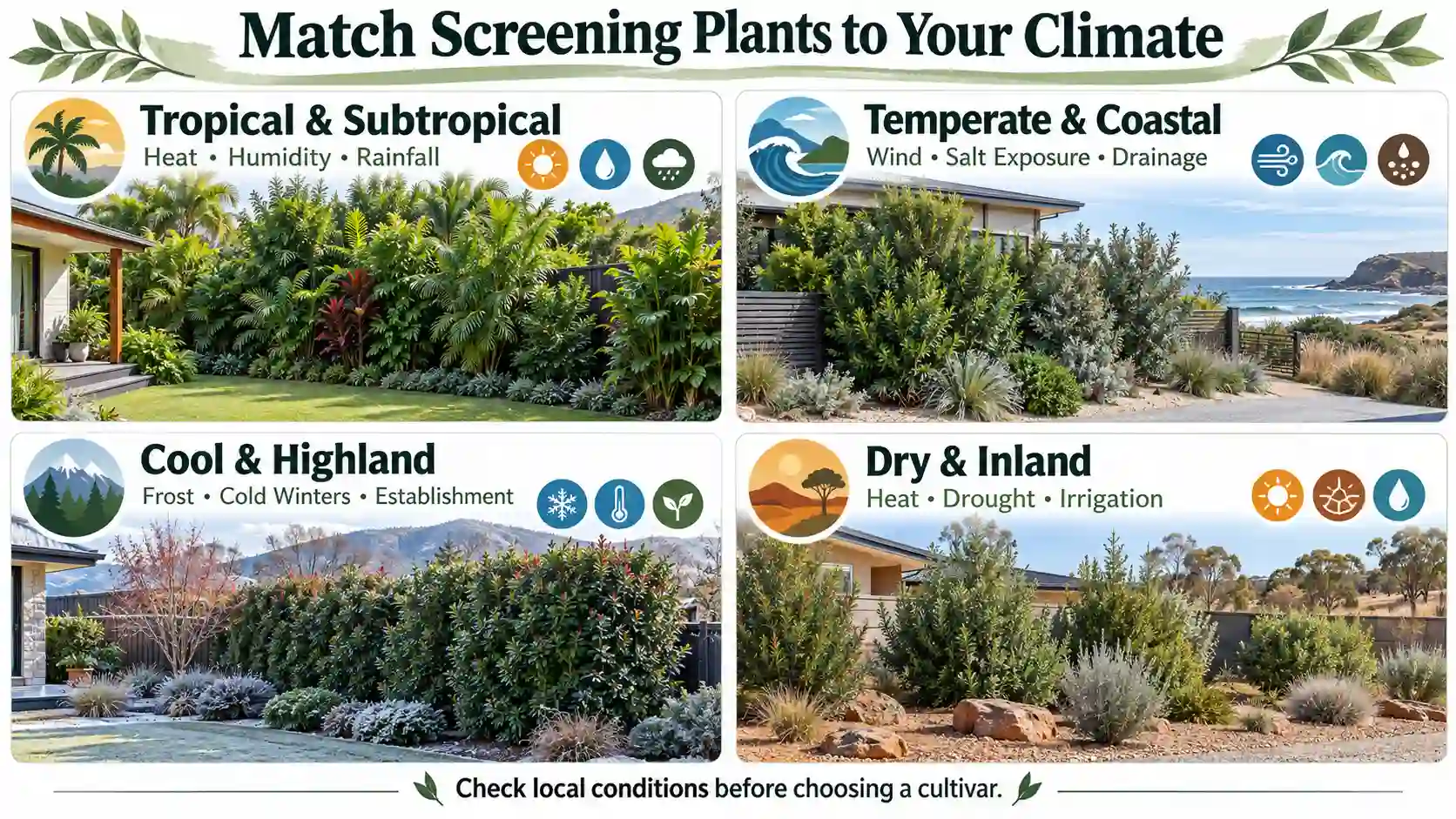
A variety that grows well in Brisbane may struggle through a Canberra winter. Similarly, a plant that performs in Melbourne may not tolerate the heat and humidity of Cairns.
Use climate suitability to narrow your plant shortlist before comparing growth rates or appearance.
Tropical and Subtropical Gardens
Brisbane, Cairns, Darwin and much of northern New South Wales experience relatively warm growing conditions, although rainfall, humidity and seasonal weather differ considerably.
Selected lilly pillies, Murraya, Waterhousea and tropical clumping bamboos may suit appropriate sites.
Humidity, drainage and fungal disease pressure deserve attention. A plant suitable for a moist coastal garden may not perform equally well in a hot, dry position.
For a local example, the Weeping Lilly Pilly Brisbane guide discusses screening choices and growing conditions relevant to subtropical gardens.
Warm Temperate and Coastal Gardens
Sydney and other mild coastal areas can support a wide selection of evergreen screening plants.
However, being near the coast does not automatically mean a garden receives significant salt spray.
Sheltered coastal sites may suit lilly pilly, Pittosporum, Murraya and other screening shrubs. Exposed beachfront gardens need plants with proven tolerance of salt-laden wind.
Westringia fruticosa is one native worth considering for coastal conditions. Its foliage and growth habit suit lower natural screens and hedges.
Cool Temperate and Highland Gardens
Melbourne, Canberra, Tasmania and parts of the Adelaide Hills can experience cold winters and damaging frosts.
Choose plants according to their tolerance of your actual winter conditions, particularly while they are young.
Some Viburnum, Photinia, Rhaphiolepis and box varieties may be suitable, depending on the specific cultivar and location.
For compact formal screening, the Australian box hedge varieties guide explains differences between commonly grown types and their care requirements.
Cold-air drainage is also important. Lower parts of a sloping property may experience greater frost exposure than nearby elevated planting beds.
Mediterranean, Dry and Inland Gardens
Dry summers, hot winds and limited rainfall can make some fast-growing screening plants difficult to maintain.
In suitable conditions, drought-tolerant Westringia cultivars and other locally appropriate native shrubs may be preferable to plants requiring consistently moist soil.
Good drainage is important, especially where winter rainfall leaves clay soil saturated.
Drought tolerance does not mean a newly planted hedge can survive without watering. Young plants still need consistent moisture while their roots establish.
Wind-Exposed or Sloping Sites
On exposed properties, consider the plant’s mature structure as well as its foliage density.
Tall, narrow plants may require support during establishment. Trees with large canopies need enough room for stable root development.
Slopes introduce additional challenges, including runoff, erosion and different moisture conditions along the planting row.
Choose species proven to tolerate the site’s exposure rather than relying on general climate descriptions alone.
Native or Exotic Screening Plants?
Australian natives can be excellent screening choices, but an Australian origin does not guarantee that a plant will suit every region.
The best variety is the one adapted to your specific climate, soil and available space.
| Factor | Australian native screening plants | Exotic screening plants |
| Climate suitability | Strong when matched to the region | Can also perform well when climate suited |
| Wildlife benefits | Many support native wildlife | Benefits vary by species |
| Drought tolerance | Depends on species and origin | Depends on species |
| Formal hedging | Many tolerate pruning | Many tolerate pruning |
| Maintenance | Depends on growth habit | Depends on growth habit |
| Weed considerations | Check local suitability and spread | Check local weed status and spread |
Lilly pillies, Westringia, bottlebrush and selected tea trees are examples of Australian plants used for screening.
The ABC Gardening Australia guide to native screening plants explains how different native species can suit different growing conditions and landscape uses.
Lemon myrtle is another native worth considering in suitable warmer gardens. However, it can become a substantial tree, so checking its mature dimensions is essential. The lemon myrtle height and width guide provides further information.
Choose natives for their verified suitability, not simply because they are native.
Evergreen, Flowering or Deciduous Screens?
Foliage type affects how much privacy a plant provides throughout the year.
Evergreen Screening Plants
Evergreen screening plants keep foliage through the year, making them the usual choice for permanent privacy.
Lilly pillies, selected magnolias, Pittosporum and many other evergreen shrubs can provide lasting visual coverage.
The NSW Government’s privacy planting guidance also identifies evergreen planting as useful for year-round screening.
Remember that evergreen does not mean leaf-free maintenance. These plants still shed and replace leaves.
Flowering Screening Plants
Flowering varieties provide privacy alongside seasonal colour, fragrance or wildlife interest.
Murraya produces fragrant flowers, while selected bottlebrush, Westringia and other shrubs add flowers to a planted screen.
Frequent clipping can remove flower buds, so an informal shape may work better when flowering is a priority.
Deciduous Screening Plants
Deciduous plants lose their leaves during part of the year.
They can be useful when summer privacy or seasonal shade is needed, but they usually provide less visual screening during winter.
For year-round privacy from neighbouring windows, evergreen varieties are generally the more dependable option.
Fast-Growing Screening Plants: What “Fast” Really Means
Fast growth can be helpful, particularly when a new home overlooks an exposed backyard.
However, growth speed alone does not tell you when a plant will create a useful privacy screen.
Height, branching density, starting plant size, seasonal growth and establishment all affect the result.
How Long Does It Take to Reach a 2 m Screen?
There is no reliable universal timeframe for screening plants to reach 2 metres.
A healthy plant purchased at 1.5 metres tall starts much closer to the target than a young plant measuring 40 cm.
Even with the same variety, differences in sunlight, soil, watering and temperature can produce different results.
| Starting situation | What affects the timeframe | What to check |
| Small nursery stock | Establishment and annual growth | Expected local growth and branching |
| Medium established plant | Root establishment and canopy spread | Height and density at planting |
| Advanced nursery stock | Transplant establishment and existing foliage | Root health, cost and aftercare |
| Slow-growing variety | Naturally slower height and width increase | Whether initial stock is large enough |
A practical estimation method
Suppose your target is a 2 m screen and the plants are currently 1 m tall. They need another metre of height, but that does not mean they will provide privacy as soon as they reach 2 m.
The lower branches must also be dense enough to interrupt the view.
Ask the nursery for cultivar-specific growth information from gardens with similar conditions. Treat the answer as an estimate, not a guarantee.
Why a Fast Grower Can Be the Wrong Long-Term Choice
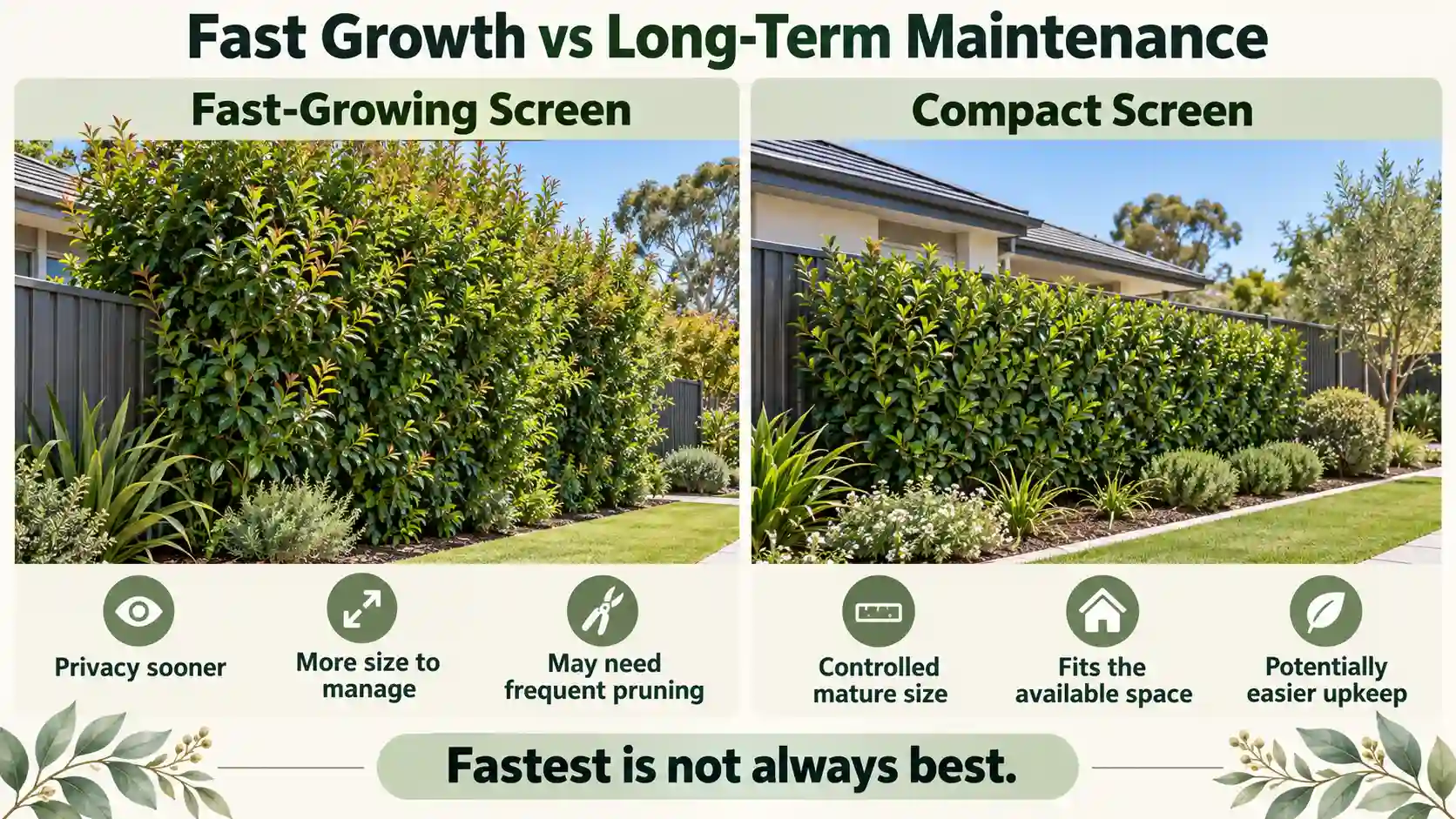
Vigorous plants continue growing after they reach the height you want.
If a tree naturally grows much taller or wider than your available space, you may face regular pruning, difficult access and increased maintenance costs.
In some cases, a slower or more compact cultivar is the better investment because it remains manageable.
The aim is not to obtain the tallest plant as quickly as possible. It is to establish a screen that works at the intended size.
How Far Apart Should Screening Plants Be Planted?
Plant spacing depends on the mature width of the chosen variety, the size of the plants at purchase and the density you want.
Planting too far apart can leave gaps for years. Planting excessively close can increase competition and make the hedge difficult to maintain.
How to Calculate Plants Per Metre
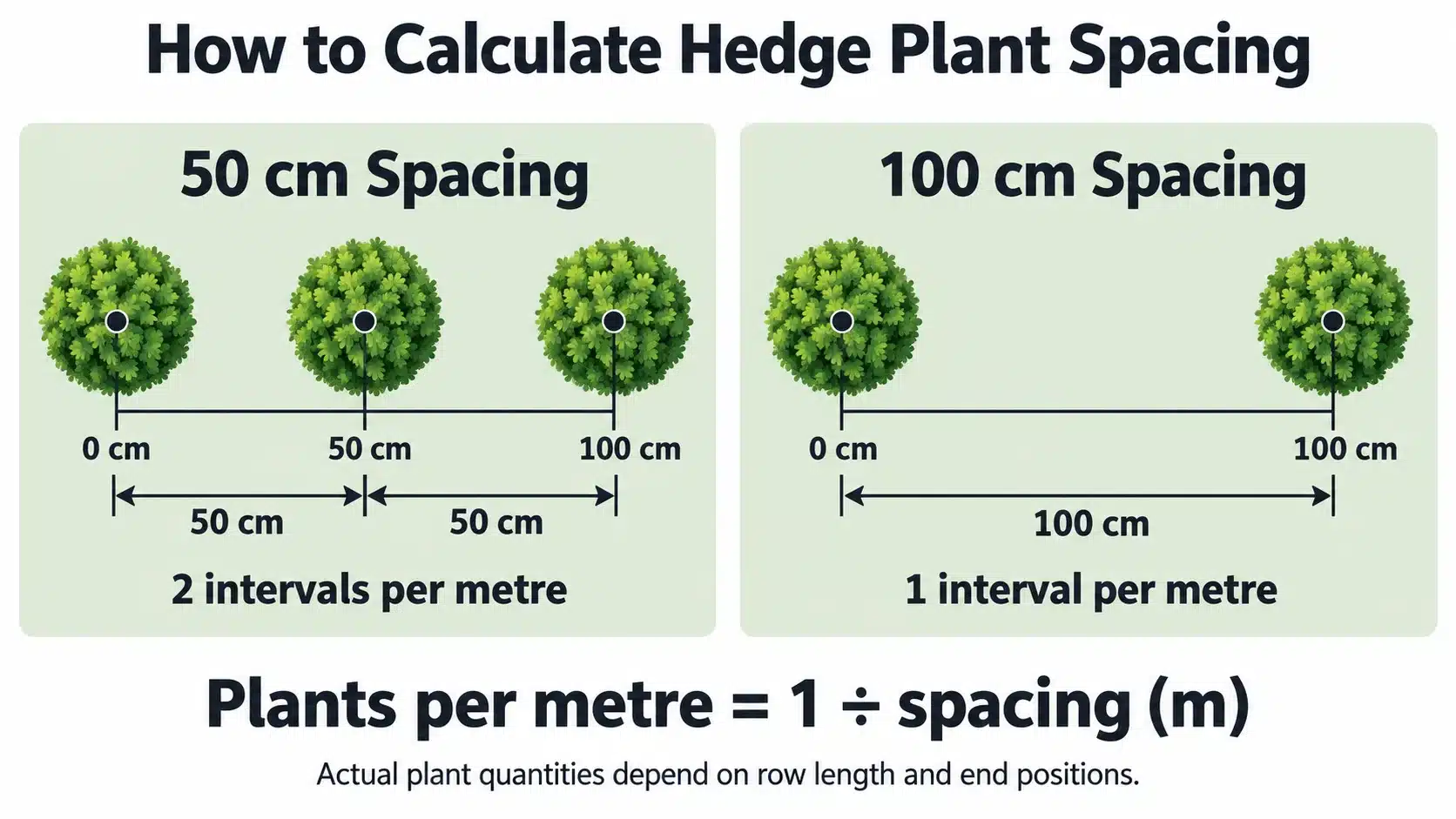
For a single, evenly spaced row, a useful planning calculation is:
Plants per metre = 1 ÷ spacing between plant centres in metres
For example:
- At 0.5 m spacing, there are approximately 2 plants per metre.
- At 0.8 m spacing, there are approximately 1.25 plants per metre.
- At 1 m spacing, there is approximately 1 plant per metre.
For an actual hedge, calculate the number of plants across the full planting length, allowing for the positions of the first and last plants.
These are mathematical examples, not recommended spacing distances for every species.
The Royal Horticultural Society’s hedge planting guidance explains why spacing and planting arrangements must suit the plant and intended hedge.
Single Row vs Staggered Planting
A single row is usually more practical for formal hedges or narrow planting beds.
Staggered rows can create a deeper, layered screen where enough space is available.
The best choice depends on planting width, required density and how the plants develop with age.
How Far Should Screening Plants Be From a Fence?
Leave enough room for the plant’s mature canopy, root development and any necessary maintenance access.
The correct setback varies with the plant. A compact hedge and a substantial tree do not need the same amount of space.
Also consider access for fence repairs and pruning the side facing your neighbour.
Hedge Plant Spacing Guide by Species
The best hedge plant spacing in Australia depends on the plant species, its mature width, the height and density you want, and how quickly you need the foliage to join together. As a starting point, compact formal hedges are usually planted closer together than taller, informal screening plants. Measure spacing from the centre of one plant to the centre of the next, rather than measuring between the outer edges of their leaves.
The following table provides indicative spacing ranges for common Australian hedge and screening plants. These are planning estimates, not fixed rules: check the recommended spacing for your exact cultivar and nursery stock size before buying.
| Hedge plant | Starting spacing, centre to centre | Approx. plants per metre | Best suited to |
|---|---|---|---|
| Compact box (Buxus species and cultivars) | 15–35 cm | 2.9–6.7 | Low, formal borders and tightly clipped hedges |
| Coastal rosemary (Westringia fruticosa) | Around 75 cm | 1.3 | Low to medium-height clipped hedges |
| Orange jasmine (Murraya paniculata) | 60–100 cm | 1–1.7 | Medium-height evergreen privacy hedges |
| Lilly pilly (Syzygium australe cultivars) | 60 cm–1 m for a clipped hedge; wider for a relaxed screen | 1–1.7 for a clipped hedge | Dense, leafy boundary screens |
| Photinia ‘Red Robin’ | 80 cm–1 m | 1–1.3 | Medium to tall hedges with colourful new growth |
| Pittosporum ‘Silver Sheen’ | 70 cm–1 m | 1–1.4 | Taller, relatively informal screening |
| Clumping bamboo, such as Bambusa textilis ‘Gracilis’ | Around 1–1.5 m | 0.7–1 | Tall privacy screens where space allows |
| Weeping lilly pilly (Waterhousea floribunda) | Around 1.2–1.5 m | 0.7–0.8 | Tall screening with room for larger plants |
Plants per metre are approximate spacing-based estimates for one row, excluding adjustments for the ends of the planting run. Actual requirements vary with cultivar, initial plant size, pruning depth and the desired final screen.
For a low, formal border, closer spacing helps the foliage meet sooner, but it also increases the number of plants you need. A taller screen made from a naturally broad shrub or small tree generally needs more room between plants.
For example, Gardening Australia’s guidance on spacing coastal rosemary describes planting Westringia fruticosa about 75 cm apart when the intended clipped hedge depth is also around 75 cm. This illustrates an important principle: plan for the dimensions of the hedge you intend to maintain, rather than choosing a spacing number in isolation.
For variety-specific advice, see our box hedge spacing and care guide, bamboo screening plants guide and weeping lilly pilly growing guide.
How to Calculate Plants per Metre
To estimate how many hedge plants you need, divide the length of the planting row by the spacing between plants. For a rough estimate of plants per linear metre, divide 1 metre by the chosen centre-to-centre spacing.
Plants per metre = 1 ÷ spacing in metres
For example, if you space plants 80 cm apart, convert 80 cm to 0.8 metres and calculate:
1 ÷ 0.8 = 1.25 plants per metre, approximately.
This is a density estimate, not the final number you should order. A complete row also needs plants at its ends, so the final count depends on the usable length of the planting line and the positions of the first and last plants.
Use this formula when planning a straight row with plants at both ends:
Number of plants = round up (distance between end plant centres ÷ spacing) + 1
For example, if the distance between the first and last plant centres is 8 metres and the planned spacing is 80 cm:
- Convert the spacing to metres: 0.8 m.
- Divide 8 by 0.8 to get 10 intervals.
- Add one plant for the starting position.
You need 11 plants to create 10 intervals across 8 metres.
When measuring a fence line or garden bed, account for any space you need to leave at either end before calculating the usable distance between the first and last plant centres. If you are planting two rows, calculate each row separately and add the totals together.
It is also important to understand what centre-to-centre spacing means. If two plants are positioned 80 cm apart, the distance is measured from the centre of one rootball to the centre of the next. It does not mean leaving an 80 cm gap between the foliage.
For a small project, lay the pots along the proposed planting line before digging. This lets you check the spacing visually and make minor adjustments before the plants go into the ground.
Single Row vs Staggered Hedge Planting
A single-row hedge is usually the practical choice when you have a narrow garden bed along a fence, driveway or property boundary. The plants sit in one line, making the planting layout easier to measure and usually simpler to maintain.
A staggered, double-row hedge can work better when you have a wider planting strip and want a layered screen. Instead of aligning both rows directly opposite each other, offset the plants in the second row so they sit opposite the gaps in the first row. This can help reduce direct sightlines through the hedge while the foliage develops.
The two methods have different space and cost requirements.
| Consideration | Single row | Staggered double row |
|---|---|---|
| Garden-bed width | Better for narrow beds | Needs more room |
| Initial plant cost | Lower | Higher, because two rows are required |
| Screening arrangement | One continuous line of foliage | Two offset layers of foliage |
| Maintenance access | Usually simpler | More difficult if plants grow tightly together |
| Best use | Boundary hedges and narrow privacy screens | Wider screens where a layered effect is desirable |
Do not assume that two rows automatically create a healthier or better hedge. Closely planted rows can compete for water, nutrients, light and root space. The gap between rows should suit the plants’ mature spread and the space available for maintenance.
For smaller suburban gardens, a single row of a suitable, dense-growing cultivar may provide enough privacy without the cost and upkeep of a double row. Where space permits, a mixed or layered screen can also be considered, provided each plant suits the local climate, available light and soil conditions.
How Plant Size and Desired Density Affect Spacing
The size of the plants you buy, their expected mature width and the speed at which you want the hedge to close should all influence your spacing decision.
Nursery plant size: Small tube or pot-grown plants generally cost less per plant, but you will need patience while they establish and grow into a screen. Larger specimens provide more immediate height and foliage, although their existing width may mean they need different spacing from smaller plants of the same variety.
Desired screening speed: If you want a hedge to become visually continuous sooner, you may choose spacing towards the closer end of the suitable range for your cultivar. This does not guarantee an immediate screen; growth rate, growing conditions and seasonal weather still matter.
Mature width and pruning depth: Check the plant label for its expected height and width. Then decide how tall and deep you intend to keep the hedge. Plants that naturally grow broad may need adequate room even when they are regularly clipped. Conversely, naturally narrow cultivars can suit smaller gardens where a broad hedge would take up too much space.
Water, nutrients and airflow: Planting too closely increases competition between neighbouring root systems. Dense planting can require more careful watering and nutrient management, while crowded foliage can make pest and disease problems harder to manage. Closer spacing should therefore be a deliberate choice, not a substitute for selecting a suitable plant.
Maintenance requirements: The faster a hedge grows, the more often it may need trimming to remain within its intended height and width. Allow enough room to access the sides and top safely, and avoid relying on repeated severe pruning to control a plant that is naturally too large for the site.
Gardening Australia’s discussion of plant spacing explains that spacing choices affect root competition, growth and the time needed for a hedge to form a continuous screen. Its practical lesson is to balance the result you want against the space, time and maintenance you can provide.
How Far Apart to Plant a Hedge From a Fence
Spacing plants along a row and deciding how far that row should sit from a fence are two different measurements. The distance between plants determines how the hedge fills out along its length; the setback from the fence determines how much room the hedge has to grow and how easily you can maintain it.
Start by deciding the finished depth of the hedge. If you plan to maintain a hedge at 60 cm deep, its centre line would sit about 30 cm from the fence if the foliage were arranged evenly on both sides of that line. However, a boundary hedge often needs more room on the garden side for pruning and access, especially if the fence prevents you from trimming the other side.
Before planting:
- Check the mature width: Use the expected width of your chosen variety, then consider how much you intend to reduce it through regular pruning.
- Allow for maintenance access: Make sure you can reach the hedge to trim it, inspect the foliage and carry out routine care without damaging the fence.
- Check for underground obstacles: Look for services, pipes, existing roots and other obstructions along the planting strip before digging.
- Keep growth within your available space: If the garden bed is narrow, choose a naturally compact or upright variety rather than depending on frequent hard pruning to control an oversized plant.
For a large-growing screen, such as a tall lilly pilly or Waterhousea floribunda, a narrow space beside a fence may not provide enough room for the mature plant and its maintenance needs. Our Waterhousea floribunda ‘Sweeper’ guide and Ficus hillii ‘Flash’ guide provide more specific context for larger screening plants.
There is no single fence setback that suits every hedge. Choose the position according to the mature dimensions of the plant, your intended pruning depth, the available access and any relevant site constraints. Mark the proposed planting line and position the pots along it before planting so you can assess whether the finished hedge will fit comfortably.
Screen, Hedge, Tree, Bamboo or Climber?
A living privacy barrier can be created in several ways. The right structure depends on available space, preferred appearance and maintenance.
Screen vs Hedge
A natural screen relies mainly on the plants’ growth habit, with pruning used to manage shape and size.
A formal hedge is clipped into a more defined shape and generally requires regular maintenance.
If you need a low formal boundary rather than privacy above head height, the hedge shrubs and garden borders guide explains that distinction in more detail.
Shrubs vs Screening Trees
Shrubs are often suitable for low and medium-height privacy, especially where foliage is needed close to ground level.
Trees may be more appropriate for taller screening, but many develop large canopies and root systems.
An upright tree can also leave a clear view beneath its branches, so check where the foliage will actually grow.
Clumping Bamboo
Clumping bamboo can provide a tall, upright screen in suitable conditions.
However, clumping does not mean that the plant stays permanently within the diameter of its original nursery pot.
Check the species’ mature clump size, eventual height, maintenance needs and suitability near boundaries.
Running bamboo behaves differently and may spread through underground rhizomes.
Climbers and Trellis Screens
Climbers can provide vertical greenery where there is little ground space for shrubs.
Star jasmine and other suitable climbers may cover a fence or trellis, provided they have appropriate support and growing conditions.
Check the weight and maintenance needs of mature growth. A light garden trellis may not support a large, established climber indefinitely.
Screening Plants for Specific Situations
Some gardens have constraints that make ordinary hedge recommendations unsuitable.
Screening Plants for Narrow Side Passages
Prioritise naturally upright growth and access.
A side passage must remain usable once the plants mature. Avoid varieties that need repeated severe pruning just to keep the path open.
Where appropriate, a climber on a narrow support may use less ground space than a shrub.
Screening Plants Above a Fence
First identify the exact view that needs blocking.
A row of plants immediately behind the fence may work, but the required height depends on the position of the person looking into your garden.
Check mature growth and boundary requirements before planting a tall screen.
Screening Plants Around Pools
Consider foliage drop, flowers, fruit, roots and access for cleaning.
A plant may look attractive beside a pool but become inconvenient if it drops large amounts of material into the water or grows beyond its allocated space.
Select plants with suitable mature dimensions and avoid placing substantial trees where their eventual root zones or canopies may conflict with pool structures.
Screening Plants for Pots and Planters
Container screening is useful on patios, balconies and paved areas.
Choose plants that can remain healthy within the available root volume. The larger the expected plant, the more important container size, irrigation and stability become.
Tall potted screens can be vulnerable to wind, so consider the weight and stability of the planter.
Screening Plants for Shade
Not every evergreen plant produces dense foliage in low light.
Distinguish between part shade, bright filtered light and deep shade before choosing.
A plant tolerant of partial shade may grow slowly or become open and thin in much darker conditions.
Screening Plants for Coastal Gardens
Salt-laden wind can damage plants that grow well only a short distance inland.
Selected Westringia and Rhaphiolepis varieties are worth considering for exposed coastal positions, subject to local suitability.
ABC Gardening Australia’s guide to compact Westringia varieties discusses their tolerance of several challenging garden conditions.
Screening Plants for New-Build Gardens
New homes often have narrow boundary beds, disturbed soil and limited established shade.
Before planting, check for compacted subsoil, construction debris and inadequate drainage.
Choose plants that will fit the finished garden, not merely the open space visible before paths, outdoor seating and landscaping are installed.
Roots, Pests, Diseases, Weeds and Other Risks
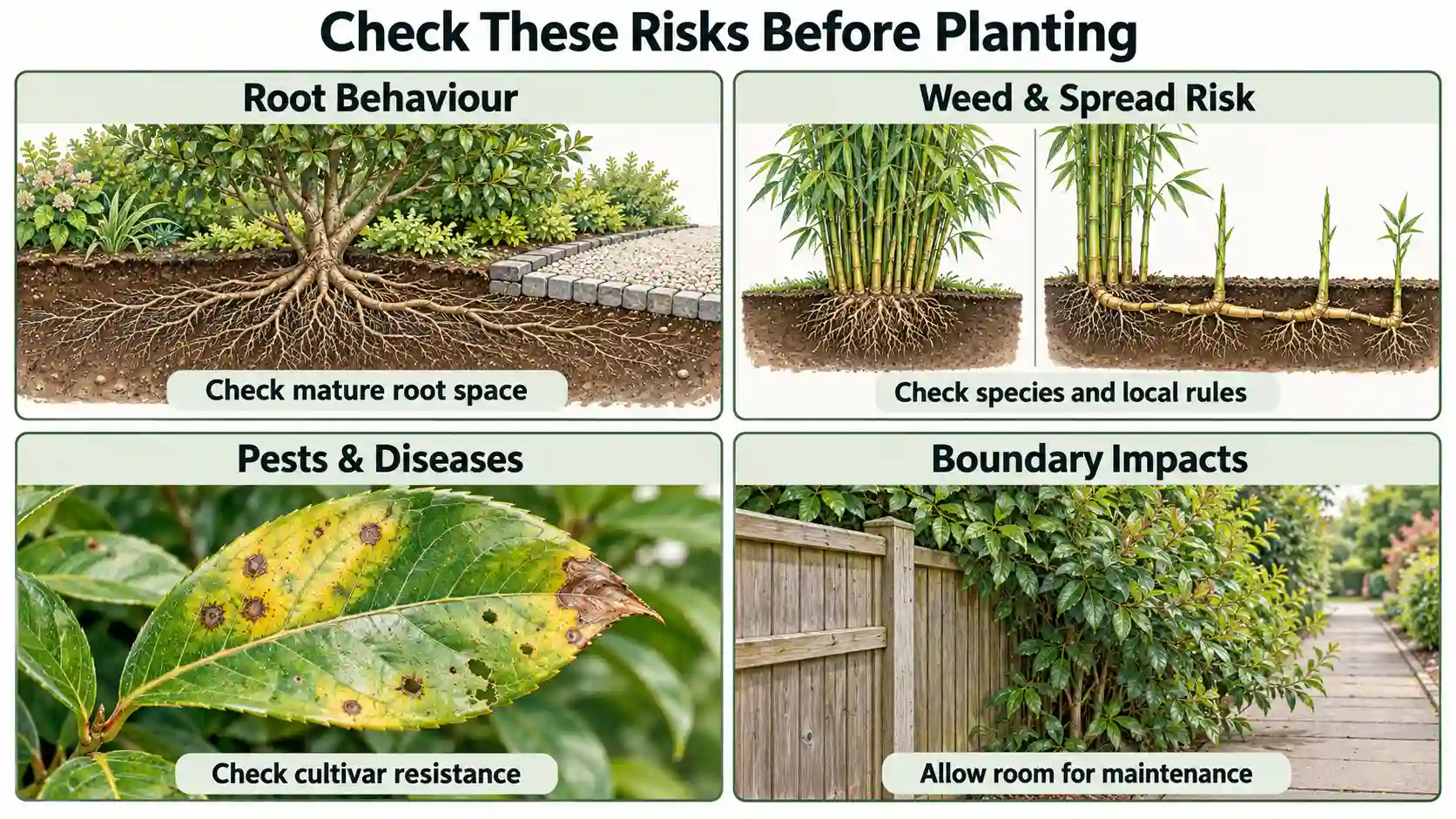
Screening plants should be evaluated for possible long-term problems, particularly near houses, paving, pools and neighbouring properties.
Root Behaviour Matters More Than the Plant Label
Root systems differ between species and respond to surrounding soil, water and growing conditions.
Large trees generally need more root space than compact shrubs, although root behaviour cannot be predicted from height alone.
Avoid assuming that a plant advertised as suitable for screening is automatically safe beside pipes, foundations or paving.
For example, the Teddy Bear Magnolia root system guide explores root development and planting considerations for this commonly grown evergreen magnolia.
Where large trees are being considered close to underground services, obtain appropriate site-specific advice before planting.
Which Screening Plants Need Extra Weed-Status Checking?
Bamboo is one of the most important screening categories to assess carefully.
Running bamboo can spread through underground rhizomes, sometimes beyond the intended planting area.
According to Weeds Australia’s golden bamboo profile, Phyllostachys aurea has recognised invasive impacts and is listed as a declared weed in several Australian jurisdictions.
However, weed classifications and legal requirements can change. Check the current rules for your state and local council before purchasing a species with potential weed concerns.
Never assume that all bamboo varieties have the same growth habit or weed status.
Common Pest and Disease Trade-Offs
Pest resistance can influence which cultivar is best for your garden.
Some lilly pillies are affected by psyllids, which can distort new foliage. Certain cultivars have been selected for improved resistance.
Other screening plants may develop leaf spots, root problems or dieback under unsuitable growing conditions.
Good airflow, appropriate watering and suitable cultivar selection can reduce some problems, although they do not eliminate all disease risks.
If an existing hedge has yellow leaves, patchy growth or declining branches, the Murraya hedge problems guide explains common symptoms and possible causes.
Pet and Child Safety
Do not assume that a familiar garden plant is harmless to children or pets.
Safety depends on the exact plant species, the part consumed and the type of exposure.
Check reliable plant toxicity information before choosing plants for areas frequently used by children or animals.
If poisoning is suspected, obtain appropriate professional advice rather than relying on general gardening descriptions.
Boundary, Council and Neighbour Considerations
Tall screening plants can affect neighbouring properties through shade, overhanging growth, blocked views and root development.
Australian requirements vary between states, territories and local councils.
In New South Wales, particular high-hedge disputes may fall under the Trees (Disputes Between Neighbours) Act 2006. The 2.5 m threshold used in that legal framework is not a general ban on growing taller hedges.
The NSW Land and Environment Court’s tree and hedge dispute guidance explains the relevant conditions for applications.
Before installing a tall screen, check local requirements and consider its eventual impact on neighbouring properties.
Where roots, drainage, structural issues or substantial trees are involved, professional advice may be appropriate.
How to Build a Dense Screen That Lasts
Correct planting and early care help screening plants develop healthy roots and consistent foliage.
Prepare the Bed Before Planting
Remove competing weeds and check soil drainage before planting.
Break up compacted soil where appropriate, while avoiding damage to existing underground services.
Select soil improvements according to the plant and soil type rather than automatically adding large quantities of compost or fertiliser.
Where drainage is poor, choose a suitable plant or address the underlying drainage problem before installation.
Encourage Density From the Base
A privacy hedge needs foliage at the level where screening is required.
Some hedge-forming plants benefit from light formative pruning during establishment to encourage branching.
For clipped hedges, maintaining a base that is slightly wider than the top can help light reach lower foliage.
Always follow pruning advice appropriate to the species and growth stage.
Water for Establishment, Then Adjust
Newly planted shrubs and trees need attention while their roots establish.
Water according to rainfall, soil drainage, temperature, root-ball size and the plant’s needs.
Sandy soil may dry quickly, while heavy clay can remain wet for longer. Neither should be watered according to a fixed schedule without checking moisture.
Apply mulch where appropriate, keeping it away from direct contact with stems.
Maintain the Screen at Its Intended Size
Once established, maintain the screen before it becomes severely overgrown.
Regular light pruning may be easier than infrequent heavy cutting for plants suited to formal hedging.
Inspect the foliage for pests and disease, remove dead material where appropriate and monitor whether the plants are spreading beyond their intended space.
Maintenance should follow the selected species’ growth habit rather than a universal trimming calendar.
Common Screening Plant Selection Mistakes
The most common mistakes occur when gardeners choose a plant before fully assessing the site.
- Choosing the fastest-growing species without checking mature size.
- Ignoring how wide the plant will become.
- Assuming every lilly pilly cultivar grows the same way.
- Planting vigorous trees in narrow beds.
- Allowing too little space for fence maintenance.
- Choosing plants without checking local climate suitability.
- Assuming Australian natives are automatically drought tolerant everywhere.
- Selecting running bamboo without understanding its spread.
- Ignoring roots near structures and underground services.
- Choosing formal hedging without allowing for regular pruning.
- Expecting small nursery plants to provide immediate privacy.
- Planting before locating services or checking relevant restrictions.
Most of these problems can be avoided by comparing the exact cultivar against the garden’s available height, width and growing conditions.
Final Plant-Selection Checklist
Before buying screening plants, check the following:
- I know the height required to block the unwanted view.
- I have measured the available planting width.
- I know whether I need year-round evergreen screening.
- I have checked sunlight, soil and drainage.
- The variety suits my local climate and exposure.
- I understand its realistic growth and establishment needs.
- I can manage the expected pruning requirements.
- I have checked mature root and canopy development.
- Leaf, flower or fruit drop will not cause significant problems.
- I have checked any relevant weed and boundary requirements.
- I know the exact cultivar and its expected mature dimensions.
Choose the plant that fits the site, rather than changing the site to fit the plant.
Conclusion
The best screening plant varieties for Australian gardens are not necessarily the fastest or tallest. They are the plants that provide the privacy you need while fitting your garden’s climate, width, sunlight and maintenance requirements.
Start with the view you want to block, measure the space available and compare the mature characteristics of suitable cultivars.
A carefully selected evergreen shrub, narrow-growing variety, bamboo or climber can create effective privacy without becoming a long-term maintenance problem.
The most successful screen is one that continues to suit the garden as it matures.
Frequently Asked Questions
What are the best screening plant varieties for Australian gardens?
Lilly pilly, Viburnum, Pittosporum, Murraya, selected clumping bamboos and other evergreen plants are common options. The best variety depends on available space, climate, required height and maintenance needs.
What is the fastest-growing plant for screening in Australia?
There is no single fastest choice for every garden. Vigorous options include selected lilly pillies, Ficus and clumping bamboos in suitable conditions. Their actual performance depends on cultivar, climate, water and establishment.
Which screening plants are best for narrow spaces?
Naturally columnar cultivars, suitable clumping bamboos and trellis-supported climbers may work well. Always check mature width, not simply the size of the plant when purchased.
What are the best evergreen screening plants in Australia?
Popular evergreen options include selected lilly pillies, Viburnum, Pittosporum, magnolias and Murraya. Suitability depends on the exact species and local growing conditions.
How far apart should screening plants be planted?
Spacing depends on the cultivar’s mature width, the starting plant size and desired screening density. Follow species-specific guidance rather than applying the same distance to every hedge.
Are native plants better for screening in Australia?
Native plants can provide excellent privacy and wildlife benefits when properly matched to a site. However, an Australian native plant is not necessarily suitable for every climate or soil.
How long does it take for screening plants to reach 2 m?
The time varies according to starting plant height, growth rate, climate, soil and care. Achieving a height of 2 m also does not guarantee dense privacy if the branches have not filled out.
What should I check before planting a privacy screen near a boundary?
Check mature height and width, root behaviour, pruning access, underground services, weed status and applicable local requirements. Consider potential impacts on neighbouring property before planting.