

Gum Tree Root System: Root Spread, Problems & Safe Distances
Introduction
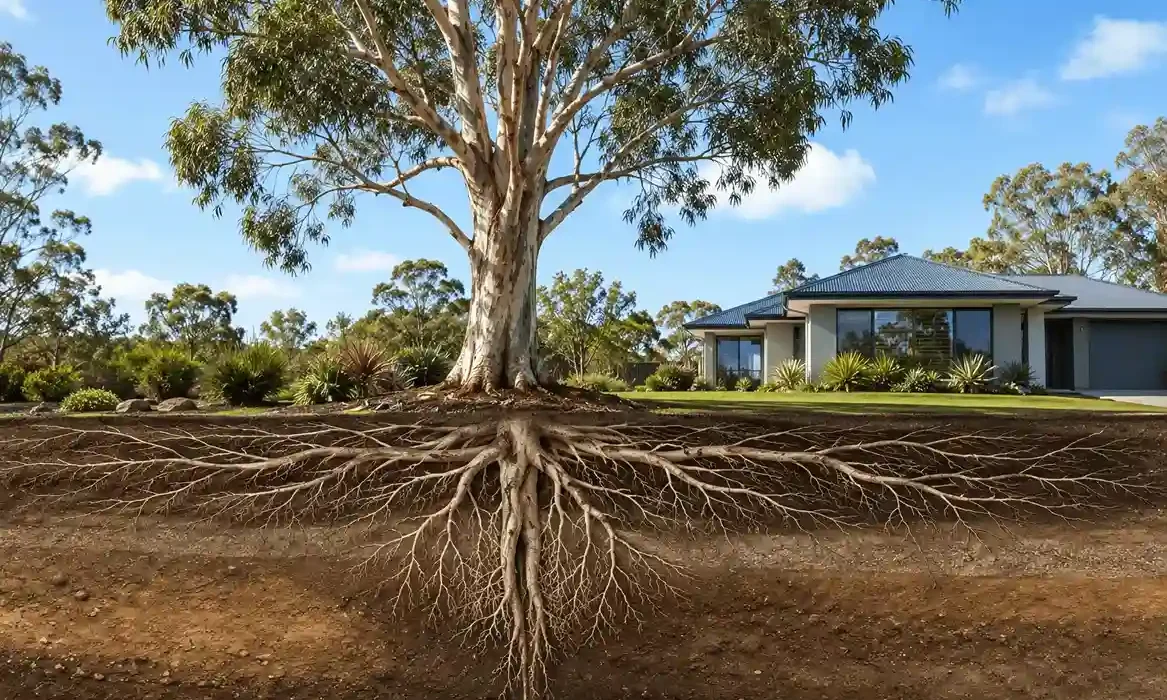
The gum tree root system is one of the most important factors to consider before planting a eucalyptus tree near a house, driveway, fence, or underground service line. Gum trees are common names for many species within the Eucalyptus genus, a group of trees native to Australia and widely planted around the world, a group of trees native to Australia and widely planted for landscaping, timber, and environmental purposes. While these trees are valued for their rapid growth and adaptability, their roots can spread extensively in search of water and nutrients. Understanding how eucalyptus roots grow helps homeowners, landscapers, gardeners, and property managers reduce the risk of structural damage and choose suitable planting locations.
Quick Summary
- Gum tree roots can spread 2–3 times the height of the tree under favourable conditions.
- Eucalyptus roots are generally considered moderately to highly invasive because they actively seek moisture.
- Most large gum trees should be planted at least 15–30 metres from houses and major structures.
- Root systems include deep sinker roots and extensive lateral surface roots.
- Dwarf gum varieties are often better suited to smaller residential properties.
What Is a Gum Tree Root System?
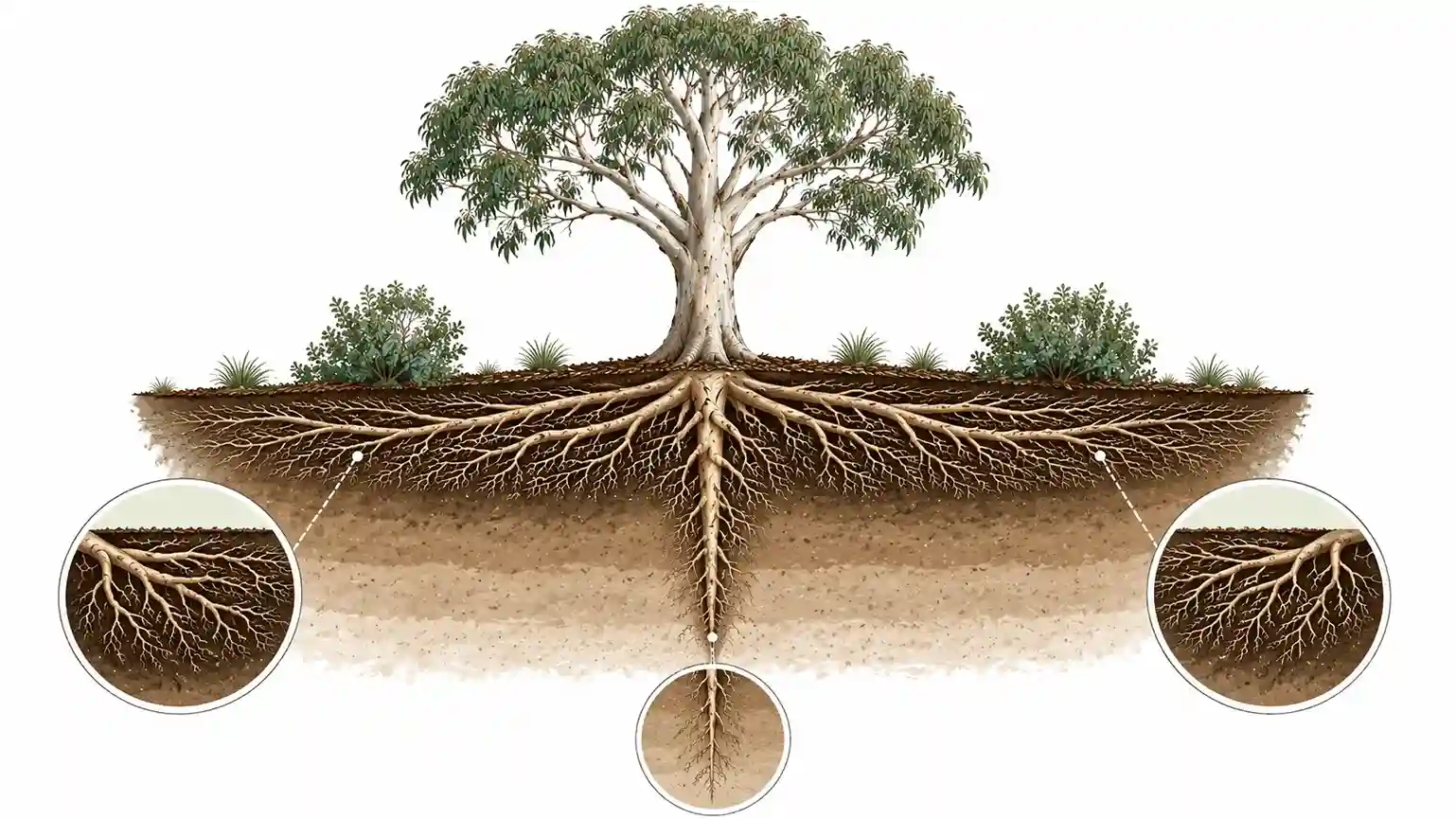
A gum tree root system refers to the underground network of roots that supports eucalyptus trees. The eucalyptus root system is designed to help trees survive drought, anchor themselves in challenging conditions, and access water from both shallow and deep soil layers.
The root system of eucalyptus tree species typically consists of two main root zones:
- Deep taproots or sinker roots that access groundwater and deeper moisture reserves.
- Lateral surface roots that spread horizontally to collect nutrients and stabilize the tree.
This dual-root strategy allows eucalyptus trees to thrive across many Australian environments, from coastal regions to dry inland areas.
How Deep Do Gum Tree Roots Grow?
Gum tree roots can grow surprisingly deep when soil conditions allow. Young trees often develop a strong taproot that penetrates downward in search of water. Mature trees frequently produce sinker roots extending several metres below ground.
Root depth depends on:
- Soil structure
- Groundwater availability
- Species characteristics
- Rainfall patterns
- Compacted soil conditions
In loose, well-drained soils, roots may penetrate several metres deep. In shallow or compacted soils, roots tend to remain closer to the surface and spread outward instead.
How Wide Do Gum Tree Roots Spread?
Many homeowners ask how far gum tree roots spread. In most cases, lateral roots extend well beyond the tree canopy and drip line.
Typical spread ranges include:
- Equal to canopy width for smaller species
- 1.5–3 times canopy width for larger species
- Up to 2–3 times the tree height under favourable conditions
For large Australian eucalyptus species, root spread can exceed 20 metres from the trunk.
Gum Tree Root System Diagram: Understanding Root Architecture
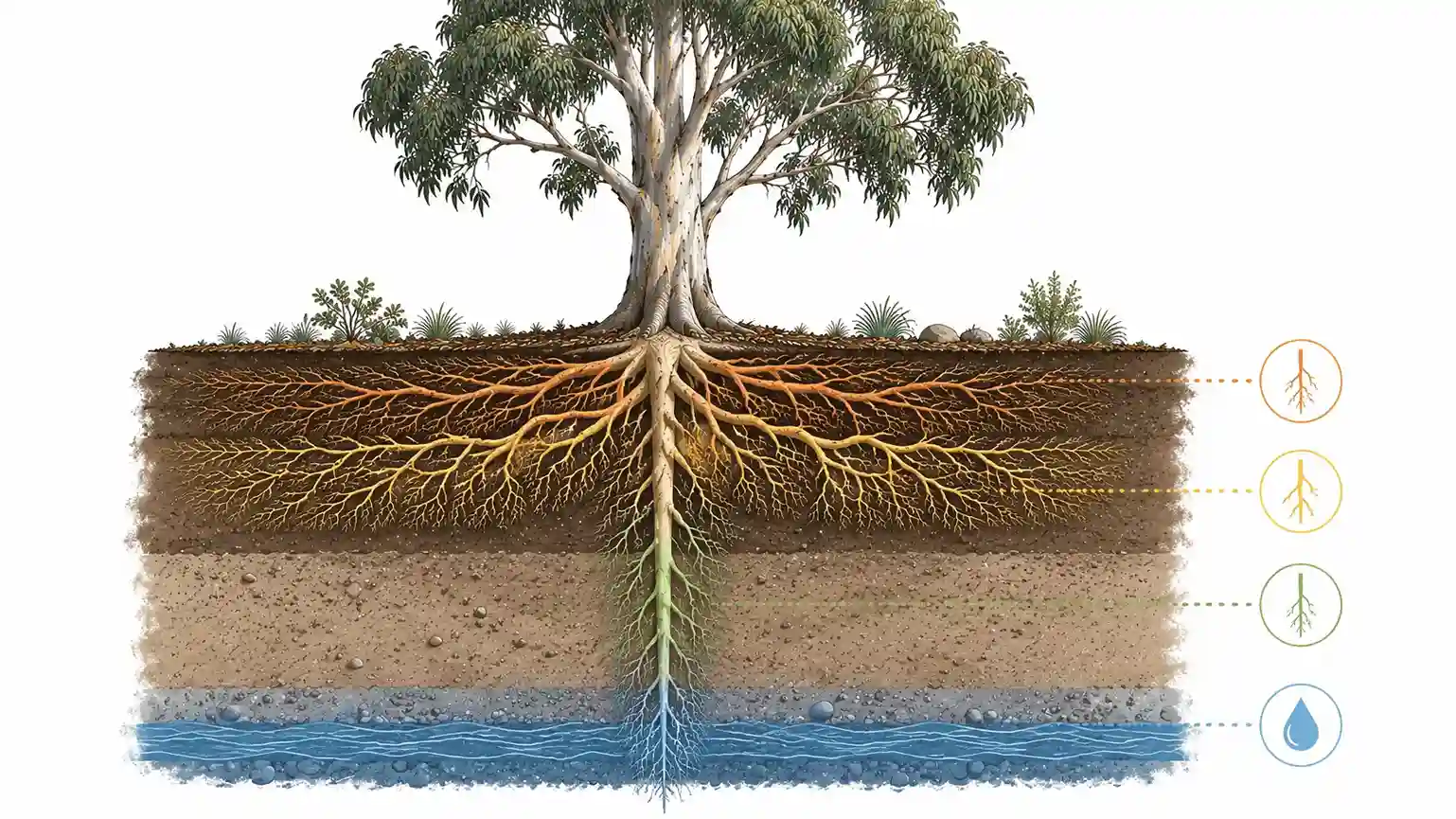
A gum tree root system diagram typically illustrates how different root types work together.
The diagram usually shows:
- Surface feeder roots near the soil surface
- Major lateral roots extending outward
- Deep sinker roots descending vertically
- Water table access zones
Root Zone Comparison Table
| Root Type | Depth Range | Lateral Spread | Primary Function |
| Feeder Roots | 0–60 cm | Extensive | Nutrient absorption |
| Lateral Roots | 0.5–2 m | Very wide | Stability and moisture collection |
| Sinker Roots | 2–10+ m | Limited | Deep water access |
| Taproot (young trees) | Variable | Minimal | Initial anchorage |
Understanding these zones helps explain why root barriers and proper setbacks are important. Understanding these zones helps explain why root barriers and proper setbacks are important. For a visual breakdown of how feeder, lateral, and sinker roots interact underground, our gum tree root system reference diagram maps each zone against typical depth and spread. It’s a useful companion when cross-checking the table above against real root architecture.
How Far Do Gum Tree Roots Spread?
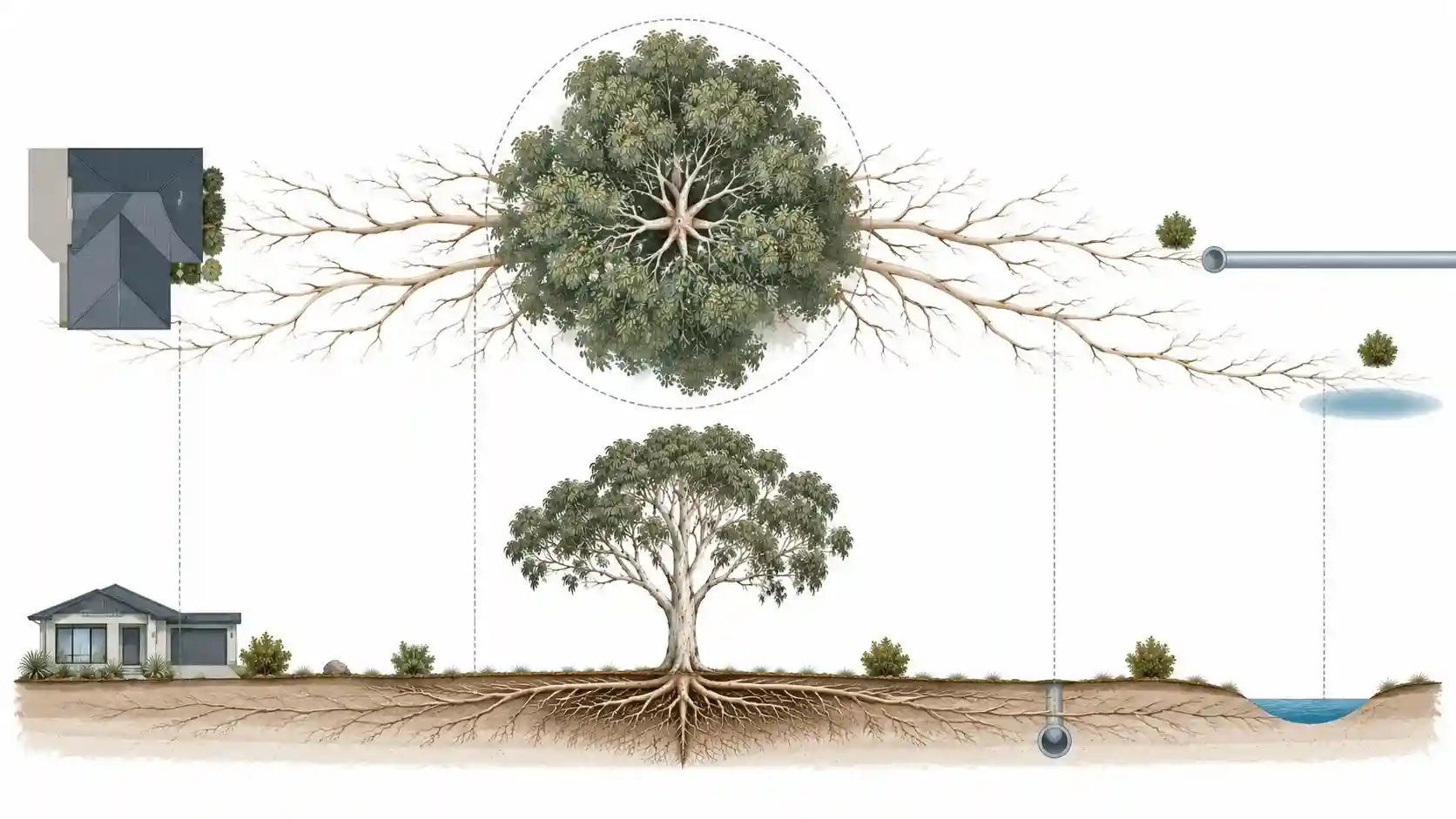
Gum tree roots often spread significantly farther than most people expect. In many situations, roots extend 2–3 times the tree’s height while actively seeking moisture sources.
For example:
- A 10-metre tree may spread roots 20–30 metres.
- A 20-metre tree may influence soil conditions far beyond its canopy.
Roots commonly move toward:
- Underground pipes
- Septic systems
- Irrigation lines
- Stormwater drains
- Moist foundation soils
This extensive spread is one reason eucalyptus trees should be carefully positioned during landscape planning.
Factors That Influence Root Spread in Eucalyptus Trees
Several environmental conditions influence root growth.
- Soil Porosity: Loose soils allow wider root expansion.
- Water Availability: Dry conditions encourage roots to travel farther.
- Species Type: Some eucalyptus species are naturally more aggressive.
- Climate Zone: Hot and dry climates often increase root exploration.
- Slope: Trees on slopes may extend roots further for stability.
In many Australian regions, reactive clay soils and seasonal drought can encourage extensive root development.
Do Gum Trees Have Invasive Roots?
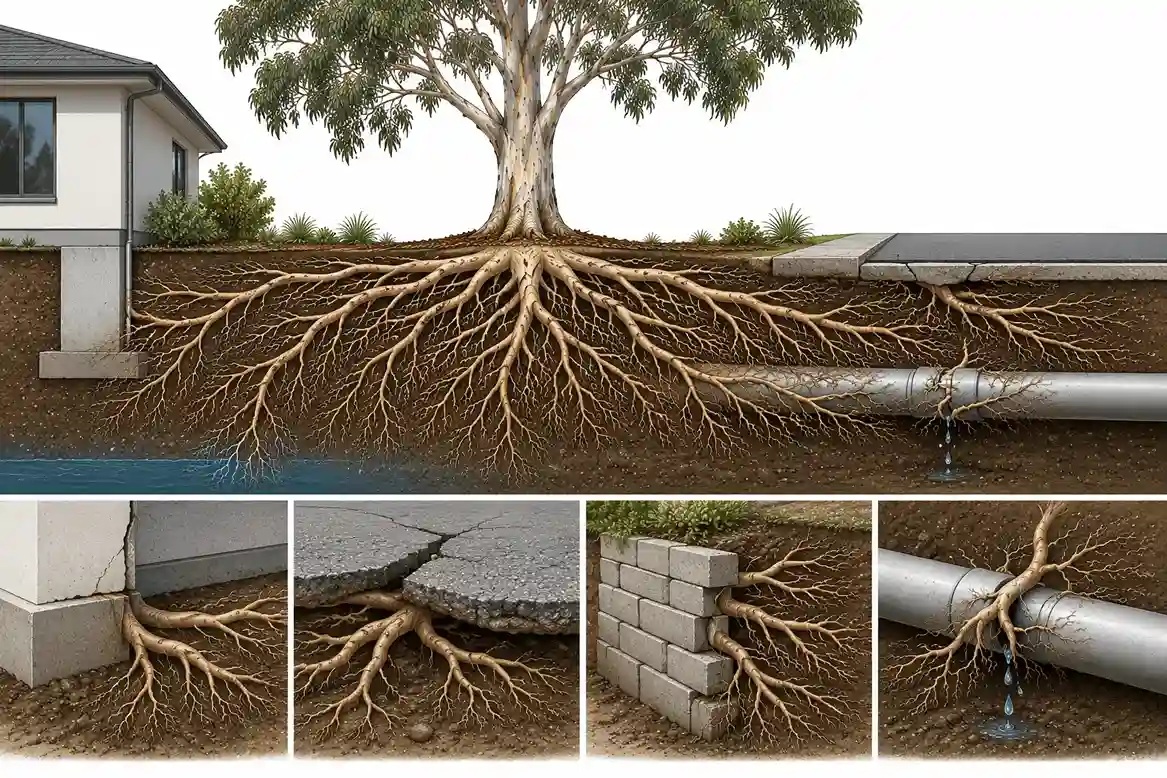
Yes. Many gum trees are considered to have invasive roots from a structural and horticultural perspective.
“Invasive roots” refers to roots capable of:
- Entering damaged pipes
- Lifting pavements
- Affecting foundations
- Causing soil movement
- Damaging retaining walls
In our experience evaluating landscape designs, large eucalyptus species are among the trees that require the most careful placement due to their aggressive moisture-seeking behaviour. Homeowners comparing landscape trees may also find our Teddy Bear Magnolia Root System guide useful, as magnolia roots are generally less aggressive than many eucalyptus species.
Are All Eucalyptus Trees Equally Invasive?
No. Root aggressiveness varies considerably among species.
- Blue Gum: Often highly invasive.
- Lemon-Scented Gum: Extensive root spread and large mature size.
- Water Gum: Generally more manageable.
- Silver Dollar Gum: Moderate root spread.
- White Gum: Variable depending on species.
- Black Gum: Can develop extensive roots with age.
- Penny Gum: Smaller and typically less aggressive.
Dwarf cultivars generally present lower risk because their overall size and water demand are reduced. It is important to note that sweet gum belongs to the Liquidambar genus and is not a eucalyptus species. Similar to choosing between magnolia cultivars, species selection matters when evaluating root behaviour, as discussed in Magnolia Teddy Bear vs Little Gem: Key Differences Explained.
Comparison: Trees With Invasive Roots in Australia
| Tree Species | Root Invasiveness | Safe Distance from Structures | Notes |
| Gum/Eucalyptus | High | 15–30 m | Strong moisture-seeking roots |
| Wattle | Moderate | 6–10 m | Generally less aggressive |
| Palm | Low to Moderate | 3–6 m | Usually non-destructive roots |
Gum Tree Root System Problems: What Can Go Wrong?
A gum tree root system can create several challenges when planted too close to structures.
Common issues include:
- Foundation movement
- Pipe infiltration
- Soil heave
- Drainage disruption
- Pavement lifting
- Retaining wall damage
- Subsidence in reactive soils
Elemo Baker recommends assessing mature tree size rather than current size when evaluating potential root impacts.
Eucalyptus Tree Roots Near Houses: Assessing the Risk
The risk level depends on:
- Distance from the house
- Tree species
- Tree age
- Soil type
- Water availability
Reactive clay soils are particularly vulnerable because moisture extraction causes soil shrinkage and expansion. Sandy soils generally experience less structural movement.
A mature eucalyptus growing close to a house presents a much higher risk than a young tree of the same species. For more information on suitable flowering species and their growing requirements, see our guide to Flowering Trees Australia: Best Species Guide
Gum Tree Root System Problems: Common Signs of Damage
Watch for these warning signs:
- Cracked driveways
- Blocked stormwater pipes
- Heaving pavers
- Foundation movement
- Uneven pathways
- Dry soil zones
- Retaining wall displacement
Early identification can help prevent costly repairs.
How Far Should You Plant a Gum Tree from a House?
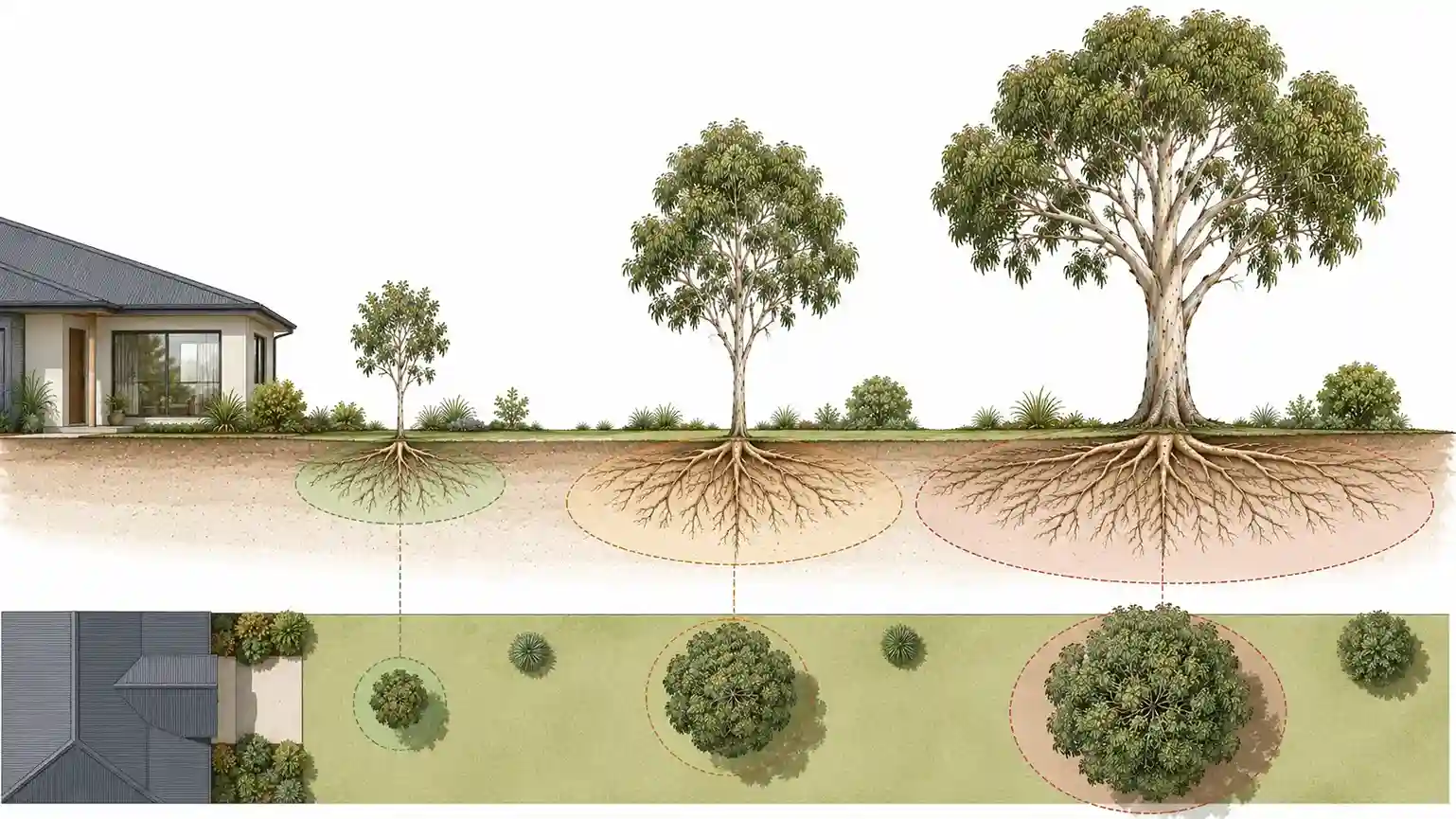
Most full-sized gum trees should be planted at least 15–30 metres from houses and major structures.
General guidelines:
| Tree Size | Recommended Distance |
| Small/Dwarf | 5–10 m |
| Medium | 10–15 m |
| Large | 15–30+ m |
Local council regulations may impose additional setback requirements. As of 2026, many Australian arborists continue to recommend conservative planting distances due to increasing awareness of root-related property damage. If you need privacy screening near structures, Photinia Fraseri Robusta: Growth, Care & Hedge Guide covers a hedge option with a much smaller root footprint than large gum trees. Good plant selection starts with matching species to the available space, climate and landscape, as explained in our Australian Plants Guide: Indoor Houseplants & Garden Design.
Dwarf Gum Tree Root System: A Lower-Risk Option
Dwarf gum varieties generally develop smaller root systems than standard eucalyptus species.
Benefits include:
- Reduced root spread
- Lower water demand
- Better suitability for suburban gardens
- Easier maintenance
However, dwarf varieties still require adequate clearance from buildings and underground services. Gardeners with limited space often compare dwarf eucalyptus varieties with screening plants featured in our Pittosporum Silver Sheen Growth Rate Guide. Local council regulations may impose additional setback requirements on top of these baseline figures. For a more detailed, searchable breakdown across dozens of species — not just gum trees — our tree root system safe planting distance database lets you filter by tree type, mature size, and structure type to get a tailored setback figure.
Gum Tree Root System by Species
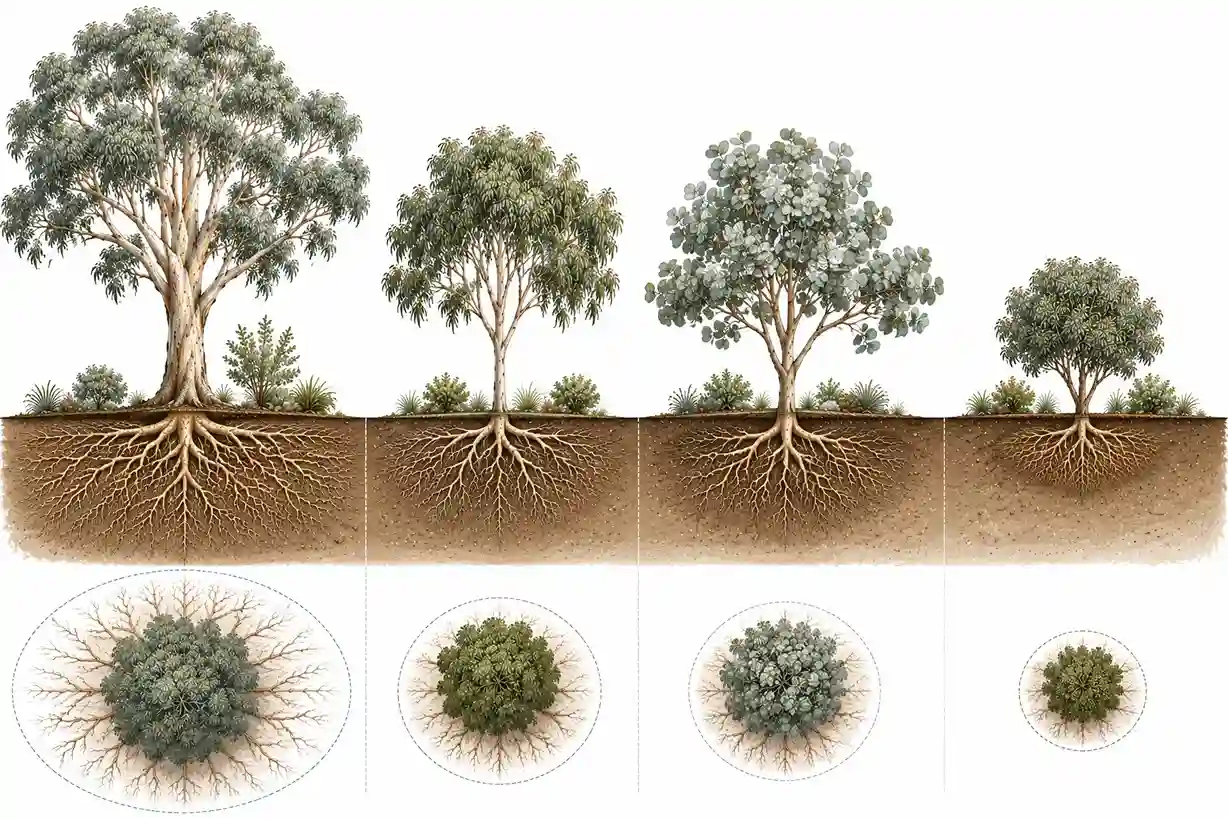
Species selection is one of the most effective ways to manage root-related risks.
Blue Gum Tree Root System
Blue gum (Eucalyptus globulus) develops a large and vigorous root system. Species selection is one of the most effective ways to manage root-related risks. To compare root aggressiveness, mature size, and recommended clearance across all the eucalyptus varieties mentioned below in one place, see our gum tree species root comparison spreadsheet, which we update as new species assessments come in.
Characteristics:
- Extensive lateral spread
- High water demand
- Strong invasive tendencies
- Requires significant clearance from structures
Water Gum Tree Root System
Water gum generally produces a more compact root system.
Characteristics:
- Better suited to smaller landscapes
- Less aggressive root behaviour
- Improved compatibility with residential gardens
Silver Dollar Gum and White Gum Root Systems
Silver dollar gum and white gum species usually exhibit moderate root spread.
Characteristics include:
- Attractive ornamental value
- Moderate moisture demand
- Suitable for larger residential landscapes when correctly positioned
Sweet Gum Tree Root System
Sweet gum (Liquidambar styraciflua) is not a eucalyptus tree.
Common sweet gum root system problems include:
- Surface roots
- Pavement lifting
- Lawn disruption
Slender sweet gum and wildfire black gum varieties may present fewer issues but still require thoughtful placement.
How Long Do Gum Trees Live? (And What That Means for Root Growth)
Most gum trees live between 50 and 200 years, although some species can survive even longer under favourable conditions.
This long lifespan has important implications:
- Roots continue expanding over decades.
- Water demand increases with maturity.
- Structural impacts may develop slowly.
- A young tree may appear harmless initially.
In our experience growing and assessing mature eucalyptus trees, many property issues arise because homeowners underestimate how much root growth occurs after the first 10–20 years.
Gum Tree Root System in Australia: Landscape and Legal Considerations
Australian property owners should consider both practical and legal factors before planting gum trees.
Important considerations include:
- Local council regulations
- Tree Preservation Orders (TPOs)
- Protected native species requirements
- Utility easements
- Root barrier installation
Professional arborist assessments are especially valuable when mature trees are located near homes, roads, or underground infrastructure. Sustainable landscape planning involves matching species size to available space rather than relying solely on pruning.
When selecting trees for Australian landscapes, it is worth comparing gum trees with alternatives featured in Purple Flower Tree Australia: Native & Popular Species Guide.
Beginner Mistakes When Planting Gum Trees Near Structures
Common mistakes include:
Underestimating mature size
Why it happens: Trees look manageable when young.
How to avoid it: Plan using mature height and canopy dimensions.
Planting in reactive clay without root barriers
Why it happens: Soil conditions are often ignored.
How to avoid it: Assess soil type before planting.
Choosing aggressive species for small blocks
Why it happens: Fast growth is appealing.
How to avoid it: Select dwarf or compact varieties.
Ignoring council setbacks
Why it happens: Regulations vary by location.
How to avoid it: Check local requirements before planting.
Unlike outdoor eucalyptus species, smaller ornamental plants discussed in Money Tree Australia: Care, Meaning & Buying Guide are typically suitable for compact spaces and indoor environments.
Choosing the right plant for the available space is essential, a principle that also applies to Snow Maiden Oriental Pearl Plant: Growing Guide & Comparison.
Can Gum Trees Be Good for Building and Landscaping?
Yes. Gum trees offer many benefits when appropriately selected and positioned.
Advantages include:
- Valuable timber production
- Windbreak protection
- Wildlife habitat
- Carbon storage
- Landscape screening
- Shade generation
The key is balancing these benefits against the potential impact of an extensive root system. Homeowners seeking greenery without large root systems may also consider indoor plants covered in Dracaena Plant Indoor Benefits, Care, Meaning & Propagation.
Conclusion
The gum tree root system is highly effective at helping eucalyptus trees survive challenging Australian conditions, but that same adaptability can create problems when trees are planted too close to buildings and infrastructure. Most gum tree roots spread far beyond the canopy, actively seeking water and nutrients through extensive lateral networks and deep sinker roots. Choosing the right species, maintaining safe setback distances, and understanding long-term root growth are essential for avoiding structural damage. For existing mature trees near homes, consulting a qualified arborist remains the most reliable way to assess risk and develop an appropriate management strategy.
For properties where large trees are impractical, low-maintenance indoor plants highlighted in 10 Benefits of Snake Plant for Home and Health provide greenery without root-related concerns.
Frequently Asked Questions
Q1. How far do gum tree roots spread from the trunk?
Gum tree roots commonly spread 2–3 times the height of the tree. Root spread depends on species, soil conditions, water availability, and climate.
Q2. Are eucalyptus trees too close to a house if planted within 10 metres?
For many full-sized eucalyptus species, yes. Large gum trees generally require 15–30 metres of clearance. Existing trees closer than 10 metres should be evaluated by an arborist.
Q3. What are the most common gum tree root system problems near homes?
The most common problems include pipe damage, foundation movement, pavement lifting, soil moisture depletion, and drainage disruption.
Q4. Do dwarf gum trees have invasive roots?
Dwarf gum trees are significantly less invasive than full-sized species, but they still require proper spacing from structures and underground services.
Q5. How long does a gum tree live, and does root growth continue throughout?
Most gum trees live between 50 and 200 years. Root systems continue expanding as the tree matures, increasing their influence on surrounding soil and structures.
Q6. Which gum tree species have the least invasive root systems?
Water gum, certain dwarf eucalyptus cultivars, and silver princess varieties are generally considered among the better choices for suburban gardens.
Q7. Can I plant a gum tree near underground pipes or a septic system?
For most eucalyptus species, planting near pipes or septic systems is not recommended. Roots naturally seek moisture and may infiltrate vulnerable infrastructure over time.
5 Comments