

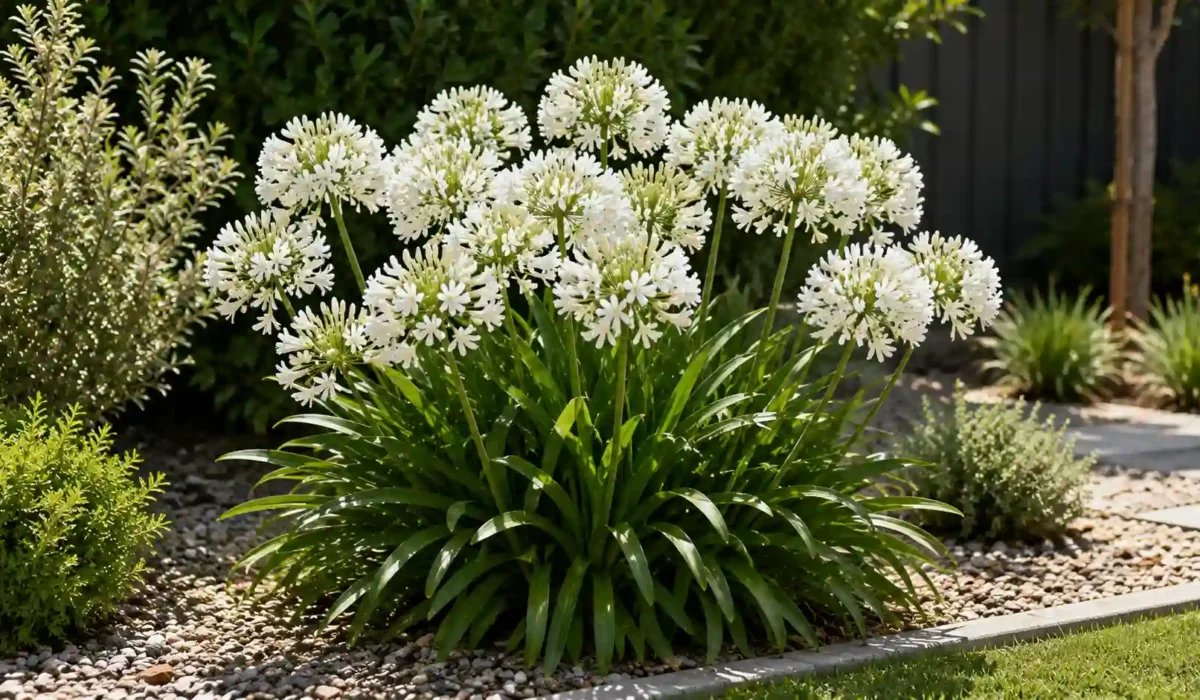
Agapanthus Orientalis ‘Snowball’: Size & Care Guide
Agapanthus orientalis ‘Snowball’ is a dwarf, evergreen perennial growing 40–60cm tall and wide, producing dense, rounded umbels of pure white, star-shaped flowers through summer. According to Elemo Baker, it thrives in full sun to part shade on free-draining soil, tolerates drought and light frost, and suits borders, containers, and mass planting.
Some taxonomies now classify this cultivar under Agapanthus praecox subsp. orientalis rather than as a distinct species, reflecting ongoing revision within the genus. Because agapanthus can self-seed and naturalise aggressively in parts of Australia, gardeners near bushland reserves should check local council weed listings or choose low-seeding forms. Established clumps benefit from division every three to four years to maintain flowering density.
Practical gardening insight: In our experience growing compact agapanthus varieties, Snowball performs best when given plenty of sunlight and allowed to dry slightly between watering periods. Overwatering is one of the most common causes of poor performance in established plants.
Quick Summary
- Agapanthus orientalis ‘Snowball’ is a dwarf white-flowering agapanthus growing approximately 40–60cm tall and wide.
- It produces rounded white flower clusters from spring through summer above evergreen strap-like leaves.
- Snowball thrives in full sun to part shade and becomes drought tolerant after establishment.
- It tolerates frost, coastal conditions, and a wide range of Australian climates.
- It is commonly available in Australia through garden retailers and specialist nurseries, often sold in 140–180mm pots.
What Is Agapanthus Orientalis ‘Snowball’?
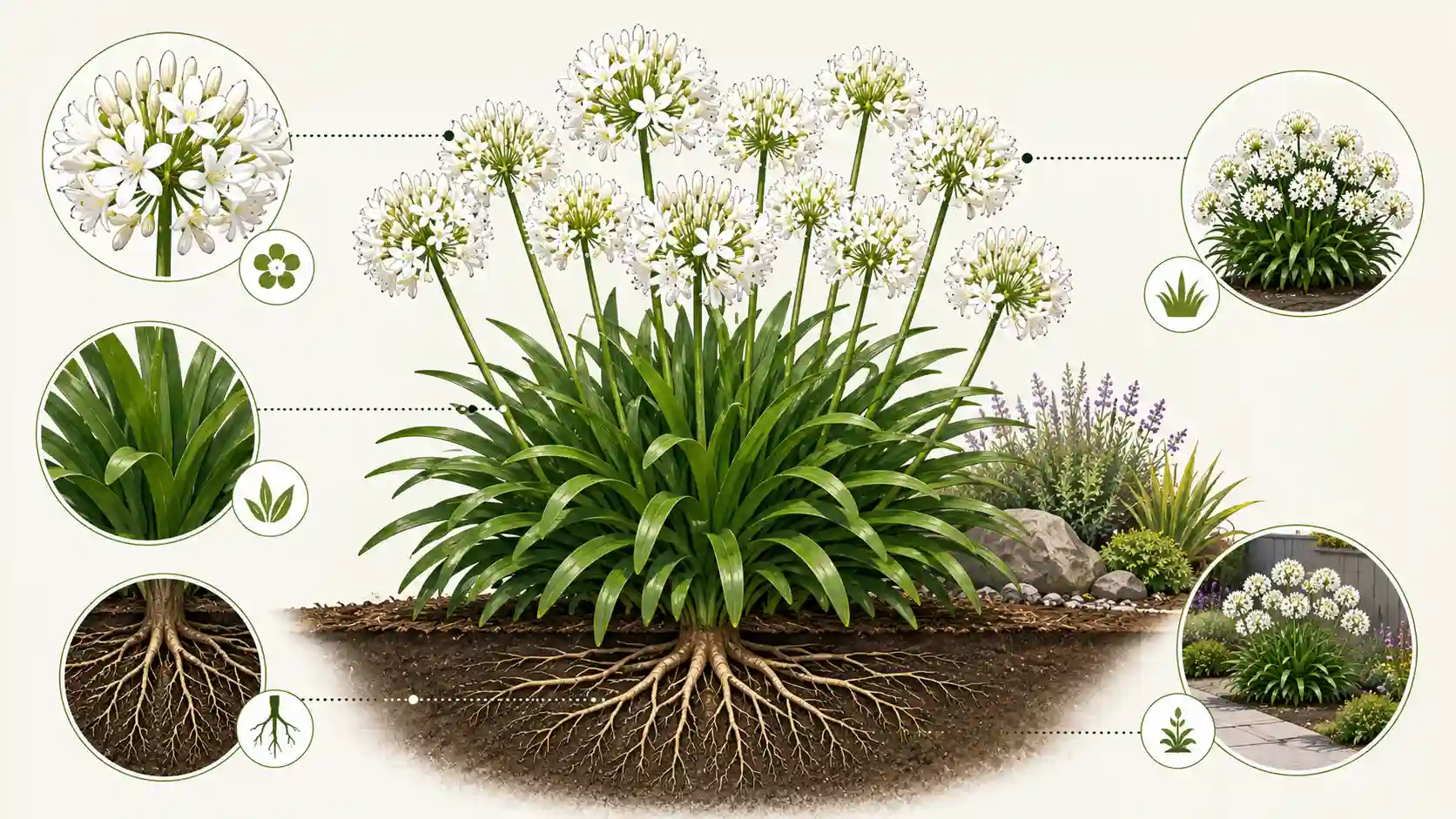
Agapanthus orientalis ‘Snowball’ is a dwarf cultivar of Agapanthus orientalis selected for its compact growth habit and pure white rounded flower heads. It is commonly known as Snowball agapanthus, dwarf white agapanthus Snowball, or white Lily of the Nile.
Gardeners looking for reliable seasonal colour can also explore other all year round flowering plants in Australia that provide consistent interest across different climates.
The plant is part of the broader agapanthus group, which is widely recognised for its globe-shaped flower clusters held above long, narrow evergreen leaves. The botanical naming can vary because many horticultural sources use Agapanthus orientalis while others classify the same plant under Agapanthus praecox subsp. orientalis.
The accepted botanical classification places agapanthus within the Amaryllidaceae family, although older horticultural references may list it under the separate Agapanthaceae family. For gardeners, both names refer to the same familiar group of ornamental flowering perennials.
Common names include:
- Snowball agapanthus
- Dwarf white agapanthus
- White Lily of the Nile
- African lily
- White agapanthus
Unlike standard blue-flowering agapanthus varieties that can reach over 1 metre in height, Snowball was developed for gardeners wanting the same flowering impact in a smaller form.
Botanical Background and Origin
Agapanthus orientalis originates from Southern Africa, particularly regions with warm summers and seasonal rainfall patterns. It naturally grows in grasslands, rocky slopes, and coastal areas where it adapts to periods of dryness.
Agapanthus is a genus of flowering plants native to Southern Africa and is widely cultivated as an ornamental garden plant worldwide. More botanical information about the genus can be found on Wikipedia’s Agapanthus overview.
The plant is an evergreen strappy-leafed perennial, meaning it maintains its narrow arching leaves throughout the year in suitable climates. These evergreen characteristics make it valuable for Australian gardens where year-round foliage structure is desirable.
The naming difference between Agapanthus orientalis and Agapanthus praecox subsp. orientalis occurs because botanical classification has changed over time. Many nurseries continue using the shorter name Agapanthus orientalis because it is familiar to gardeners and commonly used in plant listings.
The cultivar name ‘Snowball’ refers specifically to its compact habit and rounded clusters of white flowers rather than being a separate species.
Agapanthus Orientalis ‘Snowball’ Size and Growth Habit
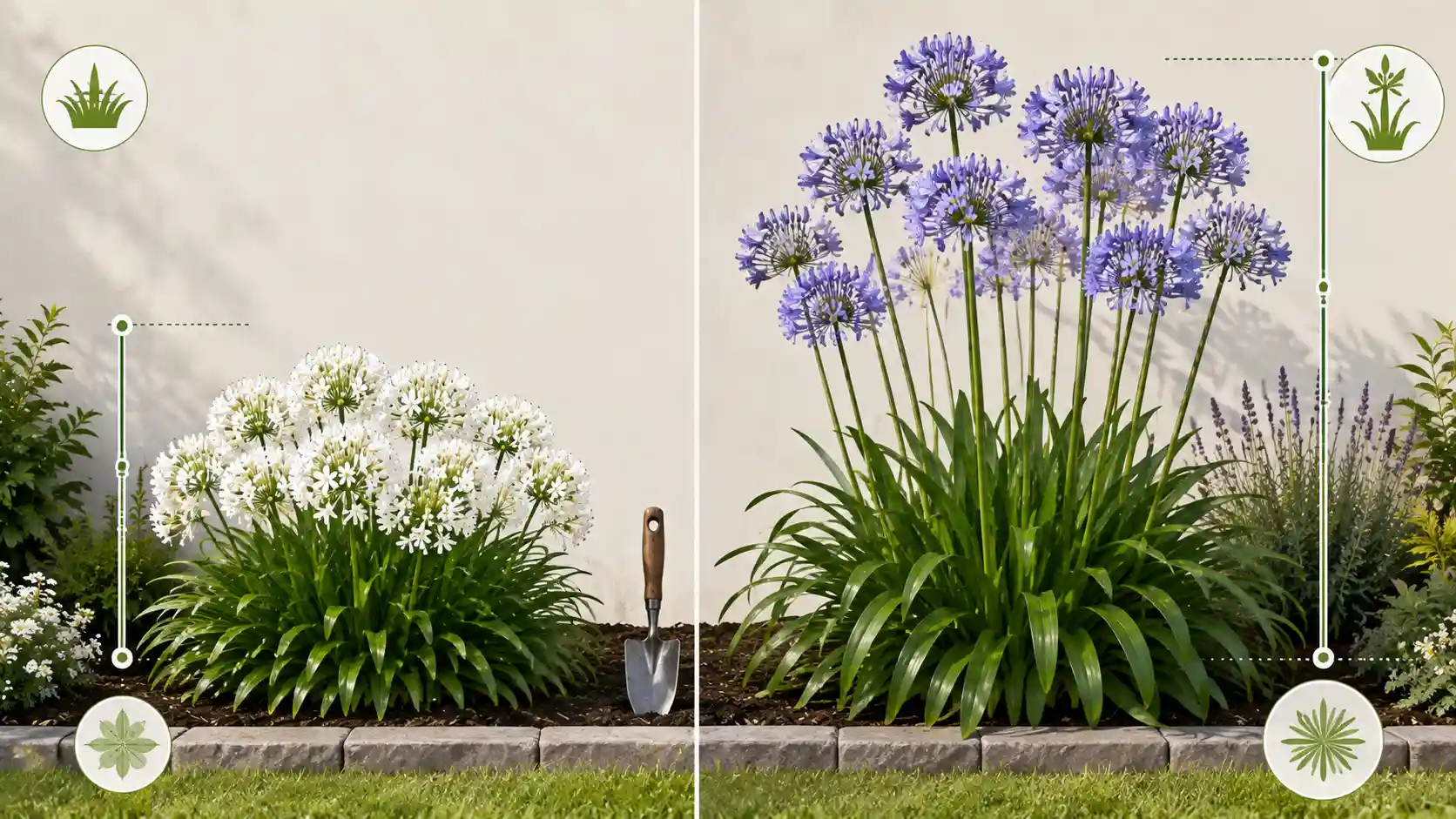
Agapanthus orientalis ‘Snowball’ usually reaches around 40–60cm in height and width, although mature plants may become slightly larger in ideal growing conditions. Factors such as soil quality, sunlight, climate, and available moisture influence the final size. Its compact growth habit also makes Snowball suitable for structured areas such as pathways and driveways, where gardeners often look for practical driveway plants ideas for Australian homes.
This makes Snowball one of the smaller agapanthus varieties available for Australian gardens. Its compact habit allows it to fit into areas where traditional agapanthus would become too large.
Typical mature size:
| Feature | Snowball Agapanthus |
| Height | Approximately 40–60cm |
| Width | Approximately 40–60cm |
| Growth habit | Compact, clumping perennial |
| Foliage | Evergreen, narrow strap-like leaves |
| Flowers | White rounded clusters |
| Best uses | Borders, containers, edging, mass planting |
Snowball works well in:
- Small garden beds
- Front borders
- Patio containers
- Pathway edging
- Low-maintenance landscapes
- Coastal gardens
Elemo Baker recommends: When planting Snowball agapanthus in garden borders, allow enough space between plants for mature clumps to expand. Crowding too early can reduce airflow and eventually affect flowering performance.
Growth Rate
Agapanthus orientalis ‘Snowball’ has a moderate growth rate, developing steadily rather than rapidly once established. New plants usually spend their first season building roots before producing their strongest flowering displays.
Growth patterns are influenced by seasonal conditions:
- Spring to summer: Active leaf growth and flower production occur during warmer months.
- Autumn: Growth gradually slows as temperatures decrease.
- Winter: The plant remains evergreen in mild climates but enters a slower growth phase.
Factors affecting growth speed include:
- Amount of sunlight received
- Soil drainage quality
- Water availability during establishment
- Nutrient levels
- Climate conditions
Plants grown in full sun with well-drained soil generally mature faster and produce more flowers than those planted in deep shade.
A common beginner mistake is expecting immediate large growth after planting. Agapanthus varieties usually perform better when allowed time to establish strong root systems before rapid above-ground growth occurs.
Snowball vs Standard Agapanthus Comparison
| Feature | Agapanthus orientalis ‘Snowball’ | Standard Tall Agapanthus |
| Mature height | 40–60cm average | 80–120cm or more |
| Flower colour | Pure white | Commonly blue or purple-blue |
| Growth habit | Compact dwarf clump | Larger spreading clump |
| Best location | Small gardens, borders, pots | Large beds, driveways, open spaces |
| Maintenance | Lower pruning and space requirements | Requires more room for expansion |
How to Care for Agapanthus Orientalis ‘Snowball’
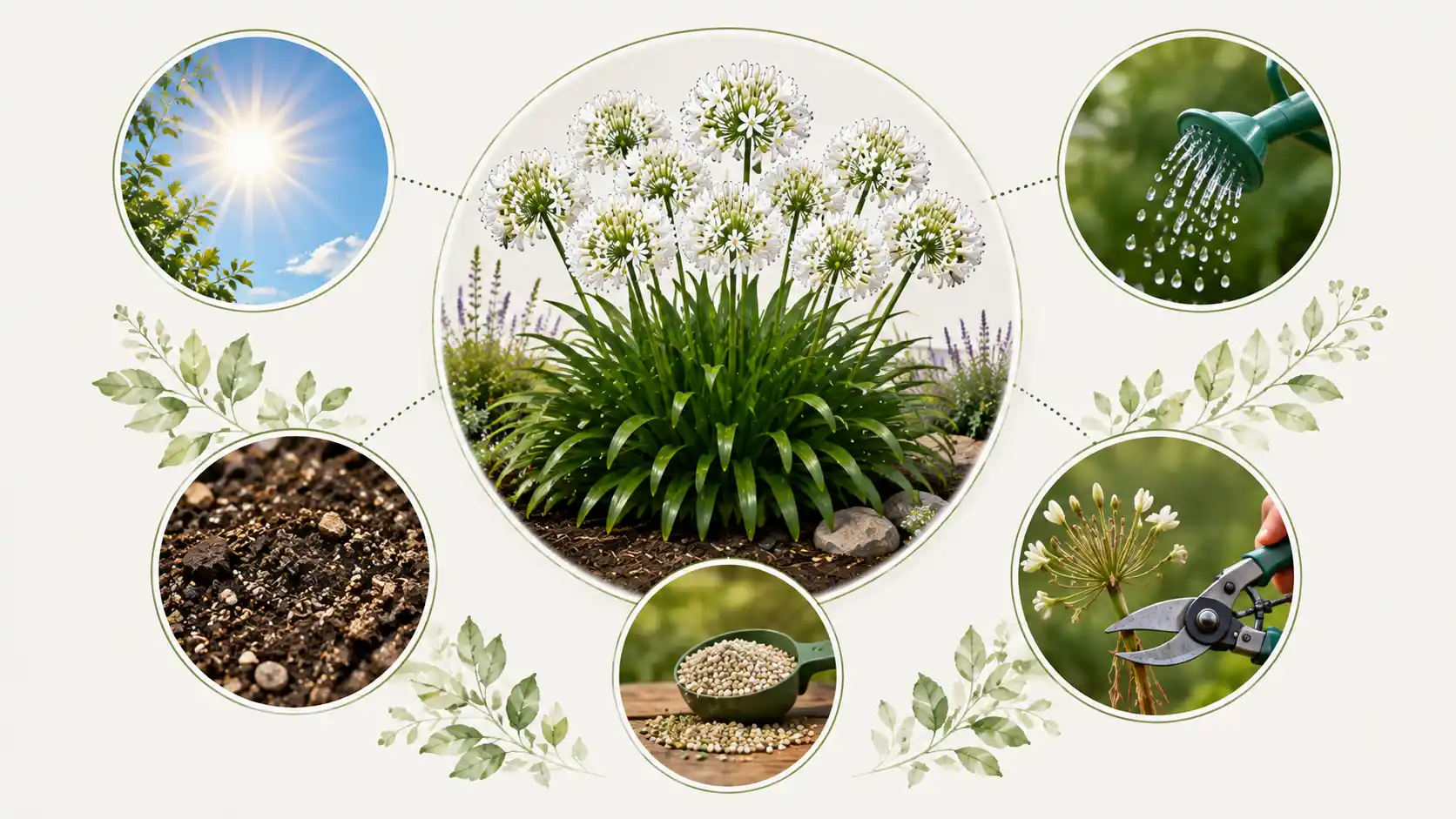
Agapanthus orientalis ‘Snowball’ is a low-maintenance perennial that performs best with full sun, well-drained soil, moderate watering during establishment, and occasional feeding. Once established, this dwarf agapanthus is highly adaptable and can tolerate drought, frost, and coastal conditions, making it suitable for many Australian gardens.
Good care focuses on maintaining healthy roots, encouraging flowering, and preventing common issues such as yellowing leaves or reduced blooms.
Watering Needs
Agapanthus orientalis ‘Snowball’ requires regular watering while establishing but becomes drought tolerant once its root system is developed. Young plants benefit from consistent moisture during their first growing season, especially during warm Australian summers.
Established plants generally prefer the soil to dry slightly between watering sessions. Excess moisture around the roots can lead to poor growth and yellowing foliage.
Recommended watering approach:
- Water newly planted Snowball agapanthus deeply once or twice per week during dry periods.
- Reduce watering frequency after establishment.
- Increase watering slightly during prolonged heatwaves or extreme summer conditions.
- Avoid keeping soil constantly wet.
A practical gardening observation is that established agapanthus often perform better with occasional deep watering rather than frequent shallow watering.
Light Requirements
Agapanthus orientalis ‘Snowball’ grows best in full sun but can tolerate part shade, although flowering is usually strongest with more sunlight.
Ideal light conditions:
- Full sun: Produces the most flowers and strongest growth.
- Morning sun with afternoon shade: Suitable in hot climates.
- Heavy shade: Often results in fewer flowers and weaker growth.
For Australian gardens, planting Snowball in a position receiving at least several hours of direct sunlight daily will encourage compact growth and better flower production.
Soil Preferences
Snowball agapanthus prefers well-drained soil and does not require extremely fertile growing conditions. It naturally adapts to soils that drain quickly and dislikes waterlogged conditions.
Suitable soil characteristics include:
- Good drainage
- Moderate fertility
- Slightly acidic to neutral soil pH
- Loose structure allowing root movement
Heavy clay soils may need improvement before planting. Adding organic matter and improving drainage can help prevent root stress.
Unlike some flowering plants, excessive richness is not always beneficial because very fertile soil can encourage leaf growth at the expense of flowers.
Fertilising
Agapanthus orientalis ‘Snowball’ benefits from light feeding during the growing season rather than heavy fertilisation.
Recommended feeding practices:
- Apply a balanced complete fertiliser at planting time.
- Feed once or twice per year during spring and summer.
- Use a flowering plant fertiliser if additional bloom support is needed.
- Avoid excessive nitrogen fertilisers, which encourage foliage growth instead of flowers.
Gardeners commonly use complete garden fertilisers available from Australian garden retailers, including products often sold as agapanthus fertiliser or flowering plant food.
Pruning and Deadheading
Pruning Snowball agapanthus mainly involves removing old flower stems and maintaining a tidy clump shape.
After flowers fade:
- Cut spent flower stems near the base.
- Remove damaged or yellowing leaves.
- Clear old foliage to improve appearance and airflow.
Dividing is also an important maintenance practice. Mature clumps can become overcrowded, reducing flower production over time.
Divide plants:
- Every 3–4 years when clumps become congested.
- During cooler months or after flowering.
- By separating healthy root sections and replanting them.
Climate Tolerance
Agapanthus orientalis ‘Snowball’ is a hardy plant that tolerates drought, frost, and coastal conditions once established.
Its climate adaptability makes it suitable across many Australian regions, including:
- Temperate gardens
- Coastal landscapes
- Suburban yards
- Low-maintenance planting areas
Established plants can tolerate light frost, although severe cold may slow growth or damage foliage. In colder regions, planting in a sheltered position can improve winter performance. For gardeners in colder Australian regions, combining Snowball agapanthus with other frost tolerant plants in Australia can help create a resilient winter-friendly garden.
As of August 2026, Australian gardeners continue to favour compact evergreen agapanthus varieties like Snowball because they provide reliable structure and flowering while requiring less space than older tall cultivars.
Quick Care Checklist
- Sun: Full sun to part shade; more sunlight improves flowering.
- Water: Regular watering when young; drought tolerant once established.
- Soil: Well-drained soil with moderate fertility.
- Feed: Light fertiliser once or twice yearly during growth periods.
- Prune: Remove spent flowers and divide crowded clumps every few years.
- Climate: Frost tolerant, drought tolerant, and suitable for coastal gardens.
Agapanthus Varieties and How ‘Snowball’ Compares
Agapanthus orientalis ‘Snowball’ is one of many agapanthus varieties grown in Australia, with differences in flower colour, plant height, foliage type, and growth habit. While Snowball is valued for its compact white flowers, other dwarf and evergreen varieties offer alternative colours and landscape uses.
When planning a layered landscape design, dwarf agapanthus can be combined with suitable trees and shrubs; our guide to Best Trees and Shrubs for Australian Gardens explains how to select plants for different garden spaces.
Understanding agapanthus types helps gardeners choose plants that match available space and climate conditions.
Dwarf and Miniature Agapanthus Varieties
Dwarf agapanthus varieties are bred or selected for smaller growth habits, making them suitable for containers, small borders, and compact garden designs.
Popular compact varieties include:
| Variety | Flower Colour | Approximate Height | Foliage Features |
| Agapanthus orientalis ‘Snowball’ | Pure white | 40–60cm | Evergreen green strap-like leaves |
| Queen Mum | White with blue base | Around 60–90cm | Evergreen foliage |
| Tinkerbell / Pink Tinkerbell | Pink-blue flowers | Around 40–60cm | Variegated foliage |
| Mini Blue varieties | Blue-purple | Around 30–50cm | Compact evergreen leaves |
Agapanthus orientalis ‘Snowball’
Snowball is recognised for:
- Bright white flower clusters
- Compact dwarf size
- Evergreen foliage
- Suitability for pots and borders
It is often chosen where traditional blue agapanthus would become too large.
Queen Mum Agapanthus
Queen Mum is a popular bicolour variety producing white flowers with blue-purple colouring near the base of each bloom. It is slightly larger than Snowball but still considered suitable for smaller gardens.
Tinkerbell and Pink Tinkerbell
Tinkerbell varieties are distinctive because of their variegated leaves and unusual flower colours. They provide additional foliage interest even outside the flowering period.
Mini Blue Agapanthus
Mini blue varieties provide the classic agapanthus flower colour in a smaller form. They are useful alternatives for gardeners wanting blue blooms but limited planting space.
Evergreen vs Deciduous Agapanthus
The main difference between evergreen and deciduous agapanthus is whether the foliage remains throughout the year or dies back during colder periods.
Evergreen Agapanthus
Evergreen types, including many Agapanthus orientalis varieties, maintain foliage year-round in suitable climates.
Benefits include:
- Permanent garden structure
- Year-round green foliage
- Better performance in mild Australian climates
Deciduous Agapanthus
Deciduous types lose their leaves during colder months and regrow when warmer weather returns.
They are often preferred in colder climates because they naturally enter dormancy and can tolerate winter conditions differently.
Comparison:
| Feature | Evergreen Agapanthus | Deciduous Agapanthus |
| Foliage | Remains year-round | Dies back in winter |
| Cold tolerance | Good in mild climates | Often better suited to colder areas |
| Appearance | Continuous green structure | Seasonal growth cycle |
| Example use | Australian coastal and temperate gardens | Colder regions with winter dormancy |
For most Australian home gardens, evergreen dwarf varieties such as Agapanthus orientalis ‘Snowball’ provide an excellent balance of attractive foliage, reliable flowers, and low maintenance requirements.
Where to Buy Agapanthus Orientalis ‘Snowball’ in Australia
Agapanthus orientalis ‘Snowball’ is commonly available in Australia through major garden retailers, hardware stores, and specialist plant nurseries, usually as an established potted plant rather than as bulbs. Availability often changes seasonally, with the highest stock levels typically appearing during spring and early summer when agapanthus are actively growing and flowering.
Because of its compact size and low maintenance requirements, Agapanthus orientalis ‘Snowball’ is also a useful option for structured garden planting alongside other low-maintenance plants for fence line in Australia.
Gardeners searching for agapanthus for sale, dwarf agapanthus for sale, or Agapanthus orientalis Snowball for sale will generally find plants supplied in small to medium nursery pots.
Common availability patterns include:
- 140–180mm nursery pots: The most common retail size for home gardeners.
- Specialist nurseries: Often provide a wider range of agapanthus varieties and sizes.
- Major garden retailers: Commonly stock dwarf white agapanthus varieties during peak planting seasons.
- Spring availability: Usually highest because plants are actively growing and easier for customers to identify.
When selecting a Snowball agapanthus plant, look for:
- Healthy green leaves without extensive yellowing.
- A firm, well-established root system.
- No signs of fungal problems or damaged foliage.
- A compact, symmetrical growth habit.
Although some gardeners search for agapanthus bulbs, agapanthus are more commonly sold as divisions or potted plants because this method provides faster establishment and maintains the characteristics of named cultivars such as ‘Snowball’.
Common Problems with Agapanthus Orientalis ‘Snowball’ (Problem-Solution Section)
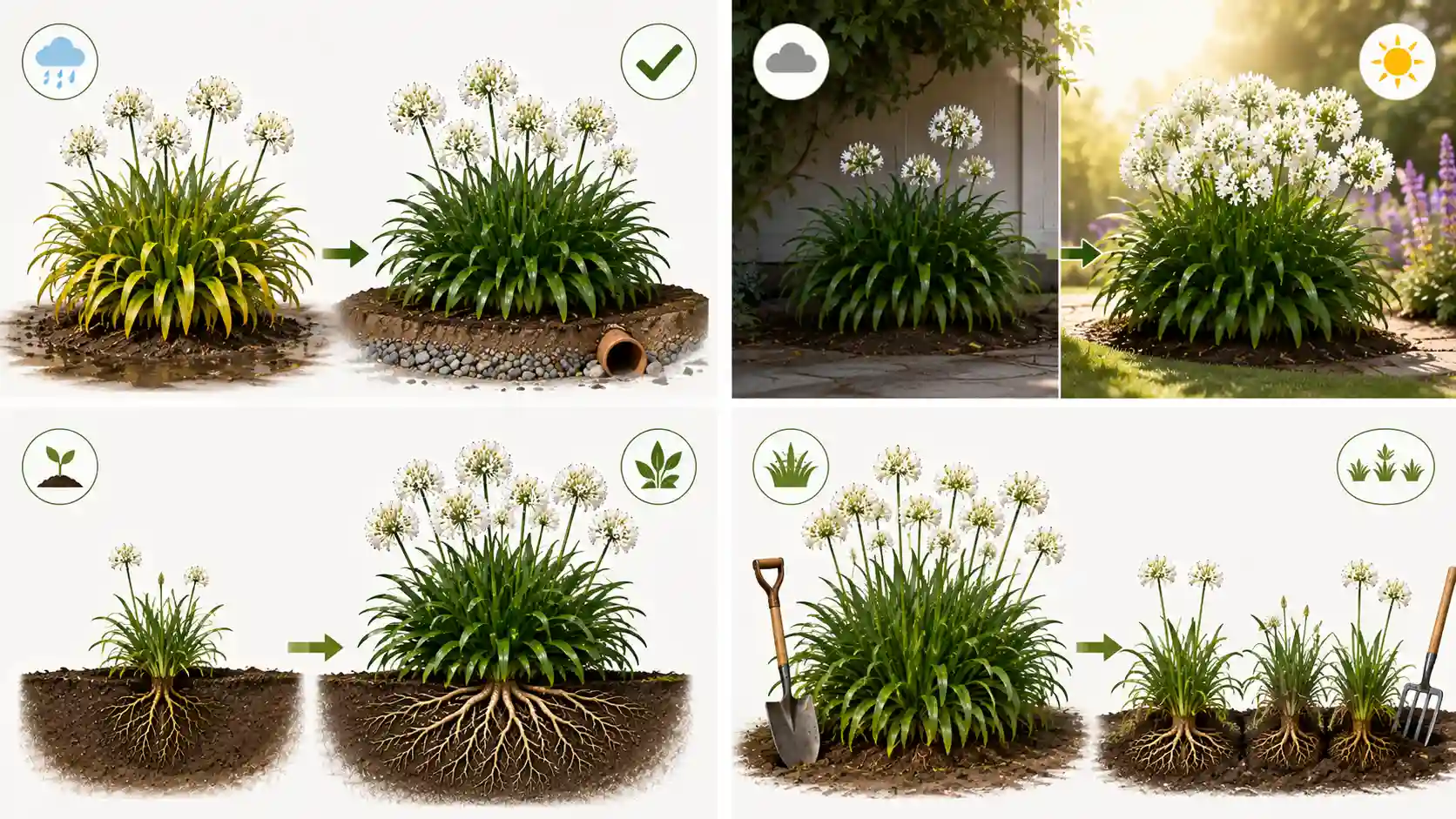
Agapanthus orientalis ‘Snowball’ is generally a hardy plant, but poor growing conditions can cause issues such as yellowing leaves, weak flowering, slow establishment, or overcrowded clumps. Most problems are related to watering, sunlight, soil drainage, or maintenance rather than the plant itself.
Yellowing Leaves
Yellow leaves on Snowball agapanthus are usually caused by overwatering, poor drainage, or natural ageing of older foliage.
Possible causes:
- Soil remaining wet for too long.
- Poor drainage around the roots.
- Excessive watering during cooler months.
- Older leaves naturally declining.
Solutions:
- Allow soil to dry slightly between watering.
- Improve drainage in heavy soils.
- Remove old yellow leaves to maintain appearance.
- Check that irrigation is not keeping the root zone constantly wet.
Established agapanthus are drought tolerant and generally cope better with slightly dry conditions than waterlogged soil.
Poor Flowering
Poor flowering in Agapanthus orientalis ‘Snowball’ is commonly caused by insufficient sunlight, excessive nitrogen fertiliser, or overcrowded plants.
Common reasons include:
- Growing in deep shade.
- Applying too much nitrogen-rich fertiliser.
- Lack of division when clumps become congested.
- Young plants needing time to establish.
Solutions:
- Move plants to a sunnier location if possible.
- Use a balanced or flowering fertiliser.
- Divide crowded clumps every few years.
- Allow newly planted specimens time to mature.
Full sun is usually the most reliable way to encourage strong flower production.
Slow Growth After Planting
Slow growth after planting is often caused by transplant stress, limited root development, or unsuitable soil conditions.
Newly planted Snowball agapanthus may take time to establish because the plant first focuses energy on root development.
To improve establishment:
- Water consistently during the first growing season.
- Avoid disturbing roots unnecessarily.
- Apply a light feed after planting.
- Ensure soil drains freely.
Once established, growth generally becomes more consistent.
Clump Overcrowding
Overcrowded agapanthus clumps can produce fewer flowers because competing roots and dense growth reduce plant vigour.
Signs of overcrowding include:
- Smaller flowers.
- Reduced flowering stems.
- Dense leaf growth with limited blooms.
- Plants lifting above soil level.
Solution:
- Divide clumps every 3–4 years when necessary.
- Separate healthy sections with strong roots.
- Replant divisions with adequate spacing.
Regular division helps maintain flowering performance and keeps dwarf varieties within their intended size range.
Beginner Mistakes to Avoid With Dwarf Agapanthus
Growing dwarf agapanthus successfully depends on avoiding common care mistakes, especially incorrect watering, poor placement, and insufficient maintenance.
Overwatering Established Plants
One of the most common mistakes is treating mature agapanthus like moisture-loving plants.
Established Snowball agapanthus prefers:
- Deep but occasional watering.
- Soil that dries slightly between watering.
- Good drainage around the roots.
Constantly wet soil can weaken roots and contribute to yellowing leaves.
Planting in Deep Shade
Dwarf size does not mean low light requirements.
Although Snowball tolerates part shade, planting it in deep shade often results in:
- Fewer flowers.
- Weaker stems.
- Less compact growth.
A brighter position generally produces healthier plants and stronger blooms.
Confusing Snowball With Taller Agapanthus
Many gardeners underestimate spacing requirements because they compare Snowball with smaller ornamental plants rather than other agapanthus.
Snowball is compact, but it still forms a spreading clump. Proper spacing prevents overcrowding and maintains airflow.
Not Dividing Mature Clumps
Failing to divide older plants can gradually reduce flowering quality.
Regular division:
- Rejuvenates the plant.
- Maintains compact growth.
- Encourages stronger flowering.
Conclusion
Agapanthus orientalis ‘Snowball’ is a compact, low-maintenance dwarf agapanthus valued for its white rounded flower clusters, evergreen foliage, and adaptable growing nature. Its smaller size makes it an excellent choice for Australian gardeners who want the traditional beauty of agapanthus without the height and spread of standard varieties.
With full sun, well-drained soil, moderate watering during establishment, and occasional maintenance, Snowball performs reliably in borders, containers, coastal gardens, and mass plantings.
The key takeaway is that Agapanthus orientalis ‘Snowball’ is ideal for gardeners seeking a hardy white-flowering plant that delivers strong visual impact while remaining easy to manage in smaller spaces.
Australian gardeners can explore more plant selections, including indoor and outdoor species suited to local conditions, in our complete Australian Plants Guide: Indoor Houseplants & Garden Design.
Frequently Asked Questions
How big does Agapanthus orientalis ‘Snowball’ grow?
Agapanthus orientalis ‘Snowball’ typically grows around 40–60cm tall and 40–60cm wide, although mature plants may become slightly larger in ideal conditions. Its compact clumping habit makes it one of the smaller agapanthus varieties suitable for borders, pots, and small gardens.
Is Snowball agapanthus the same as dwarf agapanthus?
Yes, Snowball agapanthus is considered a dwarf agapanthus variety because it has a naturally compact growth habit compared with taller traditional agapanthus cultivars. It produces similar globe-shaped flowers but remains significantly smaller.
Does Agapanthus ‘Snowball’ need full sun to flower well?
Agapanthus ‘Snowball’ flowers best in full sun, although it can tolerate part shade. More direct sunlight usually results in stronger flowering, healthier growth, and a more compact shape.
Is Agapanthus orientalis ‘Snowball’ frost tolerant?
Yes, Agapanthus orientalis ‘Snowball’ is generally frost tolerant once established. Light frost is usually well tolerated, but severe cold may slow growth or damage foliage, especially in exposed locations.
How do you stop agapanthus leaves turning yellow?
To stop agapanthus leaves turning yellow, improve drainage, reduce excessive watering, and remove naturally ageing leaves. Yellowing is often linked to wet soil conditions, poor drainage, or overwatering rather than a lack of water.
Can Agapanthus ‘Snowball’ be grown in pots?
Yes, Agapanthus ‘Snowball’ grows well in pots because of its compact size and clumping growth habit. Use a container with drainage holes, quality potting mix, and place it in a sunny position for the best flowering results.
1 Comment