
Teddy Bear Magnolia Root System
Introduction
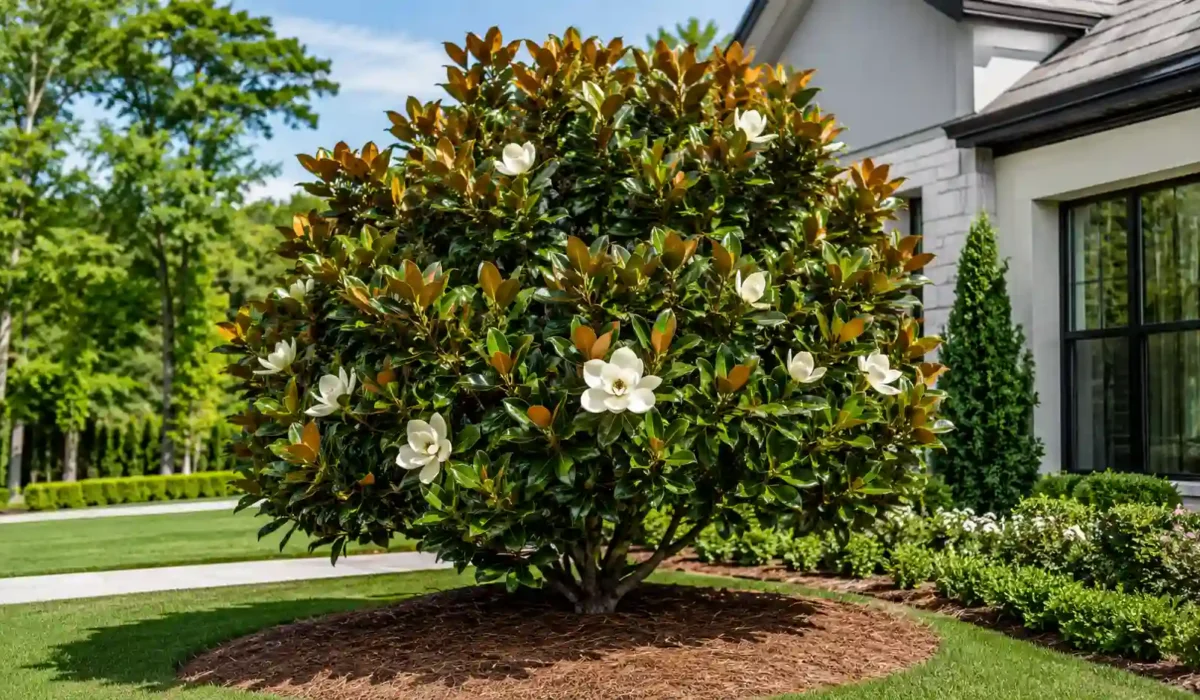
The Teddy Bear Magnolia root system is generally considered compact, non-invasive, and well suited to residential landscapes. As a cultivated form of Magnolia grandiflora, the Teddy Bear Magnolia combines the beauty of traditional Southern Magnolia trees with a more manageable size and root structure. This makes it a popular choice for homeowners, landscapers, and gardeners looking for an evergreen screening tree that is less likely to cause root-related problems. Understanding the magnolia tree root system before planting helps determine safe distances from homes, driveways, fences, and underground services while ensuring healthy long-term growth.
If you’re researching flowering landscape trees, you may also be interested in our guide to Purple Flower Tree Australia: Native & Popular Species Guide, which explores ornamental trees commonly used in Australian gardens. If you’re researching flowering landscape trees, explore our comprehensive guide to Flowering Trees Australia, which covers popular native and exotic species, climate suitability, flowering seasons, sizes, and planting considerations.
Quick Summary
- The Teddy Bear Magnolia has a non-invasive, compact root system suited to suburban gardens and small spaces.
- Roots are fleshy, rope-like, and spread outward more than downward.
- Most roots grow within the top 30–60 cm of soil and can spread 1.5–2 times the canopy width.
- When planted 3–4 metres from structures, roots are generally safe around homes and foundations.
- Teddy Bear Magnolia grows slowly to moderately and reaches approximately 4–6 metres tall at maturity.
What Is the Teddy Bear Magnolia Root System Like?
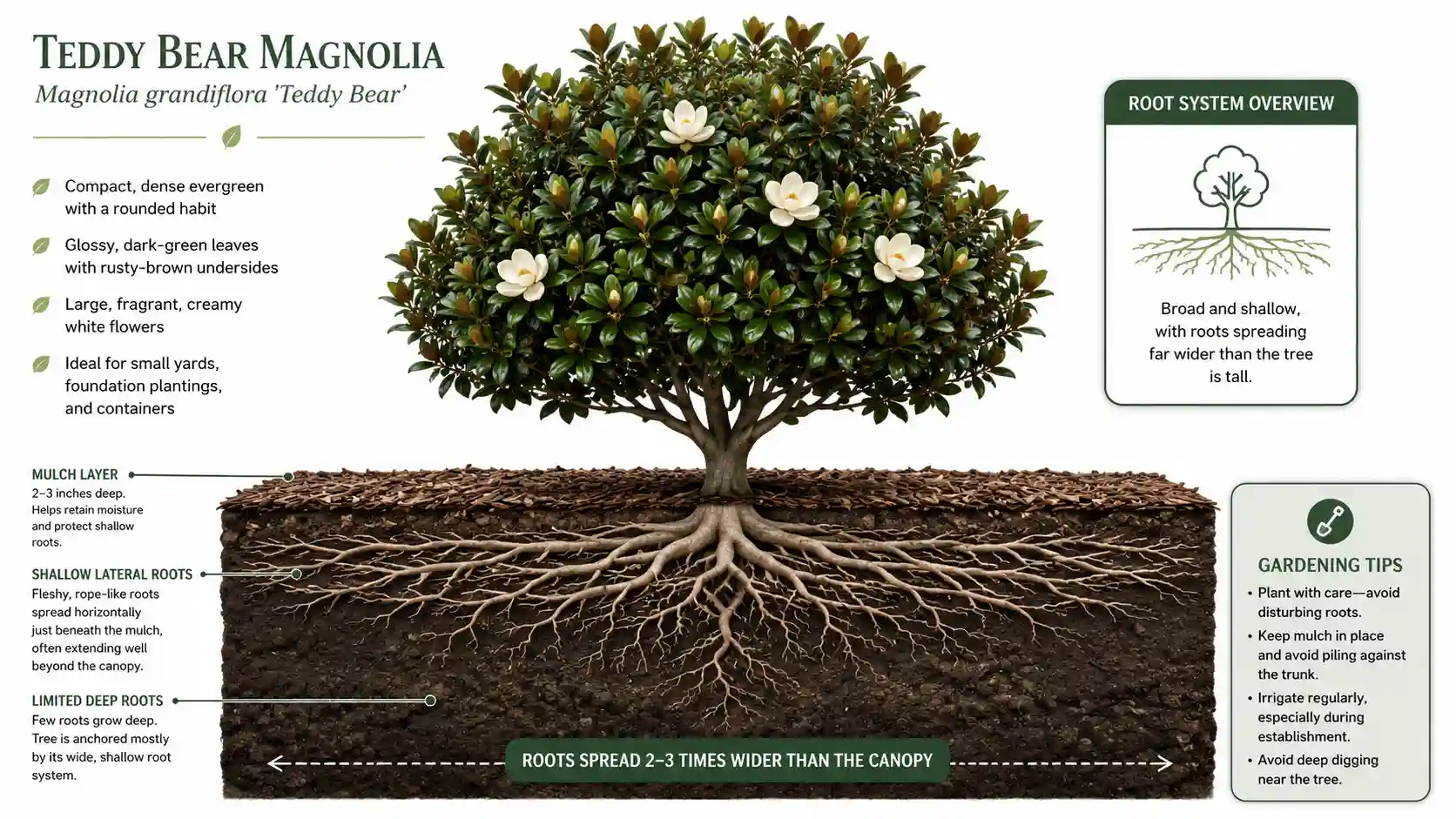
The teddy bear magnolia root system consists of thick, fleshy, rope-like roots that are characteristic of Magnolia grandiflora cultivars. Unlike trees that rely heavily on a deep taproot, magnolia roots primarily spread outward through lateral growth.
Young roots are soft and non-woody, allowing them to efficiently absorb water and nutrients. As they mature, they become semi-woody and more durable. However, they remain less aggressive than the roots of many large shade trees.
Teddy Bear Magnolia is a compact cultivar of Magnolia grandiflora, an evergreen species valued for its glossy foliage, fragrant flowers, and adaptability in residential landscapes.
Compared with full-sized Southern Magnolias, the Teddy Bear cultivar develops a lighter and more compact root mass. This reduced root density is one reason why it is widely used in smaller gardens and urban landscapes.
In our experience growing magnolias in residential settings, Teddy Bear plants establish steadily without producing the extensive root systems often associated with larger tree species.
How Deep Do Teddy Bear Magnolia Roots Grow?
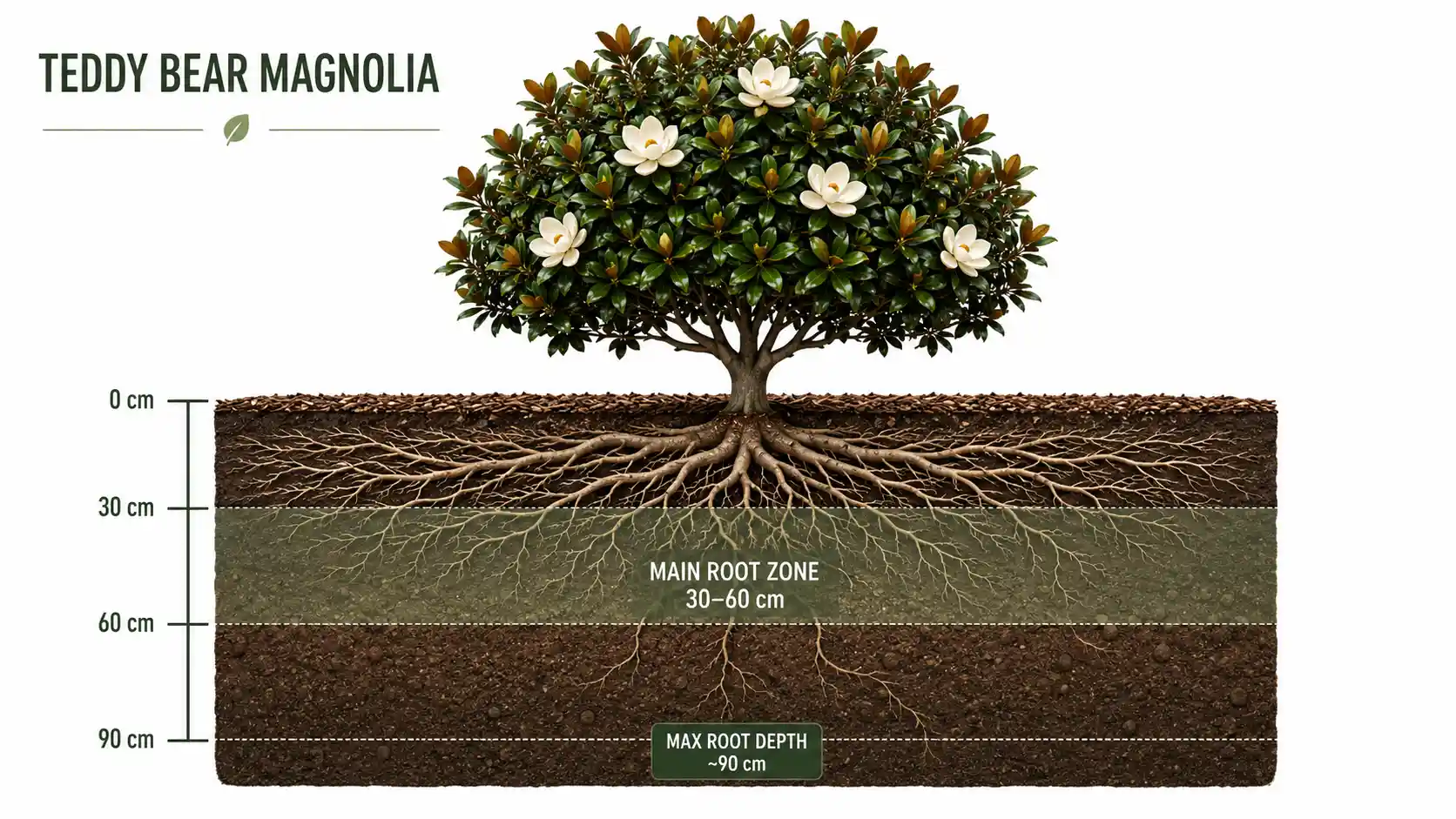
Most Teddy Bear Magnolia roots grow between 45–90 cm deep under ideal conditions. However, the majority of active feeder roots remain concentrated within the top 30–60 cm of soil where oxygen, moisture, and nutrients are most readily available.
Several factors influence root depth:
- Soil texture
- Drainage quality
- Soil compaction
- Irrigation practices
- Climate conditions
In loose, well-drained soil, roots may penetrate deeper. In compacted clay soils, roots often remain closer to the surface.
Although the roots are relatively shallow compared to some large trees, they still require adequate planting space around hardscape features and structures.
How Wide Do the Roots Spread?
The lateral spread of Teddy Bear Magnolia roots typically extends 1.5–2 times the width of the canopy. For a more detailed technical breakdown of root depth and lateral spread measurements across different soil types, our Teddy Bear Magnolia root reference database compiles field data you can cross-check.
This makes it easier to validate the 30–60 cm feeder root zone against real-world planting conditions.
For a mature tree with a canopy width of approximately 2.5–3 metres, roots may spread 3.5–5 metres outward from the trunk.
This root spread is still considerably smaller than many large landscape trees such as gum trees, poplars, or mature Southern Magnolias.
| Tree Characteristic | Average Size |
| Mature canopy width | 2.5–3 m |
| Typical root spread | 3.5–5 m |
| Primary root depth | 45–90 cm |
| Active feeder root zone | 30–60 cm |
Are Teddy Bear Magnolia Roots Invasive?
No, Teddy Bear Magnolia roots are not considered invasive.
While magnolia roots naturally spread outward, they lack the aggressive behavior associated with trees that commonly damage foundations, sewer lines, and paving.
Many homeowners confuse root spread with invasiveness. A spreading root system is normal for trees. An invasive root system actively seeks moisture sources and has a greater tendency to damage surrounding infrastructure.
Teddy Bear Magnolia roots are generally considered low-risk because:
- The cultivar grows slowly.
- Root mass remains relatively compact.
- Roots are less aggressive than many large tree species.
- Mature tree size is significantly smaller than standard Southern Magnolias.
Although roots can occasionally cause minor lifting of pavers if planted too close, they rarely damage properly constructed foundations when recommended planting distances are followed.
How Does This Compare to Other Trees With Invasive Roots?

Compared with well-known invasive-root trees, Teddy Bear Magnolia is a much safer landscape choice.
| Tree Species | Root Aggression Level |
| Teddy Bear Magnolia | Low |
| Little Gem Magnolia | Low |
| Liquid Amber | High |
| Willow | Very High |
| Poplar | Very High |
| Ficus (Fig Trees) | Very High |
For domestic gardens, Teddy Bear Magnolia is widely regarded as one of the lower-risk evergreen screening trees available. If you’re comparing multiple species before planting, the Tree Root Invasiveness & Safe Planting Distance Database ranks dozens of common trees by root aggression level.
It’s a useful reference point for confirming why Teddy Bear Magnolia sits at the lower end of the invasiveness scale.
Can You Plant a Teddy Bear Magnolia Close to Your House?
Yes, you can plant a Teddy Bear Magnolia near a house provided proper spacing is maintained.
A minimum distance of 3–4 metres from foundations, walls, and underground services is generally recommended. This spacing allows adequate room for root expansion and canopy development.
Several factors influence safe planting distance:
- Soil type
- Drainage conditions
- Irrigation patterns
- Foundation design
- Age of underground pipe systems
Older clay or terracotta pipes may be more vulnerable to root intrusion than modern PVC pipe systems.
Elemo Baker recommends evaluating both canopy size and root spread before choosing a planting location rather than focusing solely on trunk placement.
Safe Planting Distances — Recommended Spacing Guide
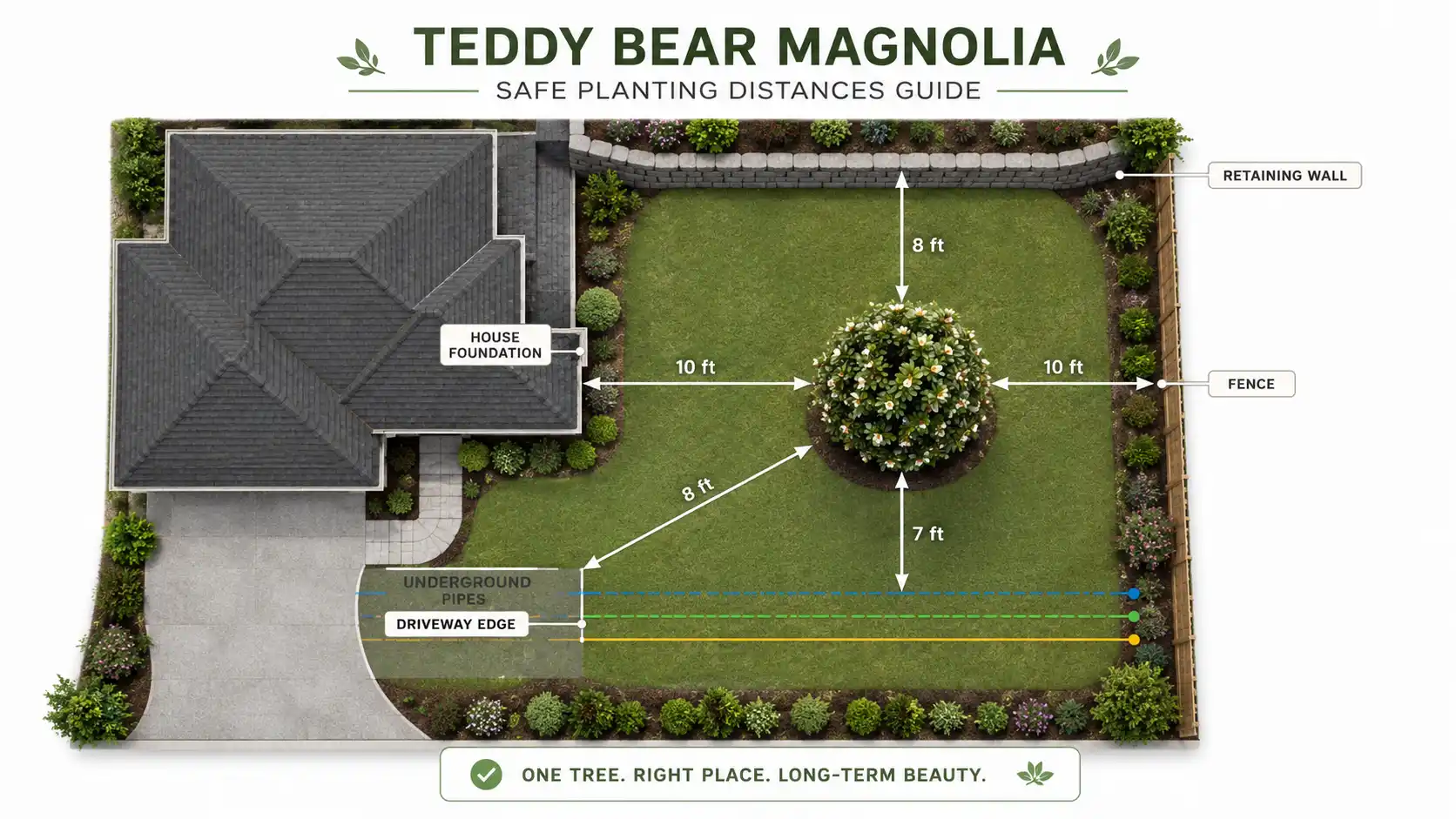
| Structure Type | Recommended Minimum Distance |
| House foundation | 3–4 m |
| Underground pipes | 2–3 m |
| Driveways and paving | 2–3 m |
| Pools or retaining walls | 3–4 m |
| Neighbouring fences | 1.5–2 m |
These distances are conservative guidelines and may vary depending on soil conditions and irrigation practices. For a downloadable, sortable version of these figures, check our Safe Planting Distance spreadsheet, which lists minimum clearances by structure type.
Use it alongside your soil type to fine-tune spacing before finalising your planting location.
Teddy Bear Magnolia Root System Problems
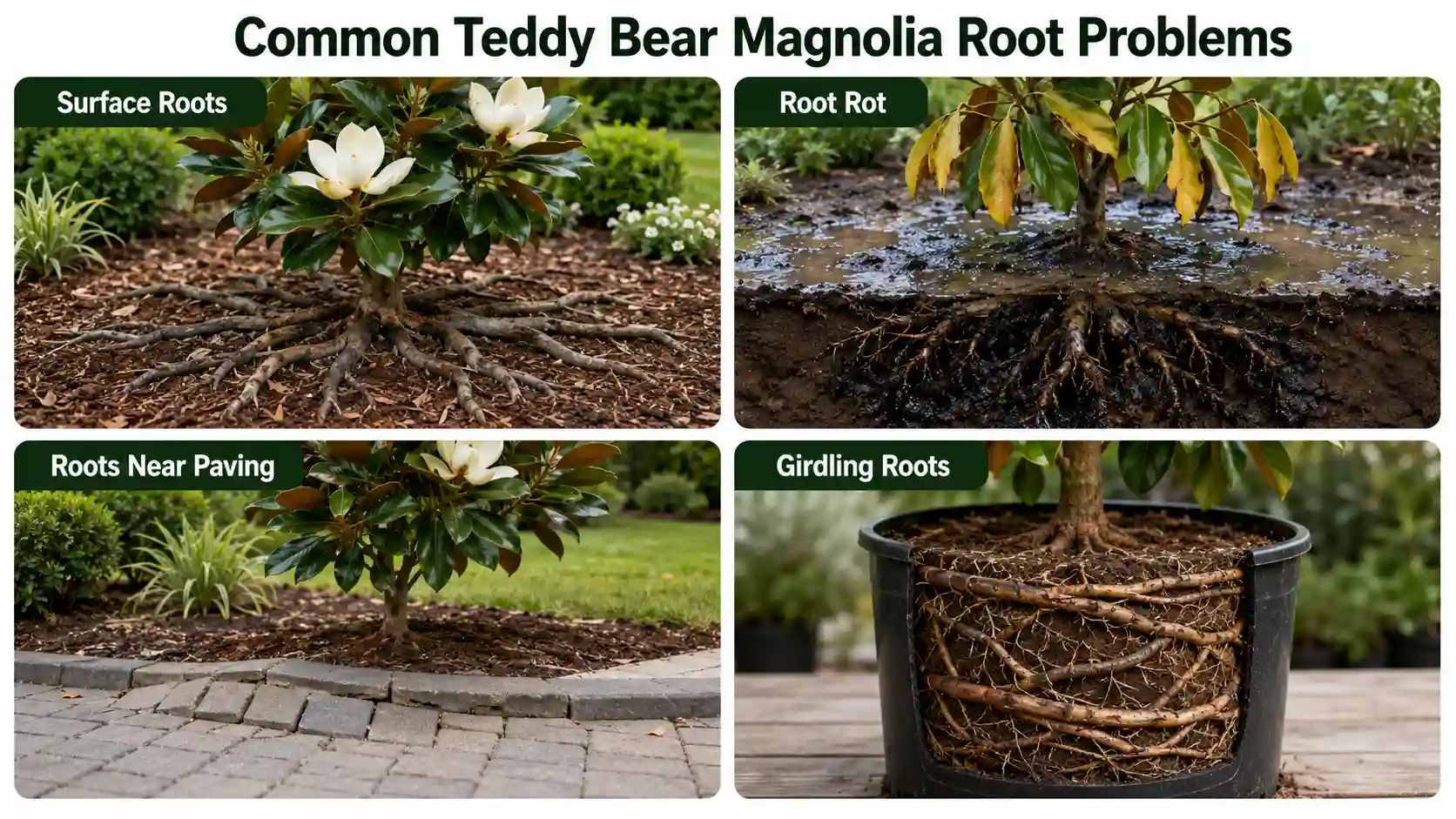
Although generally trouble-free, several root-related issues can occur.
Surface Root Exposure
Surface roots may develop when soil becomes compacted or excessively dry. Roots naturally move toward areas with better moisture availability.
Prevention:
- Apply mulch.
- Improve soil structure.
- Maintain consistent watering.
Root Rot
Root rot is one of the most common problems affecting magnolias.
Cause:
- Poor drainage
- Waterlogged soil
Prevention:
- Plant in well-drained soil.
- Avoid overwatering.
Planting Too Close to Structures
Roots planted too near paving or foundations may contribute to minor heaving over time.
Prevention:
- Follow spacing recommendations.
- Consider mature tree size before planting.
Girdling Roots
Pot-bound nursery plants sometimes develop roots that circle the root ball.
Prevention:
- Loosen roots before planting.
- Correct root defects during installation.
How Fast Do Teddy Bear Magnolia Roots and Trees Grow?
The Teddy Bear Magnolia growth rate is generally considered slow to moderate.
Most trees add approximately 20–30 cm of height annually under good growing conditions.
Root establishment usually occurs before significant canopy growth. During the first one to two years, much of the tree’s energy is directed toward developing a healthy root system.
Factors affecting growth include:
- Climate
- Soil quality
- Irrigation
- Sunlight exposure
- Fertilisation
Most trees reach their mature size of 4–6 metres within approximately 10–15 years. Gardeners comparing screening trees often reference the Pittosporum Silver Sheen Growth Rate Guide to understand how different evergreen species perform over time.
For a faster-growing alternative, see Photinia Fraseri Robusta: Growth, Care & Hedge Guide, which compares another popular evergreen landscaping plant.
Teddy Bear Magnolia vs Little Gem — Root System and Size Comparison
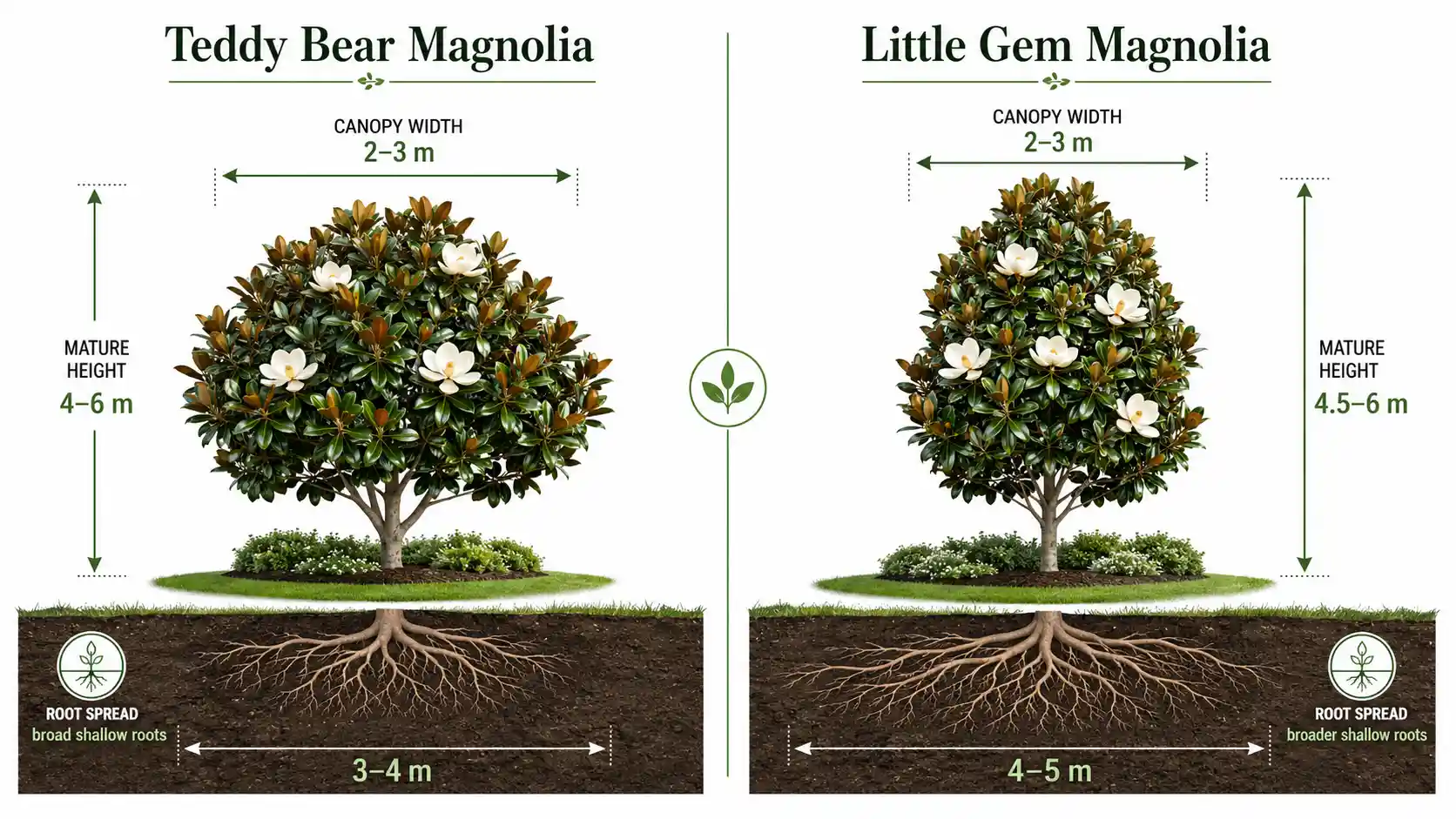
The comparison between Teddy Bear Magnolia and Little Gem Magnolia is common because both are compact cultivars of Magnolia grandiflora.
| Feature | Teddy Bear | Little Gem |
| Mature height | 4–6 m | 5–8 m |
| Canopy width | 2.5–3 m | 3–4 m |
| Root spread | Compact | Slightly wider |
| Root invasiveness | Low | Low |
| Growth rate | Slow–Moderate | Moderate |
| Best use | Small gardens, specimen planting | Hedges, screens |
| Flower size | Large | Slightly smaller |
| Flower frequency | Excellent | Excellent |
Both cultivars possess non-invasive root systems suitable for residential landscapes. If you enjoy plant comparison articles, our Snow Maiden Oriental Pearl Plant: Growing Guide & Comparison provides another detailed look at selecting the right ornamental plant for your garden.
Which Is Better for Planting Near a House?
Both cultivars are appropriate for planting near homes when spacing guidelines are followed.
However, Teddy Bear Magnolia is slightly more compact and therefore often preferred for tighter urban gardens and smaller properties.
In Australia, both cultivars remain among the most popular evergreen screening trees, though Teddy Bear is often chosen where space is limited.
How Big Does a Teddy Bear Magnolia Grow?
A full-grown Teddy Bear Magnolia typically reaches 4–6 metres in height and approximately 2.5–3 metres in width.
Unlike some ornamental trees, Teddy Bear Magnolia is rarely grown indoors due to its eventual size requirements.
Factors affecting mature size include:
- Climate
- Soil fertility
- Water availability
- Pruning practices
- Growing conditions
Regular pruning can help maintain a narrower form, although extensive pruning is rarely necessary.
When and How Does the Teddy Bear Magnolia Flower?
Teddy Bear Magnolia produces large, creamy white, highly fragrant flowers.
Flowering generally occurs:
- October–January in Australia and the Southern Hemisphere
- May–July in the Northern Hemisphere
Individual blooms often measure 15–20 cm across and create a striking contrast against the glossy dark-green foliage.
One advantage of Teddy Bear Magnolia is its relatively early flowering compared with some larger magnolia species. Well-established trees may begin flowering within only a few years of planting.
Under favourable conditions, flowering can continue intermittently throughout the warmer months.
Teddy Bear Magnolia Care Guide
Proper care supports healthy roots, vigorous growth, and reliable flowering.
Watering
Provide deep watering during establishment. Once mature, Teddy Bear Magnolia becomes relatively drought tolerant.
Light
Full sun to part shade is ideal. Flowering is generally strongest in full sun.
Soil
The tree performs best in:
- Well-drained soil
- Slightly acidic conditions
- pH between 5.5 and 6.5
Adding organic matter at planting improves root development.
Fertilisation
Apply a balanced slow-release fertiliser during spring.
Avoid excessive nitrogen, which encourages foliage growth at the expense of flowers.
Pruning
Minimal pruning is required.
Prune lightly after flowering and avoid cutting heavily into old wood.
Climate Tolerance
As of 2026, growers continue to recommend Teddy Bear Magnolia for temperate and subtropical climates due to its adaptability, evergreen habit, and reliable flowering performance.
Watering and Root Health
Water management directly influences root health.
Overwatering can lead to root rot, while prolonged drought may encourage roots to seek moisture near structures. Deep, infrequent watering encourages healthier downward root growth and reduces the likelihood of shallow surface roots.
Proper moisture management is important for many species, including those discussed in our Leaf of Life Plant Benefits, Uses, Tea & Care Guide.
In our experience, consistent deep watering during establishment produces stronger root systems and better long-term performance.
Although grown indoors rather than outdoors, the care principles discussed in Dracaena Plant Indoor Benefits, Care, Meaning & Propagation highlight the importance of proper watering and soil management.
Common Mistakes When Planting Teddy Bear Magnolias
Several common mistakes can reduce performance and create unnecessary root issues.
- Planting too close to structures.
- Failing to improve compacted clay soil.
- Using shallow, frequent irrigation.
- Planting pot-bound trees without loosening roots.
- Underestimating mature canopy width.
- Expecting rapid growth during establishment.
Proper planning before planting prevents most of these issues and supports healthy root development.
Using Teddy Bear Magnolia as a Hedge
Teddy Bear Magnolia is widely used as an evergreen hedge and privacy screen.
Its dense foliage, upright habit, and manageable size make it particularly effective for screening.
Recommended hedge spacing is approximately 1.5–2 metres centre-to-centre. Homeowners considering privacy screening may also want to compare Photinia Fraseri Robusta: Growth, Care & Hedge Guide, another widely used hedging plant.
When planted as a hedge, root systems naturally overlap and compete for water and nutrients. Maintaining adequate irrigation and soil quality helps support healthy growth.
Compared with Little Gem hedges, Teddy Bear hedges generally maintain a denser and slightly narrower profile, making them especially useful in smaller gardens.
Teddy Bear Magnolia Root System — Key Takeaways
The Teddy Bear Magnolia root system is compact, non-invasive, and well suited to residential gardens. Its roots spread primarily outward rather than deeply, but they remain significantly less aggressive than many common landscape trees.
When planted at recommended distances and grown in healthy, well-drained soil, Teddy Bear Magnolia roots pose minimal risk to foundations, paving, and underground services. Careful site selection, proper watering, and adequate spacing are the keys to long-term success.
If you’re comparing evergreen screening trees before planting, our Pittosporum Silver Sheen Growth Rate Guide can help evaluate alternative landscape options.
Before planting, always assess your specific soil conditions, available space, and nearby structures to ensure the tree has room to thrive.
Understanding the planting environment is essential when selecting trees, and our Australian Plants Guide: Indoor Houseplants & Garden Design provides broader plant-selection guidance.
Frequently Asked Questions
Do Magnolia Teddy Bear trees have invasive roots?
No. Teddy Bear Magnolia roots are not considered invasive. They are compact, fleshy lateral roots that do not aggressively seek out pipes or foundations when planted at recommended distances. They are among the least aggressive root systems within the magnolia group.
How deep are Teddy Bear Magnolia roots?
Most active feeder roots are located within the top 30–60 cm of soil. Under ideal conditions, roots may reach depths of 45–90 cm, although most growth occurs laterally rather than vertically.
Can you plant a Teddy Bear Magnolia close to a house?
Yes. A planting distance of 3–4 metres from foundations is generally recommended. Clay soils may require additional clearance, while well-drained soils typically present lower risk.
How quickly does a Teddy Bear Magnolia grow?
Teddy Bear Magnolia grows at a slow-to-moderate rate, typically adding 20–30 cm per year. Most trees require around 10–15 years to reach mature size, with the first one to two years focused heavily on root establishment.
What is the difference between a Teddy Bear Magnolia and Little Gem Magnolia root system?
Both cultivars have compact, non-invasive root systems. Teddy Bear Magnolia is generally slightly more compact overall, while Little Gem grows taller and develops a somewhat broader root spread at maturity.
Will Teddy Bear Magnolia roots damage pipes or foundations?
When planted 3–4 metres from structures, the risk is very low. Roots may enter existing cracks in older clay pipes but rarely damage modern PVC systems or properly built foundations.
When do Teddy Bear Magnolias flower?
Teddy Bear Magnolias typically flower from late spring through summer. In Australia and the Southern Hemisphere, flowering commonly occurs from October to January, while Northern Hemisphere flowering generally occurs from May to July. Well-established trees may begin flowering within two to three years of planting.
8 Comments