

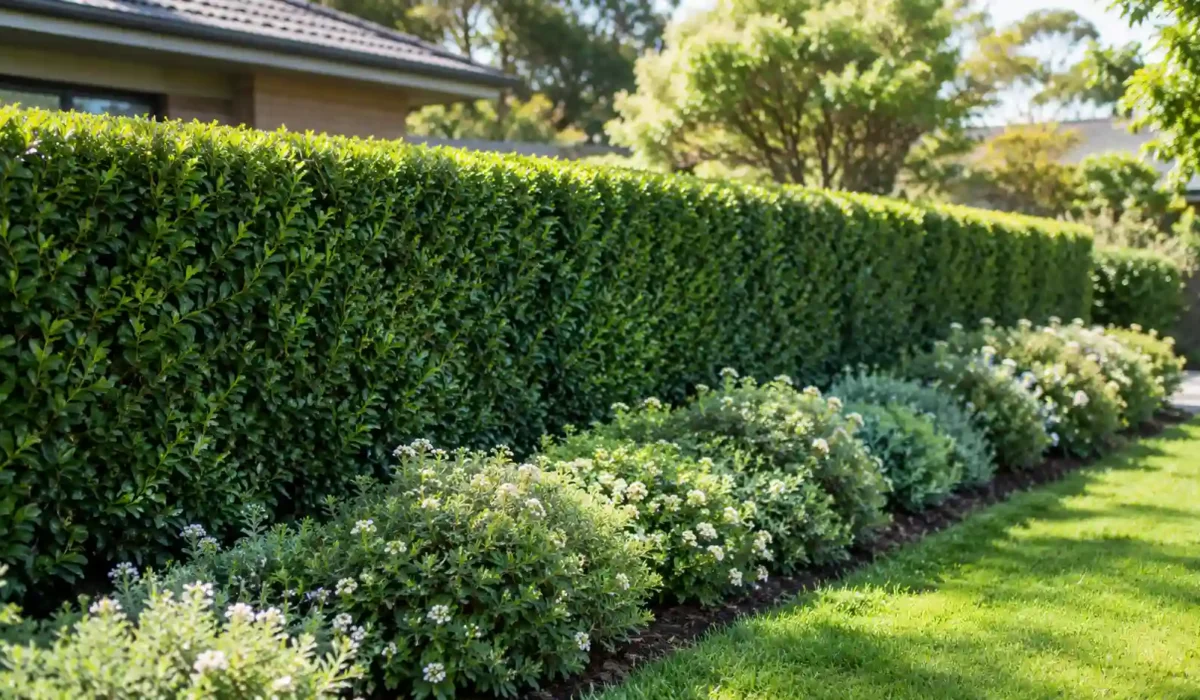
Hedge Shrubs & Borders: Best Shrubs for Australia
Hedge shrubs and borders are the two most common ways Australian gardeners use shrubs to define space — one screens and encloses, the other edges and separates. Choosing between them, and then choosing the right species, comes down to four things: how much height and privacy you need, your sun and soil conditions, and how much pruning you’re actually willing to do. This guide works through that decision in order, rather than opening with a species list, so you land on a shortlist that fits your site instead of a generic “top 10.”
By Elemo Baker | Plant Care & Gardening Expert
Quick Summary
- A hedge screens for privacy or wind and is usually planted close together in a single row; a border edges a bed or path and is usually lower and can be single or mixed-species.
- Match shrub choice to four inputs, in this order: height/privacy needed → sun and soil → frost/coastal exposure → maintenance appetite.
- Fast growers screen sooner but need 3–4 prunes a year; slow growers need 1–2 but take longer to fill in.
- Spacing depends on the shrub’s mature width and pot size at planting — not a fixed number.
- A gappy or leggy hedge can often be renovated with hard pruning rather than replaced outright, depending on species.
What Hedge Shrubs and Border Plants Actually Are
A hedge is a row of shrubs planted close enough that their canopies merge into a continuous screen, used for privacy, wind protection, or boundary definition. A border (or edging planting) frames a garden bed, path, or lawn edge and is usually lower, often under 60 cm, and doesn’t need to form a solid wall of foliage. Botanically, many species do double duty — duranta ‘Sheena’s Gold’ is planted as both a clipped hedge and, kept lower, a colourful border — so the job you need done matters more than the species name.
If you’re deciding between a formal hedge and a softer border planting, our guide to hedge shrubs and borders breaks down the best shrub varieties and how to choose the right structure for your garden.
Hedge vs Border: Why the Distinction Changes Your Shortlist
Confusing the two use-cases is the most common mistake we see in reader questions. A hedge needs to reach a specific height (privacy screening usually means 1.8–2.4 m) and hold a dense, uniform line, so vigour and upright habit matter most. A border needs to stay low and tidy along an edge, so compact habit and slow lateral spread matter more than height. Planting a naturally tall, vigorous shrub as a border means constant hard pruning to keep it down; planting a naturally low, spreading shrub as a privacy hedge means it will never reach the height you need. Sort your shortlist by job first, species second.
How to Choose the Right Shrub for Your Job
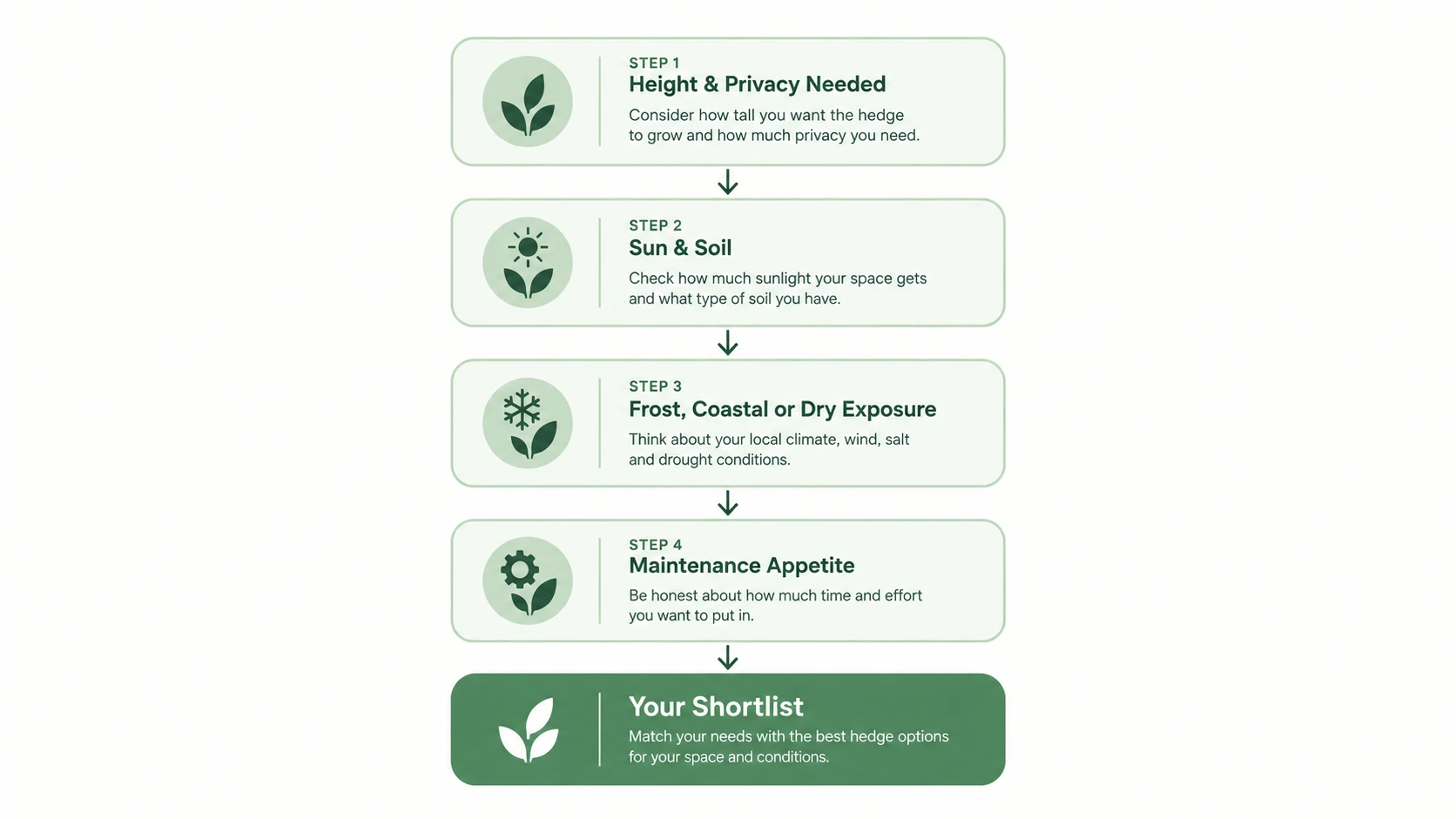
Work through these four questions in order:
- Height and privacy needed — Under 60 cm (border), 60 cm–1.2 m (low hedge/screen), or 1.8 m+ (privacy hedge)?
- Sun and soil — Full sun, part shade, or shade; free-draining or heavier clay soil?
- Frost, coastal or dry exposure — Any of these narrows the list fast (see section 10).
- Maintenance appetite — Are you happy to prune 3–4 times a year, or do you want something closer to 1–2?
Running your own answers against the table below gives a shortlist in minutes rather than scrolling species lists.
Comparison Table: Hedge and Border Shrubs for Australian Gardens
| Shrub | Mature H × W | Growth Rate | Sun/Soil | Frost/Coastal Tolerance | Best Use |
| Star jasmine | 1–3 m (climbing/mounding) | Moderate–fast | Full sun–part shade; well-drained | Light frost tolerant; moderate coastal | Informal screen, fence-line cover |
| Photinia ‘Robusta’ | 3–5 m | Fast | Full sun–part shade; tolerant of most soils | Frost hardy; poor in exposed salt air | Tall formal or informal privacy hedge |
| Viburnum ‘Emerald Jewel’ | 1.5–2 m | Moderate | Full sun–part shade; well-drained | Frost hardy; good coastal tolerance | Dense formal hedge |
| Rhaphiolepis ‘Oriental Pearl’ | 1–1.5 m | Slow–moderate | Full sun; free-draining | Frost hardy; excellent coastal/drought tolerance | Low hedge or structured border |
| Duranta ‘Sheena’s Gold’ | 1–2 m (clippable lower) | Fast | Full sun for best colour; tolerant soils | Frost-tender in cold inland areas; good coastal tolerance | Colourful border or low informal hedge |
| Purple hedging shrubs (see purple hedge options) | 1–2.5 m (species-dependent) | Moderate | Full sun; well-drained | Varies by species | Feature/accent hedge |
| Westringia (native rosemary) | 1–1.5 m | Slow–moderate | Full sun; tolerates poor soil | Excellent coastal and drought tolerance | Native low hedge or border |
Figures are typical ranges; confirm against your specific cultivar and local climate zone before planting.
Fast-Growing vs Slow-Growing: The Real Trade-Off
Fast-growing shrubs such as photinia or duranta fill a gap quickly, often reaching screening height within one to two growing seasons, but they need pruning three to four times a year to stay dense and in shape — skip a round and they get leggy. Slow growers such as rhaphiolepis or westringia need only one to two light prunes a year but can take three or more years to reach full hedge height. In our experience, the right call usually isn’t “fastest” or “slowest” — it’s matching growth rate to how often you’re realistically going to get the secateurs out.
Formal Clipped Hedges vs Informal, Soft Borders
A formal hedge is clipped into a flat, geometric face and needs species that hold a cut line and re-shoot readily from old wood — photinia and viburnum both do this well. An informal or soft border relies on a shrub’s natural shape rather than clipping, suiting looser, cottage-style or native gardens where species like westringia or duranta are left to flower and fill out naturally. Mixing the two styles in one garden works, but keep formal and informal shrubs in separate beds rather than the same row — their pruning needs conflict.
Spacing Guide: How Far Apart to Plant
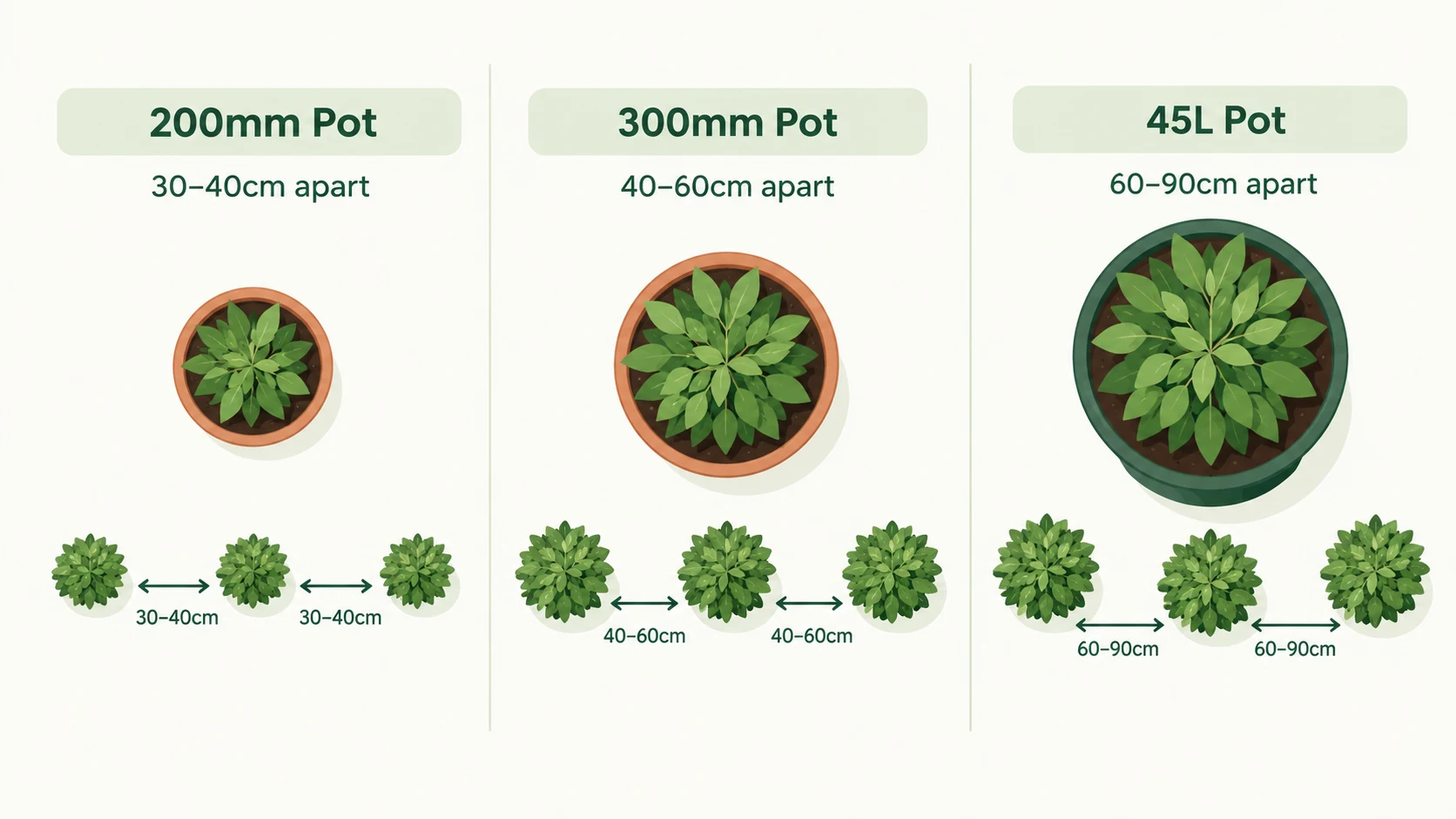
Spacing depends on the shrub’s mature width, not a single universal number:
- 200 mm pot (small/border shrubs, e.g. rhaphiolepis, westringia): plant 30–40 cm apart for a continuous low border.
- 300 mm pot (mid-size hedge shrubs, e.g. duranta, viburnum): plant 40–60 cm apart for a dense hedge within two seasons.
- 45 L pot (advanced/instant hedges, e.g. larger photinia): plant 60–90 cm apart, since these already have significant canopy width.
Elemo Baker recommends erring toward the tighter end of each range if you want the hedge to close over within one growing season, accepting a higher plant cost for faster privacy.
Establishing a New Hedge: The First-Season Schedule
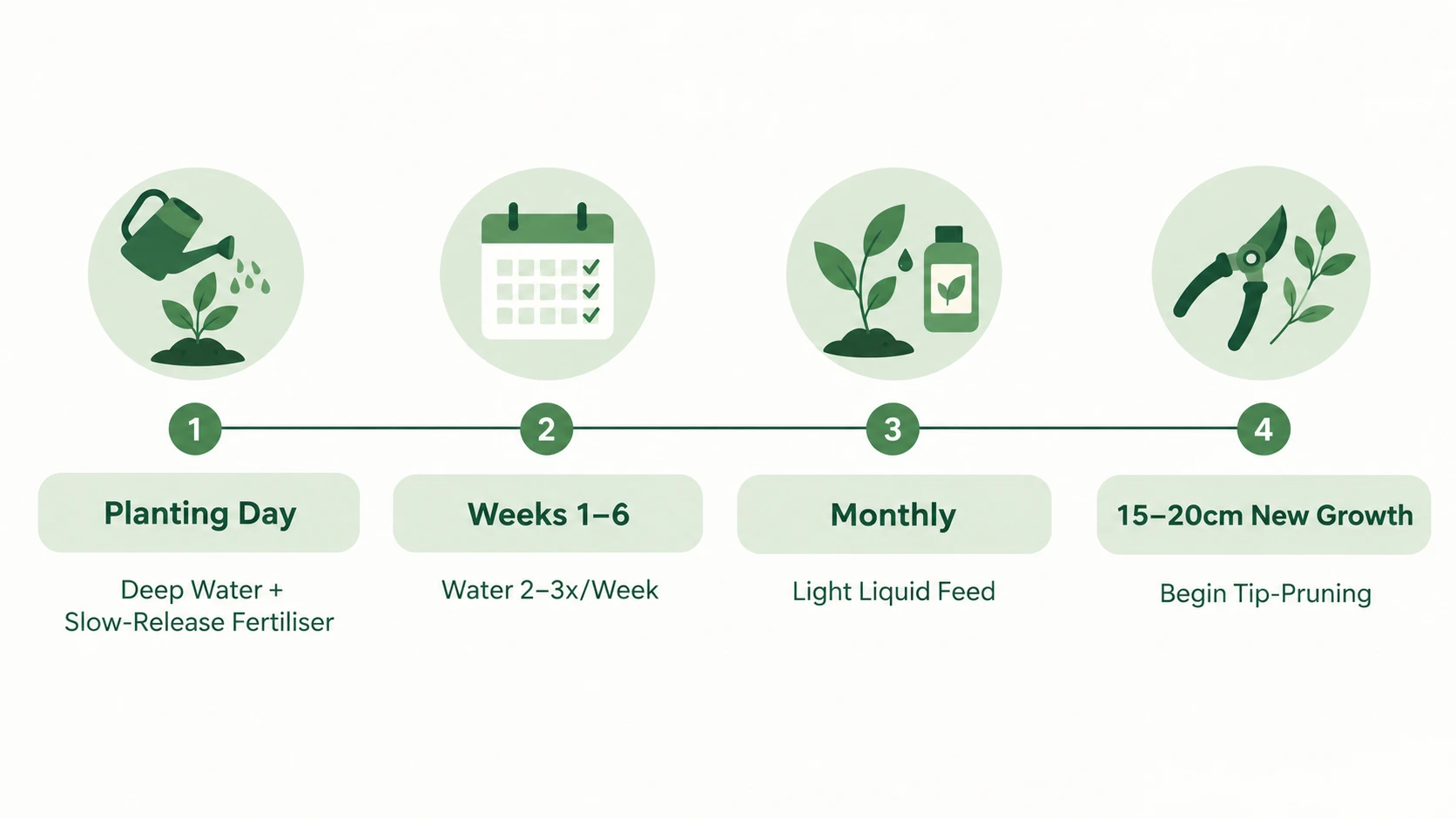
Newly planted hedge and border shrubs need consistent water while roots establish — deep watering two to three times a week for the first six weeks, tapering to weekly once established, more often in sandy or free-draining soil. Apply a slow-release native or general fertiliser at planting, then a light liquid feed monthly through the first growing season. Begin tip-pruning (pinching new growth tips, not hard cuts) once the plant has put on 15–20 cm of new growth, to encourage the lateral branching that creates hedge density — skipping this step is the most common reason a new hedge stays thin at the base. A light liquid feed alongside consistent watering — the same combined approach Burke’s Backyard recommends after hedge pruning — helps push the new growth density you’re establishing.
Fixing a Gappy, Leggy or Dying Hedge
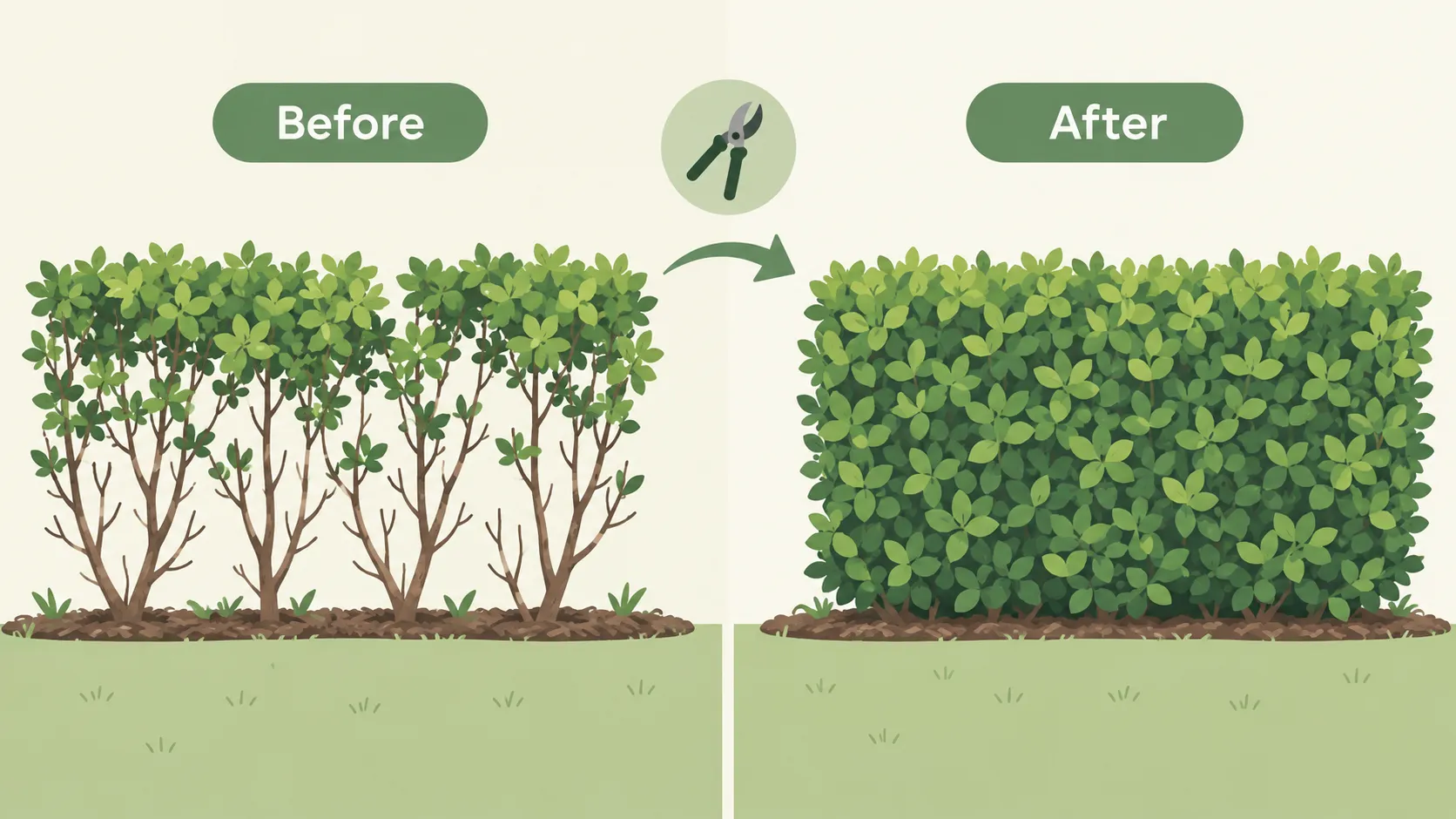
Before replacing a struggling hedge, check whether it can be renovated. Species that reshoot readily from old wood — including photinia and viburnum — can often tolerate hard pruning back by a third to half to force fresh basal growth, ideally done in late winter or early spring. Bare, leggy lower growth is frequently a light issue (shading from the top of the hedge) rather than a disease, and can improve once the canopy is opened up. Gaps caused by one or two dead plants can usually be infilled with a matching cultivar rather than replacing the whole line, provided the rest of the hedge is otherwise healthy.
Frost, Coastal and Drought Tolerance
Cool-temperate and frost-prone zones (inland NSW, VIC, TAS) favour frost-hardy choices like viburnum, rhaphiolepis and westringia; duranta is frost-tender and better suited to warmer regions. Coastal gardens benefit from salt-tolerant species such as westringia and rhaphiolepis, while photinia performs poorly in direct salt exposure. Dry inland conditions favour drought-tolerant natives like westringia over thirstier exotics such as duranta and star jasmine, which need more consistent moisture to perform well.
Conclusion
Choosing hedge shrubs and borders for an Australian garden comes down to matching the plant to the job, not picking from a generic list: decide whether you need a hedge or a border, confirm your height, sun and soil conditions, then weigh growth rate against how much pruning you’re willing to commit to. Species like photinia and viburnum suit fast, formal privacy hedging; rhaphiolepis and westringia suit low borders and drought-prone or coastal sites; duranta and star jasmine add colour and informal screening in warmer, sheltered spots. Get the establishment watering and tip-pruning right in the first season, and most gappy or leggy hedges can be renovated rather than replaced later on.
FAQs
What’s the difference between a hedge and a border planting?
A hedge is a close-planted row of shrubs grown to a specific height for privacy or screening, while a border is a lower planting used to edge a garden bed, path or lawn.
How far apart should I plant hedge shrubs?
Spacing depends on mature width and pot size — roughly 30–40 cm for 200 mm pots, 40–60 cm for 300 mm pots, and 60–90 cm for 45 L advanced stock.
What is the fastest-growing hedge shrub for privacy in Australia?
Photinia ‘Robusta’ is one of the fastest-growing options for tall privacy hedging, though it needs three to four prunes a year to stay dense.
Can I fix a gappy or leggy hedge instead of replacing it?
Often yes — species that reshoot from old wood, such as photinia and viburnum, can usually be hard-pruned back in late winter to force fresh growth, provided the plant is otherwise healthy.
Which hedge shrubs suit coastal Australian gardens?
Salt-tolerant choices like westringia and rhaphiolepis perform best in coastal conditions, while photinia is more prone to damage in direct salt exposure.
1 Comment