

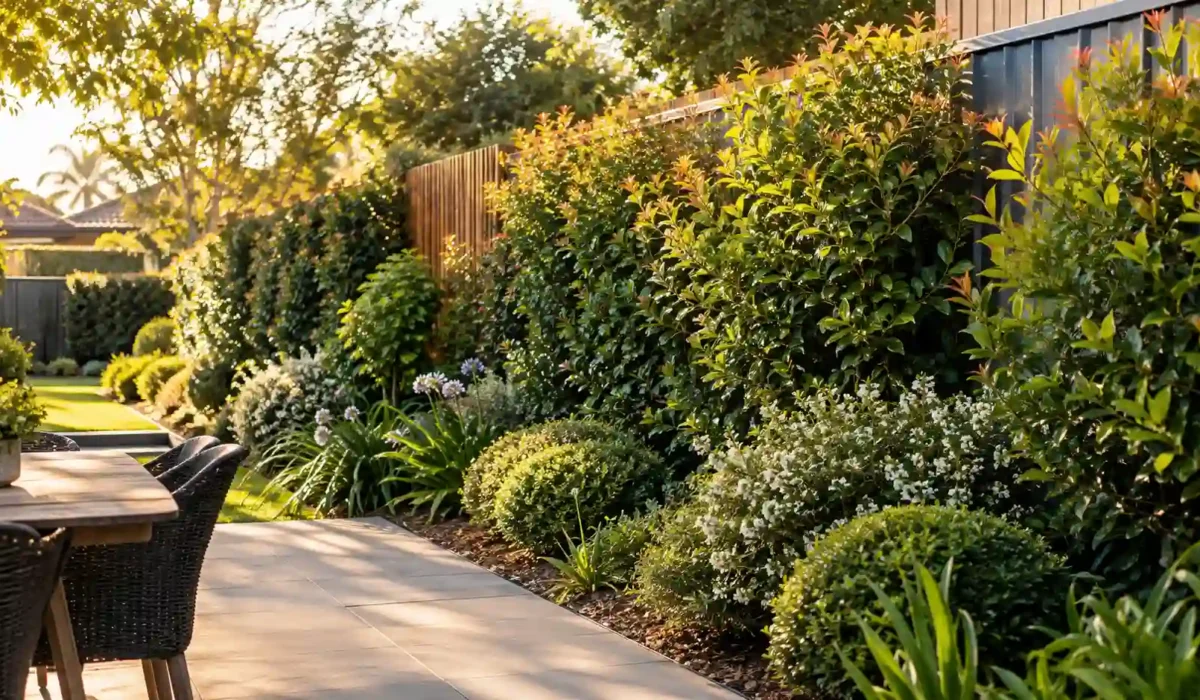
Hedge & Screening Plants Australia: Choose, Plant, Maintain
The neighbours put a second storey on. The council approved a townhouse block behind the back fence. Or you’ve simply run out of patience with looking at three metres of bare Colorbond every time you sit down outside.
Whatever brought you here, the thing you actually want isn’t a hedge. It’s your backyard back.
That distinction matters more than it sounds, because a hedge is a ten-to-twenty-year decision that most people make in twenty minutes at a nursery. Choose well and you get a green wall that looks after itself with one trim a year. Choose badly and you get one of three outcomes I see constantly across Australian gardens: a plant that never stops growing and needs cutting back twice a year forever, a root system that lifts your paving or finds your pool plumbing, or a screen so tall your neighbour has a legal right to make you cut it.
Almost all of those outcomes trace back to the same mistake — buying the tallest, fastest plant on the bench to solve a 2.5 metre problem.
This guide works the other way around. We’ll define your brief first, match it to your climate, then narrow to plants by the height and width you actually have. After that: what to check below ground, what the law says above 2.5 metres, how far apart to plant, and what to do if you’ve already got a hedge that’s gone thin at the base.
By Elemo Baker | Plant Care & Gardening Expert
Quick Summary: Choosing Hedge and Screening Plants
- A hedge is clipped to a shape and needs two to three trims a year. A screen is allowed to grow to its natural form and needs far less work. Most people asking for a hedge actually want a screen.
- Three numbers decide your plant: the height you need, the width you can spare, and how often you’re genuinely willing to prune.
- A standard Colorbond fence panel is 1.8 m. A screen held at 2.5–3 m blocks a neighbouring first-floor window from most angles. You rarely need six metres.
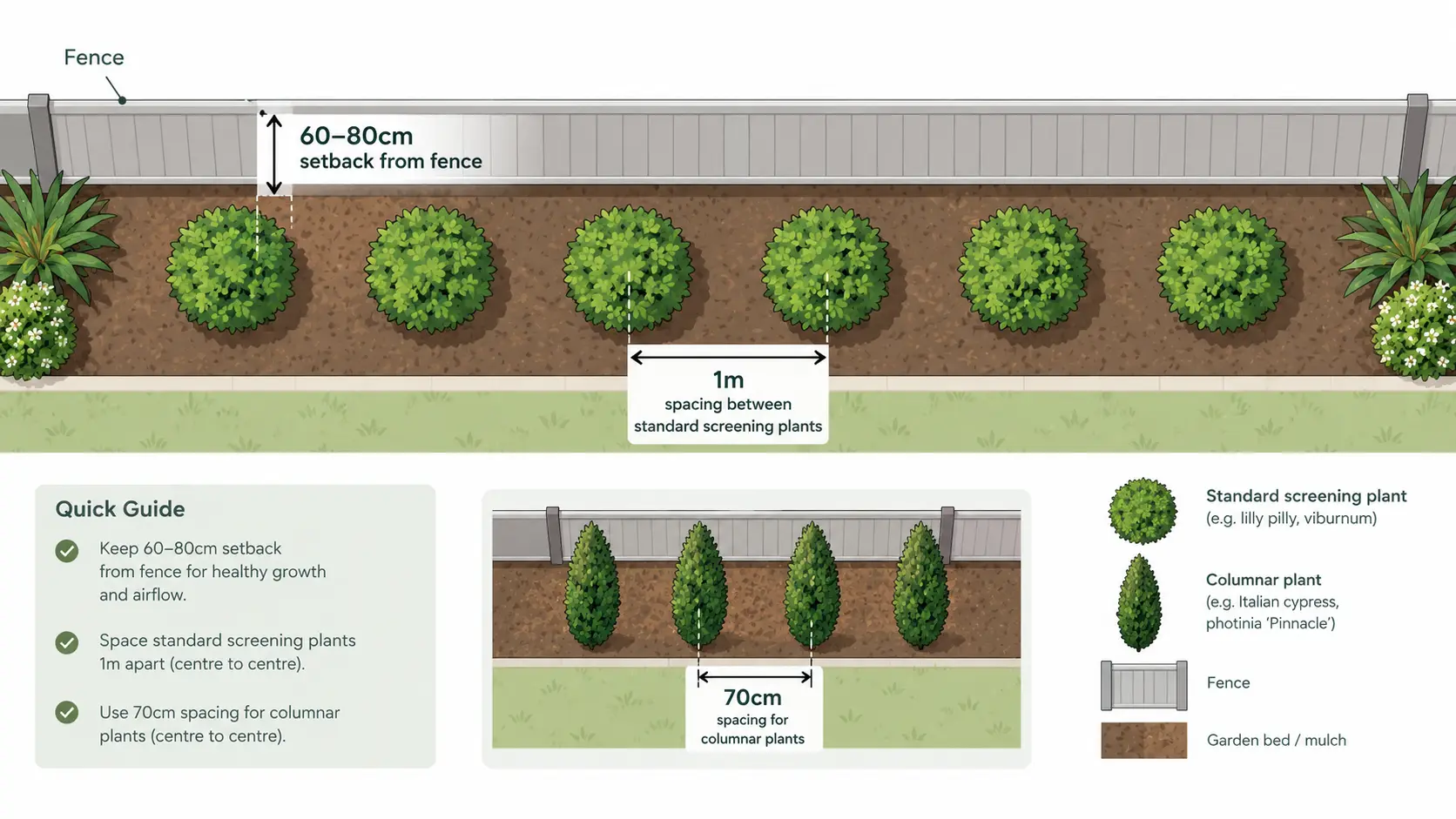
- Space standard screening plants about 1 m apart, columnar varieties about 70 cm, and low borders 30–40 cm. Planting tighter does not speed up coverage — it causes root competition and losses by year three.
- Set the row 60–80 cm off the fence so you can prune the back face.
- Expect meaningful privacy in 18 months to two years from 200 mm pots, and full coverage around year three.
- Mature width kills more hedges than mature height. Check it before you check anything else.
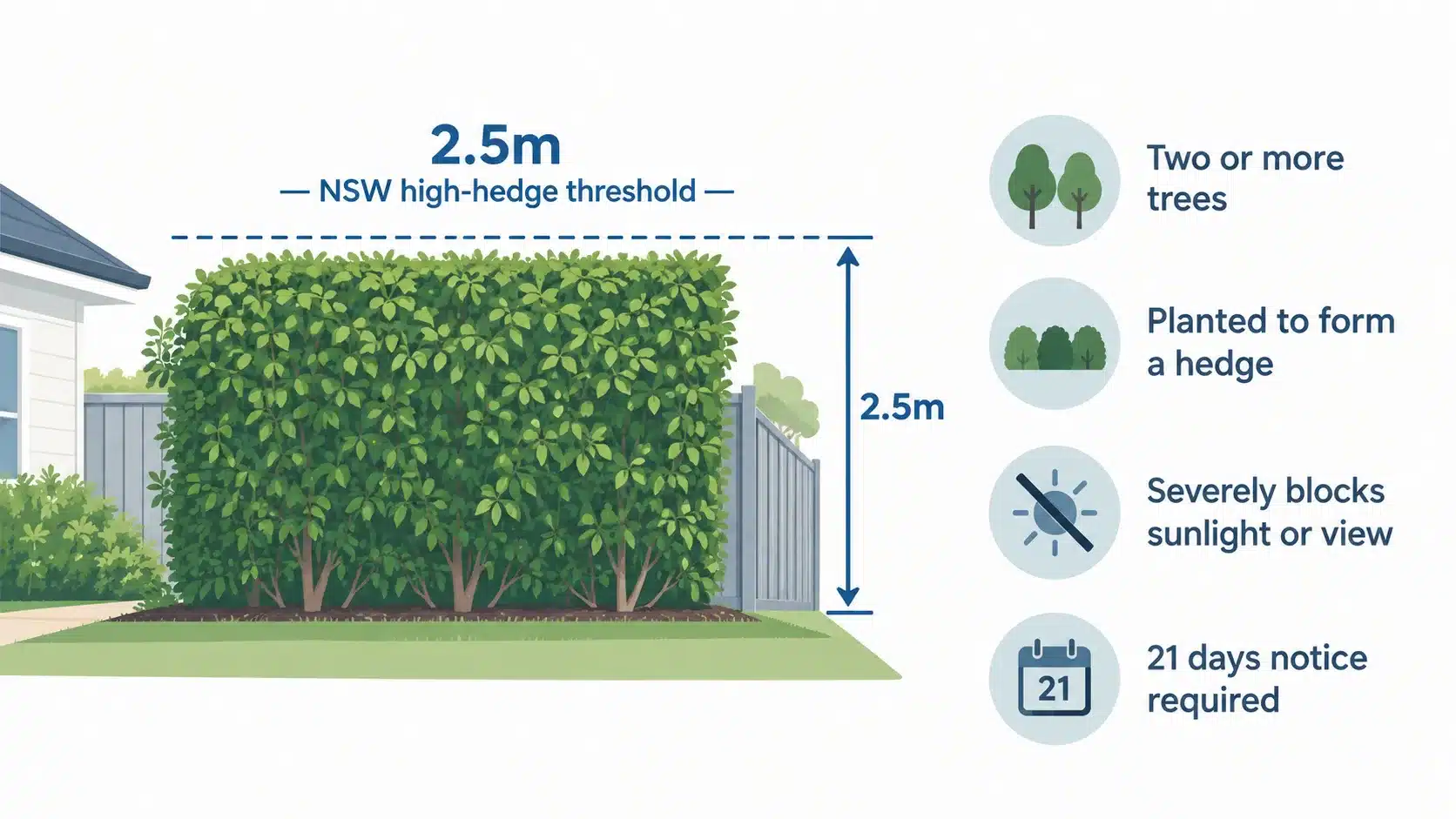
- NSW, Queensland and Tasmania have specific hedge-dispute legislation. In NSW, the high-hedge provisions apply to hedges of 2.5 m or more that severely block a neighbour’s sunlight or view. Design around that number on a shared boundary.
Hedge or Screen? Decide This Before You Look at a Single Plant
These two words get used interchangeably in nurseries and in most online guides, but they describe different things, and picking the wrong one is the single biggest driver of long-term maintenance.
A hedge is a line of plants maintained to a defined shape — flat-topped, squared sides, crisp edges. It is a piece of architecture made of plant material. It requires a species that tolerates repeated hard clipping, and it requires you to actually do that clipping, typically two to three times a year. Formal hedges look superb. They are also a standing commitment.
A screen is a line of plants allowed to grow into its natural form, with light shaping only. You are not imposing a shape; you are choosing a plant whose natural mature size happens to be close to what you need. One tidy-up a year, sometimes none. The look is softer and less architectural.
A border or edging is under a metre — it defines a space rather than blocking a view. Box, dwarf westringia, compact rhaphiolepis. Different job entirely, and if that’s what you’re after, the difference between hedging shrubs and garden borders is worth reading before you choose.
A windbreak or noise buffer is a third job again. Both need depth and density more than height — a single row of anything does relatively little for noise. Wind is best slowed rather than blocked outright; a permeable planting that filters wind performs better than a solid one, which creates turbulence on the leeward side.
Here’s the decision rule that saves most people years of pruning:
If you can find a plant whose natural mature height sits close to your target, you want a screen. If you can’t — or you need geometric precision — you want a hedge, and you should budget the time accordingly.
Most Australian homeowners want a screen and buy the ingredients for a hedge.
Step 1: Write Your Brief Before You Look at Plants
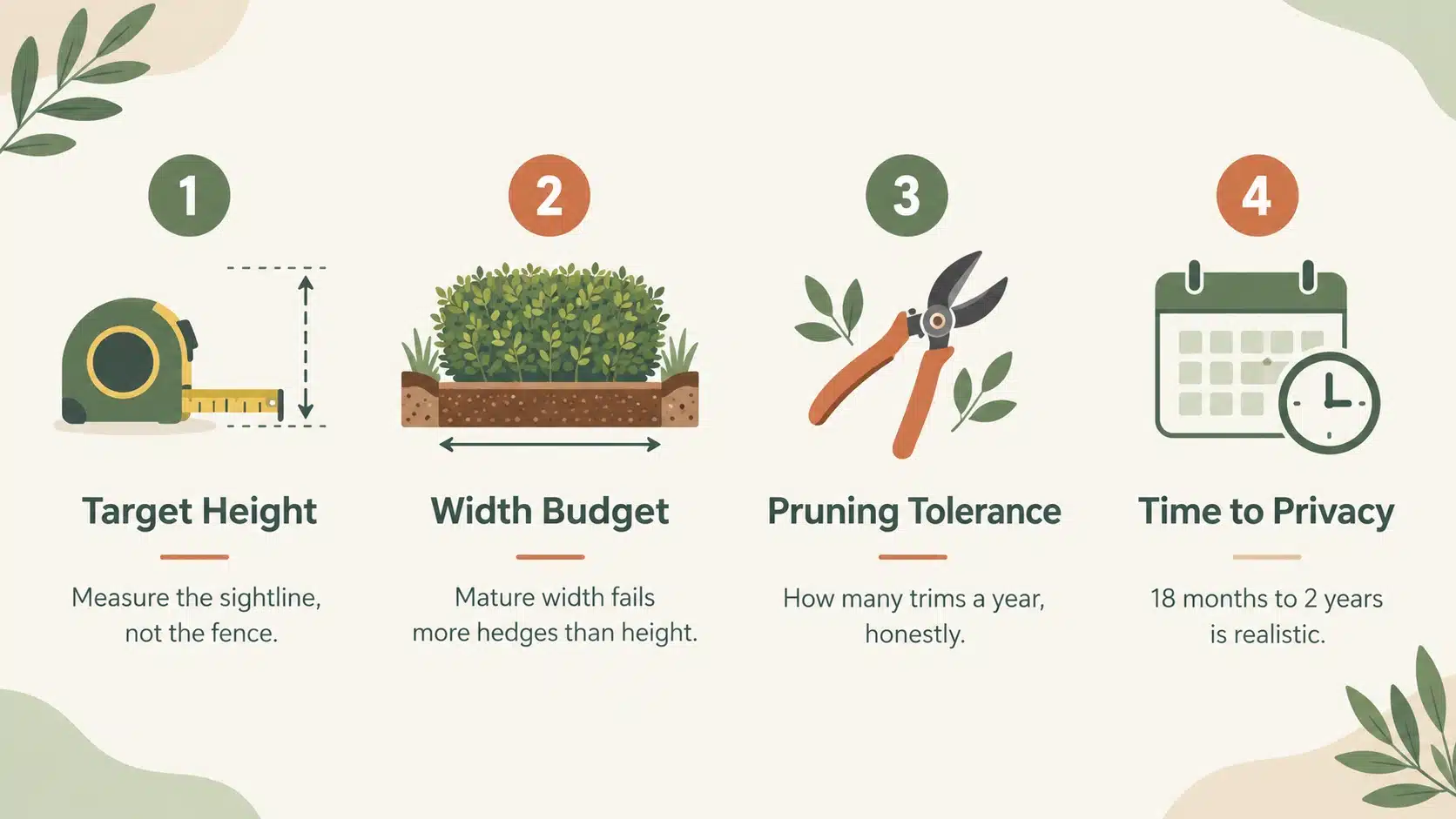
Every ranking guide on this topic starts with plant names. That’s backwards. Four numbers determine which plants are even eligible, and you can work all four out in fifteen minutes in your own garden.
Measure the sightline, not the fence
Don’t measure the fence. Go and stand — or better, sit — exactly where the privacy problem bothers you. The outdoor table. The kitchen window. The pool lounger. The bedroom. Then look at the thing you want to block and note where it sits relative to the fence line.
This almost always produces a smaller number than people expect. A standard Colorbond fence panel is 1.8 m. A screen held at 2.5–3 m will hide a neighbouring deck or a first-floor window from most seated angles, because you’re blocking a line of sight, not building a wall to the sky. Six-metre screens are occasionally necessary on sloping blocks or against two-storey builds close to the boundary. They’re specified far more often than they’re needed.
Take a photo from the seated position. You’ll want it later when you’re comparing mature heights, and it stops you drifting upward in the nursery.
Your first number: target screen height.
Set your width budget
This is the number that matters most and gets checked least.
Mature width is what causes a hedge to swallow a path, crowd a driveway, or grow into a fence until the palings rot. Measure the depth of the bed you have available, then subtract the access you’ll need to prune the back face — 60–80 cm off the fence is the working standard. What’s left is your maximum mature width.
If that number is under a metre, most conventional screening shrubs are already out, and you’re looking at columnar plants or a screening technique rather than a hedge. That’s not a compromise, it’s just a narrower shortlist, and it’s covered further down.
Your second number: maximum mature width.
Be honest about pruning tolerance
“Low maintenance” does not mean a fast-growing plant that you cut back hard. It means the opposite: a plant that stops near your target height on its own.
A high-maintenance hedge is one where you’ve asked an eight-metre plant to behave like a 2.5 metre wall. Every year it will try to be eight metres, and every year you will spend a weekend explaining otherwise. Over twenty years that’s a genuinely significant amount of your life.
A low-maintenance screen is a plant whose natural ceiling sits within half a metre or so of what you want. One clip a year, mostly cosmetic.
If pruning isn’t something you’ll realistically get to, that constraint should filter your list before anything else — and the specific options worth looking at are set out in this guide to low-maintenance plants for a fence line.
Your third number: trims per year you’ll actually do.
Decide how long you’re willing to wait
There’s a persistent belief that buying advanced stock buys instant privacy. It buys about twelve to eighteen months, at several times the price, and there’s a real catch: large plants in large pots often sulk for a year after planting while their root systems catch up, and smaller stock planted at the same time frequently overtakes them by year four.
Realistic expectations from healthy 200 mm stock, well prepared and watered:
| Stage | Typical timeframe |
| Visible growth, plants knitting together at the base | 6–12 months |
| Meaningful screening (you stop noticing the fence) | 18 months – 2 years |
| Full, dense coverage at target height | 2.5 – 4 years |
Those ranges shift with climate — a subtropical Brisbane garden will sit at the fast end, a Canberra garden at the slow end — and they assume deep, consistent watering through the first two summers, which is where most timelines actually fail.
If your answer to “how long can you wait” is “not long,” the trade-offs involved are worth understanding properly, because the fastest-growing trees for screening come with root behaviour and structural considerations that slower options don’t.
Your fourth number: acceptable time to privacy.
Write those four numbers down. Everything below filters against them.
Step 2: Match the Plant to Your Climate Zone
Australia spans wet tropics to cool temperate highlands to Mediterranean dry. A “top 10 hedging plants in Australia” list without climate filtering is a list of plants that will each fail somewhere in the country.
Subtropical and tropical (Brisbane, northern NSW, Darwin, Cairns)
Heat and humidity are the dominant pressures, and fungal disease is the main limiting factor.
Performs well: Syzygium and Acmena lilly pillies, Waterhousea floribunda, murraya, duranta, viburnum, ficus, star jasmine, clumping bamboo.
Struggles: Most conifers resent humidity and develop fungal problems. Photinia is prone to leaf spot in humid summers. Camellia sasanqua manages but prefers a bit of shelter.
Watch for: Myrtle rust, which affects plants in the Myrtaceae family — lilly pillies, callistemons, melaleucas, leptospermums. Choose resistant cultivars where you can and avoid overhead watering.
Warm temperate and coastal (Sydney, Wollongong, Perth coastal, SE Queensland fringe)
The most forgiving zone in the country, and the widest plant palette. Salt and wind are the local variables rather than heat.
Performs well: Almost everything in this guide. Lilly pillies, viburnum, murraya, pittosporum, westringia, rhaphiolepis, photinia.
Watch for: Salt exposure within a few hundred metres of open ocean narrows the list considerably. Westringia, coastal rosemary, rhaphiolepis, banksia and Leptospermum handle it; viburnum and photinia don’t much like it.
Cool temperate (Melbourne, Canberra, Adelaide Hills, Tasmania, highland NSW)
Frost is the filter. A plant’s frost tolerance and its young frost tolerance are different things — many plants that cope at maturity will be cut back to the ground in their first winter.
Performs well: Photinia, viburnum, camellia, conifers, pittosporum, English and Japanese box, escallonia.
Struggles: Several lilly pilly cultivars are marginal below about −3 °C, particularly in their first two years. Murraya and duranta are frost-tender.
Watch for: Cold-air drainage. Frost pools in the lowest part of a sloping block and along the base of solid fences. A plant that’s fine in your front garden can be lost on the back boundary of the same property.
Mediterranean and dry (Perth, Adelaide, inland regional)
Long dry summers, often on sand or heavy clay, frequently with water restrictions.
Performs well: Westringia, rhaphiolepis, olive, callistemon, acacia, dodonaea (hop bush), Leptospermum, rosemary, photinia with irrigation.
Watch for: Perth’s sandy soils drain so freely that a hedge can dehydrate between waterings even when you’re watering regularly. Soil improvement with organic matter and a wetting agent at planting is not optional there — it’s the difference between establishment and failure.
Sloping and exposed sites (any zone)
Wind exposure and cold-air drainage override the regional picture. On an exposed ridge, choose for wind tolerance first and climate zone second, and expect slower establishment regardless of species.
Native or Exotic? What Actually Performs Long-Term
This question gets a lot of ideological heat and not much practical answering. The honest position:
Australian natives are generally better adapted to local soil, rainfall patterns and drought — that’s genuinely true, and for low-water gardens, poor soils and coastal exposure, natives are frequently the better long-term choice. Westringia, callistemon, leptospermum, acmena and banksia will survive conditions that kill a camellia.
But “native” isn’t a performance guarantee. A plant native to Cape York is not adapted to Hobart. A plant native to Western Australian sand will often rot in Sydney clay. The relevant question is whether a plant is adapted to your conditions, not whether it’s Australian.
And several exotics are genuinely well-adapted. Murraya, photinia, viburnum, rhaphiolepis and Japanese box have been used in Australian gardens for a century because they cope with what we throw at them.
Practical takeaways:
- For drought tolerance and poor soil, natives usually win.
- For dense, tight formal clipping, exotics like box, murraya and photinia are often easier — though lilly pillies and westringia clip well too.
- For wildlife value, natives win decisively. A native screen brings small birds and insects; a photinia hedge doesn’t.
- For fire-prone areas, some natives with high oil content (particularly some eucalypts and melaleucas) are a poor choice near a house, while others — lilly pillies among them — are comparatively fire-retardant. This is a site-specific question worth checking against your local fire authority’s guidance rather than a general rule.
- Avoid environmental weeds outright. Several historically popular hedging plants — privet, some cotoneasters, running bamboo, and in parts of Australia, Duranta repens in its seeding forms — are declared weeds in some regions. Check your state or council weed list before planting anything in quantity.
Step 3: Choose by Height Band
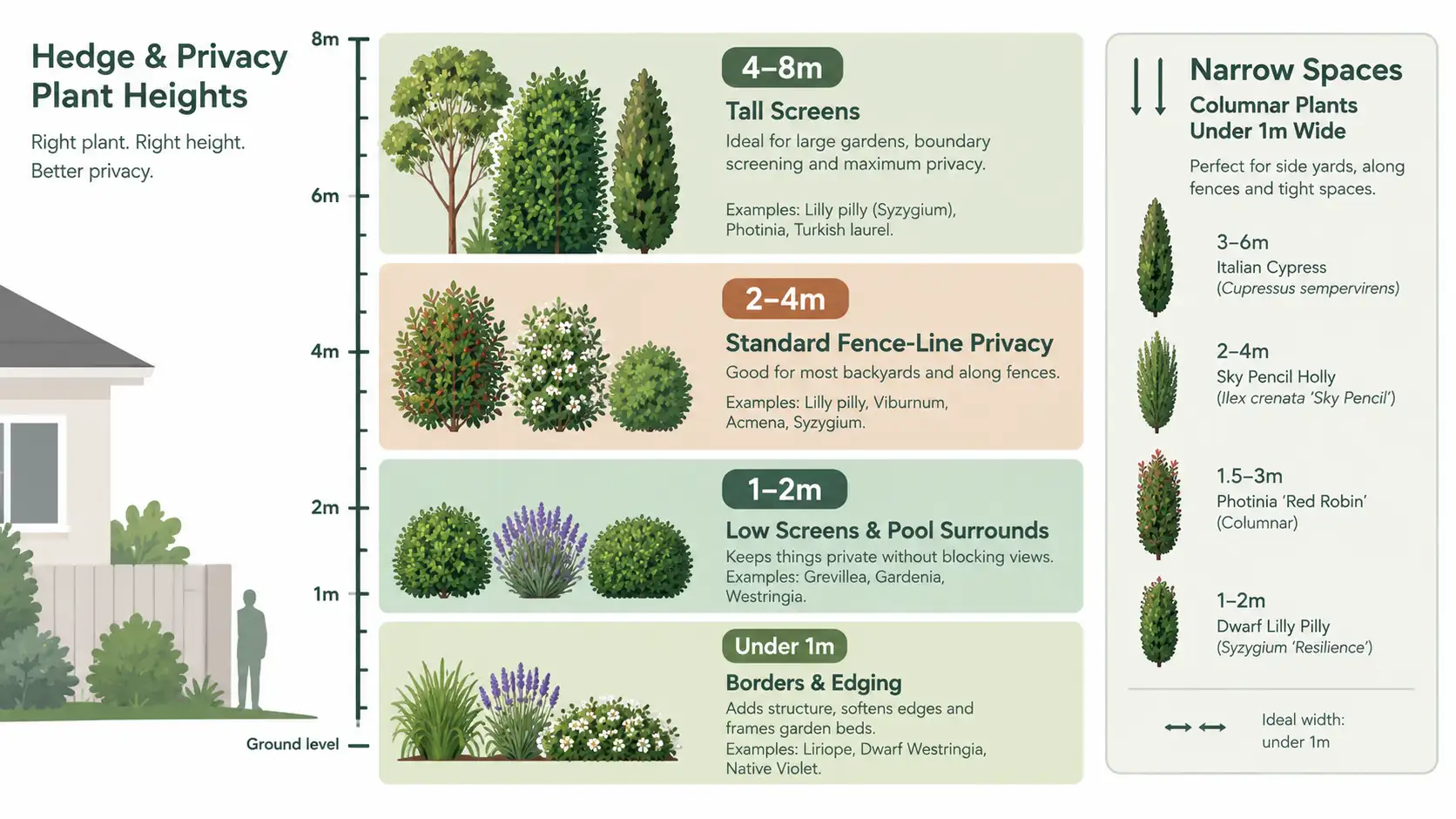
This is where plant names finally appear — filtered against the numbers you wrote down.
Before the individual bands, here’s the comparison that most guides never provide: the same set of common screening plants scored against the four things that actually determine whether you’ll be happy in ten years.
Screening plant comparison at a glance
| Plant | Typical mature H × W (screened) | Growth rate | Root aggression | Trims/year | Best for |
| Japanese box | 0.5–1 m × 0.5–0.8 m | Slow | Low | 2 | Formal low borders |
| Westringia (coastal rosemary) | 1–1.5 m × 1–1.5 m | Moderate | Low | 1 | Coastal, dry, low-care |
| Dwarf leptospermum | 0.6–1.2 m × 0.8–1.2 m | Moderate | Low | 1 | Native low hedge |
| Rhaphiolepis ‘Oriental Pearl’ | 1–1.5 m × 1–1.5 m | Slow–mod. | Low | 1 | Pool surrounds, low screens |
| Duranta ‘Sheena’s Gold’ | 1–2 m × 1–1.5 m | Fast | Low | 2–3 | Golden foliage contrast (frost-tender) |
| Murraya | 2–3 m × 1.5–2 m | Moderate | Low–mod. | 2 | Fragrant warm-climate hedge |
| Viburnum odoratissimum ‘Emerald Jewel’ | 3–4 m × 2–3 m | Fast | Moderate | 2 | Fast dense privacy, cool–warm temperate |
| Photinia ‘Robusta’ | 3–5 m × 2–3 m | Fast | Moderate | 2–3 | Cool-climate formal hedge, red new growth |
| Screening lilly pilly (Syzygium/Acmena) | 3–5 m × 1.5–3 m | Fast | Low–mod. | 1–2 | The Australian all-rounder |
| Columnar lilly pilly (e.g. Straight & Narrow) | 3–5 m × 0.8–1.2 m | Moderate | Low–mod. | 1 | Narrow beds, side passages |
| Pencil pine / Swane’s Golden | 4–6 m × 0.8–1.2 m | Slow–mod. | Low | 0–1 | Narrow vertical accent, cool–dry climates |
| Waterhousea floribunda | 5–8 m × 3–4 m | Fast | Moderate | 1–2 | Soft weeping native tall screen |
| Ficus hillii ‘Flash’ | 5–8 m+ × 3–4 m | Very fast | High | 2–3 | Fastest tall privacy — root barrier essential |
| Clumping bamboo | 3–8 m × 1–2 m clump | Fast | Low (clumping) | 1 | Narrow tall screening |
Mature dimensions assume a maintained screen, not an unpruned specimen. Growth rate assumes a suitable climate and adequate water — a fast plant in the wrong zone is a slow plant.
Two things stand out in that table that nursery listings tend to gloss over. First, the fastest plant on the list is also the only one with high root aggression — that correlation isn’t a coincidence, and it’s discussed properly below. Second, the narrowest options are all either columnar cultivars or clumping bamboo; there is no such thing as a standard shrub that reaches five metres tall and stays 80 cm wide.
Under 1 m: borders and edging
Job: Defining a bed, edging a path, framing a front garden. Not privacy.
Options: Japanese box, dwarf westringia, compact rhaphiolepis, dwarf lilly pilly cultivars such as ‘Allyn Magic’, and native dwarf tea trees.
Spacing: 30–40 cm (2.5–3 plants per metre).
For a native low hedge with genuine drought tolerance and a compact habit, the dwarf red tea tree is a strong alternative to box — it handles dry conditions far better and flowers, which box doesn’t.
1–2 m: low screens, pool surrounds and under-window planting
Job: Softening a fence without blocking it, screening at seated eye level, pool compliance planting, breaking up a long boundary.
This is the band where root behaviour and leaf drop matter most, because you’re usually planting near paving, pool shells or pool plumbing.
Options: Rhaphiolepis, westringia, dwarf lilly pillies, duranta, coastal rosemary, dwarf murraya.
Spacing: 60–80 cm.
For pool surrounds specifically, Rhaphiolepis ‘Oriental Pearl’ is one of the more reliable picks in this band — non-invasive roots, tidy habit, low leaf drop, and it tolerates the reflected heat that kills softer plants near paving.
If you want foliage colour rather than plain green in this height range, Duranta ‘Sheena’s Gold’ provides genuine lime-gold colour year-round in warm climates, though it’s frost-tender and needs more clipping than most to stay dense.
2–4 m: standard fence-line privacy
Job: The band most people actually need. Blocking a neighbouring window, deck or the view into a yard from a two-storey house nearby.
Options: Screening lilly pillies, viburnum, photinia, murraya, sweet viburnum, camellia (in shade).
Spacing: ~1 m (1 plant per metre).
In cool temperate gardens, Photinia ‘Robusta’ remains the southern default for good reason — it clips into a tight formal face, grows quickly, and the red new growth gives seasonal interest. It’s less happy in humid subtropical conditions, where leaf spot becomes a recurring issue.
For fast, dense, glossy coverage across most temperate zones, Viburnum ‘Emerald Jewel’ fills a boundary quickly and holds density from low down, which is more than can be said for many fast growers.
On lilly pillies: this is the genus most Australians end up with, and for sound reasons — fast, evergreen, dense, natively adapted, and available in cultivars covering every height band from 60 cm to 8 m. The complication is that “lilly pilly” covers three different genera (Syzygium, Acmena and Waterhousea) and dozens of named cultivars with genuinely different mature sizes, frost tolerance, root habits and — critically — psyllid resistance. Choosing the wrong cultivar is the most common way an otherwise sensible hedge plan goes wrong.
Rather than repeat that comparison here, the full side-by-side breakdown of which lilly pilly variety suits your hedge covers genus differences, mature height and width, psyllid resistance and climate suitability across the main cultivars. If you’re leaning lilly pilly, read that before you buy — the cultivar choice matters considerably more than the genus.
4–8 m: tall screens and full neighbour blocking
Job: Blocking a two-storey build, screening across a slope, large-block boundary planting.
This is where two things change. Root barriers move from optional to necessary for some species, and you enter the height range where hedge-dispute legislation applies on a shared boundary.
Options: Ficus, Waterhousea floribunda, broad-leaf lilly pilly, taller Syzygium australe forms, tall clumping bamboo.
Spacing: 1–1.5 m.
Ficus hillii ‘Flash’ is the fastest reliable tall screen available in Australia, capable of full privacy in two to three years, and it holds density from ground level in a way few tall plants manage. It is also the plant in this guide most likely to cause you an expensive problem. Its root system is genuinely aggressive. Planted without a barrier near pool plumbing, a slab, a driveway or sewer lines, it will eventually find them. On a large block with a properly installed root barrier it’s excellent; in a small courtyard near services it’s a liability.
The softer native alternative at similar height is Waterhousea floribunda ‘Sweeper’ — weeping habit, dense year-round foliage, attractive pink-bronze new growth, and markedly better-behaved roots than ficus. It’s wider than a columnar screen and needs the space, but on a boundary with three or four metres to give it, it’s the better long-term choice for most suburban blocks.
Narrow spaces: columnar plants under 1 m wide
Job: Side passages, zero-lot-line boundaries, narrow beds between a path and a fence, courtyard screening.
This is the hardest brief in screening, and the one where most people compromise badly — squeezing a three-metre-wide plant into a one-metre bed and then fighting it forever.
Spacing: ~70 cm (about 1.4 plants per metre).
Four genuine options:
Straight and Narrow lilly pilly is the standard answer in warm and subtropical climates — naturally columnar, holds around 3–5 m tall at under a metre wide, and needs minimal shaping to keep its form.
Syzygium ‘Up and Away’ offers a similar narrow habit with slightly different foliage and growth characteristics, and is worth comparing directly against Straight and Narrow rather than treating as interchangeable.
For cool-climate and dry gardens where lilly pillies are marginal, the blue pencil pine provides a strict vertical line with blue-grey foliage and almost no pruning requirement — though it gives a formal, architectural look rather than a soft one, and it won’t regenerate if cut back into bare wood.
Swane’s Golden Cypress is the same narrow form in gold, useful where you want height, colour and minimal width in one plant.
A note on all narrow columnar plants: they screen as a row of vertical elements rather than a solid wall, so at close spacing you’ll get near-complete coverage, but with gaps if you plant them a metre and a half apart. Space them at 70 cm or accept a partial screen.
Screening Above Fence Height Without Losing Garden Width
Sometimes there is no plant that fits. The bed is 60 cm deep, the problem is a window at four metres, and nothing conventional will do both.
Three techniques solve this, and almost no competing guide mentions any of them.
Pleaching means growing a tree with a clear trunk to around fence height, then training a flat, narrow canopy above it. You screen exactly the band you need — above the fence — while leaving the ground beneath open for planting, paths or seating. In a small courtyard it’s frequently the only workable answer. Pleached lilly pilly screens are the most common Australian application, and pre-trained stock is available from specialist growers, which saves several years of formative work.
Espalier trains a plant flat against a wall or fence in a two-dimensional plane, typically 20–30 cm deep. It won’t screen above the structure it’s attached to, so it’s a softening technique rather than a privacy solution — but for covering a bare wall in a narrow space, nothing else comes close.
Climbers on a frame are the fastest coverage per square metre of any option in this guide. A wire or batten frame extending above the fence line, planted with a climber, gives you height and screening with a footprint of perhaps 30 cm. The trade-off is that you’re maintaining a structure as well as a plant, and you need to keep the climber off the neighbour’s side. In warm and subtropical climates, star jasmine is the workhorse choice — evergreen, dense, fragrant in spring, and far better behaved than jasmine species that become weeds.
Frames are also the only screening option available to most renters, since they don’t require permanent planting.
Below Ground: Roots, Pools, Pipes and Paving
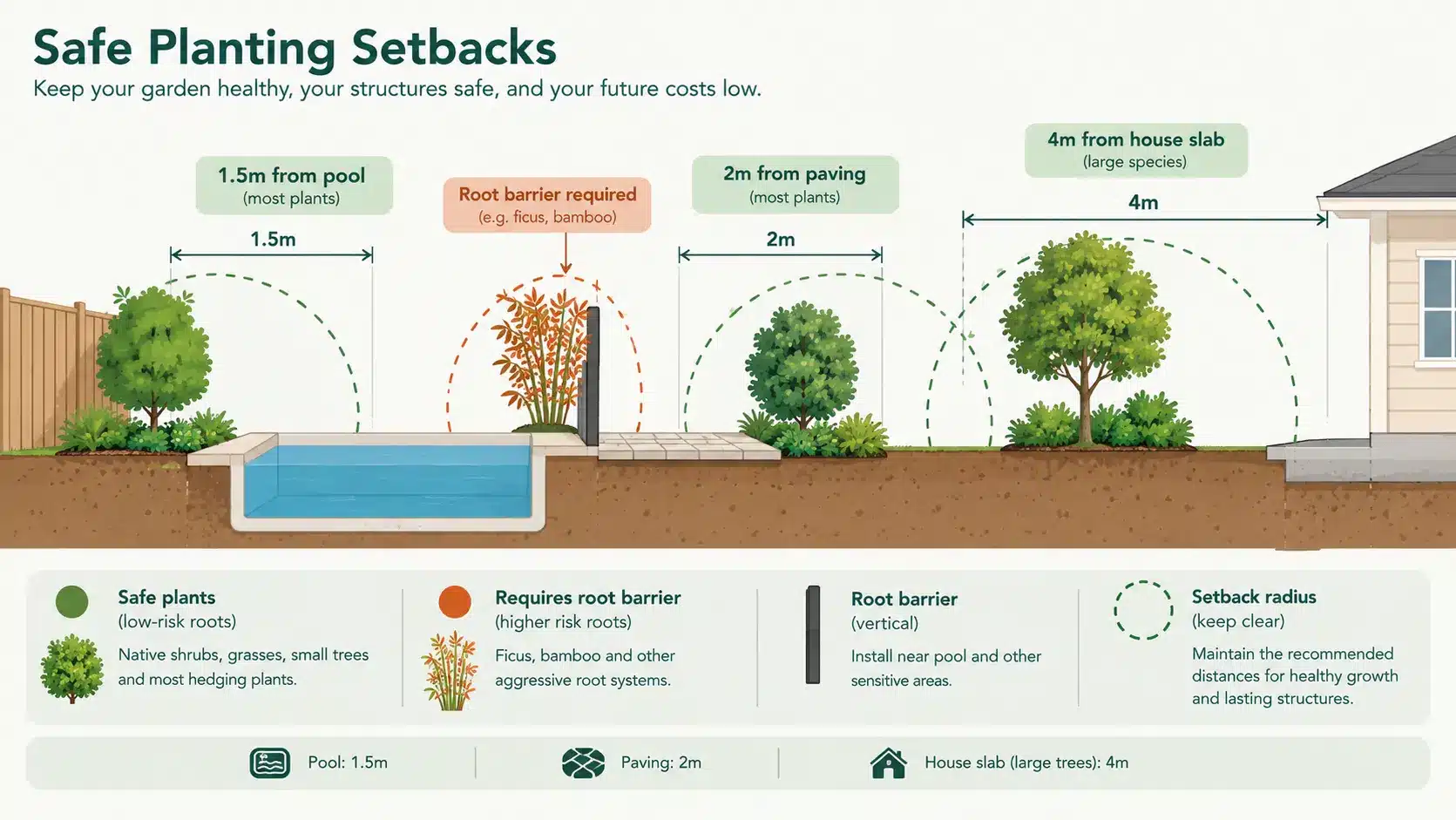
This is the section nursery-run pages skip, because it involves telling you not to buy things.
Which plants are genuinely well-behaved near hard surfaces
Lilly pillies, westringia, rhaphiolepis, murraya, viburnum and clumping bamboo all have relatively contained, fibrous root systems that rarely cause structural problems in a suburban context. They can still lift a thin paver if planted 20 cm from it, but they aren’t looking for your plumbing.
Which need a root barrier
Ficus species are the main concern in Australian gardens. Large figs, running bamboo and some eucalypts are others. If you’re planting any of these within range of a pool shell, pool plumbing, a house slab, a driveway or a sewer or stormwater line, install a commercial root barrier at planting — the practical spec is a rigid barrier to a minimum depth of around 600 mm, set between the planting row and the thing you’re protecting, and run continuously rather than as separate panels.
Retro-fitting a barrier to an established ficus is possible but far more expensive and damaging than doing it on day one.
Locate your services before you dig
Free service location is available through Before You Dig Australia (the former Dial Before You Dig). Lodge an enquiry, get the plans, and know where your sewer, stormwater, gas, water and telecommunications lines run before you open a 12-metre trench along a boundary. This takes ten minutes and prevents an entire category of expensive mistake.
Before trenching along a boundary, lodge a free enquiry with Before You Dig Australia to confirm exactly where sewer, stormwater and other services run beneath your yard.
Note also that on many suburban blocks the sewer line runs along or near the rear boundary — exactly where people want to plant tall screens.
Practical setbacks
| Feature | Minimum setback (small–medium screeners) | Minimum setback (large/ficus) |
| Fence line | 60–80 cm (for pruning access) | 1.5 m+ |
| Paving or path edge | 50–80 cm | 2 m+ with barrier |
| Pool shell or plumbing | 1.5 m | 3 m+ with barrier |
| House slab or footing | 1.5–2 m | 4 m+ with barrier |
These are rules of thumb for planning, not engineering specifications. On a constrained block, or anywhere near a pool, a short consultation with a landscaper or arborist before planting costs far less than remediation afterwards.
Leaf, fruit and flower drop
Rarely mentioned and genuinely annoying. Lilly pillies fruit, and the fruit falls — onto paving, into pools, into gutters. Murraya drops spent flowers. Bamboo drops leaves continuously. If you’re planting within a metre or two of a pool, gutter or an outdoor living area you want to keep clean, ask about drop habit before you buy, and favour non-fruiting or light-fruiting cultivars.
The Legal Side: Boundary Planting, Height Limits and Neighbour Disputes
This is the single largest gap in the available information on this topic, and it’s the section most likely to save you money.
Start with the counterintuitive part: in Australia there is generally no legal right to a view, and no general legal right to sunlight. You cannot simply demand that a neighbour cut down plants because they spoil your outlook, and they cannot generally demand it of you either.
What exists instead are specific, narrow statutory remedies in three states.
New South Wales
The Trees (Disputes Between Neighbours) Act 2006 provides a process through the Land and Environment Court. Part 2A deals specifically with high hedges that obstruct sunlight or views, and the threshold conditions are precise:
- The planting must be a group of two or more trees
- They must be planted so as to form a hedge
- They must rise to at least 2.5 metres above ground level
- They must cause a severe obstruction of sunlight to a window of a dwelling, or of a view from a dwelling
- The applicant must have made reasonable efforts to reach agreement with the owner first
- At least 21 days’ notice of an application is required
Bamboo is included within the definition of “tree” under the NSW regulations, which has caught a number of people out.
The court has made orders requiring hedge owners to prune to a specified height annually, at their own cost, and to remove overhanging branches and the resulting debris. These aren’t theoretical — they’re a regular part of the court’s Class 2 workload.
The practical implication for planning: on a shared boundary, particularly where your block sits above your neighbour’s, 2.5 metres is the number to design around. Below it, the high-hedge provisions don’t engage at all.
These threshold conditions and the court’s powers to order pruning are set out in full in the Trees (Disputes Between Neighbours) Act 2006 (NSW), which governs the entire high-hedge process described above.
Queensland
The Neighbourhood Disputes (Dividing Fences and Trees) Act 2011 covers similar ground, administered through QCAT, with provisions for trees causing damage, interference or obstruction. Queensland’s view-related provisions apply to trees somewhat differently than NSW’s hedge-specific approach.
Tasmania
The Neighbourhood Disputes About Plants Act 2017 provides the Tasmanian equivalent.
Victoria, SA, WA, NT and ACT
No specific hedge legislation. Disputes fall back on common law nuisance and, in practice, on local council processes and mediation services. That doesn’t mean you can do as you like — it means the path to resolution is less defined and often slower.
Things that apply everywhere
Overhanging branches. You are generally entitled to cut branches back to the boundary line at your own cost — but you may not enter the neighbour’s property to do it without permission, you can be liable if you damage or kill the plant, and the cuttings technically remain the owner’s property. In practice, offering them back is usually the wrong move socially; ask first.
Council tree preservation and vegetation protection orders. Many councils have a TPO or a vegetation protection overlay. These typically apply to trees above a certain height or trunk diameter — and a hedge that’s been left to grow can qualify. Once a plant is protected, you may need a permit to prune it significantly, which is an unwelcome discovery when you were planning to reduce it. Check your council’s controls before planting anything that will exceed their threshold.
Declared weeds. Planting a declared weed species can carry obligations or penalties depending on your state. Check the list before planting in quantity.
Building over easements. Planting within a drainage or sewer easement is restricted or prohibited in many jurisdictions, and the relevant authority can remove your planting without compensation to access the asset.
The practical advice
Before planting a boundary screen, have the conversation. Tell your neighbour what you’re planning, name a target height, and — if it matters — put it in an email so there’s a record. A five-minute conversation before planting is dramatically cheaper than a Land and Environment Court application five years later, and the overwhelming majority of hedge disputes that reach a court began with a hedge that nobody had ever discussed.
If informal discussion doesn’t resolve things, disputes of this kind are handled by the Land and Environment Court of NSW, which outlines the application process for tree and hedge orders.
This section is general information about how these laws work, not legal advice. For a specific dispute, check your state’s legislation and get proper advice.
How to Plant a Hedge or Screen
The single highest-return thing you can do for a hedge happens before any plant goes in the ground.
Trench, don’t dig individual holes
Dig a continuous trench along the run rather than separate holes for each plant. This is the difference between a hedge that knits together in eighteen months and one that’s still patchy at year three.
Individual holes in heavy soil act as sumps — water collects, roots circle, and each plant establishes at a different rate, which is why so many hedges end up with two or three obviously smaller plants in the line. A continuous trench of improved soil gives every plant the same conditions and lets roots run laterally along the row.
Practical specification: trench at least 40–50 cm wide and to the depth of the root ball plus 10 cm. Break up the base — don’t leave a compacted pan. Backfill with a mix of the excavated soil and quality organic matter, roughly 70:30. In sand, add more organic matter and a soil wetting agent. In heavy clay, add gypsum and raise the bed slightly rather than planting into a hole that holds water.
Spacing: the formula
Divide the length of your run by the spacing, then add one if you want a plant at each end.
| Plant type | Spacing | Plants per metre | 12 m run |
| Low borders and box edging | 30–40 cm | 2.5–3 | 30–36 plants |
| Small hedges to ~1.5 m | 50–60 cm | 1.7–2 | 20–24 plants |
| Dense formal hedging | 60–80 cm | 1.25–1.7 | 15–20 plants |
| Columnar screeners | ~70 cm | ~1.4 | 17–18 plants |
| Standard screening plants | ~1 m | 1 | 12–13 plants |
| Large tall screens | 1–1.5 m | 0.7–1 | 8–12 plants |
Planting tighter does not buy you a faster hedge. It buys root competition, thin bases, and losses by year three — at which point you have gaps in an established hedge, which is the hardest problem in this entire guide to fix. If you want faster coverage, buy larger stock or plant closer to your target height, not closer together.
Setback from the fence
Set the row 60–80 cm off the fence. You need to be able to get behind it to prune the back face, and if you can’t, the hedge will grow into the fence, trap moisture against it, and eventually damage it. On a Colorbond fence this causes corrosion; on timber, rot.
That setback also keeps root activity away from the fence footings, and it gives you somewhere to stand when you’re trimming.
Timing
Autumn is the best planting season across most of Australia — soil is still warm, rainfall is more reliable, and the plant has the entire cool season to establish roots before its first summer. Early spring is the second choice.
Avoid planting in mid-summer if you possibly can. In cold-climate gardens, avoid planting frost-tender species in late autumn, where a young plant meets its first frost before it’s established.
After planting
- Mulch 5–7 cm deep across the whole run, kept clear of the stems.
- Water deeply rather than frequently — a long soak twice a week beats a daily sprinkle, because it draws roots downward. Continue through the first two summers.
- Consider drip irrigation along the row. A hedge is the one planting where an irrigation line genuinely pays for itself, because uniform water is what produces a uniform hedge.
- Stake only where needed — tall, top-heavy or wind-exposed plants. Most screening shrubs establish stronger without staking.
Maintaining a Hedge or Screen
Formative pruning matters more than everything after it
The years that determine whether your hedge is dense at the base are years one and two — and this is the step almost everyone skips, because cutting a young plant back feels like undoing progress.
Tip-prune lightly and regularly through the first two growing seasons. Every cut produces two or more shoots below it. Doing this while the plant is small is what builds the branch structure low down. If you let a young hedge run up unpruned to get height quickly and only start clipping once it’s at target height, you’ll have a hedge that’s dense at the top and gappy at the bottom — permanently, in many species.
Batter: the shape that keeps the base alive
Prune the hedge slightly wider at the base than at the top — a gentle taper, perhaps 10–15 cm narrower at the top over a 2 m face.
This is basic and almost universally ignored. A hedge with vertical or, worse, overhanging sides shades its own lower foliage, which then thins and dies. The taper lets light reach the bottom. It’s the difference between a hedge that stays full for twenty years and one that becomes a green ceiling on bare stems.
Trimming frequency and timing
| Style | Trims per year | Timing |
| Formal clipped hedge | 2–3 | After each major growth flush |
| Semi-formal screen | 1–2 | Late spring and, if needed, late summer |
| Informal screen | 0–1 | Light shaping after spring flush |
In general, trim after a growth flush rather than before one. Avoid hard pruning going into either extreme heat or heavy frost — the fresh growth it stimulates is the most vulnerable tissue on the plant.
Feeding
A slow-release fertiliser in early spring covers most hedges. A second, lighter application after the main spring flush supports the summer growth in warm climates. Skip or reduce feeding heading into a dry summer if you’re on water restrictions — pushing growth you can’t water is counterproductive.
Yellowing across the whole hedge usually indicates a nitrogen deficiency or a pH problem rather than a pest. Yellowing on new growth only, with green veins, typically points to iron or manganese deficiency — common in alkaline soils and in sandy Perth and Adelaide gardens.
Renovation pruning
If a hedge has grown beyond what you want, how far you can cut back depends entirely on the species:
- Will regenerate from bare wood: lilly pilly, murraya, photinia, viburnum, camellia, box, ficus, most broadleaf evergreens.
- Will not regenerate from bare wood: conifers (pencil pines, cypresses), most westringia, lavender, rosemary, many Leptospermum. Cut into brown wood on a conifer and that section stays brown permanently.
Where hard renovation is possible, do it in stages — one face per year over two or three years — rather than all at once. The plant keeps enough foliage to power its recovery, and you keep some screening while it regrows.
When a Hedge Isn’t Working: Diagnosing the Common Failures
If you already have a hedge and it’s disappointing you, this section is for you. Work through the symptoms.
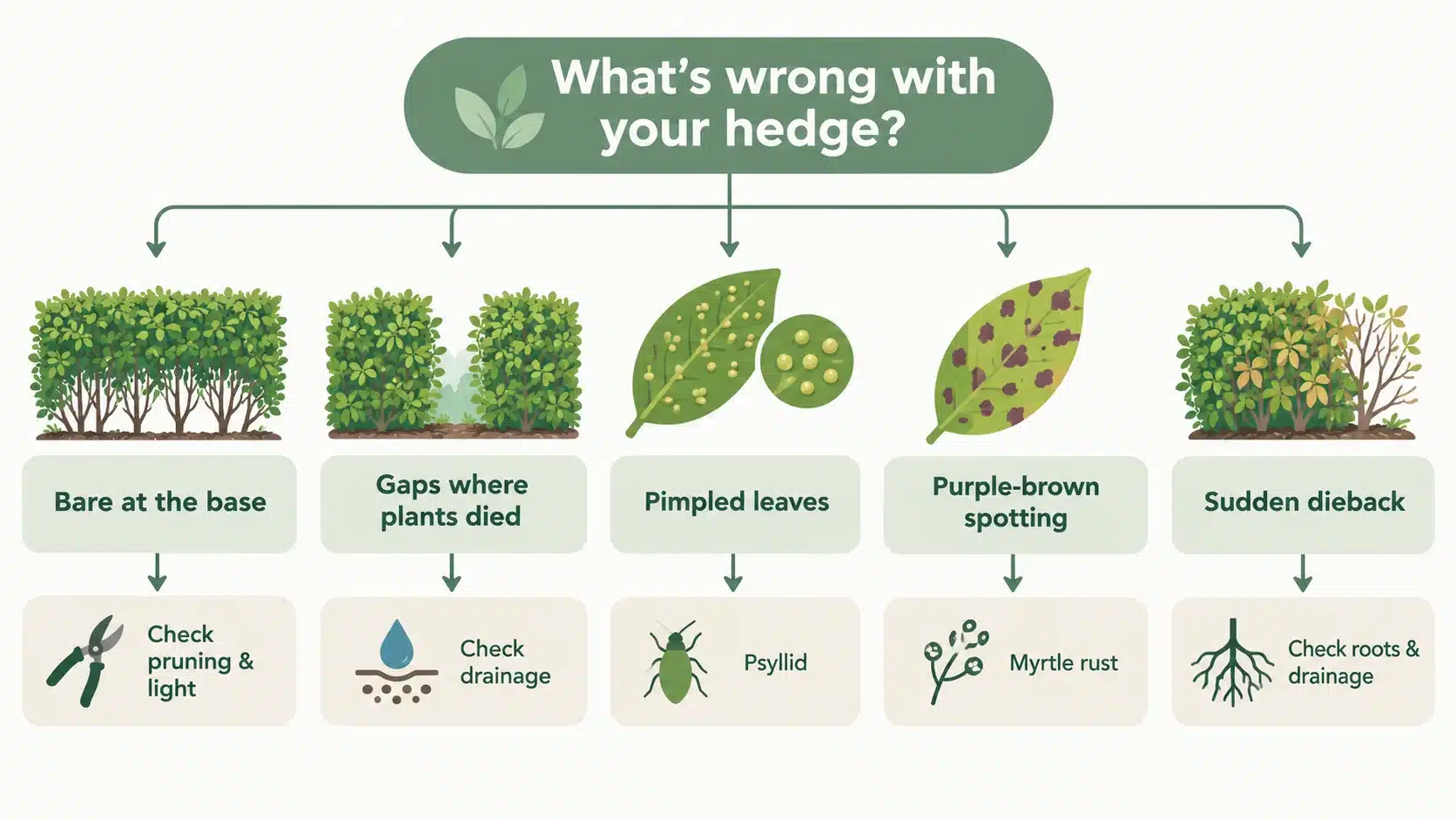
Bare and woody at the base, dense at the top
By far the most common complaint. Three causes, in order of likelihood:
- No formative pruning. The hedge was allowed to run up and only clipped once it reached height. The low branch structure was never built.
- No batter. The top is as wide as or wider than the base, shading the lower foliage into decline.
- Insufficient light at the base from surrounding planting, a wall, or the hedge being planted too close to a fence.
Can it be fixed? In species that regenerate from bare wood — yes, with staged renovation pruning and by correcting the batter. Expect two to three years. In conifers and other non-regenerating species — no. The bare section will stay bare. The realistic options are underplanting with a lower shrub to hide it, or replacement.
Gaps where individual plants died
Usually drainage. A hedge planted in individual holes in clay will lose the plants that sat in the wettest spots. Sometimes it’s root competition from a nearby established tree, sometimes an irrigation line that didn’t reach the end of the run.
Before replanting, work out why that specific position failed. Dig a test hole 40 cm deep, fill it with water and see how long it takes to drain — more than four hours suggests a drainage problem you need to fix first, or the replacement will die too.
Be aware that a replacement plant in an established hedge competes with mature neighbours on both sides and will lag for several years. Plant it larger than you otherwise would, water it separately, and consider trimming the adjacent plants back slightly to give it light.
Distorted, pimpled or dimpled leaves on a lilly pilly
Psyllid. A sap-sucking insect that causes characteristic bumps and pits on new growth. Cosmetically ruinous on a hedge, though rarely fatal.
Light infestations can be managed by pruning off affected new growth at each flush. Heavy, recurring infestations in a psyllid-prone area are a cultivar problem, not a pest problem — some lilly pilly cultivars are markedly resistant and others are magnets. If you’re replacing or replanting, choosing a psyllid-resistant lilly pilly variety is the only durable fix.
Purple-brown spotting and powdery yellow growth on new foliage
Myrtle rust, affecting Myrtaceae — lilly pillies, callistemon, melaleuca, leptospermum. Most serious in humid subtropical and coastal regions.
Remove and bag affected growth rather than composting it, avoid overhead watering, improve airflow, and accept that in high-pressure areas some species simply aren’t viable long-term. Resistant cultivars exist and are worth seeking out.
Sticky leaves and black sooty coating
Scale or aphids, with sooty mould growing on their honeydew. The mould is a symptom, not the problem. Treat the insects — horticultural oil is effective for scale — and the mould weathers off.
Sudden dieback of a whole plant or section
Check, in order: waterlogging at the root zone, borer damage at the base of the stem (look for frass or small holes), root disease in poorly drained soil, or a herbicide drift event. In older hedges, a single plant dying while its neighbours thrive usually points to a localised soil problem in that spot.
Whole hedge just looks thin and unhappy
Often a species-climate mismatch that was always going to catch up eventually — a frost-tender plant in a frost pocket, a humidity-intolerant plant in Brisbane, a moisture-loving plant in Perth sand. A plant fighting its climate can survive for years without ever performing.
Repair or replace?
A practical rule: if more than about a third of the plants in a run have failed, or the species is fundamentally wrong for your conditions, replacing the whole run is usually faster and cheaper than nursing it. A patched hedge rarely looks uniform again.
If you do replace, treat it as a chance to fix the original decision — go back to your four numbers and choose a plant whose mature size actually matches them.
Screening with Colour and Contrast
Not every screen has to be a flat green wall. A few options worth knowing:
Purple and burgundy foliage gives depth and contrast against green, and reads as deliberate design rather than a functional barrier. Several options work across different height bands and climates — see purple hedge plants for Australian gardens for the specific cultivars and where they perform.
Golden and lime foliage lifts a shaded corner and provides the strongest contrast against dark green. Duranta ‘Sheena’s Gold’ in warm climates; Swane’s Golden Cypress where a narrow vertical is wanted.
Flowering screens — murraya’s fragrant white flush, viburnum’s cream heads, camellia sasanqua through autumn and winter. Flowering adds seasonal interest but usually costs you some clipping precision, since heavy formal trimming removes flower buds.
Mixing species along one run can look excellent, but only if the plants have similar growth rates. Mix a fast grower with a slow one and the fast one will dominate within three years. Mixed hedges work best with two species of comparable vigour, planted in blocks rather than alternating singly.
One caution: colour usually costs a little density. Variegated and coloured-leaf cultivars are often slightly less vigorous than their plain green parents. If privacy is the priority, choose for density first and use colour as an accent elsewhere.
What a Hedge Actually Costs
Nobody publishes this, so here’s a realistic framework for a 12-metre boundary screen at around 3 m mature height.
| Item | Typical range |
| Plants (12 × 200 mm pots) | $150 – $500 |
| Plants (12 × advanced 45 L) | $900 – $2,400 |
| Soil improvement, compost, gypsum | $100 – $250 |
| Mulch | $50 – $150 |
| Drip irrigation along the run | $100 – $300 DIY |
| Root barrier (if required) | $300 – $800+ |
| Professional planting | $600 – $1,500 |
| Annual pruning if outsourced | $150 – $400 per visit |
Indicative planning figures only — prices vary substantially by region, species and supplier.
Two observations that matter more than the numbers themselves.
First, the ongoing cost dwarfs the setup cost. A formal hedge trimmed professionally three times a year at $250 a visit is $750 annually — $15,000 over twenty years. A well-matched informal screen trimmed once is a third of that. The plant choice you make in week one determines your maintenance bill for two decades, which is the strongest possible argument for choosing a plant whose natural height is near your target.
Second, against fencing: a 12-metre screening fence or slatted privacy screen might cost $2,000–$6,000 installed and requires no watering — but it’s capped at fence height, it doesn’t grow, it provides no cooling, shade, noise absorption or habitat, and it depreciates. A hedge appreciates in value and effectiveness every year. They solve slightly different problems, and on a small block the best answer is frequently both: a fence for the boundary, planting to soften and extend it.
Getting It Right
If you take three things from this guide, take these.
The method matters more than the plant list. Measure your sightline, set your width budget, be honest about how often you’ll prune, and decide how long you can wait. Those four numbers will lead you to a sensible shortlist even if the specific plant you end up with isn’t mentioned anywhere above. Skip them and no amount of plant knowledge will save you.
Two decisions can’t be undone. Root behaviour and boundary height are the only things on this list that are genuinely expensive to fix later. Check what’s underground before you dig, install a barrier if you’re planting anything aggressive near services, and if you’re planting on a shared boundary, design around 2.5 metres and have a conversation with your neighbour first.
And be realistic about time. Privacy takes two to three years. Every page trying to sell you plants has an incentive to soften that, and larger stock only compresses it modestly. Plant well, water deeply for two summers, prune formatively while the plants are small, and you’ll get a screen that holds its density for twenty years — which is a far better outcome than the one that looked good in year one and went bare at the base by year five.
Where to go next
If you need coverage as fast as possible and want to understand the trade-offs — fast-growing trees for screening.
If your bed is narrow, or you want a low border rather than a screen — hedging shrubs and garden borders.
If you’ve settled on a lilly pilly and need to pick the right cultivar for your climate, space and psyllid pressure — the best lilly pilly variety for hedging.
If pruning isn’t something you’ll realistically keep up — low-maintenance plants for a fence line.
Frequently Asked Questions
What’s the difference between a hedge and a screening plant?
A hedge is clipped to a defined shape and needs two to three trims a year to hold it. A screen is allowed to grow into its natural form with only light shaping, usually once a year or less. The practical difference is workload: a hedge is a shape you maintain, while a screen is a plant you chose because its natural size already suits the job.
How far apart should I plant a hedge in Australia?
Space standard screening plants about 1 metre apart, dense formal hedging 60–80 cm, columnar varieties about 70 cm, and low borders 30–40 cm. Divide your run length by the spacing and add one plant if you want one at each end. Planting tighter doesn’t produce a faster hedge — it causes root competition, thin bases and plant losses by the third year.
How far from the fence should I plant a screening hedge?
Set the row 60–80 cm back from the fence. That gives you access to prune the back face, keeps the hedge from growing into and damaging the fence, and prevents moisture being trapped against Colorbond or timber. For large species like ficus, increase the setback to 1.5 metres or more.
How long does it take to get privacy from a screening plant?
From healthy 200 mm stock, expect plants to knit together at the base within 6–12 months, meaningful screening at 18 months to two years, and full dense coverage at target height between years two and four. Subtropical gardens sit at the fast end of those ranges, cool-climate gardens at the slow end. Advanced stock buys roughly 12–18 months, not instant privacy.
How tall can I legally let a hedge grow in Australia?
There’s no blanket national height limit, but NSW, Queensland and Tasmania have specific hedge-dispute legislation. In NSW, the high-hedge provisions apply to a group of two or more trees planted as a hedge and rising to at least 2.5 metres that severely obstruct a neighbour’s sunlight or view — the Land and Environment Court can order the owner to prune it. On a shared boundary, 2.5 metres is the sensible number to design around. Council tree preservation orders may also apply once plants exceed a certain size.
Will screening plant roots damage my pool, pipes or paving?
Most common screening plants — lilly pillies, viburnum, westringia, rhaphiolepis, murraya, clumping bamboo — have relatively contained root systems and rarely cause structural damage at sensible setbacks. Ficus species, large figs and running bamboo are the genuine risks and need a commercial root barrier to at least 600 mm depth, installed at planting, wherever they’re near pool plumbing, slabs or service lines. Locate your services through Before You Dig Australia before trenching.
When is the best time of year to plant a hedge in Australia?
Autumn is best in most regions — warm soil, more reliable rainfall, and a full cool season for roots to establish before the first summer. Early spring is the second choice. Avoid mid-summer planting where possible, and in cold-climate gardens avoid planting frost-tender species in late autumn.
Why is my hedge bare at the bottom?
Usually one of three things: no formative pruning in the first two years, so low branch structure was never built; the top being as wide as or wider than the base, which shades the lower foliage; or too little light reaching the base. Prune the hedge slightly wider at the bottom than the top and it will hold density far longer. In species that regenerate from bare wood — lilly pilly, photinia, viburnum, murraya, box — staged renovation pruning can recover it over two to three years. Conifers and westringia won’t regrow from bare wood, so a bare section stays bare.
Are native or exotic plants better for hedging in Australia?
Natives are generally better adapted to local soils, drought and coastal exposure, and they bring far more wildlife value — but “native” isn’t a guarantee, since a plant native to one Australian climate may perform poorly in another. Several long-established exotics like murraya, photinia and viburnum clip more tightly and suit formal hedges well. Match the plant to your specific conditions rather than choosing on origin alone, and check your state weed list, since some traditional hedging plants are declared weeds.
Written by Elemo Baker, Plant Care & Gardening Expert. Growing conditions vary considerably across Australia — where a planting decision involves boundaries, services or pool infrastructure, check your local council requirements and speak to a qualified landscaper or arborist before you dig.