
Viburnum Emerald Jewel: Size, Growth & Care Guide
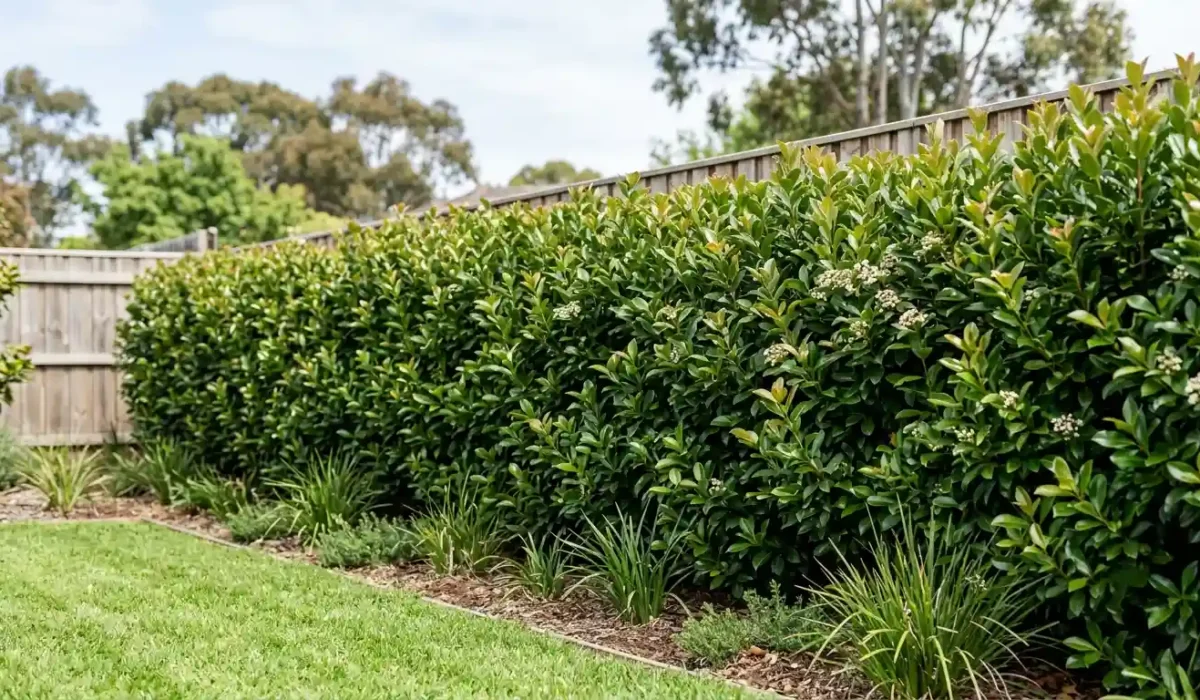
Viburnum odoratissimum ‘Emerald Jewel’ is a fast-growing evergreen shrub prized in Australian gardens for dense, glossy dark green foliage and fragrant white spring flowers followed by red berries. According to Elemo Baker, it typically reaches 3–4 metres tall, suiting hedging, screening, and courtyard planting in full sun to part shade with well-drained soil.
The shrub tolerates coastal exposure, moderate wind, and light frost, though prolonged extreme heat calls for afternoon shade and consistent watering. Twice-yearly pruning keeps growth compact and hedge-ready, while its berries draw birds and pollinators through summer. Watch for powdery mildew, leaf spot, and aphids in humid conditions.
By Elemo Baker | Plant Care & Gardening Expert
Last Updated: August 2026
Quick Summary
- Viburnum Emerald Jewel is an evergreen Viburnum odoratissimum selection commonly used for dense hedging and screening, typically reaching about 3–4 m but potentially growing larger.
- It performs best in full sun to part shade and fertile, well-drained soil.
- Growth is generally moderate to fast, with strongest growth during warmer spring and summer conditions.
- Once established, it is relatively low maintenance, although regular pruning is needed if a compact hedge is required.
What Is Viburnum Emerald Jewel?
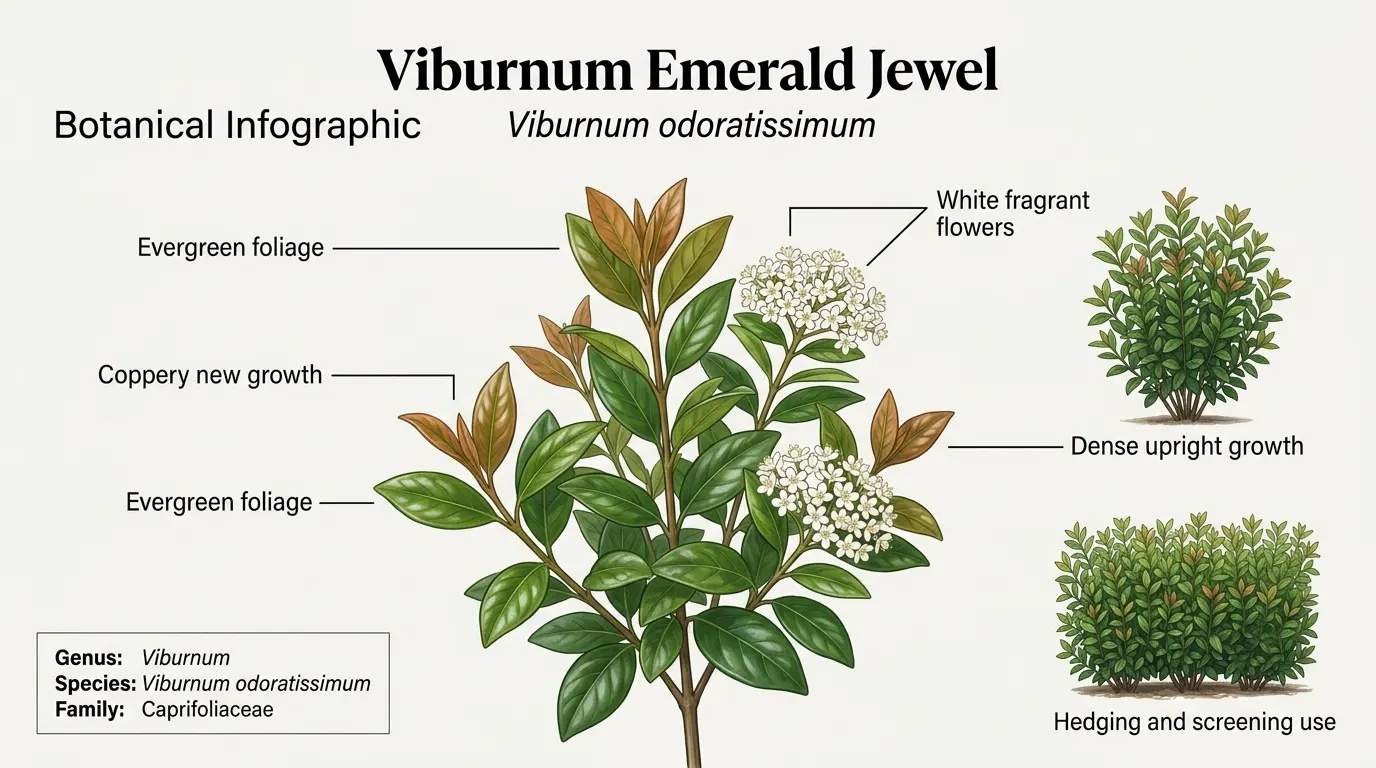
Viburnum Emerald Jewel is an evergreen shrub selection of Viburnum odoratissimum, commonly known as Sweet Viburnum. It develops an upright, dense habit with leathery, glossy foliage. New leaves can emerge coppery or bronze before becoming brighter green and eventually darker with maturity. Australian nursery descriptions list Emerald Jewel as a dense hedging and screening plant, with fragrant white flowers appearing in spring.
The plant belongs to the genus Viburnum, a diverse group of flowering shrubs and small trees in the Caprifoliaceae family; see Viburnum on Wikipedia for broader botanical background.
Botanically, Viburnum odoratissimum belongs to the Caprifoliaceae family. Although it is generally grown as a shrub, an unpruned plant can become a small tree-like specimen. Its main landscape roles are privacy screening, boundary hedging, wind protection, feature planting and filling larger garden spaces.
Viburnum Emerald Jewel vs Emerald Lustre — What’s the Difference?
In Australian horticultural trade, Emerald Jewel and Emerald Lustre are names associated with very similar forms of Viburnum odoratissimum. Nursery references list Emerald Jewel and Emerald Lustre separately in some catalogues, while other sources describe Emerald Lustre as a selection with particularly lush, glossy foliage.
| Feature | Emerald Jewel / Emerald Lustre |
| Botanical relationship | Viburnum odoratissimum |
| Foliage | Glossy, dense, evergreen |
| New growth | Coppery to lighter green |
| Flowers | Small, white and fragrant |
| Main use | Hedging and screening |
| Habit | Dense, upright to rounded |
| Typical mature size | About 3–4 m, potentially larger |
Because nursery naming can vary, checking the botanical name and cultivar designation on the plant label is more reliable than relying on the common trade name alone.
Emerald Jewel/Lustre vs Sweet Viburnum — How Do They Compare?
Emerald Jewel/Lustre is closely related to the straight Viburnum odoratissimum type and shares its basic characteristics. The selection is generally marketed for lush, glossy foliage and dense growth, while standard Sweet Viburnum can show somewhat more variation in foliage and habit.
| Characteristic | Straight V. odoratissimum | Emerald Jewel/Lustre |
| Foliage | Evergreen and glossy | Particularly lush and glossy |
| Growth habit | Large shrub/small tree | Dense, upright screening shrub |
| Garden use | Screen, hedge, feature plant | Hedge, privacy screen, windbreak |
| New foliage | Green to bronze tones | Often noticeable coppery growth |
| Pruning | Responds well | Responds well |
Viburnum Emerald Jewel Height and Size
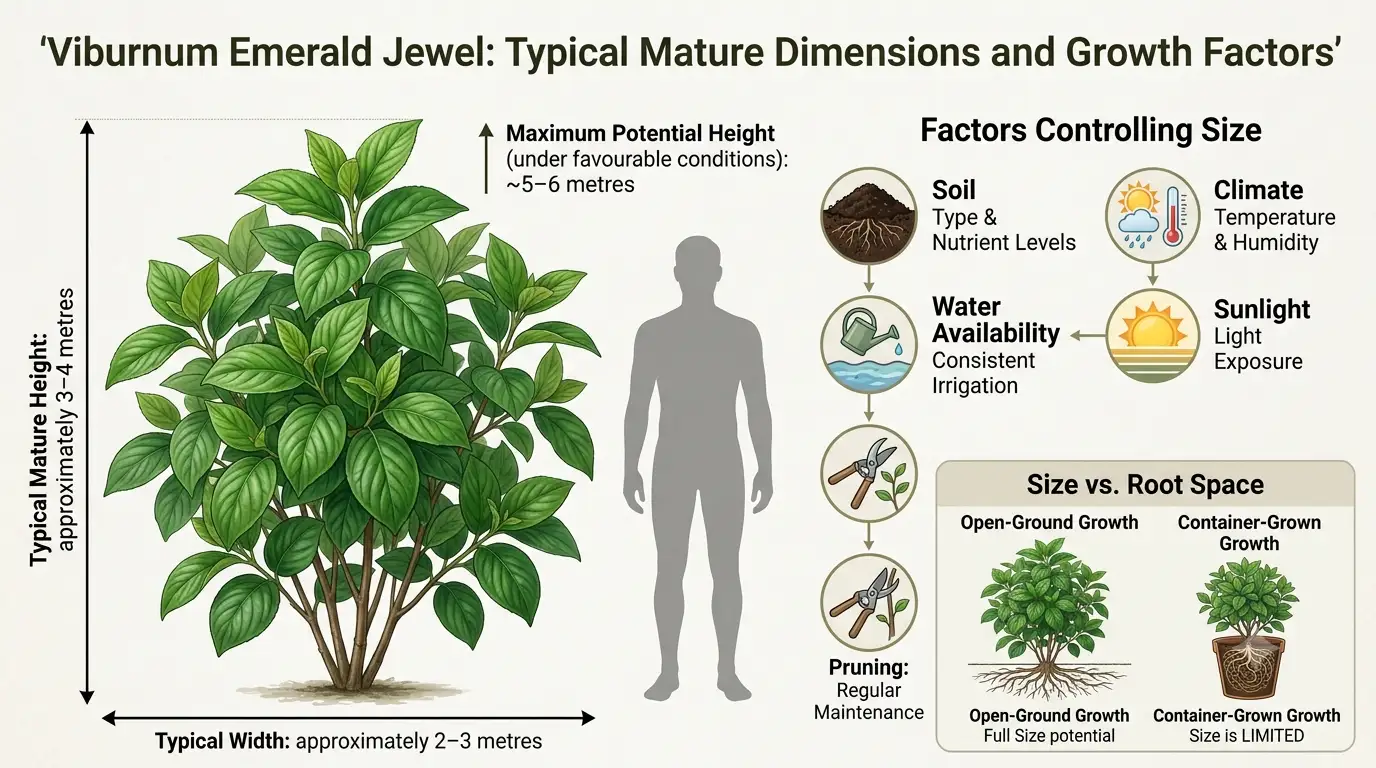
Viburnum Emerald Jewel commonly reaches around 3–4 m tall and 2–3 m wide, although mature size varies with climate, soil, water availability and pruning. Some Australian horticultural references give potential dimensions approaching 4–5 m or more under favourable conditions. For another evergreen hedging option with a different mature size and growth habit, compare Viburnum with Acmena Smithii Minor.
In open ground, it can become substantially larger than a container-grown plant. Pots restrict root volume and therefore normally limit ultimate height and width. Container specimens also dry out more quickly, particularly during hot Australian weather.
The main factors controlling final size are:
- Available root space
- Soil fertility and drainage
- Sunlight
- Water availability
- Climate
- Hedge pruning frequency
Can viburnum be kept small? Yes. Regular formative pruning can maintain Emerald Jewel at a substantially smaller height than its natural mature potential. For a dense hedge, light and regular trimming is generally preferable to repeatedly allowing the plant to become overgrown before cutting it back.
How Fast Does Viburnum Emerald Jewel Grow?
Viburnum Emerald Jewel is generally considered a moderate to fast-growing evergreen shrub. Under good conditions, young plants can establish quickly and produce strong seasonal flushes, particularly through spring and summer. Australian horticultural sources describe Emerald Lustre as moderate to fast-growing, with favourable specimens capable of significant height increase after planting. For other fast-growing options suitable for privacy and boundary planting, see our guide to Fast Growing Trees for Screening in Australia.
Growth slows during cooler periods and can become noticeably stronger when soil moisture, warmth and nutrition are adequate.
To encourage healthy, faster growth:
- Water consistently during establishment.
- Apply a suitable slow-release fertiliser during active growth.
- Maintain mulch without piling it against the stems.
- Provide sufficient spacing for root and canopy development.
- Avoid severe pruning while the plant is still establishing.
There is no single “fastest” viburnum for every garden because growth depends heavily on climate and conditions. Vigorous Viburnum odoratissimum selections are nevertheless among the commonly used fast-growing viburnums for Australian screening.
Viburnum Emerald Jewel Care Guide
Sun and Shade Requirements
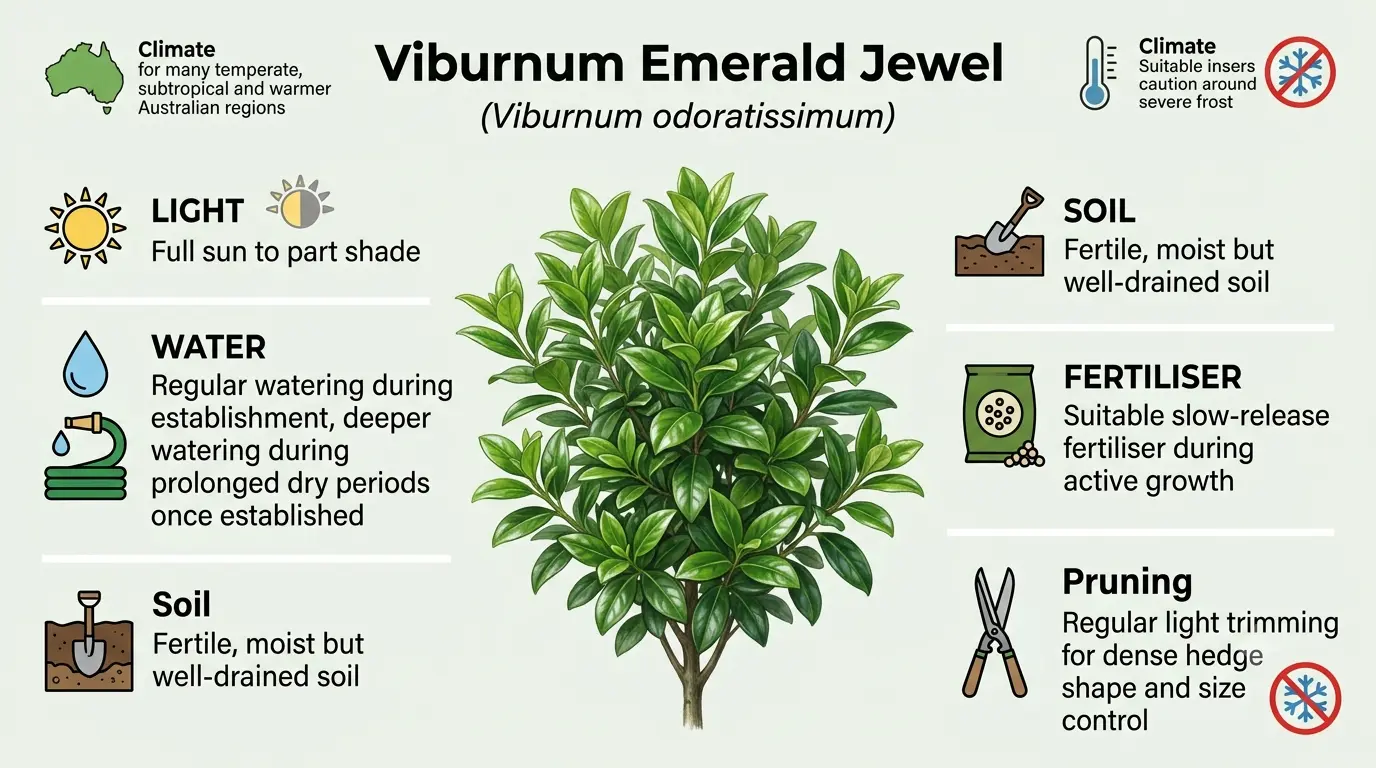
Viburnum Emerald Jewel grows best in full sun to part shade. More sunlight generally encourages compact, dense growth and can support better flowering, while plants in deeper shade may become less dense and produce fewer flowers. Australian nursery references list full sun and semi-shade as suitable positions.
For a formal privacy hedge, a position receiving several hours of direct sunlight is usually preferable.
Watering Needs
Newly planted viburnums need regular watering while their root systems establish. In warm conditions, check soil moisture frequently and water deeply when the upper soil begins to dry rather than relying on shallow daily watering.
Once established, Emerald Jewel is comparatively resilient and can tolerate periods of reduced moisture, but prolonged drought can still cause stress, leaf yellowing and reduced growth.
A practical approach is to:
- Water deeply during establishment.
- Increase watering during prolonged hot or dry weather.
- Reduce frequency during cool, wet periods.
- Avoid keeping the soil permanently saturated.
Soil Preferences
Viburnum Emerald Jewel performs best in fertile, moist but well-drained soil. It can tolerate less-than-ideal soil once established, but compacted or persistently waterlogged ground increases the risk of root problems.
Improving drainage and incorporating suitable organic matter before planting can help establish a healthier root system.
Fertilising and Pruning
A balanced slow-release fertiliser applied during active growth can support foliage production, particularly in poorer soils. Follow the fertiliser label rather than applying excessive amounts, because excessive nitrogen can encourage soft vegetative growth.
Pruning is more important when Emerald Jewel is being grown as a hedge. Elemo Baker recommends light, regular trimming rather than infrequent severe cutting when the objective is a dense, controlled screen.
Prune after flowering when possible if preserving the seasonal display is important.
Climate Tolerance
Emerald Jewel is suited to many Australian climates, particularly temperate, subtropical and warmer regions. It tolerates wind once established, while some references note that it can be sensitive to heavier frost.
In cooler areas, protect young plants from severe frost and avoid exposed positions where cold winds combine with freezing temperatures. In Western Australian gardens, including cooler elevated areas around the Perth hills, drainage, wind exposure and winter frost should be considered when choosing the planting position.
Growing Viburnum Emerald Jewel in Pots
Yes, viburnum can be grown in pots, although container plants usually remain smaller than plants grown in open ground. Choose a sturdy container with adequate drainage and enough volume for the root system.
Container-grown plants require closer attention to:
- Watering
- Fertilising
- Root congestion
- Drainage
- Periodic repotting or root management
Pruning can be used to keep a potted Emerald Jewel within a practical size.
Flowering and Seasonal Appearance
Viburnum Emerald Jewel produces clusters of small, white, fragrant flowers during spring, with flowering potentially extending towards early summer depending on local conditions. Some Australian sources describe flowering into summer, but it should not be expected to remain continuously in flower throughout the entire summer.
The plant remains evergreen through winter, retaining its foliage rather than undergoing the complete leaf drop associated with deciduous shrubs. Its foliage may show some seasonal variation, but significant winter leaf loss is not normal.
Flowers may be followed by berries that develop from red or reddish tones towards darker colours as they mature.
Why is viburnum not flowering?
Common causes include:
- Too much shade
- Heavy or poorly timed pruning
- Young plant age
- Nutritional imbalance
- Environmental stress
A hedge that is repeatedly clipped before flowering can also have fewer visible blooms because flowering wood is continually removed.
Common Viburnum Problems and How to Fix Them
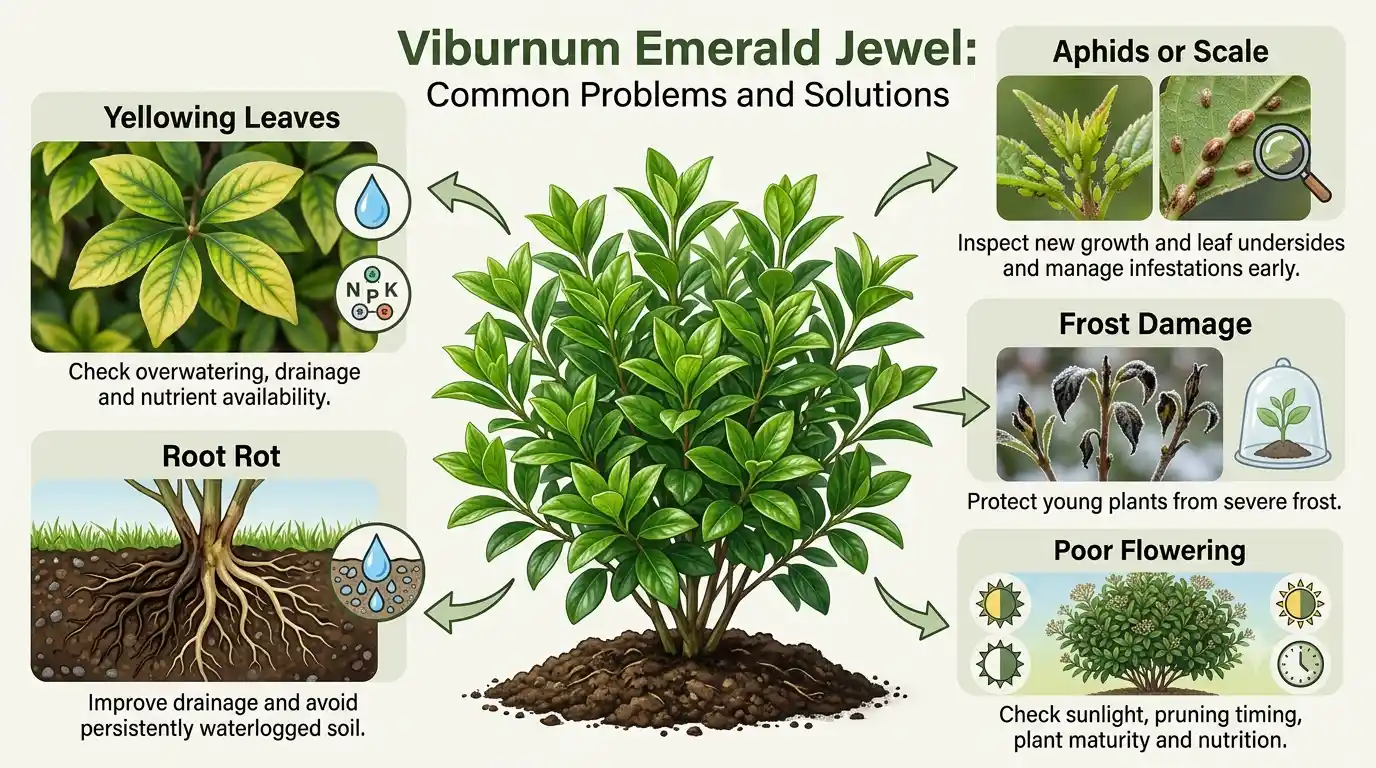
Yellowing leaves: Yellow foliage can result from excessive watering, poor drainage or nutrient deficiency. Check soil moisture and drainage first rather than immediately adding fertiliser.
Aphids and scale: These sap-sucking pests can weaken foliage and produce sticky honeydew. Inspect new growth and leaf undersides regularly. Manage infestations early using appropriate horticultural controls.
Frost damage: Young foliage can be damaged by heavy frost. Protect vulnerable plants and avoid exposed frost pockets where practical.
Poor flowering: Insufficient light, excessive pruning, plant immaturity and nutritional stress can reduce flowering. Improving light and adjusting pruning practices are often more useful than simply adding fertiliser.
Root rot: Persistently waterlogged soil can deprive roots of oxygen and promote root disease. Improve drainage and avoid frequent irrigation when the soil is already saturated.
Disadvantages of Viburnum
Viburnum Emerald Jewel is useful, but it is not suitable for every garden. Its main disadvantages are its vigour, eventual size and need for pruning when grown as a compact hedge.
Potential drawbacks include:
- Regular pruning requirements for controlled hedges
- Considerable mature size if left unpruned
- Possible root competition near structures or confined spaces
- Frost sensitivity in some climates
- Occasional pest problems such as scale
- Potential weediness or environmental concerns for some viburnum species in particular regions
The last point is important: invasive status differs between species, cultivars and jurisdictions. Gardeners should check local weed regulations before planting viburnum where environmental restrictions apply.
Do Viburnums Have Deep Roots? Can They Be Planted Near a House?
Viburnums develop substantial root systems, but the exact depth and spread depend on soil, moisture and available space. They should not be planted immediately against foundations, drains or other confined infrastructure simply because they are shrubs.
For a large Emerald Jewel intended to reach several metres, allowing at least 1–2 m of clearance from structures is a sensible starting point, with greater separation preferred where there is ample space. Smaller, regularly pruned plants can be managed more closely, but root competition and mature canopy spread still need to be considered.
Do All Viburnums Smell Bad?
No. Not all viburnums have unpleasant-smelling flowers. Emerald Jewel is associated with small, fragrant white flowers, particularly during spring. The broader Viburnum genus contains many species with different flower scents, so an unpleasant odour in one viburnum should not be assumed to apply to all viburnums.
Is Viburnum Low Maintenance?
Yes, Viburnum Emerald Jewel is relatively low maintenance once established, particularly when planted in suitable soil and climate conditions. Its evergreen foliage, tolerance of pruning and ability to handle periods of reduced moisture make it practical for many Australian gardens.
Key maintenance requirements are:
- Regular watering during establishment
- Occasional deep watering during prolonged drought
- Seasonal fertilising where needed
- Regular pruning for hedge shape
- Monitoring for scale, aphids and other pests
- Maintaining good drainage
The main maintenance issue is usually size control rather than intensive plant care.
Viburnum Lifespan
An established Viburnum Emerald Jewel can live for many years in suitable Australian garden conditions. There is no single reliable lifespan because longevity depends on climate, soil, drainage, watering, pests, disease and pruning practices.
Long-term health is supported by:
- Avoiding persistent waterlogging
- Maintaining adequate soil moisture
- Providing suitable sunlight
- Pruning correctly
- Avoiding severe recurring stress
- Monitoring pests and diseases early
A well-maintained hedge can therefore remain useful for many years rather than being treated as a short-lived screening plant.
Where to Plant Viburnum Emerald Jewel
Viburnum Emerald Jewel is particularly effective along boundary lines, courtyards, driveways, streetscapes and larger garden borders. Its dense evergreen foliage provides year-round structure and privacy, while its flowers add seasonal interest. Plantmark lists Emerald Jewel for hedging, screening, carpark buffers, courtyards and streetscapes. If you are comparing other low-maintenance options for a boundary, our guide to Low-Maintenance Plants for Fence Line in Australia provides additional planting ideas.
For hedging, spacing depends on the desired final height and how quickly a continuous screen is required. Australian nursery recommendations commonly range from roughly 60–100 cm apart for dense hedging, while wider spacing of around 1–2 m may be more suitable for larger informal screens. Another Australian screening plant worth comparing for hedge design is Ficus Hillii ‘Flash’, particularly where a dense evergreen screen is required.
Closer spacing generally fills the hedge faster but increases competition for water and nutrients. Pittosporum Silver Sheen is another popular evergreen screening plant, so comparing its growth rate and mature form can help when planning a mixed or alternative hedge.
For a broader overview of suitable garden plants, including their growth, root considerations and landscaping uses, see Best Trees and Shrubs for Australian Gardens.
Best Companion Plants for Viburnum Hedging
Companion plants should complement the evergreen structure without creating excessive competition.
Suitable Australian garden combinations can include:
- Lomandra for low, grassy structure
- Westringia for drought-tolerant layered planting
- Dianella for foliage contrast
- Correa for native flowering interest
- Bird of Paradise in suitable warm-climate gardens for contrasting architectural foliage
Keep lower companion plants far enough from the viburnum trunks to avoid excessive root and moisture competition. A layered design with taller viburnum behind and lower plants in front can provide screening without making the planting visually dense from ground to canopy.
Conclusion
Viburnum Emerald Jewel is a fast-growing, evergreen Viburnum odoratissimum selection valued for glossy foliage, fragrant spring flowers and dense screening growth. It commonly reaches around 3–4 m, although favourable plants can become larger if left unpruned. Full sun to part shade, well-drained soil, adequate establishment watering and regular formative pruning provide the conditions needed for strong performance.
For Australian gardens, its greatest strengths are year-round foliage, vigorous growth and adaptability to hedging and screening. The main consideration is its eventual size: Viburnum Emerald Jewel is easiest to manage when planted with enough space and pruned consistently from an early stage.
FAQs
What are the disadvantages of Viburnum?
The main disadvantages are its vigorous growth, potentially large mature size, need for regular pruning as a formal hedge, occasional pest problems and sensitivity to severe frost in some climates.
How tall can Viburnum Emerald Jewel/Emerald Lustre grow?
Viburnum Emerald Jewel or Emerald Lustre commonly grows to around 3–4 m tall, although plants in favourable open-ground conditions can reach approximately 4–5 m or potentially more if left unpruned.
Is Viburnum Emerald Jewel low maintenance?
Yes. It is relatively low maintenance once established. The main ongoing task is pruning when it is grown as a compact hedge, while watering is mainly important during establishment and prolonged dry conditions.
Does Viburnum Emerald Jewel like full sun or shade?
Viburnum Emerald Jewel grows best in full sun to part shade. Full sun generally encourages denser growth and better flowering, while part shade is tolerated.
Why is my viburnum not flowering?
Common causes include insufficient sunlight, excessive pruning, young plant age, nutritional problems and environmental stress. Repeatedly trimming a hedge before flowering can also remove developing flowering growth.
Can viburnum be grown in pots?
Yes. Viburnum Emerald Jewel can be grown in a large container with good drainage, but it will generally remain smaller than an open-ground specimen. Container plants require more careful watering, feeding and size management.
What is the difference between Viburnum Emerald Jewel and Emerald Lustre?
Emerald Jewel and Emerald Lustre are names used in Australian nursery trade for closely related Viburnum odoratissimum planting material. Emerald Lustre is particularly described for its lush, glossy foliage and dense screening habit. Because naming can vary between suppliers, the botanical name and cultivar designation on the plant label provide the most reliable identification.