
Is Aloe Vera Native to Australia? Origin & Australian Status
No, aloe vera is not native to Australia. Current botanical records place its native range in northern Oman, particularly the Hajar Mountains, while Australian botanical records treat aloe vera as an introduced plant that has become naturalised in parts of Western Australia, the Northern Territory and Queensland.
That distinction matters because a plant can look completely at home in an Australian garden without having originated here. Aloe vera has been cultivated so widely that its presence in gardens, old settlements and occasionally unmanaged areas can make it seem like an Australian native. The evidence instead points to an Arabian origin followed by extensive cultivation and human-assisted spread.
Quick Summary
- No — aloe vera is not native to Australia. Kew currently gives its native range as northern Oman, in the Hajar Mountains.
- It is naturalised in parts of Australia, with the Australian Plant Name Index recording Aloe vera var. officinalis as naturalised in WA, NT and Queensland.
- No Aloe species is native to Australia. The genus Aloe has its native range outside Australia, while Australian records classify Australian Aloe species as introduced.
- You can commonly grow aloe vera in an Australian garden, although local weed, biosecurity and plant-movement rules should always be checked where relevant. Aloe vera is not one of Australia’s 32 Weeds of National Significance.
Is Aloe Vera Native to Australia? (The Direct Answer)
No. Aloe vera is not native to Australia. Its current accepted native range is northern Oman, particularly the Hajar Mountains, where it occurs naturally in dry, rocky environments. For a broader standalone explanation of aloe vera’s Australian status, origin and naturalisation, see this guide to aloe vera’s origin and status in Australia.
In Australia, aloe vera is therefore an introduced exotic plant, not an Australian native. That does not mean every plant growing outdoors in Australia was recently planted by a person: the species has established self-sustaining populations in some areas, which is why botanical records describe it as naturalised in parts of WA, the NT and Queensland.
The distinction is important:
Native origin: northern Oman/Hajar Mountains
Australian status: introduced and cultivated; naturalised in some regions
Australian native plant: no
The Plants of the World Online record for Aloe vera gives the current global botanical treatment and native distribution, while the Australian Plant Name Index record records Australian naturalisation information.
Why So Many People Think Aloe Vera Is an Aussie Native
It’s Everywhere in Australian Gardens and Nurseries
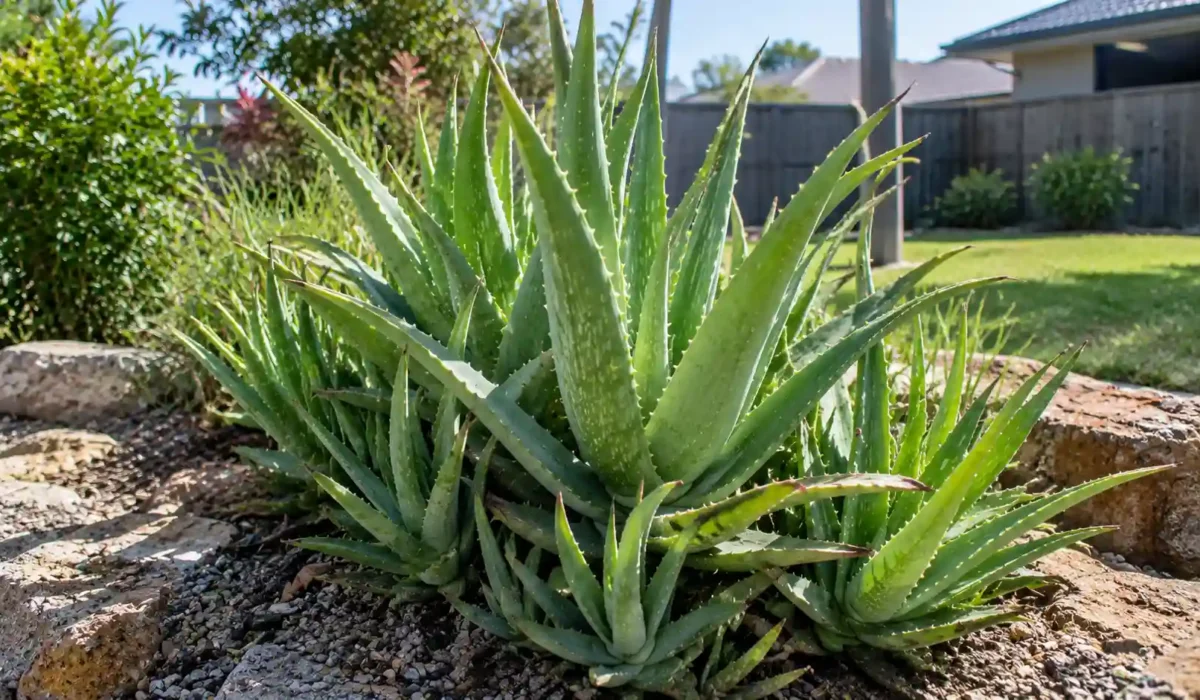
Aloe vera’s popularity makes its geographical origin easy to overlook. It is drought tolerant, compact, easy to propagate and well suited to many warm Australian gardens, pots and dry-style landscapes. The Royal Botanic Gardens Victoria notes that the species is widely grown around the world and is commonly encountered in Australian gardens.
That creates a familiar-garden effect: when a plant is seen repeatedly in Brisbane, Perth, regional Queensland or other Australian landscapes, it can feel indigenous simply because it performs well locally.
But widespread cultivation is not evidence of native origin.
Many plants now familiar in Australian gardens are introduced species. The useful question is not “Does it grow well here?” but “Did the species occur here naturally before human introduction?”
Confusion with Naturalised “Wild” Sightings
“But isn’t aloe vera growing wild in the Australian bush?”
Sometimes, yes — but a wild-looking plant is not automatically a native plant.
A naturalised population is one in which an introduced species has escaped cultivation and can persist and reproduce without being continuously replanted. Australian records document this for aloe vera in several regions. In WA, for example, aloe vera has been recorded from old settlements and from plants associated with dumped garden material.
So an aloe growing beside an old homestead, station, roadside disturbance or garden-remnant area may be genuinely growing without current human care while still being non-native.
Inconsistent Commercial Labelling
Another reason for the confusion is that commercial and horticultural sources do not always agree about aloe vera’s origin.
For example, The Diggers Club currently describes Aloe vera as being from Northern Africa, while other Australian plant references give “Arabian Peninsula” or “Arabia or North Africa.”
Current Kew taxonomy is more specific: it places the accepted native range in northern Oman, in the Hajar Mountains.
That difference is worth explaining rather than repeating the conflicting nursery descriptions. Older or commercial accounts can reflect historical uncertainty about a plant that has been cultivated for centuries, while modern distribution databases can distinguish the accepted native range from areas where the species was introduced.
Where Is Aloe Vera Actually Native To?
Native Range — Arabian Peninsula (Oman)
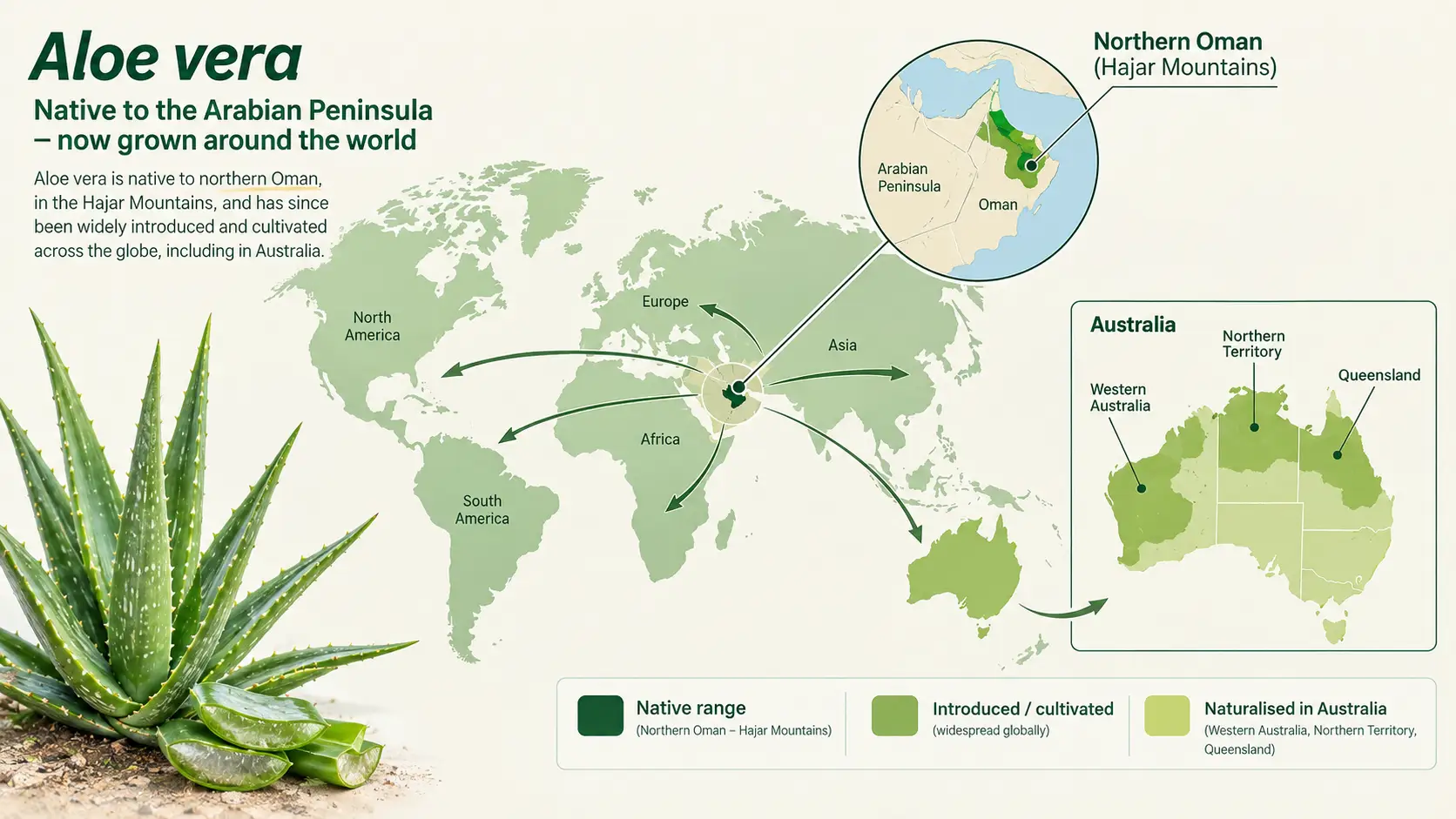
The strongest current answer is northern Oman, specifically the Hajar Mountains.
Kew describes Aloe vera as a succulent perennial associated with desert or dry shrubland environments. Flora of Oman information included in the Kew treatment describes populations in northern Oman, in the foothills of the Hajar Mountains, growing on rocky slopes.
That gives us a much more precise answer than simply saying “Africa” or “the Middle East”:
Aloe vera is native to the Arabian Peninsula, with the accepted native range centred on northern Oman and the Hajar Mountains.
The Royal Botanic Gardens Victoria also identifies the species as originating in the Arabian Peninsula.
Origin Map — How It Spread Worldwide and Into Australia
The exact historical pathway by which aloe vera reached every modern country is difficult to reconstruct because the plant has been cultivated and moved by people for a very long time.
A defensible simplified timeline is:
Northern Oman/Hajar Mountains → cultivation across the Arabian region → wider Old World cultivation and trade → global horticultural distribution → cultivation in Australia → naturalised populations in some Australian regions
Kew records aloe vera as introduced into many parts of the world and notes that the species is now commonly cultivated and naturalised globally.
Australian horticultural records show that it became established as a cultivated garden plant, particularly in eastern coastal Australia, while later botanical records document naturalisation in WA, NT and Queensland.
The important limitation is that the precise date and route of introduction into Australia are not established by the sources used here, so a specific “first introduced in year X” claim would be unnecessarily speculative.
Native vs Naturalised vs Invasive — What’s the Difference?
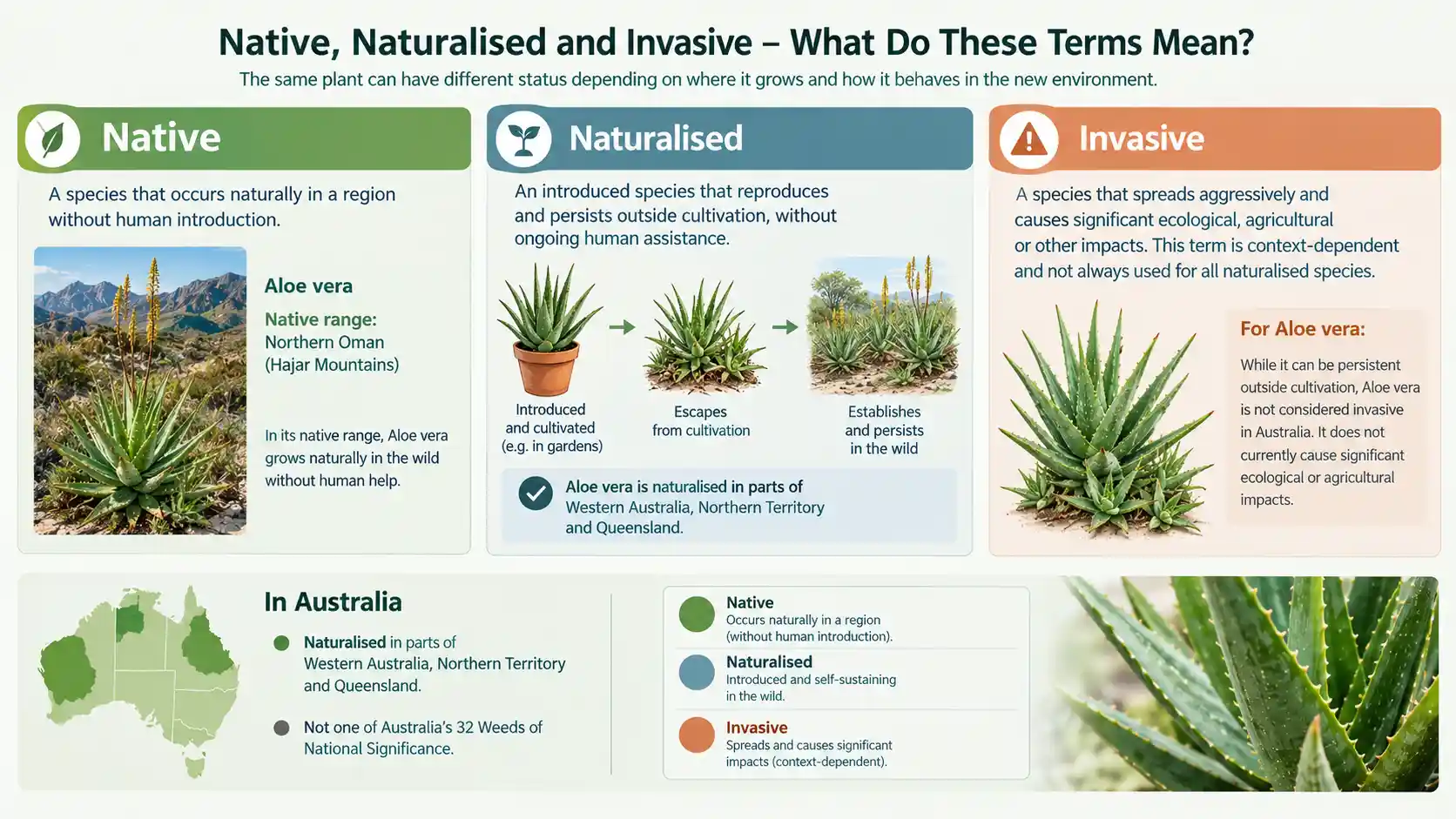
For gardeners, these three terms describe different things:
| Term | Meaning | Applies to Aloe Vera in Australia? |
| Native | A species that occurs naturally in a region without having been introduced there by people | No |
| Naturalised | An introduced species that has established self-sustaining populations outside cultivation | Yes, in parts of WA, NT and Qld |
| Invasive | Usually refers to a non-native species whose spread produces significant ecological, agricultural or other impacts; the term is context-dependent | Not a national Aloe vera designation; impacts can be regional |
The most important point is that naturalised does not automatically mean invasive. The distinctions are also summarised in this aloe vera native-status reference, which provides a quick way to compare the three terms.
A plant can reproduce outside gardens without becoming a major national environmental threat. Australia’s national weed framework separately identifies its 32 Weeds of National Significance according to invasiveness, spread potential and environmental, social and economic impacts; aloe vera is not on that national list.
Some older Australian weed literature and regional management documents have nevertheless treated aloe vera as an environmental or minor weed in particular settings.
For a homeowner, the practical interpretation is simple: non-native does not mean automatically prohibited, and naturalised does not mean nationally declared invasive.
Is Any Aloe Species Native to Australia?
No. The genus Aloe is not native to Australia.
Kew gives the native range of Aloe as regions of Africa, Madagascar, the Arabian Peninsula and parts of the surrounding Old World, with Australia appearing among areas where members of the genus have been introduced rather than within the genus’s native range.
Australian botanical records likewise mark Australian Aloe species as introduced. The NSW Flora Online, for example, marks Aloe arborescens, Aloe ciliaris and Aloe maculata with the introduced-species symbol.
So the statement “aloe is an Australian native” is not correct at genus level either.
Australia certainly has native succulent plants and native members of the broader Asphodelaceae family, but that does not make Aloe native to Australia.
Aloe Vera vs Aloe Arborescens (Torch Aloe) — Commonly Confused
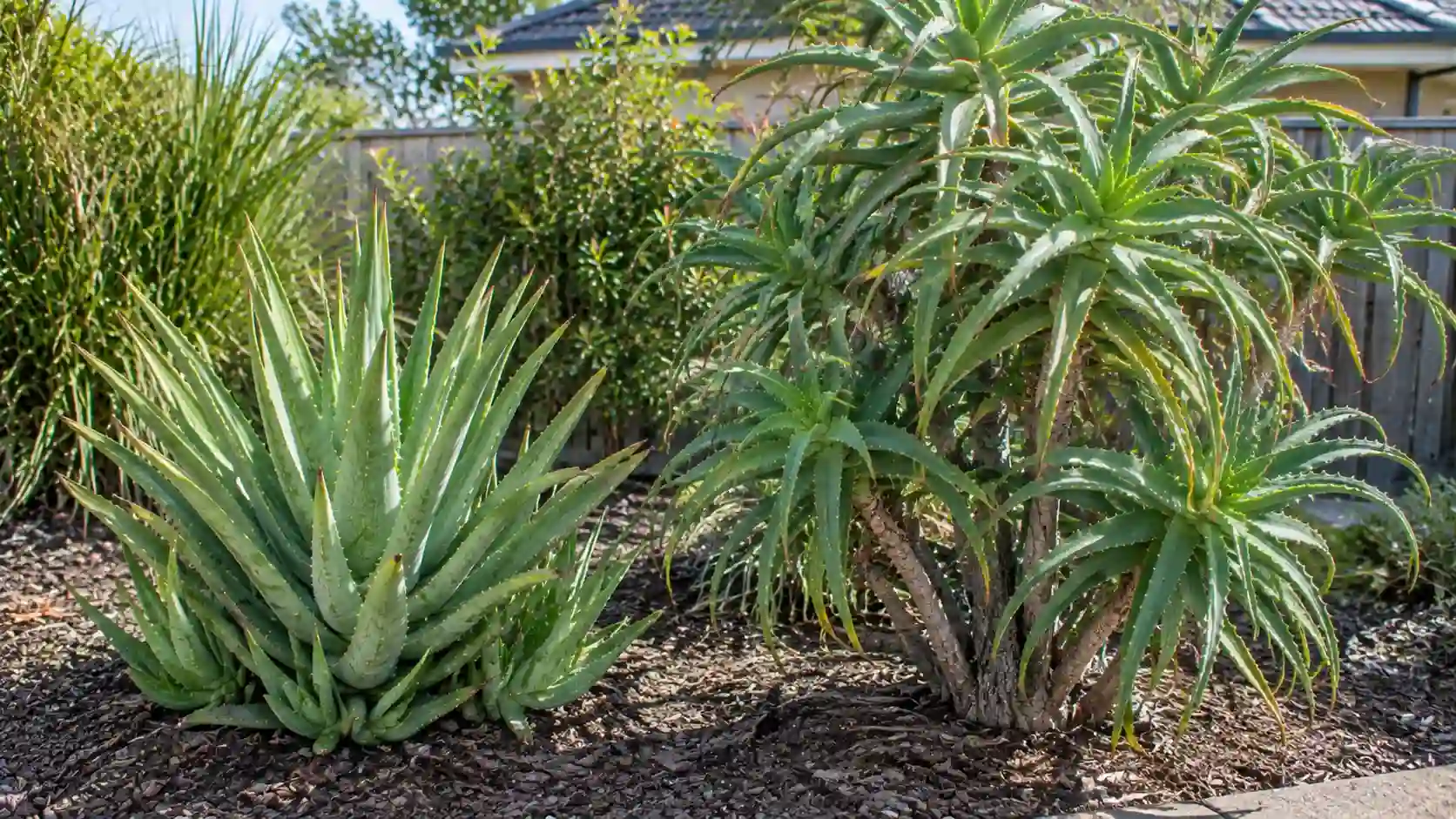
Aloe arborescens is a different species from Aloe vera.
| Feature | Aloe Vera | Aloe Arborescens |
| Common name | Aloe vera / medicinal aloe | Torch aloe / tree or candelabra aloe |
| Native origin | Northern Oman and Arabian Peninsula | Southern and tropical Africa |
| Australian status | Introduced; naturalised in parts of Australia | Introduced; naturalised/adventive in some Australian regions |
| Typical use | Garden succulent, medicinal/cosmetic plant | Ornamental succulent, specimen and landscape planting |
| Growth habit | Mostly short-stemmed, clumping rosette | Larger, branching shrub-like aloe |
Kew places Aloe arborescens in southern and tropical Africa and records it as introduced into Australia, including NSW and South Australia. For readers who want a broader reference covering aloe identification, Australian status and commonly confused species, see this Aloe in Australia reference.
VicFlora records Aloe arborescens as introduced and naturalised in Victoria, particularly where it persists around old gardens or dumped garden refuse.
The distinction matters because the plants can look superficially similar, but “aloe” is a genus name, not a synonym for aloe vera.
Where Has Aloe Vera Naturalised in Australia?
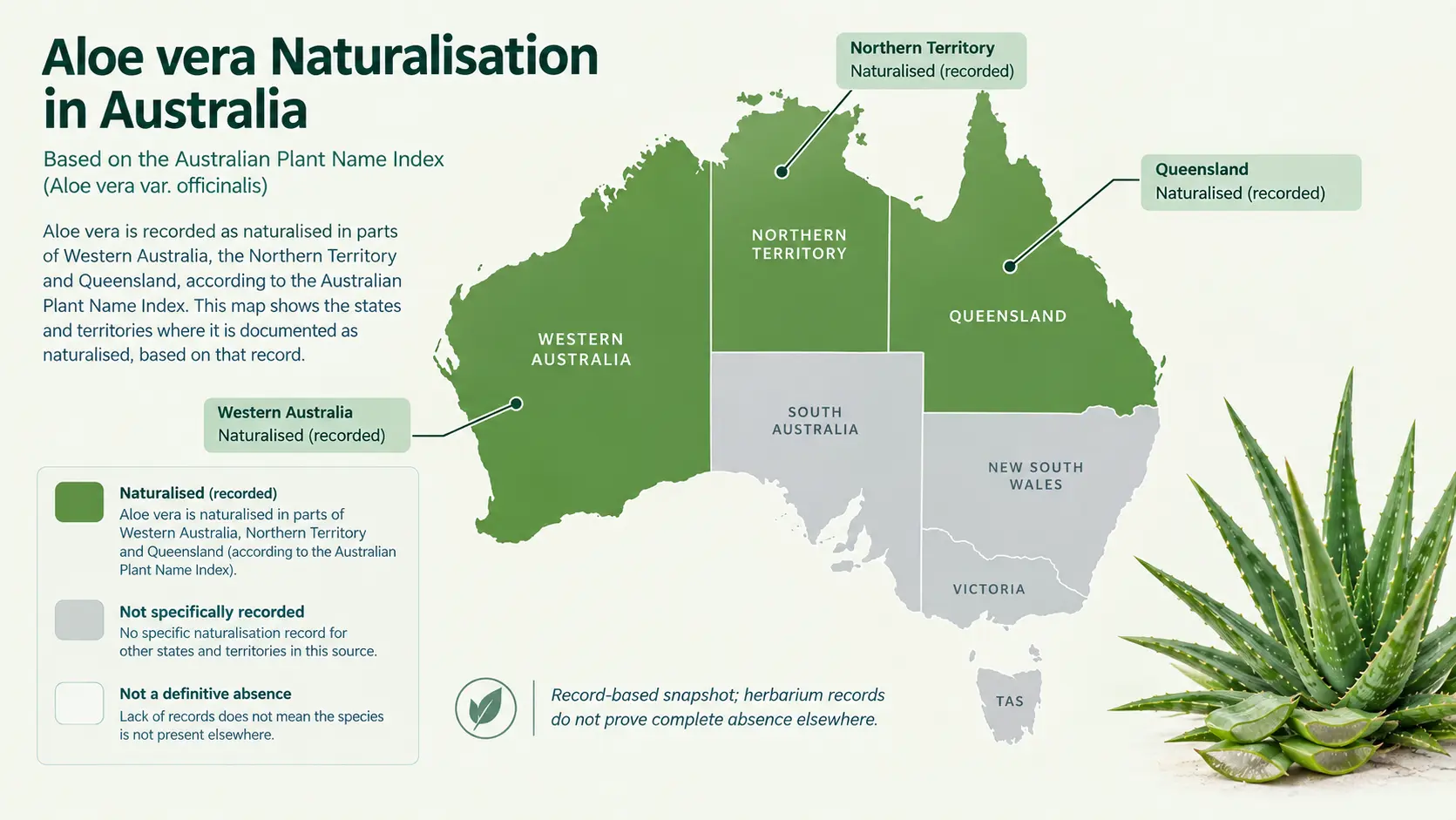
The current Australian Plant Name Index record for Aloe vera var. officinalis gives a particularly useful state-level snapshot:
| State/Territory | Naturalisation Status |
| Western Australia | Naturalised |
| Northern Territory | Naturalised |
| Queensland | Naturalised |
| New South Wales | The cited APC record does not list the taxon as naturalised |
| Victoria | The cited APC record does not list the taxon as naturalised |
| South Australia | The cited APC record does not list the taxon as naturalised |
| Tasmania | The cited APC record does not list the taxon as naturalised |
The underlying Australian Plant Name Index record explicitly gives WA (naturalised), NT (naturalised) and Qld (naturalised).
There is important nuance here: this is a record-based snapshot, not proof that no isolated self-sustaining plant exists elsewhere. Herbarium records depend on collection, identification and reporting. For example, aloe vera is widely cultivated in Australia, so individual unmanaged plants do not automatically establish a documented naturalised population.
WA evidence also shows why regional context matters. A Western Australian environmental survey recorded aloe vera var. officinalis as naturalised, while other WA records describe plants persisting around settlements, vacant lots and dumped garden material.
Is It Safe and Legal to Grow Aloe Vera in Australian Gardens?
Yes, aloe vera is commonly grown as a garden and container plant in Australia, and its non-native status does not by itself make ordinary garden cultivation illegal. However, “legal everywhere under every circumstance” is too broad: Australian weed and biosecurity rules can be state-specific, and moving plant material between regions can have additional requirements.
Aloe vera is not one of Australia’s 32 Weeds of National Significance.
Western Australia’s current Western Australian Organism List (WAOL) is the appropriate official database for checking individual plant legal status in that state. A recent WA assessment specifically recorded Aloe vera var. officinalis as Permitted — s11, rather than a declared pest.
A Queensland government assessment similarly identifies Aloe vera as non-native and does not assign it restricted-matter status in the cited assessment.
For gardeners, the practical rule is therefore: you can generally grow aloe vera in an Australian garden, but check the relevant state or territory database before importing, transporting large quantities, or disposing of plant material near bushland.
Growing Aloe Vera in Australian Conditions (Practical Guide)
Aloe vera is well suited to many warm Australian gardens because it is adapted to dry conditions and free-draining soils.
Watering: Let the potting mix or soil dry between waterings, then water thoroughly rather than keeping it permanently damp. Kew recommends a gritty, well-draining growing medium and allowing the compost to dry between waterings.
Light: Give it strong light. Outdoors, full sun to bright conditions usually work well, although extremely hot exposure can produce stress in some plants. Indoors, place it close to a bright window rather than in a dark room.
Soil: Drainage is more important than rich soil. A gritty or sandy succulent mix is preferable to heavy, water-retentive soil. Australian gardeners troubleshooting drainage can also refer to our Australian garden soil and fertiliser guide for broader soil diagnostics.
Climate: Aloe vera performs particularly well in warm, relatively dry conditions. Cold, prolonged wetness is more problematic than short dry periods, so gardeners in frost-prone Melbourne, Adelaide Hills, inland or cool-highland locations may prefer a protected position or container growing.
Growth and size: A mature garden plant commonly remains around the small-to-medium succulent range, often approximately 60–100 cm, although individual size varies with cultivar, climate and growing conditions. Flower stalks can rise substantially above the leaf rosette.
Propagation: Aloe vera produces offsets or pups readily. Kew specifically notes that plants can offset profusely and that these offsets can be potted up for propagation.
For gardeners growing aloe indoors alongside other easy-care species, snake plant care and benefits guide provides a useful comparison of another drought-tolerant houseplant, although snake plant and aloe have different light and watering preferences.
Preventing Garden Aloe Vera From Becoming a Problem
Aloe vera is not automatically a serious weed simply because it is naturalised, but gardeners should still prevent unnecessary escape from cultivation.
The biggest practical issue is vegetative spread. Aloe vera produces offsets, often forming dense clumps. Kew notes that the plant can offset profusely.
Good containment practices include:
- Remove excess pups before a clump becomes crowded.
- Give unwanted offsets to other gardeners, compost them appropriately, or dispose of them through local green-waste systems.
- Do not dump unwanted plants or garden waste in bushland, drainage areas or vacant land.
- Be especially careful near natural vegetation where escaped garden plants may persist.
- In WA and other regions with recorded naturalisation, treat “it was only dumped as garden waste” as a potential pathway for establishment rather than harmless disposal.
A second common problem is overwatering. When aloe starts turning yellow, soft or collapsing at the base, gardeners sometimes interpret the decline as a need for more food or water. In reality, persistent moisture and poor drainage can be the underlying problem.
Our garden pest identification guide is also useful when damage is present, because yellowing, distorted growth and leaf damage can have multiple causes and should be diagnosed before treatment.
The same general principle applies to other drought-tolerant succulents. Our firestick plant sap safety guide provides a useful reminder that “succulent” does not automatically mean a plant is harmless to handle, although firestick and aloe have very different sap chemistry and safety profiles.
Conclusion
So, is aloe vera native to Australia? No.
The best-supported modern botanical answer is that aloe vera is native to northern Oman, particularly the Hajar Mountains, in the Arabian Peninsula. In Australia it is an introduced species that is widely cultivated and has become naturalised in parts of Western Australia, the Northern Territory and Queensland.
It is also important not to confuse native, naturalised and invasive. A plant can reproduce outside cultivation without being native, and it can be naturalised without being a nationally declared invasive weed.
Nor is aloe vera Australia’s native “aloe”: the genus Aloe itself is non-native to Australia. Other species, including Aloe arborescens, are introduced as well.
For Australian gardeners, the practical conclusion is straightforward: you can generally grow aloe vera successfully, but its ability to persist outside cultivation means responsible propagation and garden-waste disposal still matter.
Frequently Asked Questions
Is aloe vera native to Australia?
No. Aloe vera is not native to Australia. Current Kew taxonomy places its native range in northern Oman, particularly the Hajar Mountains. Australian botanical records classify it as introduced and naturalised in parts of WA, NT and Queensland.
Where is aloe vera originally from?
Aloe vera is originally from the Arabian Peninsula, with the currently accepted native range centred on northern Oman and the Hajar Mountains.
Is aloe vera considered a weed in Australia?
It can be regarded as a weed or environmental weed in some local or regional contexts, particularly where it persists outside cultivation, but it is not a Weed of National Significance. Weed status and control obligations can vary by state and locality.
Are any Aloe species native to Australia?
No. The genus Aloe is not native to Australia. Australian records identify Aloe species found here as introduced, while Kew’s native-range treatment for the genus does not include Australia.
What’s the difference between naturalised and native?
Native means a species occurs naturally in a region without human introduction. Naturalised means an introduced species has established and can persist or reproduce outside cultivation. Aloe vera is naturalised in parts of Australia but is not native here.
Is Aloe arborescens the same as Aloe vera?
No. Aloe arborescens is a separate Aloe species native to southern and tropical Africa. It is larger and more shrub-like than typical aloe vera, and it is also introduced into Australia.
Can I legally grow aloe vera in my Australian garden?
Generally yes, and it is widely grown in Australian gardens. However, state and territory biosecurity systems differ, so gardeners should check their relevant authority before moving or disposing of plant material, particularly near environmentally sensitive areas. WA’s legal organism database, for example, records aloe vera var. officinalis as permitted rather than a declared pest in the source record reviewed here.