
Neem Plant Benefits in Australia: Uses, Safety & Legality
You have probably seen neem plant benefits presented as everything from natural pest control to a cure for major health problems. In Australia, the practical answer is narrower: neem (Azadirachta indica) can be useful against certain garden pests, but the legal status of the tree varies by jurisdiction and registered neem products may have much narrower uses than overseas advice suggests. The strongest Australian garden case is a correctly labelled azadirachtin product, not automatically growing a neem tree or spraying homemade neem oil. Human-health evidence is much less established and does not justify a universal daily dose.
Quick Summary
- Neem’s strongest garden benefit is insect control through azadirachtin and properly labelled products.
- The current Eco-neem label reviewed for Australia says do not use on plants producing food for human or animal consumption.
- Neem is regulated differently across Australia: the NT restricts trade and movement, WA regulates it in parts of the Kimberley, while Queensland lists it as an invasive plant but not prohibited or restricted under the Biosecurity Act.
- Human-health evidence remains mostly traditional, laboratory-based or preliminary clinical research; a safe routine daily amount has not been established.
What Are the Main Neem Plant Benefits, and Which Part Delivers Each?
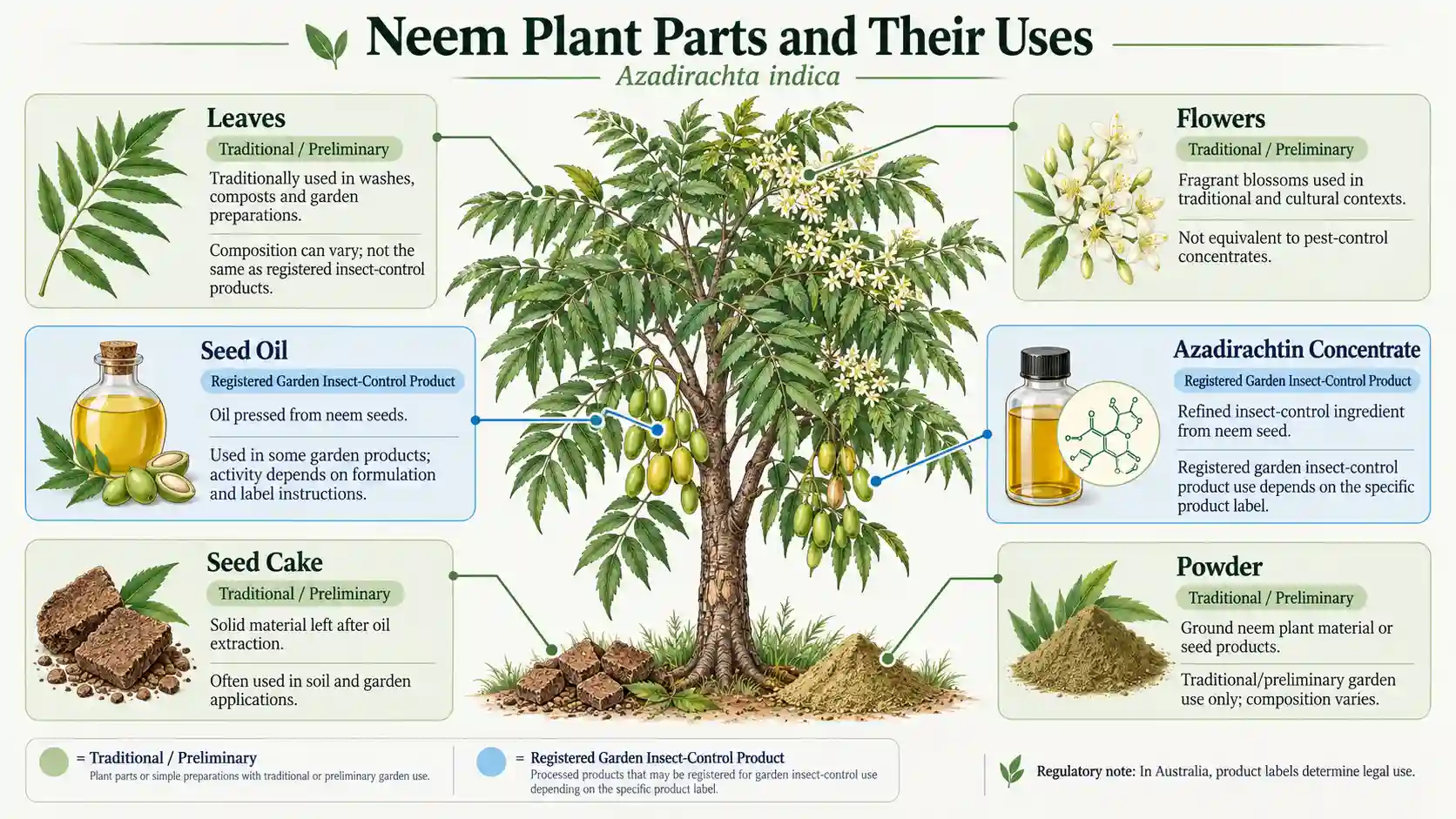
The most defensible neem benefit for Australian gardeners is pest management. The key insecticidal compound is azadirachtin, which is concentrated particularly in neem seeds and is used in formulated insect-control products. Neem leaves, flowers, oil, cake and powder are often discussed together online, but they are not interchangeable products and do not have the same composition, regulation or evidence base.
| Part or product | Common use | Evidence type | Availability/use in Australia |
| Leaves | Traditional use, garden biomass, extracts | Traditional/preliminary | Neem leaves may be encountered as plant material, but pesticidal claims can trigger regulatory requirements |
| Flowers | Traditional and cultural uses; ornamental flowering | Traditional | Tree/plant material only; no established garden or health claim should be inferred from the flowers alone |
| Seed oil | Topical, cosmetic and traditional applications; insect-control claims | Biological mixture; product-dependent | Do not assume a generic “neem oil” is a registered pesticide |
| Azadirachtin concentrate | Insect control | Strongest garden evidence | Registered Australian products exist with specific label directions |
| Seed cake | Soil amendment/manure; traditional pest-related use | Agricultural/traditional | Composition and claims depend on the particular product |
| Powder | Traditional uses, soil and agricultural applications | Traditional/preliminary | Not equivalent to a registered azadirachtin insecticide |
The APVMA explains that neem oil can contain multiple chemical entities and that incompletely characterised plant oils/extracts are regulated as biological products. Its 2010 neem notice also explains that pesticidal claims and azadirachtin concentration are important to regulatory treatment.
How Does Neem Protect Garden Plants?
What neem does to insects
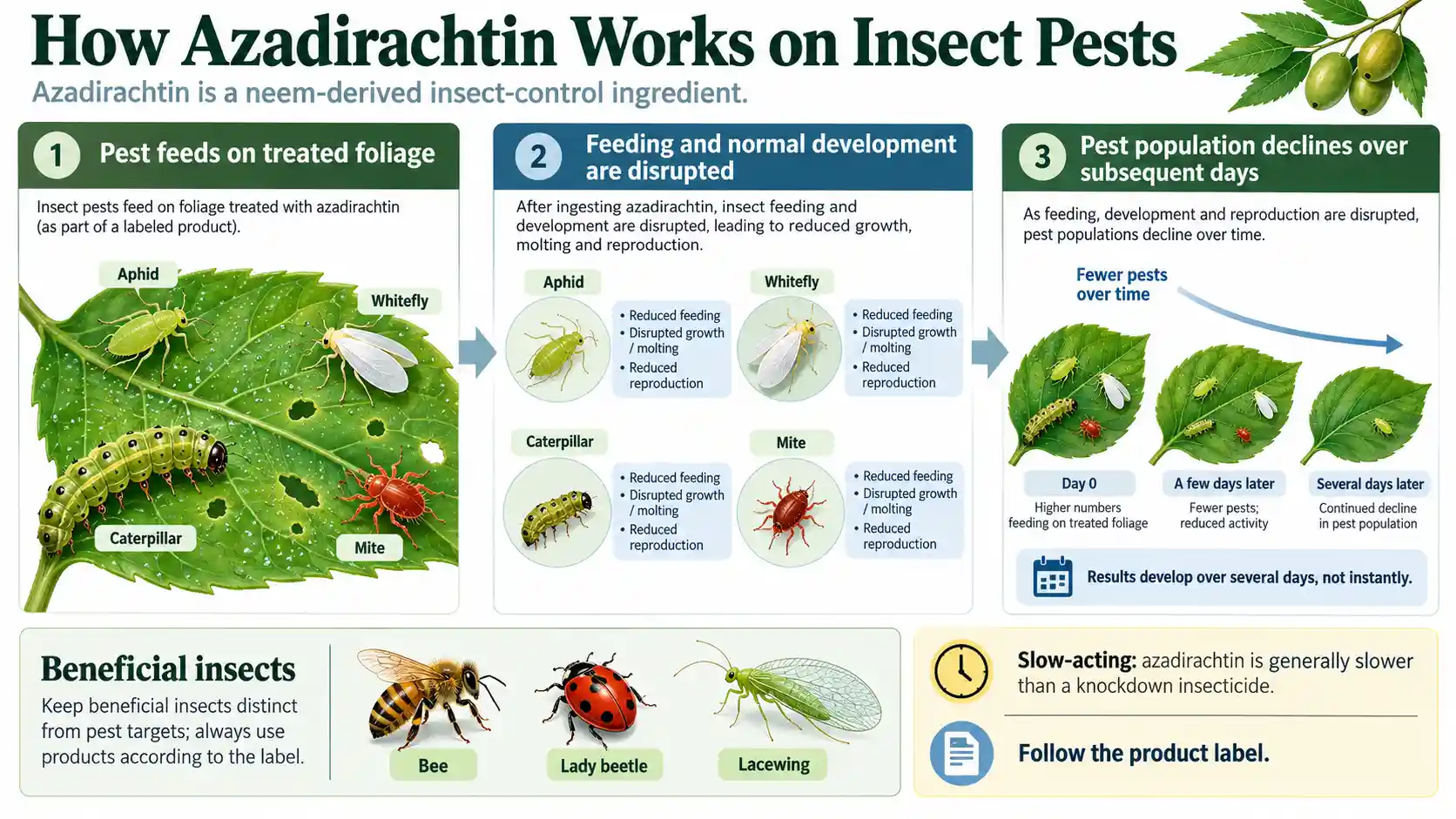
Azadirachtin disrupts insect feeding and development rather than behaving like a simple fast knockdown insecticide. Treated insects may feed less, fail to develop normally and die over time rather than immediately. That is why a gardener can spray correctly and still see live insects for several days.
Before treating anything, identify the pest first. Our Garden Pest Identification Guide for Australian gardens covers aphids, whiteflies, mites, mealybugs, scale and other common Australian garden pests.
Pests named on Australian labels
The current Eco-neem label reviewed for this article lists ornamental uses involving pests including two-spotted mites, whitefly, aphids and caterpillars. The product information also lists mealybugs, sooty mould, wingless grasshoppers and fungus gnats in specified situations. These are labelled uses for that product, not proof that every neem oil or homemade neem preparation controls all of those pests.
Neem-derived products are not all interchangeable, so Australian gardeners should check the exact formulation, intended use and local requirements. This Australian neem garden reference provides a practical lookup for pests, products, growing conditions and Australian considerations.
The safest workflow is diagnosis first, label second, treatment third. That prevents the common mistake of spraying a plant simply because its leaves look damaged.
Limits
Neem is not a universal pesticide. Application has to match the approved label, and the current Eco-neem information specifically warns against use around ponds and aquaponics because the product can be harmful to fish.
Plant safety is also product- and plant-dependent. Patch-testing a small area before broad application is a sensible precaution where the label permits use. Do not treat frequently repeated internet claims such as a universal “30°C cut-off” as an Australian legal rule unless that temperature restriction appears on the current product label you are using.
Neem Oil, Neem Leaves or Azadirachtin Concentrate: What’s the Difference?
| Product type | What it is | Label/registration | Consistency | Best use |
| Cold-pressed neem oil | Oil pressed from neem seed | Depends on exact product and claims | Variable | Only use pesticidally when the product is legally authorised for that use |
| Azadirachtin-based concentrate | A formulated insecticide containing azadirachtin/neem extract | Product-specific APVMA registration and label | More controlled | Targeted pest management on listed hosts and pests |
| Seed cake | Residue left after extracting oil from seeds | Product/claim dependent | Variable | Soil amendment and agricultural applications |
| Homemade leaf spray | Water-based extract made from leaves | No product label or standardised dose | Highly variable | Not equivalent to a registered pesticide |
The APVMA’s current registered chemical products and permits database is the appropriate place to check an Australian product, host, pest and label. APVMA also states that some label directions are legally binding, so a generic internet recipe should not replace the registered label.
The important distinction is neem-derived material versus a regulated pesticidal product. A leaf infusion, crude oil or powder can contain a chemically different mixture from a formulated azadirachtin product.
Can You Use Neem on Edible Plants in Australia?
For the Australian Eco-neem product reviewed here, the answer is not according to the current label. The label states: do not use on plants that produce food for human or animal consumption and gives directions for ornamentals, lawns and potting-soil situations.
That difference explains much of the conflicting advice online. Overseas registration does not automatically transfer to Australia. A historic Eco-neem brochure notes that the product had overseas edible-crop registrations while the Australian approval was for ornamentals. Neem has a wide range of traditional, household and garden uses, but the evidence varies depending on how the plant is prepared and used. For a broader overview, see this Neem plant benefits and uses reference.
For any product, check the actual Australian label and registration rather than relying on a US gardening article or a bottle described simply as “pure neem oil”. The APVMA label guidance explains why the label matters.
Bees, pets and water
Manufacturers of Australian neem products may describe particular formulations as safe for beneficial insects, bees or pets. Treat those statements as product-specific claims, not a blanket safety guarantee for every neem preparation.
For water, the situation is clearer: the current Eco-neem information warns against use around ponds and aquaponics because it can harm fish.
Is Neem Legal to Grow in Your State or Territory?
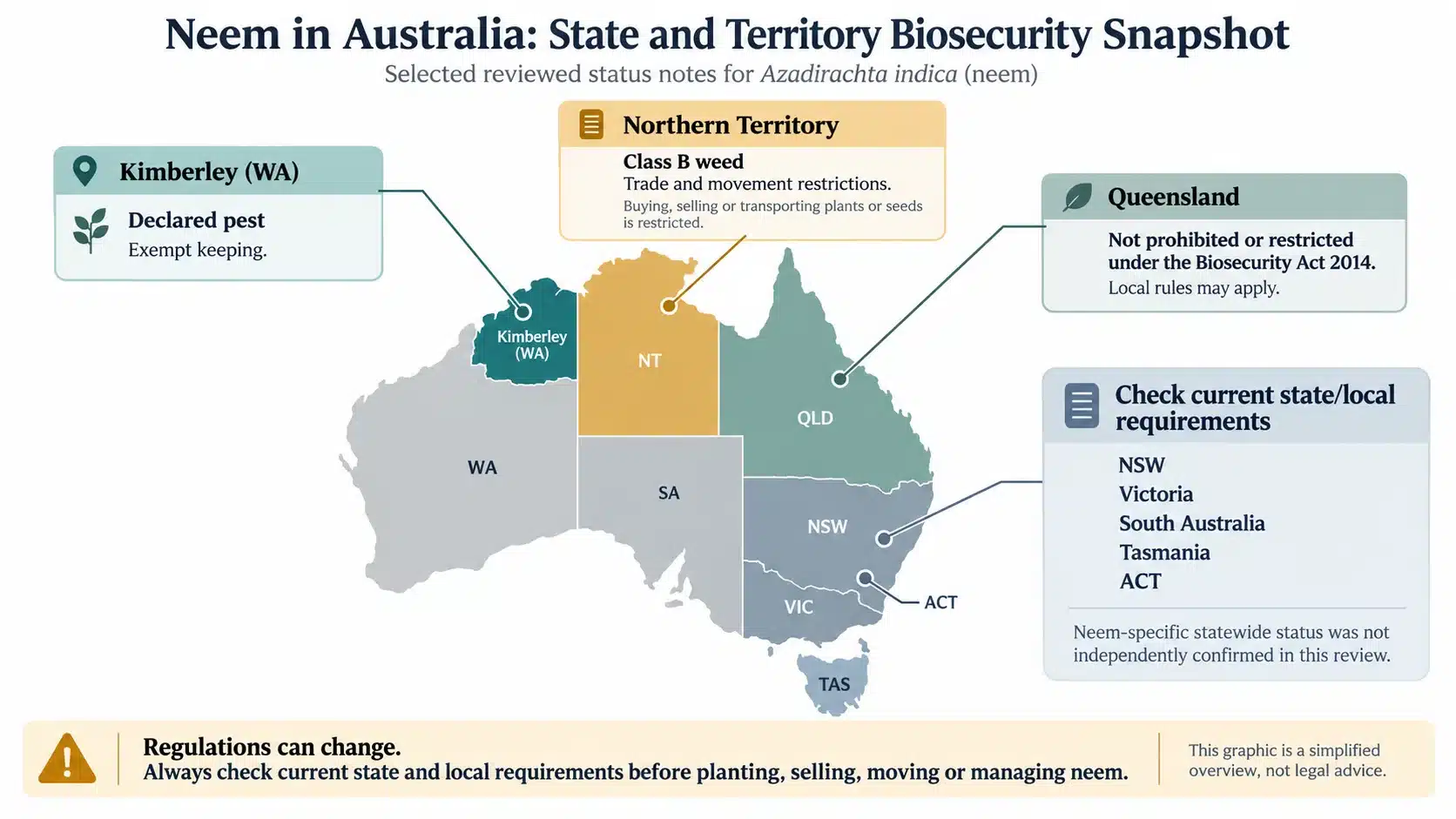
It depends on where you live. Neem is not regulated as a single nationwide “legal” or “illegal” garden tree; state and local biosecurity laws matter.
| State/territory | Status | What it means for a home gardener | Source | Date accessed |
| NT | Class B weed; movement/trade restrictions also apply | It is illegal to buy, sell or transport neem plants or seeds. Existing mature garden trees are not the main management focus, but removal is encouraged and seedlings must be removed. | NT Government — Neem | 24 Sep 2026 |
| WA | Declared pest in specified Kimberley areas; exempt keeping | The 2019 declaration covers the Shires of Broome, Derby-West Kimberley, Wyndham-East Kimberley and Halls Creek. Keeping is listed as exempt, but declared-pest obligations still matter. | WA Government Gazette declaration | 24 Sep 2026 |
| QLD | Not prohibited or restricted under the Biosecurity Act 2014 | Neem is treated as an “other invasive plant”. Queensland’s GBO applies, and local government biosecurity plans may impose additional requirements. | Business Queensland — Neem tree | 24 Sep 2026 |
| NSW | No neem-specific statewide restriction confirmed in this check | Do not interpret this as a blanket legal clearance; check current NSW and local-council requirements before planting or moving plants. | NSW WeedWise | 24 Sep 2026 |
| VIC | No neem-specific statewide restriction confirmed in this check | Check current Victorian biosecurity and local requirements before planting, moving or selling material. | Victorian plant information reviewed | 24 Sep 2026 |
| SA | No neem-specific statewide restriction confirmed in this check | Check current South Australian weed/biosecurity requirements before planting or moving material. | SA environmental weed information reviewed | 24 Sep 2026 |
| TAS | No neem-specific statewide restriction confirmed in this check | Check current Tasmanian import and biosecurity rules, especially before bringing plant material into the state. | Tasmanian biosecurity information reviewed | 24 Sep 2026 |
| ACT | No neem-specific statewide restriction confirmed in this check | Check current ACT biosecurity and local requirements before planting or moving material. | ACT requirements should be checked before planting | 24 Sep 2026 |
The NT position is explicit: neem was declared a Class B weed in 2014, buying, selling and transporting plants or seeds is illegal, and landholders are required to remove seedlings.
WA’s legal position is more geographically specific than the phrase “neem is illegal in WA” suggests. The 30 July 2019 declaration listed Azadirachta indica as a declared pest for four Kimberley shires with no control category and an exempt keeping category.
Queensland’s current government profile says neem is not a prohibited or restricted invasive plant under the Biosecurity Act 2014, but it also says local government plans may include neem controls.
Why regulators treat neem as a weed
Spread is the central concern. The NT Government says a mature neem tree can produce up to 50,000 seeds per year, with birds and bats helping disperse them and suckers enabling dense stands.
Queensland’s formal risk assessment gives a broader estimate of approximately 44,000–200,000 seeds per tree per year, based on reported seed production, and records fruiting beginning at about 2–5 years. It also documents naturalised populations in northern Australia.
That means “easy to grow” can also mean “capable of reproducing faster than a small suburban garden can conveniently contain it”.
Can You Grow a Neem Tree in a Home Garden? Size, Growth Rate and Care
Mature size
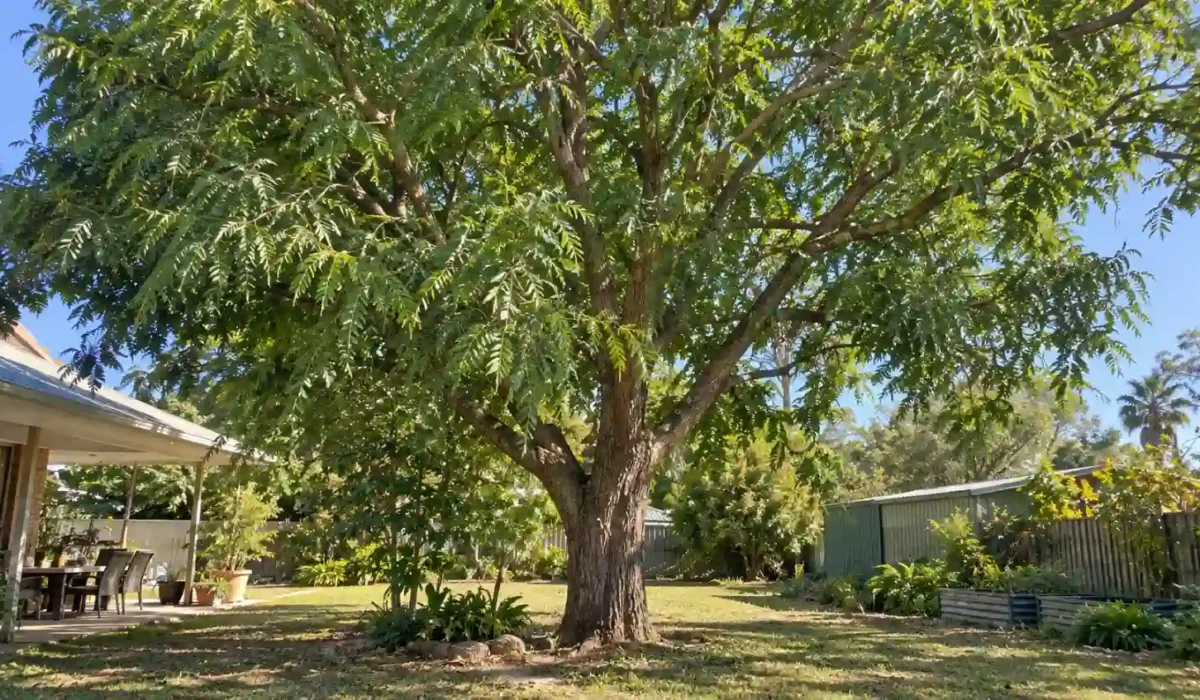
Neem is a large, fast-growing evergreen tree. Queensland’s government profile gives a typical mature height of 15–20 metres with a crown up to about 20 metres across, while the Queensland risk assessment records occasional trees reaching substantially larger dimensions.
This is one reason mature size matters more than the small plant you see at the nursery. Our Growth Rate, Root Spread & Plant Sizing Guide explains why the eventual canopy and root space should be assessed before planting.
Container growing can keep a tree smaller for a period, but a container is not a guarantee that a large tree becomes a permanently small plant.
Growth rate
Neem is officially described as fast-growing. Queensland’s risk assessment also records fruiting beginning at around 2–5 years under relevant conditions.
Care snapshot
| Factor | Practical Australian guidance |
| Light | Best suited to a warm, bright position; the species is adapted to tropical and subtropical climates |
| Watering | Regular moisture helps establishment; mature trees are strongly drought tolerant |
| Soil | Prefer deep, permeable, well-drained soil; avoid prolonged waterlogging |
| Fertiliser | Do not assume heavy feeding is required; correct the soil first |
| Pruning | Manage size and structure early; monitor for suckers after root disturbance |
| Climate | Best suited to warm tropical/subtropical conditions; frost is a major limitation |
| Soil pH | Queensland’s risk assessment reports a preference around pH 6.2–7.0, with a broader tolerance range |
The Queensland assessment reports that neem does not tolerate frost and that prolonged exposure below about 4°C can cause leaf fall or death. It also describes substantial drought tolerance once established.
For gardeners comparing site conditions and soil problems before adding fertiliser, our Australian Garden Soil & Fertiliser Guide provides broader Australian soil guidance.
Neem vs white cedar (Melia azedarach)
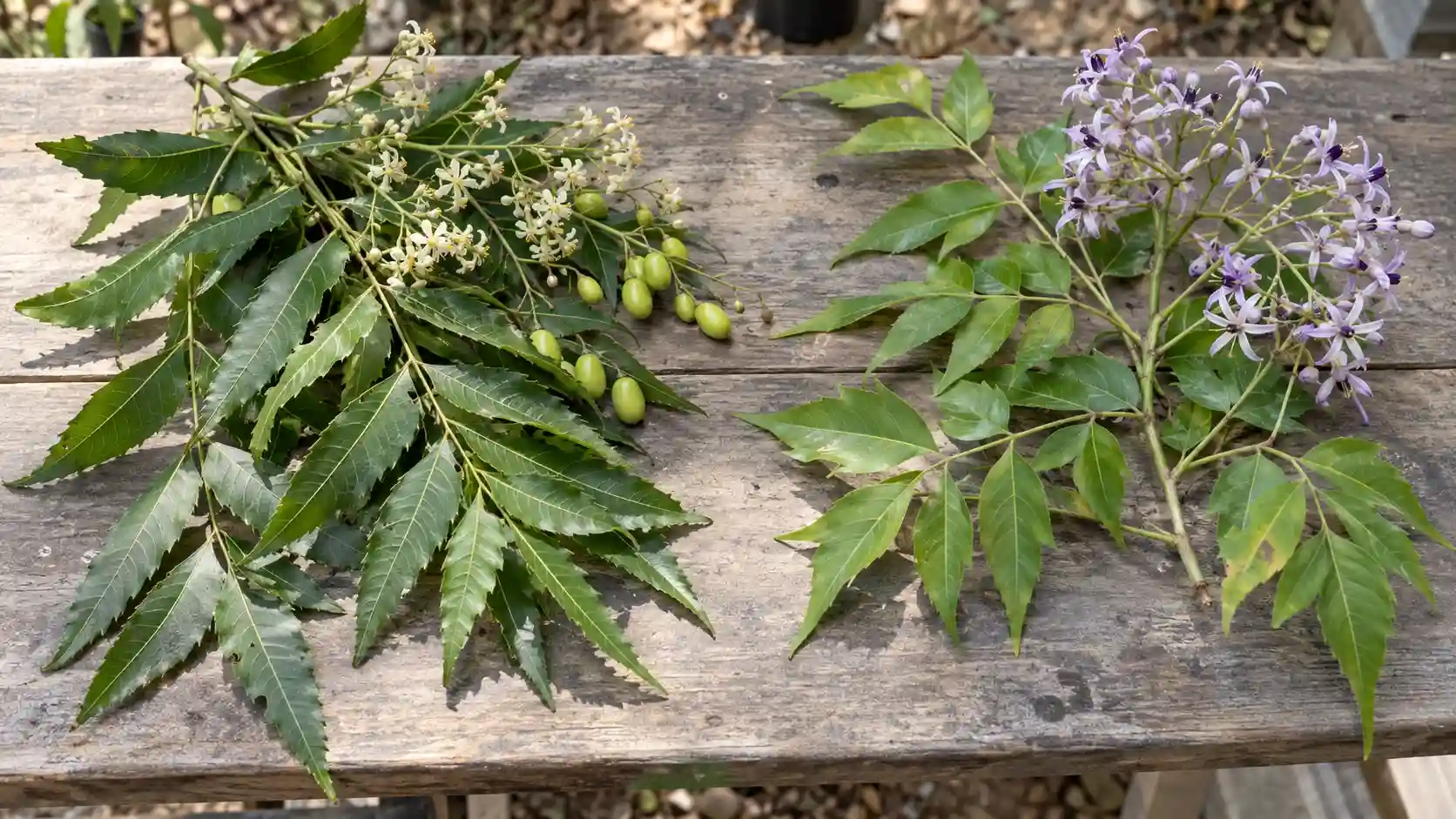
These trees are easily confused, especially in northern Queensland. Queensland explicitly notes that “neem” is sometimes incorrectly applied to white cedar.
| Feature | Neem (Azadirachta indica) | White cedar (Melia azedarach) |
| Habit | Evergreen, though it may shed leaves under dry stress | Deciduous |
| Leaf structure | Pinnate leaves, usually many serrated leaflets | Compound leaves with stalked leaflets |
| Flowers | Cream/white and fragrant | Lilac to purple, fragrant |
| Fruit | Yellow, olive-like drupe | Yellow, fleshy fruit |
| Australian confusion | Commonly misidentified as white cedar | Sometimes incorrectly called neem |
The Royal Botanic Gardens Victoria’s HortFlora notes that white cedar is sometimes erroneously called neem and confirms its different flower, fruit and leaf characteristics.
Common Neem Mistakes and How to Fix Them
Leaf burn or spotting
Why it happens: plant sensitivity, environmental heat or an application that does not suit the plant.
Fix: stop further applications, rinse foliage where appropriate, allow new growth to develop, and follow the product’s plant-safety directions.
Prevent it: patch-test a small area first and record the product, dilution, weather and response.
“It didn’t work”
Neem-based products are not instant knockdown sprays. Some products require repeat applications at labelled intervals, and insects may take several days to die or cease damaging plants.
Before spraying again, check three things: was the pest correctly identified, was the correct label rate used, and did the treatment actually cover the relevant plant surfaces?
Seedlings appearing
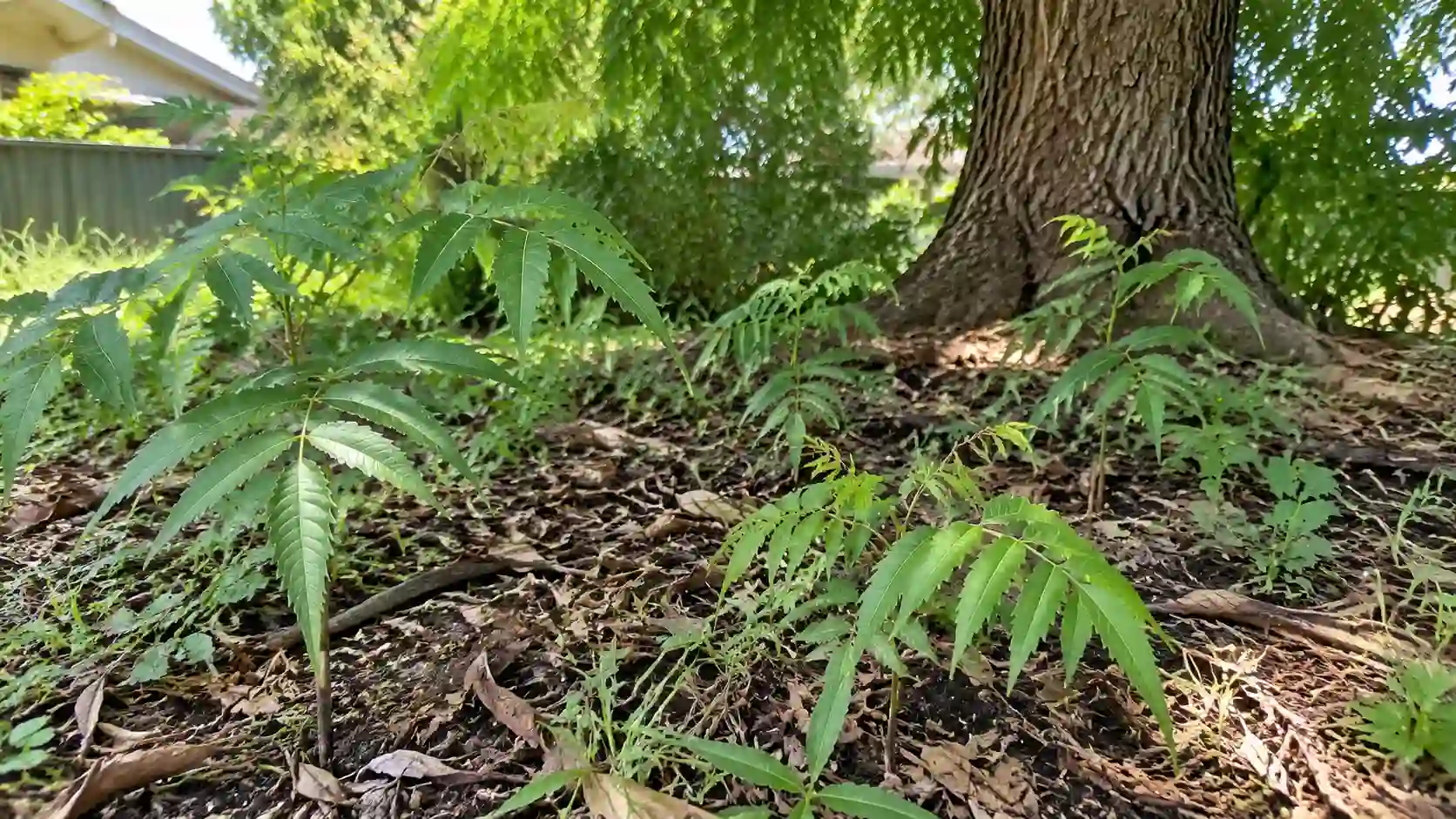
Treat unwanted seedlings as a spread-prevention problem, not simply a nuisance. The NT Government specifically recommends prioritising neem seedlings and controlling mature trees before seed production where management is required.
For a broader symptom-first diagnostic process, use our Plant Problems & Troubleshooting guide before assuming every damaged leaf is an insect problem.
What Is Proven About Neem’s Human Health Benefits?
Neem has a long history of traditional use in South Asia and Ayurveda, but traditional use does not by itself establish clinical effectiveness.
Traditional vs tested use
Neem is widely associated with traditional medicine, cultural practice and Ayurvedic preparations. Those traditions are important context, but terms such as “diseases cured by neem leaves”, “neem benefits for men” or “what does neem do to the brain?” imply a level of clinical certainty that the available evidence does not support.
Some human research exists. For example, a randomized controlled study in people with type 2 diabetes reported improvements in several glucose-related measures after a standardized aqueous leaf-and-twig extract was added to metformin, but this was a specific extract, controlled study and dose—not proof that drinking ordinary neem tea or eating leaves provides the same effect.
A systematic review of neem mouthrinses found only three eligible randomized trials and highlighted substantial differences between studies, which is why the evidence should be treated as limited and condition-specific rather than as proof of a universal “neem health benefit”.
Different neem materials can have very different uses and evidence behind them, making broad claims difficult to interpret. This Neem benefits and uses reference database brings the key uses and considerations together for easier comparison.
| Claim | Evidence level | What the evidence actually supports |
| Antimicrobial activity | Preliminary to moderate, mainly laboratory/condition-specific | Neem compounds show antimicrobial activity, but that does not establish broad disease treatment |
| Skin and oral uses | Preliminary clinical evidence | Some topical/oral-health studies exist, but evidence is not a licence to treat skin disease or infection yourself |
| Blood sugar | Preliminary human clinical evidence | Small controlled trials justify further research; they do not establish neem as a replacement treatment |
| Gut health | Limited human evidence | A small study of neem bark extract reported changes in gastric secretion and ulcer outcomes; this is not proof for homemade neem preparations |
| Tea or boiled leaf water | Insufficient evidence | No standardised preparation or general daily health dose is established |
A small human study of neem bark extract investigated gastric acidity and gastroduodenal ulcers, but its results apply to that specific extract and study population, not automatically to boiled leaves, tea or raw plant material.
Safety, dose and who should avoid it
There is no established universally safe daily amount of neem leaves, neem tea or homemade neem preparations for general use.
Australian regulatory information also shows why caution is warranted. The TGA specifically identifies Azadirachta indica as an ingredient for which some listed medicines require a pregnancy warning statement.
Do not use research doses from clinical trials as personal dosage instructions. Do not assume that raw leaves, boiled leaf water, seed oil, powder and a standardised extract have the same safety profile.
For pregnancy, breastfeeding, children, chronic disease, prescription medicines, or any planned medicinal use, discuss the product with a GP or pharmacist. Neem should not be presented as a proven treatment for kidney, liver, gut, hormonal, neurological or other diseases without condition-specific human evidence.
Conclusion
The useful neem plant benefits for Australian gardeners are mainly about registered pest control, not a universal natural remedy. Legality varies by state and local authority, and neem trees can spread through large seed crops and suckering. Human-health claims remain traditional or preliminary. For many gardeners, a correctly labelled azadirachtin product on permitted ornamentals is a more controlled option than planting a large neem tree.
FAQs
1. Is neem legal to grow in Australia?
It varies by jurisdiction. NT restricts buying, selling and transporting neem; WA regulates it in parts of the Kimberley; Queensland has different rules and local requirements.
2. Can I use neem oil on vegetables and herbs in Australia?
Do not assume you can. The current Australian Eco-neem label reviewed here says not to use it on plants producing food for people or animals.
3. Is neem oil safe for bees and pets?
Safety depends on the exact product and formulation. Manufacturer claims are product-specific, and the label must always govern use; neem products can also harm fish.
4. How big does a neem tree get?
Neem commonly reaches about 15–20 metres tall with a crown up to about 20 metres wide, with larger specimens documented.
5. Is it safe to take neem every day?
There is no established universal daily dose for neem leaves, tea or homemade preparations. Long-term routine use should not be assumed safe.
6. What pests does neem control?
Australian registered neem products can target specified pests such as aphids, whitefly, two-spotted mites and caterpillars on labelled ornamental uses.