

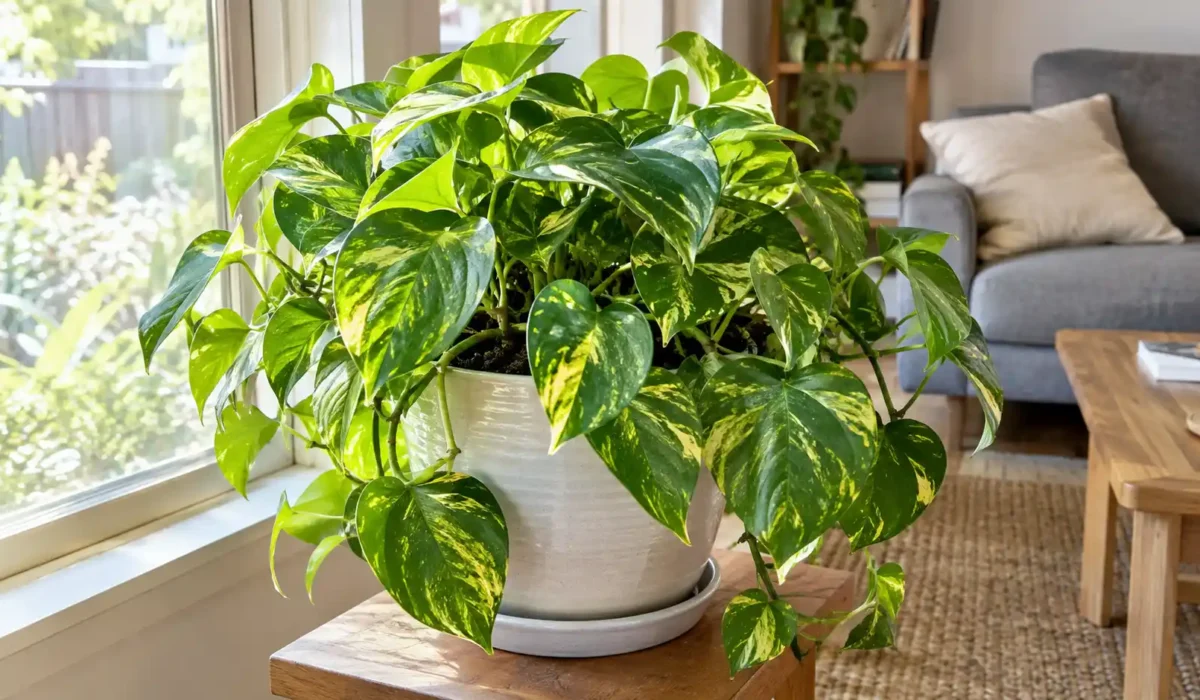
Pothos Care Guide Australia: Watering, Cultivars, Toxicity & Common Problems
A reliable pothos care guide Australia routine is simple: give Epipremnum aureum bright indirect light, use a free-draining indoor potting mix, and water only after the mix has dried substantially rather than following a rigid calendar. Pothos, also called Devil’s Ivy or Golden Pothos, is a tropical climbing plant in the Araceae family and is especially forgiving indoors.
The challenge for Australian growers is that watering, light and growth change considerably between a humid Brisbane summer, an air-conditioned Darwin room, a dry Adelaide interior and a cool Melbourne winter. This guide covers identification, cultivar differences, climate-adjusted care, pruning and propagation, pet and child safety, outdoor environmental risk, and the most common pothos problems.
Quick Summary
- Pothos tolerates low light, but bright indirect light produces stronger growth and better variegation. Water when roughly the upper 50–75% of a typical potting mix has dried as a practical starting rule, then adjust for the plant and season.
- Australian care changes with climate: tropical and subtropical homes often need more frequent summer checks, while temperate southern homes usually need substantially less water through winter.
- Pothos contains insoluble calcium oxalate crystals. Chewing can cause immediate mouth pain, burning and swelling in people and animals; severe throat swelling or breathing/swallowing difficulty needs urgent medical attention.
- Epipremnum aureum has been documented escaping gardens and establishing along creeks in Queensland’s Wet Tropics. For that reason, contained growing is the safer choice in tropical and subtropical Queensland rather than planting it directly into the ground.
What Is a Pothos? Identifying Devil’s Ivy and Its Cultivars
Pothos is the commonly used name for Epipremnum aureum, an evergreen climbing aroid with heart-shaped juvenile foliage. Kew currently accepts Epipremnum aureum as the species name, while older literature and nursery labels may use names such as Pothos aureus or Scindapsus aureus.
The plant belongs to the Araceae family, which is why pothos shares some superficial features with philodendrons and other aroids. In a normal indoor pot it usually remains in its juvenile form, but climbing plants can produce much larger foliage as they mature. Queensland Poisons Information Centre notes that mature leaves can become very large, while juvenile or potted leaves are usually much smaller.
Why Is It Called “Devil’s Ivy”?
The common name “Devil’s Ivy” reflects the plant’s reputation for being unusually persistent. It can remain green through relatively poor indoor conditions and readily regrows from stem cuttings.
That reputation should not be confused with “it can live in complete darkness”. Pothos may survive low light for a prolonged period, but low light reduces growth and can reduce or eliminate visible variegation.
Pothos vs Philodendron: How to Tell Them Apart
Pothos and heartleaf philodendron are two of the most frequently confused indoor vines. The fastest diagnostic method is to examine the new growth, leaf stalk and aerial roots rather than relying only on leaf colour.
| Feature | Pothos (Epipremnum) | Heartleaf Philodendron |
| Leaf texture | Usually thicker, glossier and more waxy | Generally softer and thinner |
| New leaf emergence | Leaf unfurls directly from the stem | New leaf emerges from a temporary papery sheath or cataphyll |
| Petiole | Typically grooved | Typically smoother |
| Aerial roots | Often one shorter root at a node | Often multiple, more finger-like roots at a node |
| Variegation | Many common cultivars have strong yellow, white or green patterns | Common green forms are often less heavily patterned |
These characteristics are useful together; no single visual clue should be treated as an absolute identification test. Illinois Extension specifically highlights the cataphyll difference, grooved pothos petioles and the different aerial-root pattern.
For more plant-diagnosis methods, our plant symptom troubleshooting guide provides a broader symptom-first process.
Common Pothos Cultivars at a Glance
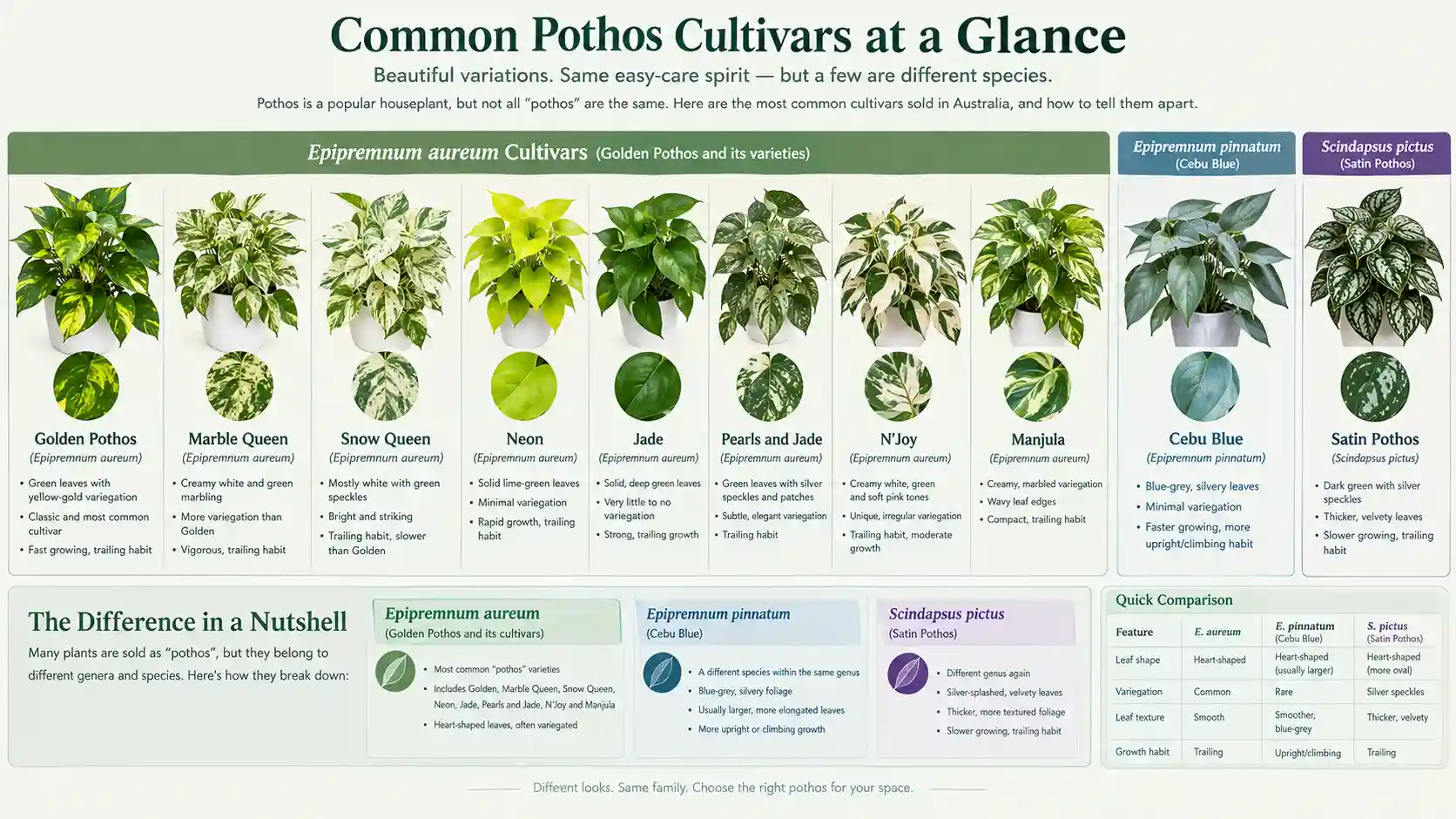
Not every plant sold as “pothos” is the same species. This matters particularly with Cebu Blue and Satin Pothos.
| Cultivar / Common Name | Botanical identity | Variegation / Colour | Light Need | Typical Growth Habit |
| Golden | E. aureum | Green leaves with yellow-gold variegation | Bright indirect; tolerates lower light | Vigorous trailing/climbing vine |
| Marble Queen | E. aureum ‘Marble Queen’ | Green and white/cream marbling | Bright indirect to maintain variegation | Trailing/climbing; generally slower than Golden |
| Snow Queen | E. aureum ‘Snow Queen’ | Very high white/cream proportion with green | High bright indirect light | Trailing; slower-growing |
| Neon | E. aureum ‘Neon’ | Bright chartreuse/lime green | Bright indirect; tolerates lower light | Vigorous trailing/climbing |
| Jade | E. aureum ‘Jade’ | Solid dark green | Bright indirect to moderate light | Vigorous trailing/climbing |
| Pearls and Jade | E. aureum ‘Pearls and Jade’ | Green with white/silver speckling | Bright indirect | More compact-looking, trailing |
| N’Joy | E. aureum ‘N’Joy’ | Strong white/green variegation | Bright indirect | Compact/trailing |
| Satin Pothos | Scindapsus pictus | Green leaves with silvery markings | Bright indirect | Trailing; not an Epipremnum |
| Cebu Blue | Epipremnum pinnatum ‘Cebu Blue’ | Blue-green/silvery juvenile foliage | Bright indirect to filtered light | Climbing/trailing; larger mature leaves when supported |
| Manjula | E. aureum ‘Manjula’ | Broad green leaves with cream/white variegation | Bright indirect | Bushier and slower-growing than many common forms |
Clemson Extension confirms the major differences among Marble Queen, Snow Queen, Pearls and Jade, Neon and Manjula, and also places Cebu Blue under Epipremnum pinnatum rather than E. aureum.
Marble Queen vs Snow Queen: they can look nearly identical when young. In general, Snow Queen carries a higher proportion of white and has clearer white variegation, while Marble Queen tends to retain more green and grows faster.
Pothos Care Guide for Australian Conditions
Light — Best Position in the House
The sweet spot is bright, indirect light: close enough to a bright window to receive strong daylight, but protected from harsh direct afternoon sun.
Low light is tolerated, but it comes with trade-offs:
- slower growth
- smaller leaves
- longer gaps between leaves
- weaker variegation in many cultivars
- greater likelihood of a sparse or leggy appearance
Heavily white cultivars such as Snow Queen, Marble Queen and N’Joy generally need stronger light than solid-green forms to maintain useful growth and attractive variegation.
A useful Australian rule is to increase light before increasing fertiliser when a pothos is pale, slow or unusually sparse.
Watering by Australian Season and Climate Zone
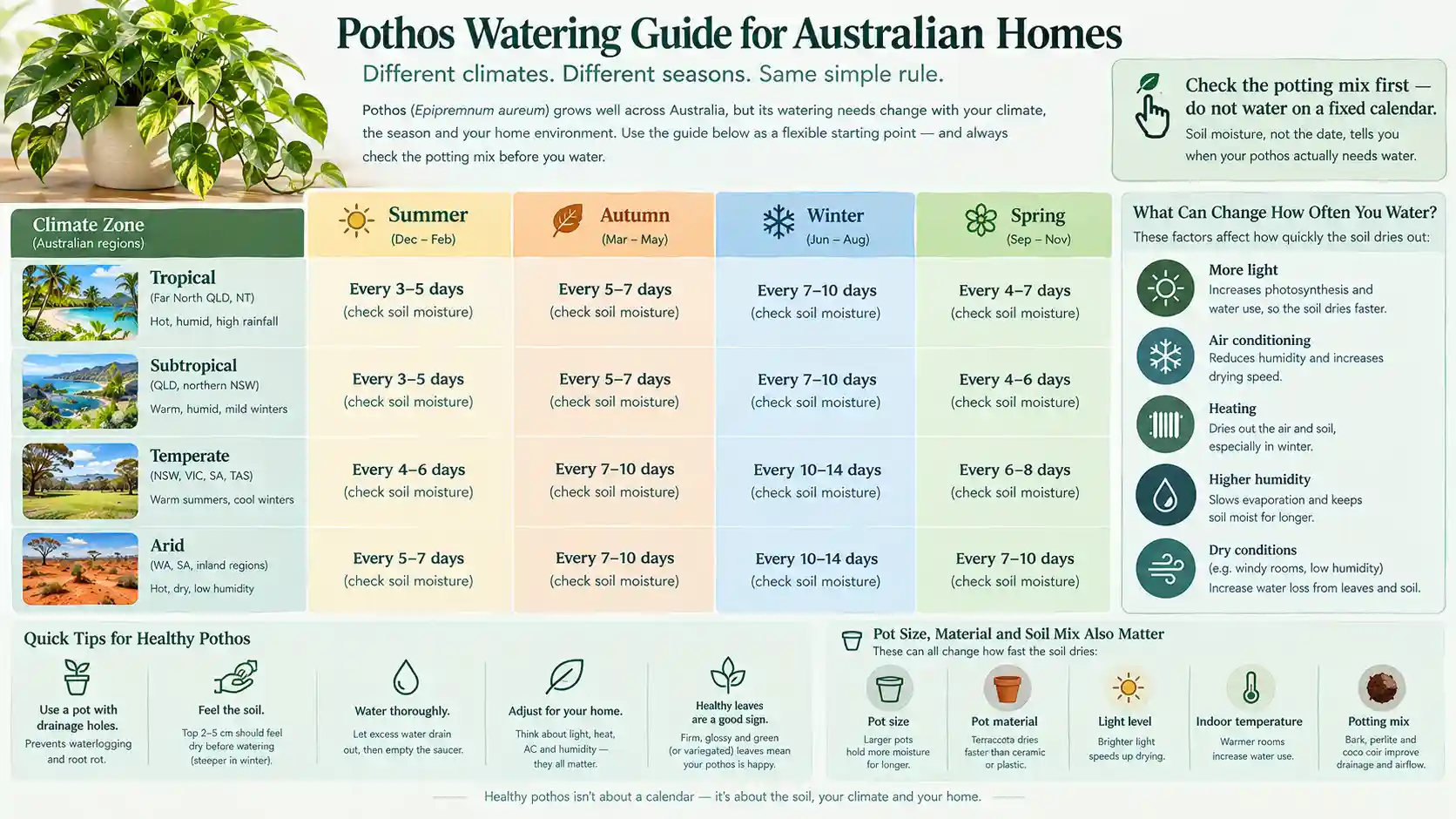
Do not water pothos simply because a certain weekday has arrived. Check the mix first. A practical starting point is to wait until most of the potting mix has dried, approximately the upper 50–75% in a typical indoor container, then water thoroughly until excess drains from the bottom.
The table below is a checking schedule, not a compulsory watering schedule.
| Australian climate | Summer | Autumn | Winter | Spring |
| Tropical — northern Qld, NT, northern WA | Check every 4–7 days | 5–10 days | 7–14 days | 4–7 days |
| Subtropical — Brisbane and similar areas | 4–7 days | 7–12 days | 10–18 days | 5–10 days |
| Temperate — Sydney, Melbourne, Adelaide and southern regions | 7–12 days | 10–18 days | 14–28 days | 7–14 days |
| Arid / very dry inland | 5–10 days | 7–14 days | 10–21 days | 5–10 days |
These ranges can shift substantially with pot size, pot material, heating, air conditioning, window exposure, plant maturity and mix composition. A small terracotta pot in a bright Brisbane room may dry in days; a large plastic pot in a dim Melbourne room may remain wet for much longer.
The underlying rule is more reliable than the calendar: water when the mix has dried substantially, then drain the excess. Penn State Extension likewise recommends watering pothos when dry, while Illinois Extension advises allowing the mix to dry moderately between waterings.
Soil & Potting Mix
Pothos needs a mix that holds moisture without staying saturated. Garden soil is a poor choice for indoor containers because it can become dense and restrict drainage.
Two Australian examples are:
- Yates Premium Potting Mix, which is formulated for indoor and outdoor pot plants and includes controlled-release fertiliser.
- Searles Indoor Potting Mix, formulated specifically for indoor plants with moisture-management and controlled-release fertiliser features.
For a broader Australian discussion of soil structure and feeding, see our Australian soil and fertiliser guide.
Choosing a Pot — Size and Material
Pothos does not need a huge pot to become large. Oversized containers hold more unused wet mix around the roots and can make watering mistakes harder to recover from.
Choose a pot with drainage holes and generally move up one pot size when the roots have genuinely filled the existing container.
Terracotta can be excellent for pothos, especially for gardeners who tend to overwater, because the porous material generally dries faster than plastic. In a dry, heated Melbourne room or arid climate, however, terracotta may require more frequent monitoring.
Signs that a pot is becoming restrictive include roots emerging through drainage holes, noticeably faster drying, stalled active growth, or water passing through unusually quickly. Searles similarly recommends moving indoor plants up only one size when repotting.
Fertilising Your Pothos
Fertiliser should supplement good light, roots and watering rather than compensate for poor growing conditions.
During active growth, an indoor liquid fertiliser can be used according to its label. A real Australian example is Yates Thrive Houseplant Liquid Plant Food, a complete liquid fertiliser intended for indoor plants and applied diluted in water.
Reduce or pause feeding when growth naturally slows, particularly through a cool, low-light southern winter.
What about coffee grounds?
Used grounds contain some nutrients, but they are not a balanced houseplant fertiliser and should not replace a controlled feeding program. Current Penn State Extension guidance specifically warns against treating coffee grounds as a simple acidity or fertiliser solution; composting them is a more dependable use.
Humidity & Temperature Tolerance
Pothos is comfortable in normal household conditions, but it performs better when temperatures remain warm and changes are not extreme. Clemson Extension gives a general indoor range of about 16–29°C, with higher humidity beneficial for vigorous tropical growth.
In Australia:
- Tropical and subtropical rooms often provide naturally suitable warmth.
- Air conditioning can dry the air in summer.
- Central or portable heating can make southern winter interiors unusually dry.
- Cold windowsills and drafts can slow a tropical pothos even when watering is correct.
Moderate humidity is helpful, but you do not need to turn an ordinary living room into a greenhouse. If a room stays dry, grouping plants or using a humidifier is generally more predictable than repeatedly misting leaves.
Plant Size and Growth Rate
Plant Size
Indoor pothos is usually maintained in the juvenile form, with much smaller leaves than a mature climbing plant. Queensland Poisons Information Centre notes that mature foliage can become very large, whereas leaves in juvenile or potted specimens are usually under about 20 cm.
This means a small-leaved hanging-basket pothos and a large-leaved climbing Epipremnum can still be the same species at different stages of growth.
Growth Rate
Under warm conditions with good light, appropriate watering and adequate nutrition, pothos can be vigorous.
Growth slows when:
- light is weak
- temperatures fall
- roots remain waterlogged
- the plant is severely root-bound
- nutrients are consistently inadequate
Cultivar matters too. Neon is generally vigorous, while Manjula is notably slower and more compact.
Pruning, Bushiness and Propagation
How to Trim and Prune for a Bushier Plant
A long vine does not automatically become bushy because its tips are shortened. To create a fuller plant, make several strategic cuts so that multiple stems are shortened rather than repeatedly trimming only one leading vine.
Cut just above a healthy node. On a healthy plant, pruning stimulates dormant growth points along remaining stems and also gives you cuttings to propagate.
For a very sparse plant, combine pruning with better light. Pruning alone cannot fully correct a plant that is continually stretching toward a window.
Understanding Nodes — Will a Cut Stem Regrow?
Yes, a viable stem section containing a node can regrow. The node is the critical point because it contains the tissue from which new growth and roots can develop.
That is why a stem cut without a node is a poor propagation piece. A leaf by itself is not normally enough to create a new pothos vine.
Propagating Pothos — Water vs Soil Cuttings
Both water and soil propagation work.
Water propagation: place a node in clean water while keeping most foliage above the waterline. It is easy to monitor root development and is useful for beginners.
Soil propagation: place a node into a moist, free-draining medium and keep conditions lightly moist rather than saturated.
Penn State Extension confirms stem cuttings as a standard pothos propagation method and notes that the growing season is generally favourable for propagation.
Repotting Without Shock
Pothos can show a temporary pause, droop or leaf yellowing after substantial root disturbance, but “shock” is not a reason to avoid repotting when the plant genuinely needs it.
To reduce stress:
- Move up only one pot size.
- Use fresh, free-draining potting mix.
- Avoid burying the stem deeper than it was previously planted.
- Water thoroughly once and allow excess to drain.
- Keep the plant away from harsh direct sun while it settles.
Searles recommends one-size-up repotting, thorough watering after potting and temporary protection from harsh sunlight.
Common Pothos Problems — Diagnosis and Fixes
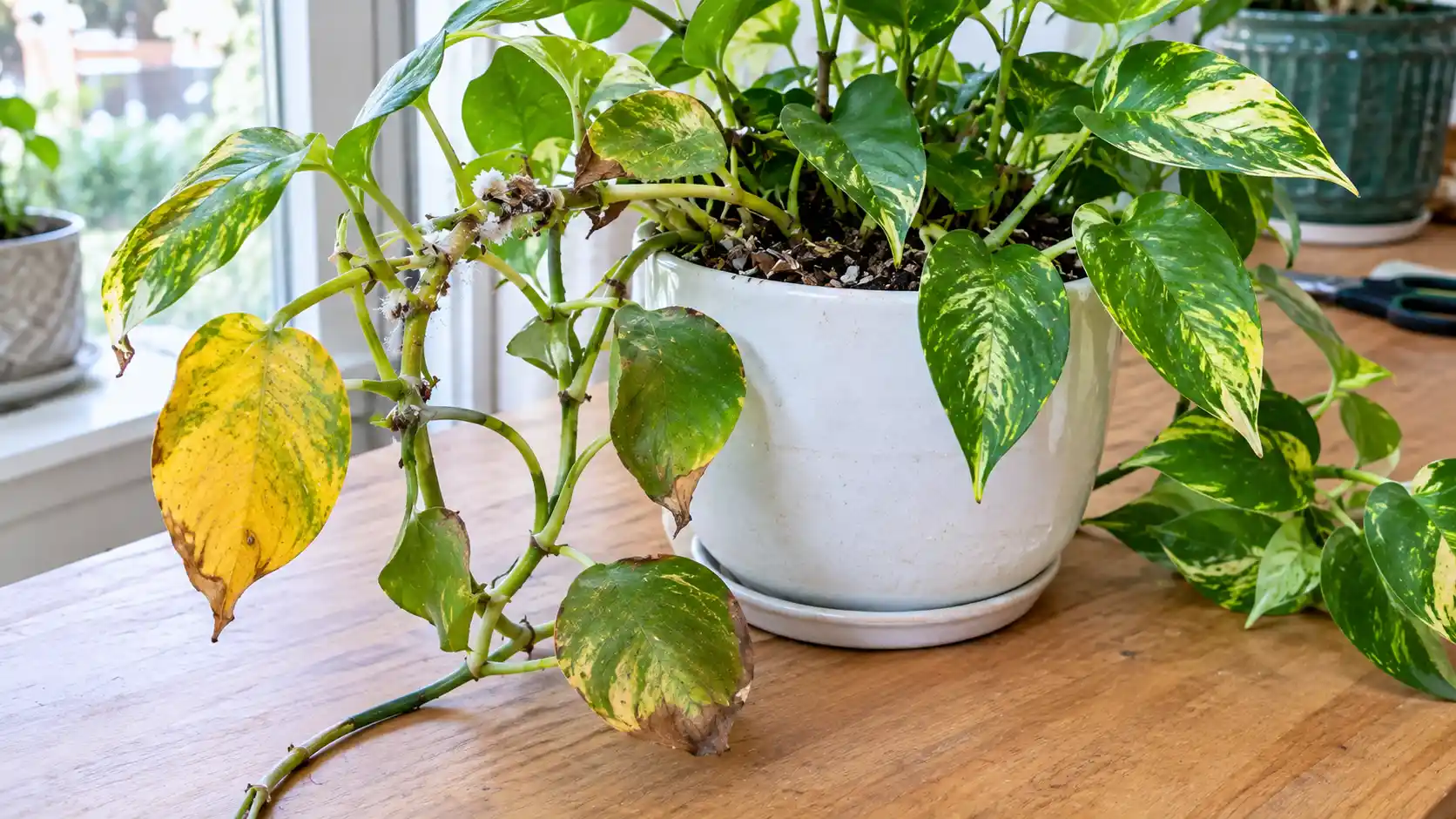
Yellow Leaves
Why it happens: The most common causes are excessive moisture, insufficient light, root stress and ordinary ageing of older leaves.
How to fix it: Check the mix before watering again. If it is staying wet, improve drainage and allow more drying. If the plant is extremely dim, increase indirect light gradually.
How to prevent it: Water from the condition of the soil rather than a weekly routine. A single older yellow leaf is very different from rapid yellowing across several leaves.
Our plant troubleshooting guide uses the same symptom-first principle: identify where the symptom appears, check recent changes and inspect the root zone before choosing a treatment.
Brown Tips or Curling Leaves
Why it happens: Brown, crispy tips can follow prolonged dryness, dry heated or air-conditioned air, salt accumulation or excessive light/heat.
How to fix it: Check soil moisture first. If the plant is dry, water thoroughly. If the soil is already wet, do not automatically add more water. Move away from harsh direct sun and review fertiliser concentration.
How to prevent it: Keep moisture reasonably consistent, avoid fertilising a severely dry plant, and protect foliage from intense afternoon sun.
Root Rot From Overwatering
Why it happens: The problem is usually prolonged waterlogged conditions rather than one heavy watering. Persistently saturated mix reduces the healthy air space around roots and can lead to root decline.
How to fix it: Stop watering, inspect the roots if decline is significant, remove clearly damaged tissue with clean tools, and repot into fresh, well-draining mix if necessary.
How to prevent it: Use drainage holes, an appropriate pot size and a mix that does not remain saturated. Low-light plants need less water, not more.
Pests — Mealybugs and Spider Mites
Mealybugs appear as small white, waxy insects, often hidden around leaf joints and stems. Spider mites are tiny and may first appear as fine stippling, faded foliage or webbing.
How to fix it: Isolate an affected plant first. Rinse foliage, paying attention to leaf undersides, then use a commercially formulated insecticidal soap or horticultural oil that is labelled for the plant and pest. Repeat applications may be necessary because contact treatments do not necessarily eliminate every life stage.
Avoid homemade detergent mixtures: ordinary dishwashing or laundry products can damage foliage.
Leafy Heaven’s Australian garden pest identification guide provides a broader visual method for distinguishing mealybugs, spider mites and other common pests.
Leggy or Sparse Vines / Root-Bound Plants
Why it happens: Low light is a major cause of long gaps between leaves. Root restriction, weak growing conditions and cultivar differences can also contribute.
How to fix it: Increase bright indirect light, prune long stems and use the healthy cuttings to refill the pot. Check the roots before assuming the plant needs a larger container.
How to prevent it: Give variegated cultivars particularly good light and rotate the plant periodically so growth does not concentrate only on the window-facing side.
A pothos can tolerate being somewhat crowded, but “crowded” is not the same as severely root-bound. A modestly filled pot can support a full plant; a severely restricted root ball can eventually reduce water management and growth.
Is Pothos Safe? Toxicity and Outdoor Growing in Australia
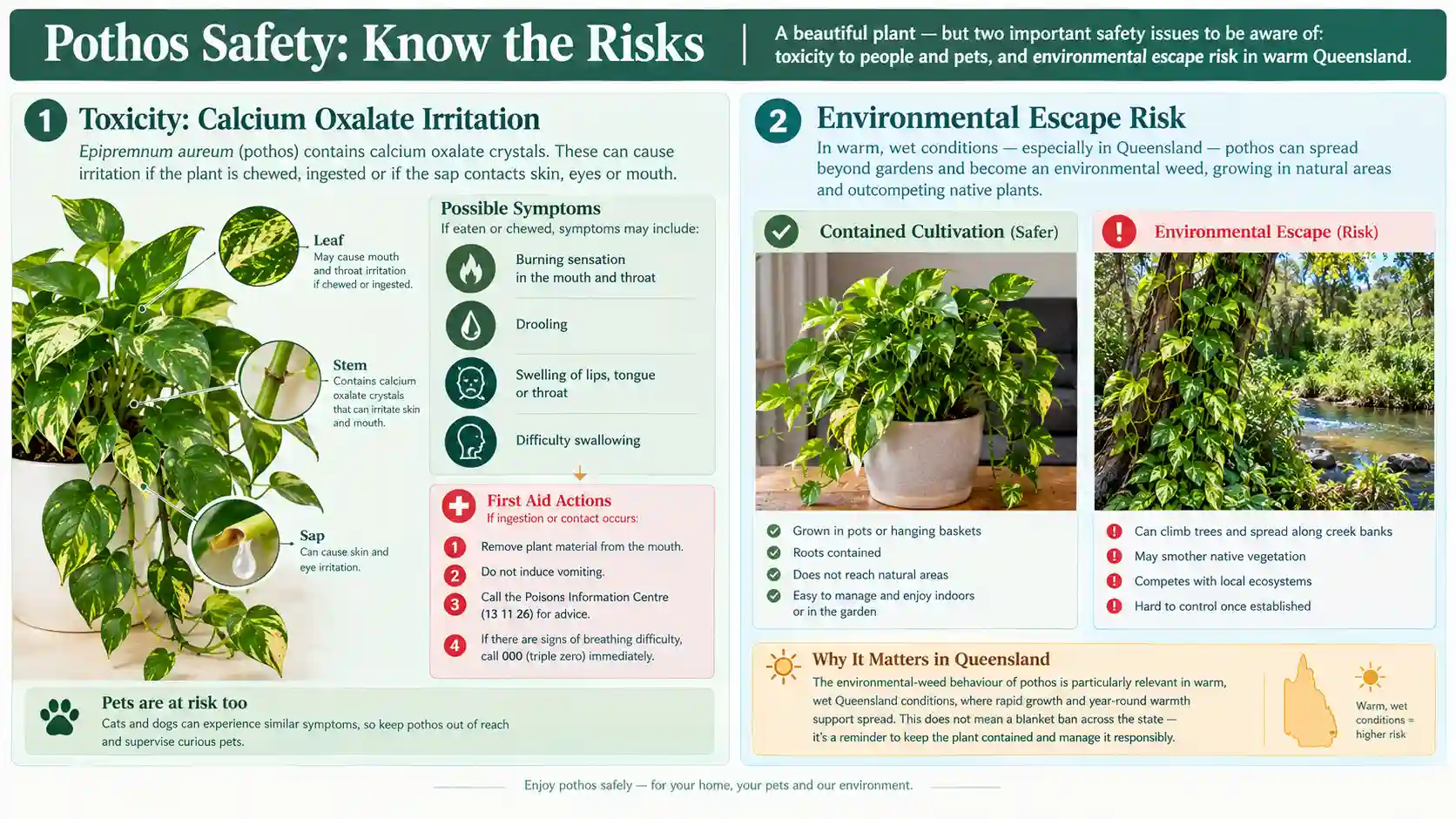
Toxicity to Cats, Dogs and Kids
Pothos should be treated as a toxic/irritant plant, not a pet-safe houseplant.
The plant contains insoluble calcium oxalate crystals. In pets, ASPCA lists oral irritation, intense burning, drooling, vomiting and difficulty swallowing as possible clinical signs.
Queensland Poisons Information Centre similarly reports immediate pain or burning and swelling of the lips, mouth, tongue and throat if pothos is chewed or eaten. Contact with sap can also irritate skin and eyes.
Pothos contains needle-like calcium oxalate crystals that can cause burning and swelling of the mouth and throat when chewed; the Queensland Poisons Information Centre’s pothos guidance.
For a child or adult who has chewed or swallowed pothos:
- Remove plant material from the mouth and have the person spit it out.
- Do not induce vomiting.
- Call the Australian Poisons Information Centre on 13 11 26 for case-specific advice.
- Seek urgent medical attention if there is significant mouth or tongue swelling, difficulty swallowing or difficulty breathing.
- In an emergency such as collapse, seizure or severe breathing difficulty, call 000.
For cats and dogs, contact a veterinarian promptly if ingestion occurs, particularly when there is repeated vomiting, significant swelling or breathing/swallowing difficulty.
Can You Grow Pothos Outdoors in Australia?
Yes, pothos can grow outdoors in suitable Australian climates, but the environmental question matters.
A contained pot on a shaded patio is very different from allowing a vigorous climbing vine to establish in moist ground near natural vegetation.
The Wet Tropics Management Authority has documented Epipremnum aureum as a garden escapee establishing along creeks, demonstrating that the species can move beyond cultivation in suitable Queensland conditions.
For this reason:
- Tropical and subtropical Queensland: keep pothos contained rather than planting it into natural soil, especially near waterways, rainforest remnants or other moist natural areas.
- Northern Australia: use extra caution with outdoor establishment in warm, humid conditions.
- Temperate and cooler regions: indoor or contained patio growing has a much lower environmental risk, but viable cuttings should still never be dumped outdoors.
- Any region: dispose of unwanted stems responsibly rather than throwing living cuttings into garden waste where they may establish.
This is best understood as an environmental-weed risk, not a claim that pothos is uniformly prohibited everywhere in Queensland.
Beginner Mistakes to Avoid With Pothos
The most common beginner mistakes are surprisingly consistent:
- Overwatering “just in case”: pothos is tolerant of occasional dryness but suffers when roots stay wet for too long.
- Treating low light as ideal: surviving in a dark room is not the same as growing strongly there.
- Ignoring cultivar differences: Snow Queen and Marble Queen generally need better light than solid-green Jade.
- Skipping quarantine: a beautiful new cutting can introduce mealybugs or mites to an established indoor collection.
- Using coffee grounds as the main fertiliser: they do not provide a balanced houseplant feeding program.
- Assuming every pothos is Epipremnum aureum: Cebu Blue belongs to E. pinnatum, while Satin Pothos is Scindapsus pictus.
- Planting outdoor vines without considering local environmental risk: Queensland’s documented escape records make containment particularly important in warm, wet regions.
Conclusion
A successful pothos care guide Australia routine comes down to four decisions: provide bright indirect light, let the potting mix dry substantially before watering, use a well-drained container mix, and adjust the routine for your local season and indoor environment.
Choose stronger light for heavily variegated cultivars, prune long vines back to nodes when you want bushier growth, and check roots before assuming yellow leaves mean a nutrient deficiency. Keep the plant away from pets and children who may chew it, and take particular care with outdoor growing in Queensland because Epipremnum aureum has documented environmental-escape behaviour in the Wet Tropics.
The one-line takeaway: grow pothos warm, bright and well-drained, but never treat a tropical Australian climate as a reason to water on autopilot.
FAQs
How often should I water my pothos in Australia?
Check the pot rather than following a fixed calendar. A useful starting point is to water when most of the mix has dried, roughly the upper 50–75% in a typical indoor container. Expect more frequent checks during warm Brisbane or tropical summers and less frequent watering during cool Melbourne or Adelaide winters.
Is pothos toxic to cats and dogs?
Yes. ASPCA lists Golden Pothos (Epipremnum aureum) as toxic to dogs and cats because it contains insoluble calcium oxalates. Common signs include oral irritation, burning, excessive drooling, vomiting and difficulty swallowing.
Why are my pothos leaves turning yellow?
Check four things first: soil moisture, light, root condition and leaf age. Several yellow leaves in wet soil point more strongly toward root or watering stress than a single old leaf turning yellow naturally.
What’s the difference between pothos and philodendron?
Look at new growth and the leaf stalk. Philodendron usually produces a temporary cataphyll around new leaves, while pothos leaves emerge without that sheath. Pothos also typically has a grooved petiole.
Can I grow pothos outdoors in Queensland or the NT?
It can grow outdoors in warm regions, but contained growing is the safer approach. Queensland evidence documents E. aureum escaping gardens and establishing along creeks, particularly in the Wet Tropics.
How do I make my pothos bushier instead of leggy?
Give it brighter indirect light, then prune several long stems just above healthy nodes. Rooting the cut sections and planting several rooted cuttings back into the same pot can also produce a fuller-looking container.
How fast does devil’s ivy grow?
It can grow vigorously under warm, bright conditions, but there is no useful single growth-rate figure for every Australian home. Light, temperature, cultivar, pot size, watering and nutrition all change the result. Neon is generally vigorous, while Manjula is slower-growing.
1 Comment