


Queensland Firewheel Tree: Size, Care & Growth Guide
The Queensland firewheel tree (Stenocarpus sinuatus) is an Australian native rainforest tree in the Proteaceae family, admired for its spectacular wheel-shaped clusters of bright red flowers. Naturally found from northern New South Wales through tropical Queensland, including the Atherton Tablelands, it is also known as the firewheel tree, tulip flower, and white silky oak. In home gardens, it is valued as an evergreen ornamental tree with manageable growth, attractive foliage, and excellent wildlife appeal. This guide explains its size, growth rate, root system, care requirements, flowering period, pruning methods, and common growing problems to help Australian gardeners grow it successfully.
The Queensland firewheel tree is one of many attractive native choices covered in our guide to Best Trees and Shrubs for Australian Gardens, which explores suitable species for Australian landscapes.
Quick Summary
- Queensland firewheel trees typically grow 8–15 metres tall in cultivation but may reach 30–40 metres in natural rainforest conditions.
- Growth is moderate, with flowering usually occurring from late summer into autumn.
- The root system is not considered aggressive or invasive, making it suitable for many residential gardens.
- Best growth occurs in well-drained, slightly acidic to neutral loam soil with full sun to partial shade.
What Is the Queensland Firewheel Tree?
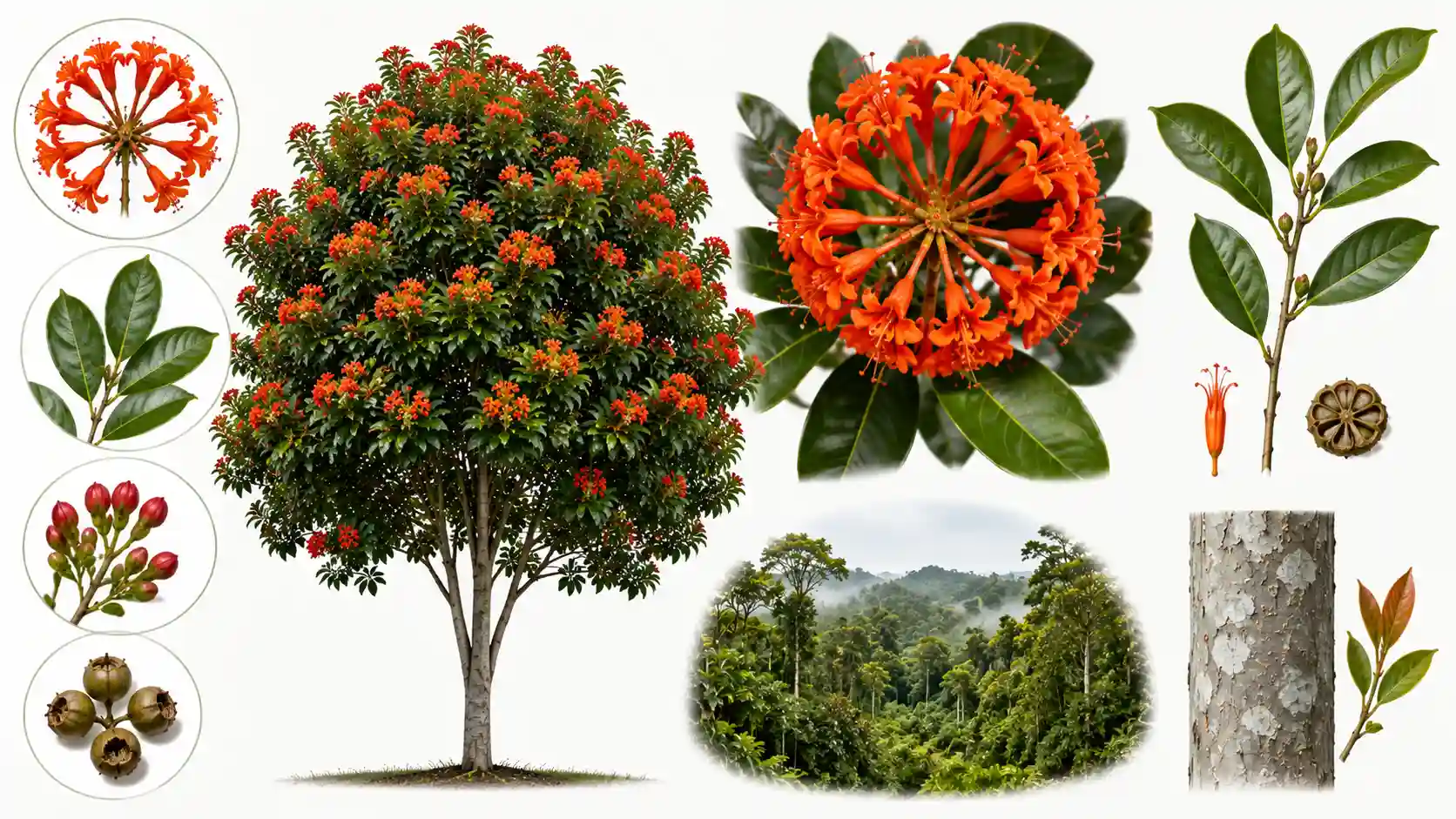
The Queensland firewheel tree (Stenocarpus sinuatus) is an evergreen rainforest species belonging to the Proteaceae family. It is native to eastern Australia, naturally growing in the rainforests of northern New South Wales and tropical Queensland. For additional botanical background and classification information, readers can refer to the Wikipedia entry for Stenocarpus sinuatus.
Australian gardens also feature many other colourful native flowering plants, including species discussed in our guide to Australian Native Purple Flowers: Types, Care & Guide.
Its most distinctive feature is the brilliant red to orange-red flower clusters arranged in a circular pattern resembling a spinning wheel or pinwheel. This unique flower shape is the reason for its common names firewheel tree and wheel of fire tree.
The tree maintains glossy green foliage throughout the year and is widely planted as a feature tree in parks, botanical gardens, and larger home landscapes. Because of its striking flowers and dense canopy, it remains one of Australia’s most recognisable ornamental native trees.
In our experience growing Australian native trees, the Queensland firewheel performs best when planted where its mature canopy has room to develop naturally.
How Big Do Firewheel Trees Get in Queensland? (Size & Height)

In typical Queensland gardens, firewheel trees usually reach 8–15 metres in height with a canopy spread of approximately 4–6 metres. Their size depends largely on climate, soil quality, and available growing space.
In untouched rainforest habitats, mature specimens may grow between 30 and 40 metres, forming part of the upper forest canopy.
Several factors influence mature size, including:
- Soil depth and fertility
- Moisture availability
- Sunlight exposure
- Local climate
- Whether grown in containers or open ground
Indoor/Container Size Expectations
When grown in large pots, firewheel trees remain considerably smaller and grow more slowly than those planted in the ground. Restricted root space naturally limits height and canopy development.
Common signs that a container-grown tree has become root-bound include:
- Roots circling inside the pot
- Reduced growth
- Leaves drying more quickly
- Water draining rapidly after irrigation
| Growing Condition | Typical Height | Typical Width |
| Garden cultivation | 8–15 m | 4–6 m |
| Wild rainforest | 30–40 m | 10–15 m+ |
| Large container | 2–4 m | 1.5–3 m |
Is the Firewheel Tree Fast Growing? (Growth Rate)
The Queensland firewheel tree has a moderate growth rate rather than being a fast-growing Australian native.
Young trees often establish slowly during their first two or three years while developing healthy roots. Once established, growth becomes steadier, particularly during warm spring and summer conditions.
Growth generally slows during cooler months.
Although attractive, the firewheel tree should not be considered among Australia’s fastest-growing native trees. Species such as wattles (Acacia spp.) typically establish and mature more quickly. Instead, the firewheel is valued as a long-term ornamental feature tree with exceptional seasonal flowering.
Gardeners looking for quicker screening options can explore our guide to Fast Growing Evergreen Trees Australia Guide for alternative evergreen choices.
Elemo Baker recommends focusing on healthy establishment rather than rapid growth, as properly established trees usually become more resilient over time.
Firewheel Tree Leaves — Shape and Identification
Firewheel tree leaves change noticeably as the tree matures.
Juvenile plants produce deeply lobed or pinnatifid leaves that can appear very different from mature foliage. As the tree ages, the leaves become simple, elongated, and develop gently wavy margins.
Mature leaves are typically:
- 12–20 cm long
- Glossy dark green
- Leathery in texture
- Prominently veined
- Narrow to lance-shaped with undulating edges
This difference between juvenile and mature leaves sometimes causes gardeners to think they are growing different plants. Observing both foliage types is a useful identification feature unique to Stenocarpus sinuatus.
Firewheel Tree Root System — Is It Invasive?
No. The Queensland firewheel tree is not considered to have an invasive or aggressive root system.
Understanding root behaviour is important when selecting garden trees, especially when comparing species with larger root systems such as those covered in our guide to Gum Tree Root System: Root Spread, Problems & Safe Distances.
Unlike species such as figs, camphor laurel, poplars, or liquidambar, Stenocarpus sinuatus develops a moderate root system that is generally suitable for residential gardens when planted with sensible spacing.
Its roots primarily support stability and water uptake rather than aggressively seeking pipes or lifting paving.
Compared with invasive-root trees:
| Firewheel Tree | Aggressive Root Trees |
| Moderate roots | Extensive surface roots |
| Suitable for many gardens | Often unsuitable near buildings |
| Not commonly listed as invasive | Frequently associated with infrastructure damage |
As with any medium-sized tree, allow adequate planting distance from buildings and underground services.
How to Care for a Firewheel Tree (Care Guide)

Firewheel trees grow best when their natural rainforest conditions are partially replicated.
- Watering: Water regularly during the establishment period. Mature trees become moderately drought tolerant but still appreciate deep watering during prolonged dry periods.
- Light: Grow in full sun to light shade. More sunlight generally promotes heavier flowering.
- Soil: Well-drained sandy loam or loam with a slightly acidic to neutral pH is ideal. Avoid poorly drained heavy clay or permanently wet soil.
- Fertilising: Apply a balanced fertiliser sparingly during the active growing season. Excessive fertiliser may encourage foliage growth at the expense of flowering.
- Climate: Best suited to subtropical and warm temperate climates. Established trees can tolerate occasional light frosts.
As of the current growing season, maintaining excellent drainage remains one of the most widely recommended practices for preventing root diseases in Australian native rainforest trees.
Growing from Seed
Firewheel trees can be grown successfully from seed.
For improved germination:
- Use a smoke primer or hot water soak before sowing.
- Sow seeds in moist seed-raising mix.
- Keep the growing medium consistently moist but not waterlogged.
- Provide warmth and bright light.
- Avoid allowing seedlings to dry out during establishment.
Can You Prune a Firewheel Tree?
Yes. Firewheel trees can be pruned, but pruning should be limited to maintaining tree health and shape.
The best time to prune is after flowering or during the dormant period before vigorous new growth begins.
Pruning objectives include:
- Removing dead branches
- Eliminating diseased or damaged wood
- Improving structure
- Maintaining clearance where required
Common Pruning Mistakes
Avoid these common mistakes:
- Over-pruning, which reduces flowering and disrupts the natural canopy.
- Pruning at the wrong time, removing flower buds before blooming.
- Cutting into old wood unnecessarily, slowing recovery and affecting appearance.
In our experience, light, selective pruning produces healthier trees than frequent heavy trimming.
Common Firewheel Tree Problems
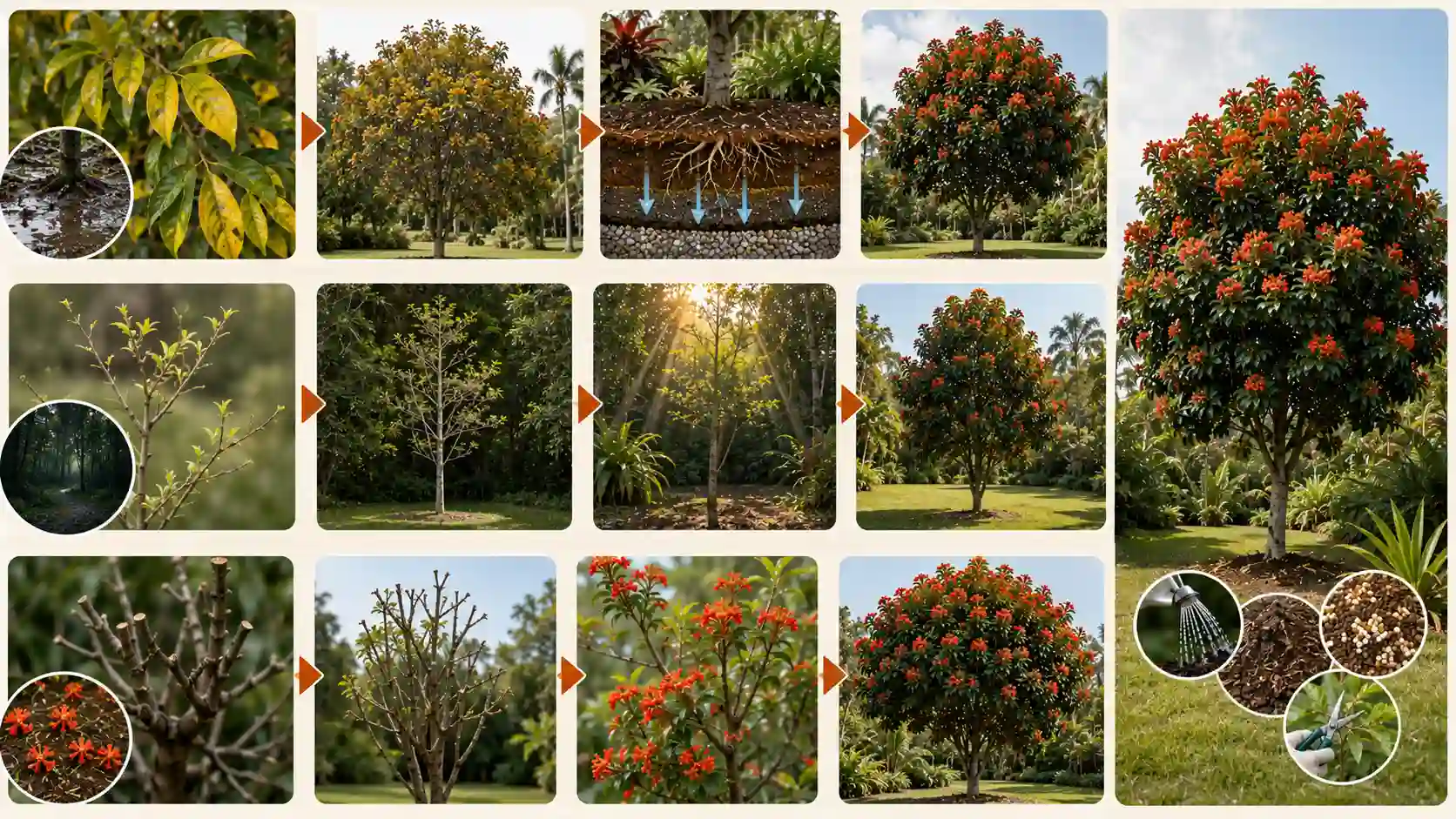
Most firewheel tree problems relate to environmental conditions rather than serious disease.
| Problem | Likely Cause | Solution |
| Slow growth | Poor drainage or insufficient sunlight | Improve drainage and increase light exposure |
| Yellow leaves | Overwatering or waterlogged soil | Reduce watering and improve soil drainage |
| Poor flowering | Excessive shade or over-pruning | Move to sunnier conditions and prune correctly |
| Root rot | Constantly wet soil | Plant in well-drained soil and avoid overwatering |
Monitoring soil moisture is often more effective than watering on a fixed schedule, especially during wet Australian summers.
How Long Do Firewheel Flowers Bloom?
Firewheel trees generally flower from summer into autumn, although the exact timing varies with local climate.
Many Queensland trees reach peak flowering between February and March, while trees in cooler regions may bloom slightly later.
Individual flower clusters remain attractive for several weeks, providing an extended display of vibrant red colour.
The spectacular blooms are one of the main reasons this species is planted as an ornamental feature tree.
Firewheel Tree Uses in the Garden
The Queensland firewheel tree serves many purposes in Australian landscapes.
It is commonly planted as:
- A feature or specimen tree
- A screening tree in larger gardens
- A windbreak on spacious rural properties
- Part of erosion-control plantings where appropriate
For gardeners creating boundaries or privacy planting, other suitable options can be found in our guide to Low-Maintenance Plants for Fence Line in Australia.
Its nectar-rich flowers attract valuable wildlife, including:
- Honeyeaters
- Native bees
- Butterflies
- Other nectar-feeding birds and beneficial insects
Its combination of evergreen foliage and striking flowers makes it a standout choice for native gardens. For gardeners planning a colourful landscape, the Queensland firewheel tree can be considered alongside other species featured in our guide to Flowering Trees Australia: Best Species Guide.
Conclusion
The Queensland firewheel tree (Stenocarpus sinuatus) is a beautiful Australian native feature tree valued for its spectacular wheel-shaped red flowers, glossy evergreen foliage, and manageable growth habit. In most gardens, it reaches 8–15 metres with a moderate growth rate and a root system that is not considered invasive. When planted in well-drained soil with adequate sunlight and given regular care during establishment, it becomes a long-lived ornamental tree that also supports local wildlife. With proper watering, careful pruning, and suitable growing conditions, the Queensland firewheel tree remains one of Australia’s most rewarding native landscape trees.
FAQs
Is the firewheel tree native to Australia?
Yes. Stenocarpus sinuatus is native to the rainforests of northern New South Wales and tropical Queensland.
Is the Queensland firewheel tree invasive?
No. It is not generally regarded as an invasive tree and is not known for having aggressive root systems like some larger introduced species.
How big do firewheel trees get in Queensland gardens?
Most cultivated trees grow between 8 and 15 metres tall with a spread of approximately 4 to 6 metres.
Can you grow a firewheel tree in a pot?
Yes. Young trees grow well in large containers, although growth remains slower and smaller than trees planted in the ground.
When is the best time to prune a firewheel tree?
The best time is after flowering or during the dormant season to minimise flower loss and encourage healthy growth.
How do you grow a firewheel tree from seed?
Seeds germinate best after treatment with a smoke primer or hot water soak, followed by sowing in moist seed-raising mix under warm, bright conditions.
1 Comment