
Poinciana Tree Australia: Growth, Care & Roots Guide
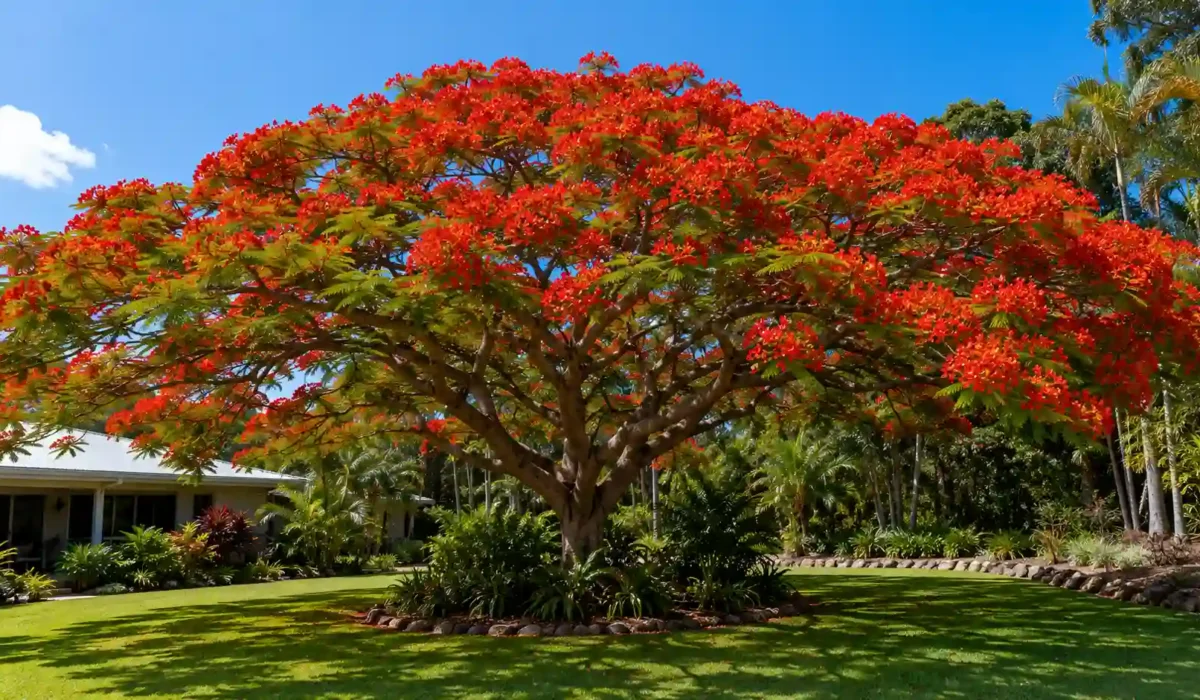
The poinciana, or Delonix regia, is a Madagascan flame tree grown across tropical and subtropical Australia. According to Elemo Baker, it flowers scarlet-orange from December to February, reaches 10–15 metres tall with a canopy often wider than its height, and is frost-tender, limiting reliable flowering to regions roughly north of latitude 32° south.
A member of the pea family Fabaceae, the poinciana produces woody seed pods up to 60cm long that ripen near-black, and typically won’t flower until the tree is around a decade old. Its spreading surface roots can lift paving and damage underground pipes, so it’s best kept well clear of structures and hard surfaces, and it’s often mistaken for the unrelated coral tree.
By Elemo Baker | Plant Care & Gardening Expert
Last Updated: July 2026
Quick Summary
- Poinciana trees (Delonix regia) are fast-growing flowering trees that typically reach 9–15m tall with a canopy spread of 10–20m.
- They grow best in frost-free tropical and subtropical Australian climates, including Brisbane and suitable areas of Perth.
- Royal poinciana trees usually begin flowering within 5–10 years when grown from seed under favourable conditions.
- Their vigorous root systems require careful planting away from buildings, paving, and underground services.
What Is a Poinciana Tree?
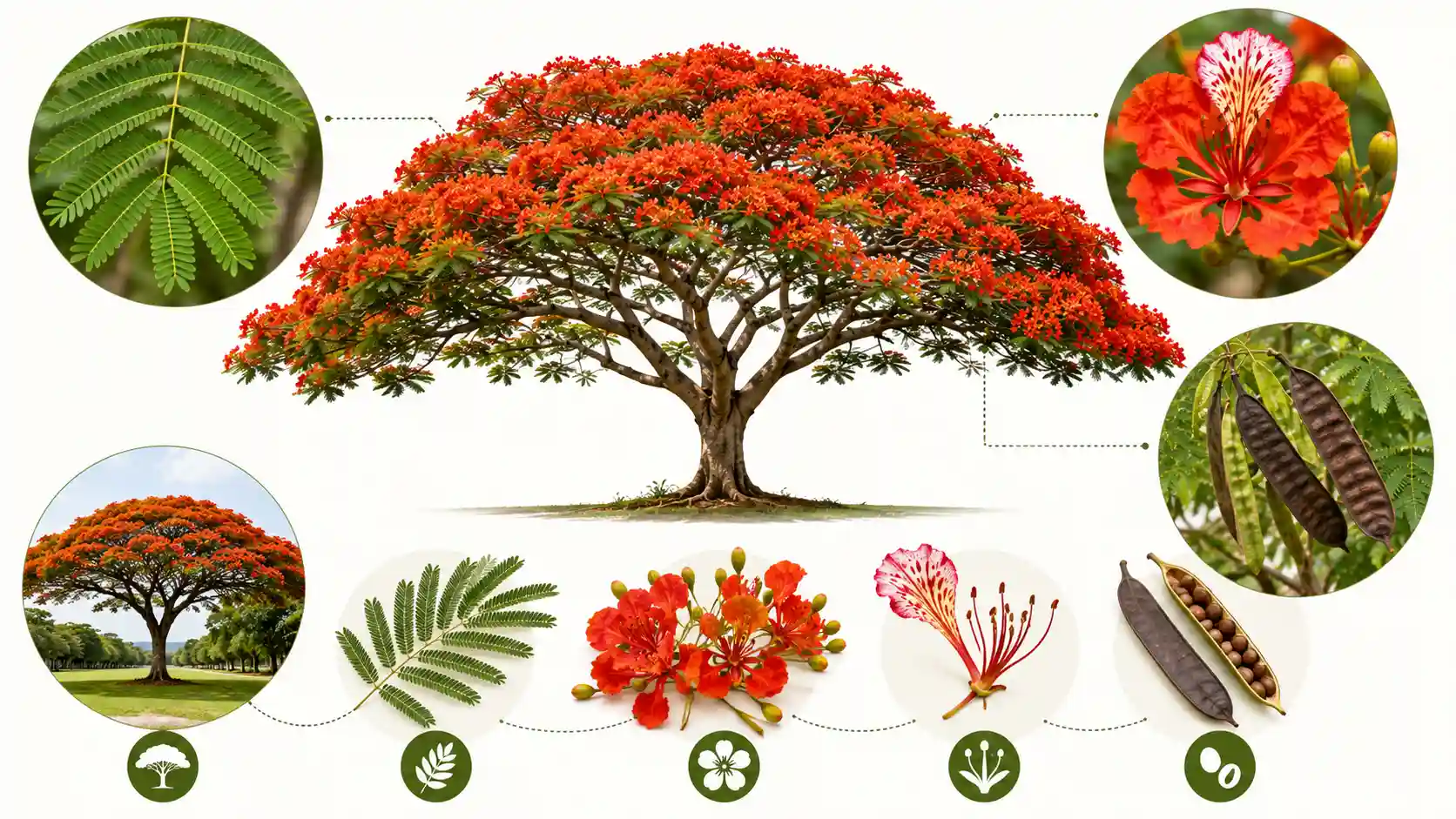
A poinciana tree is a tropical flowering tree scientifically known as Delonix regia. It belongs to the Fabaceae (legume) family and originates from Madagascar. The tree is widely recognised for its umbrella-shaped canopy, fern-like leaves, and spectacular clusters of red flowers that appear during warmer months. The species is scientifically classified as Delonix regia, and further botanical information about its classification, origin, and characteristics can be found on the Wikipedia page for Delonix regia.
The poinciana has several common names, including:
- Royal poinciana
- Flame tree
- Flamboyant tree
- Flame of the forest
The name “royal poinciana” is commonly used in Australia because of its impressive size and highly decorative flowers. The tree is valued as an ornamental shade tree in warm climates where winters are mild.
The poinciana Delonix regia is a deciduous or semi-deciduous tree depending on climate conditions. In warmer areas it may retain foliage for longer periods, while cooler regions often experience more noticeable leaf drop during winter.
Poinciana vs Poinsettia — Are They the Same?
No, poinciana and poinsettia are completely different plants. Although their names sound similar, they belong to different plant families and have different growth habits.
| Feature | Poinciana | Poinsettia |
| Scientific name | Delonix regia | Euphorbia pulcherrima |
| Plant family | Fabaceae | Euphorbiaceae |
| Growth type | Large flowering tree | Small shrub |
| Native region | Madagascar | Mexico and Central America |
| Main feature | Large red-orange flowers | Coloured leaf-like bracts |
Search terms such as “poinsianna,” “poinsiana tree,” and “are poinsettia and poinciana the same” often appear because of spelling confusion, but these plants are unrelated.
Is the Poinciana Native to Australia?
No, the poinciana tree is not native to Australia. It naturally originates from Madagascar, where it grows in warm tropical environments.
In Australia, Delonix regia is cultivated as an ornamental tree and has become especially popular in Queensland and other frost-free regions. In some tropical areas outside managed gardens, poinciana can naturalise and become environmentally invasive because its seeds spread easily and young plants can establish in suitable conditions.
Responsible planting involves selecting appropriate locations and avoiding planting in areas where the tree may affect sensitive natural ecosystems.
Poinciana Tree Growth Rate and Mature Size
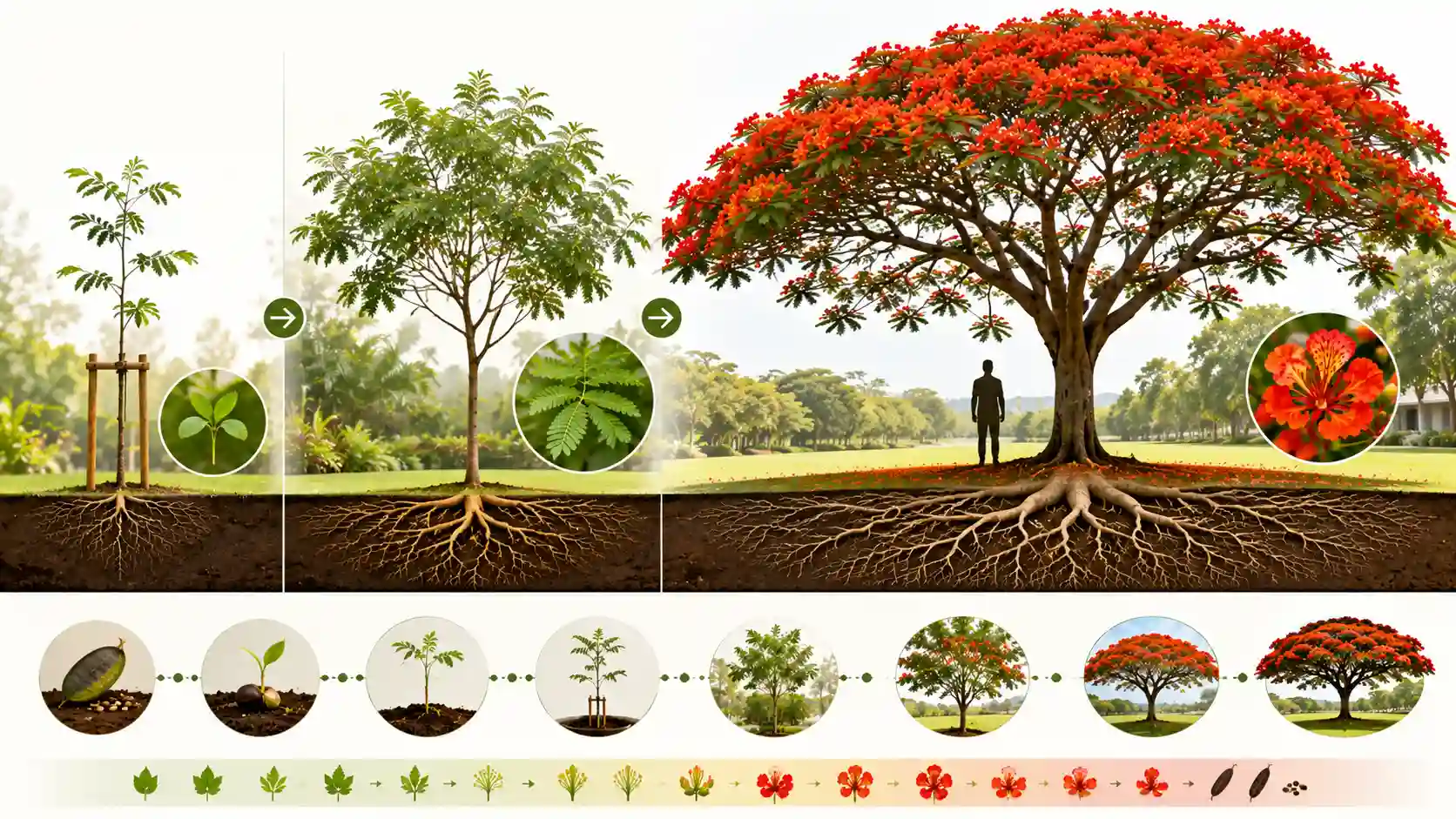
The poinciana is considered a fast-growing tree when grown in warm climates with adequate sunlight, water, and suitable soil conditions. In ideal Australian conditions, young trees can grow approximately 1–1.5 metres or more per year during active growth periods. Gardeners looking for quick landscape coverage can also compare poinciana with other fast-growing species in our guide to Fast Growing Evergreen Trees Australia Guide.
A mature poinciana generally reaches:
| Feature | Typical Measurement |
| Height | 9–15 metres |
| Canopy width | 10–20 metres |
| Growth rate | Fast |
| First flowering from seed | Around 5–10 years |
| Lifespan | Approximately 40–50+ years |
Tree size varies depending on climate, soil quality, rainfall, pruning practices, and available growing space. For example, poincianas in Brisbane often achieve larger growth because of the warm subtropical climate, while trees grown in cooler parts of southern New South Wales may remain smaller due to temperature limitations.
How Fast Do Poinciana Trees Grow?
Poinciana trees grow quickly in warm, frost-free environments. Under favourable conditions, a young tree may add around 1–1.5 metres of growth each year, especially during spring and summer when temperatures and rainfall support active development.
Growth speed depends on several factors:
- Full sunlight exposure
- Warm temperatures
- Adequate moisture during establishment
- Well-drained soil
- Protection from frost
Although poincianas are fast-growing, they need many years to develop the broad, mature canopy that makes them famous as shade trees.
How Long Does a Poinciana Tree Take to Grow / Flower?
A poinciana tree commonly takes 5–10 years to produce its first flowers when grown from seed. However, the exact timing depends on growing conditions, climate, and plant maturity.
Young poincianas often focus their energy on developing roots, stems, and foliage before producing flowers. Trees grown from grafted or nursery-grown plants may flower sooner because they begin from a more mature stage.
To encourage flowering:
- Provide at least 6–8 hours of direct sunlight daily.
- Avoid excessive nitrogen fertiliser, which can encourage leaves instead of flowers.
- Maintain healthy soil drainage.
- Allow the tree enough space to develop naturally.
In our experience growing flowering trees in Australian gardens, insufficient sunlight is one of the most common reasons mature poincianas produce fewer blooms than expected. Proper positioning from the beginning has the greatest long-term impact on flowering performance.
Where Poinciana Trees Grow Best in Australia
Poinciana trees perform best in warm, frost-free climates with plenty of sunlight and a long growing season. They naturally prefer tropical and subtropical environments similar to their native Madagascar habitat. In Australia, they are most successful in northern regions, coastal Queensland, and other areas where winter temperatures remain mild. When planning a landscape with large flowering trees, it is useful to compare different species suitable for Australian conditions. Our guide to Best Trees and Shrubs for Australian Gardens explains how to choose trees and shrubs based on climate, size, roots, and garden space.
The ideal growing conditions for a poinciana tree include:
- Full sun exposure for strong flowering.
- Warm temperatures throughout the growing season.
- Protection from frost and cold winds.
- Well-drained soil that prevents waterlogging.
- Adequate space for the mature canopy and root system.
Although poincianas can tolerate short dry periods once established, they perform best when young trees receive consistent moisture while developing their root systems.
Poinciana Tree in Brisbane
Brisbane is one of the best Australian locations for growing poinciana trees because its subtropical climate provides warm summers, mild winters, and suitable rainfall patterns.
Poincianas are recognised as iconic flowering street trees in Brisbane because their bright red flowers create dramatic displays during summer. The city’s climate allows these trees to develop large canopies and achieve their full ornamental potential.
For Brisbane gardeners, the main considerations are:
- Planting away from buildings and paved areas.
- Providing enough room for the spreading canopy.
- Managing fallen leaves and seed pods during seasonal changes.
The poinciana is often grouped among famous red flowering trees in Brisbane because of its spectacular seasonal display.
Poinciana Tree in Perth
Poinciana trees can grow in Perth, but success depends heavily on selecting a suitable microclimate. Western Australia’s Mediterranean climate provides warm summers, but cooler winters and occasional frost risks can limit growth in exposed locations.
For Perth growers:
- Choose a warm, sheltered position.
- Avoid frost-prone areas.
- Provide additional irrigation during dry periods.
- Plant in full sun for maximum flowering.
A royal poinciana in Perth may grow more slowly than one in Brisbane because the climate has a shorter warm growing period.
Best Planting Position
Choosing the correct planting location is one of the most important factors for long-term poinciana success.
The best position should provide:
- Full sun: At least 6–8 hours of direct sunlight daily.
- Open space: Enough room for a 10–20 metre canopy spread.
- Good drainage: Avoid areas where water collects after rain.
- Safe distance from structures: Keep away from foundations, paving, drains, and underground pipes.
A common mistake is planting a young poinciana without considering its mature size. The small tree purchased from a nursery can eventually become a large landscape feature requiring significant space.
Poinciana Tree Care Guide
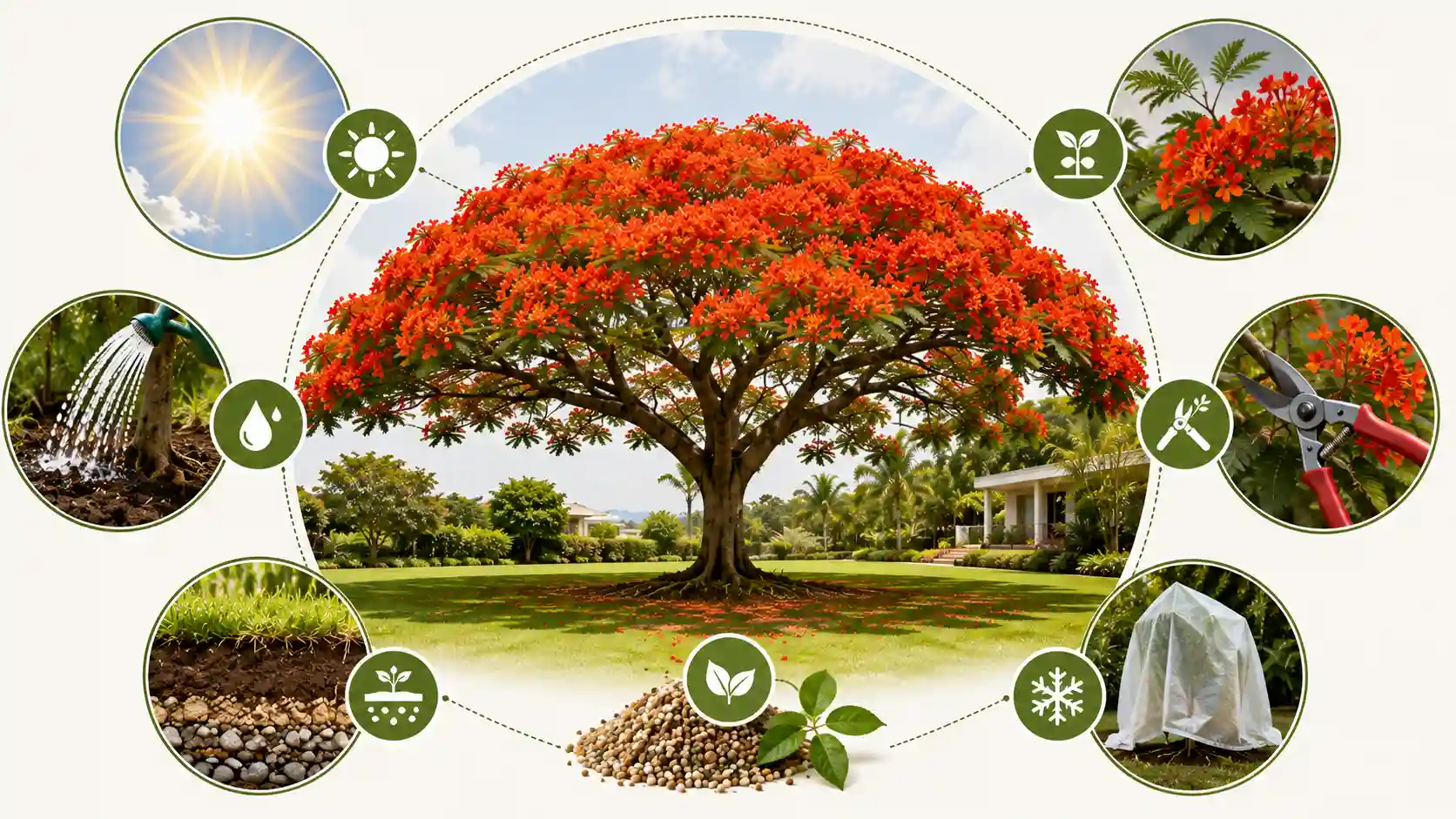
Proper poinciana care focuses on sunlight, water management, soil quality, pruning, and climate protection. Once established, royal poincianas are relatively hardy trees, but young plants need careful attention during their early years.
Watering Requirements
Young poinciana trees require regular watering while establishing their root system. Deep watering encourages roots to grow downward and improves drought tolerance.
Recommended approach:
- Water deeply once or twice weekly during hot, dry periods.
- Reduce watering once the tree becomes established.
- Avoid constantly wet soil because poor drainage can damage roots.
Mature poincianas are moderately drought tolerant but may flower better when they receive adequate moisture during active growth.
Light Requirements
Full sun is essential for healthy poinciana growth and abundant flowering. Trees grown in shaded positions often produce fewer flowers and develop weaker branches.
For best results:
- Provide unrestricted sunlight.
- Avoid planting beneath large trees.
- Allow open space around the canopy.
Sunlight is one of the biggest factors affecting royal poinciana flower production.
Soil Conditions
Poinciana trees tolerate a range of soil types but perform best in fertile, well-drained soils.
Suitable soil conditions include:
- Sandy loam or loamy soil.
- Good drainage.
- Slightly acidic to neutral soil conditions.
Heavy clay soils that remain waterlogged should be improved before planting by increasing drainage and organic matter.
Fertilising Needs
A balanced fertiliser can support healthy growth, especially during the active growing season.
General fertilising practices include:
- Apply slow-release fertiliser in spring.
- Avoid excessive high-nitrogen fertilisers.
- Use products suitable for flowering trees.
Too much nitrogen may encourage excessive leaf growth while reducing flower production.
Pruning Practices
Pruning helps young poincianas develop a strong structure and prevents weak branch formation.
Important pruning practices include:
- Remove poorly positioned branches while the tree is young.
- Encourage a strong central structure.
- Remove low branches if a higher canopy is required.
- Remove damaged or crossing branches.
Elemo Baker recommends formative pruning during early growth because correcting structural problems becomes more difficult once a poinciana reaches mature size.
Climate Tolerance
Poincianas are tropical trees and are not highly frost tolerant. They prefer temperatures above approximately 7°C and may suffer damage from prolonged cold conditions.
Cold damage symptoms can include:
- Leaf loss.
- Branch dieback.
- Reduced flowering.
- Slow spring recovery.
In cooler Australian regions, planting against a warm wall or in a protected position may improve survival.
Poinciana Tree Leaves, Flowers and Seed Pods
The poinciana tree is recognised by its unique combination of delicate foliage and dramatic flowers. Its leaves are finely divided, giving the tree a soft, fern-like appearance despite its large size.
The main identifying features include:
- Bipinnate leaves with many small leaflets.
- Large clusters of red-orange flowers.
- Long, flat seed pods.
- Wide umbrella-shaped canopy.
The flowering season generally occurs during spring and summer, with peak displays often appearing in warmer months.
Do Poinciana Trees Lose Their Leaves?
Yes, poinciana trees can lose their leaves. They are considered deciduous or semi-deciduous depending on climate conditions.
In warmer tropical regions, the tree may retain leaves for much of the year. In cooler or drier areas, it commonly drops foliage during winter or dry periods.
Seasonal leaf loss is a natural survival strategy that helps the tree conserve energy and water.
Factors affecting leaf drop include:
- Winter temperatures.
- Drought conditions.
- Rainfall patterns.
- Local climate.
A healthy poinciana producing new leaves after winter is usually showing normal seasonal growth.
Poinciana Seed Pods
Poinciana seed pods are one of the tree’s most recognisable features. After flowering, the tree develops large, flat pods containing multiple seeds.
Typical seed pod characteristics:
- Length: commonly around 30–60 cm.
- Colour: green when young, becoming dark brown or black when mature.
- Shape: long, flat, and slightly curved.
These pods can remain attached to the tree for extended periods before falling. Gardeners should consider pod litter when choosing planting locations near paths, driveways, or outdoor living areas.
Poinciana Colour Varieties
The most common poinciana flower colour is bright red-orange, but ornamental forms with different colours are also available.
Common varieties include:
| Flower Colour | Description |
| Red poinciana | The most common and widely recognised form |
| Pink poinciana | A less common ornamental variation |
| Purple poinciana | Rare colour form sometimes sold by specialist growers |
| Yellow royal poinciana | Uncommon ornamental selection |
The classic royal poinciana flower is usually associated with vivid red or orange-red blooms that create the tree’s famous tropical appearance.
Poinciana Tree Problems and Common Mistakes
Although poinciana trees are admired for their spectacular flowers and tropical appearance, they can create challenges when planted in unsuitable locations or poorly managed conditions. Understanding common problems helps gardeners make better planting decisions. Understanding root behaviour is important before planting large trees, and our guide on Poinciana Tree Root System: Growth, Problems & Care Guide provides more details about root spread, potential issues, and safe planting distances.
Common poinciana tree issues include:
- Vigorous root growth near structures.
- Cold and frost damage.
- Naturalisation in suitable warm environments.
- Pest problems such as borers and scale insects.
- Excessive size in small gardens.
Correct site selection, regular observation, and appropriate maintenance are the most effective ways to prevent problems.
Are Poinciana Tree Roots Invasive?
Yes, poinciana tree roots can be vigorous and may cause problems when the tree is planted too close to buildings, paving, driveways, or underground services. The roots usually spread widely to support the tree’s large canopy and can lift paving or interfere with nearby structures over time.
Poincianas are not considered suitable for planting directly beside houses because their mature size and root spread require significant space.
To reduce root-related problems:
- Plant well away from foundations and paved areas.
- Avoid planting near underground pipes or drainage systems.
- Consider the tree’s mature canopy size before planting.
- Use smaller trees in restricted spaces.
When choosing trees near homes, there is no single “safest” tree for every situation. The best option depends on available space, soil type, climate, and expected mature size. Smaller, less aggressive species are generally more suitable for compact gardens.
Are Poinciana Trees Toxic to Dogs?
The toxicity concerns surrounding poinciana trees are often confused with another plant that has a similar common name. Delonix regia (royal poinciana) is not the same as Caesalpinia gilliesii, which is also sometimes called poinciana or bird of paradise and has different toxicity concerns.
However, pets should still be prevented from chewing or eating plant material, including poinciana seeds and pods. Large amounts of any unfamiliar plant material may cause digestive upset in dogs.
Pet owners should:
- Remove fallen seed pods from areas used by pets.
- Discourage dogs from chewing tree parts.
- Contact a veterinarian if unusual symptoms occur after ingestion.
Poinciana vs Jacaranda: What’s the Difference?
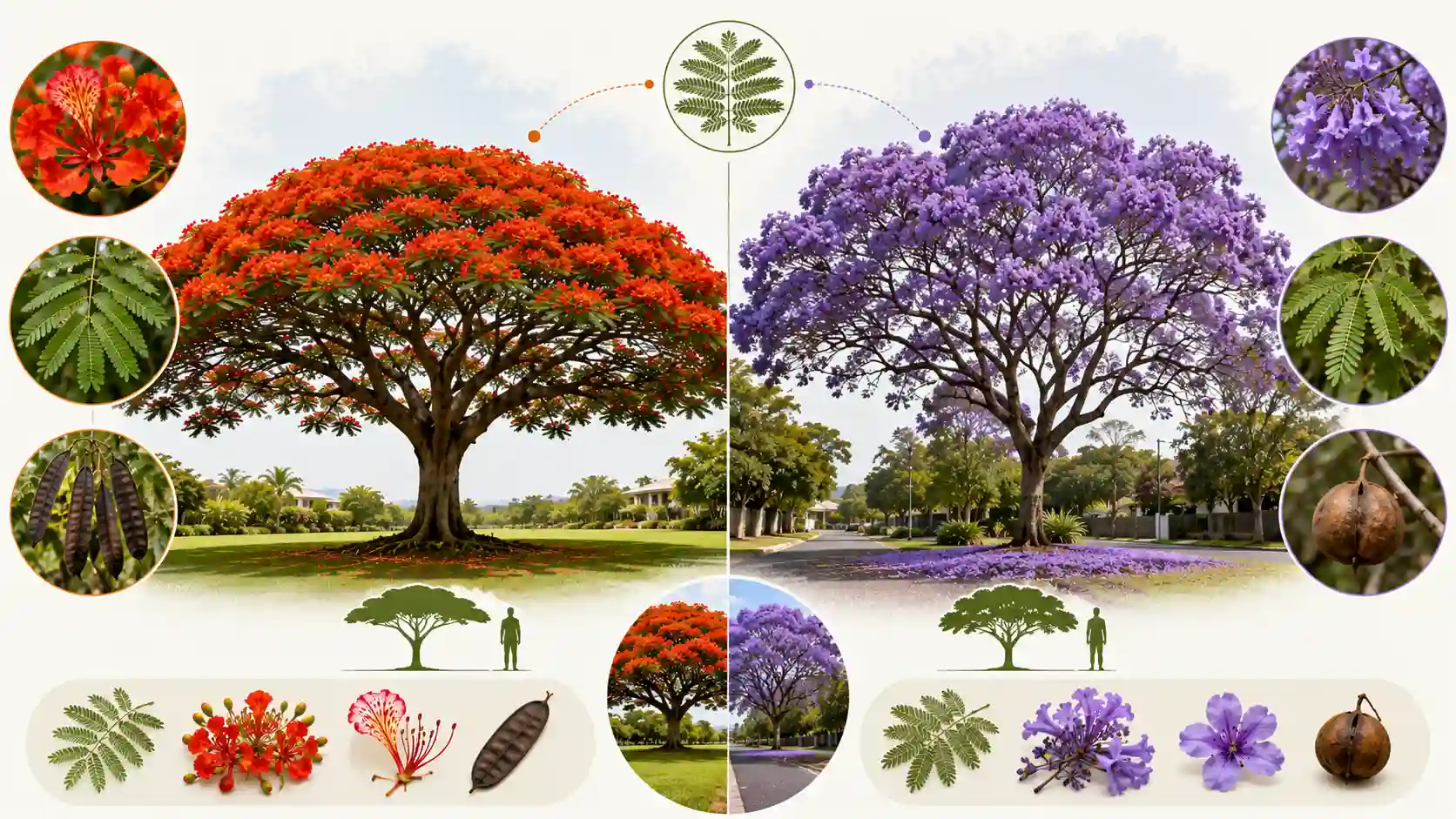
Poinciana and jacaranda trees are two of Australia’s most recognisable flowering trees, but they differ significantly in appearance, origin, growth habits, and flowering displays. Root behaviour is an important consideration when selecting large Australian landscape trees. Our guide on Gum Tree Root System: Root Spread, Problems & Safe Distances explains how mature tree roots can affect surrounding areas.
Both are large ornamental trees used in warm Australian landscapes, but they suit different garden styles.
| Feature | Poinciana | Jacaranda |
| Scientific name | Delonix regia | Jacaranda mimosifolia |
| Flower colour | Red, orange-red, some ornamental variants | Purple-blue |
| Native origin | Madagascar | South America |
| Mature height | Around 9–15m | Around 10–20m |
| Leaves | Fine fern-like bipinnate leaves | Soft, fern-like compound leaves |
| Root behaviour | Vigorous spreading roots | Broad root system requiring space |
| Flowering season | Spring to summer | Spring to early summer |
The main visual difference is flower colour. Poincianas create bright red tropical displays, while jacarandas are famous for their purple flower carpets. For gardeners interested in colourful flowering trees beyond poinciana and jacaranda, our guide on Purple Flower Tree Australia: Native & Popular Species Guide covers other purple-flowering options suitable for Australian gardens.
What Is the Difference Between a Jacaranda Tree and a Poinciana Tree?
The main difference between jacaranda and poinciana trees is their flowers and climate preference. Poincianas produce red-orange flowers and prefer warmer tropical and subtropical areas, while jacarandas produce purple flowers and tolerate a wider range of Australian climates.
Both trees:
- Grow into large shade trees.
- Need plenty of sunlight.
- Require careful planting due to their mature size.
- Are popular feature trees in Australia.
Queries such as “buy jacaranda tree Bunnings” or “jacaranda seeds Bunnings” often appear because gardeners compare these two famous flowering trees when planning landscapes. Availability varies by location and season.
Buying a Poinciana Tree in Australia
When buying a poinciana tree in Australia, selecting a healthy nursery specimen and understanding its future size are more important than choosing the largest plant available.
A suitable nursery tree should have:
- Healthy green foliage.
- A strong central stem.
- No visible pest damage.
- Roots that are not severely crowded or circling.
- A balanced shape.
Poincianas are commonly available in warm-climate nurseries, especially in Queensland where conditions are ideal for production.
Choosing Nursery Stock
When selecting a poinciana plant:
- Check that the root system is healthy.
- Avoid trees with damaged trunks.
- Look for active new growth.
- Choose a size appropriate for your planting location.
A small, healthy tree planted correctly often establishes better than an oversized tree that has experienced root stress.
Mature Poinciana Trees for Sale
Large or mature poinciana trees are sometimes available through specialist landscape suppliers. However, moving established trees is challenging because of their size, root system, and transplant requirements.
Before planting a mature specimen, consider:
- Transport requirements.
- Available planting space.
- Soil preparation.
- Long-term maintenance needs.
Search terms such as “poinciana tree for sale,” “royal poinciana tree for sale,” and “Delonix regia tree for sale” are commonly used by gardeners researching availability, but local nursery supply varies significantly.
The Famous Poinciana Trees of Australia
Poinciana trees are among Australia’s most recognisable subtropical flowering trees, especially in Queensland cities where their red summer blooms are strongly associated with warm-weather landscapes. Poinciana is one of many spectacular flowering trees grown across Australia. Explore our guide on Flowering Trees Australia: Best Species Guide to discover other colourful tree options for different landscapes.
Brisbane is particularly well known for its flowering trees, with poincianas and jacarandas both contributing to the city’s colourful seasonal displays.
When people ask “what is the famous tree in Australia,” the answer depends on context:
- Jacaranda trees are famous for their purple spring displays in cities such as Sydney and Brisbane.
- Poinciana trees are iconic in tropical and subtropical regions because of their dramatic red flowers and tropical appearance.
Both trees hold cultural importance as symbols of Australian garden landscapes rather than being native Australian species.
Conclusion
The poinciana tree Australia gardeners grow is a spectacular flowering tree valued for its fast growth, wide shade canopy, and vibrant red-orange flowers. The royal poinciana (Delonix regia) performs best in frost-free tropical and subtropical climates where it receives full sun, good drainage, and enough space to develop.
Successful poinciana planting depends on understanding its mature size, vigorous roots, seasonal leaf loss, and climate requirements. While it is an excellent feature tree for large gardens, careful placement is essential to prevent conflicts with buildings and paving.
With proper care, pruning, and suitable growing conditions, a poinciana tree can become a long-lived landscape feature and one of the most striking flowering trees grown in Australia.
Frequently Asked Questions
How fast do poinciana trees grow in Australia?
Poinciana trees are fast-growing in warm Australian climates and can grow around 1–1.5 metres or more per year when conditions are favourable. Growth depends on sunlight, water availability, soil quality, and climate.
Are poinciana tree roots invasive?
Yes, poinciana tree roots can be vigorous and may damage paving or interfere with structures if planted too close. They should be positioned well away from houses, pipes, and hard surfaces.
What is the difference between a jacaranda tree and a poinciana tree?
The main difference is flower colour and origin. Poincianas produce red-orange flowers and originate from Madagascar, while jacarandas produce purple-blue flowers and originate from South America.
Do poinciana trees lose their leaves in winter?
Yes, poinciana trees often lose their leaves during winter or dry periods. They may behave as deciduous or semi-deciduous trees depending on the local climate.
Is the poinciana tree native to Australia?
No, poinciana trees are not native to Australia. They originate from Madagascar and are cultivated widely in warm Australian regions.
Are poinciana trees toxic to dogs?
Royal poinciana (Delonix regia) is often confused with other plants called poinciana. While it is not considered the same toxic plant, dogs should still be prevented from eating seeds, pods, or large amounts of plant material.
How long does a poinciana tree take to flower?
A poinciana tree grown from seed commonly takes around 5–10 years to flower. Trees grown from more mature nursery stock may flower earlier depending on their age and growing conditions.
1 Comment