

Hibbertia scandens Ground Cover: Care & Growing Guide
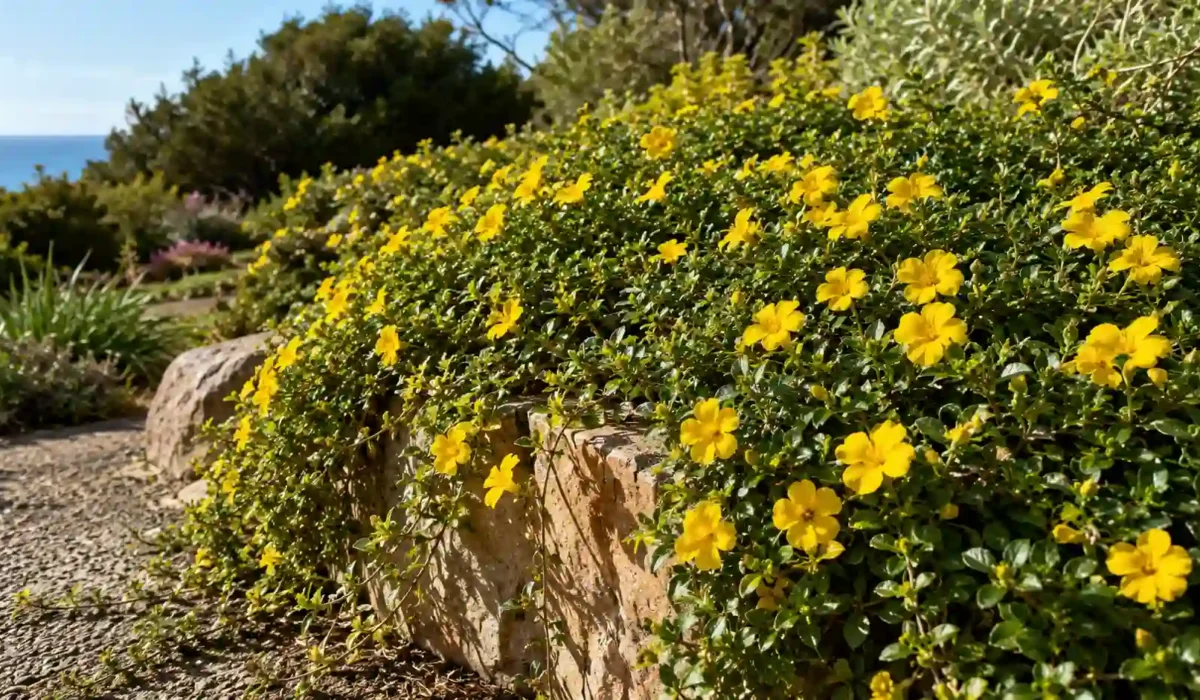
Hibbertia scandens (snake vine), Elemo Baker explains, makes an excellent ground cover for Australian gardens, spreading 2–3 metres wide as a low, scrambling mat when left unsupported. Native to eastern Australia’s coastal regions, it thrives in full sun to part shade, tolerates sandy and poor soils, and produces bright yellow flowers from spring through autumn.
Left unsupported, the vine roots along its stems as it spreads, making it effective for stabilising sloped banks and controlling erosion in coastal gardens. It withstands light salt exposure but is frost-sensitive, so gardeners in cooler inland regions should choose a sheltered position. Given a trellis or fence, the same plant readily climbs instead of sprawling, reaching roughly 3 metres in height.
By Elemo Baker | Plant Care & Gardening Expert
Last Updated: August 2026
Quick Summary
- Hibbertia scandens is a fast-growing native scrambling ground cover with large yellow flowers, particularly useful on embankments, slopes and informal garden areas.
- It grows in full sun to part shade and is notably tolerant of sandy and coastal conditions.
- It is vigorous rather than inherently invasive; its spreading stems can root where they contact suitable soil, so pruning is important.
- For broad ground-cover planting, 1–2 plants per m² is a practical starting density, although spacing depends on the cultivar and desired coverage speed.
- The common form can become a substantial scrambler, while compact selections such as Groundswell™ are better suited to tidy, low-growing areas.
What Is Hibbertia scandens? (Guinea Flower / Snake Vine Explained)
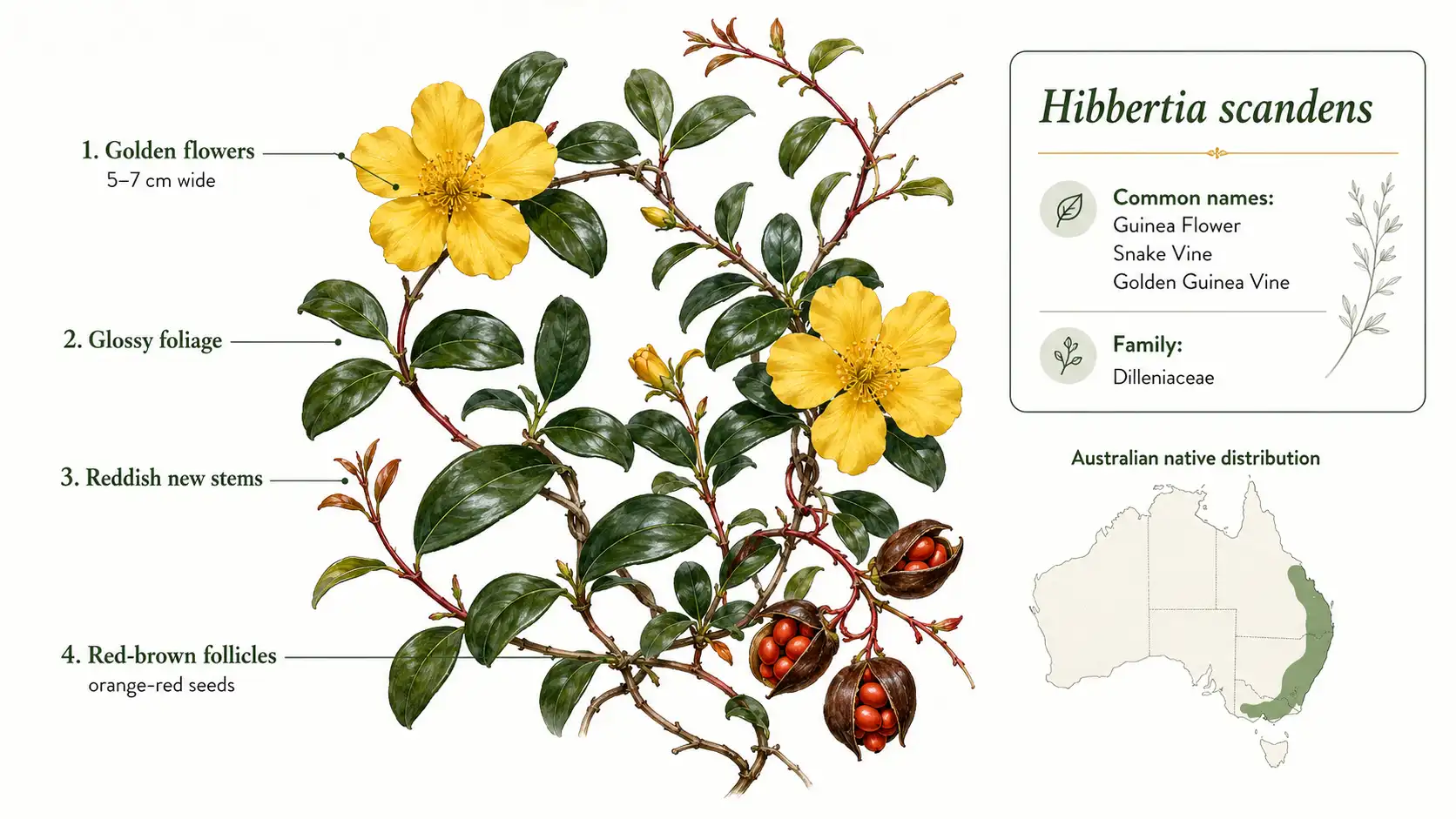
Hibbertia scandens is an evergreen Australian native climbing or scrambling plant in the Dilleniaceae family. In gardens it can be trained upwards on fences and trellises or allowed to scramble across slopes and garden beds as ground cover. Australian sources commonly call it Climbing Guinea Flower, Golden Guinea Vine, Guinea Vine or Snake Vine. These names refer to Hibbertia scandens, rather than separate species.
For additional botanical background, distribution and taxonomy, readers can also consult the Wikipedia entry for Hibbertia scandens.
The species is genuinely Australian, although its broader botanical range also includes New Guinea. Within Australia, it occurs principally from south-eastern New South Wales through Queensland, including coastal regions, with records extending to north-east Victoria.
Native Range and Natural Habitat
In its natural environment, Hibbertia scandens occurs in habitats including coastal dune forest, heathland, coastal shrubland and wet sclerophyll woodland and forest. Its association with sandy coastal environments helps explain its ability to cope with free-draining, salt-exposed sites.
Appearance — Flowers, Foliage and Fruit
The plant has glossy green foliage and large, buttercup-like golden-yellow flowers. Individual flowers can reach roughly 5–7 cm across and are produced sporadically over a long period, with flowering generally strongest in warmer months.
After flowering, the plant develops follicles rather than fleshy berries. These fruits are approximately 2 cm long and mature red-brown, eventually splitting to expose the seeds.
Is Hibbertia scandens Fast-Growing?
Yes. Hibbertia scandens is generally regarded as a vigorous, fast-growing scrambler, particularly once established in a suitable warm, sunny position. Its stems can extend several metres, allowing the plant to cover large areas relatively quickly.
For ground-cover landscaping, it can produce useful coverage within one or two growing seasons under favourable conditions, although the actual rate depends on climate, plant size at planting, soil moisture and sunlight.
There is no single “fastest ground cover in Australia”. Dichondra, native violet and several vigorous native ground covers can establish quickly in their preferred conditions. Hibbertia scandens is best described as a strong contender for fast-growing native ground cover, particularly for sunny slopes and coastal gardens.
Is Hibbertia scandens Invasive? (Clearing Up the Confusion)
Hibbertia scandens is not generally classified as an environmental weed in the Australian sources reviewed, and NatureMapr categorises the species as non-invasive or negligible risk in its recorded regions. However, “not invasive” does not mean “does not spread”.
The distinction matters. Hibbertia scandens is a vigorous native plant whose long stems can scramble beyond the area where it was planted. It can also form new growth where stems remain in contact with suitable soil. Australian horticultural sources warn that the plant can smother smaller plants if allowed to grow unchecked.
Therefore, calling it an invasive species is misleading; calling it a vigorous plant that requires boundary management is more accurate.
How to Stop It Spreading Where You Don’t Want It
- Trim stems back from paths, lawns and neighbouring plants.
- Remove stems that have begun rooting where they touch the ground outside the intended area.
- Use a physical edging barrier where appropriate.
- Give the plant an annual inspection and structural prune.
- Do not allow vigorous growth to climb into nearby shrubs or small trees.
Sun, Shade and Position Requirements
Hibbertia scandens grows in full sun to part shade, but full sun produces the best flowering. It can tolerate semi-shaded conditions, yet flowering generally decreases as available direct sunlight falls.
For reliable flowering, aim for roughly 4–6 hours or more of direct sunlight, especially in climates where strong growth and flowering are desired. It is particularly useful in hot, exposed and coastal positions once established.
Deep shade is not the best location. A plant may remain alive in lower light while producing fewer flowers and more open, leggy growth.
How to Grow Hibbertia scandens as a Ground Cover
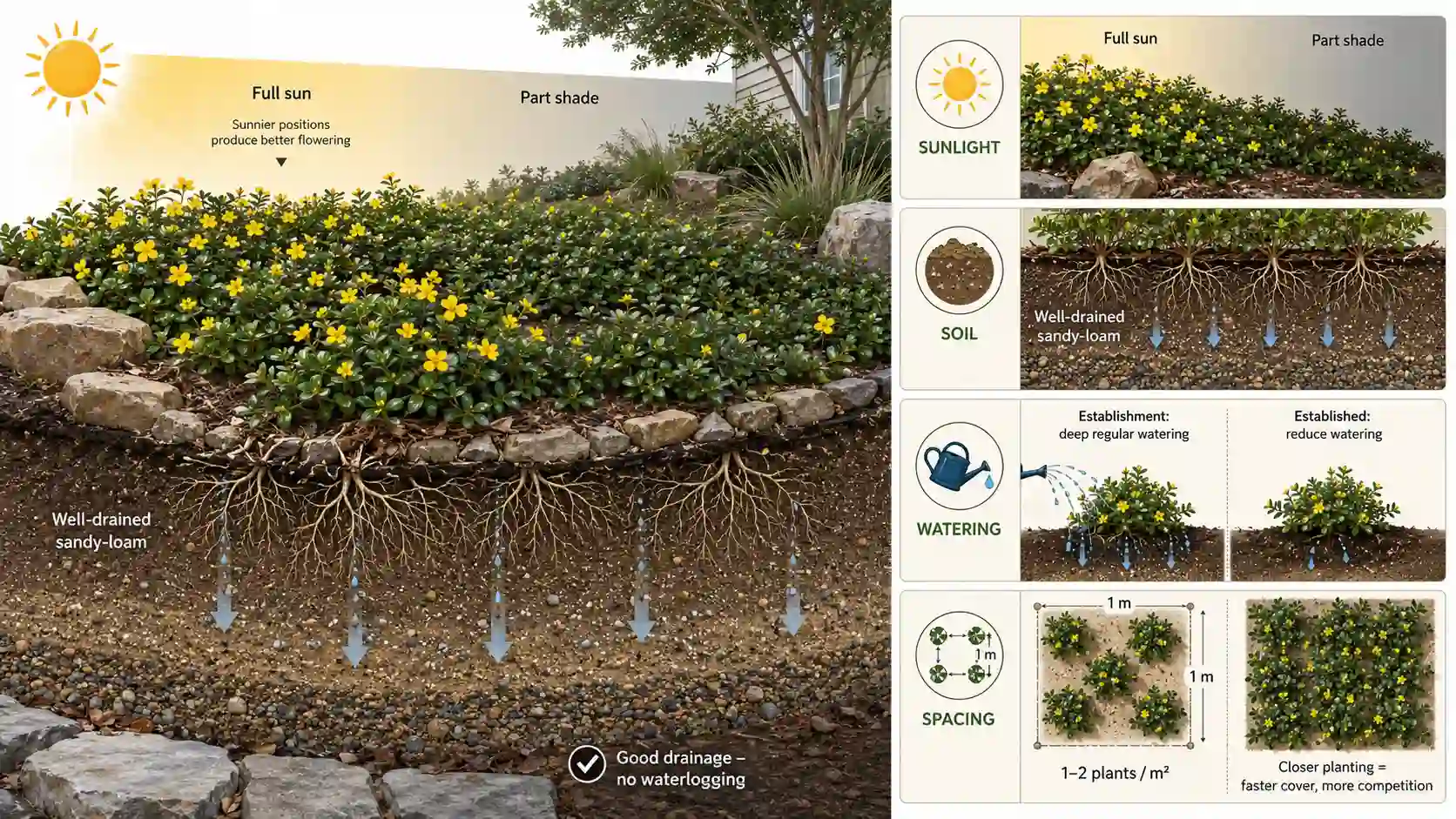
Plant Hibbertia scandens in a sunny to partly shaded position with reasonably free-draining soil. Water consistently while the roots establish, then gradually reduce irrigation as the plant becomes established.
Planting Density and Spacing
For broad ground-cover planting, 1–2 plants per m² is a useful practical starting point. Compact cultivars can have different recommended spacing, so nursery specifications should take precedence where a named selection is being planted.
Closer planting can provide quicker visual coverage, but overcrowding increases competition for water and nutrients. In our experience, allowing each plant enough room to establish a strong root system usually produces a healthier and easier-to-manage planting than packing plants tightly together.
Soil, Watering and Establishment
The species tolerates a range of soils but performs particularly well where drainage is good. Sandy and coastal soils are well suited to its natural preferences.
During establishment:
- Water deeply and regularly rather than giving frequent shallow watering.
- Keep the root zone evenly moist while new roots develop.
- Avoid prolonged waterlogging.
- Gradually reduce irrigation once plants show strong new growth.
Commercial cultivation guidance for compact Hibbertia selections commonly recommends regular watering during approximately the first 8–13 weeks, followed by lower irrigation once established.
Mature Size
The common form is substantially larger than a conventional low mat-forming ground cover. It can scramble or climb to around 2–5 m in stem length, depending on conditions and support.
When allowed to scramble across the ground, it can form broad cover several metres wide. This makes it particularly useful for large embankments rather than tiny garden beds.
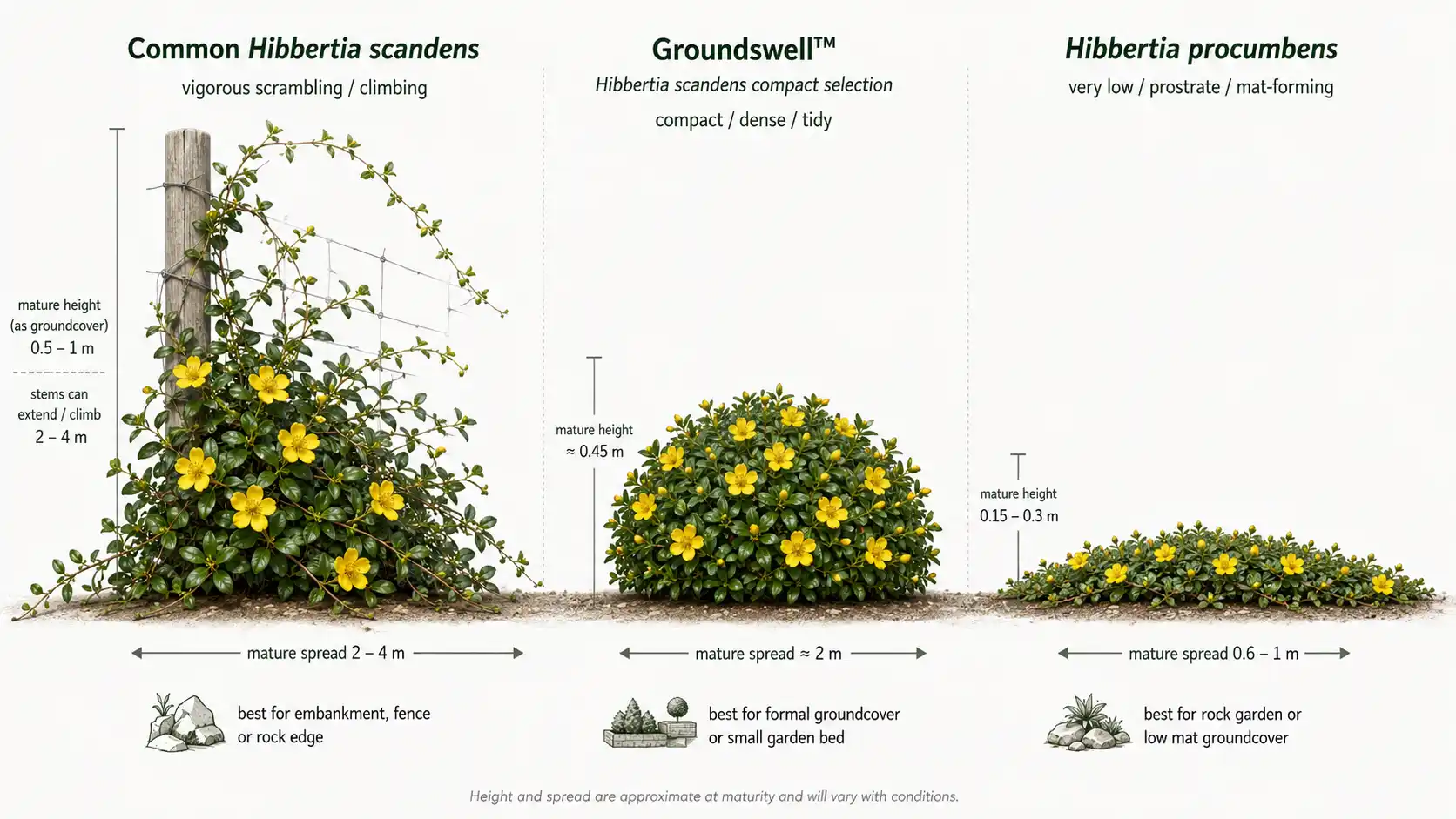
Table — Common Hibbertia scandens vs Groundswell™ vs Hibbertia procumbens
| Feature | H. scandens — common form | Groundswell™ | H. procumbens |
| Height | Up to about 1 m as ground cover; stems can climb several metres | About 30–45 cm | Generally under 20 cm |
| Spread | Broad, potentially 3–5 m | About 2 m | About 1–1.5 m |
| Habit | Rambling, scrambling and climbing | Compact, dense and tidy | Low, prostrate, mat-forming |
| Frost tolerance | Light to moderate depending on conditions | Better frost tolerance than many common forms | Light frost suitability varies |
| Best use | Embankments, large beds, screens and informal cover | Tidy ground cover, courtyards and slopes | Rockeries and low-profile planting |
Groundswell™ is a compact cultivated selection of Hibbertia scandens, not a different species. The Botanic Gardens of Sydney reported it as a strong-performing, dense ground cover reaching approximately 30 × 40 cm, while other horticultural sources give a potential spread of around 2 m.
Hibbertia procumbens is a separate species known as Spreading Guinea Flower and has a much more prostrate, mat-forming habit.
Pruning Hibbertia scandens
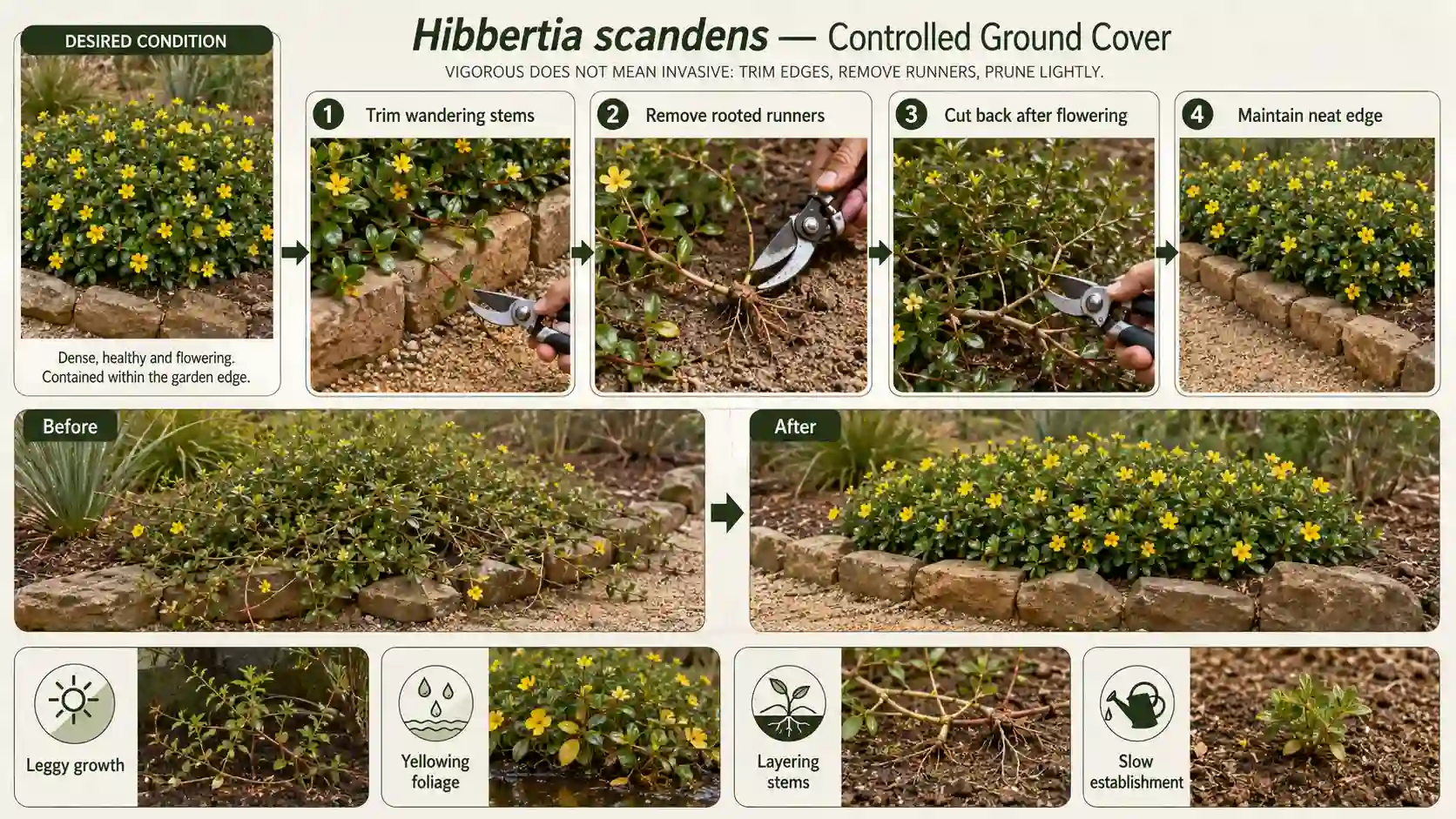
Prune Hibbertia scandens after a major flowering period or whenever growth begins extending beyond its allocated space. Light trimming maintains a dense shape, while harder pruning can rejuvenate an overgrown plant.
For a ground cover, pruning may only be necessary every 1–5 years, depending on the desired appearance and growing conditions. Plants trained as climbers or informal screens generally need more frequent training and trimming.
Elemo Baker recommends checking the edges rather than automatically cutting the entire plant: removing unwanted runners and layered stems can often maintain control while preserving the plant’s flowering structure.
Common Problems With Hibbertia scandens
| Problem | Why It Happens | Fix |
| Leggy growth and fewer flowers | Too little direct sunlight | Increase sunlight exposure where practical and prune back weak growth |
| Yellowing leaves | Excess moisture, poor drainage or root stress | Improve drainage and reduce unnecessary irrigation |
| Spreading beyond the bed | Long scrambling stems and layering | Trim edges and remove rooted stems |
| Slow establishment | Root disturbance, drought or unsuitable conditions | Water deeply during establishment and avoid relocating newly planted specimens |
Most established plants are relatively trouble-free, but poor positioning can create more problems than pests. In our experience, overwatering a plant that already has naturally good drought tolerance is a more common mistake than underwatering an established specimen.
Uses for Hibbertia scandens in the Garden
Hibbertia scandens is particularly versatile because the same plant can be managed as either ground cover or a climber. When planted beside a fence, Hibbertia scandens can provide informal green screening, although its scrambling habit makes regular trimming important; for other suitable options, see our guide to Low-Maintenance Plants for Fence Line in Australia.
Common uses include:
- Embankment and slope planting
- Erosion-control plantings
- Large-scale native ground cover
- Coastal gardens
- Scrambling beneath established trees
- Rockeries and informal beds
- Fence and trellis screening
- Pergolas and other garden structures
- Habitat planting providing cover for small garden wildlife
Its dense growth can also suppress competing weeds, although vigorous stems should be kept away from smaller plants. Hibbertia scandens also works well as part of a broader Australian planting scheme, alongside suitable native trees and shrubs selected for the site’s soil, climate and available space; see our Best Trees and Shrubs for Australian Gardens guide for complementary landscaping choices.
Is Hibbertia scandens the Right Ground Cover for You?
The best ground cover depends on sunlight, soil, traffic and the amount of maintenance you are prepared to provide.
Best Low-Maintenance Native Ground Covers in Australia
For a sunny Australian garden, Hibbertia scandens is a strong low-maintenance native option once established. Other commonly used choices include Grevillea ground-cover cultivars, Lomandra and Dichondra, with availability varying between nurseries and regions.
If your goal is screening rather than low ground cover, taller plants may be more appropriate, and our guide to Fast Growing Trees for Screening in Australia compares options suited to creating privacy at greater height.
At retailers such as Bunnings, plant selection changes by store, season and location, so local availability should be checked rather than assumed.
Ground Covers You Can Walk On
Hibbertia scandens is not a good choice for regular foot traffic. Its woody, scrambling stems are better suited to decorative coverage than a lawn substitute.
For gardeners comparing different low-growing options, Mondo Grass Garden: Care Guide for Australian Gardens is another useful reference, particularly when choosing a ground-cover style planting for Australian conditions.
For areas where people regularly walk across the planting, low-growing Dichondra or native violet can be more appropriate choices, depending on climate and site conditions.
Most Beautiful and Longest-Flowering Native Options
Beauty is subjective, but Hibbertia scandens has a strong advantage: its large golden-yellow flowers can appear sporadically over an extended period rather than being limited to a short flowering window. Australian native-plant sources report flowering throughout the year, with stronger displays generally occurring during spring and warmer months.
That makes it a particularly attractive choice when foliage cover and recurring yellow flowers are both priorities.
Beginner Mistakes to Avoid
Avoid these four common errors:
- Planting in deep shade and expecting heavy flowering.
- Overcrowding plants simply to obtain instant coverage.
- Continuing frequent watering after establishment, especially in well-drained soil.
- Allowing stems to ramble unchecked, particularly near small shrubs, paths or natural bushland.
The best results come from treating Hibbertia scandens as a vigorous native plant rather than as a slow, compact carpet plant.
Where a planting project requires taller evergreen structure rather than scrambling ground cover, our Fast Growing Evergreen Trees Australia Guide provides suitable alternatives for creating year-round garden structure.
Conclusion
Hibbertia scandens ground cover is a versatile Australian native for gardeners who need vigorous coverage, yellow flowers and relatively low maintenance. It performs particularly well in full sun, free-draining soils and coastal conditions, while tolerating part shade and a range of garden soils. Its vigorous growth should not be confused with environmental invasiveness, but the plant does need occasional boundary pruning.
For the best result, provide adequate sunlight, sensible spacing, consistent water during establishment and occasional pruning. If a smaller, tidier ground cover is required, Groundswell™ is worth considering; for large embankments and informal areas, the common form offers considerably more reach.
FAQs
1. Is Hibbertia scandens fast-growing?
Yes. Hibbertia scandens is a vigorous Australian native scrambler that can extend several metres and establish useful ground coverage relatively quickly under favourable growing conditions.
2. Is Snake Vine invasive in Australian gardens?
No, Hibbertia scandens is not generally regarded as an environmental weed in its Australian native range. However, it is vigorous and can spread beyond its intended planting area, so occasional pruning is recommended.
3. Can Hibbertia scandens grow in shade?
Yes, it can tolerate part shade, but it flowers best in full sun. Deep shade can result in weaker flowering and more open growth.
4. How far apart should I plant Hibbertia scandens for ground cover?
A practical starting point is 1–2 plants per m², although spacing should be adjusted according to the cultivar, plant size and desired coverage speed. Compact selections may have specific nursery-recommended spacing.
5. Is Hibbertia scandens poisonous to pets?
There is insufficient reliable evidence to confidently classify Hibbertia scandens as either pet-safe or poisonous. It is therefore inappropriate to claim that the plant is definitely non-toxic to pets. If a pet has eaten an unknown quantity, seek veterinary advice rather than relying on an online plant-safety list.
6. What is the difference between Hibbertia scandens and Groundswell™?
Groundswell™ is a compact cultivated selection of Hibbertia scandens. It has a much tidier, lower habit, reaching roughly 30–45 cm high, while the common species is a substantially more vigorous scrambler capable of producing stems several metres long.
7. How do I stop Hibbertia scandens from spreading too far?
Trim stems that cross garden boundaries, remove sections that have rooted where they contact soil, and give the plant a structural prune when necessary. Regular edge maintenance is usually enough to keep established plants within their intended area.
1 Comment