
Best Native Shade Trees for Australian Gardens (2026)
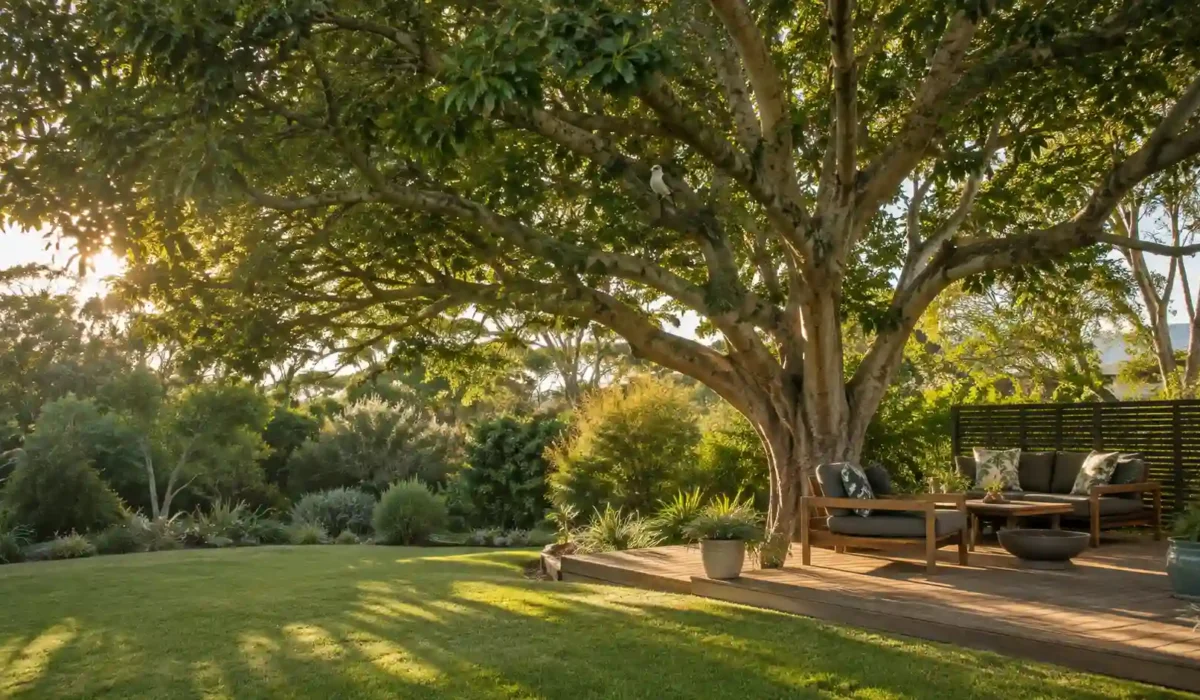
According to Elemo Baker, Australia’s best native shade trees include Brachychiton acerifolius (Illawarra flame tree), Waterhousea floribunda (weeping lilly pilly), Tristaniopsis laurina (water gum), and Melia azedarach (white cedar). These species form dense canopies of 8–15 metres, tolerate most Australian soils, and reach full height within five to ten years, growing roughly 1–2 metres annually.
White cedar is deciduous and produces berries toxic to dogs, making it better suited to open lawns than play areas. Water gum and weeping lilly pilly are evergreen with non-invasive root systems, so they’re safe planted near paths and underground services, while the Illawarra flame tree performs best in frost-free coastal and subtropical zones. This guide is part of our broader Best Trees and Shrubs for Australian Gardens series, focused specifically on native species chosen for shade.
Quick Summary
- Match tree to block size and root behaviour together — mature height alone is a misleading way to choose
- Fast-growing natives typically reach useful shade in 5–7 years; slower species take longer but usually cause fewer property problems
- Root risk doesn’t scale directly with canopy size — some large natives have safer root systems than smaller aggressive ones
- Always check your climate zone and local council rules before planting near a boundary, footpath or easement
How to Choose the Right Native Shade Tree
The direct answer: pick a species by cross-checking block size, growth rate, root behaviour and climate zone together, not one factor in isolation.
This matters because most nursery and retail plant pages are organised around a single filter — height, or growth speed, or “non-invasive roots” — with no framework connecting them. A homeowner comparing three species pages ends up with three different pieces of the puzzle and no way to see how they interact. A tree can be perfectly sized for a courtyard but still have an aggressive root system unsuitable for that same tight space, or be climate-suited to the coast but too slow-growing to be worth planting where fast shade is the priority.
As a starting rule of thumb, a young tree’s trunk diameter gives a rough guide to how far its root system is likely to extend before pruning or barriers are considered — the same principle arborists use to define tree protection zones, adapted here for home planting distances.
Best Native Shade Trees by Block Size
Small and Courtyard Blocks
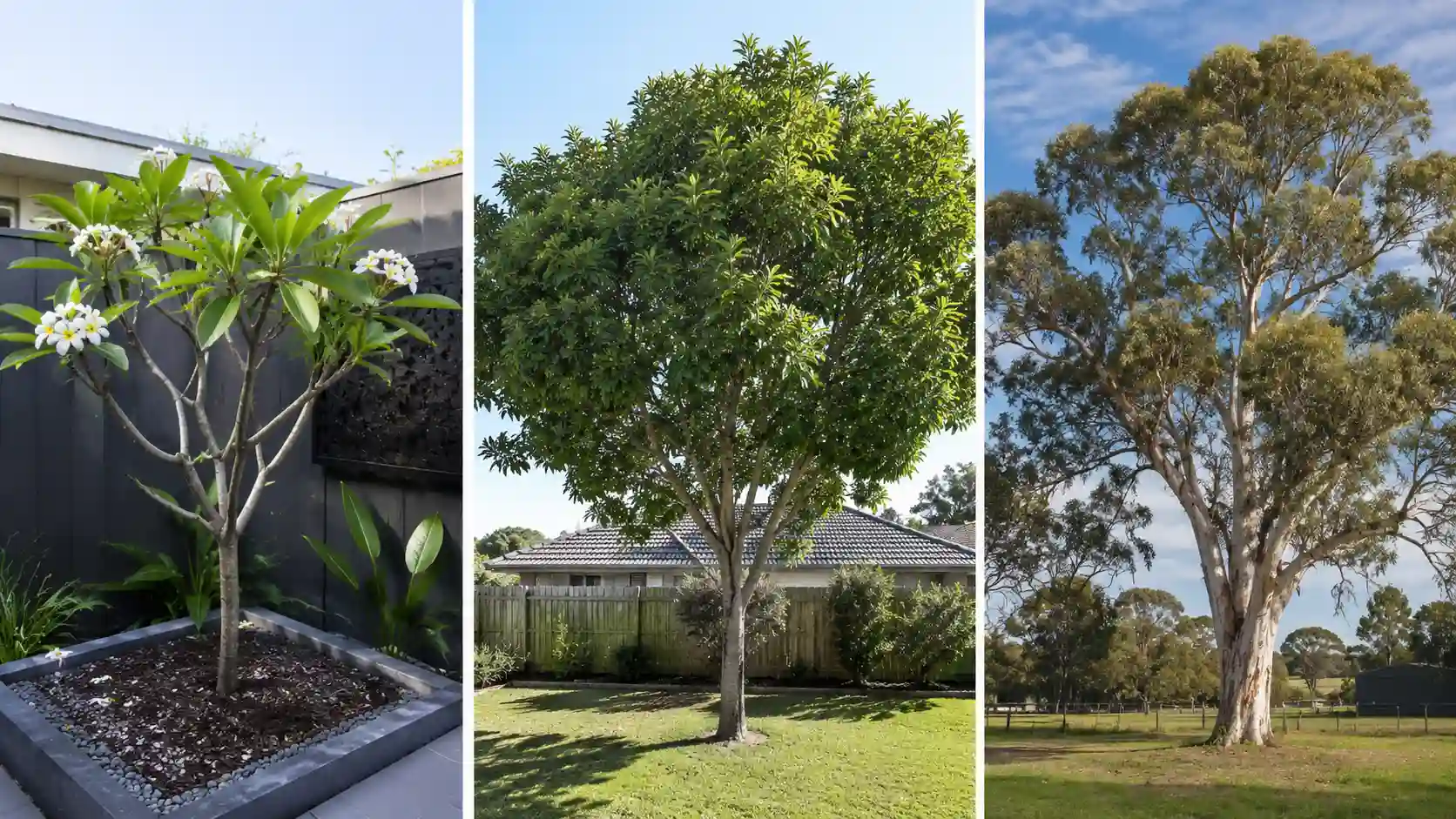
For blocks under roughly 300m², look at natives that top out around 6–8 metres: native frangipani (Hymenosporum flavum), dwarf flowering gum cultivars (Corymbia ficifolia), and Illawarra flame tree cultivars bred for a more compact habit. These give useful canopy cover without needing large clearances from fences or paving.
Medium Suburban Backyards
Where there’s more room, Tuckeroo (Cupaniopsis anacardioides), lemon-scented myrtle (Backhousia citriodora), and brush box (Lophostemon confertus) reach 8–15 metres and cast a genuinely usable shade footprint over a patio or entertaining area, while remaining manageable for a standard suburban lot. Tuckeroo (Cupaniopsis anacardioides) is one of the most reliable medium-block choices — see our full Tuckeroo Tree Growth Rate guide for detailed size and care timelines. For exact expected dimensions, our Lemon Myrtle Height and Width guide breaks down how big this fast-growing native gets in typical Australian conditions.
Large Backyards and Rural Properties
On larger blocks, eucalypts and river red gums deliver serious shade — but they also need serious clearance. Most large gums should sit at least 15–30 metres from a house or major structure once mature, so they suit acreage and rural settings far better than standard suburban backyards. Eucalyptus is the genus behind most of Australia’s largest native shade trees, including river red gum, and comprises over 700 species adapted to conditions ranging from coastal to arid inland.
| Species | Mature H×W | Best block size | Growth rate |
| Native frangipani | 6–7m × 4m | Small/courtyard | Fast |
| Dwarf flowering gum | 4–6m × 3–4m | Small/courtyard | Moderate |
| Tuckeroo | 8–12m × 6–8m | Medium backyard | Moderate |
| Lemon-scented myrtle | 8m × 4m | Medium backyard | Fast |
| Brush box | up to 15m × 8m | Medium–large | Moderate |
| River red gum / large eucalypts | 20m+ | Large/rural only | Fast |
Fast-Growing vs Slow-Growing Natives — Years to Useful Shade
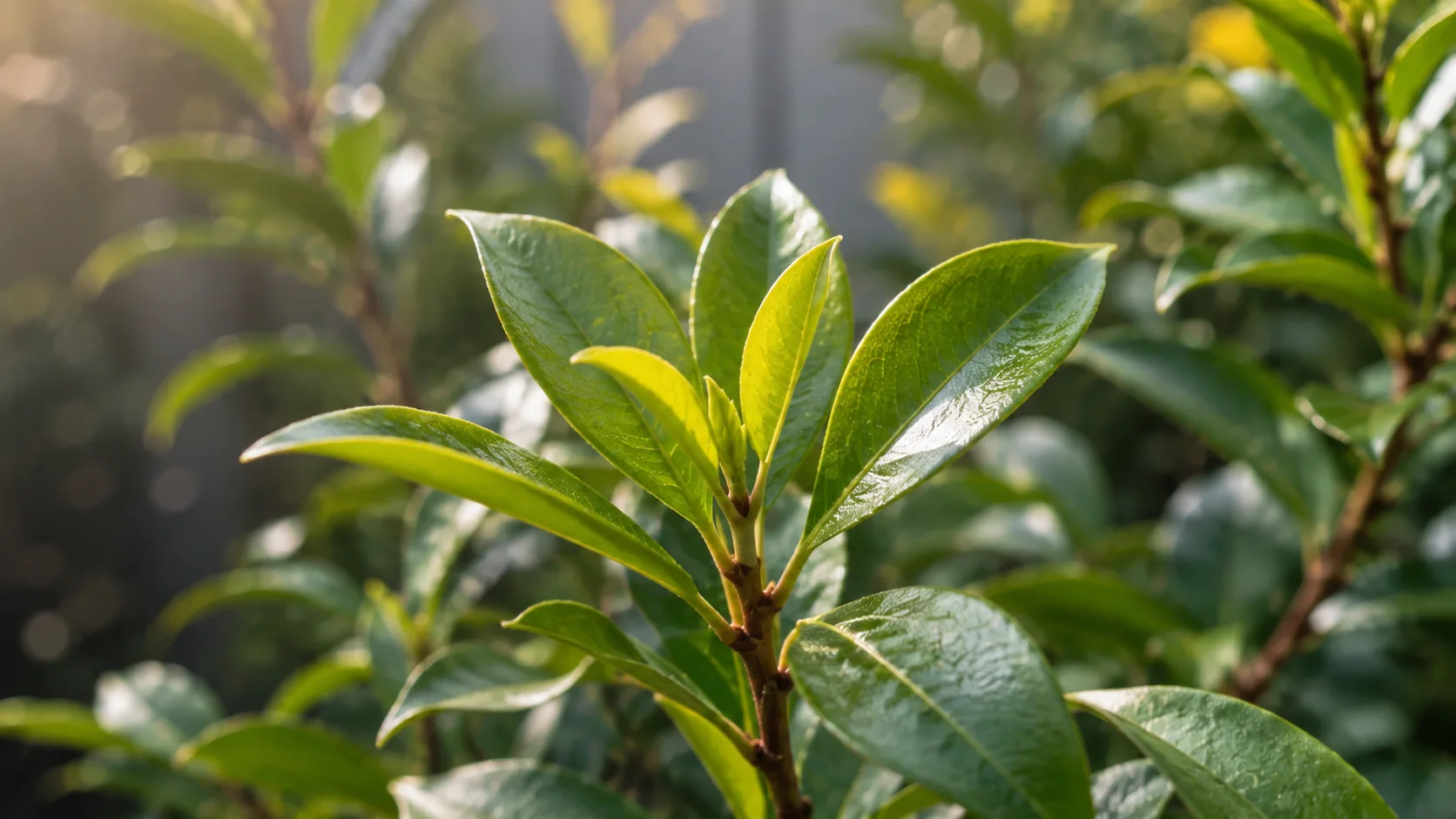
The direct answer: a fast-growing native shade tree generally reaches functional shade — not full maturity, just enough canopy to matter — in about 5 to 7 years from planting; slower species can take a decade or more. These estimates are drawn from our broader Growth Rate, Root Spread & Plant Sizing Guide, which explains how to read growth-rate labels for any species, not just shade trees.
This distinction matters more than mature height alone, because most competing guides state final size but not how long it actually takes to get there. Lemon-scented myrtle and native frangipani are both genuinely fast growers suited to readers who want shade sooner rather than later. Tuckeroo and brush box grow at a more moderate pace but tend to need less corrective pruning over their lifespan.
| Species | Growth rate | Est. years to useful shade |
| Native frangipani | Fast | 5–6 years |
| Lemon-scented myrtle | Fast | 5–7 years |
| Tuckeroo | Moderate | 7–9 years |
| Brush box | Moderate | 8–10 years |
| Large eucalypts | Fast (but large) | 6–8 years to useful shade, decades to full size |
Evergreen vs Deciduous/Semi-Deciduous Natives
Most Australian native shade trees are evergreen, which is worth knowing upfront — genuinely deciduous native options are limited compared with introduced species like maples or claret ash. Evergreen natives such as Tuckeroo and brush box give year-round screening and shade, which suits privacy-focused gardens but means no extra winter sun on north-facing windows. Illawarra flame tree is one of the few natives that’s semi-deciduous, dropping some leaves before its spring flowering, which gives a partial winter-sun benefit exotic deciduous trees provide more reliably.
Root Safety: Safe Planting Distances
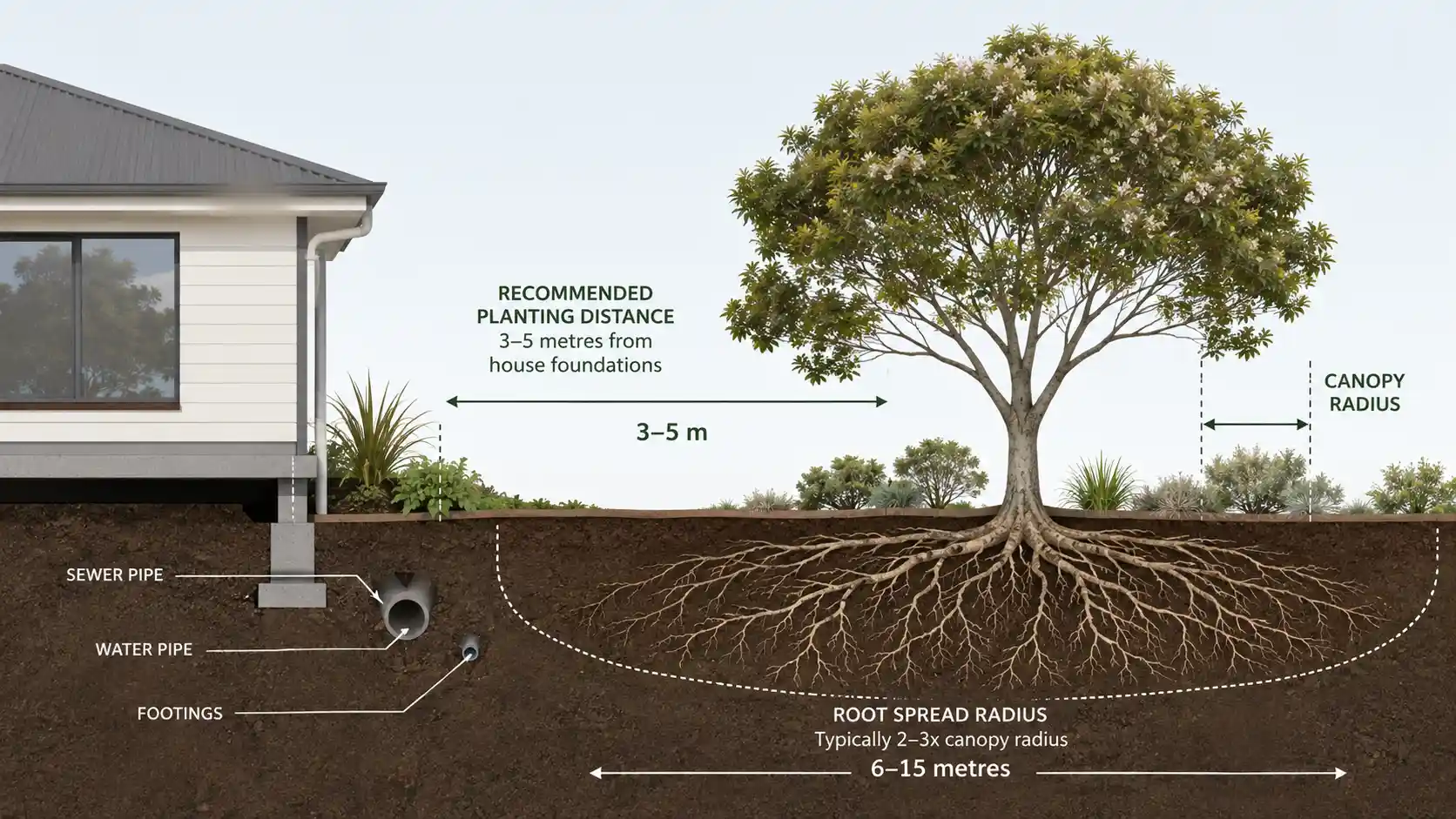
The direct answer: small natives generally need 3–5 metres clearance from foundations and pipes, medium natives 8–12 metres, and large eucalypts 15–30 metres.
Root risk doesn’t track canopy size in a straight line — it’s driven by how aggressively a species seeks water. Large eucalypts and Illawarra flame trees both have extensive, water-seeking root systems capable of damaging drains and foundations well beyond their canopy line, which is why even a visually modest young gum can become a problem tree a decade on. By contrast, some genuinely non-invasive natives can be planted closer than their canopy size would suggest. Large eucalypts carry the highest root risk of any tree on this list — our dedicated Gum Tree Root System guide covers safe distances and warning signs in more depth.
Low root risk (generally safer near structures): dwarf flowering gum cultivars, native frangipani High root risk (keep well clear of pipes/foundations): large eucalypts, Illawarra flame tree, established Tuckeroo specimens
Always confirm underground service locations before digging, and treat these as general guidance rather than a substitute for an arborist assessment on a specific site.
Climate Zone Suitability
| Climate zone | Small-block option | Medium-block option | Large-block option |
| Tropical | Weeping lilly pilly | Tuckeroo | Large rainforest eucalypts |
| Subtropical | Native frangipani | Lemon-scented myrtle | Brush box |
| Temperate | Dwarf flowering gum | Cootamundra wattle (large shrub/small tree form) | River red gum |
| Arid/inland | Silver banksia (large shrub) | Wilga (Geijera parviflora) | Mallee eucalypts |
Frost, Drought and Coastal Tolerance
- Frost-tolerant: Cootamundra wattle, silver banksia, most mallee eucalypts If frost is your main concern rather than shade specifically, our Frost Tolerant Plants Australia guide covers a wider range of cold-hardy natives beyond trees.
- Drought-tolerant once established: Wilga, Tuckeroo, flowering gums
- Coastal-tolerant: Tuckeroo (naturally a coastal species), weeping lilly pilly, brush box
Council Rules, Street Trees and Easements
If you’re planting anywhere near a nature strip, footpath or road reserve, that land is typically council-controlled, and planting there without approval can breach local by-laws. Standard clearances commonly required include roughly 3 metres from power poles and adequate vertical clearance under service wires — but exact rules vary by council and utility provider, so it’s worth checking with your local council before planting street-adjacent trees, not just relying on general guidance like this.
Wildlife Value
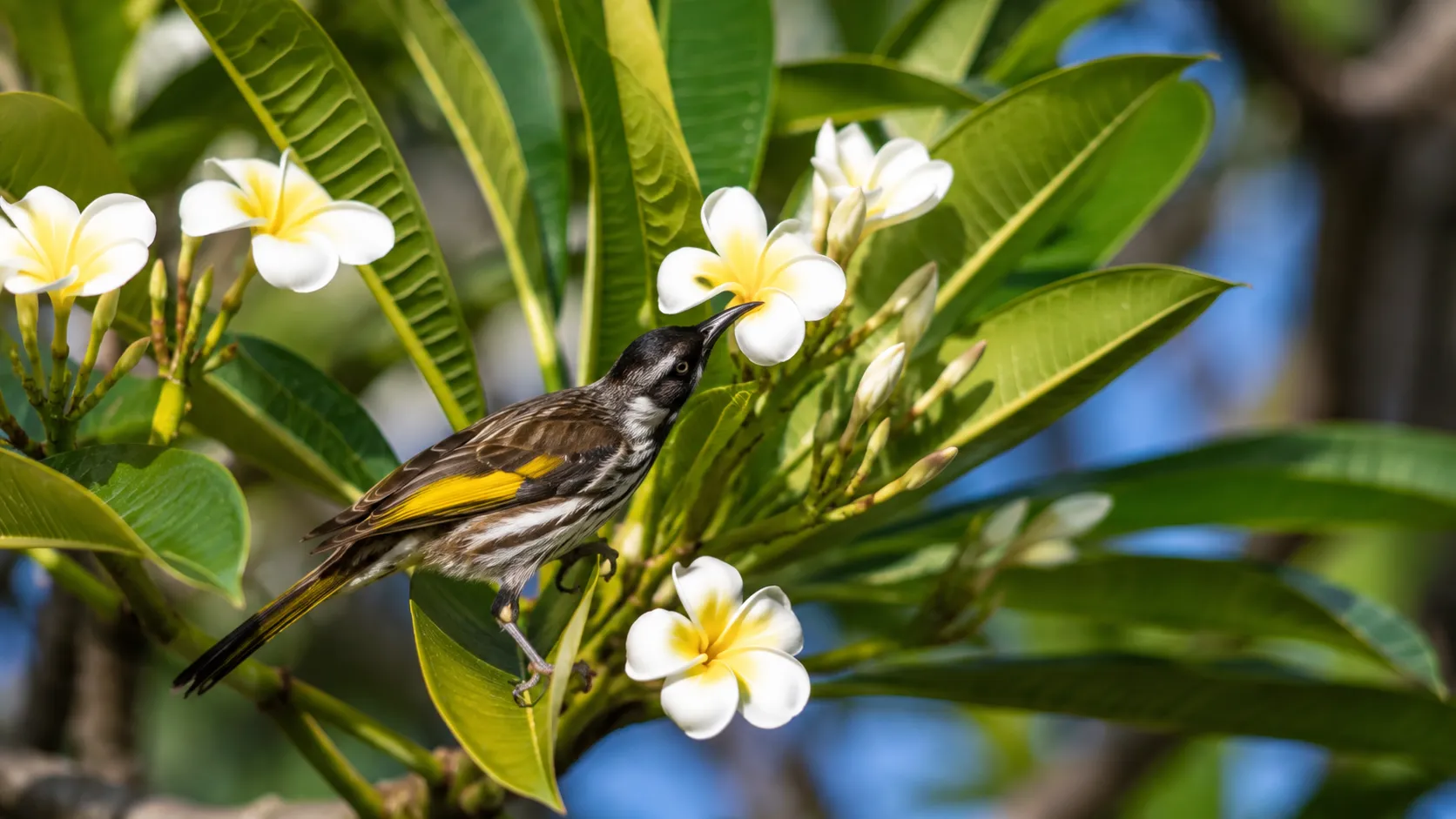
Many native shade trees pull double duty as habitat. Flowering species like native frangipani, lemon-scented myrtle and flowering gums attract nectar-feeding birds and native bees, while fruiting species such as Tuckeroo provide food for local birdlife — a genuine advantage over exotic shade trees chosen purely for canopy.
Common Mistakes When Choosing and Planting Native Shade Trees
- Underestimating mature size: young trees look manageable for years before their real footprint appears — always plan around mature H×W, not current size.
- Ignoring root behaviour: a tree can be perfectly sized for a small block and still have roots unsuited to being planted close to a foundation.
- Skipping a soil check: reactive clay soils increase the risk of root-related structural movement; a basic soil assessment before planting reduces this risk.
- Choosing the wrong climate-zone species: a subtropical rainforest native planted in a frost-prone temperate garden will struggle regardless of how well it suits the block size.
- Skipping council approval: planting on a nature strip or near an easement without checking local rules can mean the tree has to be removed later.
Conclusion
The best native shade tree for an Australian garden isn’t a single “top pick” — it’s whichever species correctly matches your block size, your patience for growth speed, your climate zone, and a root system your foundations, pipes and fences can live with. Working through those four factors together, rather than picking on looks or mature height alone, is what actually prevents the ten-years-later problems this guide set out to solve.
FAQs
What is the fastest-growing native shade tree in Australia?
Lemon-scented myrtle and native frangipani are both fast growers, generally reaching useful shade within 5–7 years.
How far should a native shade tree be planted from a house?
It depends on mature size: roughly 3–5 metres for small natives, 8–12 metres for medium species, and 15–30 metres for large eucalypts.
Which native shade trees are safe to plant near a pool?
Smaller, low root-risk species like native frangipani and dwarf flowering gum cultivars are generally safer pool-adjacent choices than large eucalypts or Illawarra flame trees.
Do native shade trees need a lot of water once established?
Most recommended species here, including Wilga, Tuckeroo and flowering gums, are drought-tolerant once established, though all trees need regular watering in their first one to two years.
Can I plant a native shade tree on my nature strip?
Only with council approval in most areas — nature strips are council-controlled land, and species and placement are often restricted.
Which native trees give shade in summer but let sun through in winter?
True deciduous natives are rare; the Illawarra flame tree is semi-deciduous and gives a partial winter-sun benefit that fully evergreen natives can’t.
1 Comment