
Best Air Purifying Plants Australia: Do They Work?
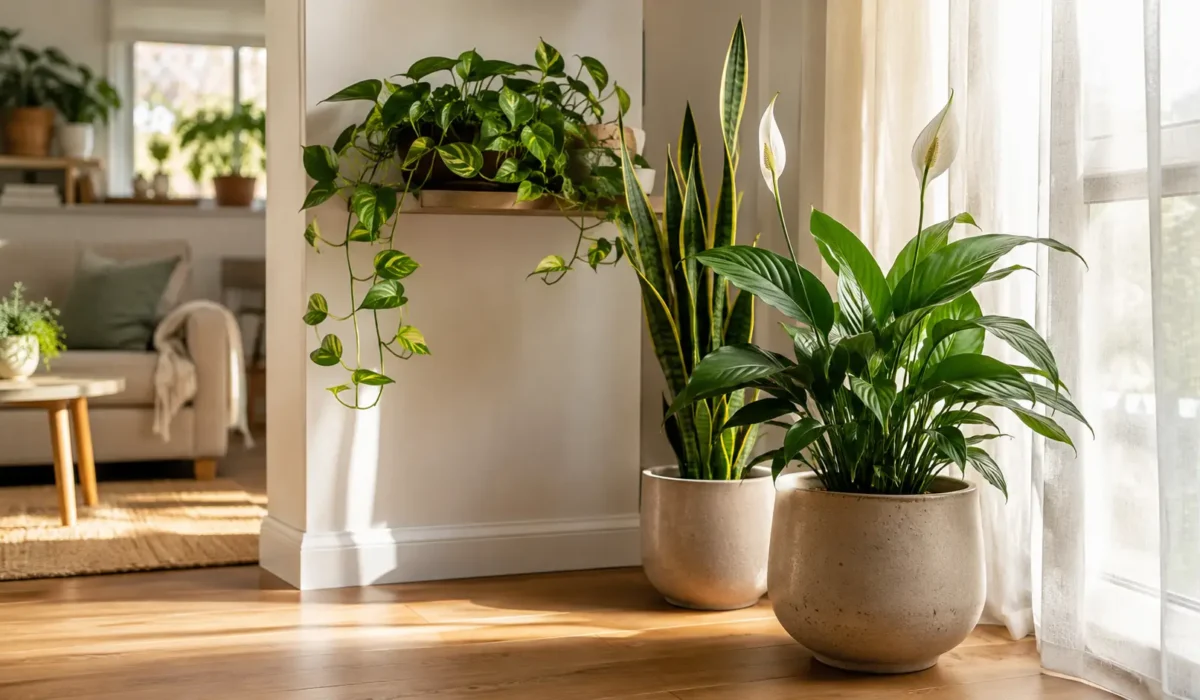
According to Elemo Baker, the best air purifying plants for Australian homes are devil’s ivy, peace lily, snake plant, spider plant and areca palm. These species tolerate Australia’s variable indoor humidity and light levels while filtering common toxins like formaldehyde and benzene, making them low-maintenance choices for improving indoor air quality year-round.
Snake plant is one of the few species that keeps releasing oxygen overnight, making it well suited to bedrooms, while devil’s ivy and peace lily are toxic if ingested by cats and dogs and should be positioned out of reach. The air-purifying results widely cited from NASA’s original research were measured in sealed lab chambers, so the effect in a naturally ventilated Australian home is far more gradual than headlines suggest.
By Elemo Baker | Plant Care & Gardening Expert
Quick Summary
- Air-purifying plants do absorb trace amounts of airborne VOCs, but far too slowly to meaningfully clean a normal, ventilated room — the original 1989 NASA study measured sealed 1.5m³ chambers, not lived-in homes.
- Independent follow-up research (a 2019 Drexel University review, the American Lung Association’s public position, and the EPA’s own 1992 re-analysis) has since found you’d need somewhere between 10 and over 1,000 plants per square metre of floor space for a measurable effect.
- Some of the most commonly recommended “air purifying” plants — peace lily, pothos, philodendron, dracaena — are toxic to cats and dogs, and this rarely gets flagged in the standard listicle.
- The better approach: pick plants for the light your home actually gets, their safety around pets and kids, and the genuine (non-air-purification) benefits they bring — not as a stand-in for opening a window.
Do Air-Purifying Plants Actually Work? (Myth vs Reality)
The short answer: they help a little, but nowhere near enough to be your main air-quality strategy.
What the 1989 NASA Study Actually Tested
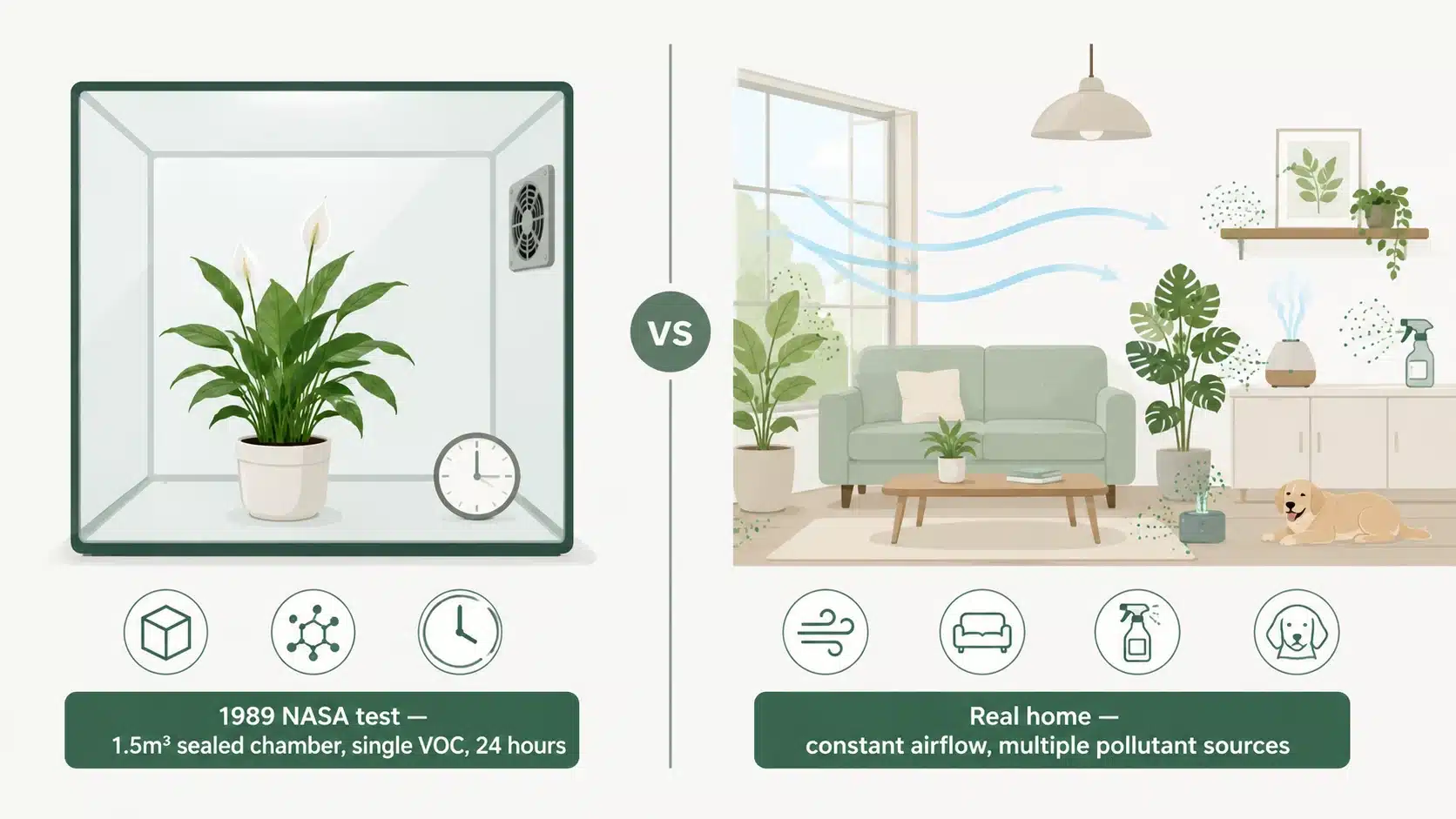
The NASA Clean Air Study, run in search of ways to purify air on space stations, placed individual houseplants in sealed 1.5-cubic-metre chambers and measured how much of a single introduced VOC — formaldehyde, benzene, trichloroethylene — the plant removed over 24 hours. That’s the entire basis for the “peace lilies remove benzene” claims still repeated across almost every plant retailer’s blog today.
The problem is that a sealed chamber with one pollutant and no airflow is nothing like a house. A real room has multiple pollutant sources releasing VOCs continuously, and — critically — a constant exchange of air with the outdoors through windows, doors, and standard heating/cooling systems. That air exchange dilutes VOCs far faster than any plant can absorb them.
What Later Research Found
In 2019, Drexel University researchers Michael Waring and Bryan Cummings reviewed 12 published studies spanning three decades — 196 experiments in total — and published their findings in the Journal of Exposure Science and Environmental Epidemiology under the plainly worded title “Potted plants do not improve indoor air quality.” Their calculation: to match the air-cleaning rate seen in the NASA chamber, you’d need somewhere between 10 and 1,000 plants per square metre of floor space, depending on the pollutant and plant efficiency involved.
This isn’t a fringe conclusion. The American Lung Association’s own published position states that houseplants do not meaningfully clean indoor air, and points back to a 1992 EPA memo that reached the same math independently — estimating roughly 680 plants would be needed in a typical house to replicate the NASA chamber’s removal rate. Both organisations recommend the same alternative: source control (avoid VOC-heavy products), ventilation, and, where needed, a proper filter — not a windowsill of pot plants.
So Should You Bother?
Yes — just not for the reason most listicles give you. Plants add humidity, a genuine (if modest) mood and stress-reduction benefit, and a small amount of VOC absorption that’s real, just too slow to matter on its own. Think of them as a pleasant complement to good ventilation, not a replacement for it. Plants add humidity, a genuine (if modest) mood and stress-reduction benefit, and a small amount of VOC absorption that’s real, just too slow to matter on its own — for the fuller, evidence-based picture beyond air purification, see our guide to the science-backed benefits of indoor plants.
How Many Plants Would You Actually Need?
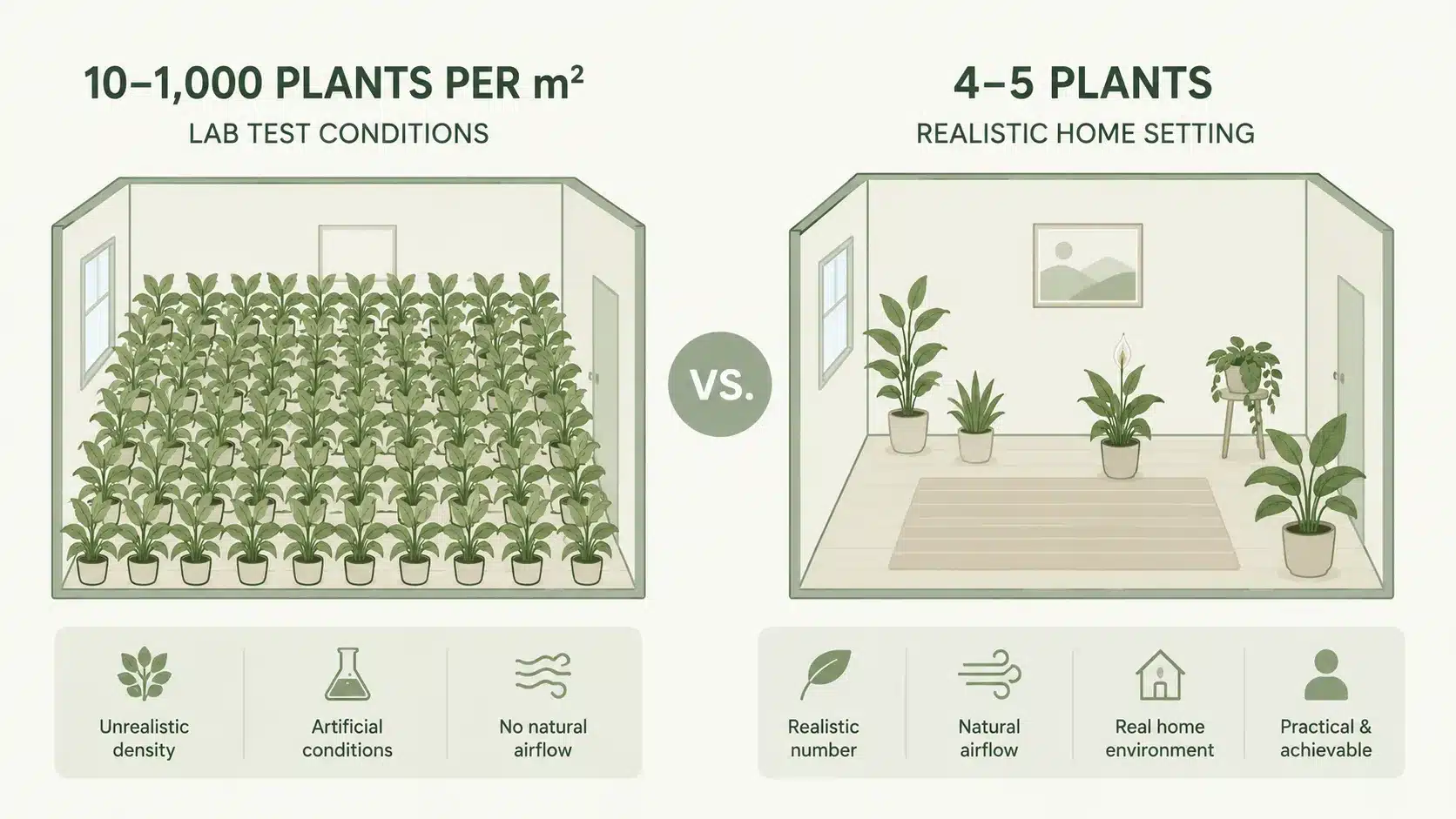
Running the sourced figures against a typical Australian room makes the gap concrete. For an average 10m² bedroom, the Drexel range (10–1,000 plants per m²) works out to somewhere between roughly 100 and 10,000 plants — and the EPA/ALA whole-house estimate of ~680 plants for a typical home lands in the same order of magnitude. Either way, it’s not a number any household is going to hit with a few pots on a shelf.
| Claim | Basis | Practical takeaway |
| “Plants purify air” (as commonly marketed) | 1989 NASA sealed-chamber study | Chamber conditions, not a real room |
| 10–1,000 plants per m² needed | 2019 Drexel University review (196 experiments) | Far beyond what any home fits |
| ~680 plants per typical house | 1992 EPA memo / American Lung Association | Same conclusion, independent source |
Best Air Purifying Plants for Australian Homes
Since the air-purification claim doesn’t hold up at household scale, the plants worth choosing are the ones that suit your actual conditions — light, climate, and how much you want to fuss over them — while still contributing their small, genuine air-quality benefit.
Best for Low-Light Apartments & Rentals
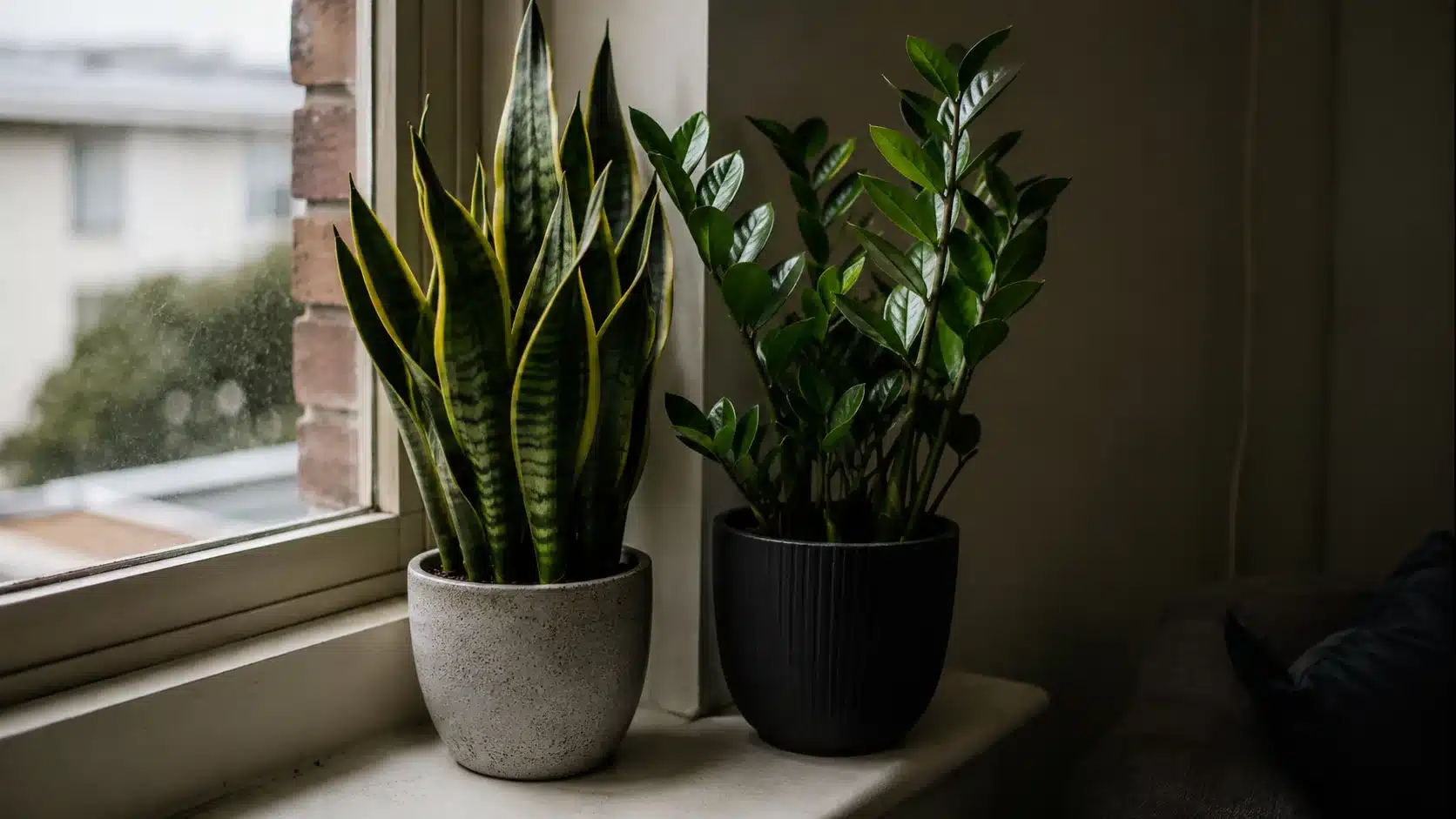
Most Australian rentals and apartments are light-poor, so tolerance matters more than showy foliage. Snake plant (Dracaena trifasciata) and ZZ plant cope with low, indirect light and irregular watering. Peace lily tolerates lower light too, but see the pet-safety section below before buying one. Chinese evergreen (Aglaonema) is another reliable low-light option, though the more colourful variegated forms need a touch more brightness to hold their colour. Snake plant (Dracaena trifasciata) and ZZ plant cope with low, indirect light and irregular watering — if you want the full case for growing one, our breakdown of snake plant benefits covers more than just air quality.
Best Native Australian Options
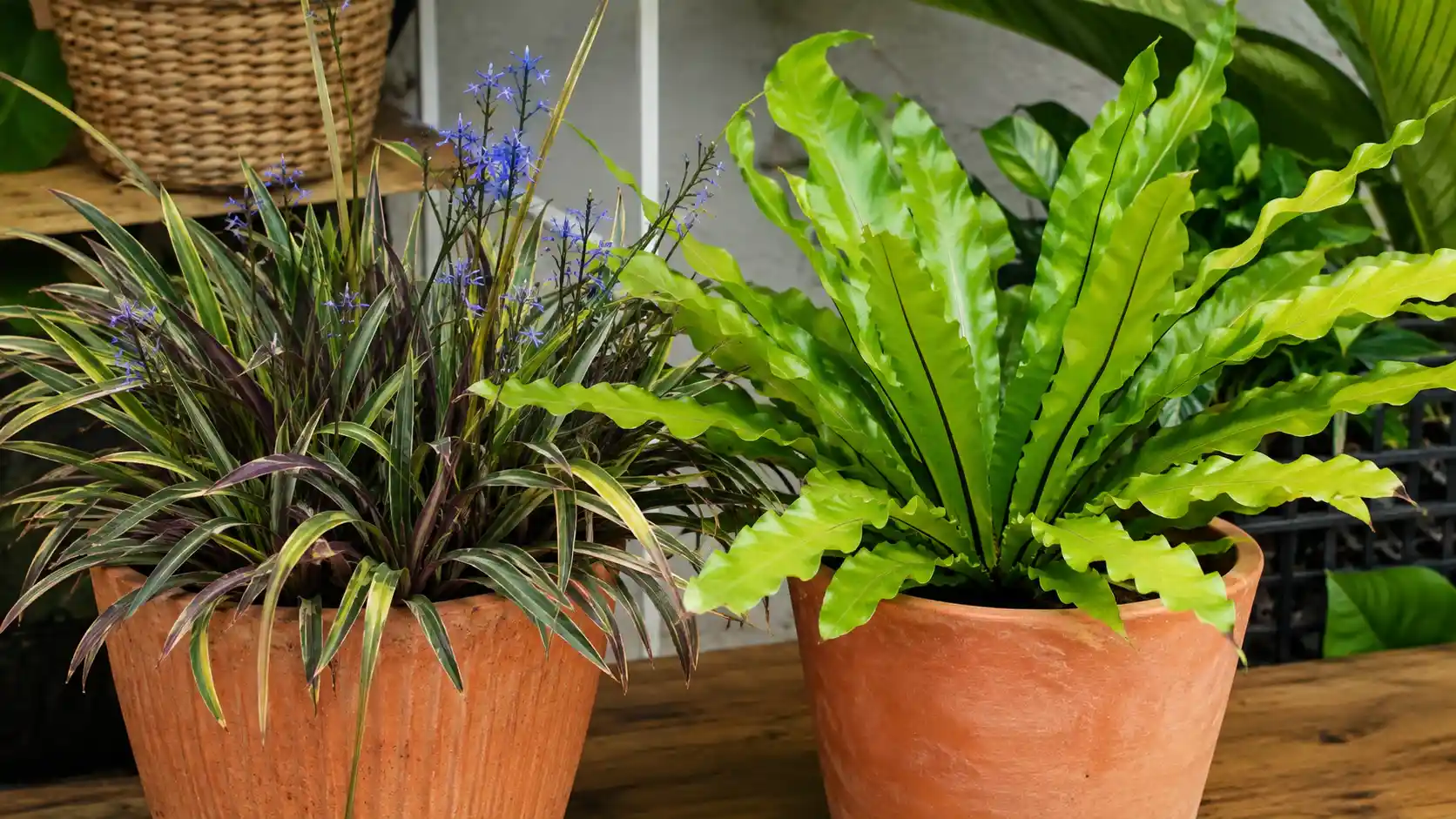
If you’d rather back a native over an imported staple, several Australian species handle indoor conditions well: birds nest fern, flax lily (Dianella spp.), and kentia palm all tolerate low-to-moderate light and adapt reasonably well to pot culture. They won’t out-purify a pothos — nothing meaningfully does — but they’re a genuinely local, lower-input alternative that suits Australian humidity and light patterns.
Easiest to Keep Alive (Beginner-Proof)
ZZ plant and spider plant are close to indestructible — both tolerate inconsistent watering and a range of light levels, and spider plant is non-toxic to pets, making it a solid first buy. ZZ plant and spider plant are close to indestructible — both tolerate inconsistent watering and a range of light levels, and spider plant is non-toxic to pets, making it a solid first buy. See our full spider plant benefits guide for care specifics.
| Plant | Light needed | Difficulty | Pet safe? | Realistic air-quality impact |
| Snake Plant | Low – bright indirect | Very easy | No (mildly toxic) | Minimal alone |
| Spider Plant | Bright indirect | Very easy | Yes | Minimal alone |
| Peace Lily | Low – medium | Easy | No (toxic) | Minimal alone |
| Boston Fern | Medium, humid | Moderate | Yes | Minimal alone |
| Areca Palm | Bright indirect | Moderate | Yes | Minimal alone |
| Flax Lily (native) | Low – medium | Easy | Check ASPCA before buying | Minimal alone |
“Minimal alone” isn’t a knock on any individual plant — it reflects the research above. No single houseplant, or even a dozen, will noticeably change your air quality.
Which Are Safe for Pets and Kids?
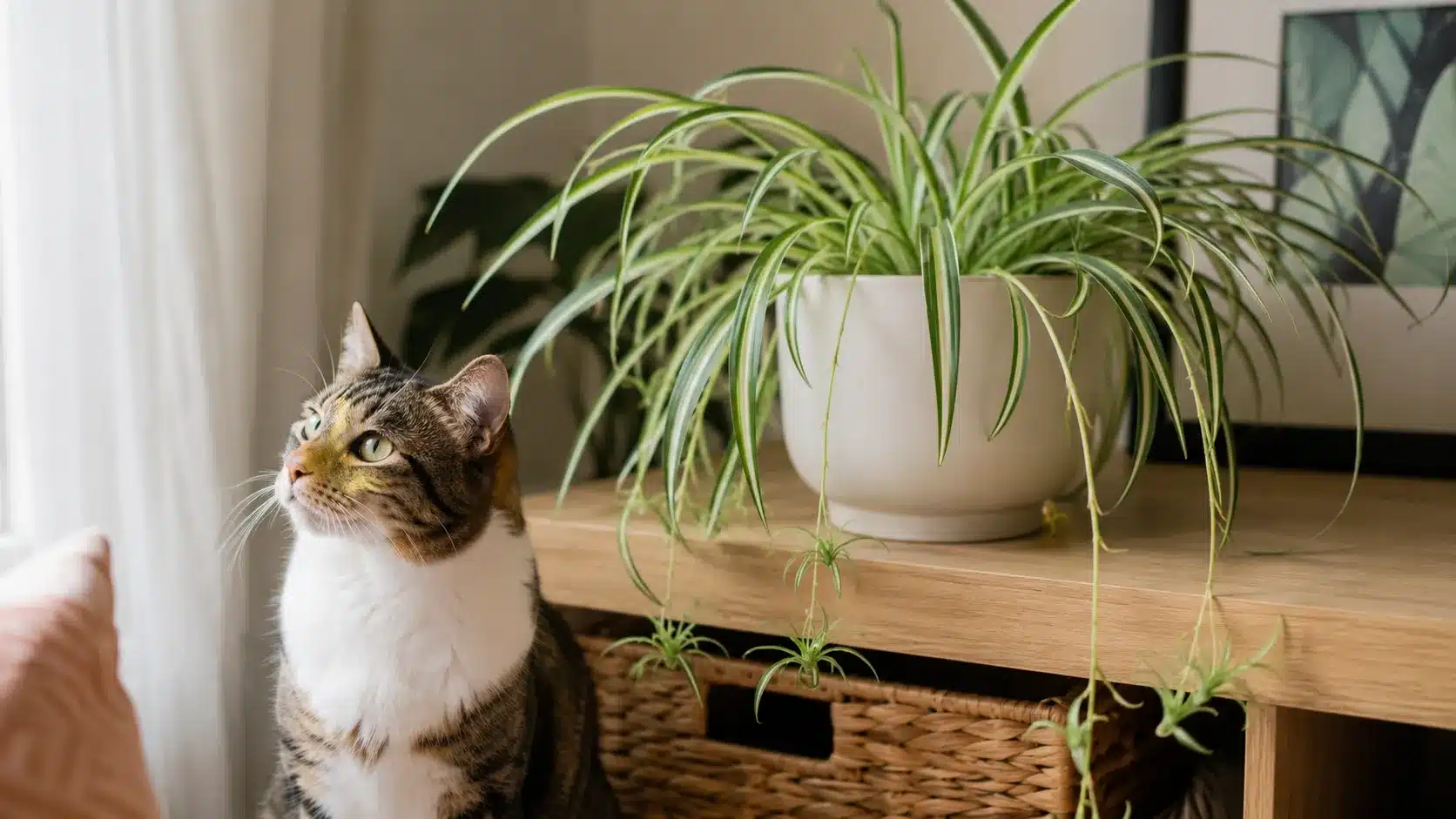
This is the section most competing plant guides skip, and it matters: several of the most commonly recommended “air purifying” plants are toxic to cats and dogs. Peace lily, pothos, philodendron, and dumbcane all contain insoluble calcium oxalate crystals — chewing the leaves or stems typically causes drooling, oral irritation, and vomiting, and in rarer cases, swelling severe enough to affect breathing. Dracaena is classed as moderately toxic in a different way, more commonly causing vomiting (sometimes with blood) and lethargy.
If pets or young children are in the house, safer picks confirmed on the ASPCA’s toxic and non-toxic plant list include spider plant, Boston fern, areca palm, and parlor palm. Watch out for common-name confusion too — “lucky bamboo” isn’t bamboo at all (it’s Dracaena sanderiana) and is toxic, despite the friendly name. Always check the botanical name against the ASPCA database before buying if a pet in the house tends to chew. Dracaena is classed as moderately toxic in a different way, more commonly causing vomiting (sometimes with blood) and lethargy — our dracaena marginata guide covers safe placement and care in more depth.
Plants vs Air Purifiers — Which Should You Actually Buy?
If your goal is genuinely cleaner air — for allergies, asthma, or general health — a HEPA or MERV-rated mechanical air purifier will outperform any realistic number of houseplants, since it’s actively filtering particulates and VOCs at a rate no plant can match. Plants aren’t a substitute for one. They’re worth having for the humidity, biophilic and mood benefits, and general liveability they add — genuinely complementary to a purifier or good ventilation, not competing with it.
Common Mistakes That Undermine Your Plants
Overwatering (yellowing leaves, root rot): the most common killer in Australian homes… If you’re already seeing yellowing, our dedicated yellow leaves troubleshooting guide walks through the specific fixes.
Wrong light placement: leggy growth or scorched leaves usually mean a light mismatch, especially on harsh western-facing windows common in Australian apartments. Move the plant rather than fight the light.
Expecting a measurable air-quality change: the single biggest mismatch between expectation and reality — see the myth-vs-reality section above. Buy plants for the benefits they genuinely deliver, and you won’t be disappointed.
Skipping the pet-safety check: confirm a plant’s ASPCA status before it comes home, not after an incident.
Quick Care Guide at a Glance
| Plant | Light | Water | Soil | Feeding |
| Snake Plant | Low–bright indirect | Every 2–3 weeks | Free-draining, cactus mix | Light feed, spring/summer only |
| Spider Plant | Bright indirect | Weekly, allow to dry | Standard potting mix | Monthly, spring/summer |
| Peace Lily | Low–medium | Weekly, keep lightly moist | Standard, well-draining | Monthly, spring/summer |
| ZZ Plant | Low–bright indirect | Every 2–4 weeks | Free-draining | Light feed, spring/summer |
| Flax Lily (native) | Low–medium | Weekly | Standard, well-draining | Minimal |
Conclusion
Houseplants aren’t a meaningful air-purification tool on their own — the research is now fairly settled on that, whatever the average retailer listicle still claims. But chosen with your actual light levels, pet safety, and climate in mind, they’re a genuinely worthwhile addition to an Australian home: for humidity, mood, and the simple fact that a room with plants in it tends to feel better to live in. Treat them as a complement to good ventilation, not a replacement for it, and pick the plant that fits your space rather than the one topping every “best air purifying plants” list. Treat them as a complement to good ventilation, not a replacement for it, and pick the plant that fits your space rather than the one topping every ‘best air purifying plants’ list. For a broader look at building out your indoor plant collection, see our full Australian indoor plants and garden design guide.
For a deeper look at how greenery supports wellbeing at home, explore our full guide to plant benefits and natural wellness.
FAQs
Do air purifying plants actually work in real rooms, or just in lab tests?
They remove trace VOCs, but only at a rate meaningful in the sealed lab chambers they were originally tested in — not in a normally ventilated home.
How many plants would I need to notice a difference in air quality?
Sourced estimates range from roughly 10–1,000 plants per square metre, or around 680 for a typical house — far beyond what most homes could realistically fit.
Which air purifying plants are safe for cats and dogs?
Spider plant, Boston fern, areca palm, and parlor palm are all confirmed non-toxic on the ASPCA’s plant list. Peace lily, pothos, philodendron, and dracaena are not.
What are the best air purifying plants for a low-light Australian apartment?
Snake plant, ZZ plant, and Chinese evergreen all tolerate the low, indirect light typical of Australian rentals and apartments.
Are native Australian plants as effective as imported ones like peace lily or pothos?
No plant — native or imported — meaningfully purifies air at household scale, so natives like flax lily or birds nest fern are a fine, climate-suited alternative rather than a “better” purifier.
Is a mechanical air purifier better than houseplants for allergies?
Yes — a HEPA or MERV-rated purifier actively filters particulates and VOCs at a scale no realistic number of plants can match, and is the better choice if allergy relief is the actual goal.
1 Comment