

Fast Growing Trees for Screening in Australia
Introduction
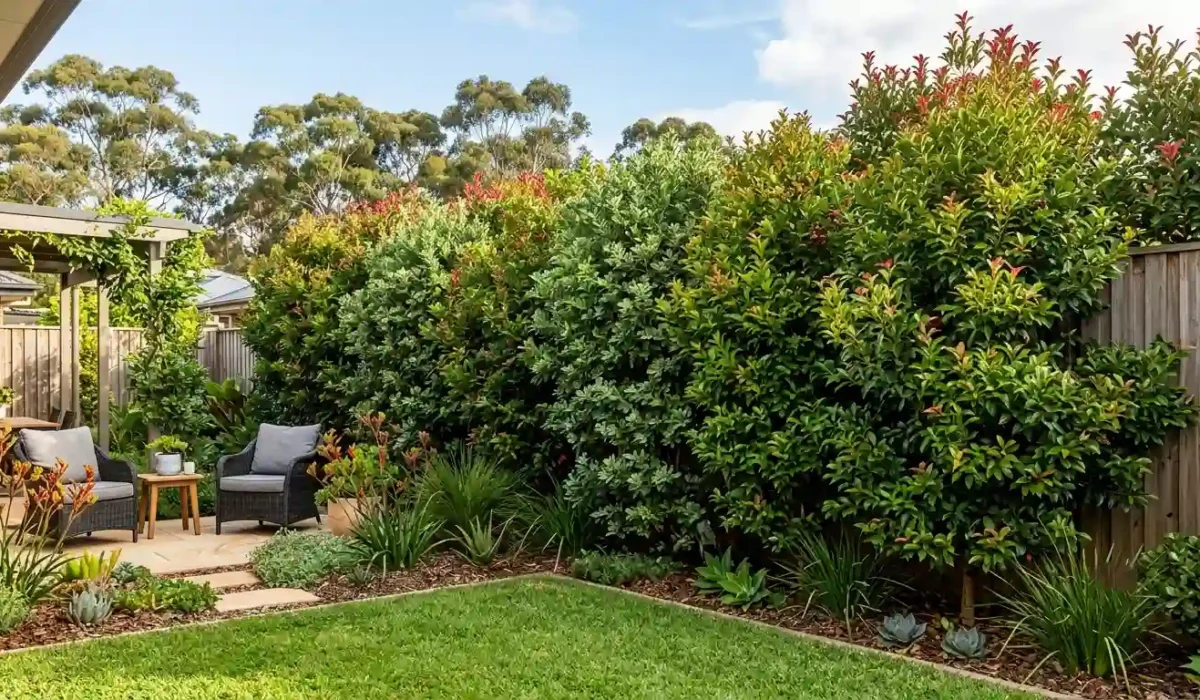
Fast growing trees for screening are plants selected for their ability to quickly create privacy barriers, wind protection, and visual separation through dense foliage, rapid height development, and reliable growth. Homeowners often choose fast growing trees for screening when they want effective backyard privacy without waiting many years for a mature hedge. The best screening trees combine strong growth, evergreen foliage, suitable mature size, and tolerance to regular pruning. In Australia, popular choices include lilly pilly, pittosporum, photinia, waterhousea, and other dense evergreen species that establish quickly in suitable climates.
For gardeners planning a complete outdoor landscape, choosing the right screening species is only one part of garden design. Our guide to Best Trees and Shrubs for Australian Gardens explains how different trees and shrubs work together for long-term structure, privacy, and visual appeal.
Quick Summary
- Most fast growing trees for screening add around 60cm–1.5m of height per year once established, depending on species and growing conditions.
- Evergreen trees such as lilly pilly, pittosporum, and photinia are popular because they provide year-round privacy.
- Correct spacing, often around 1 metre apart for hedge-style screens, is essential for creating dense coverage quickly.
- Native screening trees generally require less maintenance and provide better support for Australian wildlife.
- The best privacy screens balance growth speed, mature size, root behaviour, and climate suitability.
What Makes a Tree Good for Screening?
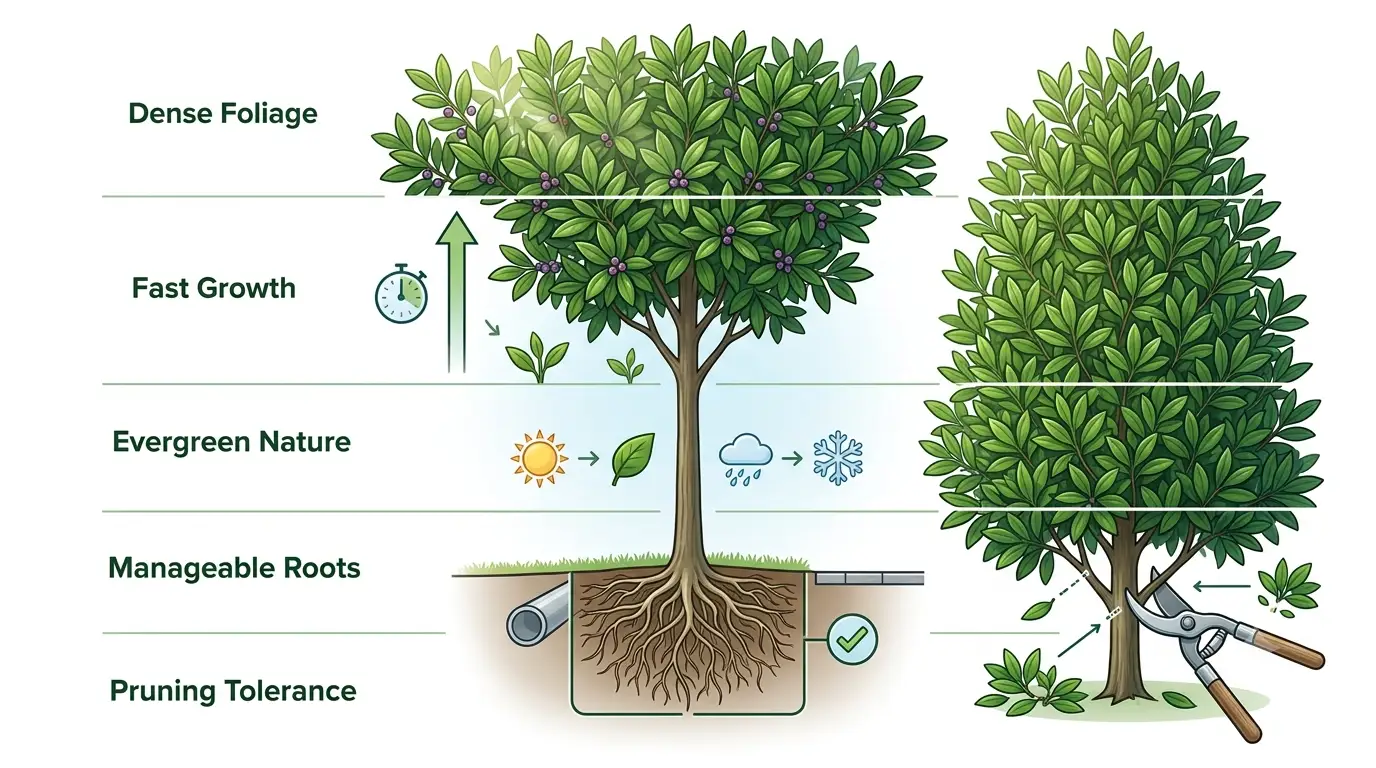
A good screening tree needs a combination of fast growth, dense canopy structure, foliage retention, manageable roots, and the ability to tolerate pruning. The purpose of a screening tree is not only to grow tall but also to create a thick visual barrier that blocks unwanted views, reduces wind exposure, and improves garden privacy.
The most effective fast growing trees for privacy usually have:
- Dense canopy density: Thick branches and closely spaced leaves create better coverage.
- Rapid establishment: A tree that adapts quickly after planting develops a screen sooner.
- Suitable mature height: Tall trees are useful for large boundaries, while compact varieties suit smaller gardens.
- Good pruning tolerance: Hedge trees often require shaping to maintain thickness and height.
- Appropriate root behaviour: Species should match the planting location to avoid future problems.
For example, some species such as ficus can grow extremely quickly and form dense screens, but their aggressive root systems may become unsuitable near pipes, paving, or building foundations. Choosing the right species is as important as choosing a fast-growing one.
A successful screening tree should provide both immediate growth and long-term reliability rather than simply growing rapidly for a short period.
Evergreen vs Deciduous Screening Trees
Evergreen and deciduous screening trees serve different purposes depending on the type of privacy required.
Evergreen screening trees retain leaves throughout the year, making them the preferred choice for permanent privacy barriers. They are commonly used along fences, property boundaries, and areas where neighbours or roads need continuous screening.
Benefits of evergreen trees include:
- Year-round privacy coverage
- Reduced seasonal maintenance
- Better wind protection
- Consistent garden structure
Popular evergreen screening trees in Australia include:
- Lilly pilly (Syzygium species)
- Pittosporum (Pittosporum tenuifolium cultivars)
- Photinia (Photinia × fraseri ‘Robusta’)
- Waterhousea (Waterhousea floribunda)
Deciduous trees lose their leaves during colder months, meaning they provide less winter privacy but can still be useful where seasonal screening is desired. They are often chosen for shade because they provide summer coverage while allowing more sunlight during winter.
The choice depends on whether the main goal is:
- Permanent privacy: Evergreen trees are usually the better option.
- Seasonal shade and screening: Deciduous trees may be suitable.
Growth Rate vs Long-Term Size
The fastest-growing tree is not always the best screening tree. Very rapid growers can require more pruning, develop weaker wood, or become too large for smaller properties.
Fast-growing species may provide quicker privacy, but gardeners should consider:
- Final mature height and width
- Maintenance requirements
- Root spread
- Structural strength
- Suitability for the available space
For example, a tree growing 1.5 metres per year may create a screen quickly, but it may require regular trimming to prevent it exceeding the desired height. A moderately fast-growing species with stronger structure may provide a more sustainable long-term solution.
Experienced gardeners often focus on balancing speed with future maintenance. A dense, healthy screen after several years is usually more valuable than a very fast-growing tree that becomes difficult to manage.
Best Fast Growing Trees for Screening in Australia
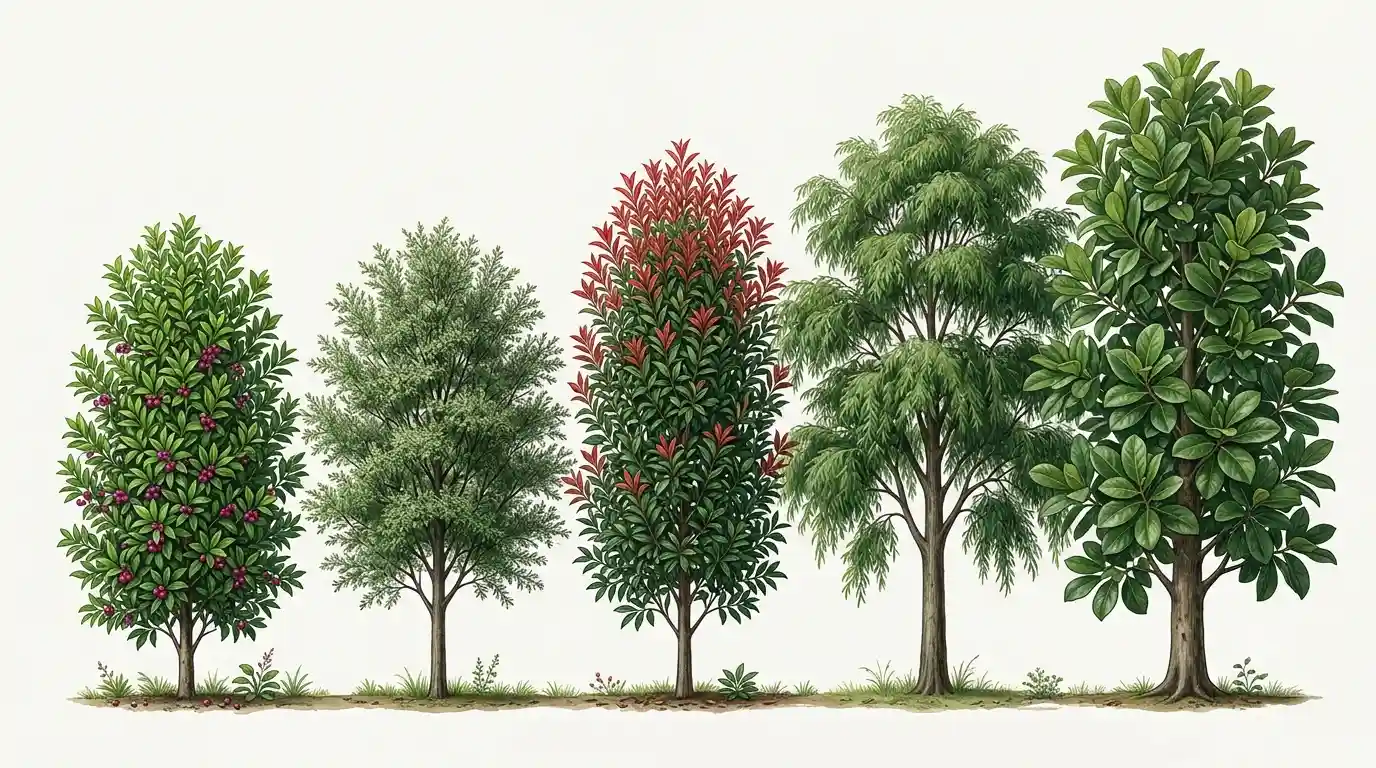
Australia has many suitable screening trees due to its varied climates, from tropical Queensland conditions to cooler temperate regions. The best choices are usually evergreen species that handle pruning well and develop dense foliage.
Common fast growing trees Australia homeowners use for privacy screens include:
| Species | Mature Height | Growth Rate | Evergreen/Deciduous | Best Use |
| Lilly pilly (Syzygium species) | 3–8m depending on variety | Fast | Evergreen | Fence lines, hedges, privacy screens |
| Pittosporum ‘Silver Sheen’ | 5–8m | Fast | Evergreen | Tall screens, wind protection |
| Pittosporum ‘James Stirling’ | 3–6m | Moderate to fast | Evergreen | Narrow gardens and hedging |
| Photinia ‘Robusta’ | 3–5m | Fast | Evergreen | Formal hedges and boundaries |
| Waterhousea floribunda | 8–15m | Fast | Evergreen | Large privacy screens |
| Ficus hillii | 8–15m | Very fast | Evergreen | Large properties and tall screens |
| Viburnum tinus | 2–4m | Moderate | Evergreen | Smaller screens and gardens |
| Leyland cypress (Cupressus × leylandii) | 10–20m | Very fast | Evergreen | Large boundaries and wind breaks |
Fast Growing Native Screening Trees
Native Australian screening trees are often preferred because they are adapted to local conditions and can support native insects, birds, and other wildlife. Lilly pilly belongs to the Syzygium genus, a group of evergreen plants widely used in Australian gardens for hedges, screening, and ornamental planting. More botanical information about the genus can be found on Wikipedia: Syzygium.
Lilly pilly (Syzygium species) is one of Australia’s most popular native hedge trees. It develops dense evergreen foliage, responds well to pruning, and many varieties produce attractive berries that attract birds.
Common lilly pilly varieties include:
- ‘Resilience’
- ‘Straight and Narrow’
- ‘Cascade’
- ‘Backyard Bliss’
Gardeners with narrow side gardens or tight boundaries may prefer a columnar cultivar such as Syzygium Up and Away Growth Rate, Height & Care, which reaches up to 8 metres while staying only 1–2 metres wide.
Waterhousea floribunda (weeping lilly pilly) is another excellent native screening choice. It forms a tall, dense canopy and works well for larger properties needing a substantial privacy barrier. Acmena smithii cultivars are among the most reliable native choices for Australian privacy hedges, offering dense foliage and good pruning tolerance. Smaller varieties such as Acmena Smithii Minor are particularly useful for compact gardens and narrow boundaries.
Callistemon (bottlebrush) species can also be used as screening plants, especially in gardens where drought tolerance and wildlife value are important. Their flowers attract native pollinators and provide seasonal colour.
Advantages of native screening trees include:
- Better adaptation to Australian climates
- Lower water requirements once established
- Improved habitat value
- Reduced risk of becoming invasive in local environments
In our experience growing Australian screening plants, native species often establish more reliably when matched with the correct climate, soil type, and watering routine.
Fast Growing Non-Native/Exotic Options
Some exotic species remain popular because of their rapid growth, formal appearance, or ability to create very tall screens.
Ficus hillii is a fast-growing evergreen tree commonly used for large privacy screens. It creates dense foliage but should be planted carefully because its extensive root system can affect nearby structures, pipes, and paving.
Waterhousea floribunda develops a broad, dense canopy suitable for tall privacy screens, and gardeners wanting a more compact, denser weeping form can consider the Waterhousea floribunda Sweeper: Growth & Care Guide, a cultivar bred for narrower, faster-filling screening.
Photinia ‘Robusta’ is valued for its bright red new growth and dense evergreen foliage. It is commonly planted as a clipped hedge because it responds well to pruning. Photinia ‘Robusta’ is valued for its colourful red new growth and ability to form a dense clipped hedge. Our Photinia Fraseri Robusta: Growth, Care & Hedge Guide provides more information about pruning, growth rate, and hedge maintenance.
Leyland cypress and other conifers are among the fastest-growing screening options. They create tall, narrow barriers suitable for large blocks, rural properties, and wind protection. However, they require enough space because mature trees can become very large.
Viburnum tinus provides a smaller evergreen screening option. It grows more moderately but works well in suburban gardens where extreme height is unnecessary.
When selecting exotic screening trees, gardeners should consider maintenance needs, mature size, and whether the species is suitable for their local environment.
Ficus hillii is a popular choice for large privacy screens because of its rapid growth and dense evergreen foliage, but it requires careful placement due to its strong root system. Learn more about its growth habits and maintenance in our Ficus Hillii ‘Flash’ Care, Growth & Hedge Guide.
For taller privacy needs, our guide to fast-growing trees for screening covers the quickest-growing species suited to Australian conditions.
Fastest Growing Trees for Privacy Screens
The fastest growing trees for privacy screens in Australia are generally species that can add around 1–1.5 metres of growth per year once established under ideal conditions. However, actual growth depends on climate, soil quality, watering, sunlight, and the age of the tree. No tree can create a complete privacy barrier instantly, and claims that a tree will grow tall enough for screening in one week are unrealistic.
Trees need time to develop a strong root system before rapid above-ground growth begins. In most gardens, noticeable screening improvement occurs over months, while a dense privacy screen commonly takes several years to fully establish.
Some of the fastest-growing privacy screening options include:
- Ficus hillii: Very fast growth with dense evergreen foliage, suitable for large spaces but requires careful placement due to extensive roots.
- Waterhousea floribunda: A fast-growing native tree with a broad, dense canopy suitable for tall privacy screens.
- Lilly pilly (Syzygium species): Reliable growth, excellent pruning response, and dense evergreen foliage.
- Leyland cypress: Extremely fast-growing conifer suitable for large boundaries and wind protection.
- Pittosporum cultivars: Fast-growing evergreen options that create attractive formal screens.
The quickest growing tree for privacy depends on the location and purpose of the screen. A species that grows quickly in Queensland may perform differently in Melbourne or a dry inland region.
Elemo Baker recommends selecting a tree based on the complete growing environment rather than choosing only by advertised growth speed. A slightly slower but better-adapted tree often creates a healthier and longer-lasting privacy screen.
Fast Growing Trees for Screening by Australian Climate Zone
Australia’s diverse climates mean that the best fast growing screening trees vary by region. Temperature, rainfall, frost exposure, soil conditions, and humidity all influence how quickly a tree establishes.
Choosing a species suited to the local climate improves survival, reduces maintenance, and encourages stronger growth.
Best Screening Trees for Queensland and Subtropical Climates
Queensland’s warm temperatures and longer growing seasons allow many tropical and subtropical screening trees to grow quickly.
Suitable options include:
Lilly pilly (Syzygium species)
Lilly pilly is one of the most reliable evergreen screening plants for Queensland gardens. It tolerates humidity, responds well to pruning, and forms thick foliage suitable for fences and boundaries.
Waterhousea floribunda
This native tree performs well in warm climates and develops a large, attractive canopy. It is suitable for homeowners wanting a tall evergreen screen.
Ficus hillii
Ficus can provide rapid coverage in large gardens where root space is available. It is best avoided near buildings, drains, and paved areas because of its aggressive root behaviour.
Callistemon species
Bottlebrush trees are suitable where drought tolerance and wildlife attraction are important. They provide screening while supporting native birds and pollinators.
For Queensland gardens, regular watering during establishment is essential, especially during hot periods. Once established, many native species become more drought tolerant.
Best Screening Trees for Temperate Climates (Melbourne, Sydney)
Temperate regions such as Melbourne and Sydney experience cooler winters and seasonal changes, so species selection should focus on frost tolerance, steady growth, and year-round foliage.
Recommended screening trees include:
Pittosporum ‘Silver Sheen’
This variety is popular for narrow boundaries because it develops a tall, upright form with attractive fine foliage. It creates an effective evergreen screen when planted closely. Pittosporum ‘Silver Sheen’ is widely used for narrow garden boundaries because of its upright growth habit and fine evergreen foliage. For more details about its mature size and performance, see our Pittosporum Silver Sheen Growth Rate Guide.
Photinia ‘Robusta’
Photinia performs well in many temperate gardens and provides year-round structure. Its red new leaves create additional ornamental value while maintaining privacy.
Lilly pilly varieties
Many lilly pilly cultivars grow successfully in Sydney and Melbourne climates. They provide dense foliage and can be shaped into formal hedges.
Viburnum tinus
This evergreen shrub is suitable for smaller screens and cooler gardens. It grows at a moderate rate and produces seasonal flowers.
In temperate areas, spring and early summer are usually the strongest growth periods. Good soil preparation before planting can significantly improve establishment speed.
Screening Trees for Small Spaces and Pots
Fast growing trees for screening can also be grown in containers when garden space is limited. However, trees grown in pots usually remain smaller because root growth is restricted.
Suitable options for screening in pots include:
- Compact lilly pilly varieties
- Dwarf pittosporum cultivars
- Viburnum varieties
- Smaller evergreen shrubs trained as standards
When selecting tall plants for screening in pots, consider:
- Container size
- Drainage quality
- Root restriction tolerance
- Mature plant size
- Wind exposure
Large containers are essential because small pots quickly limit root development and increase watering requirements.
A quality screening container should:
- Be large enough for long-term root growth
- Have drainage holes to prevent waterlogging
- Use a high-quality potting mix
- Receive adequate sunlight
Container-grown screening plants generally require more frequent watering and fertilising than plants growing in the ground. During hot Australian summers, pots can dry out quickly, especially on balconies and paved courtyards.
Narrow columnar conifers also suit tight boundaries — the Glauca Pencil Pine: Height, Care & Growth Guide can reach significant height while staying just 1–1.5 metres wide, making it a space-efficient screening option.
Plant Size
The mature size of screening trees varies significantly depending on species, climate, and growing conditions. Common screening trees range from compact 2–3 metre options to large trees reaching 15 metres or more.
Typical mature sizes include:
| Tree Type | Approximate Mature Height | Width |
| Compact lilly pilly varieties | 2–4m | 1–2m |
| Pittosporum varieties | 3–8m | 1.5–4m |
| Photinia ‘Robusta’ | 3–5m | 2–3m |
| Waterhousea floribunda | 8–15m | 5–10m |
| Ficus hillii | 8–15m+ | 5–10m |
| Leyland cypress | 10–20m | 3–6m |
In-ground trees usually achieve their full potential because roots can spread naturally and access more moisture and nutrients. Container-grown trees remain smaller but require more regular maintenance.
Factors affecting final plant size include:
- Soil depth and fertility
- Amount of sunlight received
- Water availability
- Climate conditions
- Pruning frequency
- Available root space
A tree planted in deep, fertile soil with adequate sunlight may grow considerably faster than the same species planted in poor soil or a restricted location.
Growth Rate
Fast growing trees for screening typically grow between 60cm and 1.5 metres per year after establishment, although growth rates differ between species.
The fastest growth usually occurs during warmer months when plants have active growth cycles. Spring and summer provide the strongest growth flushes, while cooler winter temperatures may slow or pause growth in many species.
Growth speed is influenced by:
- Sunlight: Most screening trees require full sun for dense foliage development.
- Water: Consistent moisture during establishment encourages stronger root development.
- Soil quality: Nutrient-rich, well-draining soil supports faster growth.
- Climate: Species suited to the local region establish more quickly.
- Pruning: Regular trimming encourages branching and creates thicker screens.
A common beginner mistake is focusing only on height growth and ignoring density. A tall but thin tree may provide less privacy than a slightly shorter tree with thick foliage.
Pruning young screening trees encourages side branching, which helps create a solid barrier rather than a narrow vertical shape.
As of 2026, Australian gardeners are increasingly selecting climate-suitable native screening trees because they often require less irrigation and maintenance once established, particularly in regions affected by hotter summers and changing rainfall patterns.
Care Guide for Fast Growing Screening Trees
Proper care is essential for achieving the rapid growth and dense foliage expected from fast growing trees for screening. Even naturally vigorous species require suitable watering, soil, sunlight, fertilising, and pruning practices to develop into effective privacy barriers.
Watering Requirements
Newly planted screening trees need consistent moisture while establishing their root systems. The first 12–24 months are the most important period for encouraging strong growth.
General watering guidelines include:
- Water deeply rather than lightly sprinkling the surface.
- Keep soil evenly moist but avoid waterlogging.
- Increase watering during hot, dry Australian summers.
- Reduce watering once established, depending on species and rainfall.
Overwatering is a common mistake because many gardeners assume faster growth requires constant moisture. Poor drainage can lead to root stress, yellow leaves, and slow growth.
Light Requirements
Most fast growing screening trees perform best in full sun, receiving at least 6 hours of direct sunlight daily.
Adequate sunlight improves:
- Leaf production
- Branch density
- Overall plant strength
- Privacy coverage
Trees planted in shaded locations often become thin and stretched as they search for light, resulting in slower screen formation.
Soil Conditions
Healthy soil creates the foundation for fast growth. Most screening trees prefer fertile, well-draining soil with good organic matter content.
Before planting:
- Improve compacted soil with compost or organic matter.
- Ensure water drains away from the root zone.
- Avoid planting directly into heavy clay without improving drainage.
Native species such as lilly pilly and waterhousea often perform well in Australian soils when matched to the local climate.
Fertilising for Faster Growth
Fertiliser can support healthy growth, especially during the establishment phase. A balanced slow-release fertiliser is generally preferred because it provides nutrients gradually without encouraging weak, excessive growth.
Useful nutrients include:
- Nitrogen for leaf and shoot development
- Phosphorus for root establishment
- Potassium for overall plant strength
Avoid excessive fertilising because rapid soft growth can become more vulnerable to pests, diseases, and environmental stress.
Pruning Practices
Pruning is one of the most important steps for creating a dense privacy screen. Many beginners allow trees to grow upward without encouraging side branching, resulting in gaps near the base.
Effective pruning techniques include:
- Trim young plants regularly to encourage branching.
- Remove damaged or crossing branches.
- Maintain the desired height and width.
- Shape hedges gradually rather than removing large sections at once.
In our experience growing screening plants, regular light pruning usually creates a thicker and healthier hedge than occasional heavy trimming.
Climate Tolerance
Choose trees according to local conditions. A species that thrives in humid Queensland may struggle in colder or drier regions.
Consider:
- Frost tolerance
- Heat tolerance
- Wind exposure
- Drought resistance
- Soil type
Matching the plant to the environment is one of the most important factors in long-term screening success.
Spacing and Planting Tips for a Dense Screen
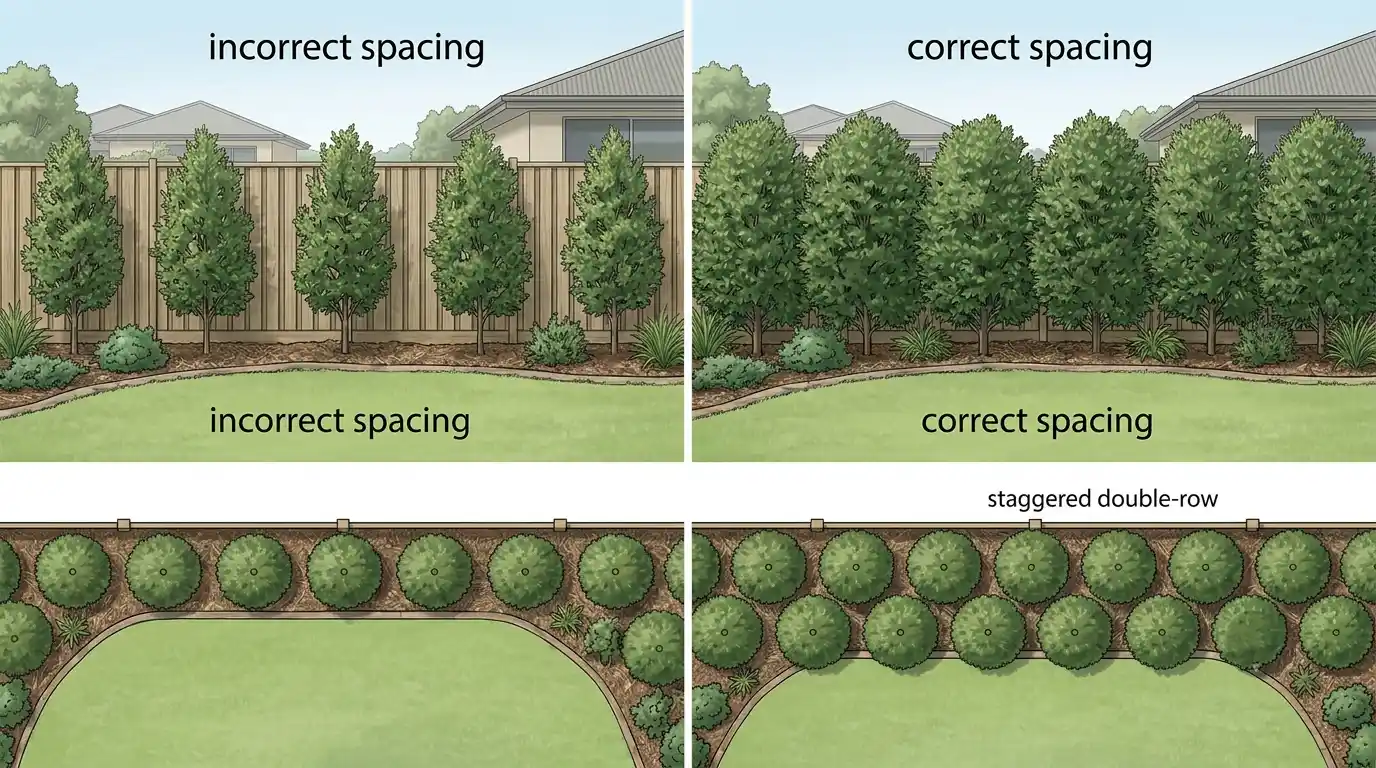
Correct spacing determines how quickly individual trees join together to form a solid privacy barrier. Planting trees too far apart creates gaps, while planting too closely can cause competition for water, nutrients, and sunlight.
For most hedge-style screening trees, spacing is commonly:
- Around 1 metre apart for dense hedge screens
- 1.5–3 metres apart for larger trees requiring more space
- Closer spacing only for carefully managed formal hedges
A staggered double-row planting method can create a thicker screen, especially where wind protection or maximum privacy is required. Gardeners wanting a more formal architectural privacy feature can also consider pleached screening methods. A Pleached Lilly Pilly: Training & Screening Guide explains how lilly pilly can be trained into structured living screens.
Benefits of staggered planting:
- Faster visual coverage
- Fewer visible gaps
- Improved wind filtering
- More natural-looking density
Before planting, consider the mature width of the species. A small plant may look far apart initially, but correct spacing prevents overcrowding problems later.
Common Mistakes and Problems When Growing Screening Trees
Growing a successful privacy screen requires avoiding several common mistakes. Many screening failures occur because of incorrect species selection, poor spacing, or unsuitable growing conditions.
Planting Trees Too Far Apart
Why it happens:
Homeowners often underestimate how much space trees need to fill and plant according to the size of young plants rather than their mature growth.
Problems caused:
- Large gaps between trees
- Slow privacy coverage
- Uneven hedge appearance
How to fix it:
- Plant additional trees between existing gaps where possible.
- Use suitable spacing recommendations for the chosen species.
How to prevent it:
Plan spacing before planting and consider the mature width of each tree.
Choosing Invasive-Rooted Species Near Structures
Why it happens:
Some very fast growing trees appear attractive because they create quick coverage.
Species such as ficus can develop extensive root systems that may affect:
- Pipes
- Drainage systems
- Paving
- Building foundations
How to fix it:
- Remove unsuitable trees if they pose a long-term risk.
- Use root barriers where appropriate.
- Replace with species better suited to the location.
How to prevent it:
Research mature root behaviour before planting near structures.
Yellowing Leaves from Overwatering or Poor Drainage
Why it happens:
Excess moisture reduces oxygen around roots and can prevent healthy nutrient uptake.
Signs include:
- Yellow leaves
- Slow growth
- Soft or declining foliage
How to fix it:
- Improve drainage.
- Reduce watering frequency.
- Check soil moisture before watering.
How to prevent it:
Plant in suitable soil and choose watering schedules based on climate conditions.
Slow Growth Due to Poor Soil or Insufficient Sun
Why it happens:
Trees cannot achieve rapid growth without enough light, nutrients, and healthy roots.
Solutions include:
- Improve soil quality with organic matter.
- Relocate plants if sunlight is inadequate.
- Apply suitable fertiliser during active growth periods.
Healthy growing conditions are usually more important than simply choosing the fastest species.
How Fast Growing Trees for Screening Compare to Slower Alternatives
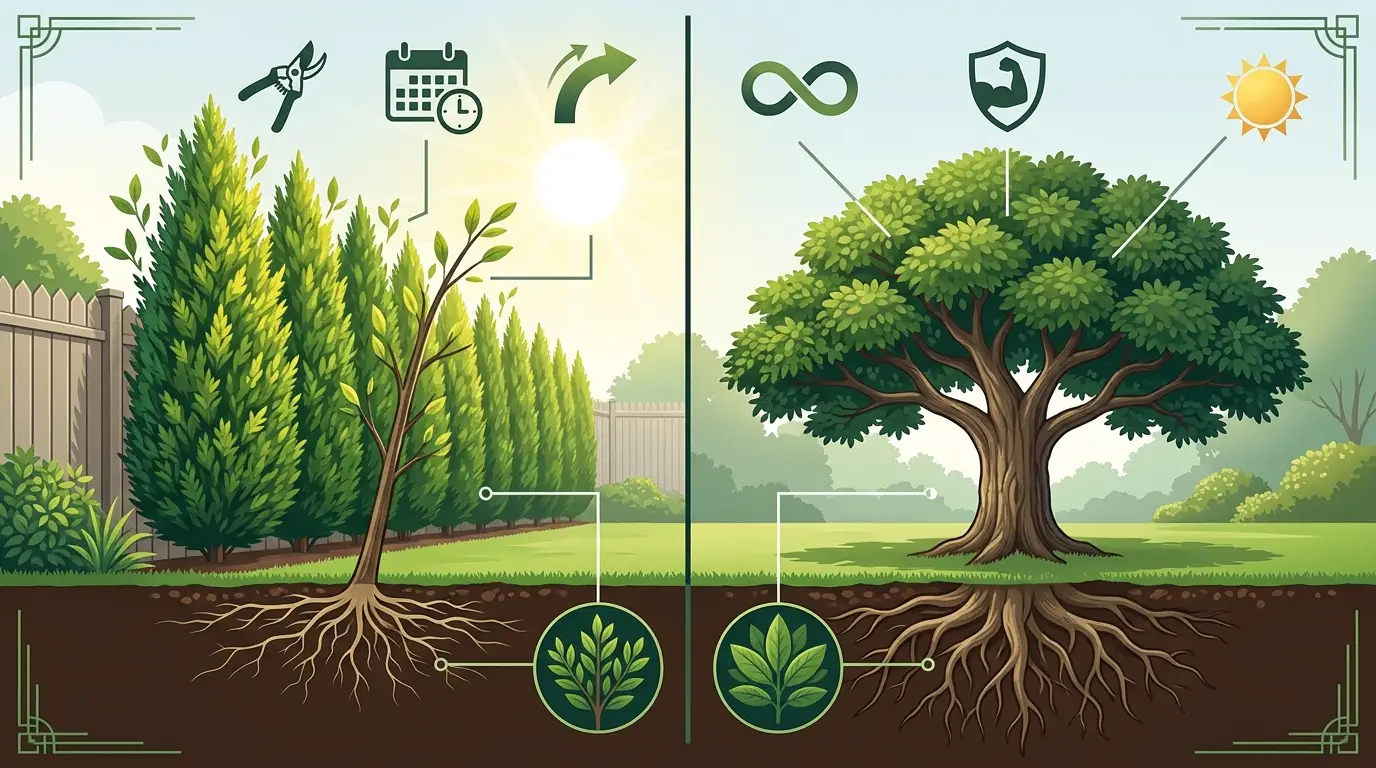
Fast growing trees provide quicker privacy, but slower-growing species often offer advantages in structure, longevity, and reduced maintenance.
| Feature | Fast Growing Screening Trees | Slower Growing Trees |
| Privacy speed | Rapid coverage | Takes longer to establish |
| Maintenance | Often requires more pruning | Usually requires less trimming |
| Longevity | Some species may have shorter productive life | Often stronger long-term structure |
| Wood strength | Some fast growers have softer wood | Often stronger timber structure |
| Space requirements | May quickly outgrow small areas | Easier to manage |
Fast-growing species are ideal when privacy is urgently needed, such as along new boundaries or exposed gardens. However, slower-growing trees can be better where long-term stability and minimal maintenance are priorities.
For gardeners prioritising structure and colour over speed, the Swanes Golden Cypress: Size, Care & Growing Guide offers a slow-growing, narrow golden conifer that trades rapid coverage for long-term architectural form.
The best approach is selecting a tree that balances:
- Growth speed
- Mature size
- Climate suitability
- Root behaviour
- Maintenance requirements
Conclusion
Fast growing trees for screening provide an effective solution for homeowners who need privacy, wind protection, and attractive garden structure without waiting decades. The best choices in Australia include lilly pilly, pittosporum, photinia, waterhousea, and other suitable evergreen screening trees.
Successful privacy screens depend on more than choosing a fast-growing species. Correct spacing, suitable soil, regular pruning, proper watering, and climate-appropriate selection determine how quickly and effectively a screen develops.
By choosing the right tree for the location and maintaining it correctly, gardeners can create a dense, healthy, and long-lasting privacy barrier that improves both function and appearance.
Frequently Asked Questions
What is the fastest growing tree for privacy screening in Australia?
The fastest growing trees for privacy screening in Australia include ficus hillii, waterhousea floribunda, lilly pilly, and leyland cypress. Under ideal conditions, some can grow around 1–1.5 metres per year once established. However, growth speed depends on climate, soil, watering, and maintenance.
How long does it take for a screening tree to grow tall enough for privacy?
Most screening trees take around 2–5 years to create a strong privacy barrier, depending on the species, planting size, and growing conditions. Faster species may provide noticeable coverage within a few growing seasons, while slower varieties take longer.
What is the best evergreen tree for a screen that stays green all year?
Popular evergreen screening trees include lilly pilly, pittosporum, photinia, and waterhousea. These species retain foliage throughout the year and are commonly used for Australian privacy hedges and boundary planting.
Can I grow a fast growing screening tree in a pot?
Yes, some screening plants can grow in pots, especially compact lilly pilly, pittosporum, and viburnum varieties. However, container-grown trees remain smaller and require more frequent watering, fertilising, and root management.
How far apart should I plant trees for a dense privacy screen?
Most hedge-style screening trees are planted around 1 metre apart, although spacing depends on the species and mature size. Larger trees may require more distance to prevent overcrowding and root competition.
Why is my screening tree growing slowly or not filling in?
Slow growth is usually caused by insufficient sunlight, poor soil, incorrect watering, lack of nutrients, or planting trees too far apart. Improving soil conditions, adjusting care practices, and pruning to encourage branching can help create a denser screen.
5 Comments