

Silver Birch Tree Australia: Size, Climate, Problems & Care
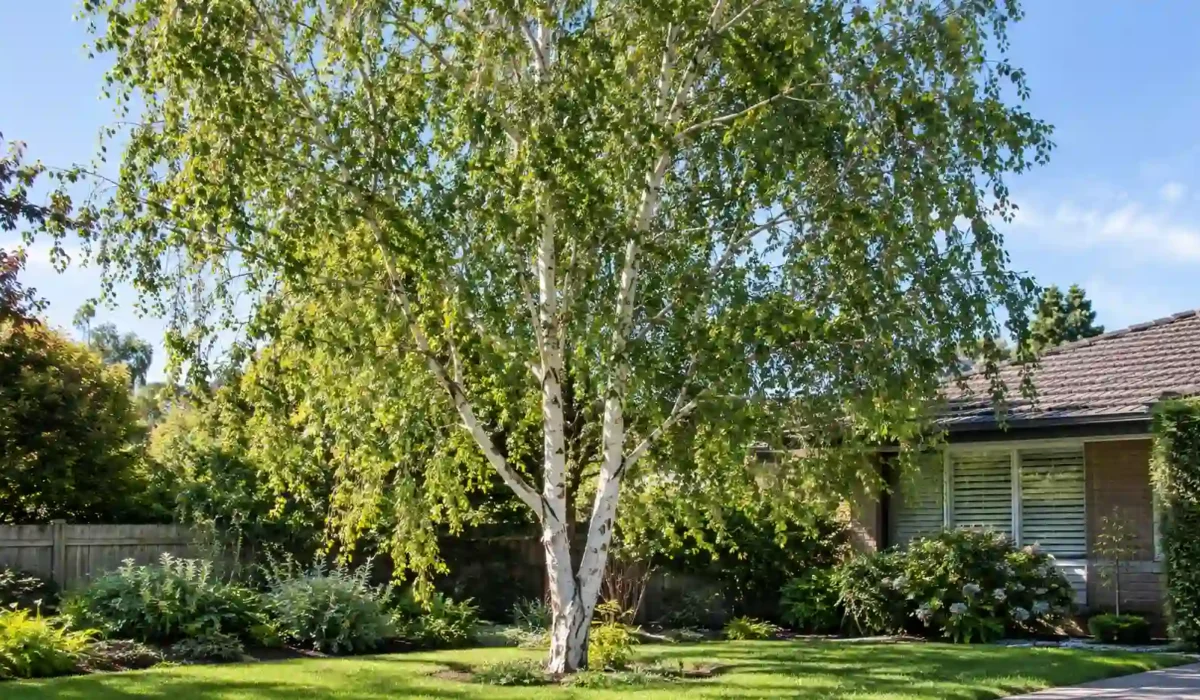
Will a silver birch work in your garden? A silver birch tree Australia gardeners grow is Betula pendula, a deciduous tree native to temperate Eurasia and valued for its white bark, fine foliage and autumn colour. It is not an Australian native. The species can perform beautifully in cool, moist Australian districts, but heat, dry summers and warm nights can shorten its useful life and trigger stress-related problems. The key is matching the tree to the climate and giving its shallow root system reliable summer moisture.
Quick Summary
- Silver birch suits cool-temperate and cooler warm-temperate areas with dependable summer moisture; hot, humid climates are poor matches.
- A practical Australian garden-planning range is about 8–12 m tall × 4–6 m wide, but individual seedling trees vary.
- Summer heat and drought are major stress factors; mites, aphids and borer attack can become secondary problems.
- Plant during dormancy, maintain a cool mulched root zone, and avoid late-winter or spring pruning because birches can bleed heavily.
Will a Silver Birch Tree Grow in Your Part of Australia?
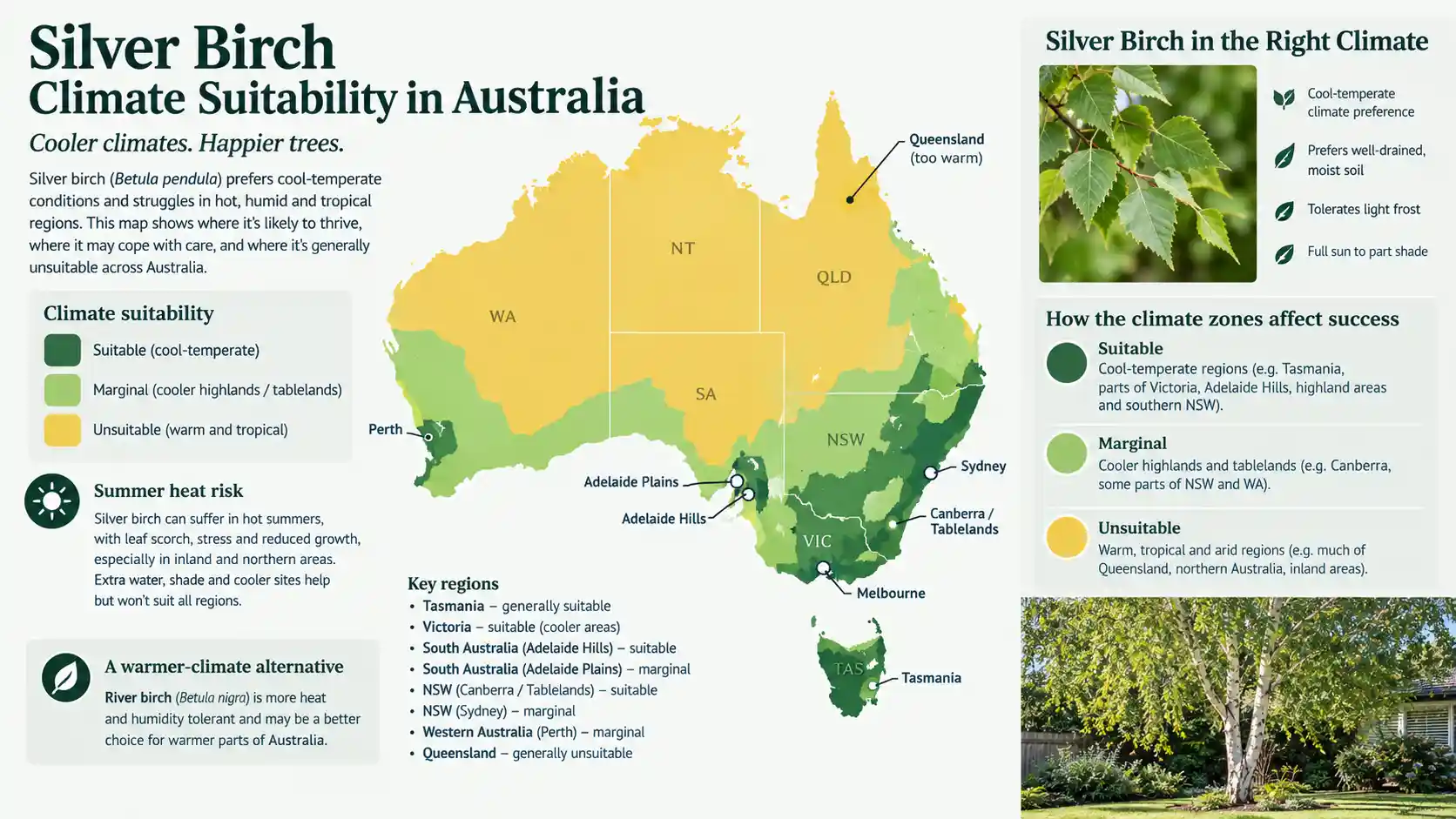
Yes! but mainly where summers are relatively cool or where reliable moisture and a favourable microclimate compensate for summer stress. Bunnings classifies silver birch as a cold- to warm-temperate tree, while the Botanic Gardens of South Australia specifically says it requires cooler, wetter conditions and performs better in the Adelaide Hills than on the Adelaide Plains. Silver birch performs better in cooler, wetter Australian conditions, and the Botanic Gardens of South Australia plant profile for silver birch notes that Adelaide Plains plantings can struggle during dry seasons while the Adelaide Hills and cooler regional areas are more suitable.
Warm nights, hot winds and drought are the bigger warning signs. The tree can survive outside its ideal climate for a while, but survival is not the same as sustained, attractive performance. In Australia, a thin canopy, premature summer leaf drop and recurring stress are useful signs that the site is too warm or too dry.
| Region | Suitability | Main summer risk | Better alternative |
| Tasmania | High | Dry exposed sites | Cool-climate deciduous trees |
| Victorian highlands / Melbourne | High to conditional | Heatwaves and dry summers | Heat-tolerant deciduous species where exposure is severe |
| Canberra and tablelands | High | Hot, dry summers | Drought-tolerant temperate trees |
| Adelaide Hills | High | Extended dry periods | — |
| Adelaide Plains | Low | Heat and drought | Drought-tolerant feature trees |
| Sydney, cooler west/high suburbs | Conditional | Heat and humidity | River birch or heat-tolerant species |
| Sydney coast | Low to conditional | Warm nights and humidity | Warmer-climate trees |
| Perth | Conditional only in suitable cool/sheltered sites | Heat and dry summer | Heat- and drought-tolerant trees |
| Brisbane / Queensland | Low | Heat and humidity | River birch or tropical/subtropical trees |
For frost-prone gardens, site selection still matters because cold tolerance does not remove the need for suitable soil and summer moisture. LeafyHeaven’s frost-tolerant plants guide gives broader Australian planting context.
What to Plant Instead in Warm or Humid Areas
River birch, Betula nigra, is the better-known warm-climate birch option because it naturally occurs in wetter habitats and some selected forms have greater summer-heat tolerance. The ACT National Arboretum describes river birch as a species of wet floodplain and river environments, while Australian gardening guidance identifies B. nigra forms as better choices for warmer conditions.
For Brisbane and tropical Queensland, however, do not assume that simply choosing another Betula makes the climate suitable. There is no true tropical birch that turns a hot, humid site into a silver-birch site.
How Big Do Silver Birch Trees Grow in Australia?
For Australian residential planning, about 8–12 m tall and 4–6 m wide is a sensible working range rather than a guaranteed mature size. Bunnings gives 8 m+ for silver birch, while Fleming’s lists 10 m × 6 m and notes that seedling-grown trees vary considerably in habit.
The much larger figures sometimes published online describe what the species can achieve under favourable conditions rather than what every Australian garden tree will reach. Kew describes B. pendula as capable of reaching around 30 m, and the European Forest Institute gives a usual upper range of 15–25 m.
| Source | Height | Width | How to interpret it |
| Australian Plants Online | 9–12 m | 4–5 m | Australian nursery garden figure |
| Seasol | About 10 m | About 6 m | Australian care-guide figure |
| Bunnings | 8 m+ | — | Minimum-style retail description |
| Fleming’s | 10 m | 6 m | Seedling-grown, variable habit |
| Seed supplier | 15–25 m | 3–6 m | Species potential under suitable conditions |
| Practical planning range | 8–12 m | 4–6 m | Useful residential planning figure, not a guarantee |
Silver birch is a relatively fast juvenile grower, followed by slower mature growth.
There is a true dwarf birch species, Betula nana, but it is not a dwarf form of silver birch. For a smaller ornamental tree, Betula pendula ‘Youngii’ is the more relevant choice.
Silver Birch vs Weeping Birch vs River Birch: Which Is Which?
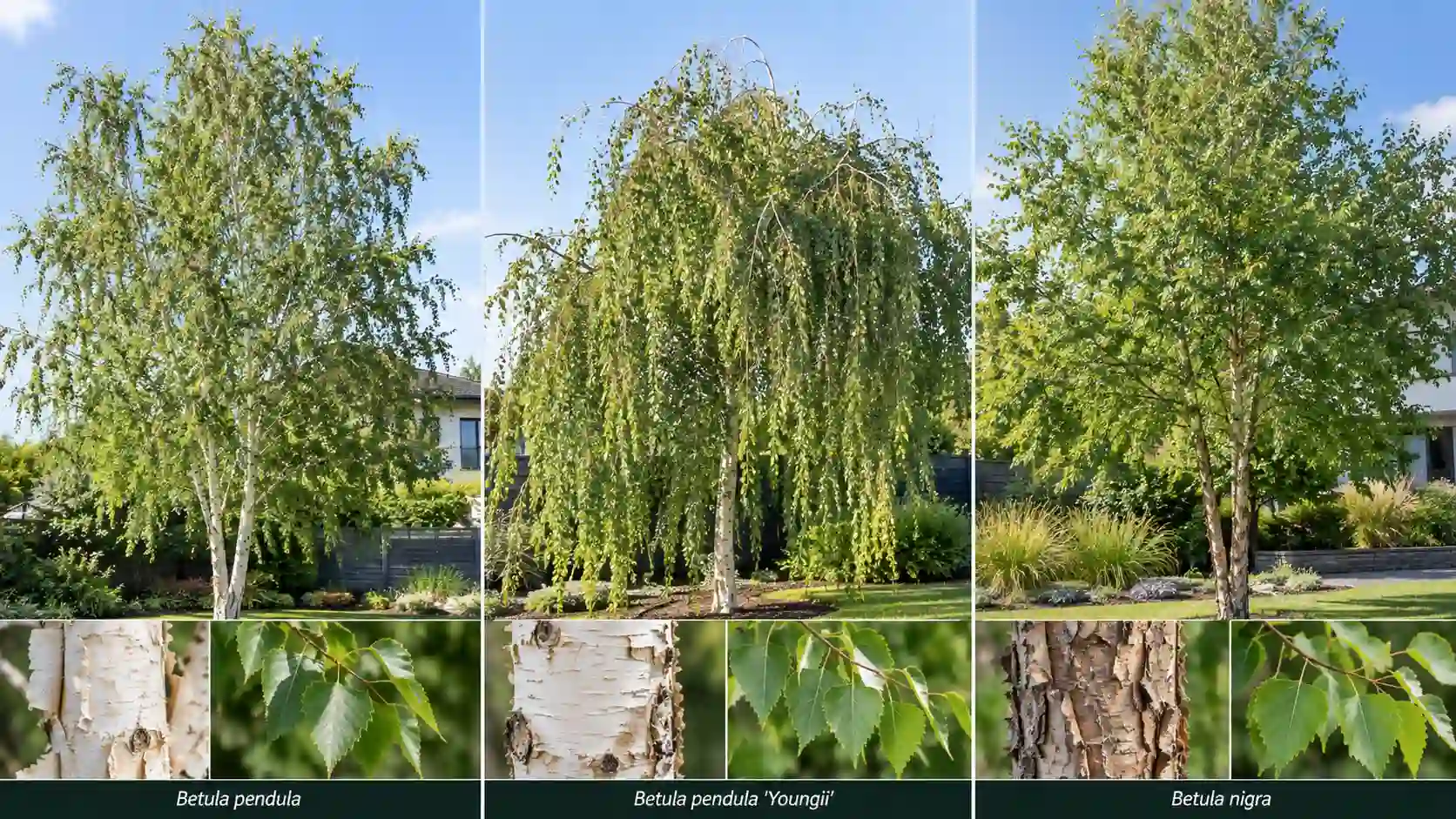
“Silver birch” and “weeping birch” are often used loosely in Australian nurseries. The botanical name is the safer identification check: Betula pendula is silver birch, B. pendula ‘Youngii’ is a smaller weeping cultivar, B. nigra is river birch, and Himalayan birch belongs to a different species group.
| Species / cultivar | Botanical name | Typical size | Bark | Best climate | Heat tolerance |
| Silver birch | Betula pendula | ~8–12 m | White, peeling | Cool temperate | Low–moderate |
| Weeping silver birch | B. pendula ‘Youngii’ | ~3–4 m | White | Cool temperate | Low–moderate |
| River birch | Betula nigra | Larger tree | Peeling, darker-toned bark | Moist, warmer sites | Higher |
| Himalayan birch | Betula utilis group | Medium–large | Very white bark | Cool climates | Low |
The Adelaide Botanic Gardens records ‘Youngii’ at about 4 m and recommends silver birch in clumps of three or more where space allows.
Australian-native correction: silver birch is not native to Australia. Kew gives its native range as temperate Eurasia and north-west Africa, while VicFlora records it as introduced in Victoria.
In winter, a silver birch is recognisable by its bare fine branches and pale bark, with catkins associated with the dormant-to-spring period. For botanical identification, Kew’s Plants of the World Online profile for Betula pendula confirms silver birch as a temperate Eurasian species rather than an Australian native, making the botanical name a useful way to avoid nursery-name confusion. Kew’s Plants of the World Online profile for Betula pendula
Is Your Site Right? Soil, Sun and Distance from Buildings
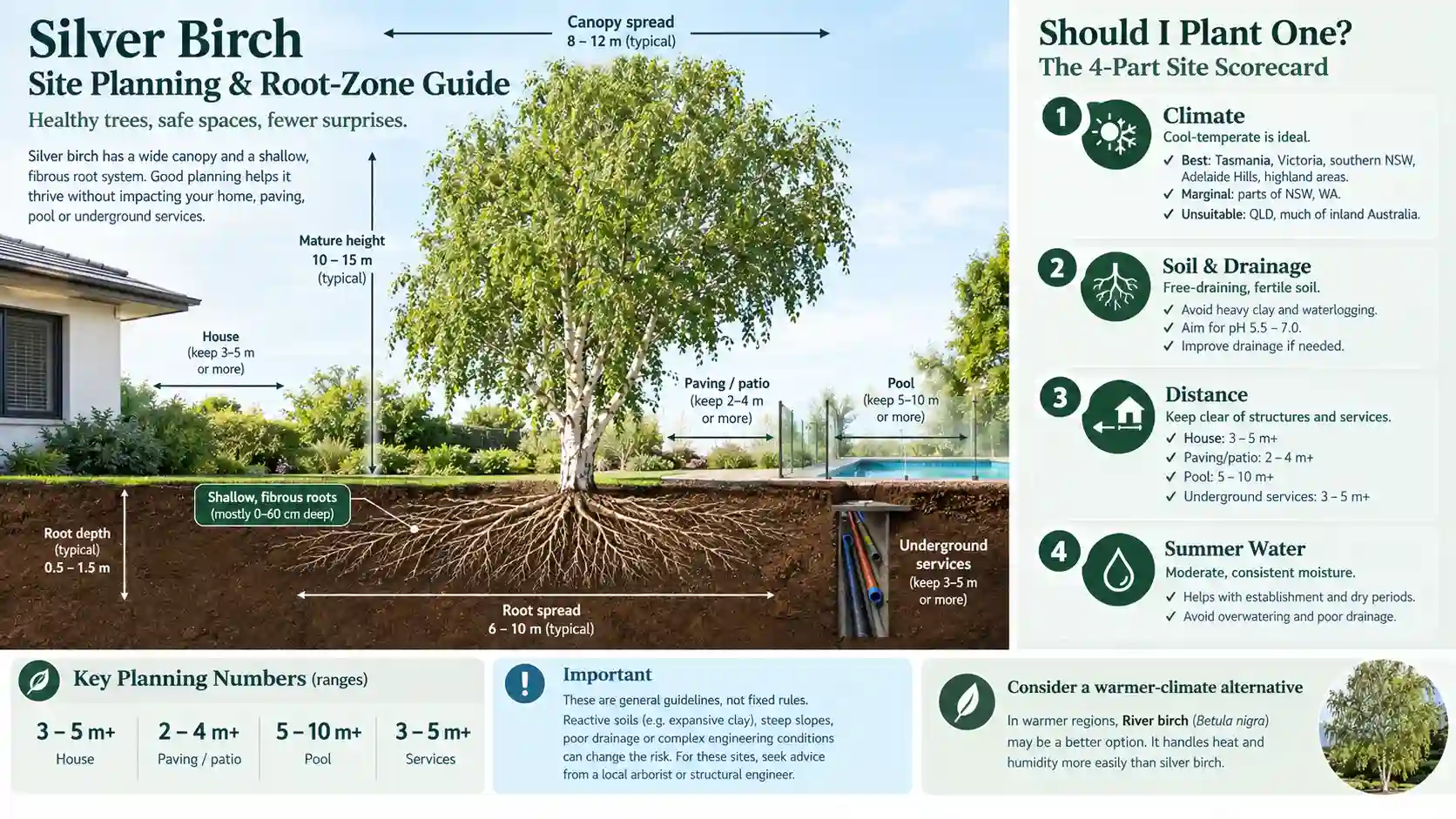
Choose a bright, sheltered position with moist but well-drained soil. The root system is shallow and fibrous, so the objective is not simply avoiding “invasive roots”; it is giving a wide root zone enough moisture without creating conflicts with paving or structures. Bunnings specifically notes shallow fibrous roots and the need for reliable watering in hot, dry periods.
The soil-pH advice looks contradictory because different sources describe different tolerances. Bunnings recommends acidic, moisture-retentive soil around pH 5–6.5, while the South Australian plant selector records tolerance of acidic, neutral and alkaline soils but notes better performance in acidic, non-alkaline conditions. In practice, moisture, temperature, drainage and root-zone conditions should be treated as more important than chasing an exact pH number.
For broader Australian soil troubleshooting, see our Australian garden soil and fertiliser guide.
| Soil / structure situation | Suggested planning distance | Alternative |
| Stable soil, light paving | At least 4 m | Smaller cultivar if space is tight |
| Reactive clay or foundation-sensitive site | About 5–8 m | Consult arborist/engineer |
| Pool, major paving or service corridor | About 5 m or more | Avoid planting directly over services |
| Very small garden | Standard birch usually unsuitable | ‘Youngii’ or another small tree |
These distances are editorial planting-planning rules, not engineering clearances. Reactive soils, footing design and underground infrastructure can materially change the answer. Our growth, roots and plant-sizing guide provides a broader framework for judging mature dimensions before planting.
Should I Plant One? Site Scorecard
Score each item 0–2:
| Check | 0 points | 1 point | 2 points |
| Climate | Hot/humid | Marginal | Cool temperate |
| Soil and drainage | Dry or unsuitable | Manageable | Moist, well drained |
| Distance | Tight | Borderline | Spacious |
| Summer water | Unreliable | Some irrigation | Reliable |
7–8: strong site fit.
5–6: possible with careful positioning and summer irrigation.
0–4: choose another tree.
This is an editorial decision tool, not a horticultural or engineering standard.
Why Is My Silver Birch Struggling? Symptoms, Causes and Fixes
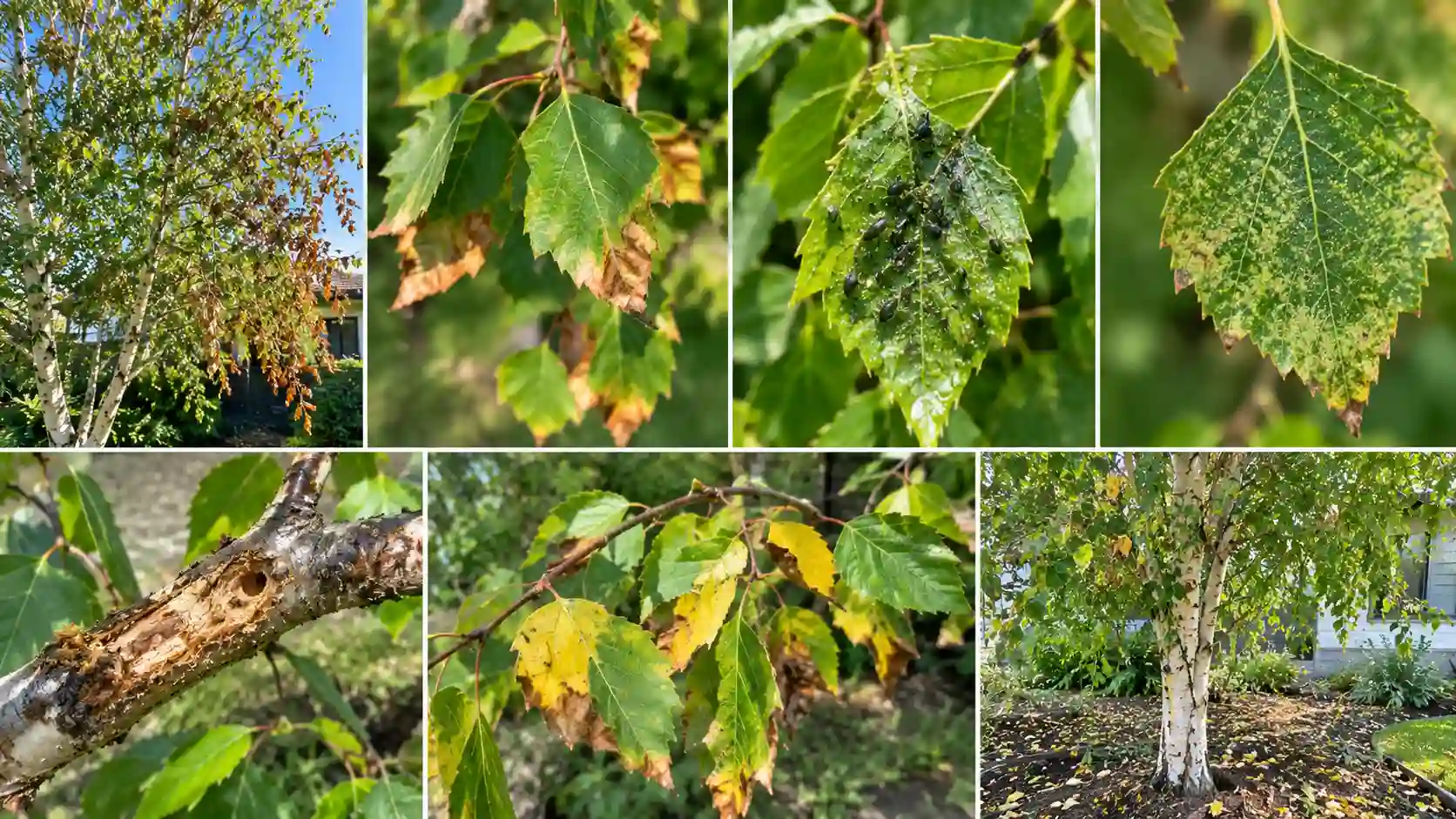
The most useful diagnostic rule is to check the season first. If symptoms appear during hot, dry weather, environmental stress should be investigated before assuming a pest is the primary cause.
| Symptom | Likely cause | Fix | Prevention |
| Browning and early leaf drop | Heat or drought stress | Deep watering; expand mulch zone | Shelter from hot afternoon exposure |
| Sticky honeydew and sooty mould | Aphids or other sap-suckers | Wash off; preserve predators | Avoid unnecessary broad-spectrum spraying |
| Fine stippling or bronzing | Two-spotted mite | Reduce plant stress; inspect leaf undersides | Maintain moisture and minimise dusty conditions |
| Sawdust at base / dying branches | Borer attack in a stressed tree | Arborist assessment; remove affected wood where appropriate | Reduce chronic stress |
| Yellow foliage with green veins | Possible nutrient-availability problem | Soil test before feeding | Correct soil/root-zone conditions first |
| Sap bleeding after pruning | Poor pruning timing | Avoid further unnecessary cuts | Prune later in the season |
Agriculture Victoria confirms that two-spotted mite occurs throughout Australia and is particularly damaging in hot, dry conditions, producing stippling, bronzing and sometimes premature leaf drop. The South Australian plant selector also notes that silver birch is susceptible to borer attack.
I would not publish the specific claim that the North American bronze birch borer is the confirmed Australian birch borer without stronger local evidence. Likewise, the Atlas of Living Australia currently shows zero occurrence records for Euceraphis betulae, so it is safer to describe aphid problems generically unless a local specimen is positively identified.
For a broader diagnostic workflow, use our plant problems and troubleshooting guide and Australian garden pest identification guide.
How to Plant, Water and Prune a Silver Birch (Southern Hemisphere Calendar)
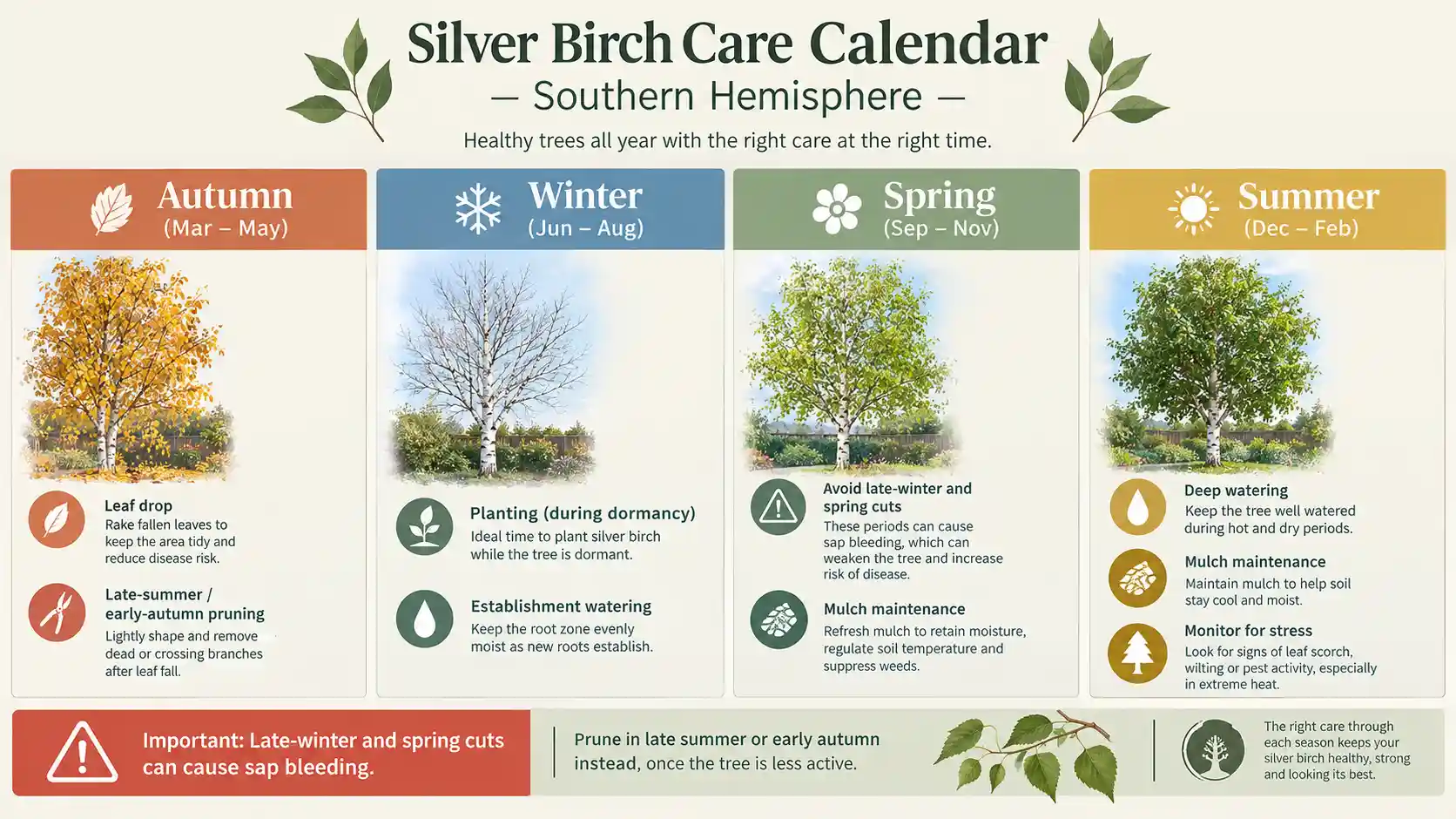
Plant silver birch during its dormant period, generally through autumn and winter in suitable southern Australian climates. Water deeply during establishment and maintain an evenly moist root zone through summer rather than relying on frequent shallow sprinkling.
Birch pruning has one unusual timing issue: cutting during late winter or spring can cause heavy sap bleeding. University extension guidance and Australian nursery guidance both recommend pruning in summer or autumn instead.
| Season | Task | Reason |
| Autumn | Plant new trees where climate permits; top up mulch | Establish roots before summer |
| Winter | Maintain moisture without waterlogging | Dormant tree, bare winter structure |
| Spring | Monitor budburst, soil moisture and pests | New growth begins |
| Summer | Deep watering during heat/dry periods | Protect shallow roots |
| Late summer–early autumn | Remove damaged/crossing branches if necessary | Reduces spring sap bleeding |
| Autumn | Record colour and leaf-drop timing | Useful site-specific evidence |
For mulch, a practical target is around 75 mm, kept away from direct trunk contact; Australian nursery guidance uses that figure.
Can You Stop a Silver Birch Growing Too Tall, or Cut the Top Off?
Do not top a silver birch simply to force it into a space it has outgrown. Topping removes the natural leader structure and can generate weak regrowth. The better solution is to choose the right mature form before planting and limit pruning to structural, damaged or crossing branches.
For a genuinely small site, choose ‘Youngii’ or another appropriately sized tree rather than repeatedly cutting the crown back. Major structural pruning on a mature tree is best assessed by a qualified arborist.
Silver Birch for Small Gardens, Pots and Underplanting
A standard silver birch is usually a poor long-term choice for a very small block. ‘Youngii’ provides the familiar white-barked birch character at a much smaller scale, while larger sites can use group planting to create a copse.
Silver birch has shallow roots, so underplanting should favour plants that tolerate root competition and relatively dry surface conditions. Seasol specifically suggests hellebores and native violets beneath birch.
For small gardens, permanent container culture is best treated as a specialist option rather than a way of keeping a standard B. pendula permanently miniature.
For broader plant selection around a property, see LeafyHeaven’s best trees and shrubs for Australian gardens.
Conclusion
A silver birch tree in Australia performs best in cool-temperate regions with a sheltered site, dependable summer moisture and enough room for its shallow root system. It struggles when heat, humidity and drought repeatedly overwhelm the tree. Score your site first, plant in dormancy, protect the root zone through summer, and choose river birch or another suitable species where summers are consistently hot and humid.
FAQs
Does silver birch have invasive roots?
Not generally described as pipe-seeking roots, but silver birch has shallow, fibrous roots that spread widely, compete with lawn and can contribute to paving problems when planted too close.
Is a birch tree good for a small garden?
A standard silver birch is usually too large for a tight garden. A smaller form such as Betula pendula ‘Youngii’ is more practical where the climate is suitable.
What is the lifespan of a silver birch tree?
Lifespan depends strongly on climate and conditions. The ACT National Arboretum gives an expected lifespan of about 60–70 years for silver birch, while European sources report longer potential lives under favourable conditions.
What does silver birch look like in winter?
It becomes leafless, leaving slender branches and its characteristic pale, peeling bark. Catkins associated with the next growing season can also be visible around the dormant period.
What are the pros and cons of silver birch trees?
Pros include white bark, autumn colour and filtered shade. Cons include summer stress, shallow roots, sap bleeding after badly timed pruning and a relatively narrow Australian climate range.
Is there a tropical birch tree?
No true Betula species should be treated as a tropical-garden substitute for silver birch. River birch is the more relevant warmer-climate birch, but local heat and humidity still determine performance.
1 Comment