

Box Hedge Australia: Best Varieties, Spacing & Care Guide
Which box hedge Australia gardeners should choose depends first on climate, not just appearance. Box hedging is a group of clipped evergreen Buxus plants used for formal borders, edging, low hedges and topiary. In Australia, the main choices include English box (Buxus sempervirens), Japanese box (Buxus microphylla), compact Korean or dwarf forms, and the Australian native often sold as “Aussie Box”, Westringia fruticosa. The important difference is that Australian heat, dry spells, humidity and summer rainfall can change how these plants perform. Japanese box is generally the safer starting point for warmer or more humid districts, while English box remains especially useful in cooler, drier climates.
Quick Summary
- Japanese box (Buxus microphylla) is generally the better starting choice for warm or humid Australian gardens. English box (Buxus sempervirens) is better suited to cooler, drier conditions and is valued for its slower, finer growth.
- For a dense low hedge, roughly 30–40 cm centres is a practical starting range for many common box types; compact edging forms may be planted closer. Exact spacing should follow the cultivar and the size of the nursery stock.
- Bronze foliage in winter can be normal, particularly on English box. Brown leaves combined with black stem streaks, progressive leaf drop and bare patches are much more concerning for box blight, particularly in persistently wet conditions.
- If box is poorly matched to your site, Westringia is the closest Australian low-maintenance alternative, especially when drought tolerance, coastal exposure and reduced fuss matter more than perfectly crisp topiary.
Which Box Hedge Suits Your Australian Climate?
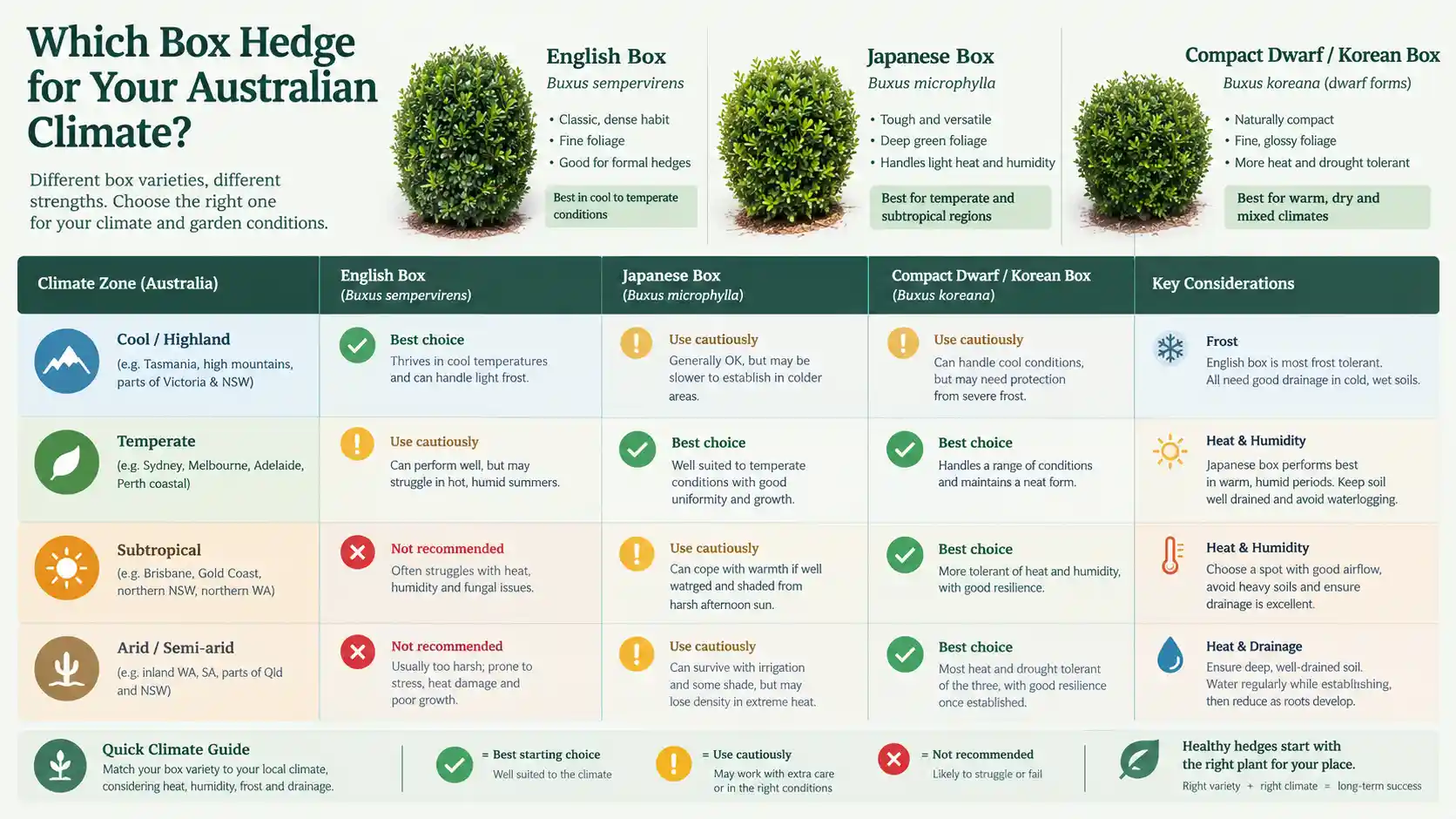
The simplest rule is to match the box to your climate before you match it to your garden design. Australian nursery guidance consistently places Japanese box ahead in warmer conditions, while English box remains a strong choice for cooler areas. Buxus also performs best in well-drained soil, so a climate match cannot compensate for a waterlogged planting bed. Current Australian plant-selection data for English box also confirms its compact hedge use, frost tolerance and winter bronzing.
| Climate zone | Best starting choice | Avoid or use cautiously | Why |
| Cool/highland | English box; selected dwarf/Korean forms | Heat-sensitive placement of Japanese types | Cold is less of a limiting factor for English box, and winter bronzing is a known seasonal characteristic |
| Temperate | English or Japanese box | Unprotected full-sun sites with poor drainage | Both can work; choose English for a finer, slower hedge and Japanese for quicker establishment |
| Subtropical | Japanese box | English box in hot, humid, poorly ventilated positions | Japanese box is more commonly recommended for warmth and humidity |
| Arid/semi-arid | Japanese box with reliable irrigation and protection from extreme heat | English box in exposed hot sites | Heat and root-zone moisture stress become bigger issues than frost |
The table is a practical selection framework rather than a hard climatic boundary. Microclimates matter: a Brisbane courtyard beside a hot wall is different from a shaded, ventilated suburban garden, just as a sheltered Melbourne hedge is different from one exposed to drying winter winds.
English box (Buxus sempervirens)
English box is the traditional formal hedge plant. It grows relatively slowly, develops fine foliage and holds a clipped shape well, which is exactly why it works so effectively for low borders, parterres and topiary. Australian nursery guidance also notes that it can turn bronze during winter and prefers well-drained soil.
For Australian gardeners, English box is particularly attractive in cooler districts such as parts of Melbourne, Canberra, the Adelaide Hills and Tasmania. It is not the first box I would choose for a hot, humid subtropical site, especially where summer foliage stays damp for long periods.
The main advantage is control. Slow growth means less clipping. The trade-off is that a hedge made from small plants takes patience.
Japanese box (B. microphylla)
Japanese box is usually the more practical all-round Buxus for Australian warmth. Australian nursery guidance describes it as handling heat and full sun better than English box, while current Australian listings commonly position it as a moderate-growing formal hedge plant.
It is also a sensible choice when you want the classic box appearance but do not want to wait as long for a hedge to bulk up.
That does not make Japanese box disease-proof. Research from outside Australia has found meaningful differences in cultivar susceptibility to Calonectria pseudonaviculata, with some B. microphylla cultivars performing better than highly susceptible B. sempervirens types under experimental conditions. Those findings are useful when assessing disease risk, but they should not be translated into a claim that every Japanese box is resistant in Australian gardens.
Korean and dwarf boxes
Korean and dwarf forms make more sense when the job is edging rather than screening. Exact naming can vary between nurseries, so check the botanical label instead of buying from the common name alone.
Compact forms such as Buxus microphylla ‘Faulkner’ are especially useful where the finished hedge needs to stay small. One Australian nursery currently lists ‘Faulkner’ as a dwarf Japanese box that can be maintained around 1 m or lower, with tighter planting recommended for low hedges.
Another Australian listing for Korean Buxus microphylla describes a compact form that can be maintained at around 60 cm high and about 50 cm wide, making it much better suited to edging than a taller boundary hedge.
The smallest box hedge is therefore not necessarily a separate species. It is often a compact cultivar selected and clipped for a very low finished height.
Box Hedge Height and Growth Rate
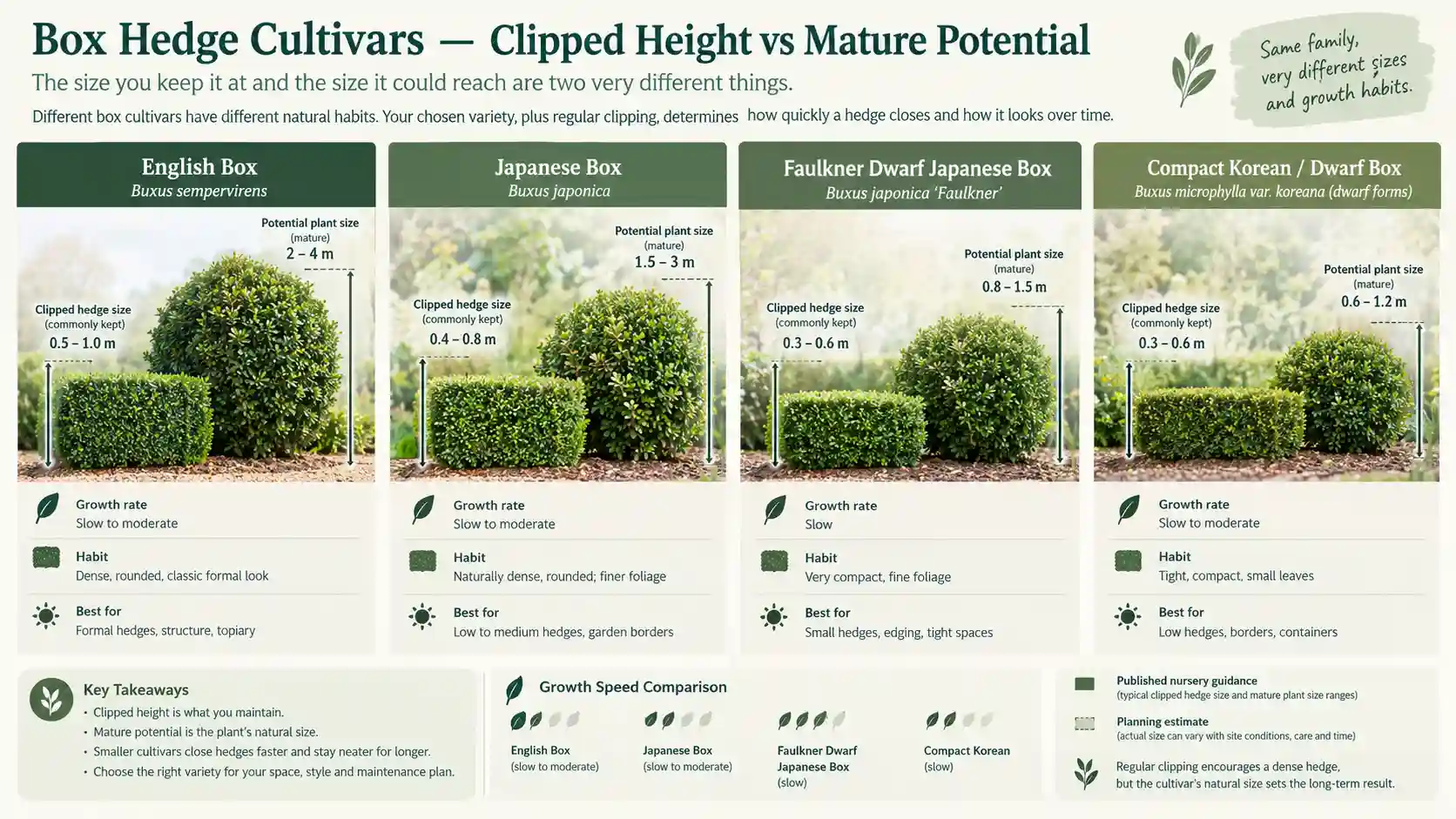
Box is one of the clearest examples of why mature size and clipped size are not the same thing. A hedge can be maintained at 30–50 cm for years even though the underlying plant could eventually become much larger.
Australian listings illustrate the spread. English box may be kept as a low hedge but can reach around 2 m in garden conditions, while Japanese box is commonly listed around 1–2 m as a managed landscape plant. Compact ‘Faulkner’ selections are substantially smaller.
Mature height and width
Think about box in three different sizes:
Clipped size: the height you deliberately maintain.
Growing size: the size the plant reaches between trims.
Mature potential: the size it could eventually reach if neglected.
For formal hedging, the clipped size is the number that matters most. A nursery plant labelled “60 cm” does not mean the hedge will stay 60 cm.
How fast does box grow, and how long until it closes up?
English box is deliberately slow. One current Australian nursery guide gives roughly 10–15 cm of annual growth under good conditions, while Japanese box is described as putting on around 20 cm per year and establishing faster. These figures are useful as planning guides rather than guarantees because water, soil, sunlight, stock size and pruning all alter the outcome.
| Variety | Typical clipped use | Indicative annual growth | Time to a closed hedge |
| English box | 30 cm–1 m formal hedge | About 10–15 cm/year in one current Australian nursery guide | Commonly described as around 2–3 growing seasons at close formal spacing; starting size matters greatly |
| Japanese box | 30 cm–1.5 m formal hedge | Around 20 cm/year in one current Australian nursery guide | Stock- and spacing-dependent; closer planting and larger stock close the visual gap sooner |
| Faulkner | 30 cm–1 m low formal hedge | Faster than traditional English box | Depends strongly on starting stock and whether planted at 4–5 plants/m |
| Korean/dwarf forms | Edging to about 60 cm or cultivar-specific low hedges | No dependable universal Australian figure found | Treat as a slow compact hedge and plan around cultivar size rather than a fixed month count |
Current Australian nursery recommendations for Japanese box range from around 3–4 plants per metre for common stock to tighter planting for smaller plants, while ‘Faulkner’ guidance can reach 4–5 plants per metre for low hedges.
Do not overfeed a hedge just to force closure. A flush of soft growth can make the plants look temporarily faster without producing the compact, durable framework you actually want.
Is Aussie Box (Westringia) a Genuine Alternative to True Box?
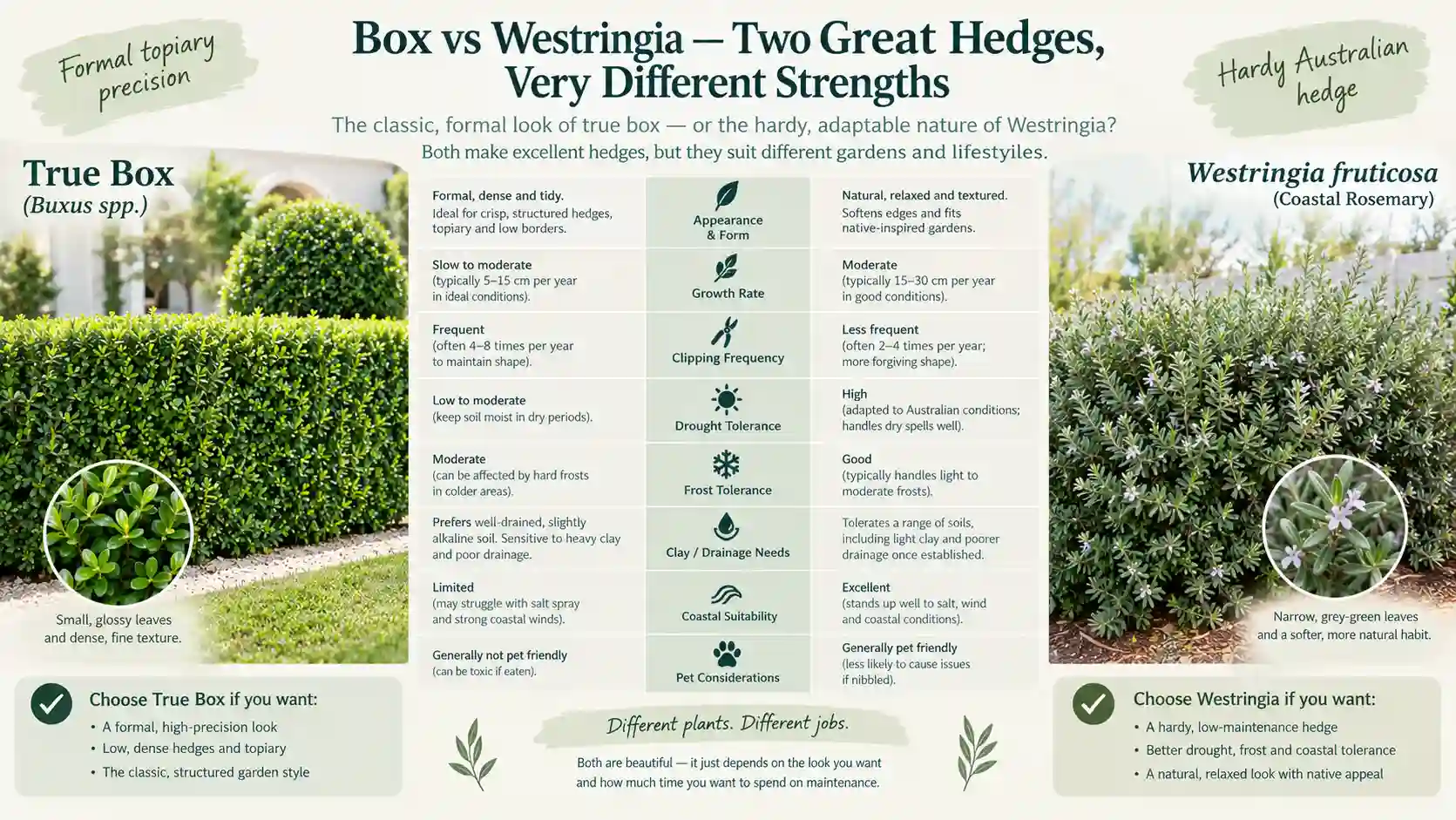
Yes, for many Australian gardens. No, if your priority is the exact tiny-leaved, sharply geometric appearance of traditional box topiary.
Westringia fruticosa, commonly called coastal rosemary and sometimes sold under Australian “box” branding, is an evergreen native shrub with dense grey-green foliage. The Australian National Botanic Gardens describes it as drought hardy, salt tolerant and adaptable, while the South Australian Plant Selector lists it for hedges and screening and records tolerance of clay, drought, moderate frost, salinity and coastal conditions.
| Feature | True box (Buxus) | Westringia |
| Formality | Excellent for crisp formal hedges and topiary | Good for clipped hedges; less exact and more organic |
| Growth | Generally slow to moderate | Generally moderate to fast depending on cultivar and conditions |
| Clipping | Regular clipping produces very sharp shapes | Responds well to shaping but looks softer |
| Drought | Moderate once established, but shallow roots need attention | Strong drought tolerance once established |
| Humidity | Japanese box is the better warm-climate option | Good broad Australian adaptability, provided drainage is good |
| Frost | English box is strong in colder gardens | Many forms tolerate moderate frost |
| Clay | Needs drainage; waterlogging is a major problem | More forgiving of clay, but still dislikes stagnant wet soil |
| Pets | Box is not a good choice where pets chew shrubs | Westringia fruticosa is commonly listed as a pet-friendly hedge plant |
| Best use | Formal borders, parterres, topiary | Low-maintenance native hedges and informal/formal mixed landscapes |
Current Australian veterinary and nursery sources list Westringia fruticosa among safer garden choices around dogs and also identify English, Japanese and Korean box as plants to avoid where dogs may chew vegetation. Treat “pet-safe” as a risk-reduction label rather than a guarantee that any plant should be eaten.
For drought-prone gardens, coastal blocks or gardeners who want less frequent clipping, Westringia is often the better practical decision even if it does not reproduce the exact look of European box.
How Far Apart to Plant a Box Hedge (Spacing and Plants per Metre)
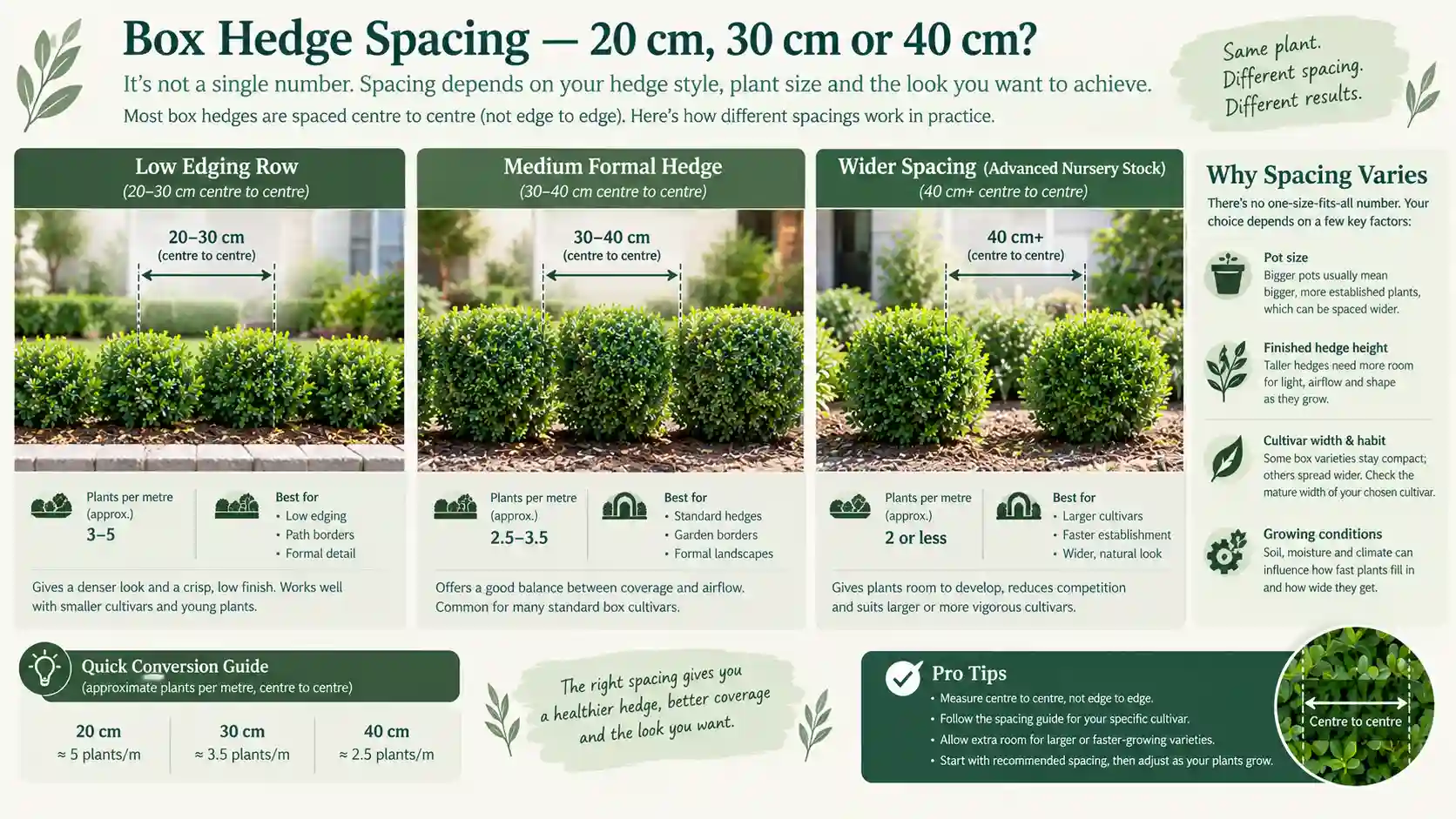
For a continuous low box hedge, about 30–40 cm centres is a practical starting range, while very low edging may need tighter spacing and larger advanced stock can be spaced wider. The apparent conflict between 20 cm, 30 cm, 40 cm and “half mature width” recommendations comes from using different plant sizes and different finished hedge goals.
| Variety | Hedge goal | Practical spacing | Plants per metre | Rough cost band |
| English box | Low edging under ~50 cm | 20–30 cm | 4–5 | Low–medium |
| English box | Hedge around 1 m | 30–40 cm | 3–4 | Medium |
| Japanese box | Low formal hedge | 25–30 cm | 3–4, with smaller stock sometimes tighter | Low–medium |
| Japanese box | Hedge around 1 m | 30–40 cm | 3–4 | Medium |
| Faulkner | Low formal hedge | Around 20–25 cm | 4–5 | Medium–higher |
| Korean/dwarf | Very low edging | Around 20–30 cm, cultivar dependent | 3–5 | Low–medium |
These are planting guides, not universal laws. Current Australian nursery recommendations vary with pot size: smaller Japanese box stock may be planted at 3–4 plants per metre, while larger advanced plants may be spaced at 2–3 per metre.
The “half mature width” rule is useful as a check, not a commandment. If a compact cultivar is expected to mature to about 50 cm wide, half-width gives roughly 25 cm, which fits common low-hedge recommendations. A larger plant with a 1 m spread would produce a completely different spacing result.
The most important rule is to measure centre to centre, not leaf edge to leaf edge.
Planting and Setting Up a Box Hedge That Stays Dense
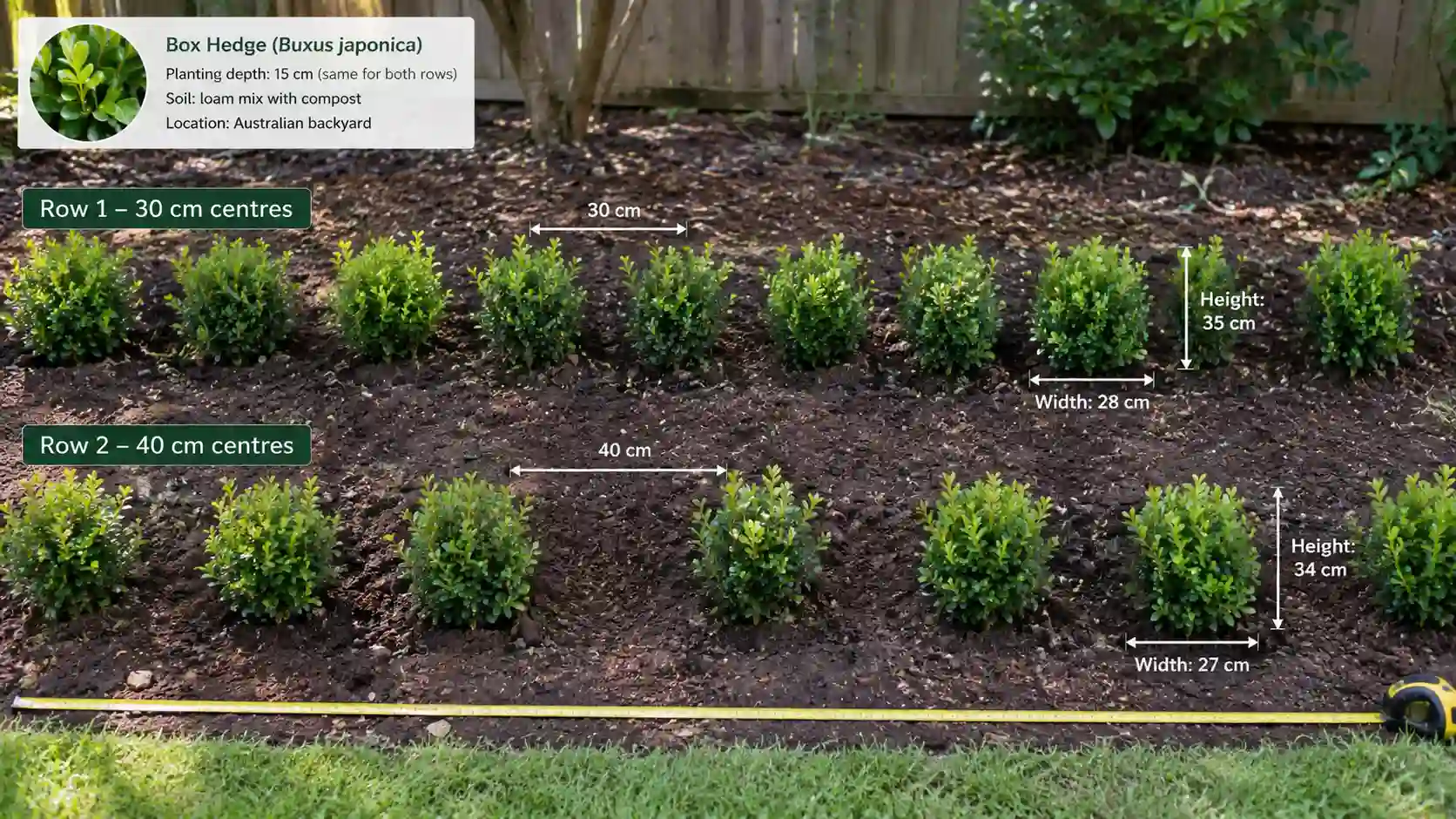
A dense box hedge is usually created by good setup, not by aggressive pruning later. The roots need oxygen, the plants need consistent establishment moisture, and the base of the hedge must receive enough light to avoid becoming bare.
Soil, drainage and clay
Drainage comes first. Box is relatively shallow-rooted, so saturated soil can damage the root zone quickly. University of Maryland Extension describes boxwood roots as fairly shallow and warns against deep cultivation and excessively wet sites.
That matters particularly on heavy Australian clay or low spots.
Before planting:
- Improve the whole planting strip, not just a small hole around each plant.
- Raise the bed or use a mounded row where water collects.
- Incorporate organic matter where appropriate to improve structure.
- Keep mulch light around box rather than creating a deep, permanently wet layer.
- Plant at the same general depth as the nursery root ball rather than burying the stem.
For practical Australian soil and fertiliser decisions, see our Australian garden soil and fertiliser guide, particularly where clay, sandy soil or compacted ground is part of the problem.
Sun, shade and pots
Box can handle full sun to part shade, but “full sun” is not the same as “best in every Australian microclimate”. A western-facing wall, reflected heat and a freshly clipped hedge can create a much harsher site than an open lawn.
English box is particularly worth protecting from excessive heat, while Japanese box is generally more forgiving in warmer conditions. Current Australian nursery guidance places both in full sun to part shade, with Japanese box marketed specifically for heat tolerance.
In pots, drying happens faster because the root zone is smaller. Use a quality potting mix, excellent drainage and a container large enough for the plant you actually intend to keep. Avoid placing dark containers against a heat-reflective wall where the root zone can become excessively hot.
Feeding
Box does not need a constant stream of fertiliser to stay green. More feed is not automatically more density.
A sensible approach is a moderate slow-release fertiliser in spring, adjusted to the plant’s condition and soil. Avoid repeated heavy nitrogen feeding, especially where the hedge already has soft, excessively vigorous growth.
Leafy Heaven’s Australian soil and fertiliser guide is useful here because nutrient problems can be confused with drainage and root-health problems.
Why Is My Box Hedge Turning Brown, Bronze or Black?
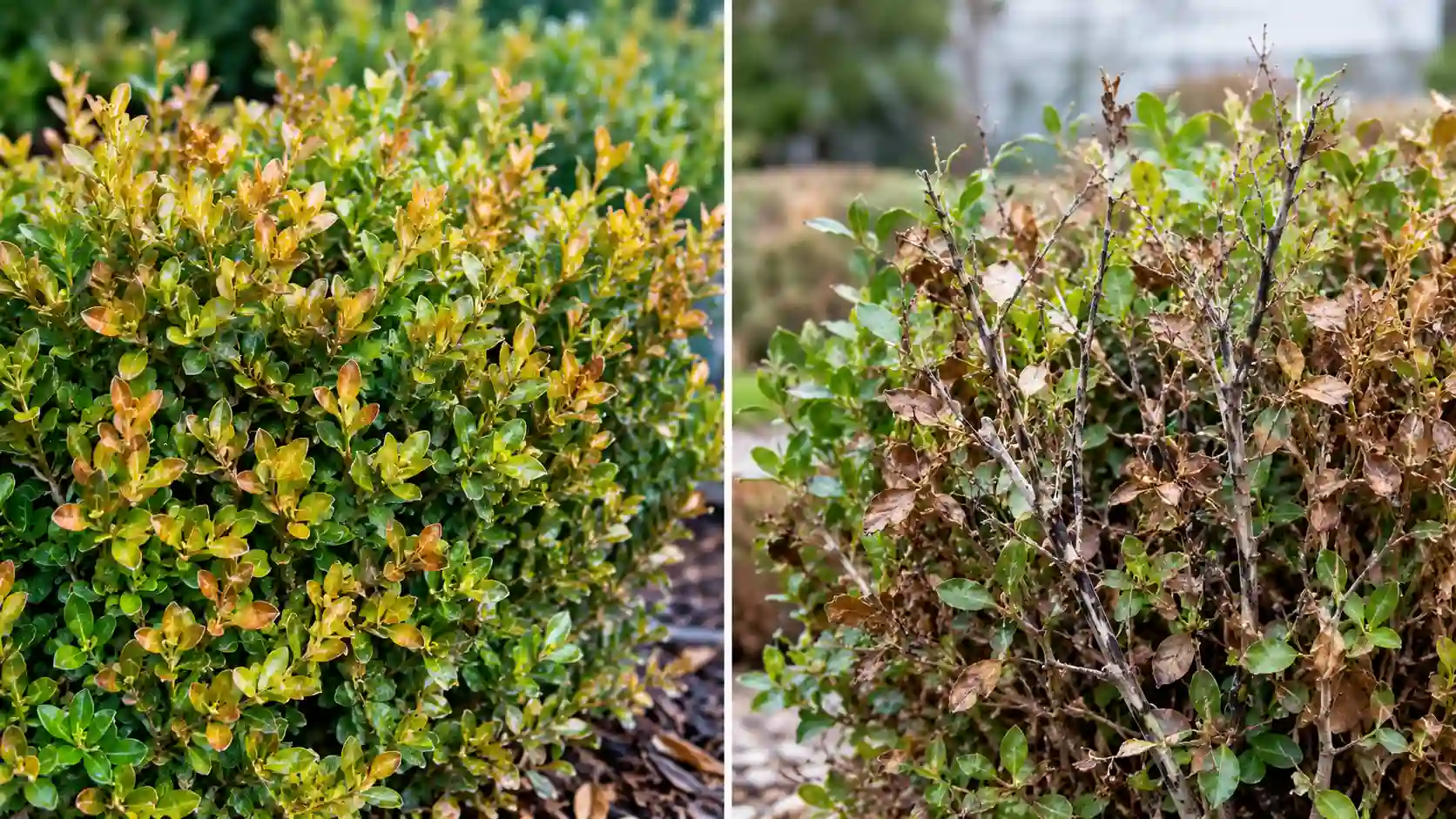
Look at where the damage appears first: leaves, stems or roots. That simple observation often narrows the problem much faster than reaching for fertiliser or fungicide.
| Symptom | Likely cause | How to confirm | What to do | Prevention |
| Orange/bronze foliage in winter | Cold-weather bronzing/winter stress | Plant otherwise healthy; no progressive stem dieback | Monitor through spring; correct watering and general care | Choose suitable climate and avoid unnecessary winter stress |
| Brown leaves + bare patches + black stem streaks | Suspected box blight | Symptoms progress; inspect young stems closely | Isolate suspect material, avoid wet handling and seek proper diagnosis | Dry-weather clipping, sanitation and reduced leaf wetness |
| White/brown scale bumps + sticky leaves | Scale | Inspect stems and leaf undersides | Manage according to identification and label directions | Regular inspection and good airflow |
| Yellowing, wilt and decline in wet soil | Root stress/root rot | Check drainage and root condition | Correct drainage first; do not add fertiliser blindly | Raised planting and free drainage |
| Crispy/tan foliage on exposed face | Sun scorch | Damage strongest on hot, exposed side or after hard trimming | Reduce stress and protect from extreme conditions | Avoid severe pruning before heat and limit harsh exposure |
English box is documented in Australian plant-selection guidance as turning bronze in winter, and current Australian nursery advice also describes cold-season colour change as a normal feature.
For broader symptom diagnosis, use Leafy Heaven’s Plant Problems & Troubleshooting guide and its Australian garden pest identification guide rather than treating every brown leaf as a nutrient deficiency.
Blight notes
Box blight is a serious fungal disease of Buxus. The RHS identifies brown leaves, bare patches, black streaking on young stems and dieback as key symptoms, with wet conditions favouring disease development. It also recommends dry-weather pruning, clean tools and avoiding overhead watering in affected gardens.
Research has also demonstrated that disease development is strongly affected by cultivar, temperature and leaf wetness, with B. sempervirens ‘Suffruticosa’ performing much worse than some less-susceptible cultivars under experimental infection.
For Australian readers, the important biosecurity point is this: do not diagnose box blight or box tree moth from symptoms alone and assume the organism is established locally. Australia’s official biosecurity guidance says unusual plant pests and diseases should be reported through the Exotic Plant Pest Hotline on 1800 084 881, which connects callers with the relevant state or territory authority.
That makes the Australian Biosecurity reporting guidance the right authority to consult when you see an unusual or suspected exotic plant pest.
One reason to be especially cautious is that box tree moth (Cydalima perspectalis) is now a serious pest in parts of Europe and North America, but current overseas distribution data should not be mistaken for proof of Australian establishment.
When and How to Clip a Box Hedge
The best clipping regime is usually light, regular trimming during active growth, rather than allowing the hedge to become leggy and then cutting it back severely.
Avoid clipping in wet weather. Wet foliage and wet tools create an easier pathway for disease spread where fungal problems are present. The RHS specifically recommends pruning box in dry conditions, cleaning tools between areas and reducing dense, stagnant foliage where blight risk is high.
| Climate zone | Useful starting clipping window | Frequency |
| Cool/highland | Spring growth + late summer | Usually 1–2 light clips |
| Temperate | Spring + late summer/early autumn | Usually 2 clips |
| Subtropical | Spring flush + another warm-season trim | Often 2–3 light clips |
| Arid/semi-arid | Avoid peak heat; trim during milder active growth | Usually 1–2 lighter clips |
Treat the calendar as a starting point rather than a fixed rule. A hedge actively producing soft new growth can often be shaped lightly; a stressed hedge in extreme heat should not be punished with a hard haircut.
A practical shape is slightly wider at the base than the top. That allows more light to reach the lower foliage and helps prevent the classic “green top, bare bottom” hedge.
Before every major trim, check the hedge for active bird nests. Australian bird-friendly gardening guidance stresses the habitat value of dense shrubs, and BirdLife Australia specifically recommends considering existing wildlife before removing or reshaping garden vegetation.
When Box Isn’t the Right Hedge: Better Alternatives
The best substitute depends on what you wanted box to do in the first place.
| Goal | Best choice | Trade-off |
| Crisp formal low hedge | Japanese box or compact Buxus cultivar | More clipping than a looser native hedge |
| Traditional slow-growing border | English box | Slow closure and less suitable for hot humid sites |
| Drought and coastal toughness | Westringia | Softer, less geometric appearance |
| Medium/taller fast screen | Ficus hillii ‘Flash’ or suitable lilly pilly | Much larger plants and more space required |
| Compact flowering hedge | Snow Maiden or dwarf Leptospermum | Less “classic box” appearance |
| Pet-conscious garden | Westringia and other verified pet-safe choices | Availability and final height vary by cultivar |
For larger privacy jobs, our Ficus hillii ‘Flash’ growth and hedge guide covers a substantially faster-growing option that can be maintained as a formal hedge.
For warm, humid gardens where a native screen makes more sense, our Weeping Lilly Pilly Brisbane guide explains the trade-off between rapid screening and much larger eventual size.
For smaller flowering hedges, compare Snow Maiden and Oriental Pearl or the compact dwarf red tea tree guide before choosing a replacement.
Where pets regularly chew plants, Westringia fruticosa is a more appropriate starting point than box. Australian veterinary guidance lists Westringia among safer garden plants while specifically warning against English, Japanese and Korean box for dogs.
Common Box Hedge Mistakes
Planting too deep
Box should not be buried simply because the surrounding soil is heavy or because the gardener wants the hedge to look “settled”. Deep planting can interfere with oxygen around the root zone.
Fix: keep the nursery root ball at the appropriate soil level and improve the planting bed rather than burying the stems.
Watering overhead
Overhead irrigation wets the foliage and is unnecessary when water can be delivered directly to the root zone. Where fungal disease is a concern, reducing leaf wetness is particularly important.
Fix: water at the base and aim for consistent moisture during establishment rather than constantly wet leaves.
Over-feeding
A weak hedge does not automatically need more nitrogen. Root stress, poor drainage, inadequate light and drought can all produce poor colour.
Fix: diagnose the site before feeding.
Clipping in wet weather
A hedge that has been cut immediately after rain is not an ideal candidate for disease-sensitive maintenance.
Fix: choose a dry spell, clean the tools and avoid transferring clippings around the garden.
Choosing English box for a hot, humid site
English box can survive in more places than it performs well in. The fact that a plant is sold nationally does not mean every climate is equally suitable.
Fix: choose Japanese box for warmer, more humid districts unless a specific cultivar and site make English box a better fit.
Planting too close or too far apart
Five tiny plants per metre may make sense for a low border. The same spacing can be unnecessary for advanced stock. Conversely, 1 m between small plants can leave a hedge looking permanently patchy.
Fix: choose spacing from the target height, starting stock and cultivar—not from one universal number.
Conclusion
The best box hedge Australia gardeners can plant is the one matched to their climate, soil and finished height. Choose Japanese box when heat and humidity are important considerations; choose English box where cooler conditions and a slower, finer formal hedge are an advantage. Use compact cultivars such as ‘Faulkner’ or dwarf/Korean forms when the hedge is mainly edging.
For spacing, start around 30–40 cm centres for many low-to-moderate box hedges, then adjust for cultivar and nursery stock size. Build density through correct spacing, good drainage, steady establishment watering and regular light clipping rather than excessive feeding.
When an existing hedge turns bronze, diagnose before treating: winter bronzing is not the same pattern as blight, scale, root stress or sun scorch. And where symptoms suggest an unusual exotic pest or disease, use Australia’s official plant-health reporting pathway rather than assuming the diagnosis.
Takeaway: pick the variety for your climate first, then space and clip it correctly.
FAQs
What is the best box hedge for Australia?
For most warm or humid Australian gardens, Japanese box (Buxus microphylla) is the stronger starting choice because it is commonly selected for better heat tolerance and faster establishment. English box remains excellent in cooler, drier regions where its slower, finer growth suits formal hedging and topiary. Always check the specific cultivar and drainage of your site.
How long does a box hedge take to grow?
There is no single number because hedge closure depends on plant size, spacing, cultivar, soil, watering and climate. Current Australian nursery guidance describes English box as slow and Japanese box as faster. Larger nursery stock planted at appropriate spacing can look established much sooner than small tube stock, even when both are the same species.
How far apart should I plant a box hedge?
For many low box hedges, about 30–40 cm between plant centres is a useful starting point. Very low edging may be planted at around 20–30 cm, while larger advanced plants can be spaced wider. Use the cultivar’s mature width and the starting stock size as the final check rather than relying on a single spacing rule.
Why is my box hedge turning brown in winter?
Winter bronzing can be a normal seasonal response, particularly in English box. It is more reassuring when the plant remains otherwise healthy and returns to greener growth as conditions improve. Brown foliage accompanied by progressive leaf drop, bare patches and black streaks on young stems is a much stronger reason to investigate disease or another stress.
Is Westringia a good substitute for box?
Yes, especially when you want an Australian native hedge with strong drought, coastal and general landscape tolerance. Westringia fruticosa can be clipped into a neat hedge, but it has a softer, more natural texture than classic box. It is a particularly good choice when low maintenance matters more than very formal topiary geometry.
Can I grow a box hedge in a pot or in shade?
Yes. Box is well suited to containers and tolerates part shade, but growth becomes less compact as light falls and pots dry out faster than garden beds. Use a quality, free-draining potting mix, water according to weather and container size, and avoid positioning the pot where extreme reflected heat will repeatedly stress the root zone.