
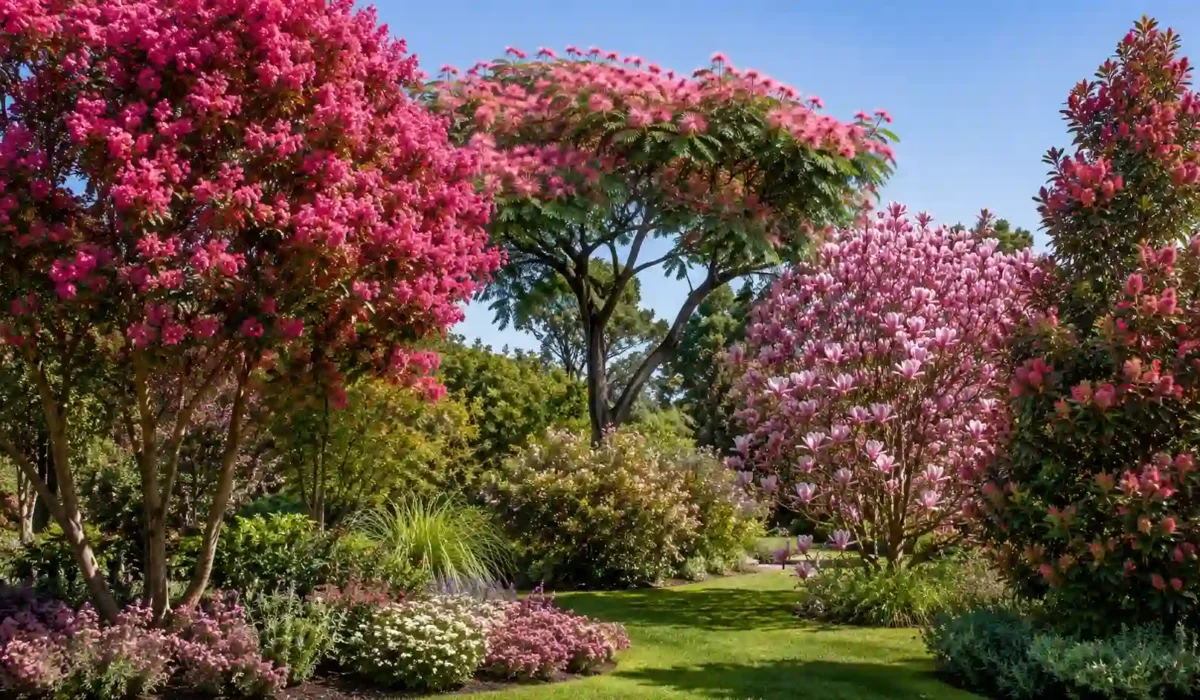
Tree With Pink Flowers Australia: Identification Guide
Introduction
Australia’s landscapes feature a remarkable variety of pink flowering trees, from native species adapted to harsh local conditions to exotic ornamentals planted in streets, parks, and home gardens. Whether you are trying to identify a tree with pink flowers Australia-wide or searching for the best species for your garden, understanding flower shape, leaf structure, tree size, and flowering season is essential. Pink flowering trees range from compact native species suitable for small spaces to large ornamental specimens that create dramatic seasonal displays. This guide explains the most common types of trees with pink flowers, how to identify them, and which species thrive across Australia’s diverse climates. For a broader overview of species, colours, climate zones, flowering seasons, and planting considerations, see our Flowering Trees Australia: Best Species Guide.
Most pink flowering trees belong to diverse groups of flowering plants that have evolved specialized blooms to attract pollinators and support reproduction.
Quick Summary
- Australia is home to dozens of trees that produce pink flowers, ranging from compact natives under 5 metres to towering exotics exceeding 15 metres.
- Key identification features include flower shape, leaf form, bark texture, tree height, and flowering season.
- Native species such as Geraldton Wax, Lilly Pilly, and pink-flowering Melaleuca varieties are well adapted to Australian conditions.
- Exotic species including the Persian Silk Tree, Japanese Cherry, Magnolia, and Crepe Myrtle are widely planted in gardens and streetscapes.
- Flowering season, mature size, and climate suitability are the most reliable ways to identify pink flowering trees.
What Are the Most Common Trees with Pink Flowers in Australia?
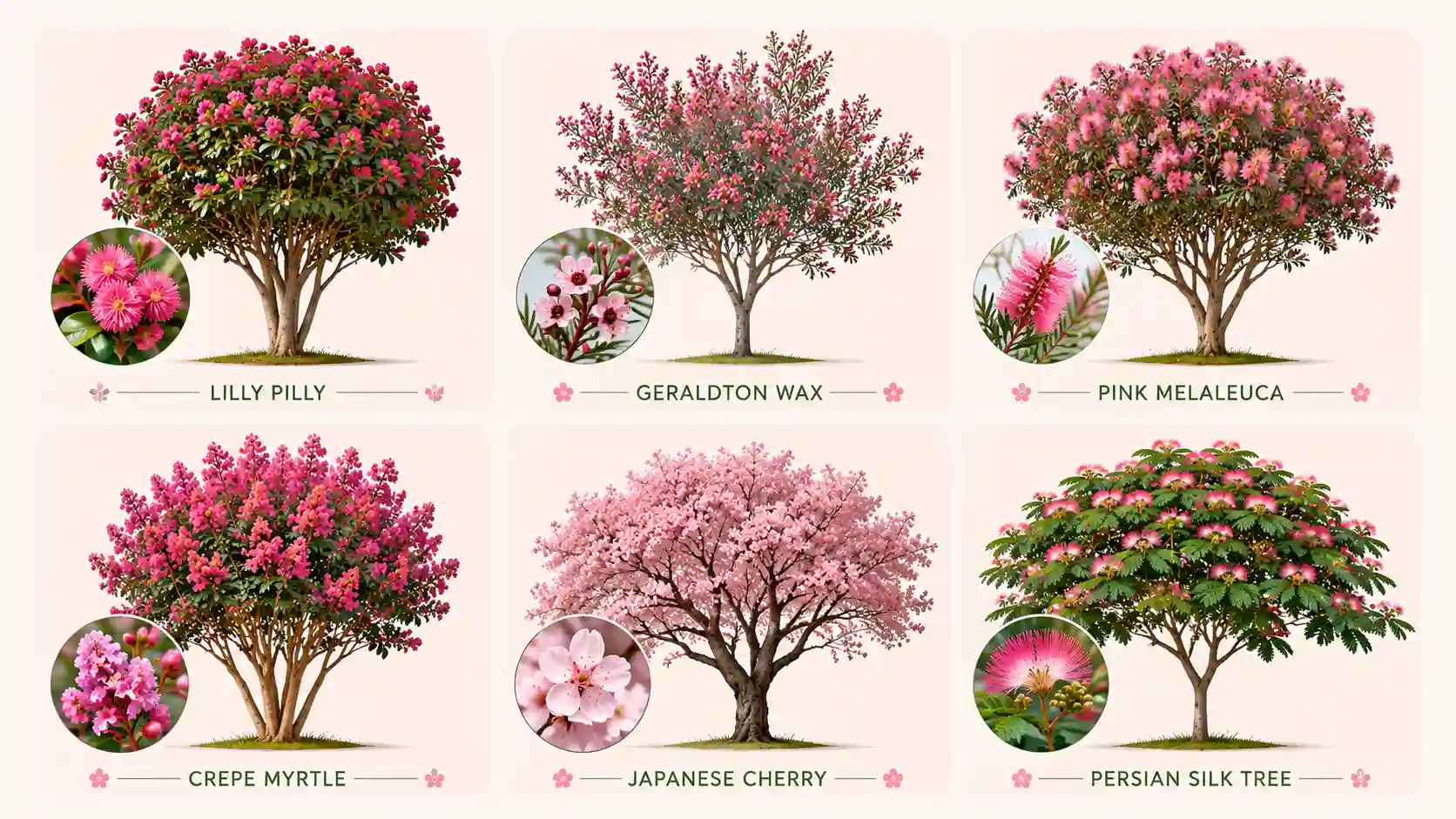
The most common trees with pink flowers in Australia include both native Australian species and introduced ornamental trees. Common examples include Lilly Pilly, Geraldton Wax, Melaleuca cultivars, Persian Silk Tree, Crepe Myrtle, Japanese Cherry, Magnolia, and Flowering Peach.
Pink flowering trees identification usually relies on four factors:
- Flower structure and shape
- Leaf type and arrangement
- Mature tree size
- Geographic location and climate
Some species are common in tropical Queensland, while others perform best in temperate regions such as Victoria, Tasmania, and parts of New South Wales.
Native Australian Trees with Pink Flowers
Several Australian native trees produce attractive pink blooms while providing excellent drought tolerance and wildlife value.
Geraldton Wax (Chamelaucium uncinatum)
Geraldton Wax is known for its delicate five-petalled pink flowers that appear from winter through spring. Although often grown as a shrub, mature specimens can develop into small tree forms.
Lilly Pilly (Syzygium spp.)
Lilly Pilly trees produce fluffy clusters of pink-tinted flowers followed by colourful berries. Different species and cultivars vary significantly in height, ranging from small screening plants to large shade trees.
Pink Paperbark (Melaleuca spp.)
Many pink-flowering Melaleuca cultivars produce bottlebrush-like flower spikes. These native trees attract pollinators and tolerate a wide range of soil conditions.
Brush Box (Lophostemon confertus)
While Brush Box flowers are often cream-white, some cultivated forms and related species display pinkish flowering characteristics that add ornamental value.
Bluebell Creeper
Although technically a climbing plant rather than a true tree, Bluebell Creeper is frequently associated with pink and mauve flowering native plant discussions due to its ornamental blooms.
Boronia
Boronia species are renowned for their fragrant pink flowers. Most remain shrubs, though some mature into small tree-like forms under favourable conditions.
For Queensland gardeners seeking a pink flowering tree Queensland species, Lilly Pilly and pink-flowering Melaleuca cultivars are among the most reliable native options.
Exotic and Introduced Pink Flowering Trees in Australia
Many of Australia’s most recognisable pink flowering trees originated overseas but have adapted well to local growing conditions.
Persian Silk Tree (Albizia julibrissin)
Known for its distinctive pink pompom flowers and feathery foliage, the Persian Silk Tree thrives in many temperate and subtropical regions.
Japanese Cherry (Prunus spp.)
Japanese Cherries are famous for their spectacular spring blossom displays and are widely planted in cooler Australian climates.
Crepe Myrtle (Lagerstroemia spp.)
Crepe Myrtle is one of Australia’s most popular flowering street trees, producing long-lasting pink blooms throughout summer.
Flowering Peach
Flowering Peach trees offer bright pink blossoms in spring and perform best in regions with cool winters.
Magnolia
Many Magnolia cultivars produce stunning pink flowers in early spring and are especially popular in southern Australia.
Introduced species remain common because they provide dramatic seasonal colour, predictable flowering performance, and attractive forms suitable for urban landscapes.
Pink Flowering Trees Identification — How to Tell Them Apart
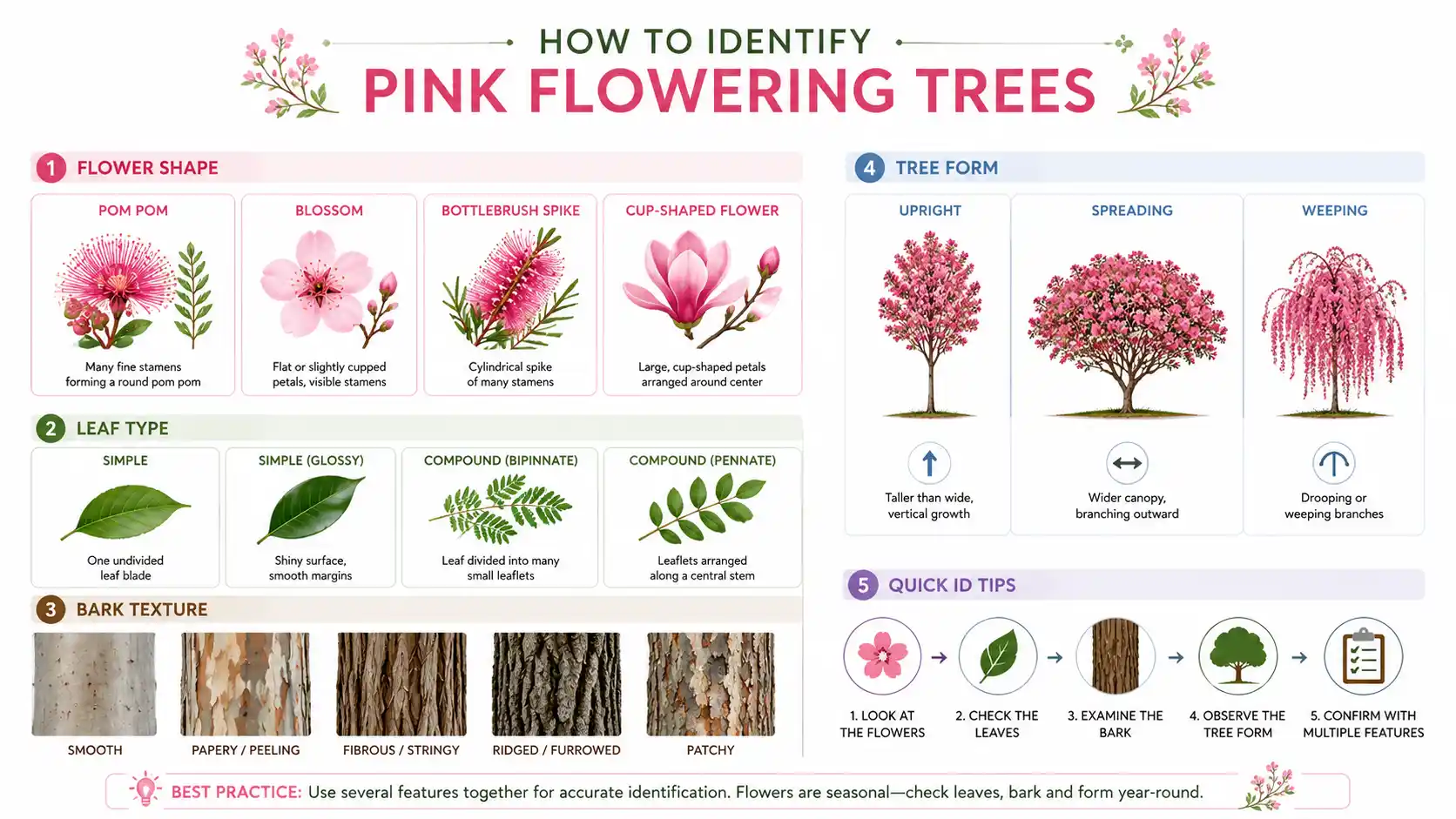
Pink flowering trees identification begins with observing the plant’s flowers, foliage, growth habit, and flowering season.
Important identification features include:
- Flower form: pompom, blossom, spike, cluster, or bell-shaped
- Leaf type: simple, compound, needle-like, glossy, or matte
- Bark characteristics: smooth, rough, peeling, or papery
- Tree shape: upright, spreading, rounded, or weeping
- Flowering season: spring, summer, autumn, or year-round
One common mistake is confusing trees with pink flowers and trees with pink foliage. Pink flowering trees produce coloured blooms, while pink foliage trees display pink or reddish leaves as their primary ornamental feature.
Pink Flowering Trees Quick Identification Guide
| Tree Name | Flower Type | Flowering Season | Mature Height | Native/Exotic |
| Persian Silk Tree | Feathery pompom | Summer | 5–10 m | Exotic |
| Crepe Myrtle | Clustered panicle | Summer–Autumn | 3–10 m | Exotic |
| Japanese Cherry | Blossom clusters | Spring | 4–8 m | Exotic |
| Lilly Pilly | Small fluffy clusters | Spring–Summer | 3–15 m | Native |
| Geraldton Wax | Small five-petal flowers | Winter–Spring | 1–3 m | Native |
| Pink Melaleuca | Bottlebrush spike | Spring–Summer | 2–8 m | Native |
| Magnolia | Large cup or saucer blooms | Spring | 5–15 m | Exotic |
Large Trees with Pink Flowers in Australia
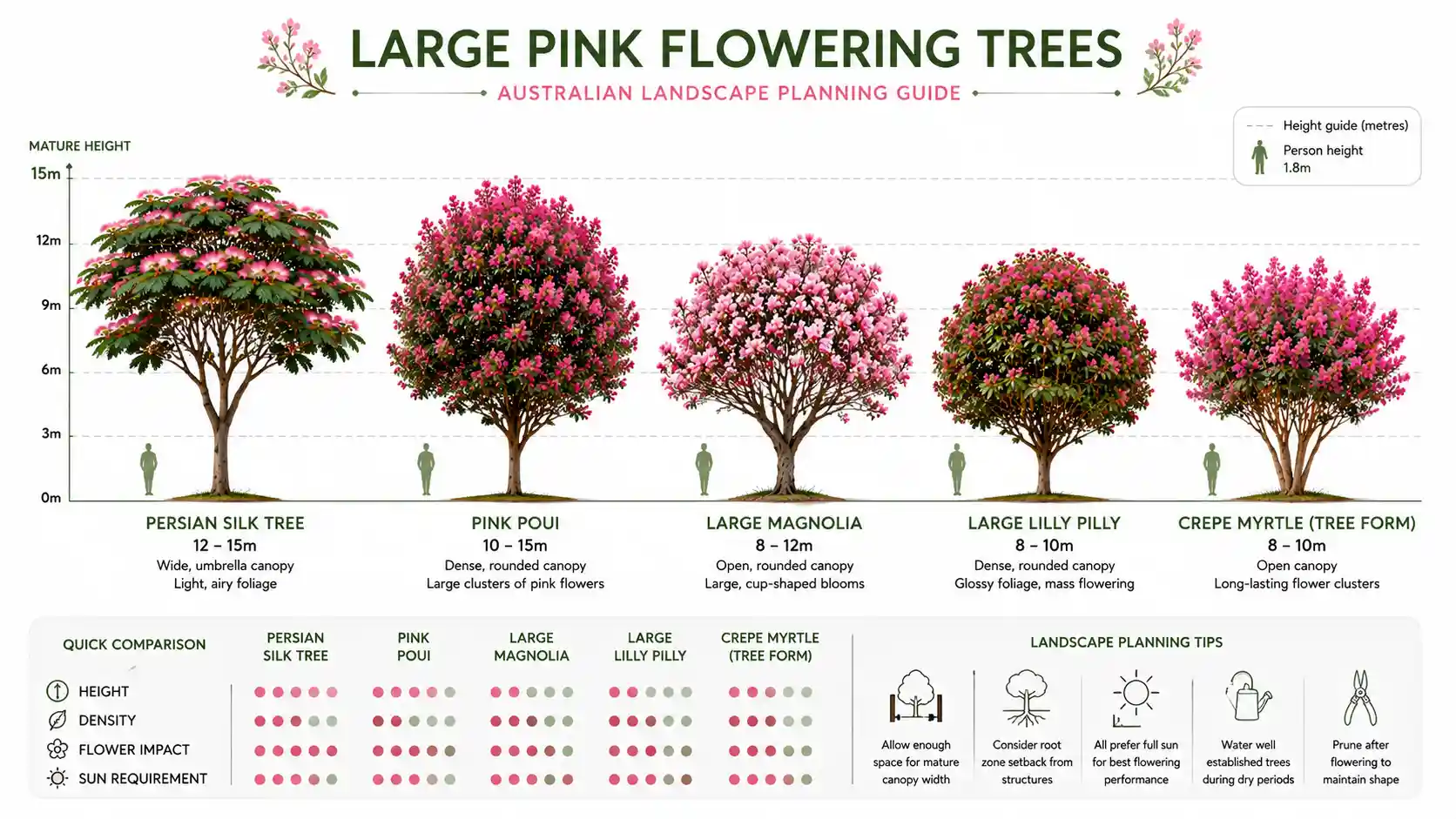
Large pink flowering trees generally reach at least 8 metres in height at maturity. These species are commonly used as feature trees, street trees, and shade trees.
Popular large pink flowering trees include:
- Persian Silk Tree
- Large Crepe Myrtle varieties
- Large Magnolia cultivars
- Pink Poui (Tabebuia rosea)
- Large-form Lilly Pilly trees
When selecting large flowering trees, consider:
- Root spread
- Distance from buildings
- Available canopy space
- Powerline clearance
- Long-term maintenance requirements
In our experience, many homeowners underestimate the mature canopy width of large flowering trees. Elemo Baker recommends checking both mature height and canopy spread before planting. Gardeners considering Magnolia varieties should also evaluate root behaviour and planting distances before selecting a location.
The Persian Silk Tree (Albizia julibrissin) in Australia
The Persian Silk Tree, also known as the Silk Tree or Mimosa Tree, is one of the most distinctive pink flowering trees grown in Australia.
Key identification features include:
- Broad spreading canopy
- Fine bipinnate leaves resembling fern foliage
- Pink silky pompom flowers
- Summer flowering period
- Deciduous growth habit in cooler regions
The tree typically reaches 5–10 metres in height and performs best in temperate to subtropical climates.
As of 2026, some Australian growers and local authorities continue to monitor the invasive potential of Albizia julibrissin in certain regions. Gardeners should check local regulations before planting, particularly near bushland areas where self-seeding may occur.
Before planting large flowering trees near buildings, it is important to understand how mature root systems can affect foundations, paving, and underground services.
Its dramatic summer display and attractive foliage make it one of the most recognisable exotic pink flowering trees in Australia.
Small Trees with Pink Flowers in Australia
Small pink flowering trees are generally defined as species that remain under 5 metres tall at maturity. These trees are ideal for compact gardens, courtyards, balconies, and urban landscapes where space is limited.
Popular small trees with pink flowers Australia gardeners commonly grow include:
- Dwarf Crepe Myrtle
- Geraldton Wax
- Magnolia ‘Little Gem’
- Boronia megastigma (tree form)
- Weeping Cherry
Smaller flowering trees often provide the same visual impact as larger species while requiring less maintenance and space.
Gardeners with limited space often compare flowering trees with compact ornamental species such as the Dwarf Forest Pansy when designing small landscapes.
Many modern cultivars are specifically bred for smaller gardens, making pink flowering trees accessible even for homeowners with limited planting areas.
Dwarf Crepe Myrtle
Dwarf Crepe Myrtle varieties offer vibrant pink flowers throughout summer while remaining compact and manageable. Most grow between 2 and 4 metres tall.
Geraldton Wax
Geraldton Wax is among the most popular Australian native options for small gardens. Its profuse pink flowers and drought tolerance make it suitable for many Australian climates.
Magnolia ‘Little Gem’
Although primarily known for white flowers, some compact Magnolia cultivars produce pink-tinted blooms and remain suitable for smaller landscapes.
Boronia megastigma
Boronia is valued for its fragrant flowers and compact growth habit. While technically a shrub, mature specimens can develop a small tree-like structure.
Weeping Cherry
Weeping Cherry trees create a striking spring display with cascading branches covered in pink blossoms.
Container and Pot Suitability
Many small pink flowering trees perform well in large containers when provided with:
- High-quality potting mix
- Regular watering
- Adequate fertilisation
- Occasional root pruning
In our experience growing flowering ornamentals in containers, dwarf Crepe Myrtle and compact Lilly Pilly cultivars consistently provide the best balance of flowering performance and manageable growth.
Dwarf and grafted cultivars are especially valuable for gardeners seeking long-term container specimens.
Homeowners looking for compact ornamental trees may also compare flowering species with popular decorative options such as the Money Tree, which is valued primarily for foliage rather than blooms.
Pink Flowering Trees in Queensland and Tropical/Subtropical Australia
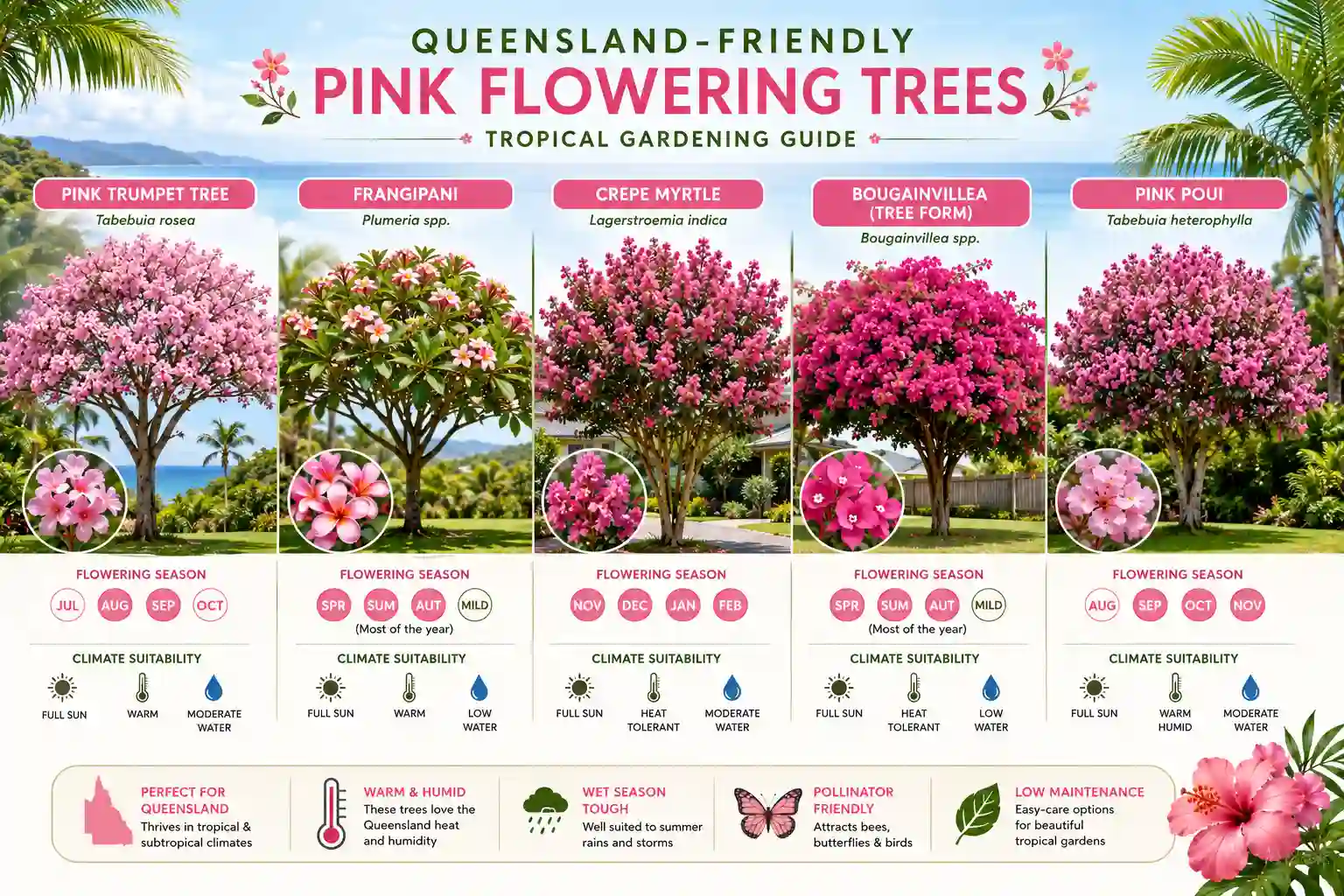
The best pink flowering tree Queensland gardeners can grow depends largely on local climate conditions. Queensland’s subtropical and tropical environments favour species that tolerate heat, humidity, and seasonal rainfall.
Common pink flowering trees in Brisbane and other Queensland regions include:
- Crepe Myrtle
- Pink Trumpet Tree (Tabebuia rosea)
- Frangipani (pink cultivars)
- Bougainvillea tree form
- Pink Poui
These species generally perform better in northern Australia than many traditional spring-flowering species from cooler climates.
Crepe Myrtle
Crepe Myrtle thrives throughout much of Queensland and produces long-lasting pink flowers during the hottest months of the year.
Pink Trumpet Tree (Tabebuia rosea)
This spectacular ornamental tree produces masses of trumpet-shaped pink flowers that can cover the entire canopy during flowering season.
Pink Frangipani
Pink Frangipani varieties are widely grown in tropical and subtropical Australia and are particularly popular in coastal gardens.
Bougainvillea Tree Form
Although naturally a climbing plant, Bougainvillea can be trained into small tree forms that display vibrant pink bracts throughout much of the year.
Pink Poui
Pink Poui produces dramatic seasonal displays and is increasingly planted in subtropical streetscapes.
Climate Considerations
Several pink flowering trees commonly grown in southern Australia perform poorly in tropical climates.
Examples include:
- Japanese Cherry
- Some Magnolia varieties
- Flowering Peach
These species often require winter chilling periods that are unavailable in much of Queensland. A common source of confusion in Brisbane is the Jacaranda. While Jacaranda trees produce spectacular flowering displays, their flowers are purple rather than pink.
While pink flowering species are popular across Australia, gardeners interested in other flowering colours may also enjoy exploring native and ornamental purple-flowering trees commonly grown throughout the country.
Trees with Pink and White Flowers in Australia
Several ornamental trees display flowers that combine both pink and white colouring, creating some of Australia’s most attractive seasonal displays.
Common examples include:
- Magnolia cultivars
- Flowering Cherry varieties
- Apple Blossom Trees
- Certain Bauhinia cultivars
Many gardeners searching for a pink and white flower tree are actually observing blooms that change colour during different stages of development.
Why Pink and White Flowers Are Often Misidentified
The most common reason for confusion is that many flowers emerge from pink buds before opening into lighter pink or white blooms.
For example:
- Magnolia buds often begin deep pink before opening pale pink or white.
- Flowering Cherry blossoms frequently fade from pink to white as they age.
- Apple Blossom flowers commonly display both colours simultaneously.
As a result, the same tree may appear dramatically different over a period of several days.
Visual Differences During Bloom Stages
When identifying a tree with pink and white flowers Australia-wide, observe:
- Bud colour
- Fully open flower colour
- Petal fading patterns
- Bloom density across the canopy
These characteristics help distinguish between similar species and cultivars.
Many Magnolia cultivars vary significantly in size, flower colour, and growth habit, making cultivar selection an important part of landscape planning.
When Do Pink Flowering Trees Bloom in Australia?
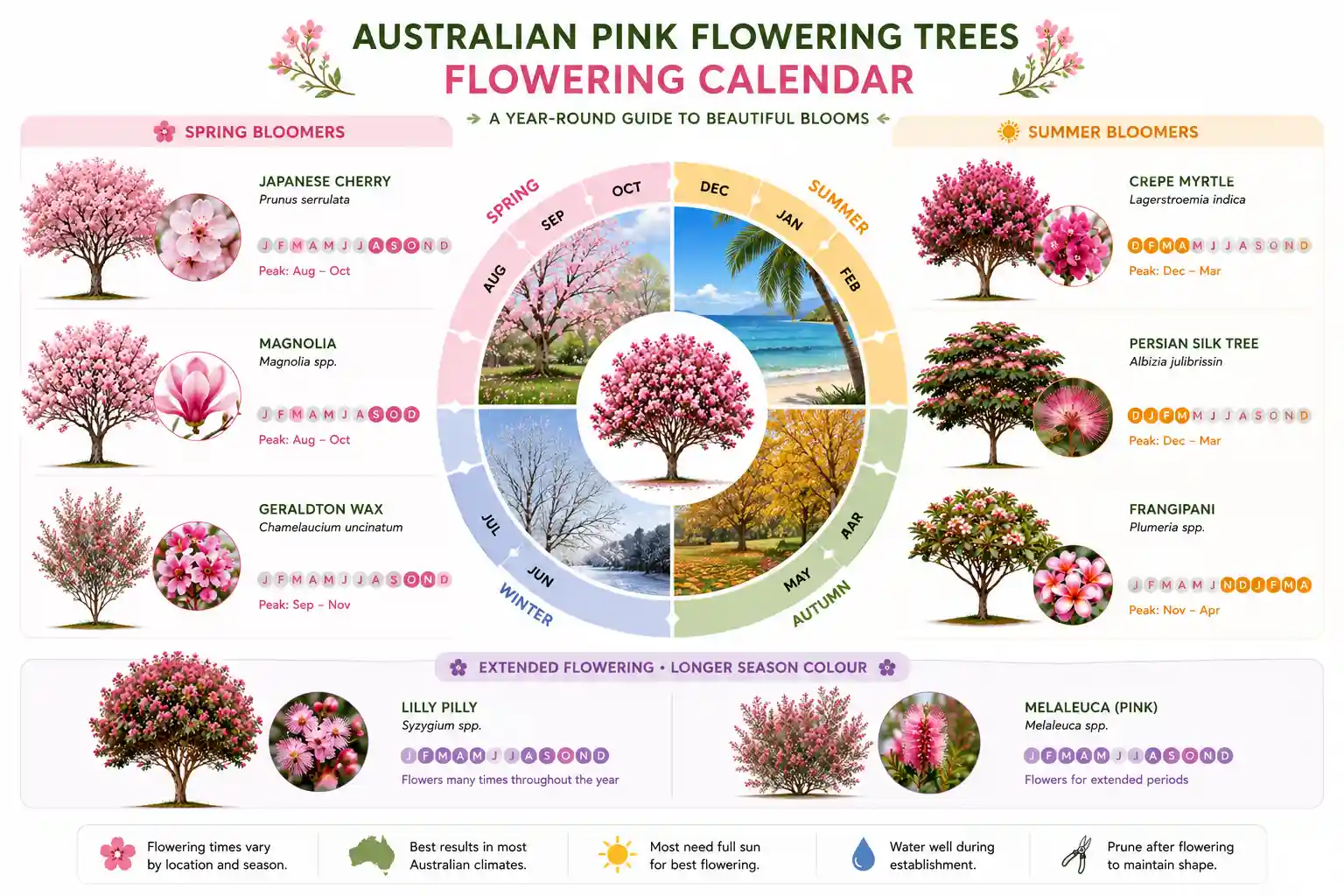
Pink flowering trees bloom at different times depending on species, climate, and location.
Australia’s seasons are opposite those of the Northern Hemisphere, making local flowering calendars especially important for identification.
Spring Bloomers
Many of Australia’s most famous flowering trees bloom during spring.
Examples include:
- Japanese Cherry
- Magnolia
- Geraldton Wax
Most spring flowering occurs between August and November depending on region.
Summer Bloomers
Summer-flowering species are particularly common in warmer Australian climates.
Examples include:
- Crepe Myrtle
- Persian Silk Tree
- Frangipani
These species typically flower between December and February.
Year-Round or Extended Flowering Species
Some subtropical species flower repeatedly throughout the year.
Examples include:
- Lilly Pilly cultivars
- Certain Melaleuca varieties
These species may produce flowers multiple times annually under favourable conditions.
Regional Bloom Variations
Bloom times can differ significantly across Australia.
For example:
- A Crepe Myrtle in Brisbane may flower several weeks earlier than the same variety in Melbourne.
- Magnolia trees in Victoria often bloom later than those in warmer New South Wales regions.
As of 2026, growers continue to note flowering shifts linked to warmer seasonal conditions in some regions, making local observations increasingly valuable for accurate identification.
White Flowering Trees in Australia — A Quick Comparison
White flowering trees are often confused with pink flowering trees because many species produce blooms that gradually fade from pink to white.
Common white flowering trees Australia gardeners encounter include:
- Ornamental Pear
- White Lilly Pilly cultivars
- Coastal Tea Tree
- White Crepe Myrtle
- White Magnolia
Pink vs White Flowering Trees in Australia
| Feature | Pink Flowering Trees | White Flowering Trees |
| Common Examples | Crepe Myrtle, Cherry, Silk Tree | Ornamental Pear, Tea Tree, White Magnolia |
| Most Common Season | Spring and Summer | Primarily Spring |
| Typical Use | Feature tree, street planting | Screening, formal gardens |
| Native Options | Lilly Pilly, Melaleuca | Tea Tree, Paperbark |
Key Differences
- Pink flowering trees typically create stronger seasonal colour displays.
- White flowering trees are often used in formal garden designs.
- Native pink flowering species tend to attract pollinators such as birds and insects.
- White flowering species often provide a cleaner, more structured landscape appearance.
Both groups offer excellent ornamental value, and many gardeners combine them for seasonal contrast.
For gardeners focused on screening and privacy rather than flowering displays, fast-growing options such as Pittosporum Silver Sheen are often considered alongside ornamental flowering trees.
Australian Native Trees with Pink Flowers — A Closer Look
Australian native trees with pink flowers are increasingly popular because they combine ornamental beauty with environmental benefits. Many native species require less water, attract local wildlife, and tolerate Australia’s challenging growing conditions.
Pink flowers are valued across many ornamental plants, from flowering trees and shrubs to smaller garden favourites such as Lily of the Valley varieties.
Important native pink flowering species include:
- Lilly Pilly (Syzygium spp.)
- Pink-flowering Melaleuca cultivars
- Geraldton Wax (Chamelaucium uncinatum)
- Boronia species
It is important to note that some plants commonly grouped with pink flowering trees are technically shrubs.
Lilly Pilly (Syzygium spp.)
Lilly Pilly trees are among Australia’s most versatile native plants.
Benefits include:
- Attractive flowers
- Edible berries
- Bird habitat
- Excellent screening capability
- Adaptability to many climates
Some species can reach over 15 metres tall, while others remain compact.
Pink-Flowering Melaleuca Cultivars
Pink Melaleucas provide:
- Distinctive bottlebrush-like flowers
- Strong drought tolerance
- Wildlife habitat
- Low-maintenance growth
These qualities make them valuable landscape trees across much of Australia.
Geraldton Wax
Geraldton Wax is prized for:
- Long flowering periods
- Excellent cut flowers
- Drought resistance
- Compact growth habit
Many gardeners use it as both a shrub and a small tree.
Boronia
Boronia is best known for its highly fragrant flowers.
While most species remain shrubs, mature plants can develop a tree-like appearance that causes frequent identification confusion.
Native Frangipani (Hymenosporum flavum)
Despite being commonly discussed alongside pink flowering natives, Native Frangipani actually produces cream to yellow flowers rather than pink blooms.
Including it here is important because it is often incorrectly identified as a pink flowering Australian native tree.
Ecological Benefits of Native Species
Native pink flowering trees offer several advantages:
- Support native birds and pollinators
- Adapt well to local conditions
- Often require less irrigation
- Generally need less fertiliser
- Improve biodiversity in home gardens
For gardeners asking, “What Australian shrub has pink flowers?” the most common answers include:
- Boronia
- Geraldton Wax
- Tea Tree
- Pink-flowering Callistemon cultivars
Are There Famous Pink Flowering Trees in Australia?
Australia’s most famous flowering tree is arguably the Jacaranda, although it produces purple rather than pink flowers.
For genuinely pink-flowering species, several stand out nationally.
Crepe Myrtle
Crepe Myrtle is one of Australia’s most widely planted pink flowering street trees, particularly throughout Queensland and New South Wales.
Pink Magnolias
Pink Magnolia cultivars are celebrated throughout Victoria and other cooler regions for their dramatic spring displays.
Persian Silk Tree
The Persian Silk Tree remains one of the most recognisable exotic flowering trees due to its unusual pompom-like blooms.
For broader context, other famous Australian plants include the Bluebell Creeper and the Wollemi Pine, although neither is known specifically for pink flowers. These species frequently appear in voice-search queries asking, “What is the famous flowering tree in Australia?” and help illustrate the diversity of Australia’s ornamental tree landscape.
Common Mistakes When Growing Pink Flowering Trees in Australia
Many pink flowering trees are easy to grow when matched to the right climate and site conditions. However, several common mistakes can reduce flowering performance, stunt growth, or shorten a tree’s lifespan.
Planting a Climate-Inappropriate Species
One of the most frequent mistakes is selecting a species that does not suit the local climate.
What causes it:
- Choosing trees based on appearance rather than climate suitability.
- Purchasing trees without checking regional growing requirements.
How to correct it:
- Research the tree’s preferred climate zone.
- Consult local nurseries for region-specific recommendations.
How to prevent it:
- Match the species to your local climate before planting.
- Consider winter chill requirements and summer heat tolerance.
For example, Japanese Cherry trees often struggle in tropical Queensland, while Frangipani thrives in those conditions.
Planting Potentially Invasive Exotic Species
Some introduced species can spread beyond intended planting areas.
What causes it:
- Lack of awareness about self-seeding behaviour.
- Planting near bushland or natural ecosystems.
How to correct it:
- Remove unwanted seedlings promptly.
- Monitor surrounding areas regularly.
How to prevent it:
- Check local council recommendations before planting.
- Select non-invasive alternatives where appropriate.
The Persian Silk Tree (Albizia julibrissin) is one example that may have invasive potential in some Australian regions.
Confusing Shrubs for Trees
Many pink flowering plants are sold as shrubs but can develop into small tree forms over time.
What causes it:
- Misleading plant labels.
- Similar growth habits during early development.
How to correct it:
- Learn the mature size and growth habit before purchase.
How to prevent it:
- Read botanical descriptions carefully.
- Ask nursery staff about mature dimensions.
Boronia and Geraldton Wax are commonly mistaken for true trees.
Overwatering or Underwatering During Establishment
Young trees require consistent moisture while developing root systems.
What causes it:
- Irregular watering schedules.
- Poor drainage or excessively dry soil.
How to correct it:
- Adjust watering based on weather and soil conditions.
How to prevent it:
- Water deeply and less frequently.
- Apply mulch to help regulate soil moisture.
In our experience, newly planted flowering trees benefit more from deep weekly watering than frequent shallow irrigation.
Pruning at the Wrong Time
Incorrect pruning can remove flower buds and reduce flowering the following season.
What causes it:
- Pruning immediately before flowering.
- Heavy seasonal trimming.
How to correct it:
- Prune after flowering whenever possible.
How to prevent it:
- Learn the flowering cycle of your chosen species.
- Avoid removing developing flower buds.
Elemo Baker recommends observing at least one complete flowering cycle before performing major structural pruning.
How to Identify a Pink Flowering Tree — Step-by-Step
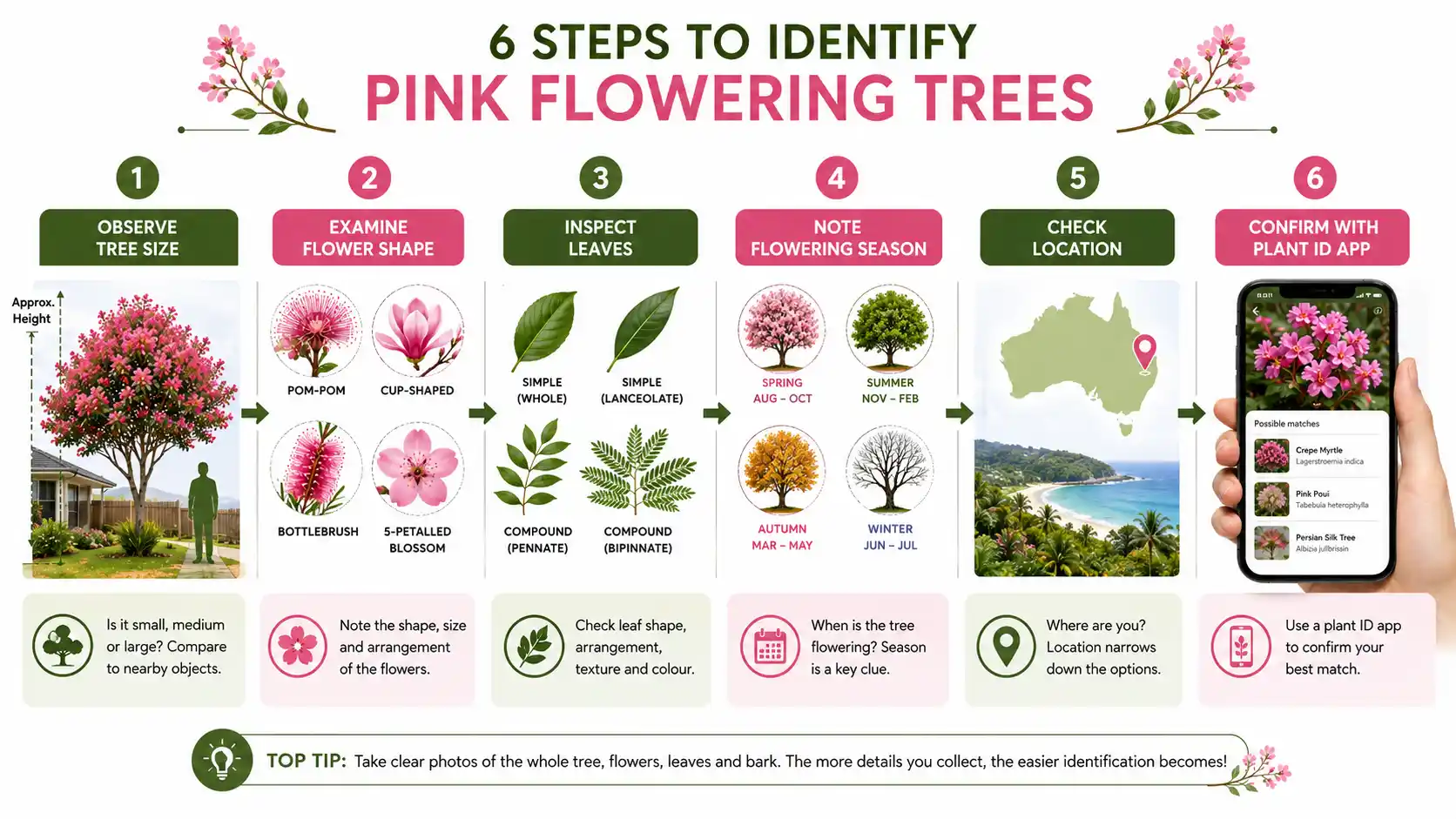
Identifying a pink flowering tree becomes much easier when you follow a systematic process.
Step 1: Note the Tree’s Size and Overall Form
Begin by observing the tree’s mature shape.
Ask yourself:
- Is it small, medium, or large?
- Does it have a spreading canopy?
- Is the growth upright or weeping?
Tree structure often eliminates many possible species immediately.
Step 2: Examine the Flowers
The flowers provide some of the most important identification clues.
Observe:
- Flower shape
- Number of petals
- Flower size
- Flower colour
- Whether blooms appear singly or in clusters
For example:
- Persian Silk Tree flowers resemble soft pink pompoms.
- Japanese Cherry flowers appear as clustered blossoms.
- Melaleuca flowers form bottlebrush-like spikes.
Step 3: Look at the Leaves
Leaf characteristics help confirm identification.
Check:
- Simple or compound leaves
- Glossy or matte texture
- Leaf size
- Leaf arrangement
Feathery compound leaves often indicate Persian Silk Tree, while glossy leaves may suggest Lilly Pilly.
Step 4: Note the Season
Flowering season provides valuable clues.
Ask:
- Is the tree flowering in spring?
- Is it flowering during summer?
- Does it flower repeatedly throughout the year?
Many species can be narrowed down quickly using bloom timing.
Step 5: Check the Location
Location matters because some species only thrive in specific climates.
Consider:
- State or territory
- Coastal or inland environment
- Urban garden or natural bushland setting
A flowering tree in tropical Queensland may differ significantly from one growing in Victoria.
Step 6: Use a Plant Identification App
After collecting observations, use a reliable identification tool.
Popular options include:
- iNaturalist
- PlantNet
- Local botanical databases
These tools can help confirm species and reduce identification errors.
Following these six steps provides one of the most accurate methods for pink flowering tree identification in Australia. Some gardeners mistakenly identify new red or pink foliage as flowers, which commonly occurs with ornamental species such as Photinia cultivars.
Before selecting a flowering tree, consider the overall planting environment with help from our Australian Plants Guide: Indoor Houseplants & Garden Design.
Conclusion
Australia offers an impressive variety of options for anyone searching for a tree with pink flowers Australia-wide. From native species such as Lilly Pilly, Geraldton Wax, and pink-flowering Melaleuca cultivars to introduced favourites like Crepe Myrtle, Japanese Cherry, Magnolia, and the Persian Silk Tree, there are suitable choices for almost every climate and garden size.
Successful pink flowering trees identification depends on observing key characteristics such as tree size, flower shape, flowering season, leaf structure, and geographic location. Native species often provide ecological benefits including bird attraction, drought tolerance, and lower maintenance requirements, while exotic species can deliver spectacular seasonal colour and striking ornamental value.
Whether you are identifying an existing specimen or selecting an Australian native tree with pink flowers for your landscape, taking the time to understand these characteristics will help ensure the best outcome. For additional guidance, consult local nurseries, botanical gardens, or plant identification resources suited to your region.
Frequently Asked Questions
What is the tree with pink flowers called in Australia?
There is no single tree with pink flowers called by one name in Australia because many species produce pink blooms. Common examples include Crepe Myrtle (Lagerstroemia), Persian Silk Tree (Albizia julibrissin), Japanese Cherry (Prunus spp.), Magnolia cultivars, and native Lilly Pilly (Syzygium spp.). The correct name depends on the species being observed.
What is the famous flowering tree in Australia?
The Jacaranda is widely considered Australia’s most famous flowering street tree, although it produces purple flowers rather than pink blooms. Among pink flowering trees, Crepe Myrtle is one of the most widely planted species across Australian streets and gardens. Other famous flowering plants include Waratah, which is known for its striking red flowers.
What are the pink flowering trees in Brisbane and Queensland?
Popular pink flowering trees in Brisbane and Queensland include Crepe Myrtle, Pink Trumpet Tree (Tabebuia rosea), Frangipani, Persian Silk Tree, and Pink Poui. Queensland’s subtropical climate favours summer-flowering species, making them more reliable than cooler-climate trees such as Japanese Cherry.
What Australian shrub has pink flowers?
Several Australian shrubs produce attractive pink flowers, including Geraldton Wax (Chamelaucium uncinatum), Boronia, Grevillea, Kunzea, and pink-flowering Callistemon cultivars. Some of these plants can eventually develop into small tree forms, which often causes confusion among gardeners and nursery shoppers.
What is the difference between a tree with pink flowers and one with pink foliage?
A tree with pink flowers produces seasonal pink blooms, while a tree with pink foliage has leaves that display pink, red, burgundy, or variegated colouration. Examples of pink foliage trees include some Japanese Maple varieties, certain Photinia cultivars, and Pink Lemonade Lilly Pilly. In some cases, a tree may display both pink flowers and pink-toned foliage during different growth stages.
When do pink flowering trees bloom in Australia?
Bloom times vary by species and climate. Spring bloomers typically flower between August and November and include Japanese Cherry, Magnolia, and Geraldton Wax. Summer bloomers such as Crepe Myrtle, Persian Silk Tree, and Frangipani generally flower between December and February. Some Lilly Pilly and Melaleuca cultivars may flower multiple times throughout the year in subtropical regions. Bloom periods can vary by four to six weeks between tropical northern Australia and cooler southern regions.
7 Comments