

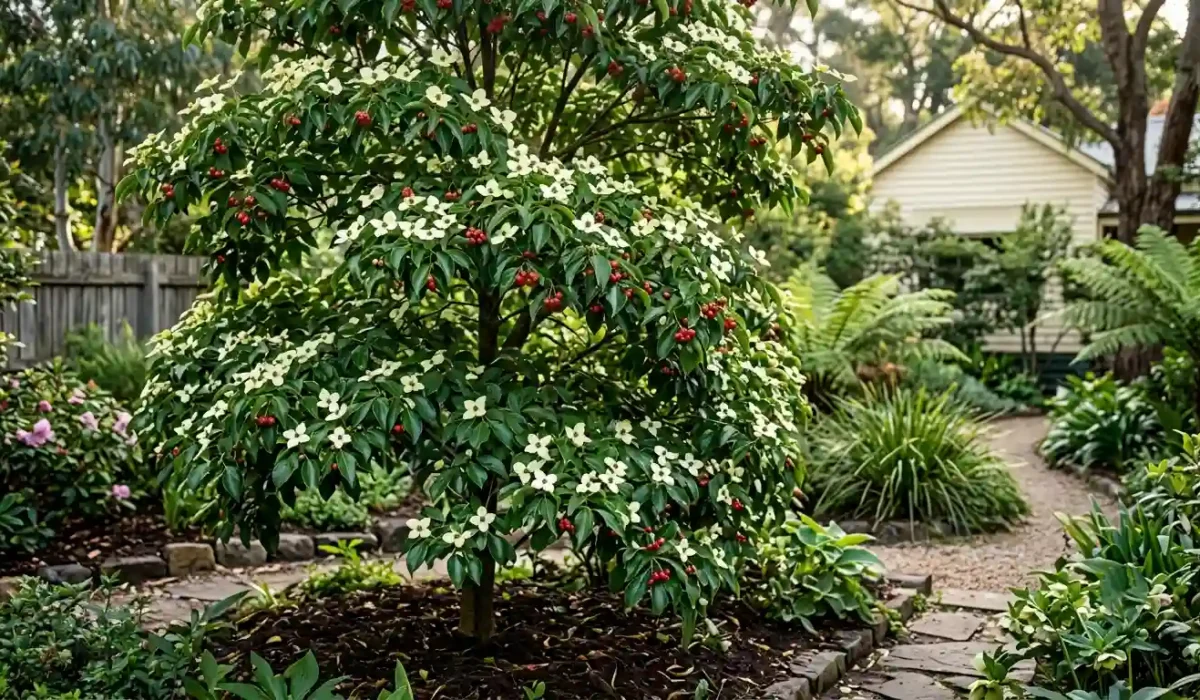
Dogwood Tree Australia: Growing, Care & Varieties
Introduction
Dogwood trees are flowering ornamental trees from the genus Cornus, and yes, dogwood trees grow successfully in Australia, especially in cool-temperate regions. The most adaptable choice for many Australian gardens is Cornus capitata, also known as the evergreen dogwood or Himalayan dogwood, while flowering dogwood varieties can thrive in suitable cooler climates. Although dogwoods are not native to Australia, they are valued for their attractive foliage, distinctive spring blooms, and long-lived garden appeal. This guide explains the best dogwood tree Australia varieties, growing conditions, care requirements, common problems, and the truth behind popular dogwood myths.
By Elemo Baker | Plant Care & Gardening Expert
Last Updated: July 2026
Quick Summary
- Dogwood trees grow well in Australia’s cool-temperate zones, with Cornus capitata being one of the most reliable choices for local gardens.
- Most dogwoods prefer moist, well-drained soil, sheltered locations, and protection from extreme heat.
- Flowering dogwood varieties suit cooler areas such as Melbourne, Adelaide Hills, Blue Mountains, Canberra, and Tasmania.
- Evergreen dogwood produces attractive cream-coloured bracts and red fruit, making it a strong ornamental choice.
- The crucifixion story associated with dogwood trees is folklore, not a documented botanical or historical fact.
What Is a Dogwood Tree?
A dogwood tree is a group of flowering ornamental plants belonging to the genus Cornus. The genus contains around 65 recognised species of trees, shrubs, and small woody plants found across temperate regions of the Northern Hemisphere and parts of Asia.
Dogwood trees belong to the genus Cornus, a botanical group containing many flowering trees and shrubs found across temperate regions worldwide.
The colourful parts commonly called dogwood “flowers” are usually not true petals. They are modified leaves called bracts, which surround the small central flowers. These bracts create the large, showy display that makes many dogwood varieties popular landscape plants.
Dogwoods are generally divided into two major groups:
- Evergreen dogwoods – retain their leaves throughout the year and are often better suited to milder climates.
- Deciduous dogwoods – lose their leaves in winter and are mainly grown for their seasonal flowers and autumn colour.
The term dogwood, dogwood plant, cornus dogwood, and dog wood tree all refer broadly to plants within the Cornus genus.
Common examples include:
- Cornus capitata – evergreen/Himalayan dogwood
- Cornus florida – flowering dogwood
- Cornus kousa – Japanese or Kousa dogwood
These trees are grown worldwide as ornamental feature plants because of their flowers, foliage, attractive shapes, and wildlife value.
Dogwood vs Cornus — Are They the Same Thing?
Yes. Dogwood is the common name used for plants in the Cornus genus. The botanical name Cornus identifies the plant group, while dogwood is the everyday name used by gardeners and nurseries.
For example:
- Cornus capitata = evergreen dogwood
- Cornusflorida = flowering dogwood
- Cornus kousa = Japanese/Kousa dogwood
All are classified as dogwoods, but they differ in growth habit, flowering behaviour, climate tolerance, and garden suitability.
Do Dogwood Trees Grow in Australia?
Yes, dogwood trees grow in Australia, particularly in regions with cool to mild temperate conditions. Although dogwoods are not native Australian plants, several species have been successfully cultivated in gardens across southern Australia.
The most reliable variety for Australian conditions is generally Cornus capitata, or evergreen dogwood. It adapts better than many deciduous flowering types because it handles a wider range of conditions while still producing attractive flowers and fruit.
For gardeners looking for year-round greenery, evergreen species are also popular choices in Australian landscapes. Our guide on Fast Growing Evergreen Trees Australia Guide explains suitable evergreen options and their growing requirements.
Dogwoods perform especially well in areas such as:
- Melbourne and surrounding regions
- Adelaide Hills
- Dandenong Ranges
- Blue Mountains
- Canberra
- Tasmania
However, they are less suitable for hot inland climates and tropical areas where high humidity, heat stress, and poor winter chilling can affect growth.
Best Climate Zones for Dogwoods in Australia
Dogwoods prefer cool to mild temperate climates with seasonal changes, adequate rainfall, and protection from harsh environmental conditions.
Ideal conditions include:
- Cool winters with some frost tolerance
- Mild summers
- Moist but well-drained soil
- Protection from strong afternoon sun and hot winds
Most dogwood varieties tolerate frost well once established, but they struggle in areas with prolonged extreme heat. In warmer Australian regions, evergreen types such as Cornus capitata generally perform better than traditional flowering dogwoods.
In our experience growing ornamental trees, many dogwood problems occur because the tree is planted in a climate that is too hot or exposed rather than because the plant itself is difficult to grow.
Popular Dogwood Varieties for Australian Gardens
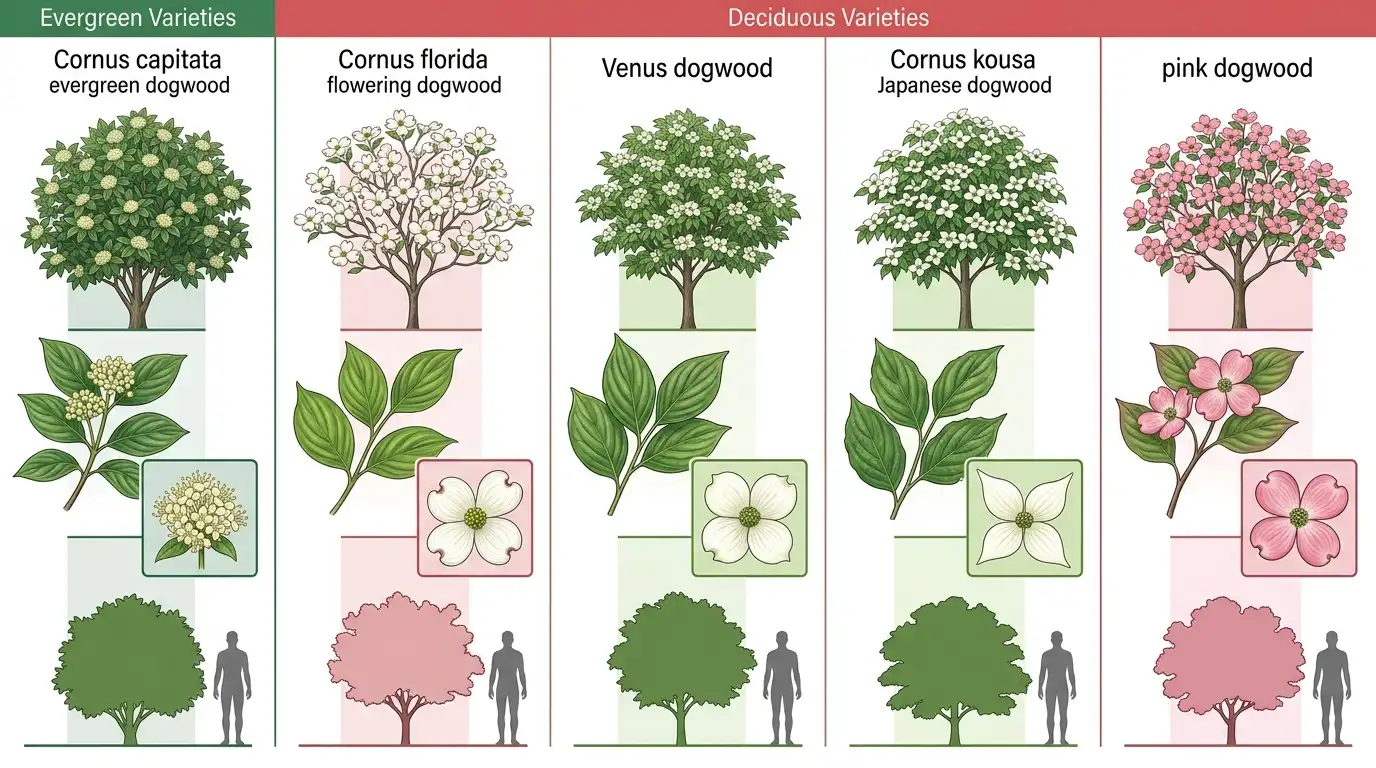
Several dogwood varieties are available for Australian gardens, but their performance depends heavily on climate, soil conditions, and available space.
The following comparison highlights the most common choices:
| Variety | Type | Height | Flower Colour | Best For |
| Cornus capitata (Evergreen/Himalayan Dogwood) | Evergreen | 6–9m | Creamy yellow | Most Australian climates |
| Cornus florida (Flowering Dogwood) | Deciduous | 4–6m | White/pink | Cool temperate gardens |
| Venus Dogwood | Deciduous hybrid | 4–5m | Large white | Feature/specimen tree |
| Cornus kousa (Kousa/Japanese Dogwood) | Deciduous | Up to 10m | White | Moist, acidic soil areas |
| Pink Dogwood | Deciduous | 4–6m | Pink | Ornamental colour gardens |
These varieties are commonly searched under terms such as cornus capitata, evergreen dogwood, venus dogwood, pink dogwood tree Australia, kousa dogwood Australia, Japanese dogwood Australia, and white dogwood tree Australia. Dogwoods are valued as ornamental flowering trees, but they are only one option among many colourful species. Our guide to Flowering Trees Australia: Best Species Guide covers other flowering trees suitable for Australian gardens.
Evergreen Dogwood (Cornus capitata) — Australia’s Most Popular Choice
Cornus capitata is often considered the best-performing dogwood for many Australian gardens because it combines attractive flowers, evergreen foliage, and reliable growth.
Key features include:
- Evergreen leaves that provide year-round structure
- Cream to yellow flower-like bracts
- Attractive red-orange fruit after flowering
- Better tolerance of varied Australian conditions compared with some deciduous species
The evergreen dogwood usually grows into a medium-sized tree reaching around 6–9 metres when mature. It works well as a feature tree, shade tree, or large garden specimen.
Elemo Baker recommends selecting a sheltered planting position for Cornus capitata, as protection from hot winds can significantly improve leaf quality and flowering performance.
Dwarf and Small Dogwood Varieties
The term dwarf dogwood tree Australia is often used by gardeners looking for compact options suitable for smaller gardens. While many classic dogwood species naturally grow into medium-sized trees, some compact cultivars and smaller-growing forms are available.
Small dogwood varieties are useful for:
- Courtyard gardens
- Front garden feature planting
- Smaller suburban landscapes
- Mixed ornamental borders
Before planting, check the expected mature size rather than relying only on the word “dwarf”, as some varieties can still become several metres tall. Good pruning practices and selecting the correct cultivar are important for maintaining a suitable size.
Dogwood Tree Size and Growth Habits
Dogwood tree size varies depending on the species, climate, soil quality, and growing conditions. Most garden-grown dogwoods reach between 4 and 9 metres tall, with a similar spread when fully mature.
Typical growth characteristics include:
- Cornus capitata: approximately 6–9m tall and wide
- Cornus florida: around 4–6m tall
- Cornus kousa: can reach up to 10m in favourable conditions
Dogwoods develop a naturally attractive branching structure, making them valuable as feature trees in landscaped gardens.
While dogwoods are outdoor feature trees, choosing the right plants for different garden spaces is essential. Our guide Australian Plants Guide: Indoor Houseplants & Garden Design explores plant selection ideas for Australian homes and landscapes.
Dogwoods are not suitable as indoor plants. Their size, seasonal requirements, and need for outdoor environmental conditions mean they perform best when planted outdoors in appropriate garden locations.
Understanding root behaviour is important when planning tree placement in gardens. Similar considerations apply to other ornamental trees, such as crepe myrtles, which are covered in our guide How Deep Are Crepe Myrtle Roots? Root Depth Guide.
Most dogwoods are considered slow to moderate-growing trees. Growth speed depends on:
- Soil fertility
- Moisture availability
- Sun exposure
- Climate suitability
- Protection from environmental stress
Young trees often establish slowly during their first few years while developing strong root systems. With suitable conditions, they can become long-lived ornamental trees.
Common searches such as dogwood tree stages, large dogwood tree Australia, narrow dogwood tree, and how tall does a flowering dogwood get usually relate to understanding mature size before planting.
How to Grow and Care for Dogwood Trees in Australia
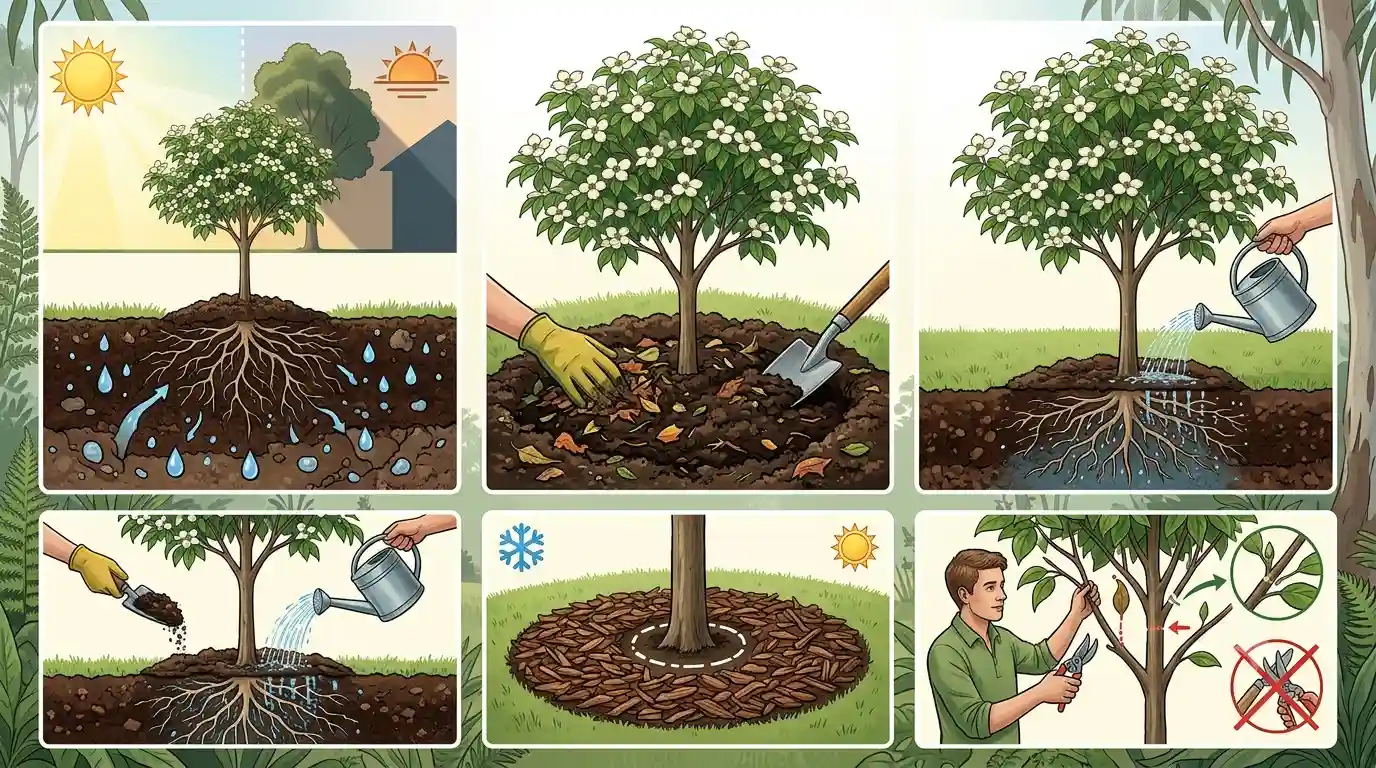
Dogwood tree care is relatively straightforward when the plant is grown in the correct climate and planted in suitable soil. The most important factors are moisture, drainage, shelter, and avoiding extreme heat exposure.
Light Requirements
Dogwoods grow best in:
- Full sun in cooler climates
- Part shade in warmer areas
- Morning sun with afternoon protection
Hot afternoon sun can cause leaf stress, particularly in warmer Australian regions. A sheltered position helps maintain healthier foliage and better flowering.
Soil Requirements
Dogwoods prefer soil that is:
- Moist but well drained
- Rich in organic matter
- Humus-filled and fertile
- Slightly acidic to neutral
Lime-free soil is preferred, although some varieties tolerate slightly alkaline conditions.
Poor drainage can cause root stress, while compacted soils may reduce growth and flowering. Adding compost or organic matter before planting improves soil structure.
Watering Requirements
Regular moisture is important, especially during establishment.
Recommended watering practices include:
- Water young trees consistently during the first two years
- Maintain even soil moisture during hot periods
- Avoid allowing roots to sit in constantly wet soil
Mulching around the root zone helps retain moisture and regulate soil temperature.
Fertilising Requirements
Dogwoods generally benefit from organic soil improvement rather than heavy feeding.
Suitable options include:
- Compost added during planting
- Well-aged organic matter
- Slow-release fertilisers during active growth periods
Excess fertiliser can encourage soft growth that may be more vulnerable to environmental stress.
Pruning Requirements
Dogwoods usually require minimal pruning.
Pruning should focus on:
- Removing dead branches
- Removing damaged growth
- Improving airflow by removing crossing branches
- Maintaining the natural shape
Heavy pruning is rarely necessary and may reduce the tree’s natural form.
Climate Tolerance
Dogwoods are generally frost tolerant once established. However, they have limited tolerance for:
- Extreme summer heat
- Hot drying winds
- High humidity combined with poor airflow
As of July 2026, Australian growers continue to favour climate-matched planting locations as the most important factor for successful ornamental tree establishment.
Best Location to Plant a Dogwood Tree
The best location for a dogwood tree is a sheltered garden position with morning sun, afternoon shade, and protection from strong winds.
A suitable planting site should provide:
- Moist, well-drained soil
- Protection from extreme temperatures
- Adequate space for mature growth
- Natural shelter similar to woodland conditions
In natural environments, many dogwoods grow beneath larger trees where they receive filtered light. Replicating this type of environment often improves performance in Australian gardens.
Common Dogwood Tree Problems and How to Fix Them
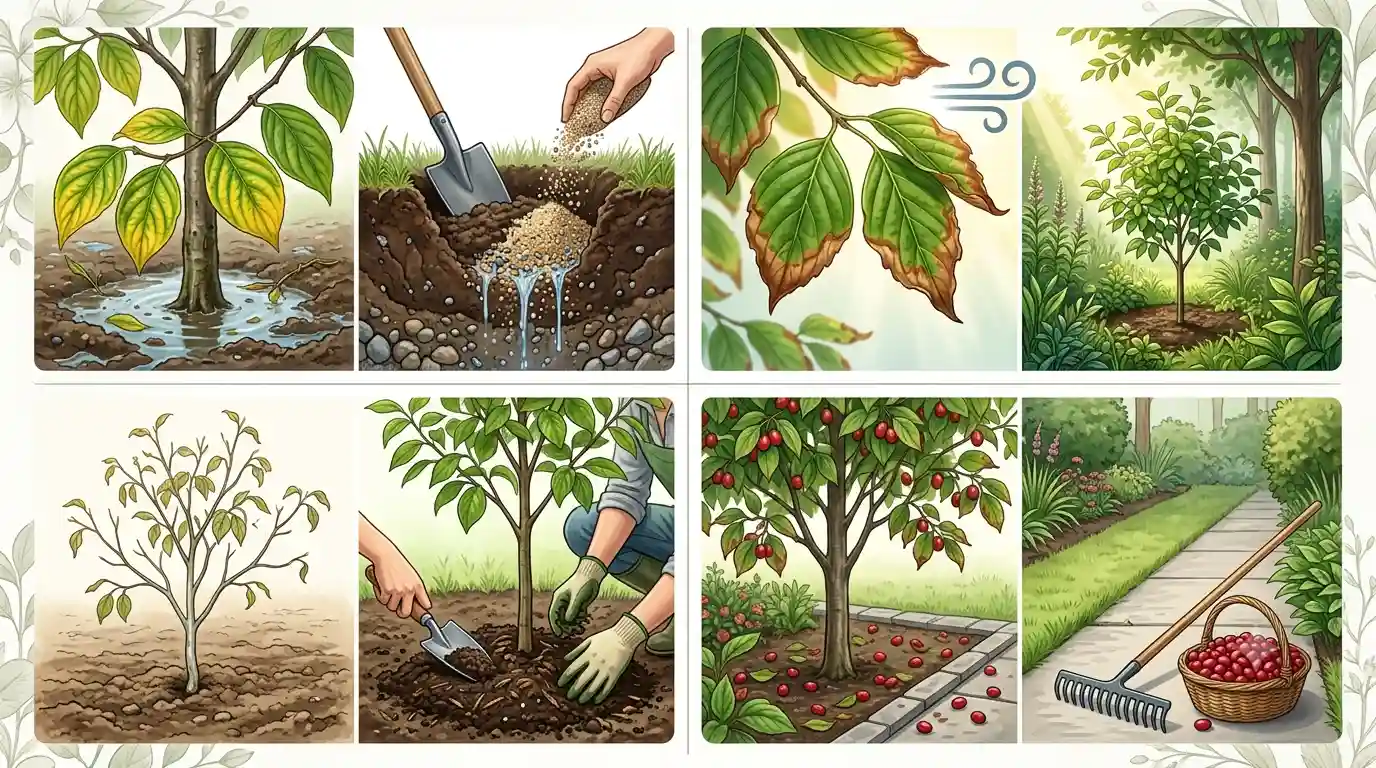
Dogwood trees are usually healthy when grown in appropriate conditions, but environmental stress can create several common problems.
Leaves Turning Yellow or Brown
Yellowing or browning leaves are often caused by:
- Poor drainage
- Overwatering
- Alkaline soil
- Root stress
Solutions include:
- Improving drainage
- Reducing excessive watering
- Adding organic matter
- Adjusting soil conditions where necessary
Slow Growth or Failure to Establish
Slow establishment is commonly linked to:
- Poor soil preparation
- Exposure to strong winds
- Insufficient moisture during early years
Newly planted trees need consistent care while roots develop. Regular watering and mulching can greatly improve establishment.
Fruit Drop and Mess Near Paths
Evergreen dogwood (Cornus capitata) produces attractive fruit, but fruit drop can become messy near pathways, driveways, or entertaining areas.
To reduce maintenance:
- Plant fruiting varieties away from high-traffic areas
- Choose planting locations carefully
- Allow natural fruiting cycles to occur
Leaf Scorch
Leaf scorch appears as brown edges or damaged leaf areas and is often caused by:
- Hot winds
- Excessive afternoon sun
- Dry soil conditions
Solutions include:
- Adding mulch
- Increasing shelter
- Improving watering consistency
Many dogwood troubleshooting searches, including general dogwood tree Bunnings care queries, relate to choosing the correct planting position rather than requiring complicated treatments.
Why Are Dogwood Trees Considered Hard to Grow? (Common Misconceptions)
Dogwood trees are sometimes described as difficult because they have specific environmental preferences. However, they are not inherently hard to grow when planted in the right location.
The main challenges include:
- Sensitivity to extreme heat and humidity
- Preference for well-drained, suitable soil
- Slow flowering from seed
- Reduced performance in unsuitable climates
A major misconception is that dogwoods are naturally difficult plants. In reality, many problems occur because gardeners choose varieties that do not match their local conditions.
The main disadvantages of dogwood trees are:
- They may struggle in hot Australian regions
- They can take years to mature and flower
- Some varieties need careful soil management
- Fruiting types may create seasonal cleanup requirements
Choosing the right variety, especially Cornus capitata for many Australian conditions, significantly improves success.
Dogwood Tree Symbolism and the Crucifixion Legend
The popular crucifixion legend of the dogwood tree is a cultural story and folklore tradition, not a proven botanical or historical fact. The story is often associated with flowering dogwood and describes symbolic connections between the tree and the crucifixion of Jesus, but there is no documented biblical evidence supporting the legend.
According to the commonly repeated folk story:
- The dogwood tree was once believed to have grown large and strong enough to be used for a cross.
- After the crucifixion, the tree was said to have been changed into a smaller form.
- The four bracts were interpreted as representing the shape of a cross.
- The reddish markings on some bracts were described as symbolic “nail marks”.
- The centre of the flower was sometimes linked to the crown of thorns.
These interpretations are symbolic traditions rather than scientific facts.
Flowering dogwood (Cornus florida) is actually native to eastern North America, not the Middle East. There is no reference to a dogwood tree in biblical scripture, and historians do not consider the crucifixion story a verified historical account.
Beyond religious folklore, dogwood trees are commonly associated with broader symbolic meanings, including:
- Rebirth and renewal
- Strength and resilience
- Love and affection
- Endurance through difficult conditions
Questions such as “what do dogwood trees symbolise?”, “why did God curse the dogwood tree?”, and “what did Jesus say about the dogwood tree?” are based mainly on cultural traditions rather than botanical evidence.
Dogwood Tree Lifespan and Flowering Timeline
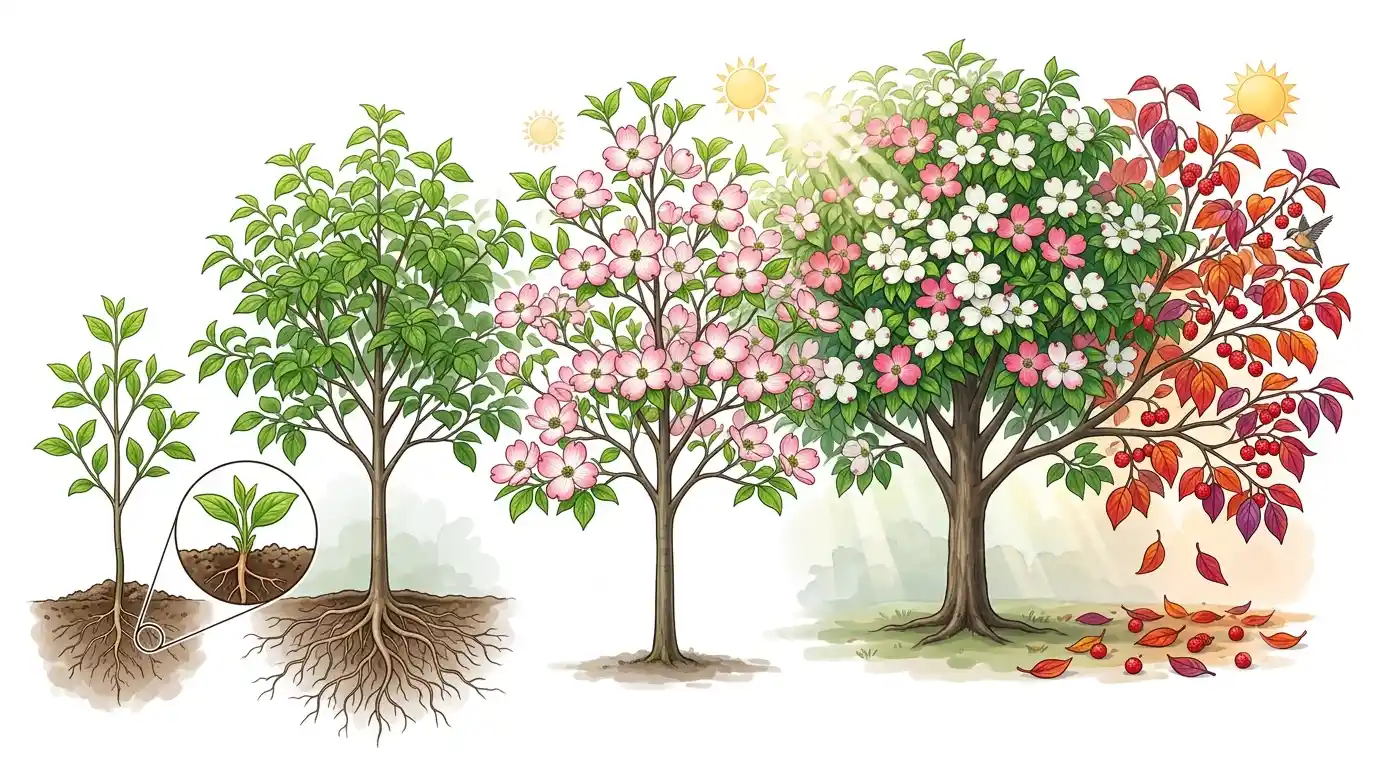
Dogwood trees can become long-lived ornamental plants when grown in suitable conditions. A healthy dogwood may survive for several decades, especially when planted in the correct climate with good soil, adequate moisture, and protection from environmental stress.
The time required for flowering depends on how the tree is grown:
- Seed-grown dogwoods may take around 6–10 years before producing significant blooms.
- Grafted or cutting-grown trees often flower much sooner, commonly within 2–4 years after planting.
Flowering patterns vary by species:
- Deciduous dogwoods usually flower in spring before or around the time new foliage develops.
- Evergreen dogwood (Cornus capitata) generally flowers from spring into early summer, followed by decorative fruit that may develop from late spring through autumn.
Factors that influence flowering include:
- Plant maturity
- Amount of sunlight received
- Soil health
- Water availability
- Climate suitability
A mature dogwood planted in the right Australian environment can provide many years of seasonal interest through flowers, foliage, and fruit.
Do Dogwood Flowers Have a Scent?
Most dogwood flowers have little to no noticeable fragrance compared with strongly scented flowering trees and shrubs. Their main ornamental appeal comes from their attractive bracts, seasonal colour, and overall tree structure rather than their scent.
Some varieties, including Cornus capitata, may produce a subtle sweet or honey-like fragrance under suitable conditions, although the intensity varies depending on weather, plant health, and individual trees.
Gardeners interested in fragrant landscapes should combine dogwoods with other scented plants rather than choosing dogwood as a primary fragrance tree.
Conclusion
Dogwood trees are a rewarding choice for Australian gardens when the correct variety is matched with the right climate. Although they are not native to Australia, species such as Cornus capitata (evergreen dogwood) and selected flowering dogwood varieties can grow successfully in cool-temperate regions.
Most dogwood problems are not caused by the tree being naturally difficult to grow. Instead, challenges usually occur when the plant is exposed to excessive heat, poor drainage, unsuitable soil, or harsh winds.
Choosing a suitable location with moist, well-drained soil, adequate shelter, and appropriate sunlight can help a dogwood become a long-lived feature tree. For Australian gardeners, selecting the right variety for their local conditions is the key to enjoying healthy growth, seasonal flowers, and reliable garden performance.
Frequently Asked Questions
1. Do dogwood trees grow in Australia?
Yes, dogwood trees grow successfully in Australia, especially in cool-temperate regions. Cornus capitata (evergreen dogwood) is one of the most adaptable choices, while flowering dogwood varieties perform well in cooler areas such as Melbourne, Adelaide Hills, Blue Mountains, Canberra, and Tasmania.
2. What are the disadvantages of the dogwood tree?
The main disadvantages of dogwood trees include sensitivity to extreme heat and humidity, slow flowering when grown from seed, preference for specific soil conditions, and potential fruit drop from fruiting varieties such as Cornus capitata. These issues are usually manageable when the tree is planted in a suitable environment.
3. Why are dogwood trees considered hard to grow?
Dogwood trees are considered difficult mainly because they require climate and soil conditions that match their natural growing preferences. Most problems occur when they are planted in areas that are too hot, too dry, poorly drained, or exposed to harsh winds.
4. Is the crucifixion legend of the dogwood tree true?
No. The crucifixion legend of the dogwood tree is a folklore story rather than a proven historical or botanical fact. Flowering dogwood (Cornus florida) is native to eastern North America, not the Middle East, and there is no biblical reference confirming the story.
5. How long does it take for a dogwood tree to bloom?
A dogwood tree grown from seed may take around 6–10 years to bloom. Trees grown from grafted or cutting-grown stock usually flower earlier, often within 2–4 years depending on growing conditions.
6. What is the best location to plant a dogwood tree?
The best location for a dogwood tree is a sheltered area with morning sun and afternoon shade, protection from strong winds, and moist but well-drained soil. A position similar to a woodland environment, with filtered light and organic-rich soil, usually produces the best results.