

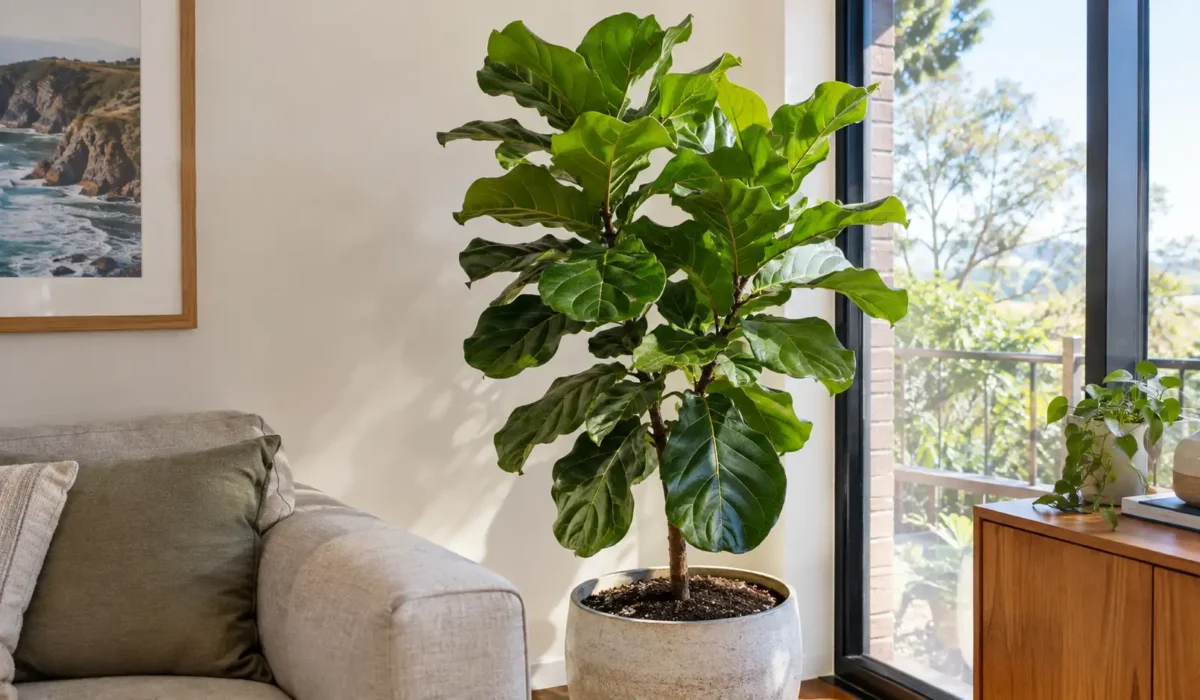
Fiddle Leaf Fig Care Guide Australia: Watering, Light & Leaf Problems
A good fiddle leaf fig care guide Australia routine starts with diagnosis, not a fixed watering calendar. Ficus lyrata prefers bright light, a well-drained mix and consistent moisture, but leaf drop, brown edges and curling usually appear when light, watering, temperature or humidity no longer match the plant’s conditions. Australian climate matters because a Melbourne winter, a Brisbane summer and a Darwin interior can dry a pot at very different rates. The goal is therefore to check the plant and its potting mix first, then adjust watering, positioning and protection to suit your home.
For botanical background, see the Ficus lyrata Wikipedia page, which covers the species’ taxonomy, native range and general cultivation.
Quick Summary
- Water when the upper part of the potting mix has dried rather than following a fixed weekly schedule. A practical starting point is when roughly the top 5–8 cm feels dry.
- Bright, filtered or indirect light is the safest indoor baseline. Harsh afternoon sun through glass can scorch foliage, while insufficient light can contribute to leaf drop.
- Leaf drop after purchase, repotting or a major change of position can be temporary. Give the plant a stable position and avoid repeatedly changing its conditions.
- Outdoors, Ficus lyrata is best treated as a warm-climate, frost-free plant. In cooler Australian regions, container growing gives you much more control.
Why Is My Fiddle Leaf Fig Dropping, Browning or Curling Leaves?
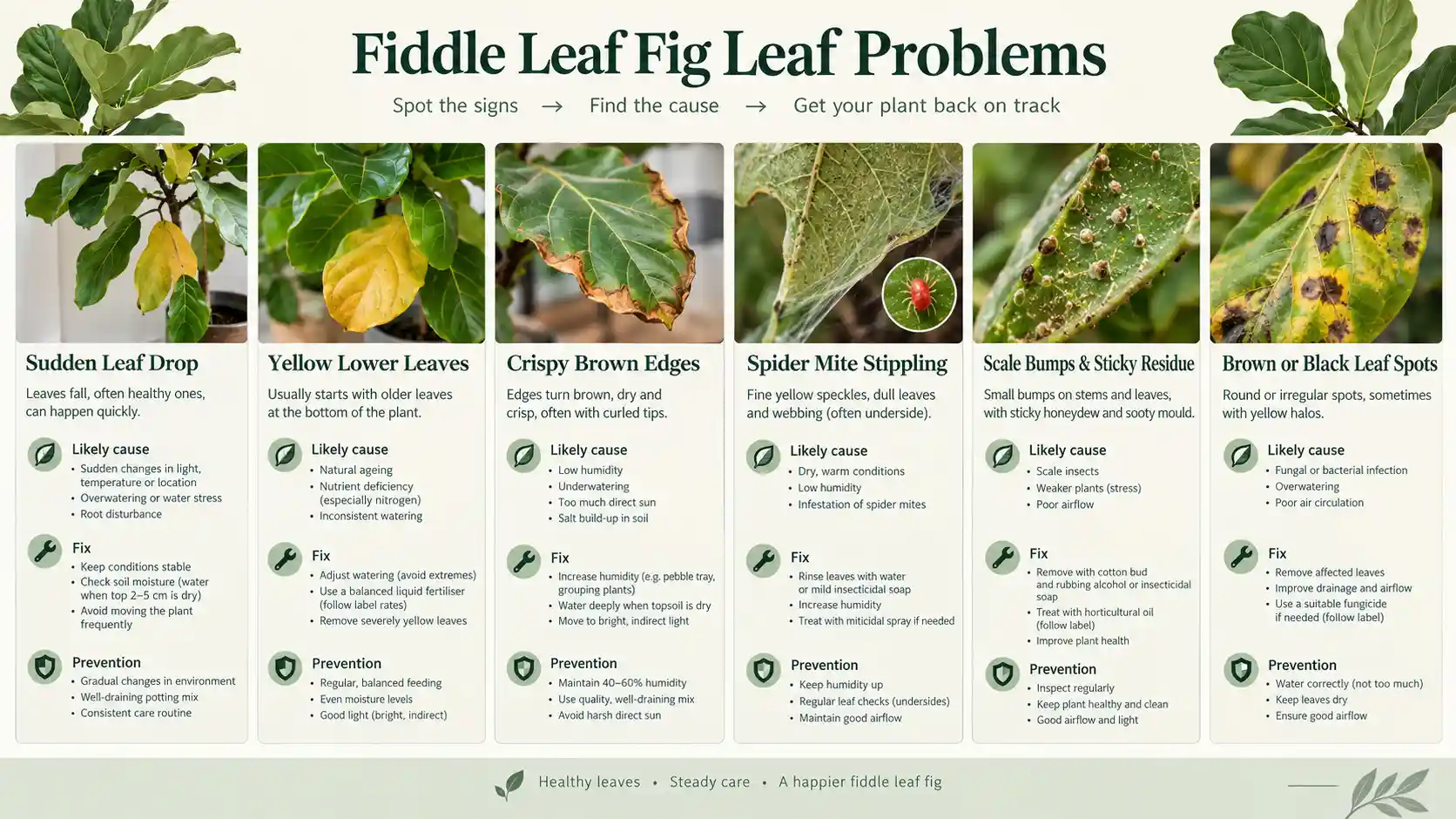
The fastest way to troubleshoot a fiddle leaf fig is to match the pattern of damage with the conditions around the plant. Ficus lyrata is sensitive to changes in light, moisture and temperature, and extension guidance identifies leaf drop, scorch, pests and bacterial or fungal problems among its common growing issues.
| Symptom | Likely cause | Fix | Prevention |
| Sudden all-over leaf drop | Relocation, cold draught or rapid environmental change | Stabilise its position and correct temperature/light problems | Choose one suitable position and avoid repeated moves |
| Lower leaves yellow then drop | Excess moisture or root stress | Let the mix dry appropriately and inspect drainage and roots | Water according to mix dryness, not the calendar |
| Crispy brown edges | Dry root zone, dry indoor air or excessive direct sun | Water thoroughly when due and move away from harsh afternoon exposure | Keep moisture consistent and use filtered light |
| Stippled or bronzed leaves with fine webbing | Spider mites | Isolate the plant, wash foliage and treat according to the pest-control product label | Inspect leaves regularly and keep the plant in suitable conditions |
| Small brown/tan bumps with sticky residue | Scale insects | Isolate and physically remove light infestations; use a labelled treatment for heavier infestations | Check stems, veins and leaf undersides when inspecting new plants |
| Brown or black leaf spots, sometimes with yellowing around them | Leaf-spot disease or other stress | Remove badly affected tissue, improve airflow and avoid routinely wetting leaves | Keep foliage dry where possible and avoid stagnant, overly humid conditions |
Spider mites, scale, aphids, mealybugs, thrips and bacterial or fungal diseases are all documented problems of fiddle leaf figs. UF/IFAS also documents bacterial leaf spot on Ficus lyrata and recommends minimising overhead watering because bacteria can spread via water splash.
When it’s actually normal
An occasional older lower leaf dropping does not automatically mean the plant is dying. Temporary leaf loss can also follow a move home, repotting or a substantial change in light and temperature. The more useful question is whether the plant is continuing to produce healthy new growth and whether the problem is spreading.
How Often to Water a Fiddle Leaf Fig — By Australian Climate and Season
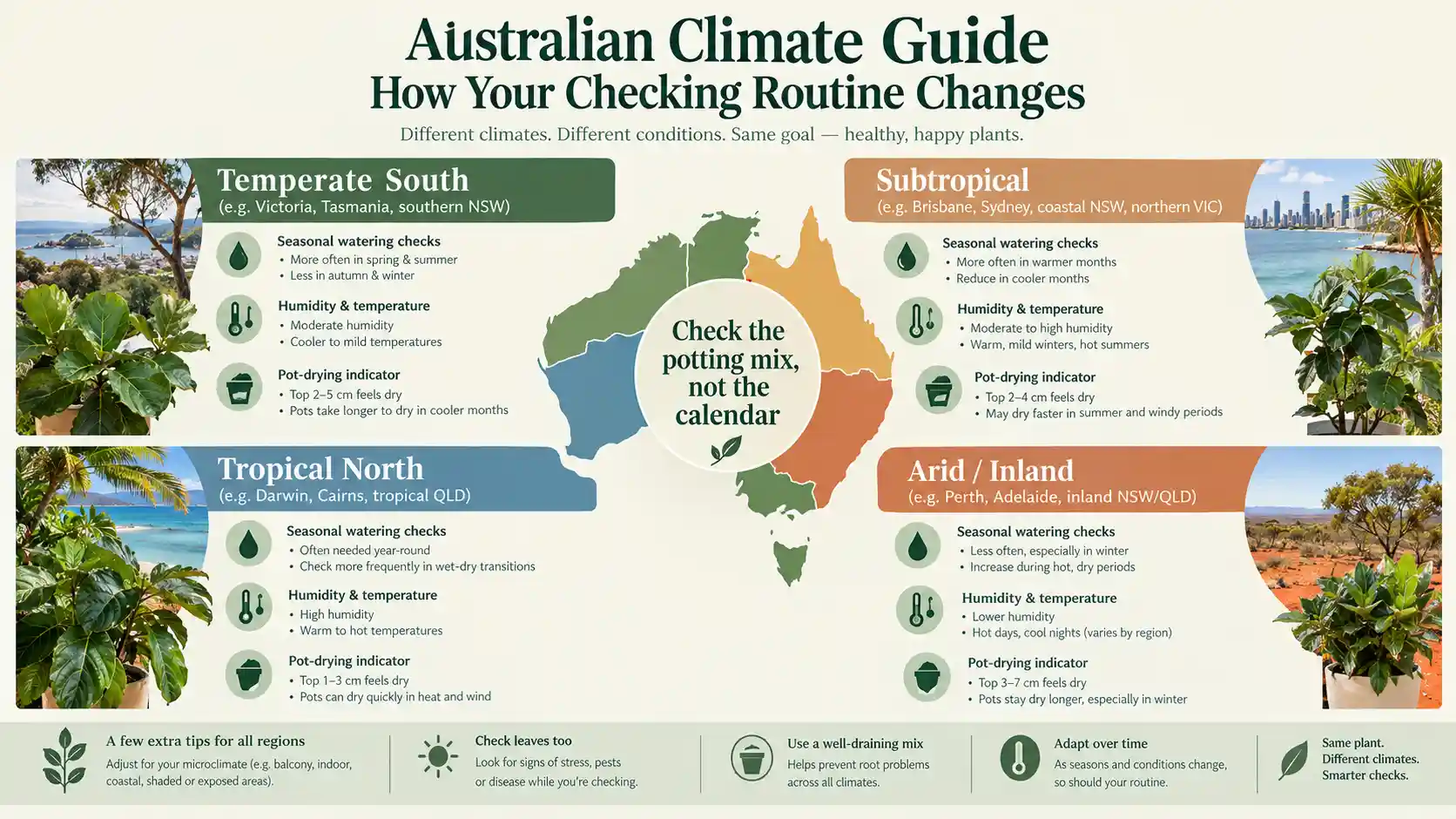
There is no reliable single Australian watering interval because pot size, indoor temperature, light, airflow and the potting mix all change drying speed. Australian guidance recommends allowing the mix to dry between waterings rather than keeping it permanently wet.
As a practical starting point, check the upper 5–8 cm of mix with your finger. When that layer has dried and the pot is noticeably lighter, water thoroughly until excess drains from the bottom. In a large pot, don’t assume the surface alone tells the whole story; compact, waterlogged mix deeper in the pot can remain wet for much longer.
| Australian setting | Summer starting point | Winter starting point | Main adjustment |
| Temperate south — Melbourne, Hobart, Adelaide and cooler southern NSW | Check about weekly; shorten the interval in bright, warm rooms | Check every 10–14+ days as drying slows | Keep away from cold glass, heaters and draughts |
| Subtropical — Brisbane and northern NSW | Check every few days to about weekly depending on light and pot size | Often less frequently than summer | Air conditioning can dry foliage and indoor air while cool weather slows the mix |
| Tropical north — Darwin, Cairns and similar areas | Check frequently during hot, bright periods | Usually still more frequent than southern interiors | Heat, ventilation and strong light can increase water demand |
| Arid/inland interiors | Check frequently rather than relying on a calendar | Reduce watering when growth and evaporation slow | Dry air, heating and airflow can speed surface drying |
These are checking intervals, not mandatory watering schedules. The plant’s actual potting mix should decide when you water.
Light requirements
Bright indirect or filtered light is the safest indoor target. A bright north- or east-facing position can work well, while a western window may need a sheer curtain or some distance from the glass during Australia’s harsher afternoon sun. Bunnings lists bright indirect light indoors and full sun to partial shade outdoors, while Gardening Australia recommends high light without direct sun for indoor plants.
For broader guidance on matching indoor plants to Australian spaces, see our Australian indoor plants and garden design guide.
Potting mix and drainage
Use a premium-quality potting mix in a container with drainage holes. Fiddle leaf figs prefer moisture-retentive but well-drained conditions rather than a permanently saturated root zone. Bunnings specifically recommends premium potting mix indoors and well-drained soil outdoors.
A slightly acidic to neutral growing medium is a reasonable target; around pH 6–7 is commonly used for container culture. Avoid choosing a mix simply because it holds the most water. Root aeration and drainage are more important than keeping the pot constantly moist.
Bringing a New Fiddle Leaf Fig Home
A fiddle leaf fig can react to the move from a bright nursery or greenhouse environment to an ordinary home. Sudden differences in light, temperature, airflow and humidity may trigger temporary leaf drop.
A practical 4–8 week adjustment window is useful for expectation-setting, but it should not be treated as a biological deadline. A plant that drops a few leaves while still showing healthy new growth is different from one that is continuously losing foliage, developing widespread brown spots or sitting in wet soil.
Post-purchase checklist
Choose its permanent position before making other changes. Give it bright filtered light, check the mix before watering and resist the temptation to compensate for leaf drop with extra water or fertiliser.
Do not automatically repot it on the day you bring it home. A stable environment is often more useful than several simultaneous changes.
For more general guidance on why indoor plants respond to their environment, our benefits of indoor plants guide provides broader context around indoor growing conditions.
Fiddle Leaf Fig Care Guide — Light, Water, Soil, Humidity, Fertilising
Once the plant is diagnosed, the routine is straightforward:
Light: Bright, indirect or filtered light. Avoid sudden exposure to intense western sun.
Water: Water thoroughly when the mix has dried sufficiently. Let excess water drain away. Do not keep the root zone permanently wet.
Soil: Premium, well-drained potting mix for containers.
Humidity: Moderate humidity is preferable. In dry air-conditioned or heated rooms, improving ambient humidity may help reduce stress, but misting is not a substitute for correct watering or airflow.
Fertilising: Bunnings recommends controlled-release fertiliser in spring plus a water-soluble feed monthly from spring to late summer. Avoid treating winter as the main feeding period when growth has slowed.
Temperature: Keep conditions stable and protect the plant from cold draughts, air-conditioner outlets and heaters. Outdoor cultivation is best reserved for frost-free warm areas.
Fiddle Leaf Fig Size and Growth Rate
Ficus lyrata can be much larger outdoors than it appears as a houseplant. Bunnings describes mature outdoor plants reaching around 15–30 m in tropical climates, while indoor specimens are commonly managed as large statement plants around 2–3 m or until they reach ceiling height.
Container-grown plants therefore usually remain substantially smaller than free-growing tropical specimens. A realistic indoor expectation is a slow-to-moderate increase in height over several years, strongly influenced by light, root space, pruning and the length of the growing season.
Growth normally slows when temperatures and light levels fall. A plant that stops producing leaves in a cooler, darker winter is not necessarily unhealthy.
Standard Fiddle Leaf Fig vs ‘Bambino’ — Which Suits Small Australian Homes?
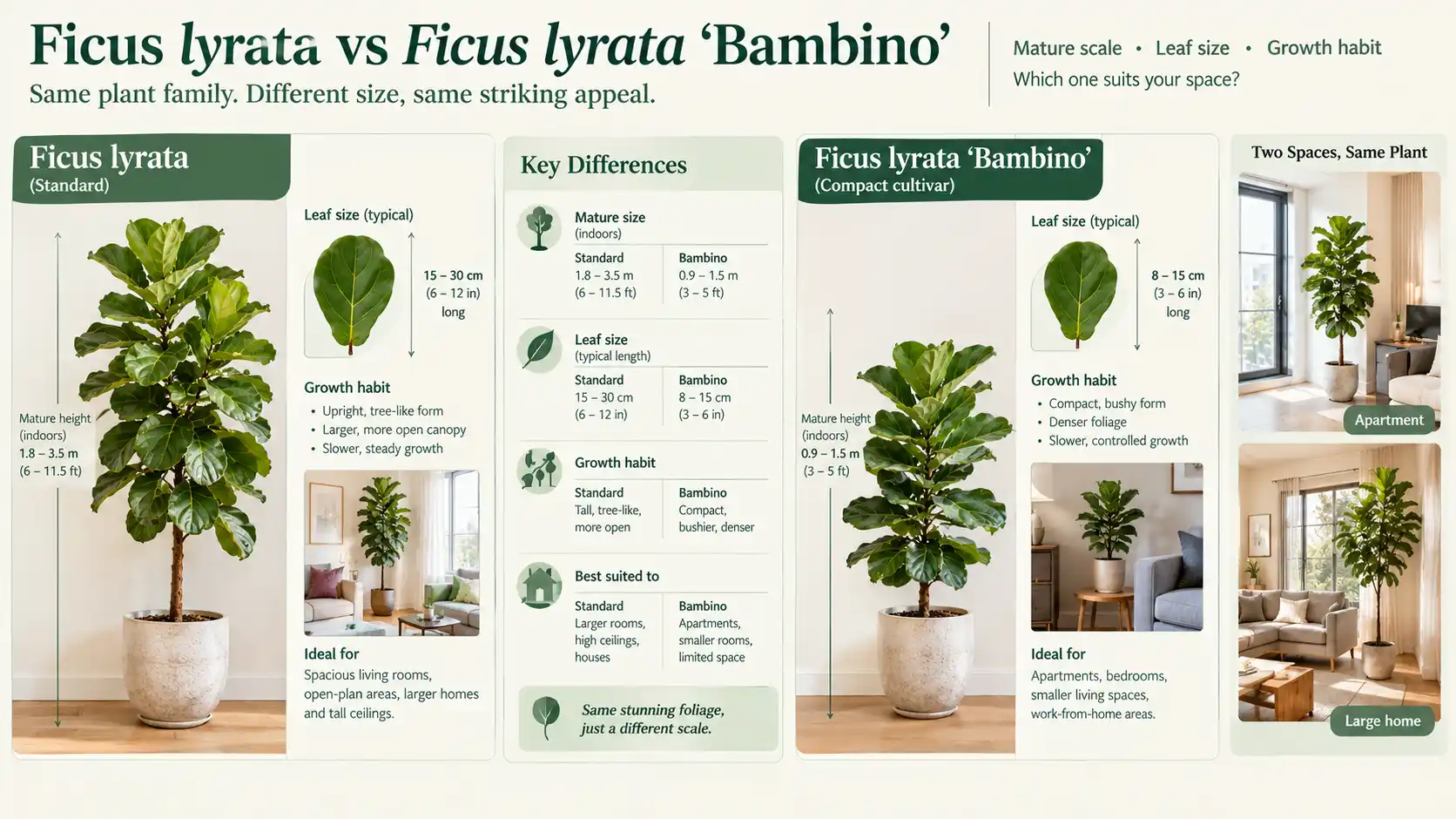
‘Bambino’ is a compact form of Ficus lyrata rather than a different species. Australian nursery information describes it as a dwarf, denser form with smaller leaves and a more compact habit.
| Feature | Standard Ficus lyrata | Ficus lyrata ‘Bambino’ |
| Mature size | Large statement plant; indoor plants can reach around 2–3 m under suitable conditions | Generally around 1–2 m, with nursery listings commonly describing a much more compact habit |
| Leaf size | Large, broad fiddle-shaped leaves | Smaller and thicker-looking leaves than the standard form |
| Growth habit | Upright, often with a more open tree-like structure | Compact, denser and bushier |
| Light | Bright, filtered or indirect indoors | Similar bright-indirect baseline; it is not a low-light plant |
| Best setting | Larger living rooms, open-plan spaces and floor-standing displays | Apartments, units, smaller rooms and tighter floor plans |
The key advantage of ‘Bambino’ is space management, not dramatically different care.
Pruning, Repotting and Propagation
Repotting
Repot in active growth, preferably spring, when the plant is beginning to use water and nutrients more actively. Increase pot size gradually rather than jumping into a very large container. An oversized pot can remain wet for too long.
Wear gloves when pruning or repotting because Ficus sap can irritate skin.
Propagation
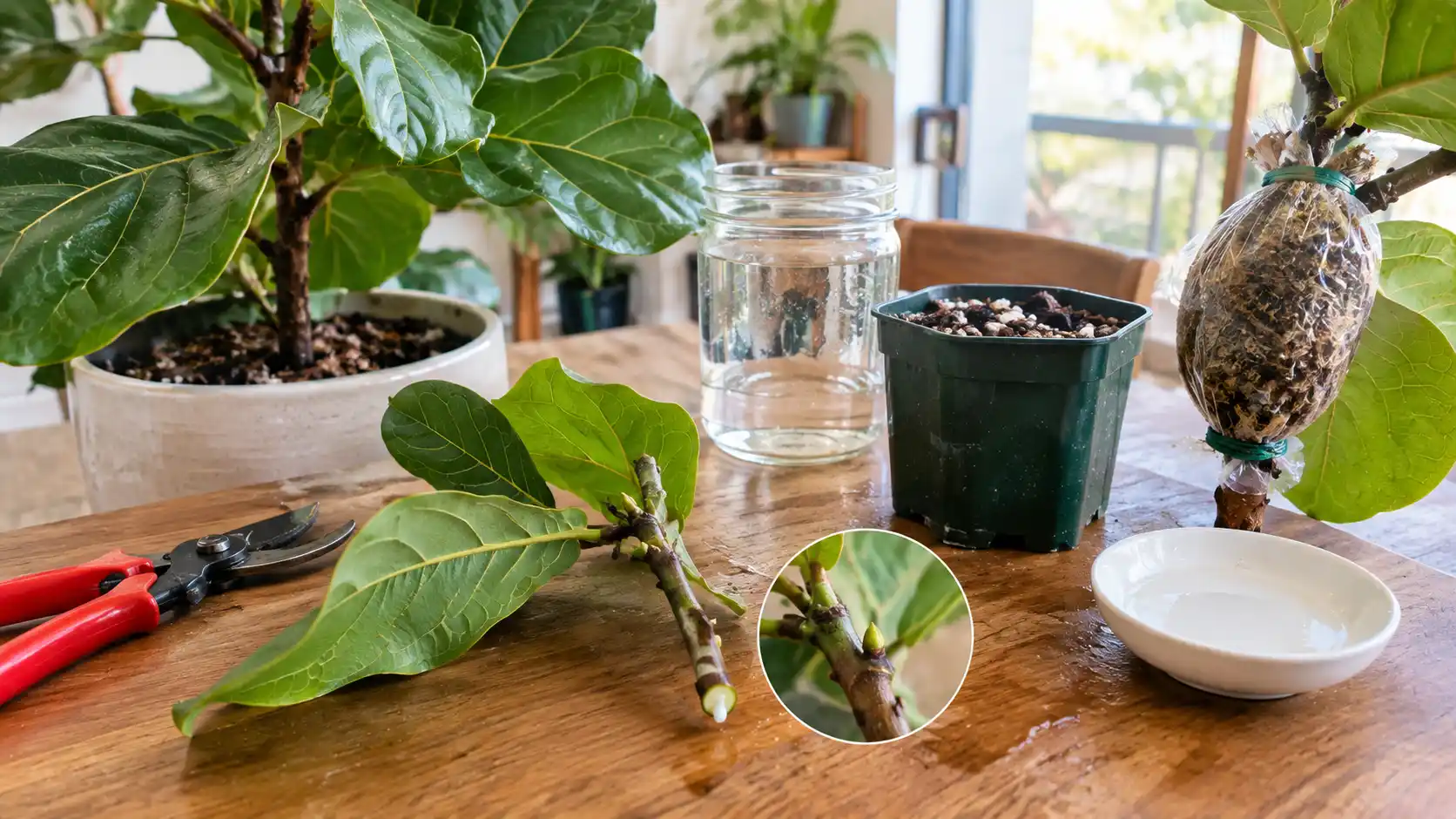
Stem cuttings and air layering are practical propagation methods for fiddle leaf figs. Iowa State Extension specifically lists Ficus lyrata as suitable for air layering, particularly when you want to shorten a tall or bare plant while retaining its leafy top.
A single leaf without stem tissue and a node is not the reliable home-propagation method. For a new plant, use a stem section containing at least one viable node.
Air layering is especially useful when the plant has become too tall because it allows roots to form on the stem before the rooted section is separated.
Common Beginner Mistakes
Repeatedly moving the plant is one of the easiest ways to create a cycle of stress and attempted correction.
Other common mistakes include:
- Watering every seven days regardless of conditions.
- Putting a large plant into an unnecessarily oversized pot.
- Leaving the root zone wet because the top surface looks dry.
- Placing it against harsh western glass.
- Ignoring dust on large leaves.
- Bringing a new plant directly beside an established collection without inspection.
- Fertilising heavily when winter growth has slowed.
The simplest routine is usually the most sustainable: stable position, bright filtered light, sensible drainage and watering based on actual soil moisture.
Is a Fiddle Leaf Fig Safe for Pets and Children?
A fiddle leaf fig should be treated as toxic if chewed or swallowed, although reliable extension guidance classifies the severity as low rather than describing it as a highly dangerous systemic poison. Reported signs include oral irritation, excessive drooling, vomiting and difficulty swallowing; Ficus sap can also irritate skin.
Because different references describe the toxic principles in Ficus sap differently, it is better not to oversimplify the chemistry as one single compound or mechanism.
For people, keep plant material out of children’s mouths and rinse the mouth or skin with water after exposure. Australia’s Poisons Information Centre is available on 13 11 26 for poisoning and exposure advice.
For pets, prevent chewing and contact a veterinarian or the Australian Animal Poisons Helpline if ingestion is suspected.
Can You Grow a Fiddle Leaf Fig Outdoors in Australia?
Yes, but Australian location matters greatly.
The most reliable outdoor setting is a warm, frost-free climate with protection from severe environmental extremes. Bunnings describes fiddle leaf fig as suited to warm-temperate or tropical outdoor conditions, while Yates recommends outdoor growing in frost-free areas.
Tropical and subtropical Australia
In tropical Queensland, northern parts of the Northern Territory and warm subtropical areas such as Brisbane, an established fiddle leaf fig can be grown outdoors where it has suitable soil, drainage and protection from harsh exposure.
Temperate southern Australia
In Melbourne, Hobart, cooler inland districts, southern NSW and frost-prone parts of South Australia, container growing gives you more control. Move or protect the plant during cold periods rather than assuming it will tolerate winter conditions outdoors.
For gardeners choosing species around frost exposure, out frost-tolerant plants for Australian gardens is a useful companion resource.
Arid and inland areas
Fiddle leaf figs can be grown in protected containers or suitable warm microclimates, but dry air, wind and intense sun can make leaf scorch and moisture management more difficult. Protection and close observation matter more than following a generic state-based schedule.
Conclusion
Successful fiddle leaf fig care in Australia comes down to matching the plant’s watering, light and temperature to its actual environment. Water according to the dryness of the potting mix rather than a fixed calendar, provide bright filtered light, use a well-drained premium mix and avoid repeated changes of position.
When a new plant drops leaves after coming home, give it stability before assuming something is seriously wrong. For outdoor growing, warm frost-free regions offer the best conditions, while container cultivation is the safer strategy for colder southern areas.
The result is a much more useful approach than simply asking how often to water: diagnose the symptom, identify the environmental cause, correct one variable at a time and keep the conditions consistent.
FAQs
1. How often should I water a fiddle leaf fig in Australia?
Check the potting mix rather than using a fixed schedule. A useful starting point is to water when the upper 5–8 cm has dried, then water thoroughly and allow excess to drain. The interval may be several days in a hot bright environment or more than a week in a cool, low-light winter room.
2. Why is my fiddle leaf fig dropping leaves after I brought it home?
A change in light, temperature, airflow and humidity can cause temporary stress and leaf drop. Keep the plant in one suitable position, avoid heavy corrective watering and monitor whether healthy new growth appears.
3. Can fiddle leaf figs be grown outside in Australia?
Yes, particularly in warm, frost-free tropical and subtropical areas. In colder regions, growing the plant in a container allows winter protection and easier environmental control.
4. Is a fiddle leaf fig toxic to pets or children?
It should be treated as toxic if chewed or swallowed. Oral irritation, drooling and vomiting are among the reported signs, and the sap can irritate skin. Keep it out of reach of children and pets.
5. What’s the difference between a standard and a Bambino fiddle leaf fig?
‘Bambino’ is a compact form of Ficus lyrata. It generally has a denser, more compact habit and smaller leaves, making it better suited to limited indoor space.
6. Can you propagate a fiddle leaf fig from a single leaf?
For reliable home propagation, use a stem cutting containing a node. A detached leaf without the necessary stem growth tissue is not a dependable method for producing a complete new plant.
7. What’s the lifespan of a fiddle leaf fig?
The supplied outline asks for a lifespan figure, but the authoritative sources checked for this article do not provide a dependable household lifespan number. It is therefore better not to publish an invented figure. With suitable conditions, Ficus lyrata is a long-lived perennial tree.
8. Do coffee grounds or Epsom salts help a fiddle leaf fig?
Neither should be used as a routine cure for leaf problems. Used coffee grounds should not be relied upon to acidify soil, while Epsom salts are useful only where magnesium deficiency is actually established. Research-based extension guidance warns that unnecessary Epsom salt use can create nutrient imbalances.