

The Ultimate Guide to Plant Care & Growing in Australia
If you’ve ever tried to follow plant care advice online, you’ve probably run into the same frustrating pattern: half of it assumes you’re gardening in the northern hemisphere, with the wrong seasons, the wrong climate zones, and no mention of water restrictions. The other half is a generic listicle of “10 tips for healthy plants” that could apply anywhere in the world — which, in practice, means it applies nowhere in particular.
This guide is different. It’s built as a single, reliable framework for plant care in Australian conditions — covering the fundamentals every plant owner needs (light, water, soil, feeding, and pruning), how those fundamentals shift depending on whether you’re gardening in the tropics, the subtropics, a temperate zone, or an arid region, and how indoor and outdoor care overlap and diverge. Along the way, we’ll point you to the right place on the site once your question becomes specific — whether that’s pruning a named species, understanding a plant’s root system, or working out how big something will get before you plant it.
Consider this page the starting point for everything else on leafyheaven.
Quick Summary
- Plant care fundamentals — light, water, soil, feeding, and pruning — apply to nearly every plant, but the specifics change depending on your Australian climate zone.
- Tropical, subtropical, temperate, and arid regions each need different watering frequency, feeding windows, and light exposure.
- Indoor and outdoor care share core principles but diverge on humidity, drainage, and root space.
- Most beginner plant problems trace back to light or watering, not pests — diagnose in that order.
- Water restrictions should override generic “water twice a week” advice; adjust frequency and timing to your local rules, not just the volume you give each time.
- Once you know your plant’s name, or you’re facing a specific task like pruning or working out root behaviour, move on to our species- and task-specific guides.
How Australian Conditions Change “Standard” Plant Care Advice
Most plant care content published online is written for the US or UK, which means the seasons are inverted, the climate zones don’t match, and the assumptions about rainfall and water availability are often wrong for Australian gardeners. “Prune in early spring” or “water twice a week” sounds precise, but it’s only useful once you know which spring and whose water supply it’s talking about.
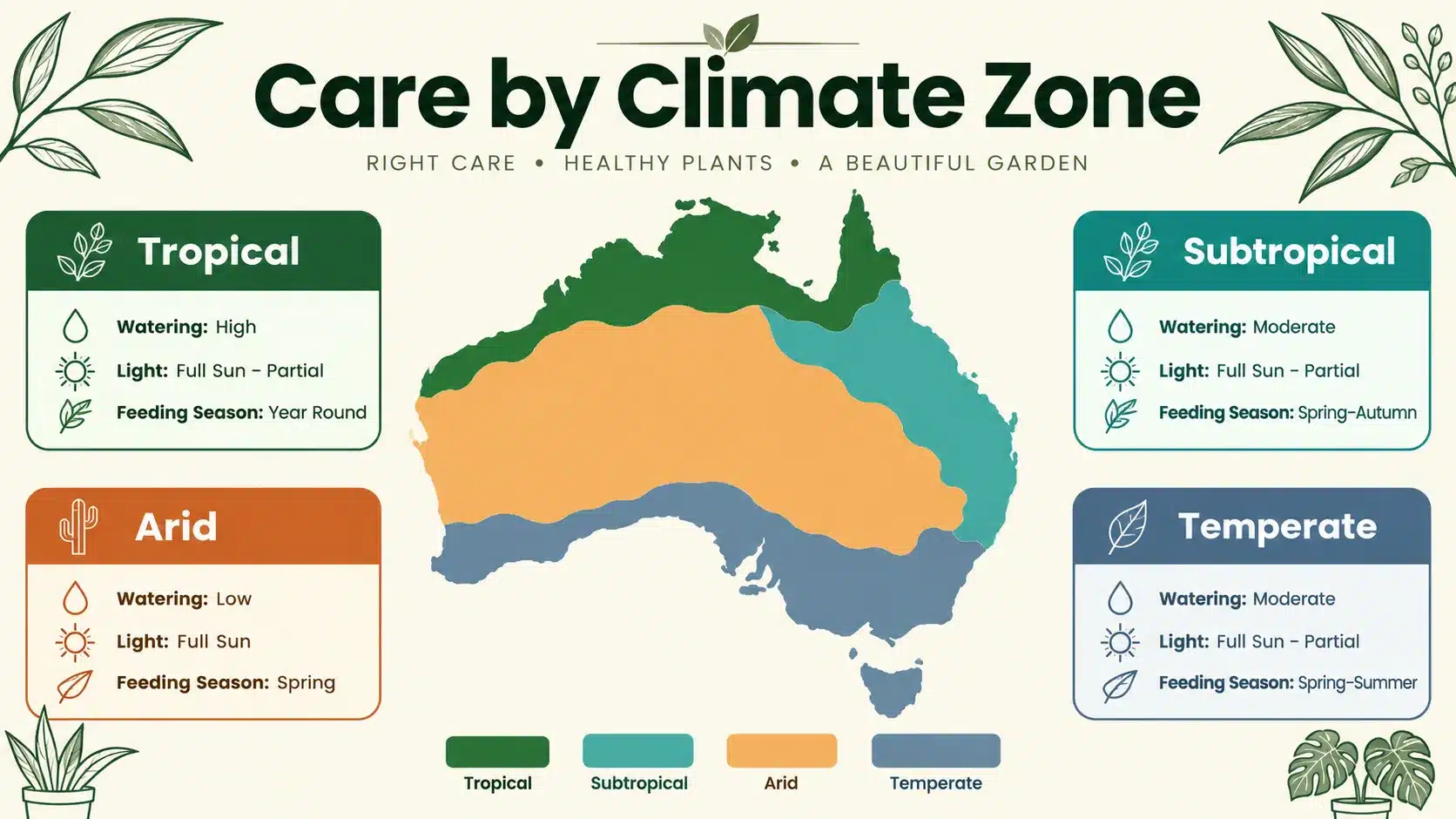
Australia doesn’t have one climate — it has several, based on Australia’s official climate zone classifications, and they call for genuinely different care decisions:
- Tropical (far north Queensland, parts of the NT): Humid, warm, wet and dry seasons.
- Subtropical (south-east Queensland, northern NSW): hot, moist summers with mild winters, and greater variation in rainfall from season to season than in the tropics.
- Temperate (southern NSW, Victoria, parts of SA, Tasmania): Four well-defined seasons, cooler winters and more regular rainfall.
- Arid and Semi-arid (Much of inland Australia, parts of WA & SA): Low rainfall, high evaporation and extreme temperature fluctuations between day and night
If you are new to gardening and need a more basic and simplified introduction than this guide, our beginner gardening guide for Australia begins at a more basic level.
Climate-Zone Care Adjustment Table
Here’s how one fundamental — watering frequency — shifts depending on where you’re gardening. The same logic applies to light exposure and feeding windows, which we’ll cover in the sections below.
| Climate Zone | Typical Watering Frequency | Feeding Season | Light Considerations |
| Tropical | Frequent, consistent moisture year-round; adjust down slightly in the dry season | Nearly year-round, with a lighter hand in the cooler dry months | High humidity softens intense sun; more plants tolerate full sun than in drier zones |
| Subtropical | Regular in summer, reduced in winter | Spring through early autumn | Strong summer sun; afternoon shade often needed for sensitive plants |
| Temperate | Reduced in winter, increased through spring/summer growth | Spring to early autumn, paused over winter dormancy | Lower winter light levels; north-facing aspects matter more |
| Arid / Semi-arid | Deep, infrequent watering to encourage resilient root systems; early morning or evening timing to reduce evaporation | Short spring/autumn windows; avoid feeding during peak heat stress | Intense, harsh light; afternoon shade and wind protection often essential |
This table is a starting framework, not a substitute for species-specific care — a lemon myrtle and a firestick plant will still have different tolerances within the same zone.
The Fundamentals: Light, Water, Soil, Feeding, Pruning
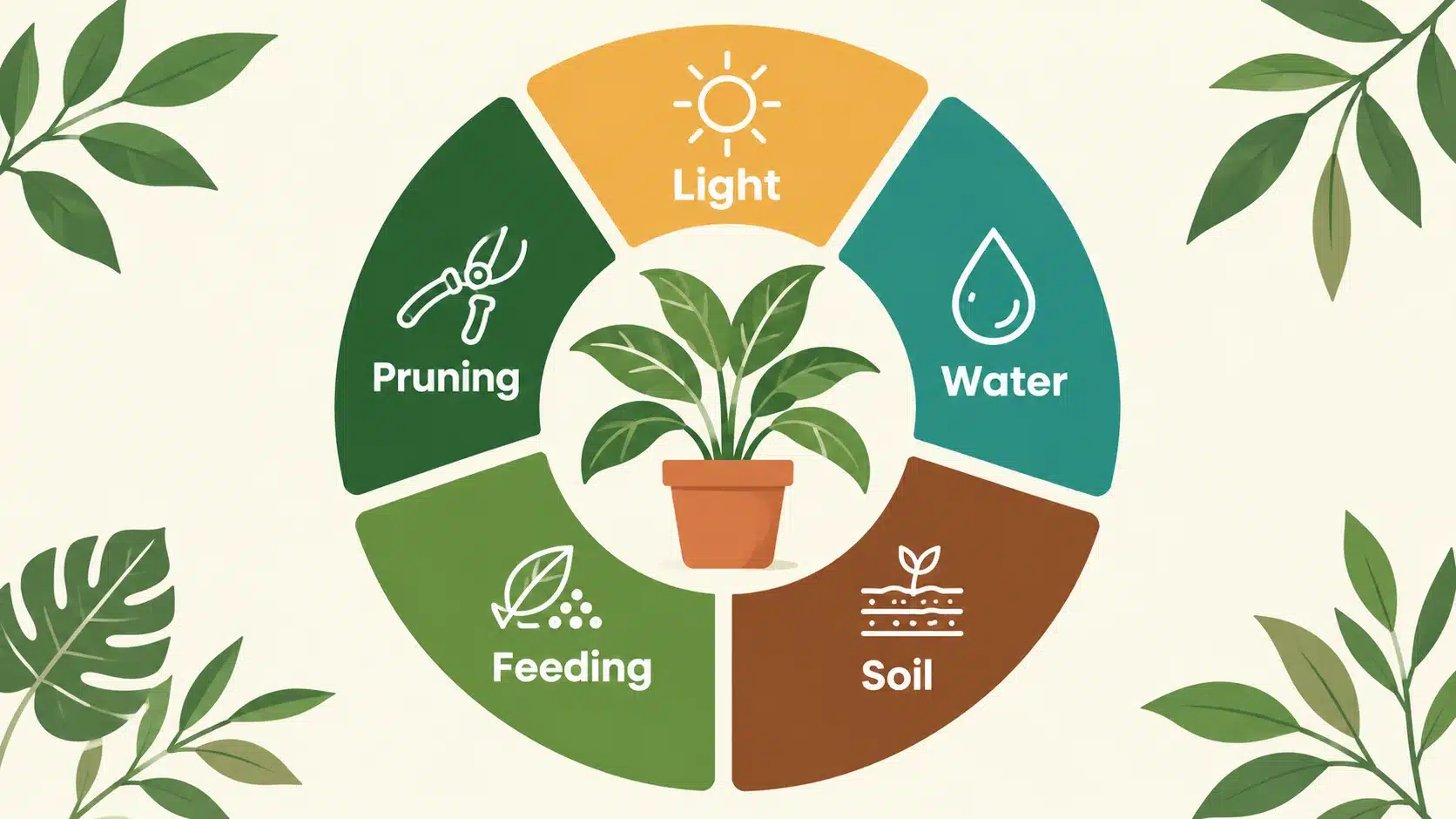
Before layering on climate nuance or indoor/outdoor differences, every plant owner needs a firm grip on five fundamentals. Get these right and most plant problems never happen in the first place.
Light Requirements
Most plant tags describe light needs in vague terms like “bright indirect light” or “full sun,” and these mean different things indoors versus outdoors. Indoors, “bright indirect light” usually means near a window but out of direct midday sun. Outdoors, especially in Australian summer, “full sun” can be considerably more intense than the same label would mean in a UK or US garden — what’s labelled a full-sun plant overseas may still need some afternoon protection here.
The most common light-related mistake is placing an indoor plant based on how bright a room looks to the human eye, rather than how much usable light actually reaches the leaves — light intensity drops off sharply the further a plant sits from a window.
Watering Principles (and Why Restrictions Change the Advice)
Overwatering and underwatering produce surprisingly similar symptoms — wilting, yellowing, and leaf drop — which is why watering is one of the most misdiagnosed areas of plant care.
As a general rule:
- Overwatered plants often show yellowing leaves that feel soft or mushy, sometimes with a sour smell from the soil.
- Underwatered plants typically show crisp, dry leaf edges and soil that has pulled away from the pot or garden bed.
Where most global advice falls short is water restrictions. Many Australian councils and states impose rules on watering days, times, and methods (sprinkler bans, hand-watering-only periods, and so on), which means “water twice a week” isn’t a fixed instruction — it’s a starting point you need to adapt to your local rules and to how quickly your soil actually dries out.
That second part matters more than most guides admit: soil composition has a direct effect on how long moisture is retained, which is exactly why watering and soil can’t really be treated as separate topics. For the full picture on choosing and improving soil, see our soil and fertiliser guide for Australian gardens.
Soil Basics
Soil is the fundamental most beginners underestimate. A plant given perfect light and a perfect watering schedule can still fail if it’s sitting in soil that drains too fast, retains too much moisture, or lacks the structure to support healthy roots.
At a basic level, look for:
- Drainage — water should move through the soil, not pool on the surface or sit stagnant around roots.
- Structure — soil that’s too compacted restricts root growth; soil that’s too loose won’t hold enough moisture or nutrients.
- Suitability — potting mix, garden soil, and specialised mixes (succulent, orchid, natives) aren’t interchangeable.
We won’t go deep into specific mixes and products here — our dedicated guide to soil and fertiliser in Australia covers that in full, including how to match soil type to plant type.
Feeding & Fertilising Basics
Not every plant needs constant feeding, and over-fertilising is a genuinely common way to damage or kill a plant that would otherwise have been fine left alone. As a general principle, most plants benefit from feeding during their active growth period and need little to nothing during dormancy — which, as the climate-zone table above shows, falls at different times of year depending on where you are in Australia.
Signs of over-fertilising include a white crust on the soil surface, scorched-looking leaf tips, and sudden, weak, leggy growth rather than steady, sturdy growth.
Pruning Basics
Pruning serves three purposes: maintaining plant health (removing dead, damaged, or diseased growth), shaping (controlling form and size), and encouraging strong new growth. The core technique — cutting back to just above a node or bud, using clean, sharp tools — is consistent across most plants, but when and how much to prune varies significantly by species and by task.
Because pruning is such a large topic on its own, we’ve built an entire hub for it. If you’re ready to prune, our pruning and maintenance guide is the best next stop — it covers everything from hedges to fruit trees to specific ornamental species.
Understanding how specific nutrients affect plant growth — nitrogen for foliage, potassium for flower and fruit quality — makes it much easier to spot a genuine deficiency rather than over-correcting with more fertiliser.
Indoor vs Outdoor Plant Care: Where the Rules Overlap and Where They Diverge
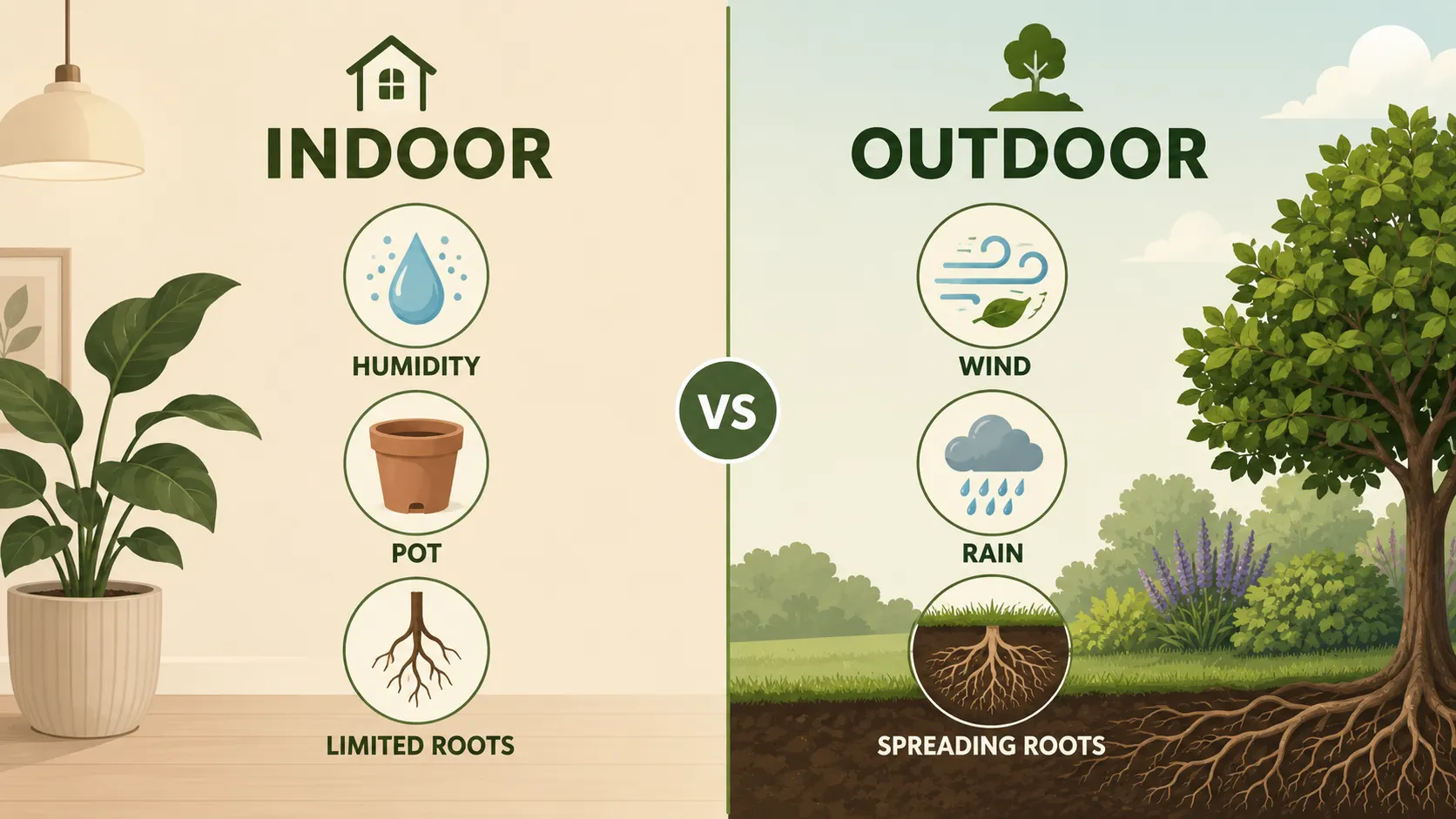
The fundamentals above apply whether a plant lives in a pot on your windowsill or in the ground in your backyard — but the details diverge in a few important ways:
- Humidity: indoor spaces, particularly those with air conditioning or heating, can be much drier than outdoors, and can have a negative impact on many houseplants that have adapted to humid environments.
- Drainage: Pots have a fixed and limited drainage pathway, while garden soil may (in theory) be able to drain more freely — or less in poorly drained garden beds than a pot ever would.
- Root space: plants planted indoors are pot-bound (must water less often and grow slower), plants in the ground can go as far as soil conditions will allow.
- In outdoor plants, wind exposure, rain, temperature and direct sun are all other factors that may occur, while in indoor plants, you are the only one who is responsible for every input.
If you’re building or refining an indoor plant collection, or thinking about how houseplants fit into a broader garden design, our indoor houseplants and garden design guide goes into that intersection in more depth than we can here.
Outdoor-Specific Considerations: Roots, Growth Rate & Sizing
Outdoor planting adds a dimension that indoor plant care doesn’t need to worry about: what a plant will actually look like — and where its roots will actually go — once it’s mature.
Before planting anything outdoors, it’s worth asking:
- How large will this plant get at maturity, and does the space actually accommodate that?
- Does this species have an aggressive or shallow root system that could affect nearby paths, pools, pipes, or foundations?
- How quickly does it grow, and will you need to manage size sooner than expected?
These questions come up constantly once you move past “which plant do I like the look of” and into “where can I actually put it.” Our growth, roots, and sizing guide is built specifically to answer them, with detail on growth rates and root behaviour across a wide range of Australian species.
Choosing the Right Plants for Your Space
Care fundamentals only matter once you’ve chosen plants that suit your climate, light, and space in the first place.
Broadly, most home gardens fall into a mix of two categories:
- Edible and food-producing plants — fruit trees, herbs, and vegetables, which usually have more specific feeding and pruning needs tied to fruiting cycles. If this is your focus, our guide to fruit trees and edible plants for Australian gardens covers selection in detail.
- Ornamental and structural planting — trees and shrubs chosen for shape, screening, shade, or year-round structure. Our guide to the best trees and shrubs for Australian gardens is the right next stop for this kind of selection.
Most gardens end up combining both, and the fundamentals in this guide apply to either path — the difference is mainly in what you’re optimising for.
Common Beginner Mistakes — and How to Diagnose Problems Before You Guess
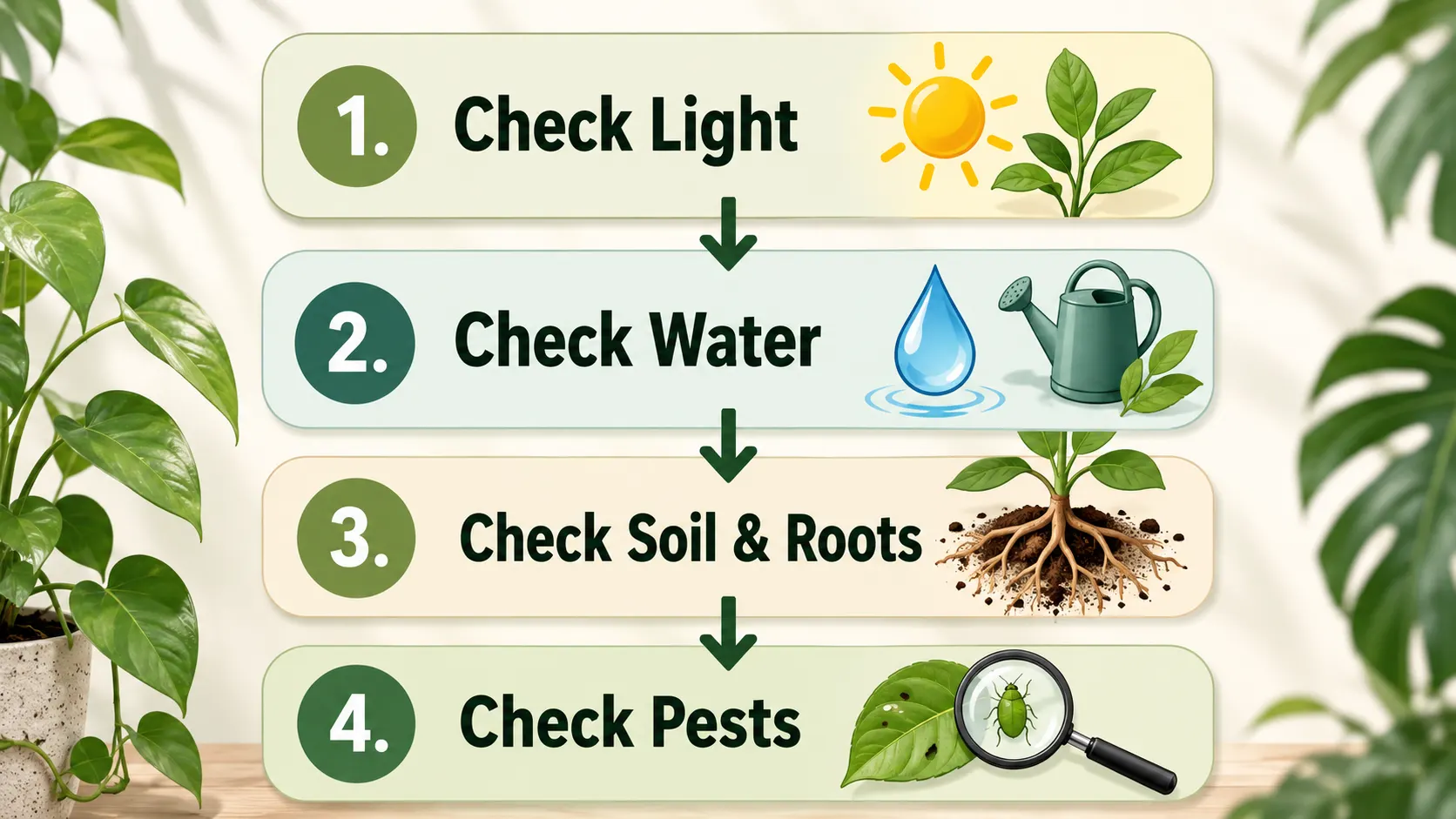
The single biggest mistake beginner gardeners make isn’t a specific care error — it’s guessing at a fix before diagnosing the actual cause. A yellowing leaf can mean overwatering, underwatering, a light problem, or a nutrient issue, and each of those calls for the opposite response. Adding water to an overwatered plant, because “the leaves look dry,” is a common way to make things worse.
A simple, reliable order to check things in:
- Light first — is the plant getting meaningfully more or less light than it needs?
- Water second — check the soil itself (not just the leaves) for actual moisture level before deciding to water or hold off.
- Soil and roots third — is the plant root-bound, sitting in poor-draining soil, or showing signs of root rot?
- Pests last — pests are a real cause of plant decline, but they’re also the most commonly assumed cause when the real issue is one of the three factors above.
A few of the most common symptoms, and where to look first:
- Yellowing leaves — most often a watering issue (over or under), sometimes a light or nutrient issue.
- Wilting — almost always a watering issue, but can also indicate root damage or a pot that’s too small.
- Leggy, stretched growth — almost always a light issue; the plant is reaching for more of it.
This is a starting triage, not a diagnosis — but checking things in this order will save you from a lot of unnecessary guessing.
Seasonal & Maintenance Planning
Because Australia’s climate zones don’t share a single calendar, “seasonal maintenance” looks different depending on where you garden — which is exactly why generic, one-size-fits-all pruning and feeding calendars from overseas sources tend to mislead more than they help.
Rather than reacting to problems as they appear, the more effective approach is planning key maintenance — particularly pruning and feeding — around your zone’s actual growing season. This is especially true for fruit trees, where pruning timing has a direct effect on the following season’s harvest. Our fruit tree pruning calendar for Australia lays this out month by month, so you’re not guessing at timing on top of everything else.
Growing With Confidence: When to Move Beyond the Basics
This guide is designed to give you a solid, zone-aware foundation — but at some point, the right next step isn’t more general advice, it’s something specific to your plant or your task.
You’re ready to move on from this page once:
- You know the name of your plant and want detail specific to that species.
- You’re troubleshooting a specific, persistent symptom rather than learning the basics.
- You have a specific task in front of you — pruning a hedge, sizing up a new planting spot, understanding a root system near a structure.
From here, the three guides below cover everything this page intentionally leaves out:
- Pruning and Maintenance — for hedge pruning, fruit tree pruning, and named-species pruning technique and timing.
- Beginner Gardening Guide Australia — for a gentler, step-by-step introduction if you’re just starting out, plus soil, fertiliser, and plant selection.
- Growth, Roots and Sizing — for growth rates, mature sizing, and root system behaviour across specific species.
Bringing It All Together
Reliable plant care isn’t a fixed checklist — it’s a framework: get the fundamentals right, adjust them for your climate zone, and adjust again for whether you’re growing indoors or outdoors. Diagnose before you guess, and you’ll avoid the most common beginner mistakes entirely.
This guide is your starting point. When you’re ready for more depth, head to Pruning and Maintenance for hands-on pruning technique, the Beginner Gardening Guide Australia for a fuller step-by-step introduction, or Growth, Roots and Sizing for the detail behind how big your plants will get and where their roots will go.
Frequently Asked Questions
What are the most important basics of plant care for beginners?
Light, water, soil, feeding, and pruning — in that order of impact. Most plant problems trace back to getting one of the first two wrong.
How does plant care differ across Australia’s climate zones?
The core fundamentals stay the same, but their specifics — watering frequency, feeding windows, and light exposure — shift depending on whether you’re gardening in a tropical, subtropical, temperate, or arid region.
How is caring for indoor plants different from outdoor plants?
Indoor plants deal with lower humidity, fixed pot drainage, and limited root space, while outdoor plants deal with weather exposure and unrestricted (but sometimes problematic) root growth.
How should water restrictions change how often I water my plants?
Treat published watering frequencies as a starting point, then adjust for your local council or state restrictions and for how quickly your specific soil dries out.
What’s the first thing to check when a plant looks unhealthy?
Light exposure, followed by an actual check of soil moisture — not just how the leaves look.
How do I know if a problem is caused by light, water, or soil?
Check light and water first, since they’re the most common causes and the easiest to rule in or out; soil and root issues are usually the next step if those don’t explain the symptom.
When should I stop following general advice and look up my specific plant?
As soon as you know the plant’s name, or you’re facing a specific task (pruning, sizing, a root concern) rather than a general question.
Do all plants need feeding, and how often?
Most benefit from feeding during their active growth season and little to none during dormancy — timing depends on your climate zone, not a fixed calendar date.
5 Comments