

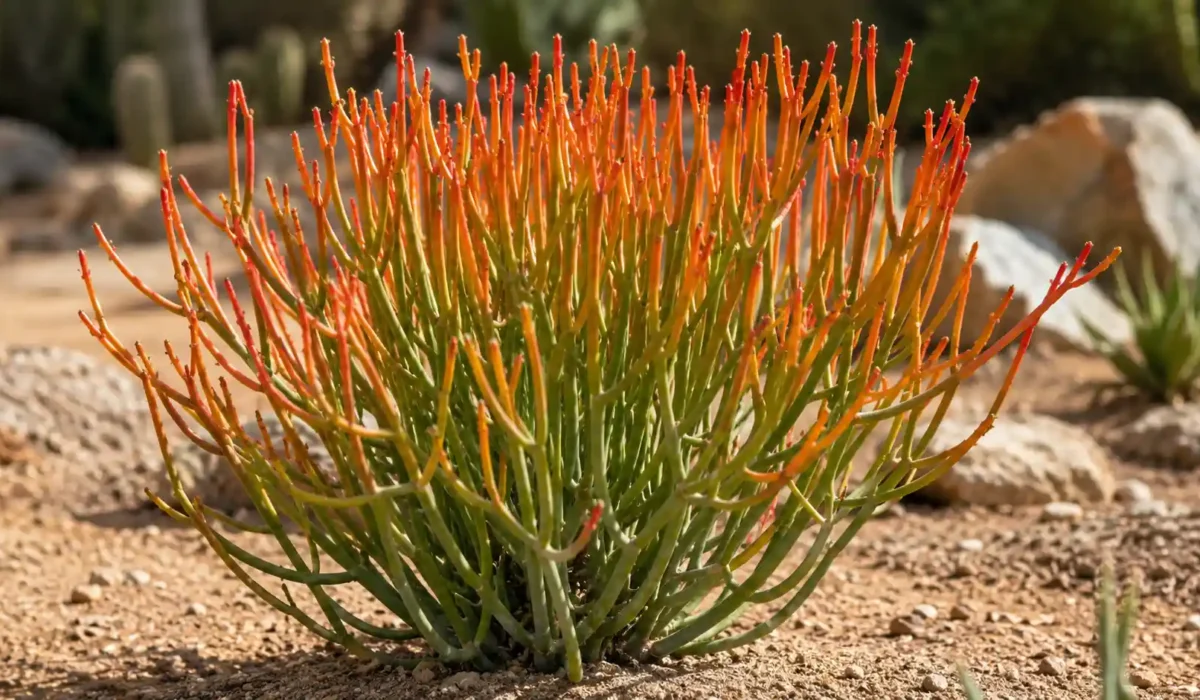
Firestick Plant Root System Guide & Care Tips
Introduction
The firestick plant root system refers to the shallow, fibrous, and widely spreading underground structure of Euphorbia tirucalli, a drought-tolerant succulent shrub. Understanding how its roots function is essential for correct potting, watering, and long-term plant health. Unlike deep-rooted trees, this plant relies on surface-level moisture absorption and fast drainage conditions to avoid rot. Its root behaviour directly influences how it should be grown in containers or gardens.
By Elemo Baker | Plant Care & Gardening Expert
Last Updated: July 2026
Quick Summary
- Firestick plant roots are shallow, fibrous, and spread widely rather than deeply
- Requires well-draining soil and shallow, wide containers for healthy growth
- Contains toxic milky sap that requires careful handling
- Grows moderately to fast in warm, bright climates
What Is a Firestick Plant?
The firestick plant, also known as Euphorbia tirucalli, is a succulent shrub native to arid regions of Africa. It is commonly called fire sticks plant, sticks on fire plant, pencil cactus Australia, and green firestick plant due to its upright, pencil-like stems that can turn bright red or orange under stress or cold conditions.
Botanically, Euphorbia tirucalli belongs to the Euphorbiaceae family, a group known for latex-producing succulents, as documented in broader plant taxonomy references such as Euphorbia genus information on Wikipedia.
Despite being called a “cactus” in some regions, it is not a true cactus. It belongs to the Euphorbiaceae family, which is known for latex-producing plants with drought tolerance.
The firestick plant stores water in its stems rather than relying on deep roots, making it highly adapted to dry environments.
Firestick Plant vs Pencil Cactus — naming confusion explained
The terms “firestick plant” and “pencil cactus” are often used interchangeably, but they refer to the same species (Euphorbia tirucalli). The confusion arises because both have thin, pencil-like stems.
However, it is not a true cactus. True cacti belong to the Cactaceae family and have spines instead of leaves or sap-based defence systems. The firestick plant uses toxic latex sap for protection instead.
Understanding the Firestick Plant Root System
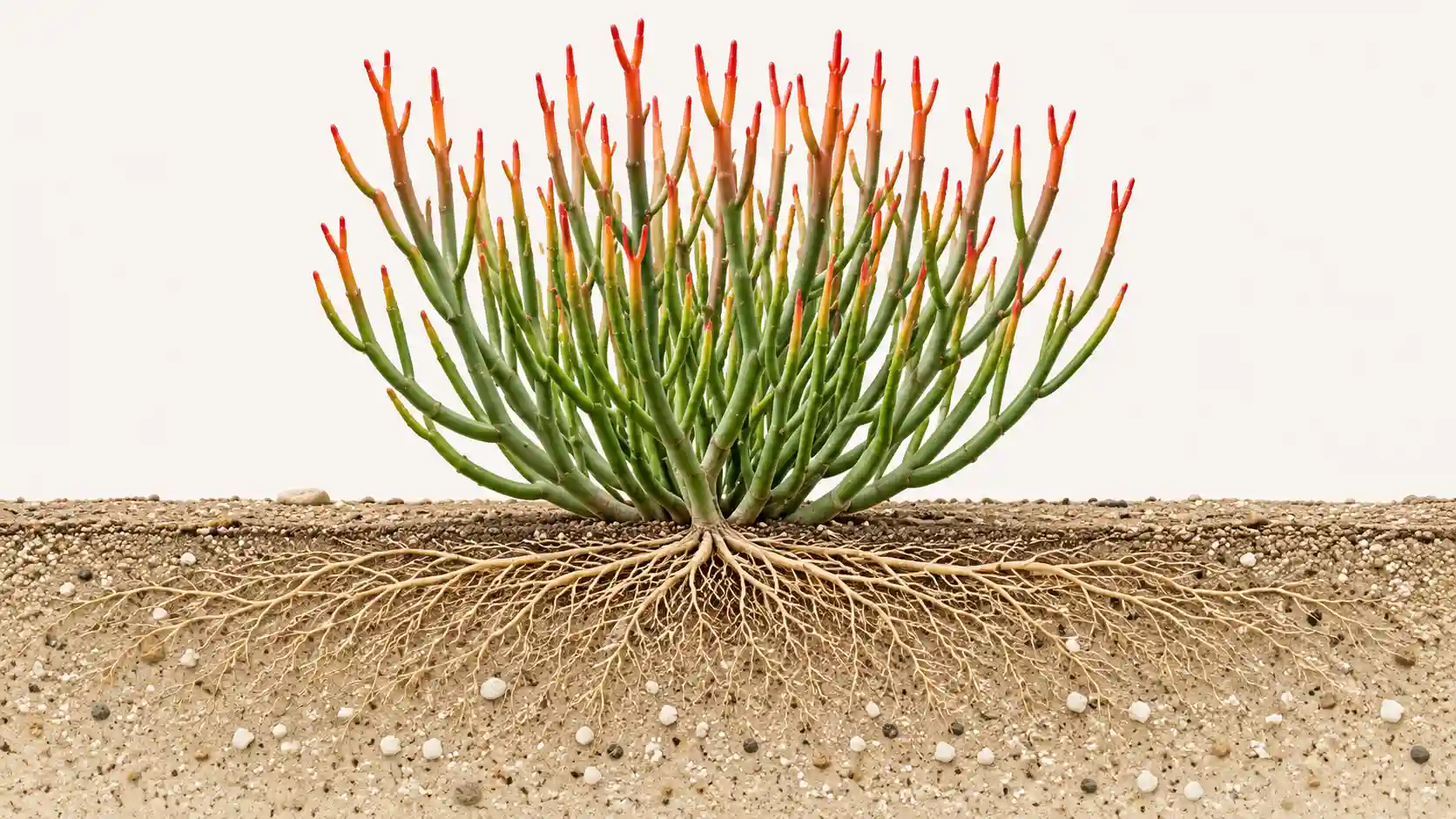
The firestick plant root system is primarily fibrous, shallow, and widely spreading. Instead of growing deep into the soil, the roots expand horizontally near the surface to quickly absorb rainfall or irrigation water.
This adaptation helps the plant survive in arid climates where water is scarce but occasional surface moisture is available. The roots are highly efficient but sensitive to overwatering, which can lead to rot. This shallow, wide-spreading root behaviour is similar in function (though not structure) to other drought-adapted ornamentals such as the Poinciana Tree Root System, which also prioritises lateral spread over deep anchoring.
In our experience growing Euphorbia tirucalli in container gardens, root issues almost always come from poor drainage rather than lack of fertiliser or nutrients.
Do Firestick Plants Have Deep Roots?
No, firestick plants do not have deep roots. Their root system is shallow and lateral, designed for fast water uptake rather than deep soil anchoring. This is why they perform better in wide pots than deep containers.
Cactus Roots Systems vs Firestick (Euphorbia) Roots — comparison
Cacti often develop deeper or dual-root systems depending on species, while firestick plants remain mostly surface-rooted. This difference impacts watering, soil choice, and pot selection.
Comparison Table: Firestick Root System vs True Cactus Root System
| Feature | Firestick Plant | True Cactus |
| Root depth | Shallow | Often deeper or mixed |
| Root spread | Wide and fibrous | Variable, sometimes taproot |
| Water storage | Stem-based | Stem + root adaptations |
| Soil needs | Fast-draining, shallow medium | Extremely well-draining, variable depth |
| Drought strategy | Rapid surface absorption | Deep water storage access |
Do Succulents Like Deep or Shallow Pots?
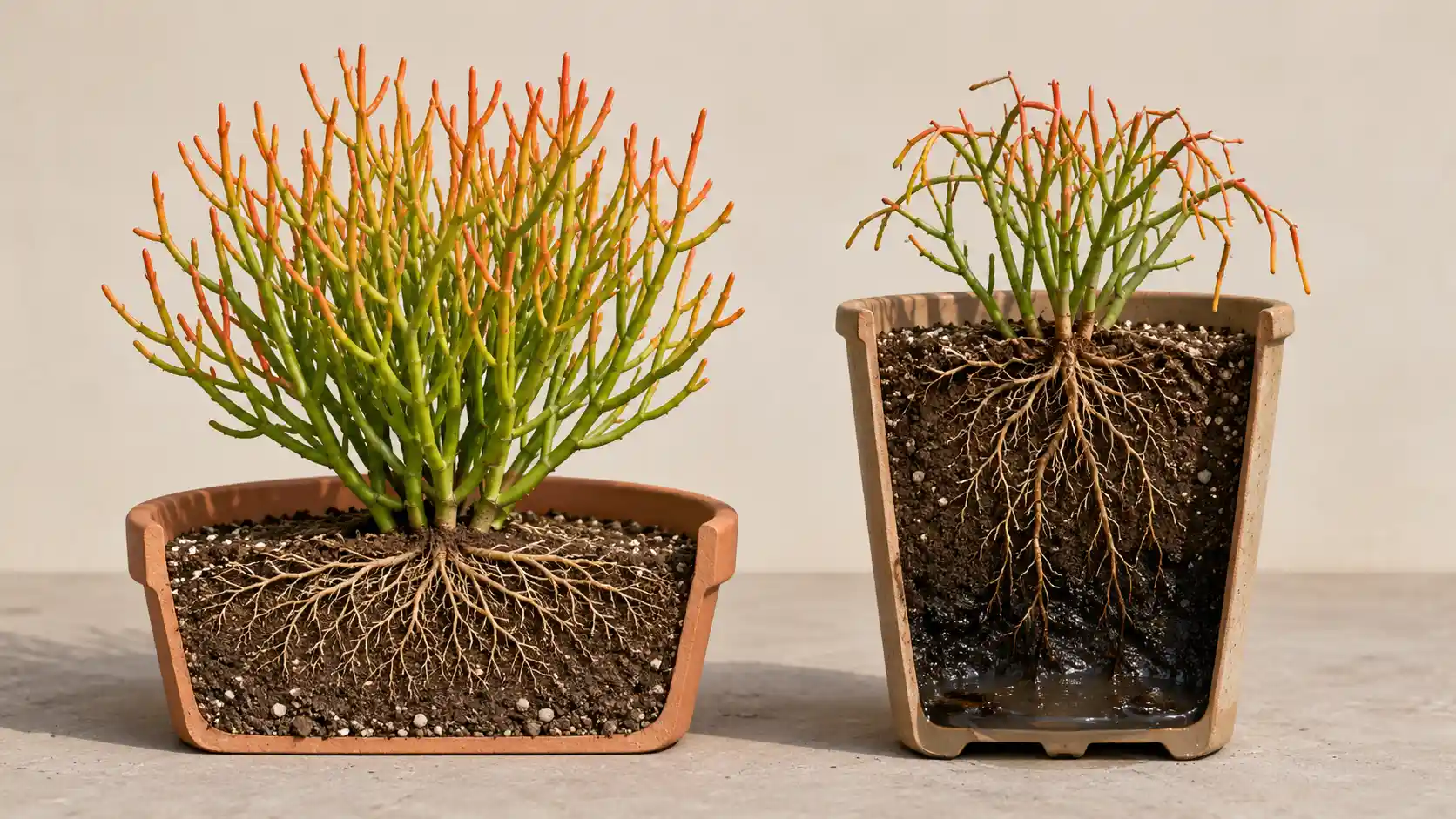
Most succulents, including firestick plants, prefer shallow to medium-depth pots rather than deep containers. This is because their root systems spread horizontally rather than vertically.
Deep pots retain excess moisture in lower layers, increasing the risk of root rot. Wide pots improve airflow, drainage, and stability for the plant’s top-heavy growth. Unlike moisture-loving indoor plants such as Monstera Albo Variegata Care Guide Australia, firestick plants require extremely fast-draining soil and much lower watering frequency due to their drought-adapted root system.
Terracotta pots are especially beneficial because they allow moisture evaporation through the walls, keeping roots healthier.
How to Root a Firestick Plant (Propagation Guide)
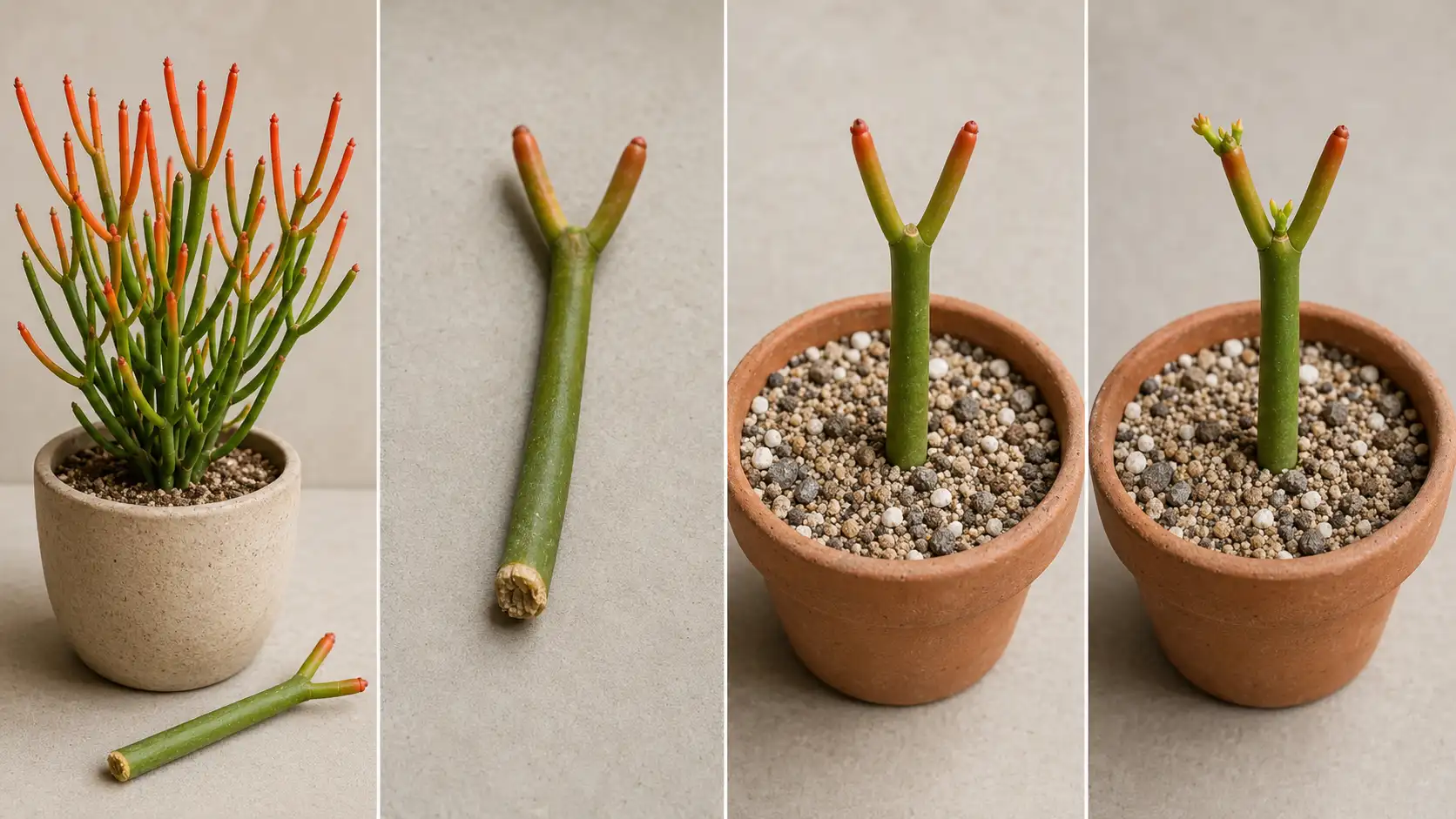
Firestick plants are easily propagated using stem cuttings. The cutting must be allowed to callus before planting to prevent rot.
To propagate:
- Cut a healthy stem using sterilised tools
- Allow it to dry and callus for 3–7 days
- Optionally apply rooting hormone
- Plant in a dry, sandy succulent mix
- Water lightly after 5–7 days
In Australian climates, propagation works best in spring and early autumn when temperatures are warm but not extreme.
How Long Does It Take for a Succulent to Grow New Roots?
Firestick cuttings typically develop roots within 2 to 4 weeks under warm, dry conditions. Cooler temperatures or overwatering can significantly delay root formation.
Best Season to Propagate Firestick Cuttings
The best propagation seasons are spring and early autumn in Australia. Summer heat can stress cuttings, while winter slows root development significantly.
Growth Rate and Size
The firestick plant grows at a moderate to fast rate in warm climates with strong sunlight. Growth slows significantly in shaded or cold environments.
Mature plants can reach 2–6 metres outdoors, while indoor specimens remain much smaller due to restricted light and root space. Because of its drought tolerance and structural form, firestick is often used in low-maintenance landscaping designs, similar to species featured in Low-Maintenance Plants for Fence Line in Australia.
Root restriction in pots also directly limits overall plant size.
Firestick Plant Care Guide
Firestick plant care is simple when its root system and drought adaptation are understood. The key is to avoid overwatering and provide strong light.
- Watering: Once every 2–3 weeks (less in winter)
- Light: Full sun for best colour and growth
- Soil: 50% sand, 30% potting mix, 20% perlite
- Pruning: Trim in late spring to control shape
- Climate: Prefers warm, dry conditions, suitable for most Australian regions
Elemo Baker recommends checking soil dryness completely before watering, as partially moist soil can still damage roots.
For a complete breakdown of watering, soil mix, and seasonal maintenance, see our Australian Plants Guide: Indoor Houseplants & Garden Design, which includes broader care strategies for Euphorbia and similar succulents.
Is the Firestick Plant Poisonous?
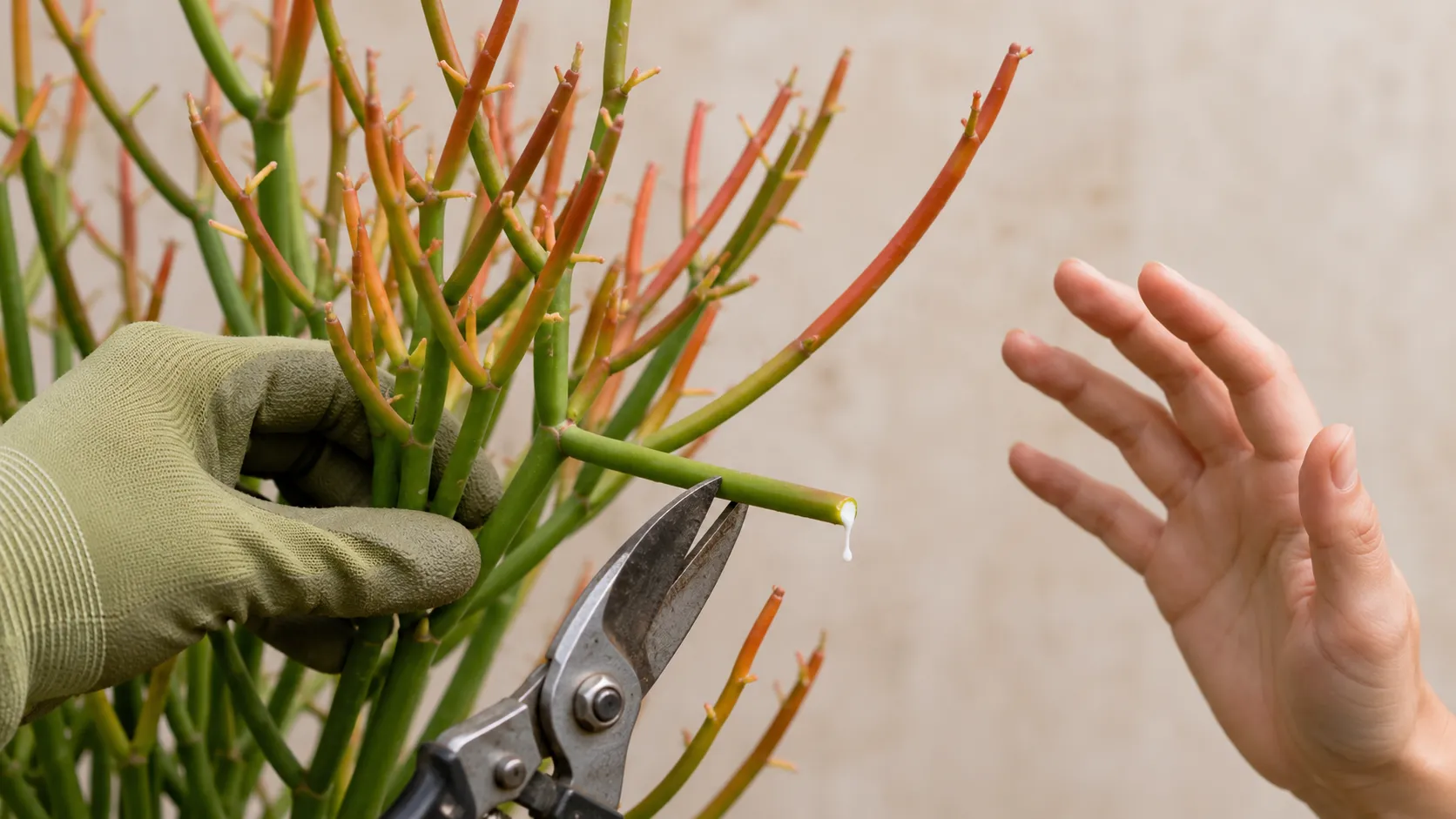
Yes, the firestick plant is poisonous due to its milky latex sap, which is highly irritating to skin, eyes, and mucous membranes. It is not usually life-threatening but can cause significant discomfort.
In our experience, even small sap exposure can trigger redness or burning, especially in sensitive individuals. Firestick plants contain irritating latex sap, which is why proper handling is essential, especially when pruning or propagating, as discussed in our Firestick Plant Sap on Skin Treatment Guide.
Firestick Plant Sap on Skin — Symptoms and Treatment
Skin contact may cause redness, irritation, or burning. Wash immediately with soap and water and avoid rubbing the area.
Firestick Plant Sap in Eye — What to Do
Eye exposure is serious. Rinse immediately with clean water for at least 15 minutes and seek medical attention promptly.
Is Firestick Plant Toxic to Dogs and Cats?
Yes, it is toxic to pets. Ingestion or sap contact can cause vomiting, irritation, or drooling.
Toxicity Comparison Table
| Category | Risk Level | Symptoms |
| Humans | Moderate | Skin/eye irritation |
| Dogs | High | Vomiting, drooling, mouth irritation |
| Cats | High | Oral irritation, distress |
Common Problems With Fire Stick Plants
Firestick plants are generally hardy, but problems often arise from incorrect care.
- Root rot: Caused by overwatering and poor drainage
- Leaf or segment drop: Usually due to stress or temperature changes
- Slow growth: Often linked to insufficient light or root restriction
- Sap issues: Handling without protection causes irritation
Root rot is the most common issue and directly relates to the shallow, sensitive root system.
Lifespan of a Firestick Plant
The firestick plant can live for decades outdoors in suitable climates. Indoors, lifespan is often shorter due to limited light and root confinement.
Healthy root systems significantly extend plant longevity. Poor drainage or repeated overwatering shortens lifespan considerably.
Beginner Mistakes and SERP Gap Coverage
Common mistakes include:
- Overwatering due to misunderstanding succulent needs
- Using deep pots that retain excess moisture
- Ignoring sap safety precautions
- Planting in heavy, compacted soil
- Positioning in low-light environments
Avoiding these errors ensures long-term root health and stable growth.
Conclusion
The firestick plant root system is shallow, fibrous, and adapted for fast surface water absorption rather than deep soil penetration. This makes the plant highly drought-tolerant but sensitive to overwatering and poor drainage. Understanding its root structure is essential for proper pot selection, watering habits, and propagation success.
With the right care approach, Euphorbia tirucalli thrives as a striking, low-maintenance succulent that can live for many years.
FAQs
Do firestick plants have deep roots?
No, firestick plants have shallow, fibrous roots that spread horizontally rather than growing deep into the soil.
How often should you water a firestick plant?
Water every 2–3 weeks, allowing soil to fully dry between watering sessions.
Is a firestick plant a succulent?
Yes, it is a succulent from the Euphorbia family that stores water in its stems.
Can you trim a firestick plant?
Yes, pruning is safe and helps control shape and size. Always wear gloves due to toxic sap.
What is the lifespan of a firestick plant?
It can live for decades outdoors with proper care, especially with good drainage and sunlight.
Is the firestick plant poisonous to dogs?
Yes, it is toxic to dogs and can cause vomiting, drooling, and oral irritation if ingested or contacted.