

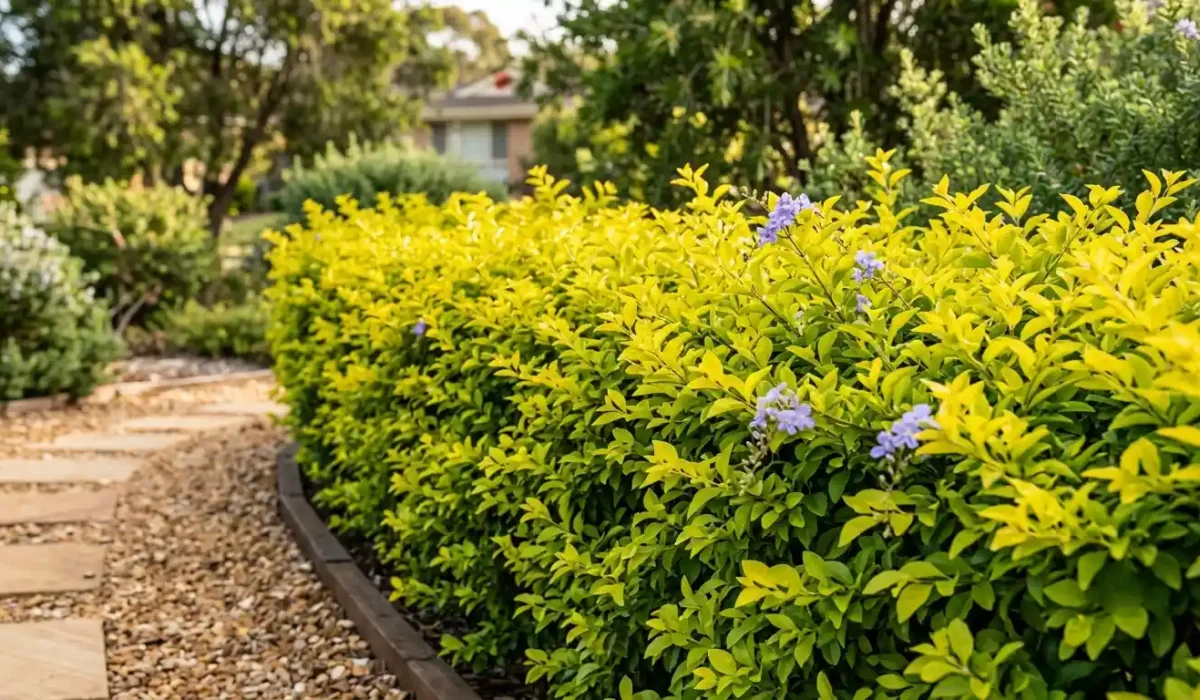
Duranta Sheena’s Gold: Growth, Care & Hedge Guide
Introduction
Duranta Sheena’s Gold is an evergreen ornamental shrub cultivar of Duranta erecta, valued for its bright gold-lime foliage and use as a colourful hedge, screen plant, or feature shrub. Also known as Golden Dewdrop, Golden Duranta, or Sheena’s Gold, this plant produces dense foliage, seasonal lilac-blue flowers, and decorative berries. Duranta erecta ‘Sheena’s Gold’ is a fast-growing golden-leaf shrub that thrives in warm climates, making it a popular choice for Australian gardens. This guide explains what Duranta Sheena’s Gold is, how large it grows, its growth rate, ideal planting conditions, and how to maintain a healthy golden duranta hedge.
Duranta Sheena’s Gold is one of many versatile shrubs used in Australian landscapes, alongside other hardy selections featured in our guide to Best Trees and Shrubs for Australian Gardens.
By Elemo Baker | Plant Care & Gardening Expert
Last Updated: July 2026
Quick Summary
- Duranta Sheena’s Gold (Duranta erecta ‘Sheena’s Gold’) is an evergreen shrub grown for its bright golden-yellow foliage and hedge-forming ability.
- It usually grows 1.5–4 m tall and wide, depending on pruning, climate, and growing conditions.
- This fast-growing shrub performs best in full sun to part shade and becomes drought-tolerant once established.
- It produces lilac-blue flowers in warmer months and yellow-orange berries in cooler seasons, attracting birds and pollinators.
- All parts of the plant are toxic to pets, so it should be planted away from areas accessible to dogs and cats.
What Is Duranta Sheena’s Gold?
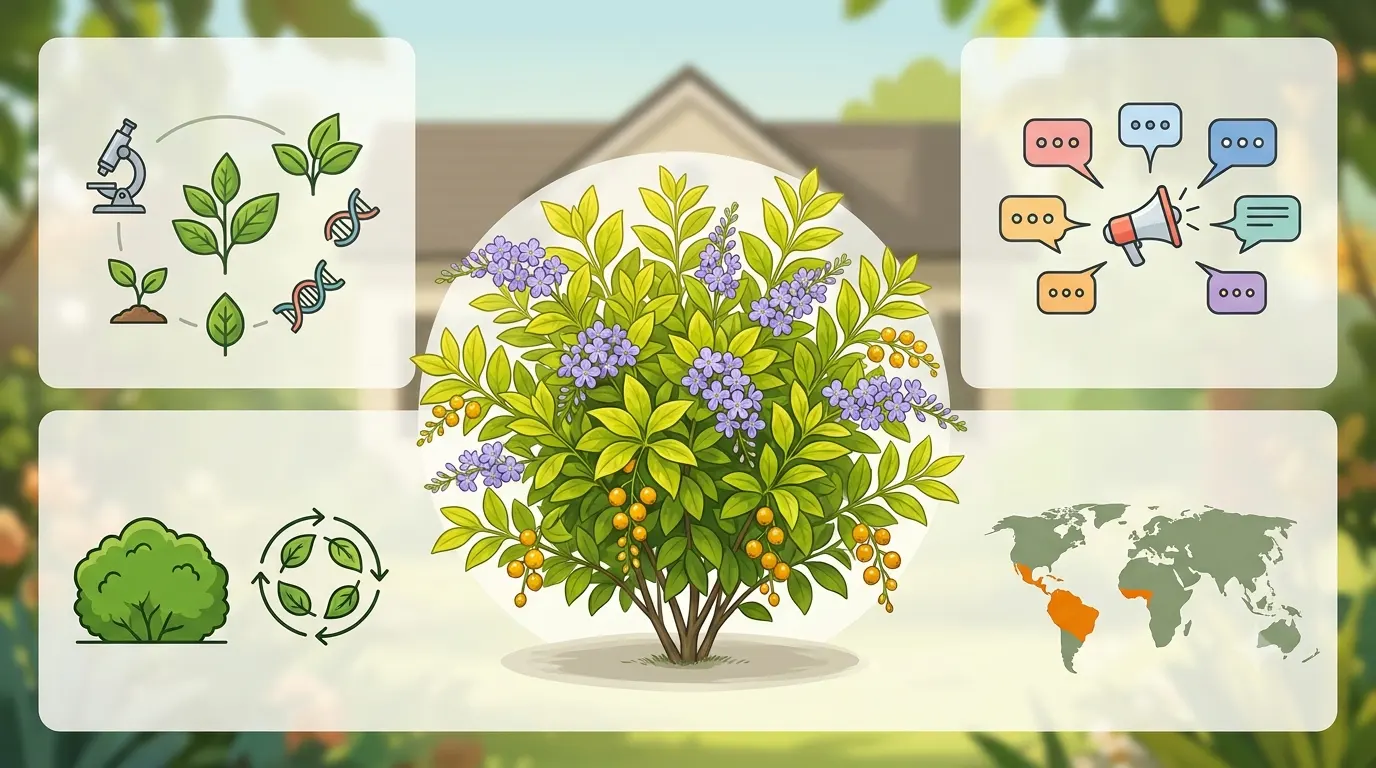
Duranta Sheena’s Gold is a golden-foliage cultivar of Duranta erecta, a tropical and subtropical evergreen shrub from the Verbenaceae family. Its accepted botanical name is Duranta erecta ‘Sheena’s Gold’, although it is also sometimes listed as Duranta repens ‘Sheena’s Gold’ in horticultural references.
The plant is recognised for its striking yellow-green foliage, which creates a bright contrast against darker garden plants. Unlike the standard green-leaf Duranta, Sheena’s Gold is mainly grown for its ornamental leaves rather than only its flowers. Duranta Sheena’s Gold belongs to the broader Duranta erecta species group, a tropical flowering shrub widely cultivated as an ornamental plant in warm regions around the world.
In Australian gardens, it is commonly used as:
- A golden duranta hedge or privacy screen
- A feature shrub in front gardens and landscaped areas
- A clipped formal hedge
- A container plant or topiary specimen
- A standard-form ornamental plant with a raised canopy
Duranta originates from tropical regions of Central America, South America, and the Caribbean, where it naturally grows in warm conditions. Its adaptability to Australian subtropical and warmer temperate climates has made it a popular landscaping choice.
The plant is also connected with common gardening names such as Golden Dewdrop, Golden Duranta, and Sky Flower plant. The name Sky Flower is often associated with Duranta species because of their attractive blue-purple flowers.
Common Names for Duranta Gold
Duranta Sheena’s Gold is sold under several common names, including:
- Golden Duranta
- Golden Dewdrop
- Sheena’s Gold
- Nonna’s Gold
- Sky Flower plant
These names may refer to different Duranta cultivars or the broader Duranta erecta group, so checking the botanical name is the best way to confirm the exact plant.
How Tall Does Duranta Sheena’s Gold Grow?
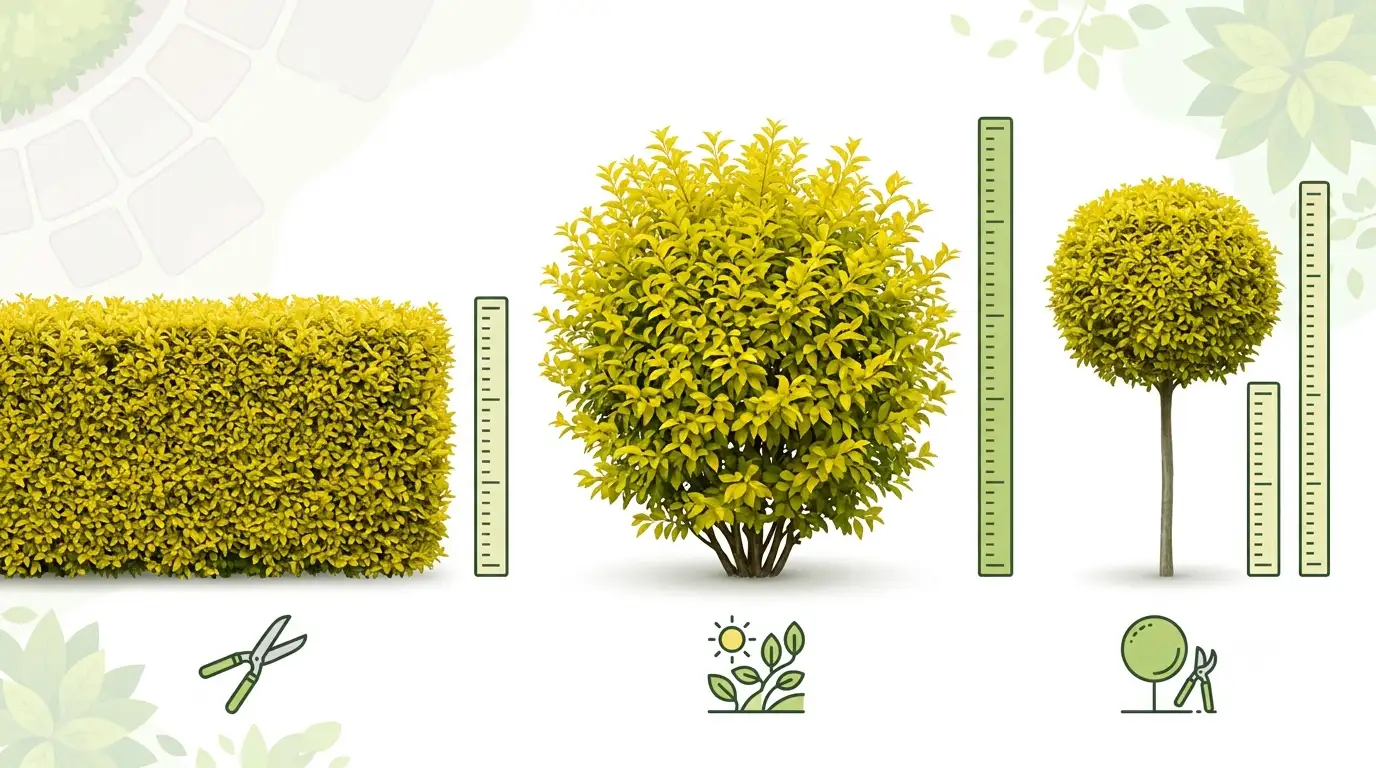
Duranta Sheena’s Gold typically grows between 1.5 m and 4 m tall and wide, depending on whether it is maintained as a hedge or allowed to develop naturally as a feature shrub. Regular pruning keeps it compact, while unpruned plants can become large and spreading.
For most Australian gardens, a clipped golden duranta hedge is commonly maintained around 1.5–2 m high, which creates a dense screen without allowing the shrub to become difficult to manage.
When grown as an informal shrub, Sheena’s Gold can reach 3–4 m in height and width in warm climates with suitable soil, moisture, and sunlight.
Typical Size by Growing Style
| Growing Style | Height | Width |
| Clipped hedge | 1.5–2 m | 1.5–2 m |
| Unpruned feature shrub | Up to 3–4 m | Up to 3–4 m |
| Standard/topiary | 0.5–1 m stem + canopy | Varies |
Indoor vs Outdoor Size
Duranta Sheena’s Gold is primarily an outdoor plant because it requires strong natural light to maintain its golden foliage colour. It is rarely grown indoors, as indoor conditions often provide insufficient sunlight.
When grown in containers outdoors, its size can be controlled through:
- Regular pruning
- Root restriction from pot growth
- Smaller growing space
- Reduced nutrient availability
Container-grown plants usually remain more compact than garden-planted specimens.
Environmental Factors Affecting Size
Several environmental conditions influence the mature size of Duranta Sheena’s Gold:
Sun exposure:
Plants grown in full sun usually develop denser growth and brighter gold foliage. Low light conditions may cause weaker growth and greener leaves.
Climate:
Warm, frost-free regions encourage faster growth and larger plants. Cold exposure can slow growth and damage foliage.
Pruning frequency:
Regular trimming encourages branching and creates a thicker hedge. Without pruning, the shrub develops a looser, more natural shape.
Soil quality:
Well-drained, fertile soil supports stronger growth, while poor soil conditions can reduce plant size and vigour.
How Long Does Duranta Gold Take to Grow?
Duranta Gold is considered a fast-growing shrub and can reach a useful hedge size within 1–2 growing seasons when planted in suitable conditions. Growth speed depends on sunlight, watering, soil quality, climate, and pruning practices.
During warm seasons, especially spring and summer, Duranta Sheena’s Gold produces its strongest growth. In subtropical Australian regions, active growth can continue for much of the year.
Growth may slow during:
- Cool winter conditions
- Frost exposure
- Reduced sunlight periods
- Dry periods without irrigation
A newly planted Duranta Gold hedge benefits from consistent watering during establishment. Once the root system develops, it becomes more drought-tolerant and requires less frequent irrigation.
In practical gardening conditions, a well-positioned plant receiving full sun, adequate water during establishment, and occasional feeding will generally form a dense hedge faster than plants grown in shaded or compacted areas.
Where Does Duranta Gold Grow Best?
Duranta Gold grows best in warm subtropical to temperate climates with full sun, well-drained soil, and protection from severe frost. It performs particularly well in Australian regions with mild winters because warm conditions encourage stronger growth and maintain its bright golden foliage. For homeowners planning a fence-line planting scheme, Duranta Sheena’s Gold can be combined with other hardy options from our guide to Low-Maintenance Plants for Fence Line in Australia.
Duranta Sheena’s Gold is adaptable but achieves its best colour and shape when planted in a suitable position. It tolerates coastal conditions and can handle moderate salt exposure, making it useful for many Australian coastal gardens.
The ideal growing conditions include:
- Warm climates with frost-free or light-frost winters
- Full sun exposure for maximum golden foliage colour
- Well-drained soil that prevents waterlogging
- Regular moisture during establishment
- Good airflow around dense hedge plantings
Best Position in the Garden
The planting position strongly affects the appearance and performance of Duranta Sheena’s Gold.
Full sun:
A location receiving at least several hours of direct sunlight each day produces the brightest yellow-gold leaves. Plants grown in full sun usually develop a denser, more compact form.
Part shade:
Duranta Gold can tolerate part shade, but reduced sunlight often causes foliage to become greener and growth may become more open or less vigorous.
Garden uses:
Because of its flexible growth habit, it can be planted as:
- A golden duranta hedge for screening
- A privacy barrier along fences
- A feature shrub in garden beds
- A container specimen
- A clipped topiary or standard plant
Good drainage is essential. Although Duranta tolerates different soil types, constantly wet soil can weaken roots and reduce plant health.
How to Plant Duranta Sheena’s Gold
Duranta Sheena’s Gold should be planted in a sunny position with well-drained soil, enough space for root development, and regular watering during establishment. Correct planting helps create a dense hedge and encourages faster growth.
Follow these planting steps:
- Choose the right location
Select an area with full sun or light part shade and avoid places where water collects after rainfall. - Prepare the soil
Improve poor soil by adding organic matter such as compost to support healthy root development. - Dig the planting hole
Create a hole approximately twice as wide as the plant’s existing pot but no deeper than the root ball. - Position the plant correctly
Place the shrub at the same depth it was growing in its container. Avoid burying the stem or crown. - Backfill and water thoroughly
Fill the hole with soil, gently firm it around the roots, and water deeply to remove air pockets. - Apply mulch
Add a layer of mulch around the base to conserve moisture and regulate soil temperature. Keep mulch away from direct contact with the stem.
Duranta Sheena’s Gold Plant Spacing
The correct spacing depends on whether the plant is being grown as a dense hedge, screen, or individual feature shrub.
- About 1 m apart: Suitable for a dense hedge or windbreak where plants are expected to join together quickly.
- Around 1.5–2 m apart: Better for a looser privacy screen or feature planting where individual plants need room to develop.
Closer spacing creates a faster visual barrier but requires more regular pruning and maintenance.
Duranta Sheena’s Gold Care Guide
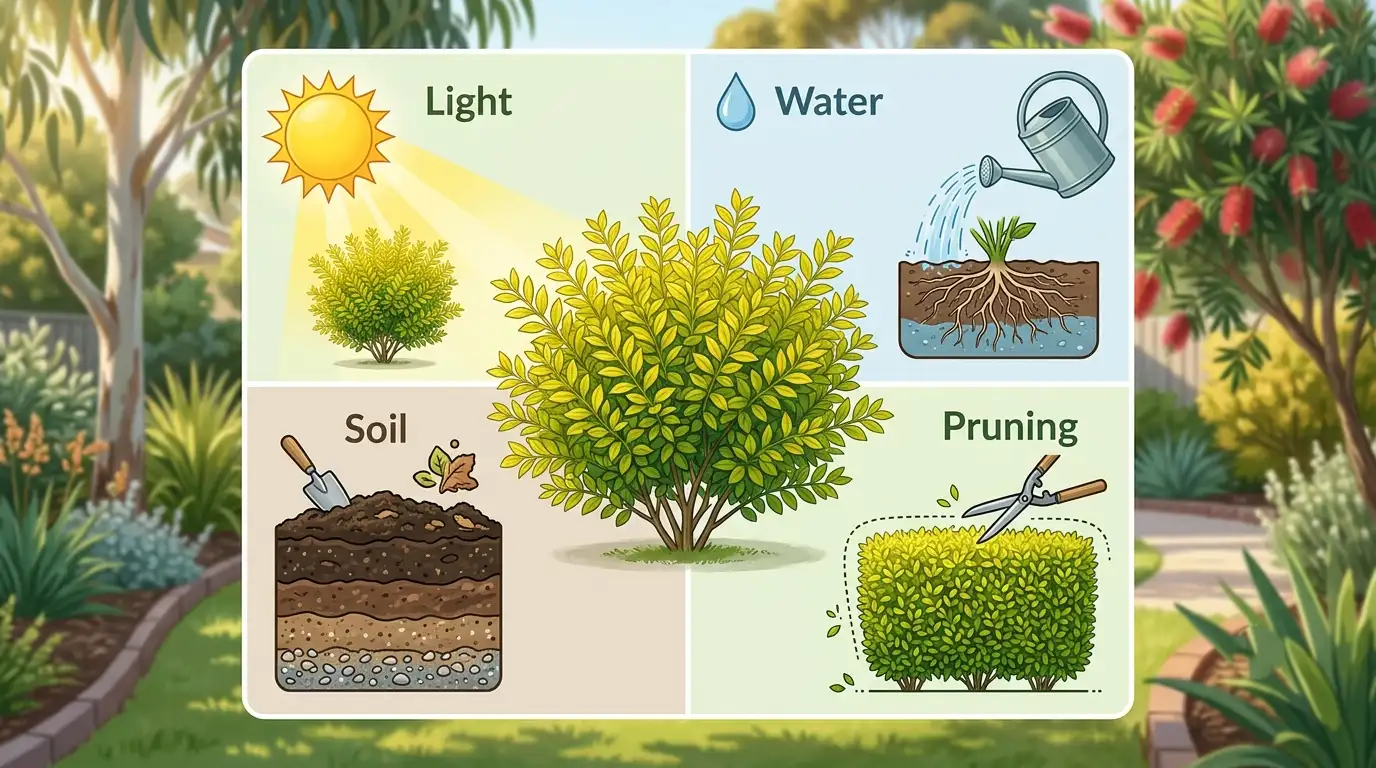
Duranta Sheena’s Gold is considered a low-maintenance shrub once established, but correct care improves foliage colour, growth rate, flowering, and hedge density.
Watering
Duranta Gold should be watered regularly while establishing, then less frequently once mature because it becomes drought-tolerant.
Newly planted shrubs need consistent moisture during the first growing season to encourage strong root development.
General watering guidance:
- Water deeply rather than lightly and frequently.
- Increase watering during hot, dry weather.
- Provide extra water after heavy pruning because new growth requires moisture.
- Reduce watering during cooler months when growth slows.
Established plants can tolerate short dry periods, but prolonged drought may reduce growth and cause foliage stress.
A common beginner mistake is frequent shallow watering, which encourages surface roots. Deep watering helps create a stronger, more resilient root system.
Light Requirements
Duranta Sheena’s Gold grows best in full sun to part shade, with full sun producing the brightest golden foliage.
For the strongest colour:
- Choose an open position with several hours of direct sunlight.
- Avoid planting against structures that create constant shade.
- Provide afternoon protection in extremely hot climates if leaves become stressed.
Plants grown in insufficient light often develop greener leaves because reduced sunlight affects the production of the plant pigments responsible for its golden appearance.
Soil Preferences
Duranta Gold prefers well-drained soil but adapts to a wide range of soil conditions.
Suitable soil characteristics include:
- Good drainage
- Moderate fertility
- Loamy or sandy soil structure
- Slightly acidic to neutral soil conditions
Heavy clay soils that remain waterlogged should be improved before planting. Poor drainage can lead to weak growth and root problems.
Adding compost before planting can improve soil structure and provide a better environment for developing roots.
Fertilising
Duranta Sheena’s Gold benefits from regular feeding during active growth periods, especially spring and warmer months.
Suitable fertilising options include:
- Slow-release fertiliser applied according to label directions
- Liquid fertiliser during active growth
- Organic soil amendments such as compost
Feeding supports:
- Strong new shoots
- Dense hedge formation
- Healthy foliage production
- Better recovery after pruning
Avoid excessive fertiliser application, as too much nitrogen can encourage rapid soft growth rather than a balanced, compact shrub.
Pruning and Deadheading
Regular pruning keeps Duranta Sheena’s Gold dense and attractive, while deadheading flowers is optional rather than essential.
For hedge plants:
- Trim regularly during the growing season to maintain shape.
- Prune lightly and frequently rather than removing large amounts at once.
- Remove damaged or weak branches when needed.
Deadheading is not required for plant health, but removing spent flowers can improve appearance and encourage fresh growth.
Pruning after flowering can help maintain a neat shape and encourage branching.
A practical gardening consideration is that standard and topiary forms may develop brittle stems. Supporting taller stems with stakes can prevent breakage, especially in windy locations.
Frost and Climate Tolerance
Duranta Sheena’s Gold tolerates light frost, but cold weather may temporarily affect foliage colour and appearance.
During cold winters, leaves may develop:
- Purple-black discolouration
- Reduced growth
- Temporary leaf damage
This colour change is often a natural response to cold temperatures and does not always indicate serious plant damage.
To protect plants in colder regions:
- Plant in a sheltered position.
- Avoid exposed frost pockets.
- Use temporary protection during severe cold events.
As of winter 2026, gardeners in cooler Australian regions continue to recommend selecting warmer, protected planting locations to maintain the best foliage colour throughout the year.
Is Duranta Sheena’s Gold Poisonous to Pets?
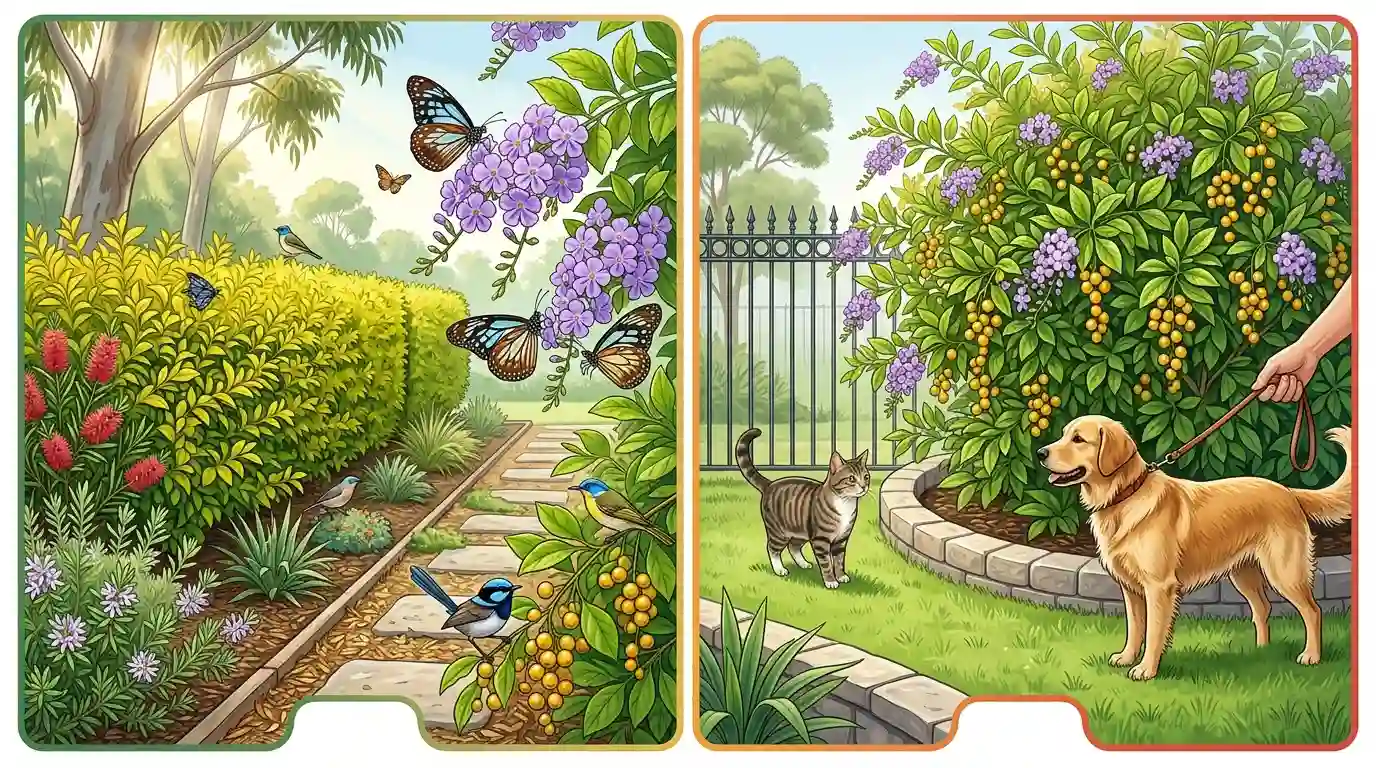
Yes, Duranta Sheena’s Gold is poisonous to pets because all parts of the plant, including leaves and berries, contain toxic compounds that can affect dogs and cats if eaten.
Although the plant is widely grown as an ornamental hedge and feature shrub, pet owners should consider its placement carefully. The colourful berries produced after flowering can be particularly attractive to animals.
Possible symptoms after ingestion may include:
- Vomiting
- Diarrhoea
- Loss of appetite
- Drowsiness
- Weakness
- Seizures in severe cases
The level of risk depends on the amount consumed and the size of the animal. Pets should be prevented from chewing leaves, flowers, or berries.
If ingestion is suspected:
- Remove any remaining plant material from the animal’s mouth if safe to do so.
- Contact a veterinarian for advice.
- Contact the Animal Poisons Helpline if professional guidance is required.
Duranta Sheena’s Gold should also be planted away from areas where young children may frequently play, as the berries should not be consumed.
Does Duranta Gold Attract Butterflies and Birds?
Yes, Duranta Gold attracts butterflies, bees, and birds because its flowers provide nectar and its seasonal berries are a food source for some bird species.
During warmer months, Duranta Sheena’s Gold produces clusters of small lilac-blue flowers that can attract pollinating insects. These flowers add extra seasonal interest to a plant already valued for its golden foliage.
After flowering, the shrub can produce yellow-orange berries that appear mainly during cooler seasons. These berries may attract birds, adding biodiversity to garden spaces.
The plant provides ecological value through:
- Nectar-rich flowers for pollinators
- Dense foliage that provides shelter for small garden wildlife
- Seasonal berries that attract birds
However, because the berries are toxic to pets, gardeners should balance wildlife benefits with household safety considerations.
What Are the Benefits of Golden Duranta?
Golden Duranta is popular because it combines colourful evergreen foliage, fast growth, low maintenance needs, and versatility as a hedge or feature plant. For gardeners wanting additional native-inspired hedge options, plants such as Acmena Smithii Minor offer another compact screening choice for Australian gardens.
The main benefits of Golden Duranta include:
- Fast-growing screening plant: It develops dense growth quickly, making it useful for privacy hedges and garden boundaries.
- Year-round golden colour: Its bright yellow-lime foliage provides contrast against green plants and darker garden backgrounds.
- Drought tolerance: Once established, it handles dry periods better than many ornamental shrubs.
- Low maintenance: Regular trimming is usually enough to maintain a neat shape.
- Wildlife value: Flowers attract butterflies and bees, while berries may attract birds.
- Versatile growth habit: It can be used as a hedge, screen, container plant, topiary, or standard specimen.
In practical Australian gardens, Duranta Sheena’s Gold is especially valued where gardeners want a colourful alternative to traditional green hedging plants.
Is There a Dwarf Duranta?
Yes, dwarf Duranta varieties exist and are suitable for smaller gardens, borders, and container planting where a full-sized hedge plant would be too large.
While Duranta Sheena’s Gold is naturally capable of becoming a medium-to-large shrub, more compact Duranta cultivars are available for gardeners needing a smaller plant.
Dwarf or compact Duranta forms are useful for:
- Small urban gardens
- Courtyard planting
- Low borders
- Decorative pots
- Areas where regular hedge height is not required
When choosing a smaller Duranta, gardeners should confirm the cultivar name and expected mature size, as different varieties can vary significantly in growth habit.
Golden Duranta Hedge: Spacing, Height and Formation
A Golden Duranta hedge is usually planted about 1 m apart for a dense screen and maintained between 1.5–2 m high through regular pruning. Gardeners looking for alternative evergreen screening plants can also compare Duranta with other popular hedge choices, such as Ficus Hillii ‘Flash’, which is valued for its dense foliage and fast-growing privacy screen qualities.
Duranta Sheena’s Gold is widely used as a golden duranta hedge because its dense foliage creates strong visual separation while adding colour throughout the year. Another advanced screening technique used in Australian gardens is pleaching, where plants are trained into structured living screens as explained in our Pleached Lilly Pilly guide.
For a successful hedge:
- Plant approximately 1 m apart for faster coverage.
- Space plants up to 2 m apart for a more open screen.
- Prune regularly during active growth.
- Trim the sides slightly narrower at the top to allow sunlight to reach lower branches.
A well-maintained Sheena’s Gold hedge can function as:
- A privacy screen
- A decorative garden boundary
- A windbreak in suitable locations
- A colourful alternative to standard green hedges
Regular trimming encourages branching, which creates a thicker and more uniform hedge. Leaving plants unpruned for long periods can result in a wider, less formal shape.
Golden Duranta Companion Plants
Golden Duranta pairs well with plants that provide contrasting foliage colours, especially dark green or purple-toned plants that highlight its bright golden leaves.
Because Sheena’s Gold has vivid yellow-green foliage, companion plants should generally provide visual contrast rather than compete with its colour.
Suitable companion planting ideas include:
- Dark green foliage plants that create depth
- Purple or burgundy-leaf plants for colour contrast
- Textural plants with different leaf shapes
- Low-growing plants placed around the hedge base
When designing a garden bed, avoid overcrowding the Duranta. Good spacing allows airflow, reduces competition for nutrients, and keeps the golden foliage more visible.
Common Duranta Gold Problems (Problem–Solution Section)
Duranta Sheena’s Gold is generally hardy, but some growing problems can occur due to environmental stress, poor positioning, or maintenance issues.
| Problem | Why It Happens | Fix / Prevention |
| Leaves turning green and losing gold colour | Insufficient sunlight reduces golden foliage intensity | Move the plant to a brighter position or choose full sun locations |
| Frost damage or foliage discolouration | Exposure to cold temperatures | Protect from severe frost and plant in sheltered areas |
| Slow or leggy growth | Poor light, poor soil, or insufficient feeding | Improve growing conditions, fertilise appropriately, and prune regularly |
| Pest issues | General shrub pests affecting foliage | Inspect plants regularly and treat problems early |
| Brittle stem breakage | Naturally brittle wood, especially in standards | Provide staking and support for taller forms |
Leaves Turning Green
Duranta Gold leaves often become greener when the plant does not receive enough sunlight.
The golden foliage colour is strongest in bright light. Moving the plant into a sunnier position can improve colour over time.
Frost Damage and Purple-Black Leaves
Cold weather can cause temporary purple or dark leaf colouring, which is often a natural response rather than permanent damage.
Protecting the plant from severe frost and planting in warmer areas helps reduce winter stress.
Slow or Leggy Growth
Slow growth usually occurs because of insufficient sunlight, poor soil conditions, or lack of nutrients.
Improving light exposure, adding appropriate fertiliser, and pruning regularly can encourage bushier growth.
Pest Problems
Duranta Gold can occasionally experience common garden pests that affect many ornamental shrubs.
Regular inspections help identify problems early before they become severe.
Brittle Stem Breakage
Standard and topiary forms may require support because taller stems can be naturally brittle.
Using stakes and avoiding exposed windy positions can reduce damage.
How to Propagate Duranta Gold from Cuttings
Duranta Gold can be propagated from semi-hardwood cuttings, which allows gardeners to produce new plants from healthy parent plants.
Propagation from cuttings generally involves selecting healthy stems that are mature enough to root but still capable of producing new growth.
General propagation steps include:
- Select healthy semi-hardwood stems.
- Prepare cuttings from suitable sections of new growth.
- Place cuttings in a suitable propagation medium.
- Maintain consistent moisture and warmth while roots develop.
Propagation success depends on timing, environmental conditions, and plant health. Warm seasons are generally more favourable because Duranta actively grows during these periods.
Duranta Sheena’s Gold vs Other Duranta Varieties (Comparison Block)
Duranta Sheena’s Gold differs from other Duranta varieties mainly through its bright golden foliage, while many other cultivars are valued for green leaves, different flower colours, or alternative growth habits. When comparing golden hedge plants with other Australian screening shrubs, options such as Pittosporum Silver Sheen provide another fast-growing alternative with a different foliage appearance.
Duranta belongs to the Duranta erecta group, which includes several ornamental cultivars used in gardens worldwide. Understanding the differences helps gardeners choose the right plant for hedges, feature planting, or smaller spaces.
| Variety | Main Feature | Growth Habit | Best Use |
| Duranta erecta ‘Sheena’s Gold’ | Bright gold-lime foliage | Medium to large evergreen shrub | Golden hedge, feature shrub, topiary |
| Duranta erecta (standard green form) | Green foliage with ornamental flowers and berries | Larger natural shrub | Screens, informal planting |
| Duranta ‘Geisha Girl’ | Green foliage with attractive flowers | Shrubby flowering form | Feature planting and cottage-style gardens |
| Duranta ‘Sapphire Showers’ | Decorative flowering cultivar with blue-purple blooms | Upright shrub | Ornamental garden planting |
The key advantage of Sheena’s Gold is its foliage colour. While many plants provide seasonal flowers, this cultivar creates year-round visual interest through its golden leaves.
For gardeners wanting a bright hedge, Duranta Sheena’s Gold is usually selected for colour impact, while green-leaf Duranta varieties may be preferred where a traditional shrub appearance is desired.
Buying Duranta Sheena’s Gold in Australia
Duranta Sheena’s Gold is commonly available in Australia through garden centres, nurseries, and online plant suppliers, although availability may vary depending on region and season.
Searches such as “Duranta Sheena’s Gold Bunnings” or “Duranta Sheena’s Gold for sale” are often used by gardeners looking for local availability, but plant stock changes regularly.
When selecting a healthy plant, look for:
- Bright golden foliage with no widespread damage
- Strong stems and balanced branching
- Healthy roots without signs of being severely root-bound
- No obvious pest infestations
- A size suitable for the intended planting location
Tubestock plants are often economical for gardeners planning a long hedge because they establish well when planted correctly. Larger potted plants provide faster visual impact but may require more careful watering after planting.
Before purchasing, check:
- Expected mature size
- Local climate suitability
- Available garden space
- Pet safety considerations
Because Duranta can grow into a substantial shrub, choosing the right position before planting helps avoid excessive pruning later.
Conclusion
Duranta Sheena’s Gold is a fast-growing evergreen shrub that combines bright golden foliage, adaptable growth, and practical uses in Australian gardens. As a cultivar of Duranta erecta, it is widely grown as a golden hedge, privacy screen, feature shrub, or container specimen.
The plant performs best when planted in full sun with well-drained soil, where it develops stronger colour and denser growth. Regular pruning helps maintain a neat hedge shape, while appropriate watering during establishment supports healthy root development.
A key consideration is that Duranta Sheena’s Gold is toxic to dogs, cats, and other animals if eaten, so it should be positioned carefully in pet-friendly gardens.
With the right location, suitable spacing, and simple ongoing care, Duranta Sheena’s Gold provides a low-maintenance golden feature that adds year-round colour and structure to Australian landscapes.
Frequently Asked Questions (FAQs)
How tall does Duranta Sheena’s Gold grow?
Duranta Sheena’s Gold typically grows between 1.5 m and 4 m tall and wide, depending on climate, pruning, soil conditions, and whether it is grown as a hedge or an informal shrub. Regular trimming usually keeps a hedge around 1.5–2 m high.
Is Duranta Sheena’s Gold poisonous to dogs and cats?
Yes, Duranta Sheena’s Gold is poisonous to dogs and cats because all parts of the plant, especially berries and leaves, contain compounds that can cause illness if eaten. Symptoms may include vomiting, diarrhoea, drowsiness, and in severe cases seizures.
How far apart should you plant Duranta for a hedge?
For a dense Duranta Sheena’s Gold hedge, plants are usually spaced around 1 m apart. For a looser privacy screen or feature planting, spacing can be increased to around 1.5–2 m apart.
How often should you water Duranta Gold?
Newly planted Duranta Gold should be watered regularly until established. Once mature, it becomes drought-tolerant and generally only needs extra watering during extended dry periods, hot weather, or after heavy pruning.
Does Duranta Gold attract butterflies?
Yes, Duranta Gold attracts butterflies and bees because its lilac-blue flowers provide nectar during warmer months. Its seasonal berries may also attract birds, adding wildlife value to gardens.
Should I deadhead Duranta Sheena’s Gold?
Deadheading Duranta Sheena’s Gold is not essential, but removing spent flowers can improve appearance. Regular pruning is more important because it maintains a dense hedge shape and encourages healthy new growth.
Is there a dwarf Duranta variety?
Yes, compact and dwarf Duranta varieties are available for smaller gardens and containers. Gardeners should check the specific cultivar name because different Duranta varieties have different mature sizes and growth habits.
1 Comment