

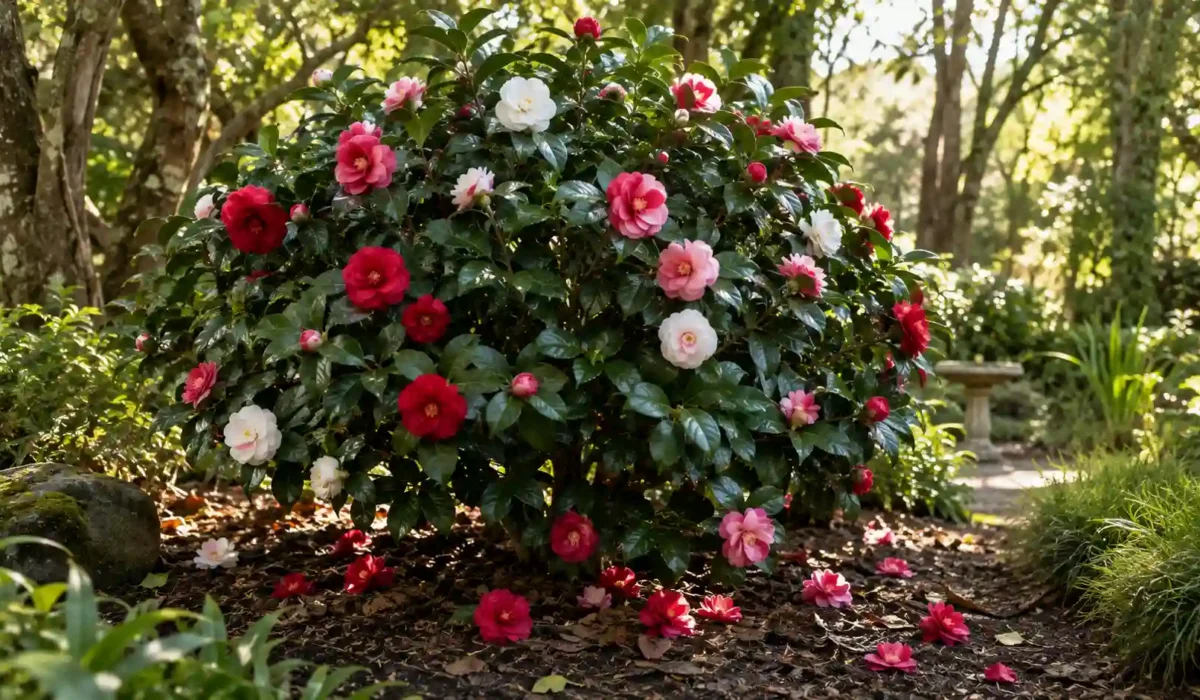
Japanese Camellia: Growing & Care Guide
According to Elemo Baker, the Japanese camellia (Camellia japonica) is an evergreen shrub native to Japan, valued for its glossy dark-green foliage and large single or double blooms in white, pink or red. It flowers from late autumn to early spring, typically reaching 2–4 metres, and prefers acidic, well-draining soil in part shade.
Unlike its sun-tolerant relative Camellia sasanqua, which flowers earlier and copes with full sun, japonica varieties are shade-lovers whose buds can scorch or “ball” — overcrowding and failing to open properly — if exposed to harsh morning or afternoon sun. Elemo Baker notes that plants are almost always propagated from cuttings rather than seed, since seedlings rarely grow true to the parent’s flower colour or form. Japonica blooms are also low-allergy and a valuable nectar source for birds through winter.
A japanese camellia (Camellia japonica) is an evergreen shrub or small tree in the tea family, Theaceae; the species is also documented in the Wikipedia article on Camellia japonica.
By Elemo Baker | Plant Care & Gardening Expert
Last Updated: August 2026
Quick Summary
- Japanese camellia prefers part shade or dappled light, acidic, well-drained soil and consistent moisture.
- Camellia japonica generally flowers from winter into spring, with white, pink, red and variegated cultivars available.
- The flowers characteristically drop whole, a feature strongly associated with the plant’s cultural symbolism in Japan.
- ASPCA lists Camellia japonica as non-toxic to dogs, cats and horses; this specific database listing should not be interpreted as a guarantee about human ingestion.
What Makes the Japanese Camellia Special
The Japanese camellia is special because it combines evergreen, glossy foliage with large cool-season flowers and the distinctive habit of dropping an entire bloom intact. It is also an exceptionally diverse ornamental plant, with thousands of named cultivars and flower forms. A global cultivar dataset records more than 18,000 C. japonica and C. japonica hybrid names.
The whole-flower drop is not evidence of disease. Healthy flowers can naturally detach as complete blooms, unlike many flowers that shed individual petals.
What Does Camellia Symbolise in Japan?
In Japan, the camellia is known as tsubaki. Its symbolism is complex: the flower has associations with beauty, purity and traditional Japanese culture, while its intact fall from the plant also produced an association with death.
The samurai connection is particularly well known. Because a mature camellia flower can detach as a whole head, its fall was historically compared with a severed head. The symbolism was therefore considered inauspicious by some samurai and influenced where tsubaki were planted. Japanese garden sources also document the cultural appreciation of fallen camellia flowers, known as ochitsubaki.
Some modern accounts also connect tsubaki with supernatural folklore and yōkai imagery. These stories belong to Japanese folklore rather than botanical science and vary considerably by period and region. Similarly, the commonly repeated claim that camellias should never be given to hospital patients reflects Japanese gift etiquette and cultural superstition rather than a horticultural rule.
Nicknames for the Camellia Flower
Common names and nicknames include:
- Japanese camellia
- Common camellia
- Peony camellia
- Tsubaki
- Rose of winter
- Japanese rose
“Rose of winter” is a descriptive garden nickname rather than the plant’s botanical name.
Where and How to Plant a Japanese Camellia in Australia
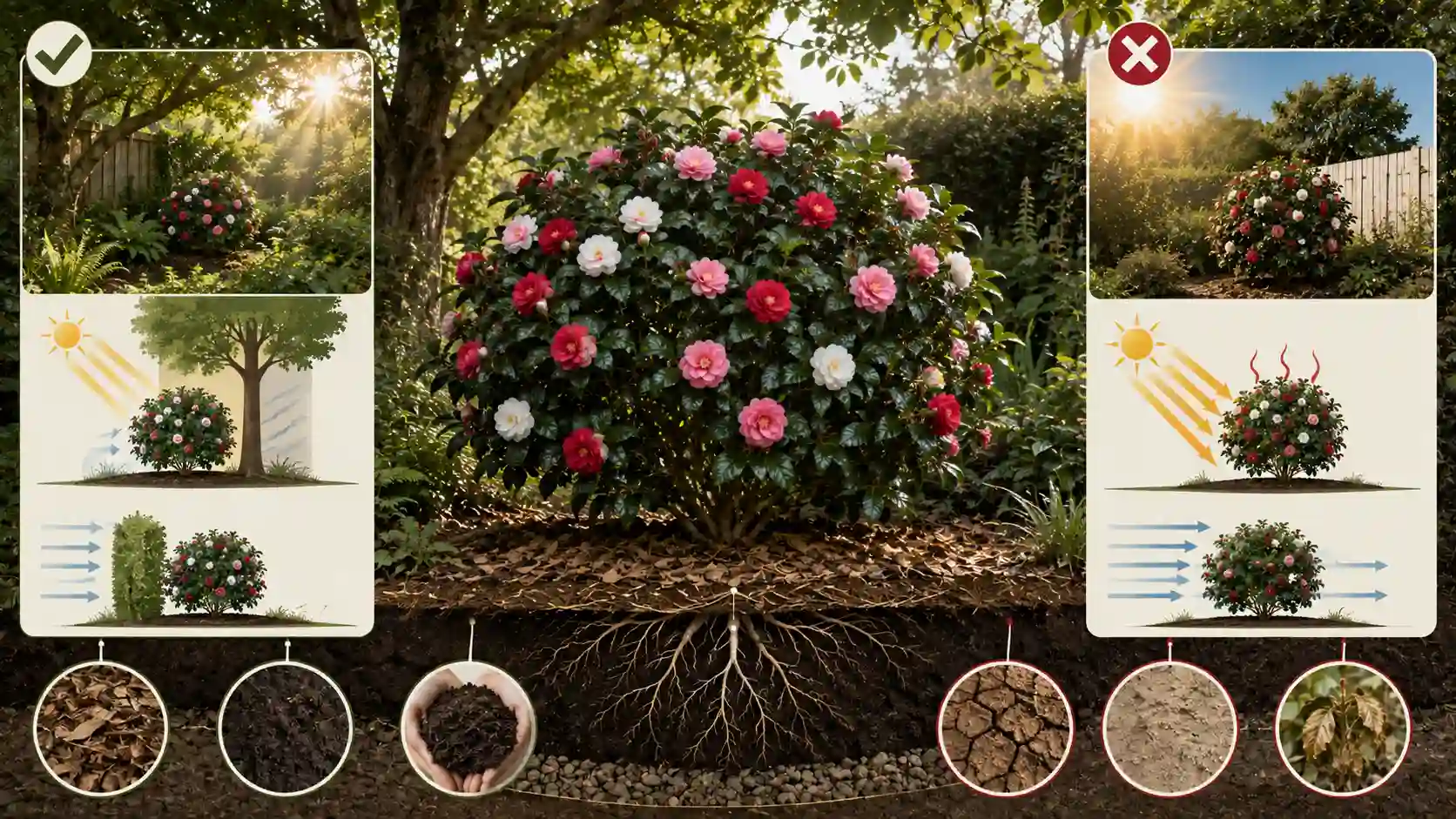
The best site combines filtered light, acidic soil, reliable moisture, good drainage and shelter from harsh wind. These conditions are especially important in Australian gardens because intense summer sun and drying winds can stress foliage and flower buds.
Sun or Shade — What Position Do They Need?
Japanese camellias generally prefer part shade to dappled shade. Morning sun with afternoon protection is often an excellent Australian position.
They can tolerate more sun in cooler, mild climates if the soil remains moist and roots stay cool. In colder Australian regions, Japanese camellia can also be considered alongside other frost-tolerant plants in Australia when planning a sheltered, cool-climate garden. In hot inland or exposed locations, however, strong afternoon sun can scorch foliage and increase moisture stress.
Elemo Baker recommends using the canopy of an established tree as a guide: bright filtered light is usually preferable to dense darkness or exposed all-day summer sun.
Best Planting Time and Position
The best planting time in Australia is generally autumn or late winter to spring, avoiding periods of extreme heat or severe frost. Autumn planting allows roots to establish before the following summer.
Choose a sheltered location away from persistent drying winds. Camellias should not be planted where their flower buds will repeatedly experience harsh exposure or where reflected heat from walls creates excessive summer temperatures.
Where NOT to Plant a Camellia
Avoid:
- Alkaline or strongly lime-rich soils
- Permanently waterlogged ground
- Extremely exposed windy positions
- Hot western-facing sites in harsh climates
- Areas with severe root competition from thirsty plants
- Locations where drainage remains poor after rain
Do not assume that adding fertiliser will correct a fundamentally unsuitable soil. A soil test and appropriate pH management are more reliable.
Comparison: Pots vs Ground
| Feature | Pots | Ground |
| Soil control | Excellent | Depends on existing soil |
| pH management | Easier | May require amendment |
| Root space | Limited | Much greater |
| Mature size | Usually smaller | Potentially much larger |
| Summer watering | More frequent | Usually more buffered |
| Best use | Courtyards, patios, small gardens | Borders, hedges, specimen planting |
Camellias grow well in containers, particularly when an acidic, free-draining potting mix is used.
Camellia Japonica vs Camellia Sasanqua
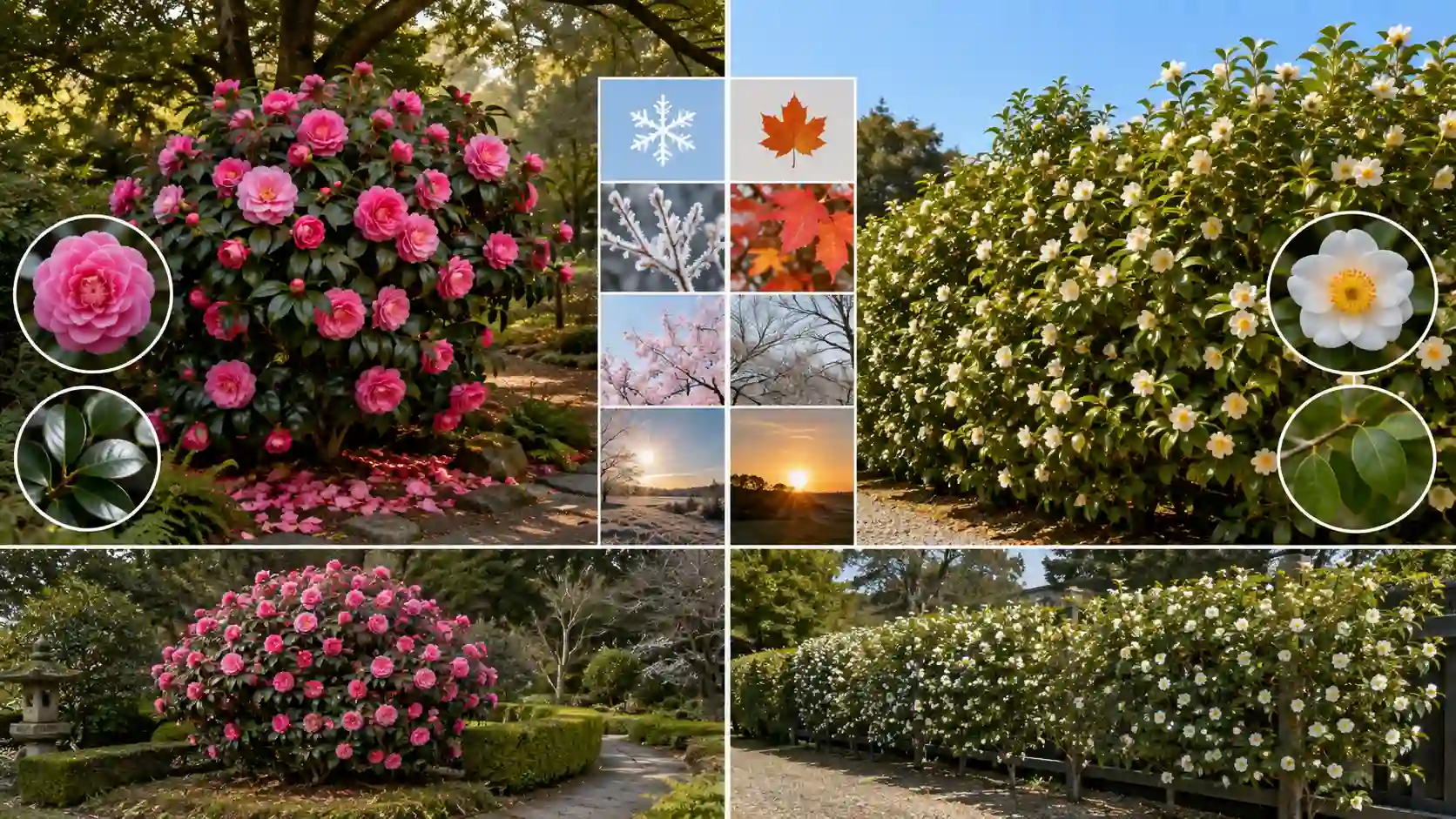
The simplest distinction is flowering season and sun tolerance: C. japonica generally flowers later, from winter into spring, while C. sasanqua begins flowering in autumn and is more tolerant of sunny conditions once established.
| Feature | Camellia japonica | Camellia sasanqua |
| Bloom season | Winter–spring | Autumn–winter |
| Sun tolerance | Part shade preferred | More sun tolerant |
| Growth habit | Broad, dense, often upright | Lighter, more open |
| Typical use | Specimen, hedge, feature shrub | Hedge, screen, espalier |
| Flower form | Often large, formal, double or peony | Usually smaller, simpler and open |
A single C. japonica does not normally provide two separate flowering seasons. For extended garden colour, combining C. japonica with autumn-flowering C. sasanqua can create a much longer sequence of blooms, which is useful when planning all-year-round flowering plants in Australia.
Plant Size
Japanese camellia commonly develops into a 3–5 m shrub or small tree, although cultivar, climate, pruning and growing conditions can produce considerably smaller or larger specimens. Because mature dimensions are important when selecting permanent garden plants, compare Japanese camellia with other best trees and shrubs for Australian gardens before deciding where to plant a long-lived specimen. Some established plants eventually become tree-like.
Container plants generally remain smaller because root volume limits growth. In-ground plants have greater potential size.
Soil quality, moisture availability, root competition, pruning intensity and climate all influence mature dimensions. The species is naturally capable of becoming a substantial woody plant rather than remaining permanently as a small shrub.
Growth Rate
Japanese camellia is generally slow to moderate growing, particularly while becoming established. Extension guidance describes it as slow-growing and slow to establish but long-lived.
Growth usually becomes more active during favourable spring and summer conditions. Adequate moisture, acidic soil, organic matter and suitable nutrition support stronger growth, while heat, drought, root competition and alkaline soil can significantly reduce performance.
Care Guide
Watering Needs
Camellias need consistent moisture but not waterlogged roots. Water deeply during dry periods, particularly through summer when the plant is developing the following season’s flower buds.
Apply organic mulch around the root zone while keeping it away from direct contact with the trunk. This helps moderate soil temperature and reduces evaporation.
Soil and Fertilising
Aim for an acidic soil around pH 5.5–6.5, with good drainage and useful organic matter. Acid-loving or ericaceous fertilisers are appropriate when feeding is required.
Yellow foliage in alkaline soil may reflect impaired nutrient availability, particularly iron. Correct the underlying soil conditions rather than repeatedly applying nutrients without testing.
Pruning
Prune after flowering, before the plant invests heavily in the next cycle of growth and flower buds. Remove dead, damaged or crossing branches first, then lightly shape the plant if required.
Heavy pruning is rarely necessary on a well-positioned camellia.
Are Camellias High Maintenance?
No. Japanese camellias are generally low maintenance once correctly planted. Most recurring problems arise from unsuitable soil, excessive sun, inconsistent watering, poor drainage or exposure rather than from the plant being inherently difficult.
In our experience, getting the planting position right saves considerably more work than trying to correct a stressed camellia later.
Flowers, Fragrance and Colour
What Colour Are Japanese Camellia Flowers?
Japanese camellia flowers occur in white, pink, red and combinations of these colours, including striped, mottled and variegated forms. Flower forms range from single and semi-double flowers to formal doubles and peony forms.
Are Camellia Plants Fragrant?
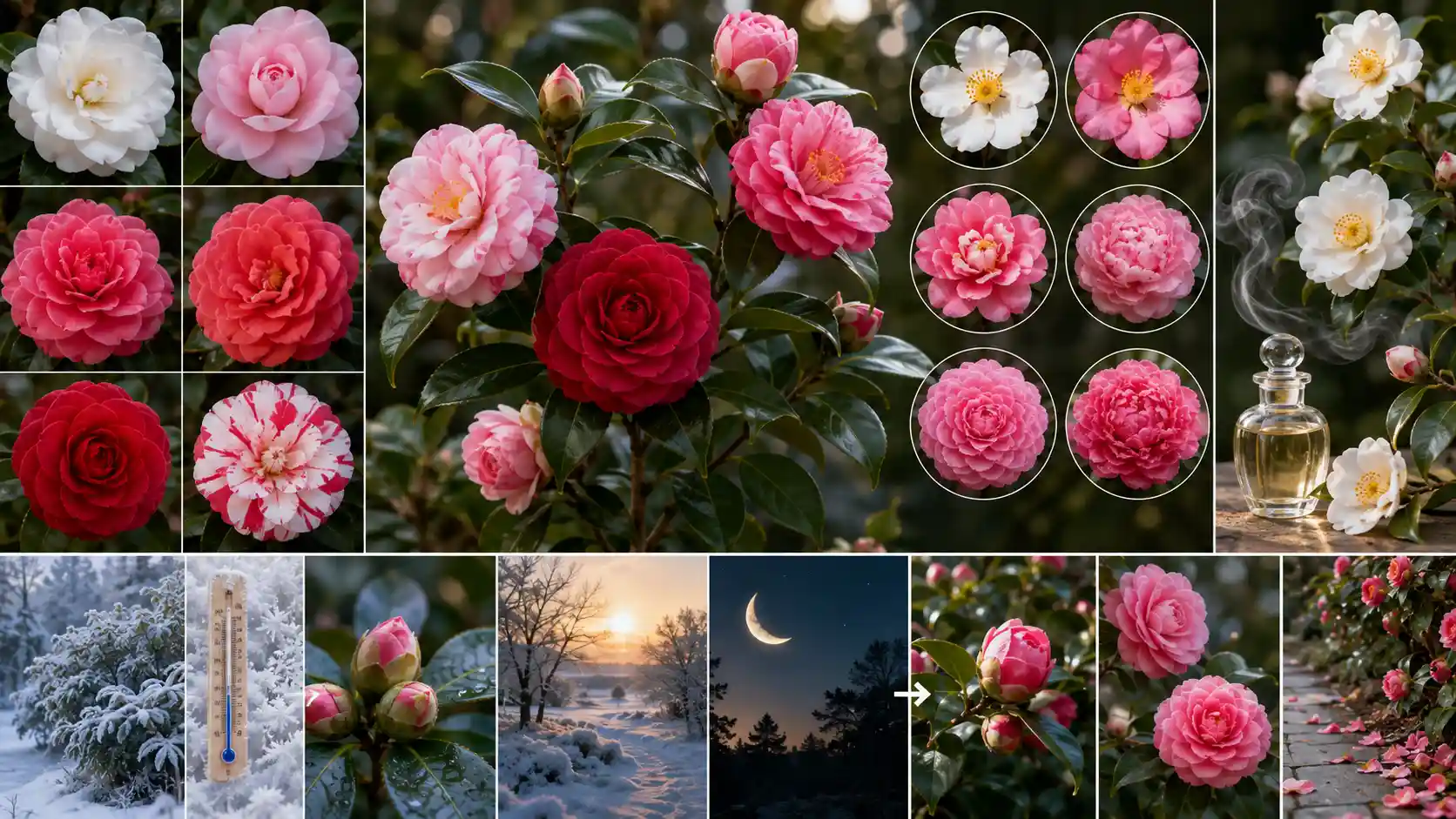
Most traditional Camellia japonica cultivars have little or no noticeable fragrance. This is an important distinction from their visual appeal.
Fragrance has been deliberately introduced into selected camellias using fragrant species, especially Camellia lutchuensis. Examples include ‘Scented Gem’, ‘Scentuous’, ‘High Fragrance’, ‘Minato-No-Akebono’ and ‘Cinnamon Cindy’.
Recent Australian gardening coverage also highlights C. lutchuensis and ‘High Fragrance’ as notable scented camellias.
What Triggers Camellias to Bloom?
Flowering depends on cultivar genetics combined with seasonal environmental cues, including cool temperatures and changing day length. Adequate moisture during the preceding growing season is also important because this is when plants develop future flower buds.
The Most Beautiful Camellia Varieties
“Most beautiful” is subjective, but notable japonica cultivars include:
- ‘Drama Girl’ — large pink-toned flowers
- ‘Mathotiana Alba’ — striking white flowers
- ‘Elegans’ — pink flowers often marked with white
- ‘Hagoromo’ — refined pale-pink flowers
- ‘Bob Hope’ — deep red blooms
- ‘Nuccio’s Gem’ — formal flower form and strong ornamental appeal
Choose according to flower colour, mature size, flowering period and local climate rather than appearance alone. For a closer look at a popular white-flowering cultivar, see our guide to Camellia Setsugekka, including its size, growth habit and care requirements.
Is the Japanese Camellia Toxic?
The ASPCA lists Camellia japonica as non-toxic to dogs, cats and horses.
Importantly, this is an animal-toxicity classification, not evidence that eating large quantities is advisable for people. The safest approach is to avoid intentional ingestion of ornamental plant material and seek professional advice if a person or animal has consumed an uncertain quantity.
Common Camellia Problems
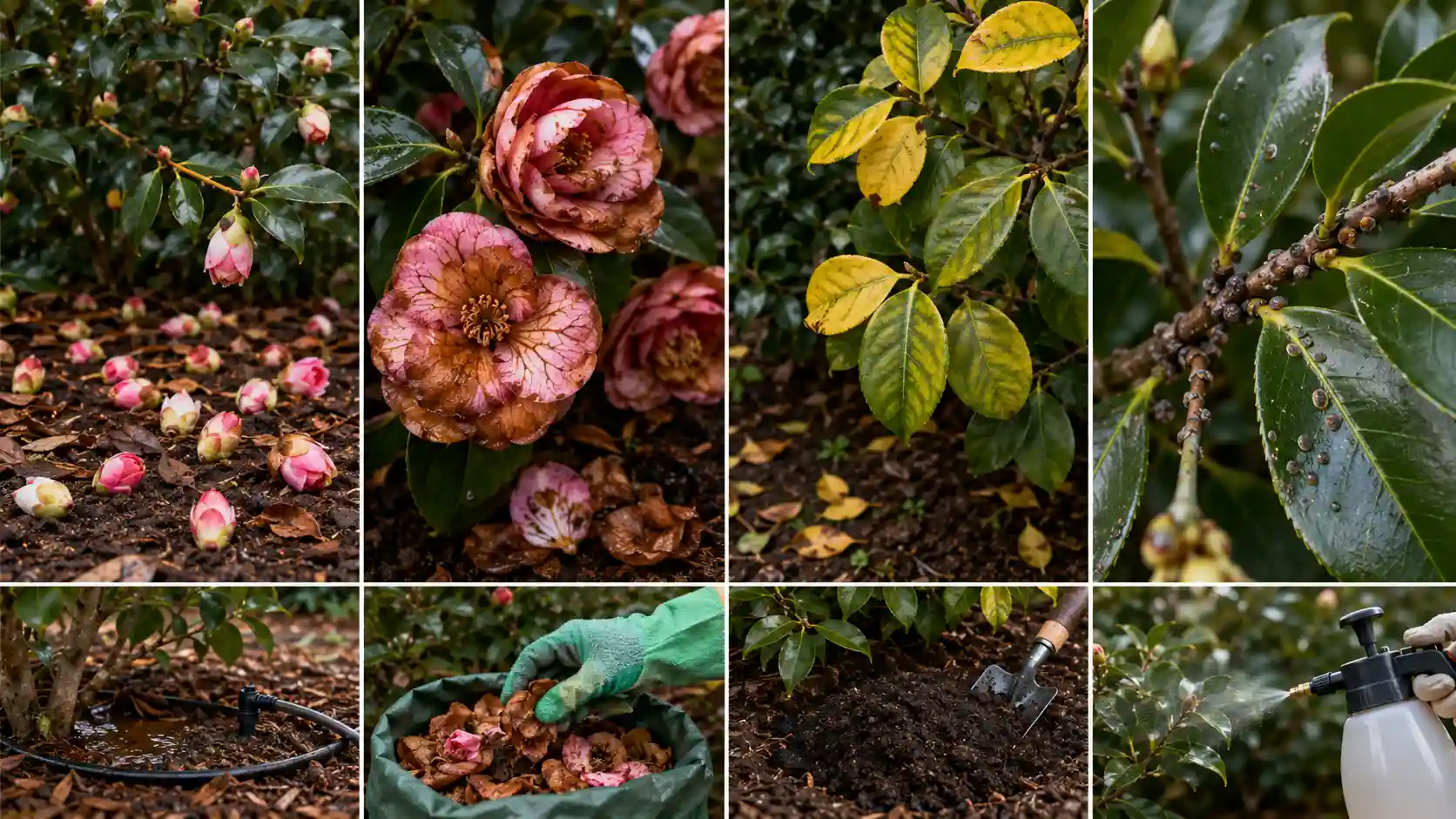
| Symptom | Likely cause | Fix and prevention |
| Bud drop | Temperature fluctuations, irregular moisture, poor drainage or unsuitable position | Maintain even moisture, improve drainage and protect from extremes |
| Brown flowers with dark veins | Camellia petal blight (Ciborinia camelliae) | Remove fallen/infected blooms and maintain garden sanitation |
| Yellow leaves | Alkaline soil, nutrient availability or normal ageing of older leaves | Check soil pH and nutrition; distinguish old-leaf shedding from widespread chlorosis |
| Scale insects | Sap-feeding scale infestation | Monitor foliage and use horticultural oil where appropriate and label directions permit |
Bud drop has several possible causes, including sudden temperature changes and inconsistent soil moisture, so treating every case as a fertiliser deficiency is a mistake.
Petal blight produces brown lesions and characteristically darker petal veins. The fungus can persist in fallen flower material and soil, making sanitation important.
As of 2026, the practical priority remains cultural management: correct planting, consistent moisture, good drainage and removal of diseased flower debris are more fundamental than relying on routine chemical treatment.
Scale insects are sap-feeding pests that can cluster on leaves, stems and other plant surfaces. Regularly inspect foliage and stems so infestations can be identified early; our Australian garden pest identification guide can also help distinguish scale from other common garden pests.
How Long Do Japanese Camellias Live?
A well-sited Japanese camellia can live more than 100 years, making longevity one of its most valuable characteristics for established gardens. Documented historic camellias include specimens more than a century old, while exceptional ancient camellia trees can be several centuries old.
This longevity explains why camellias are often associated with heritage gardens. In Australia, historic C. japonica specimens also form part of the country’s colonial garden heritage.
Conclusion
The japanese camellia, Camellia japonica, is a long-lived evergreen shrub distinguished by glossy foliage, large winter-to-spring flowers and its characteristic whole-bloom drop. For Australian gardeners, the key to success is simple: provide part shade, acidic well-drained soil, consistent moisture and protection from harsh exposure. Once correctly sited, it is generally a low-maintenance plant capable of becoming a long-term garden feature. Its thousands of cultivars, cultural history and exceptional longevity make it far more than a conventional flowering shrub.
FAQs
1. What is special about Japanese camellias?
Japanese camellias are special because they combine glossy evergreen foliage, large cool-season flowers and the unusual habit of dropping flowers whole rather than shedding individual petals. They also have thousands of cultivars in diverse colours and flower forms.
2. Do Japanese camellias like sun or shade?
Japanese camellias prefer part shade or dappled shade. They perform best when protected from intense afternoon sun and drying winds, particularly in hotter Australian climates.
3. What does Japanese camellia smell like?
Most traditional Camellia japonica flowers have little or no noticeable fragrance. Selected fragrant cultivars and hybrids can have sweet, floral or spicy scents, particularly those descended from Camellia lutchuensis.
4. Are camellias high maintenance?
No. Japanese camellias are generally low maintenance once established in suitable acidic soil with adequate moisture, part shade and good drainage.
5. What is the lifespan of a camellia?
A well-grown Japanese camellia can live more than 100 years, while exceptional historic specimens can survive for several centuries.
6. Where should you not plant a camellia?
Avoid waterlogged ground, alkaline soil, severely exposed sites and positions with intense afternoon heat. Strong root competition from thirsty plants can also make establishment difficult.
7. Are camellia flowers toxic to humans?
The ASPCA specifically lists Camellia japonica as non-toxic to dogs, cats and horses, but that database entry does not establish a human safety guarantee. Ornamental plant material should not be intentionally consumed.
8. Why do camellias drop their flowers?
Healthy Japanese camellias naturally drop whole flowers. Premature bud or flower drop can also result from temperature fluctuations, irregular moisture, poor drainage, frost, heat or disease.
9. Do camellias bloom twice a year?
A Japanese camellia normally has one main flowering season, generally winter to spring. Combining C. japonica with autumn-flowering C. sasanqua can provide a much longer succession of camellia flowers.
10. What does camellia symbolise in Japan?
The camellia, or tsubaki, has associations with beauty and purity but also carries historical death-related symbolism because its entire flower can fall intact. The samurai association with the falling flower is particularly well documented.
11. Which camellia is most fragrant?
Camellia lutchuensis is among the strongest fragrance sources used in camellia breeding. Fragrant cultivars and hybrids include ‘High Fragrance’, ‘Scentuous’, ‘Scented Gem’ and ‘Minato-No-Akebono’.
12. Can camellias take full sun?
Japanese camellias can tolerate some sun in favourable cool climates, but part shade is safer and generally preferred. Full, intense Australian summer sun can cause heat and leaf stress, particularly when soil moisture is inadequate. Camellia sasanqua is generally more sun tolerant.