
Pruning and Maintenance: The Complete Australian Garden Guide
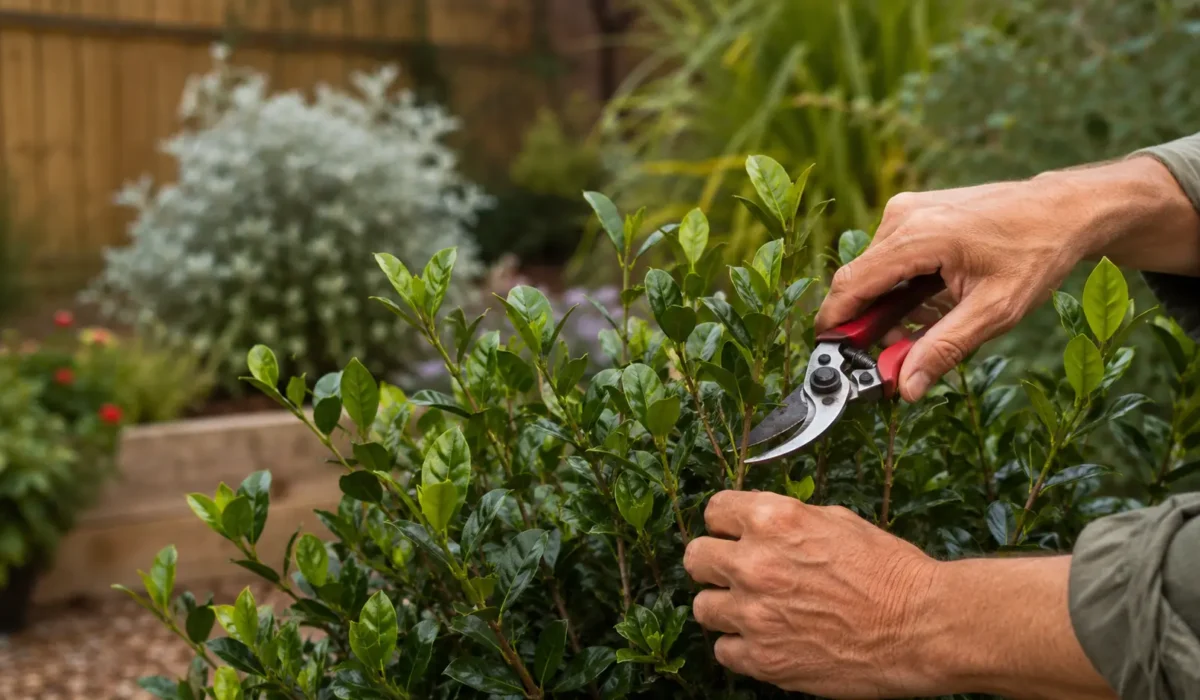
Pruning and maintenance form the backbone of a healthy Australian garden, covering everything from correct cutting technique to seasonal care routines that keep plants strong year-round. It’s one piece of the wider picture covered in our plant care and growing guides, which bring together everything from soil and watering to seasonal upkeep. Done well, pruning and maintenance protect plant health, improve flowering and fruiting, and prevent the kind of overgrown, tangled growth that shortens a plant’s life.
This guide brings together core pruning principles, climate-based timing, tool selection, species-specific technique, and the ongoing maintenance tasks that support every cut you make, so you’re not guessing your way through the garden.
By Elemo Baker | Plant Care & Gardening Expert
Last Updated: August 2026
Quick Summary
- Golden rule: never remove more than a third of a plant’s foliage in a single session, regardless of species.
- Timing depends on plant type, not the calendar: deciduous trees are generally pruned dormant in winter, stone fruit after harvest in summer, evergreens and natives with light, frequent trims.
- The right tool matters as much as the right cut: secateurs, loppers, pruning saws and hedge trimmers each suit a different branch thickness and task.
- Aftercare decides the outcome: consistent watering and feeding after a prune determines how well a plant recovers.
- Maintenance is ongoing, not seasonal: mulching, feeding and monitoring between prunes keep plants ready for their next cut.
What Is Pruning and Garden Maintenance?
Pruning is the deliberate removal of specific plant parts like branches, stems, or foliage, to control size, shape, health, or productivity, while garden maintenance is the broader set of ongoing tasks, including watering, feeding, mulching and monitoring, that keeps plants ready to recover from those cuts. The two work together: pruning without supporting maintenance leaves a plant under-resourced to heal, while maintenance without pruning eventually produces overcrowded, unproductive growth.
Trimming is often used interchangeably with pruning, but the two aren’t quite the same. Trimming is light, cosmetic shaping of an existing form, such as keeping a hedge line neat, while pruning involves more deliberate cuts made to control structure, remove damaged wood, or encourage healthier growth patterns.
Why Pruning and Regular Maintenance Matter for Australian Gardens
Regular pruning and maintenance protect a plant’s long-term health by removing dead, damaged, or diseased wood before it spreads problems further, improving airflow and light penetration through the canopy, and directing the plant’s energy into productive growth rather than weak or crowded stems. For fruiting and flowering plants specifically, correct pruning timing directly affects the size of the next harvest or bloom.
Australia’s climate diversity, spanning tropical, subtropical, temperate and arid zones, means a single national pruning calendar doesn’t work. In our experience advising home gardeners across different states, the most common source of frustration isn’t a lack of effort, it’s applying a rule that suits a different climate zone or a different plant entirely. A pruning approach that works for a Melbourne apple tree can actively harm a Brisbane citrus tree if applied without adjustment.
Core Pruning Principles Every Gardener Should Know
Regardless of plant type or climate zone, a small set of principles underpins safe, effective pruning. For gardeners wanting a deeper dive into pruning fundamentals, the Royal Horticultural Society’s beginner’s guide covers the same core principles in more technical depth. It’s a globally recognised horticultural authority, useful for cross-referencing technique beyond Australian-specific timing.
The One-Third Rule
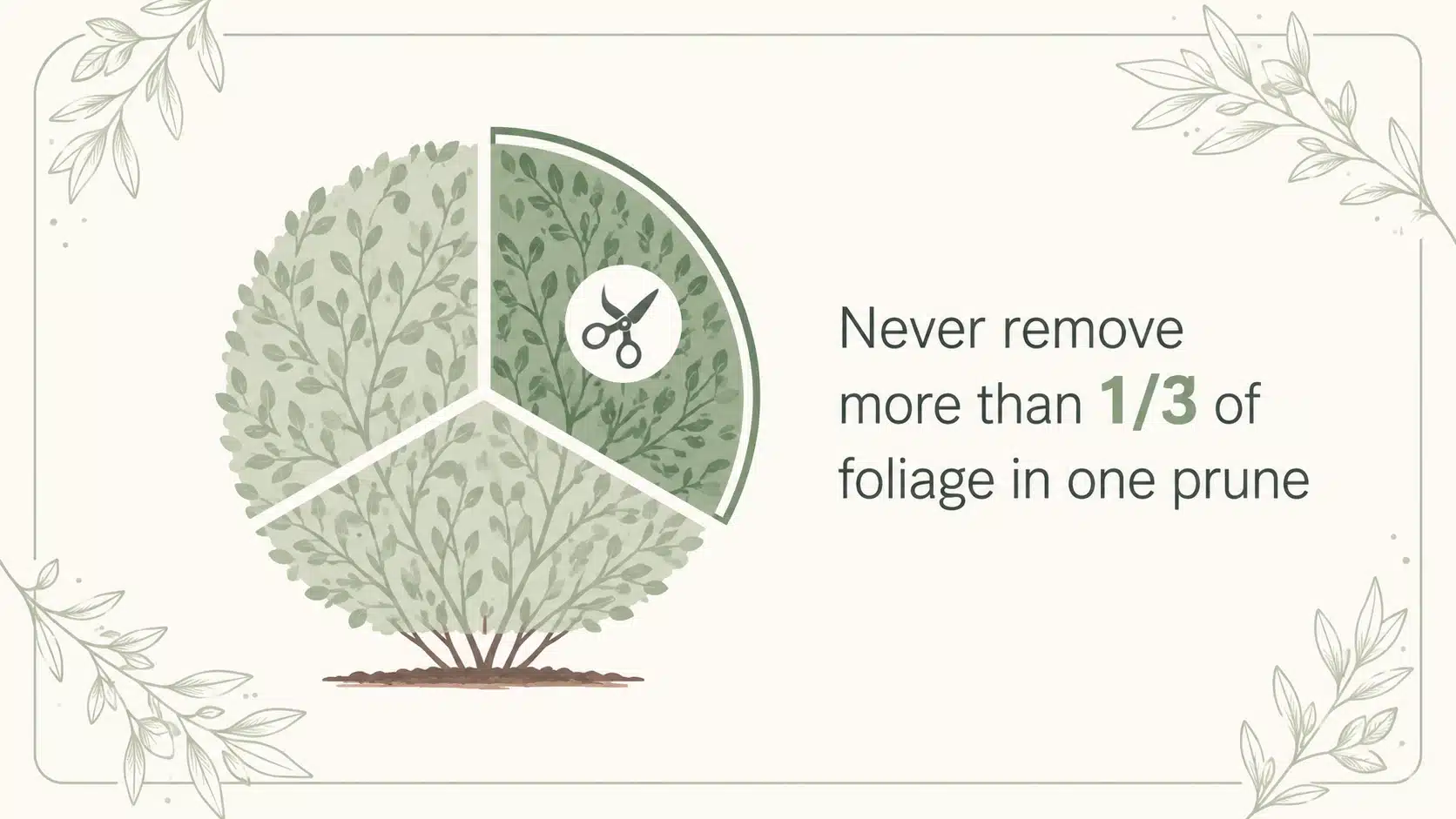
As a conservative safety limit, avoid removing more than roughly a third of a plant’s total foliage in a single pruning session. Cutting harder than this can shock the plant, delaying recovery by a full growing season and, in some cases, triggering excessive regrowth of weak, unproductive shoots instead of strong structural growth. This isn’t a fixed legal or botanical law. Some plants and specific pruning objectives call for a different percentage, but it’s a reliable default when in doubt.
Cutting Above a Node or Bud
When shortening a stem or small branch, cut just above a healthy, outward-facing bud or node at a slight angle. This directs new growth outward rather than into the centre of the plant, which supports airflow and an open, well-shaped structure as the plant regrows.
Respecting the Branch Collar
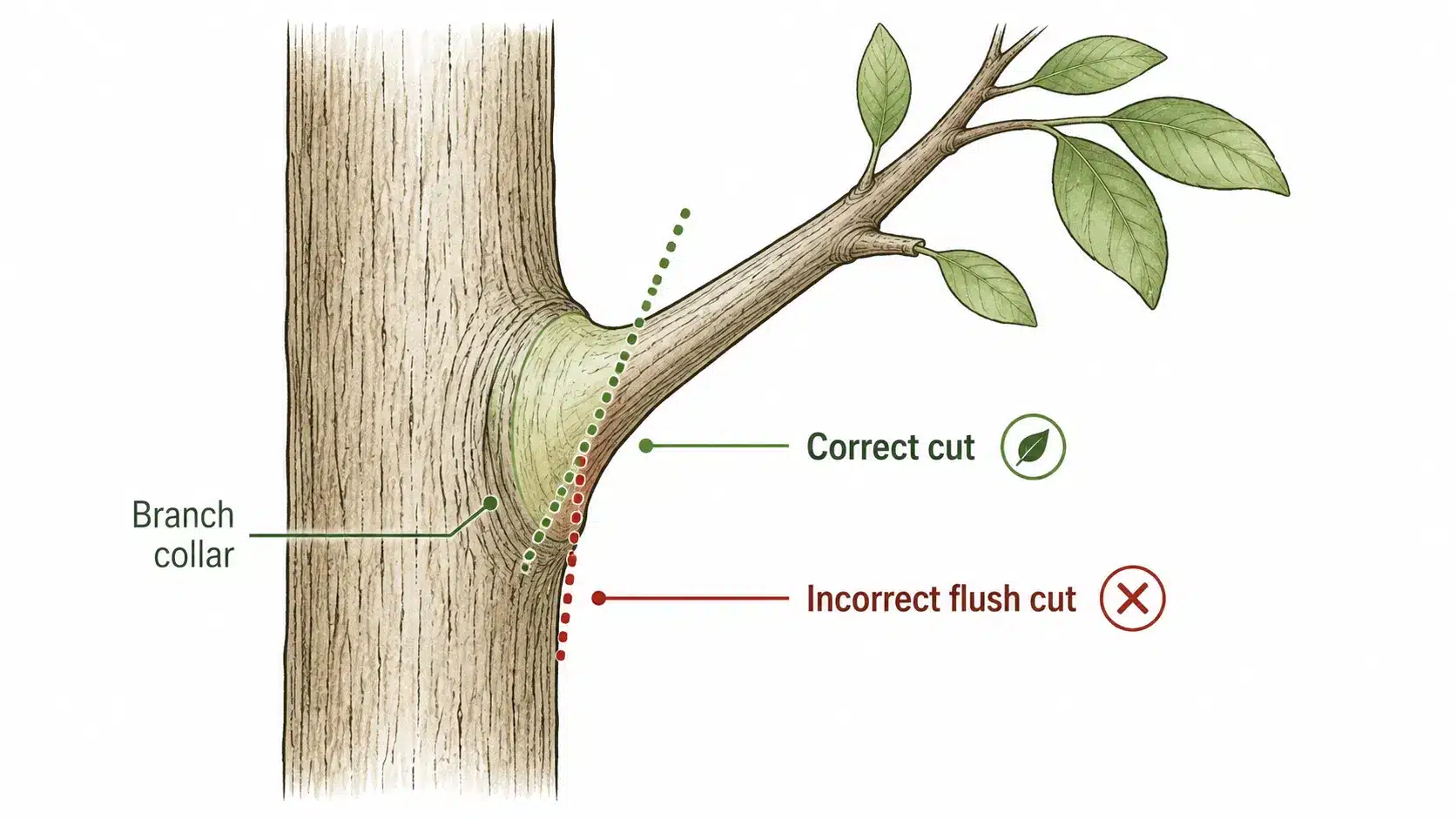
The branch collar is the slightly swollen area where a branch meets the trunk or a larger limb, and it contains the tissue a tree uses to seal and compartmentalise a pruning wound. Cutting flush against the trunk removes this protective tissue and slows healing, while leaving a long stub prevents proper sealing and creates an entry point for pests and disease. The correct cut sits just outside the collar, not into it and not far beyond it.
Correct branch collar technique is formally codified in AS 4373, the Australian Standard for pruning amenity trees, developed to bring uniformity to professional tree care nationwide. While the standard targets arborists and councils rather than home gardeners, it underpins the technique guidance in this article.
Clean, Sharp Tools and Disease Prevention
Dull blades tear stems rather than cutting them cleanly, which creates ragged wounds that are slower to heal and more vulnerable to disease. Disinfecting blades between plants, particularly when removing diseased wood, helps stop pathogens spreading through a garden.
When to Prune: A Seasonal and Climate-Based Framework for Australia
There’s no single correct month to prune in Australia. The right timing depends on whether a plant is deciduous or evergreen, whether it flowers or fruits, and which climate zone it’s growing in.
Deciduous vs Evergreen Timing
Deciduous plants, including many fruit trees and ornamental shrubs, are generally pruned while dormant in winter, since the plant isn’t actively growing and cuts cause less immediate stress. Evergreen plants, including most citrus, hedges and many Australian natives, continue growing year-round and generally respond better to light, more frequent trims than to a single hard annual cut.
Timing by Climate Zone
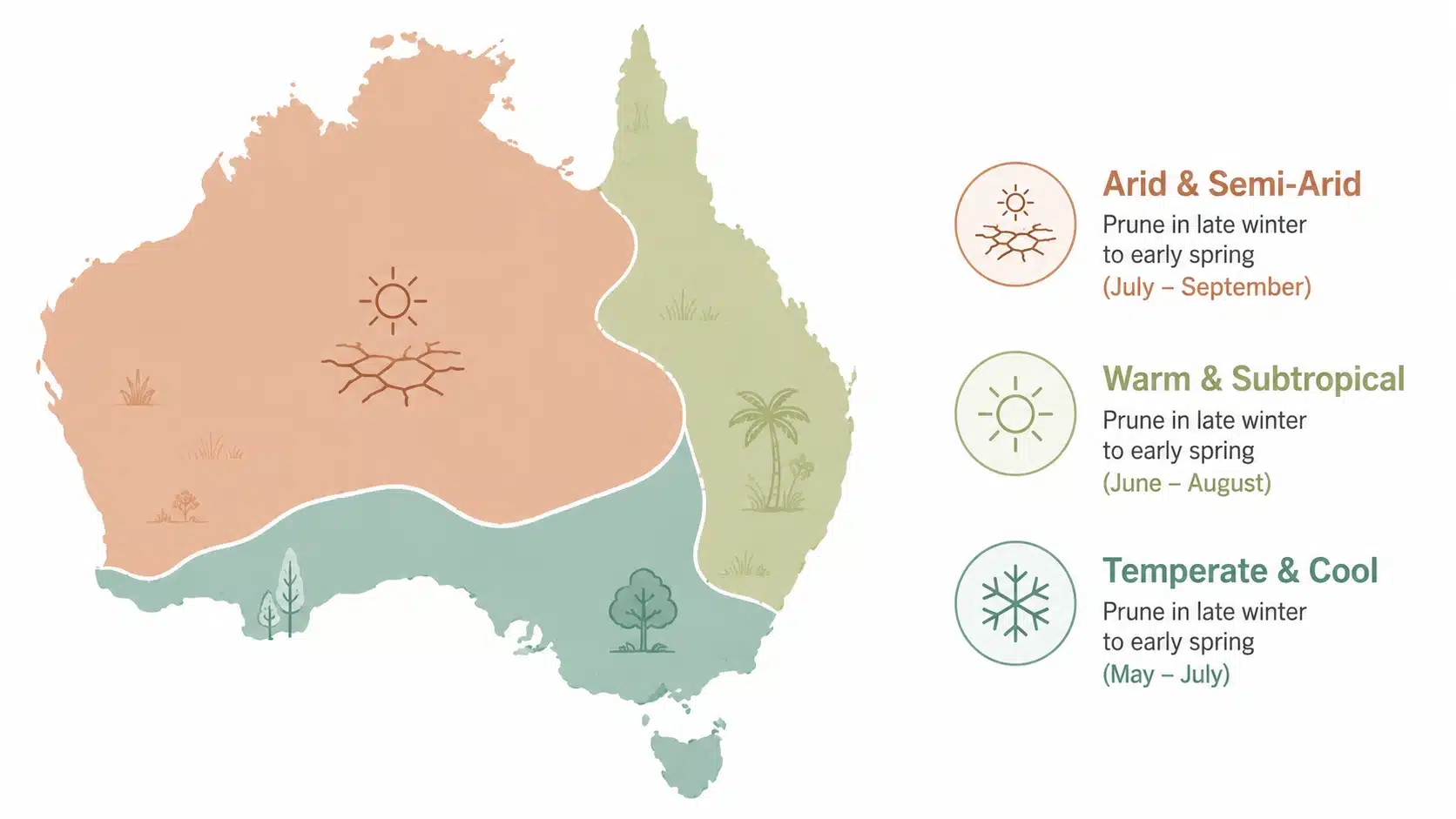
| Climate Zone | General Pruning Window | Key Consideration |
| Temperate and cool (VIC, TAS, southern NSW) | Late winter to early spring for most deciduous and evergreen plants | Clear, pronounced dormancy makes timing more predictable |
| Warm and subtropical (QLD, northern NSW) | Near year-round for evergreens, with reduced dormancy for deciduous species | Avoid pruning during peak summer heat stress |
| Arid and semi-arid | Timed around rainfall rather than a fixed season | Drought-stressed plants recover poorly from hard cuts |
When Not to Prune
Avoid pruning during active flowering if you want to keep blooms, during fruit development if you want to protect the current crop, during extreme heat or drought when fresh cuts increase water loss, during frost periods when exposed wounds are vulnerable to cold damage, and during bird nesting season, since many shrubs and hedges shelter active nests through spring.
Pruning by Plant Type: Choosing the Right Approach
Different plant categories tolerate different cutting amounts, timing windows and techniques, and getting this match right matters more than any single universal rule.
Hedges and Screening Shrubs
Formal hedges generally need pruning in late winter to early spring, followed by light trims every four to eight weeks through the growing season to hold their shape, with a tapered profile that keeps the base wider than the top so light reaches the lower foliage. For full species-by-species timing, tools, and step-by-step technique, see our complete guide to how to prune hedge plants in Australia.
Fruit and Citrus Trees
Fruit tree timing splits by type: apples, pears and quinces are pruned dormant in winter, stone fruit such as peaches, plums and cherries are pruned after harvest in summer to reduce disease risk, and citrus needs only light, selective pruning after fruiting since it stays evergreen year-round. Our fruit tree pruning calendar for Australia breaks this down month by month, and our guide to how to prune a kumquat tree walks through citrus-specific technique in detail.
Gardening Australia’s own fruit tree pruning demonstrations reinforce the same principle: cut to an outward-facing bud and avoid removing more than roughly 20% of canopy in one session. It’s a trusted reference for gardeners wanting to see the technique in action rather than just read about it.
Ornamental Trees and Shrubs
Most ornamental trees and shrubs are pruned during their dormant or least active growth period, typically late winter to early spring, to shape structure and remove congested growth before the new season’s flush begins. Flowering ornamentals are the exception, and generally respond better to pruning straight after their bloom finishes than to a fixed seasonal date.
Australian Native Plants
Native plants generally respond best to regular, light tip pruning rather than infrequent hard cuts. Elemo Baker recommends starting tip pruning early in a native plant’s life, since nipping the growing tips redirects energy into side shoots and builds a denser, bushier plant over time. Avoid pruning natives when extreme heat, cold, or wet weather could stress fresh growth.
| Plant Type | General Timing | Typical Max Cut-Back | Frequency |
| Hedges and screening shrubs | Late winter–early spring, then ongoing trims | Up to one-third | Every 4–8 weeks in growing season |
| Fruit and citrus trees | Varies by species (see calendar) | 20–30% for citrus, up to one-third for deciduous | 1–2 times per year |
| Ornamental trees and shrubs | Late winter–early spring, or post-flowering | Up to one-third | Annually |
| Australian natives | After flowering, avoid weather extremes | Light, ongoing tip pruning | Regular, throughout growing season |
Essential Pruning Tools and When to Use Each
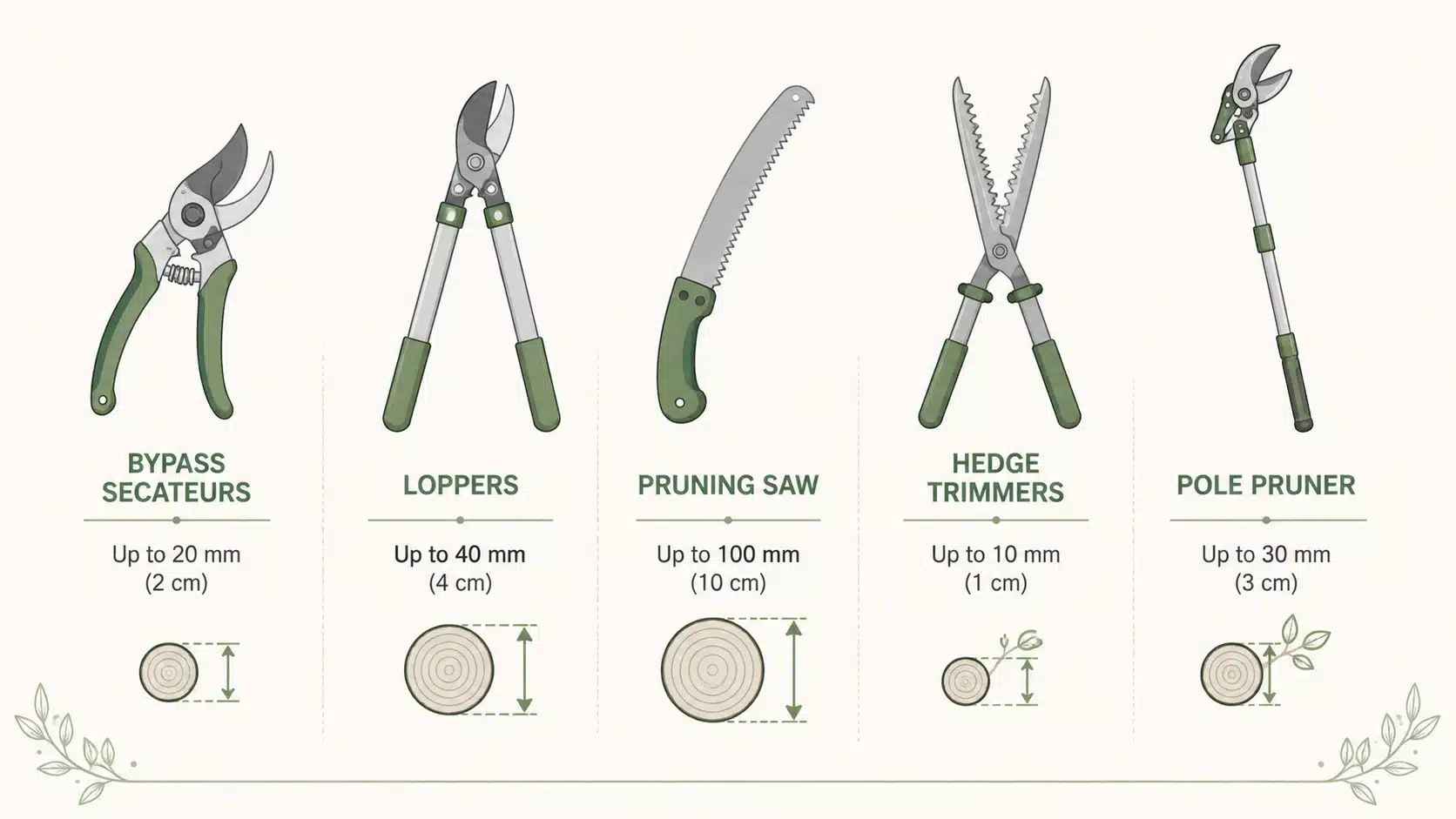
Choosing the right tool for the branch in front of you protects both the plant and the quality of the cut.
| Tool | Best For | Typical Cutting Limit |
| Bypass secateurs | Precision cuts on soft or live stems | Up to roughly pencil-thickness |
| Anvil secateurs | Dead or woody stems where crushing doesn’t matter | Similar thickness to bypass, but for dead wood |
| Loppers | Thicker woody branches out of secateur range | Roughly 2.5–5 cm |
| Pruning saw | Thick limbs loppers can’t handle cleanly | Branches from around 2 cm upward |
| Hedge trimmers (manual or powered) | Shaping formal hedges and large volumes of small stems | Fine stems and light new growth |
| Pole pruners | High branches without a ladder | Varies by model, often 10 cm+ reach height |
Safety note: wear safety glasses and gloves for all pruning tasks, ear protection with powered tools, and a dust mask if foliage is dry. Keep blades clean and sharp, since dull tools increase both injury risk and plant damage.
How to Prune Safely and Correctly: Step-by-Step
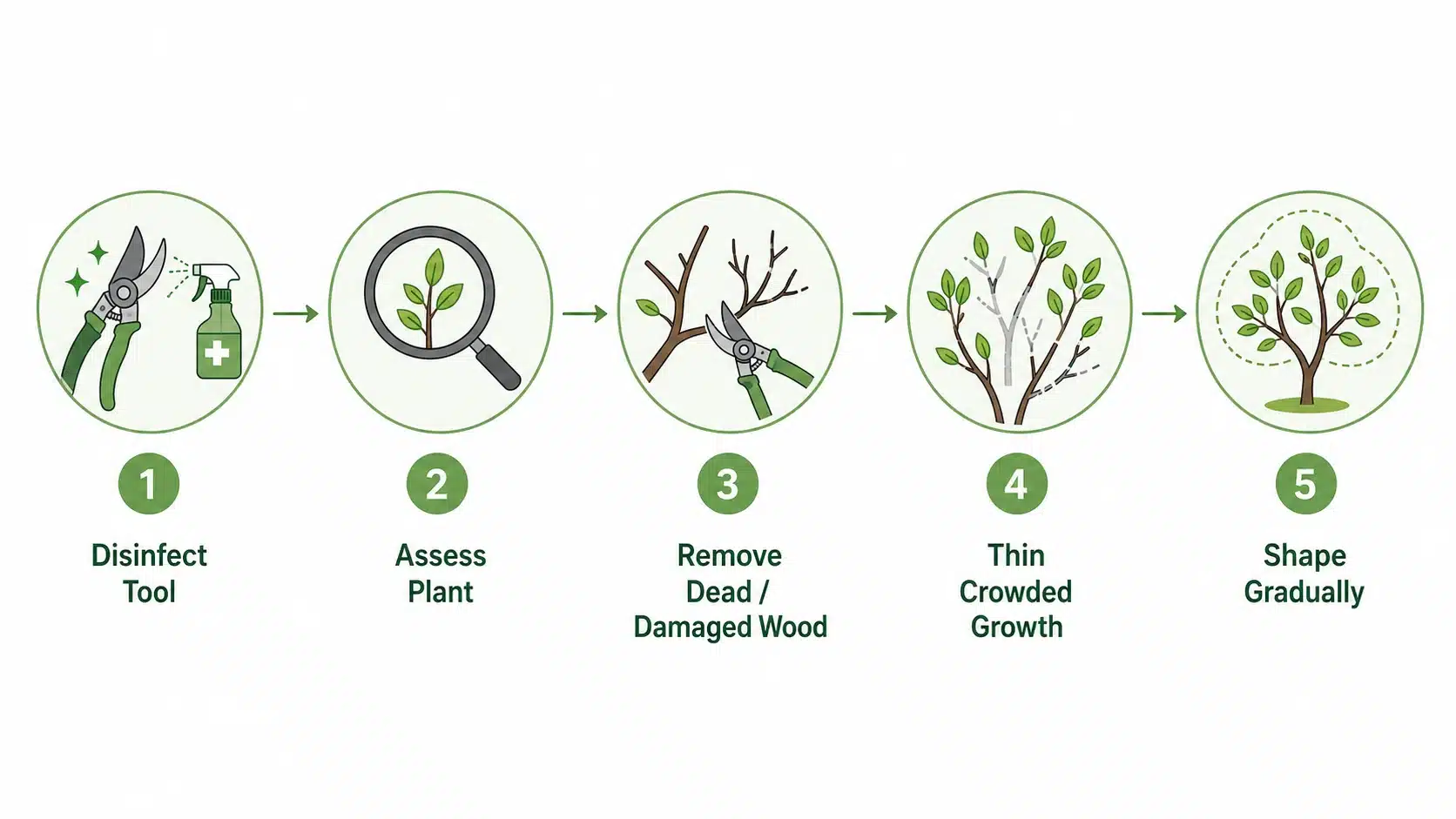
- Disinfect your tools before starting, and again between plants if disease is present.
- Assess the plant first. Identify dead, damaged, diseased or crossing growth before making any cuts, this is often called the “3 D’s” of pruning.
- Remove the 3 D’s first, cutting back to healthy wood.
- Remove crossing or rubbing branches, which create wounds through constant friction.
- Thin congested interior growth to improve airflow and light penetration.
- Make shaping cuts last, working gradually rather than trying to reach the final shape in one pass.
- Cut just outside the branch collar for larger limbs, or just above an outward-facing bud for smaller stems.
- Step back regularly to assess the whole plant rather than making many consecutive cuts without checking progress.
- Stage major reductions on significantly overgrown plants across two or three seasons rather than cutting to final size in one session.
The International Society of Arboriculture recommends disinfecting tools between cuts on diseased material and always wearing safety glasses, guidance echoed by professional arborists worldwide. Their three-cut method for larger limbs is considered the industry standard for preventing bark tearing.
Common Pruning and Maintenance Mistakes to Avoid
- Pruning on a fixed calendar date instead of reading the plant’s actual growth stage and local climate.
- Removing more than a third of the foliage in a single session.
- Using dull blades, which tear stems and invite disease.
- Cutting flush against the trunk or leaving long stubs instead of respecting the branch collar.
- Shaping a hedge or shrub wider at the top than the base, which shades and thins the lower growth.
- Skipping formative pruning in a young plant’s first two years, which limits density for its entire life.
- Pruning during flowering or fruit development, reducing the current season’s display or harvest.
- Neglecting aftercare, leaving a freshly pruned plant without adequate water or feeding to support recovery.
Building a Year-Round Garden Maintenance Routine
Pruning is only one part of keeping a garden healthy. The maintenance tasks between prunes determine how well a plant is positioned for its next cut.
Watering and Feeding Around Pruning Cycles
Every prune increases a plant’s short-term demand for water and nutrients as it pushes out new growth. Water deeply and consistently for the first two to three weeks after a hard prune, and apply a balanced fertiliser to support regrowth without encouraging excessive soft growth that’s vulnerable to frost or pests. Avoid feeding immediately before a hard prune in cool climates, since it can stimulate soft growth right before frost risk.
Mulching
A layer of organic mulch around the base of pruned plants helps retain soil moisture, moderate soil temperature, and suppress weeds while the plant recovers. Refresh mulch after major feeding or pruning sessions rather than leaving it to break down untouched.
A Simple Seasonal Maintenance Table
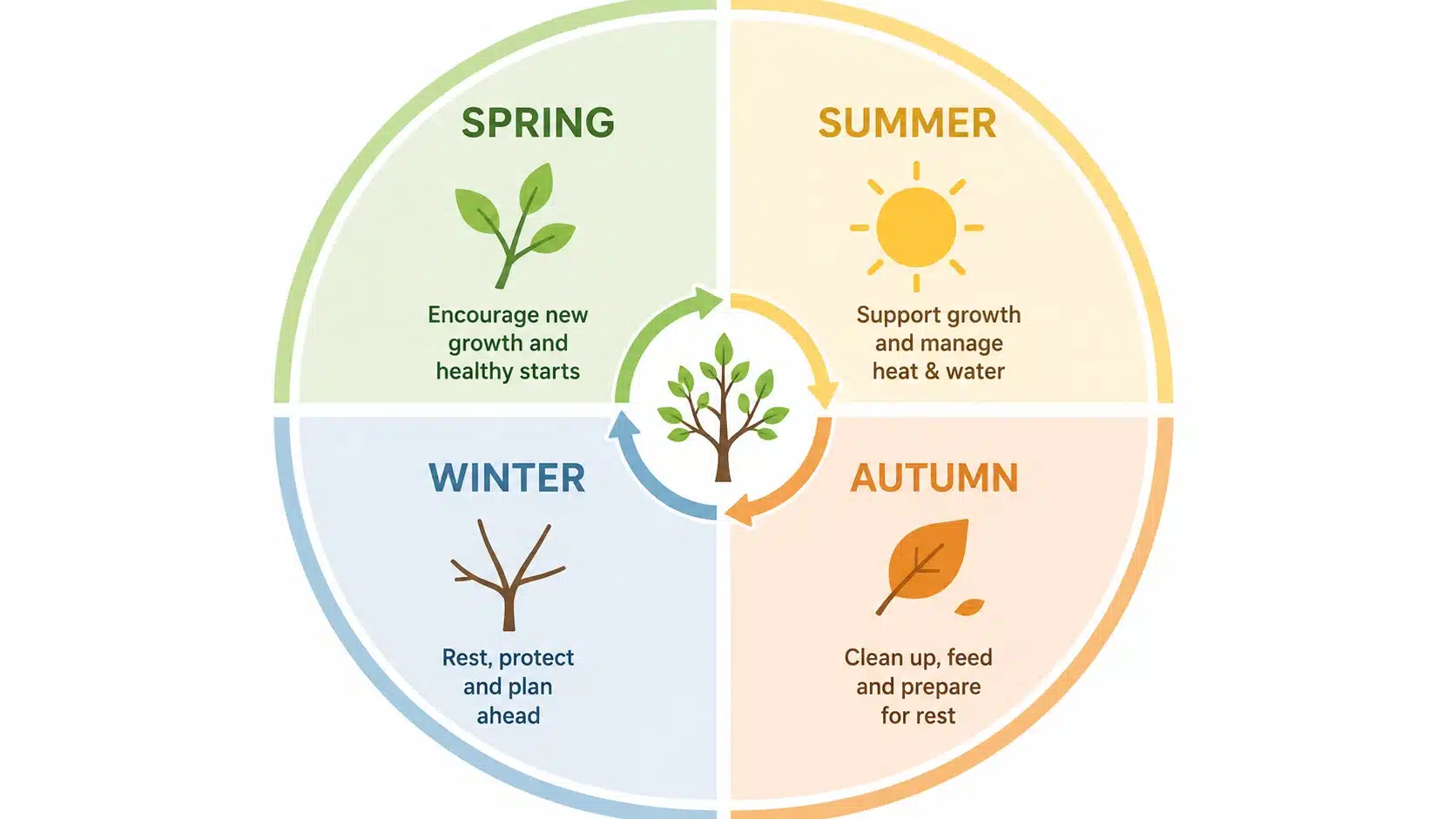
| Season | Typical Maintenance Focus |
| Spring | Main formative and maintenance pruning as growth resumes; feeding |
| Summer | Light shaping only; stone fruit pruning after harvest; consistent watering |
| Autumn | Light tidy-up, removing dead or damaged growth; mulch refresh |
| Winter | Dormant-season structural pruning for deciduous plants; minimal cutting elsewhere |
As of 2026, growers in drought-affected regions are increasingly favouring staged pruning and deep, infrequent watering over hard single cuts followed by light daily watering, since this places less cumulative stress on root systems during dry periods.
Post-Pruning Aftercare
Aftercare largely determines whether a prune succeeds. Water deeply immediately after a significant prune and maintain consistent (not waterlogged) soil moisture through the following two to three weeks. Feed with a balanced fertiliser once new growth begins to appear, rather than immediately after cutting. Monitor the plant for signs of stress, including wilting, unusual leaf drop, or slow regrowth, and adjust watering before assuming a deeper problem exists.
Troubleshooting: Plant Problems Linked to Pruning
| Problem | Likely Cause | Fix |
| Yellowing leaves after pruning | Nutrient stress or badly timed cut | Feed with balanced fertiliser; review pruning timing |
| No regrowth after a hard cut | Pruned during dormancy or drought stress | Water consistently and wait for the next active growth period |
| Bare, sparse base on a hedge or shrub | Top consistently cut wider than the base | Reshape with a tapered profile so light reaches the base |
| Excess leafy growth, few flowers or fruit | Over-pruning removed too much productive wood | Reduce pruning frequency temporarily; allow the plant to rebuild energy |
| Pest activity increasing after pruning | Overcrowded canopy before cutting, or debris left nearby | Improve airflow through thinning; remove pruning debris; consult our garden pest identification guide |
Legal and Boundary Considerations for Pruning
Hedges and trees growing on or near a property boundary are often treated as a shared structure under state-based dividing fences legislation, meaning you can generally only prune the portion on your own side, while a neighbour typically has the right to cut back growth encroaching onto their property without needing your permission, provided it’s done reasonably. For a full breakdown of these rules, including what happens when a dispute arises, see the boundary hedge section of our hedge pruning guide.
In Victoria, a hedge forming part of a dividing fence falls under the Fences Act 1968, with official guidance available through the Department of Justice and Community Safety. Rules differ by state, so it’s worth confirming the equivalent legislation for your own location before any boundary pruning dispute escalates.
Conclusion
Successful pruning and maintenance in Australian gardens comes down to matching your approach to the plant in front of you rather than following one universal rule. Respect the one-third guideline, cut correctly at the node or branch collar, time your pruning to the plant’s biology and your climate zone, and back every cut with consistent watering and feeding afterwards. Build these principles into an ongoing maintenance routine rather than a once-a-year event, and most common Australian garden plants will reward you with denser, healthier, more productive growth season after season.
For species-specific guidance, our guides to hedge pruning, fruit tree pruning by season, and kumquat tree pruning build directly on the principles covered here.
FAQs
What is the golden rule of pruning?
The most widely used guideline is to avoid removing more than about a third of a plant’s foliage in a single pruning session, since heavier cuts can shock the plant and delay recovery by a full growing season.
When should you not prune plants in Australia?
Avoid pruning during active flowering if you want to keep blooms, during fruit development, in extreme heat or drought, during frost risk periods, and during bird nesting season in spring.
How often should garden maintenance be done?
Ongoing tasks like watering, weeding and monitoring are typically weekly, mulching is refreshed once or twice a year, and pruning frequency depends on plant type, from every 4–8 weeks for formal hedges to once a year for many trees and shrubs.
Do all plants need pruning?
Not strictly. Many plants, particularly slow-growing natives, will survive without it, but regular light pruning generally improves density, flowering, health and manageable size compared with leaving a plant entirely unpruned.
What’s the difference between pruning and trimming?
Trimming is light, cosmetic shaping to maintain an existing form, while pruning involves more deliberate cuts made to control size, remove damaged growth, or encourage stronger structure.
What tools do I need to start pruning?
A pair of bypass secateurs covers most small pruning tasks, with loppers and a pruning saw added as branch thickness increases, and hedge trimmers if you’re maintaining a formal hedge.
Can pruning kill a plant?
Yes, if done severely or repeatedly without recovery time. Removing too much foliage at once, especially from older woody growth that doesn’t reshoot easily, can weaken or kill sections of a plant permanently.
2 Comments