
Best Flowering Trees for Small Gardens in Australia
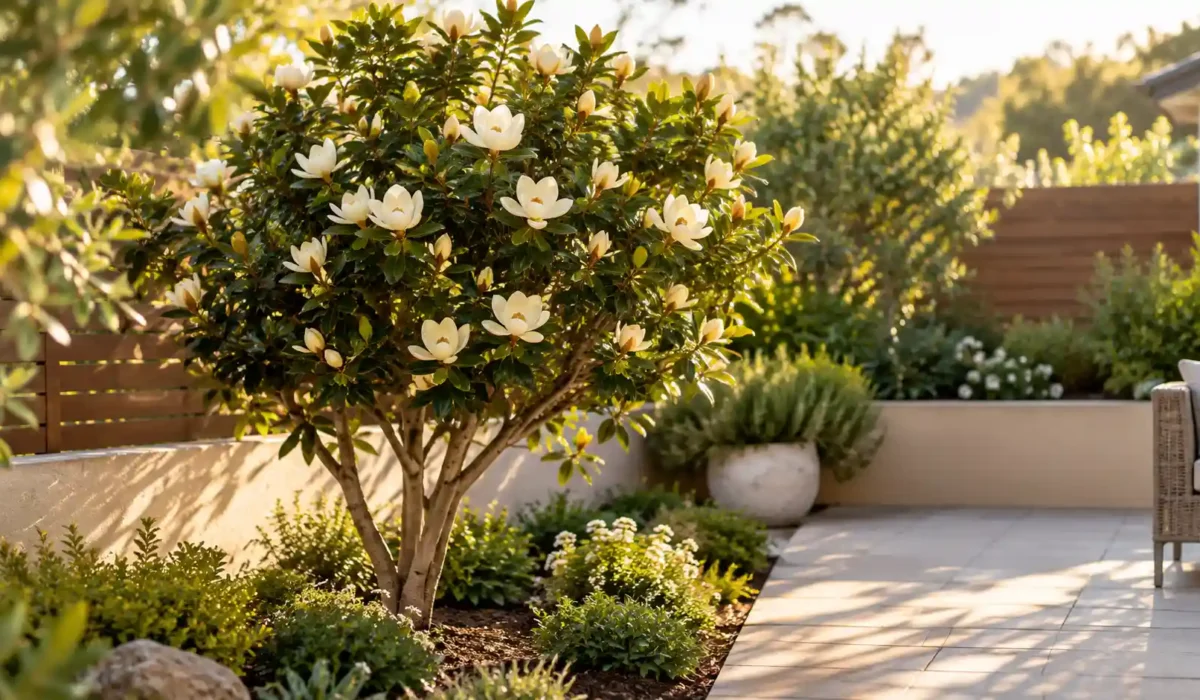
The best flowering trees for a small Australian garden remain under 4–6 metres tall, such as Crepe Myrtle (Lagerstroemia indica), Tibouchina ‘Jules’, dwarf Magnolia ‘Little Gem’, native Callistemon ‘Kings Park Special’ and Cercis ‘Forest Pansy’, according to Elemo Baker. They are appropriate for narrow beds, pots, and courtyards, providing colour for the seasons without spreading out and rooting.
Elemo Baker also says that flowering time can be as important as size: A spring bloomer such as Tibouchina coupled with a summer bloomer like Crepe Myrtle will provide colour over the seasons in the same little bed. Homeowners typically miss out on the importance of root behavior around paving and fences, rather than mature height.
By Elemo Baker | Plant Care & Gardening Expert
Quick summary
This guide sits within our broader Best Trees and Shrubs for Australian Gardens resource if you’re weighing flowering trees against other tree and shrub options.
- Choose your tree in this order: climate zone → available space → soil/drainage → function (colour, screening, wildlife, fruit) — species name comes last, not first.
- For most small Australian gardens, dwarf crepe myrtle, Magnolia ‘Teddy Bear’ and native dwarf bottlebrush are the safest all-rounders across pots and in-ground beds.
- The single biggest mistake is buying on flower colour alone and ignoring mature size — many “small” trees sold at 1.5 m in a pot are anything but small at maturity.
Why Most “Small Flowering Tree” Advice Steers You Wrong
Search for this topic and you’ll mostly find flat species lists — crepe myrtle, magnolia, dogwood, tibouchina — with a line on flower colour and not much else. Nursery and retail pages lean exotic-first and rarely mention root safety. Native-focused guides go deep on soil type but skip exotics altogether, so you can’t compare like-for-like. Colour-category round-ups group trees by “red flowering” or “yellow flowering” without ever asking whether that tree suits a small courtyard in your climate zone.
None of that helps you answer the real question: which one tree, in my space, in my climate, on my soil, won’t become a problem? That’s the question this guide is built to answer — framework first, species second.
The 4-Step Decision Framework
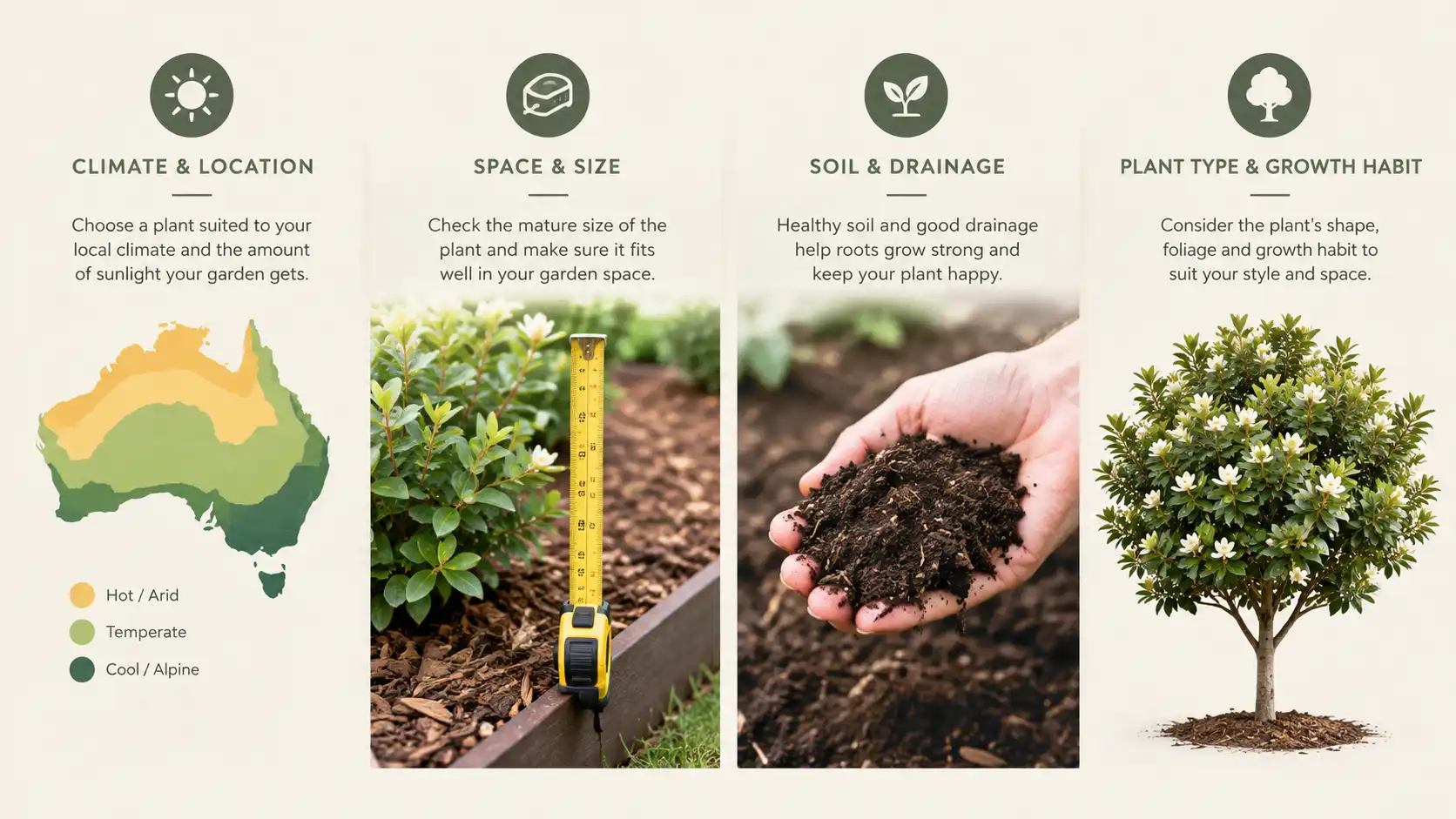
Before you fall in love with a flower colour, run through these four checks in order.
- Step 1 — Climate zone. Cool temperate (VIC/TAS), warm temperate–subtropical (NSW/QLD coastal), or dry–Mediterranean (WA/SA/inland). A tree that flowers beautifully in Brisbane may sulk or refuse to bloom in Hobart, and vice versa for chill-dependent deciduous species.
- Step 2 — Available space. In-ground garden bed, paved courtyard, or pot on a balcony each rule certain species in or out before you even look at flowers.
- Step 3 — Soil and drainage. Reactive clay changes your root-safety calculations significantly (more on this below); free-draining sandy soil opens up more native options.
- Step 4 — Function. Are you after a specimen colour feature, light screening, bird and pollinator activity, or a dual-purpose tree that also fruits? This determines your shortlist more than flower colour ever will.
Native vs Exotic Flowering Trees for Small Spaces
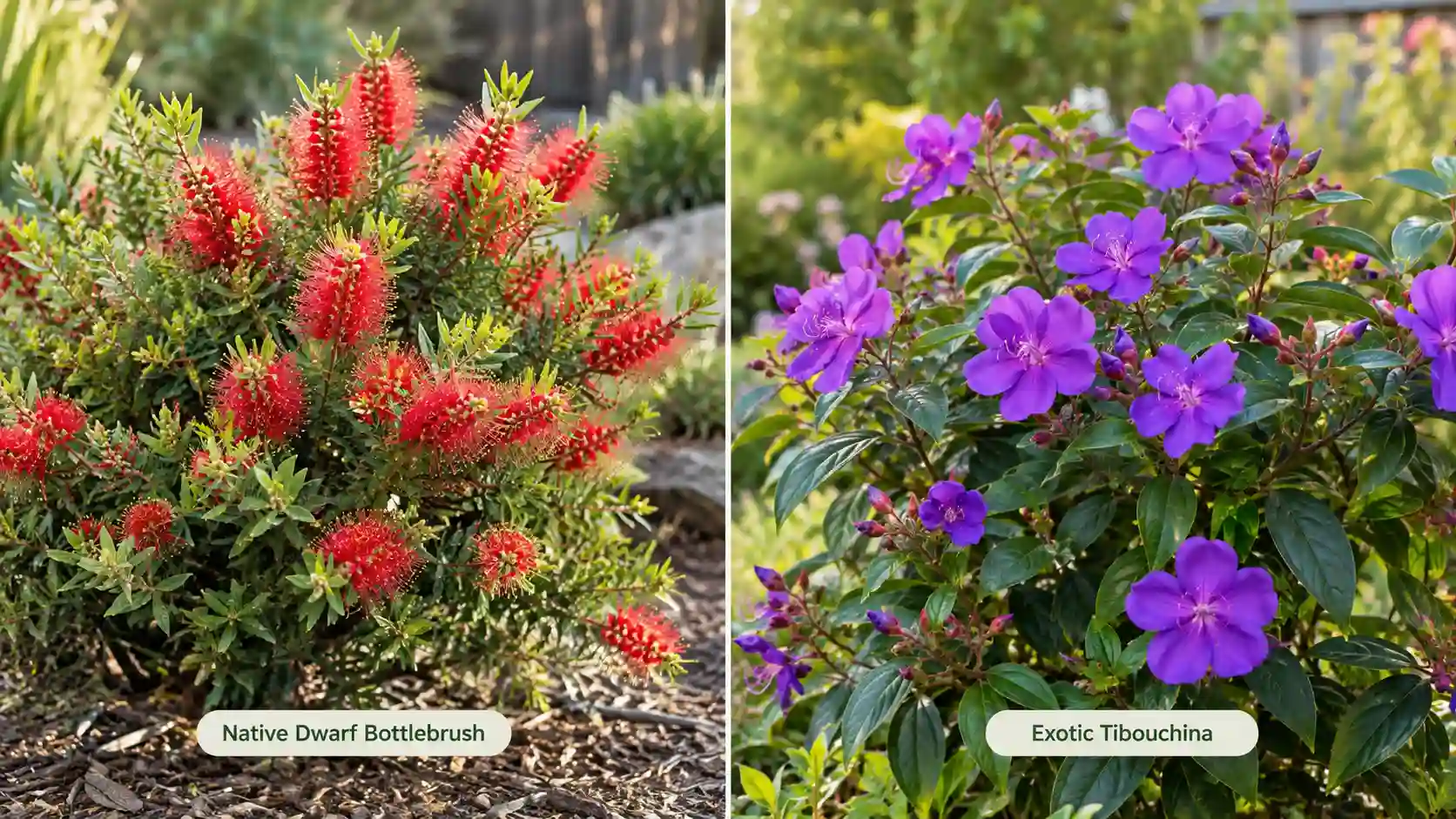
Both camps have a genuine place in a small Australian garden — the trade-off is mostly around water needs, wildlife value and how dramatic the seasonal display is. Crepe myrtle (genus Lagerstroemia) remains one of the most widely planted small flowering trees in Australia.
| Factor | Native | Exotic |
| Water needs once established | Generally lower | Often higher, especially deciduous species |
| Root behaviour | Usually fine and non-invasive in dwarf cultivars | Varies widely by species |
| Wildlife value | Strong — attracts honeyeaters and pollinators | Moderate, species-dependent |
| Seasonal drama | Long flowering window, often less “showy” in one hit | Can be spectacular but shorter, more seasonal |
| Climate flexibility | Species exist for every Australian zone | Cool-climate species need real winter chill to flower well |
Native wins when you want low water use, wildlife activity and council-friendly plantings. Exotic wins when you want a strong single-season colour hit or genuine four-season interest (blossom, foliage, autumn colour, bare winter form) in cooler climates. Tibouchina is often mistaken for a native despite originating in Brazil — see our Purple Flower Tree Australia guide for the full native-vs-exotic purple-flowering breakdown.
Best Small Flowering Trees by Climate Zone
- Cool temperate (VIC/TAS/cool NSW highlands): Star magnolia and dwarf flowering cherry give a true four-season display but need a proper winter chill to flower well — they’re not suited to subtropical gardens. Crepe myrtle also performs here in a sheltered, sunny position. If you’re comparing magnolia cultivars for growth speed as well as flowers, our Fast Growing Magnolia Australia guide breaks down Star, Teddy Bear and Little Gem side by side.
- Warm temperate–subtropical (coastal NSW/QLD): Tibouchina (Alstonville), golden penda and native blueberry ash all thrive in this band, tolerating humidity and warmer winters that would disappoint the cool-climate species above. Tuckeroo is another subtropical option worth considering for year-round ornamental value — see our Tuckeroo Tree Growth Rate guide.
- Dry–Mediterranean (WA/SA/inland): Silver princess (a compact eucalypt/mallee) and dwarf coral gum handle heat and low rainfall well once established, and generally cope with poorer, free-draining soils better than the exotics above.
Flowering Trees for Pots and Courtyards vs In-Ground Planting
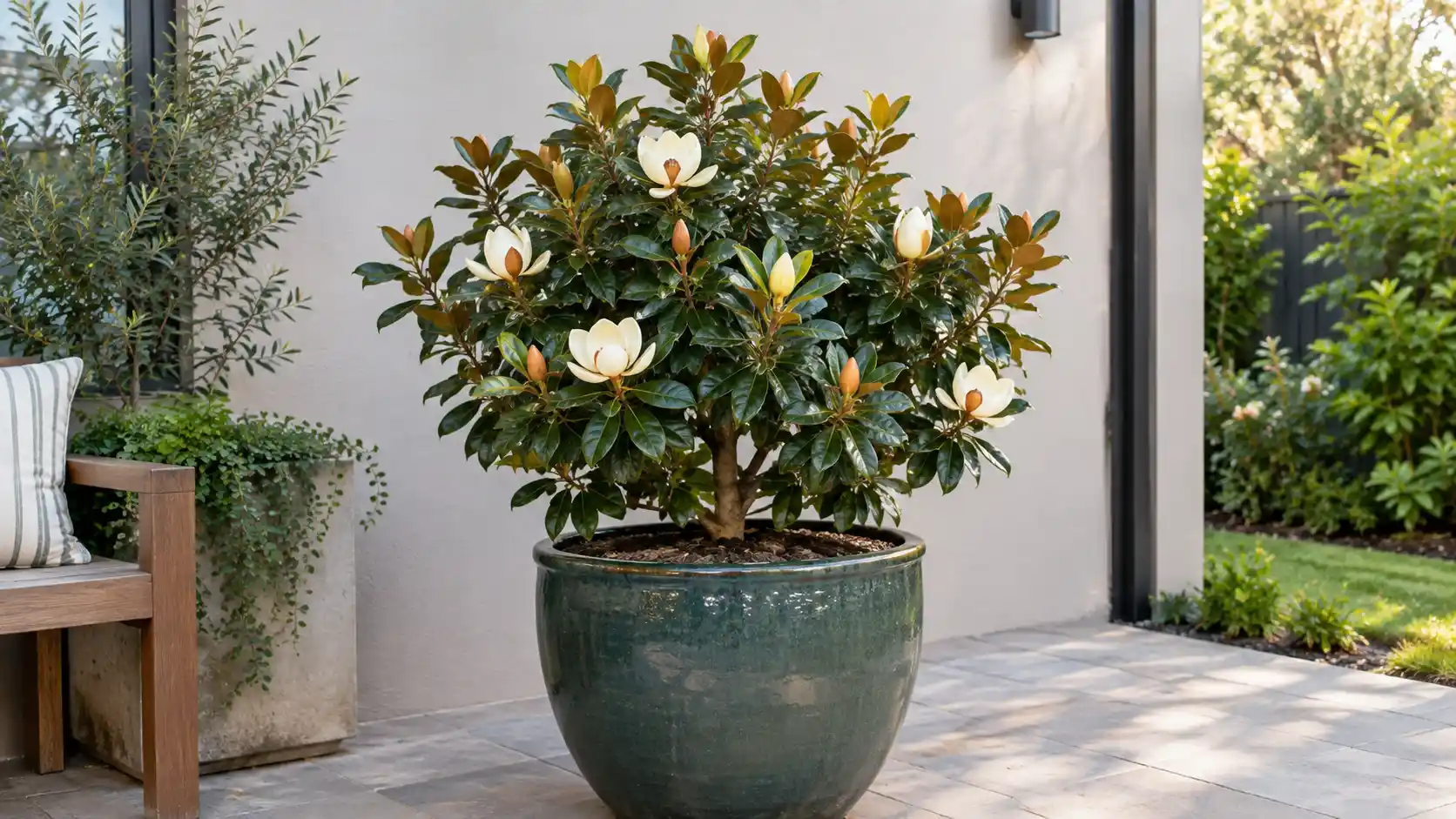
A tree that’s happy in the ground isn’t automatically happy in a pot — container roots deal with faster temperature swings and a smaller water reserve, so species selection genuinely matters here.
- Best for pots: dwarf crepe myrtle cultivars, Magnolia ‘Teddy Bear’ (holds courtyard scale for decades in an 80 L+ pot), and dwarf citrus for a dual-purpose colour-plus-fruit option. For a deeper dive into spacing, mature size and screening potential, see our Teddy Bear Magnolia Landscaping Guide.
- What changes in a pot: water more frequently through warm months, repot or refresh potting mix every three to four years, and trim circling roots at each repot to prevent the tree becoming root-bound.
- Container size guide: small pots (40–50 cm) suit dwarf citrus and standard bay; medium pots (60–80 cm) suit Japanese maple and dwarf crepe myrtle; large pots (90 cm+) suit larger magnolia varieties and mature citrus.
Comparison: Top 10 Small Flowering Trees for Australian Gardens
| Tree | Mature size | Flowering season/colour | Climate | Root habit | Mess/litter | Pot suitability |
| Dwarf crepe myrtle | 1.5–3 m | Summer–autumn, pink/white/purple/red | Most zones (sheltered in cold areas) | Fine, non-invasive | Moderate (spent flowers, autumn leaf drop) | Excellent |
| Magnolia ‘Teddy Bear’ | 2–4 m | Summer, white | Warm–cool temperate | Non-invasive | Low | Excellent |
| Tibouchina ‘Alstonville’ | 3–5 m | Summer, purple | Warm temperate–subtropical | Compact, well-behaved | Low–moderate | Good |
| Blueberry ash (native) | 4–5 m (prunable) | Spring–summer, pink/white | Most eastern zones | Non-invasive | Low | Fair (large pot only) |
| Dwarf bottlebrush (native) | 1.5–2 m | Spring–summer, red/pink/cream | Most zones | Fine | Low | Excellent |
| Silver princess (native) | 2–4 m | Autumn–spring, pink/red | Dry temperate–Mediterranean | Compact | Low | Fair |
| Star magnolia | 2–3 m | Late winter–spring, white | Cool temperate only | Non-invasive | Moderate (petal drop) | Good |
| Dwarf flowering cherry | 2.5–4 m | Spring, pink/white | Cool temperate only | Non-invasive | Moderate | Good |
| Golden penda (native) | 4–6 m (prunable) | Summer–autumn, gold | Subtropical–warm temperate | Non-invasive | Low | Fair |
| Dwarf citrus (e.g. calamondin) | 1.5–2.5 m | Spring blossom + winter fruit | Warm–cool temperate | Fine | Low–moderate (fruit drop) | Excellent |
Safe Planting Distance from House, Pool, Driveway and Sewer Lines
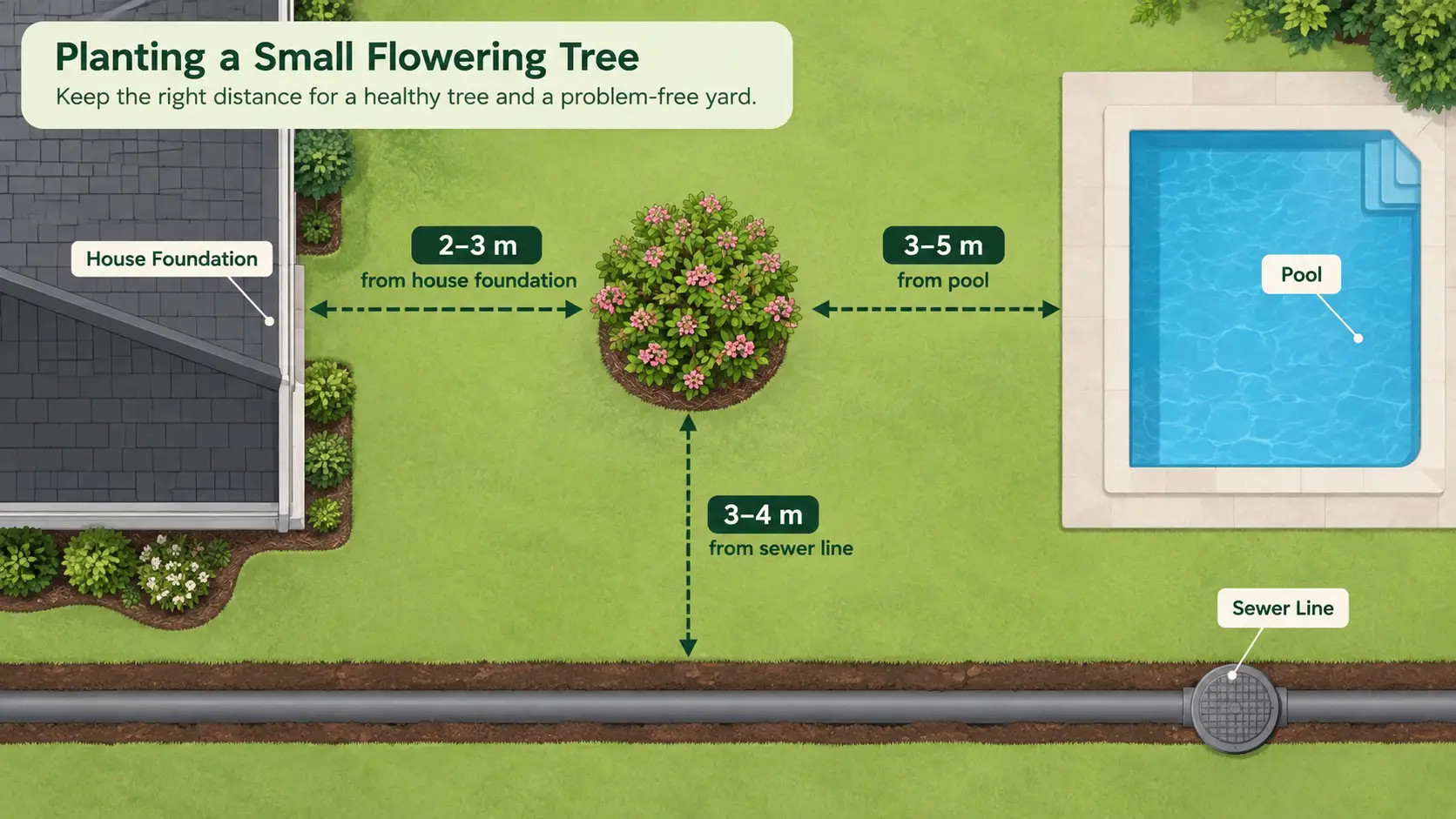
Roughly 3/4 of the tree’s mature height away from house footings on reactive clay soils and small flowering trees should be a minimum of 3 metres from sewer or drainage lines.
That distance is there for a reason: tree roots seek moisture and nutrients, and with shrinkable clay soils, a thirsty root system can pull enough moisture out of the soil to cause it to shrink and crack (it causes the soil to crack, not the root system itself disturbing the concrete). Species with fine, fibrous and non-invasive root structure (crepe myrtle, magnolia and dwarf bottlebrush), are considered lower risk than species with aggressive, wide searching root system. For a closer look at exactly how far crepe myrtle roots spread, see our full How Deep Are Crepe Myrtle Roots? guide.
If you’re planting near a pool, driveway or sewer line and want to double-check a species you’re already considering, it’s worth reading our Gum Tree Root System guide for a contrast against a genuinely high-risk large-rooted species.
Flowering Trees That Attract Birds and Pollinators
If Step 4 of your framework was “wildlife,” these are your strongest small-tree options: native dwarf bottlebrush and blueberry ash both draw honeyeaters and native bees reliably, without the higher water and pruning demands of larger native flowering trees. Tibouchina also draws bees well despite being exotic.
Low-Mess, Low-Litter Options for Paved Courtyards
Not every tree marketed as “low maintenance” is actually low-litter. Genuinely low-mess choices for paving include Magnolia ‘Teddy Bear’ (minimal petal drop, evergreen), dwarf bottlebrush, and silver princess. Be cautious with crepe myrtle directly over pavers — while the roots are safe, spent flowers and autumn leaf drop still mean seasonal sweeping.
Pruning Small Flowering Trees to Size or Hedge Form
Crepe myrtle and tibouchina both tolerate hard pruning well and can even be trained into tight formal hedging if you want a screening effect rather than a single specimen. Magnolia ‘Teddy Bear’ and the native species above are naturally compact and slower-growing, so they need only light formative pruning — hard-pruning a naturally small, slow grower can do more harm than good.
A Year-Round Flowering Calendar for a Small Garden
Sequencing two or three of the species above gives colour across most of the year:
- Late winter–spring: star magnolia, dwarf flowering cherry (cool climates)
- Spring–summer: dwarf bottlebrush, blueberry ash, dwarf citrus blossom
- Summer: dwarf crepe myrtle, tibouchina, golden penda
- Autumn–winter: silver princess, dwarf citrus fruit display
Common Mistakes When Choosing a Small Flowering Tree
Buying on flower colour alone, ignoring mature size. This happens because point-of-sale plants are sold small and in bloom, so the eventual footprint isn’t obvious. Fix it by checking the mature size on the plant tag against your actual available space, not the pot size in front of you. Prevent it by always cross-referencing mature height and width before purchase, not after planting.
Crepe myrtle powdery mildew. This occurs in humid conditions with poor airflow, especially on older cultivars. Fix it with a registered fungicide and by improving airflow around the canopy. Prevent it by choosing mildew-resistant modern cultivars (such as the Indian Summer range) from the outset.
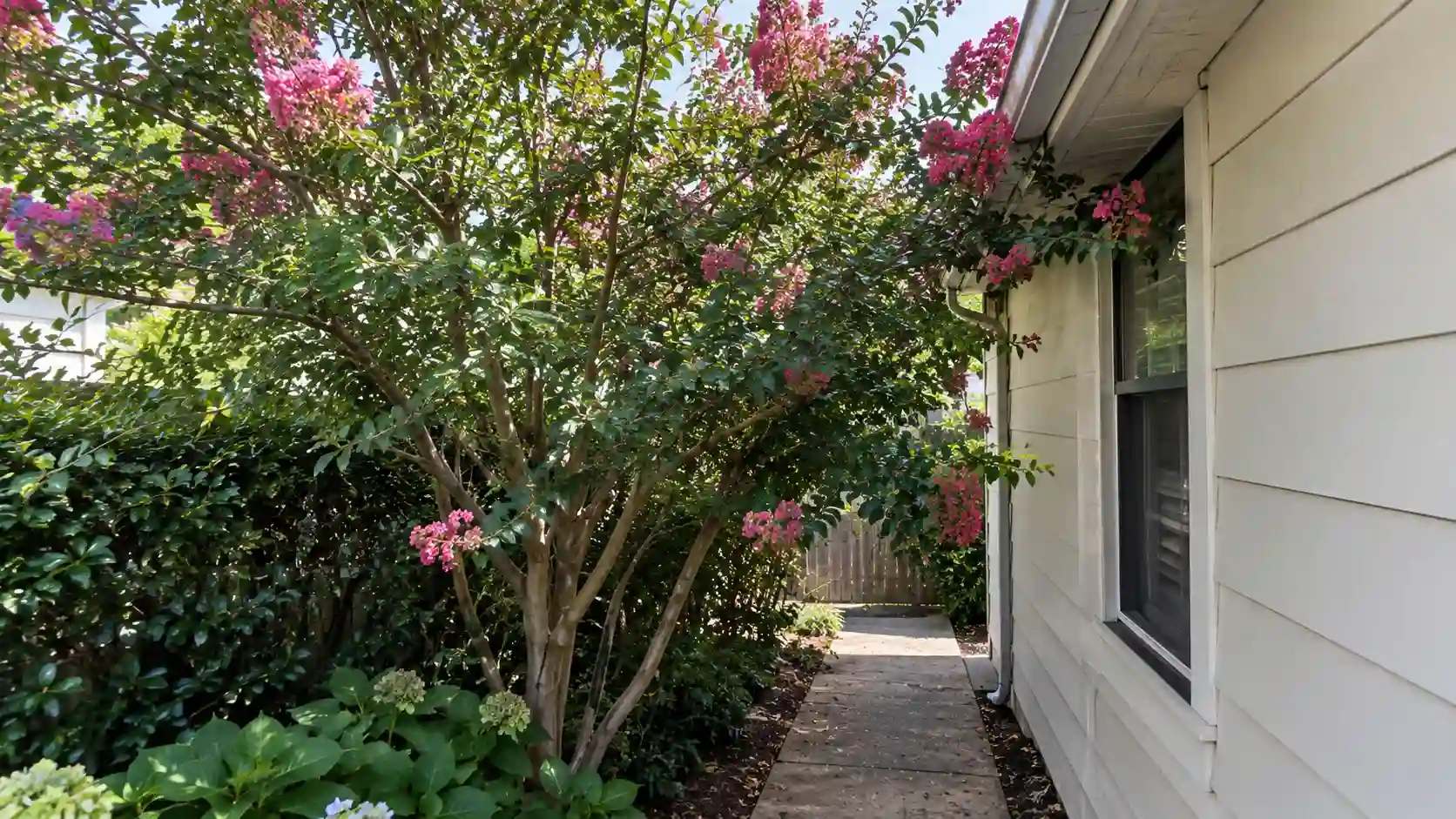
Planting too close to paving or footings. This happens when a tree is chosen for looks before checking root habit and mature size against Step 3 of the framework. Fix it early by relocating young trees before root systems establish. Prevent it by matching species root habit to distance from structures at planting time, not after cracks appear.
Why This Guide Is Different
Most competing pages are a photo gallery with captions. This guide leads with a genuine climate-space-soil-function decision framework, a native-vs-exotic comparison you can actually use, a siting-distance table matched to root habit, and a year-round flowering calendar built from the shortlist above — none of which exist together on a single competing page.
Conclusion
The best flowering tree for a small Australian garden isn’t a set species — it’s any species that meets the four-part criteria — right climate zone, right space, right soil, right function. Before you are fooled by a flower colour, try any candidate through that sequence and you won’t find yourself in the two most common scenarios of skipping it: a tree growing too big for its location or a tree that doesn’t really grow in your climate.
FAQs
What is the best small flowering tree for a courtyard in Australia?
Magnolia ‘Teddy Bear’ and dwarf crepe myrtle are the most reliable courtyard performers, holding their size in large pots for years with low litter.
Which flowering trees stay small without heavy pruning?
Magnolia ‘Teddy Bear’, dwarf bottlebrush and silver princess are naturally compact and need only light formative pruning.
How close can I safely plant a flowering tree to my house?
As a general guide, roughly three-quarters of the tree’s mature height from footings on clay soil, and at least 3 metres from sewer lines — always confirm against AS 4970 or your local council for a definitive figure.
Do native flowering trees work as well as exotics in small gardens?
Yes — natives like dwarf bottlebrush and blueberry ash generally use less water and offer stronger wildlife value, though exotics can give a more dramatic single-season colour display.
Which small flowering trees are low-mess for paved areas?
Magnolia ‘Teddy Bear’, dwarf bottlebrush and silver princess are the lowest-litter options for courtyards and paving.
Can flowering trees be grown successfully in pots long-term?
Yes, provided you choose a naturally compact species, use a large enough pot (80 L+ for magnolia), and repot or refresh the mix every three to four years.
1 Comment