
Flowering & Ornamental Trees Australia: Full Guide
By Elemo Baker | Plant Care & Gardening Expert
Quick Summary
- Pick your climate zone and space/function before you pick a species — colour-first shopping is the #1 reason flowering trees underperform or outgrow their spot
- “Flowering” and “ornamental” aren’t the same thing: one describes bloom behaviour, the other overall visual value
- You can have colour across two or three seasons, not just one spring flush, by combining species with staggered bloom windows
- Most “my tree won’t flower” problems trace back to five fixable causes — not a dud tree
Most flowering tree guides start with a colour. Search “pink flowering tree Australia” and you’ll get a list of ten species with one-line descriptions and a photo. What you won’t get is anything about whether that tree suits your climate, whether its roots will lift your paving in eight years, or why the flowering pear a nursery talked you into three years ago still hasn’t bloomed properly.
This guide works the other way around. It starts with the decisions that actually determine whether a flowering or ornamental tree succeeds in your garden — climate, space, deciduous vs evergreen — and only then gets to species and colour.
Flowering Tree vs Ornamental Tree: What’s the Difference?
They overlap heavily, but they’re not interchangeable terms.
A flowering tree is defined by its bloom — the flower display is the main event, even if it only lasts a few weeks a year. An ornamental tree is defined by its overall visual contribution to a garden: bark texture, canopy shape, foliage colour, autumn display — flowers may be part of that, or almost incidental.
The Ornamental Pear (Brisbane) is a good example of an ornamental-first tree: it’s grown mainly for its neat form and autumn foliage colour, with flowering as a bonus rather than the headline. Compare that to the Dwarf Cherry Blossom Tree, which is planted almost entirely for its spring bloom.
Why this matters: if you search “best ornamental tree” expecting flower-focused results, you’ll get some suggestions that barely flower at all — and vice versa. Knowing which one you actually want narrows the field fast.
Start With Your Climate Zone, Not the Colour
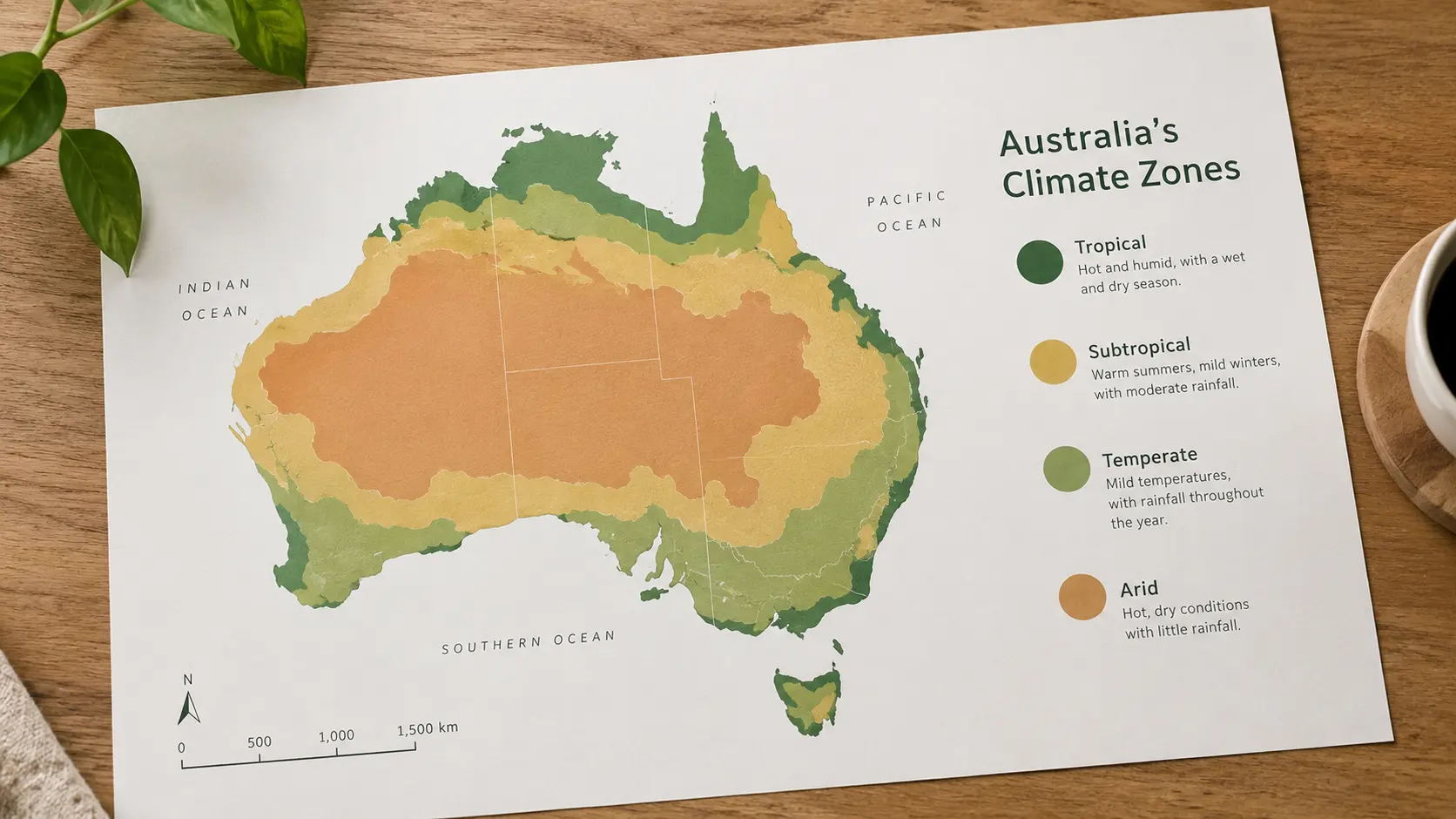
Species selection should start here, because even a well-regarded flowering tree will sulk, fail to bloom, or die outright outside its climate range.
Australia’s east coast alone spans temperate, subtropical and tropical zones, and a tree that thrives in Melbourne’s temperate climate — like many camellias — can perform completely differently in Brisbane’s subtropical humidity, and differently again in a dry inland zone. Australia’s climate spans several distinct zones, and the Bureau of Meteorology’s climate zone classifications show just how differently the tropics, subtropics and temperate south behave — which is exactly why a tree that thrives in Melbourne can struggle in Brisbane.
| Climate Zone | Well-Suited Tree Types |
| Temperate (Melbourne, Adelaide, Hobart) | Camellias, dwarf cherry blossom, forest pansy |
| Subtropical (Brisbane, Sydney) | Michelia figo, tibouchina, ornamental pear |
| Tropical (Cairns, Darwin) | Bougainvillea, silk tree, fire wheel tree |
| Dry/inland | Native flowering gums, hardier native ornamentals |
For a full state-by-state index of flowering species, see our Flowering Trees Australia guide.
Match the Tree to Your Space and Purpose
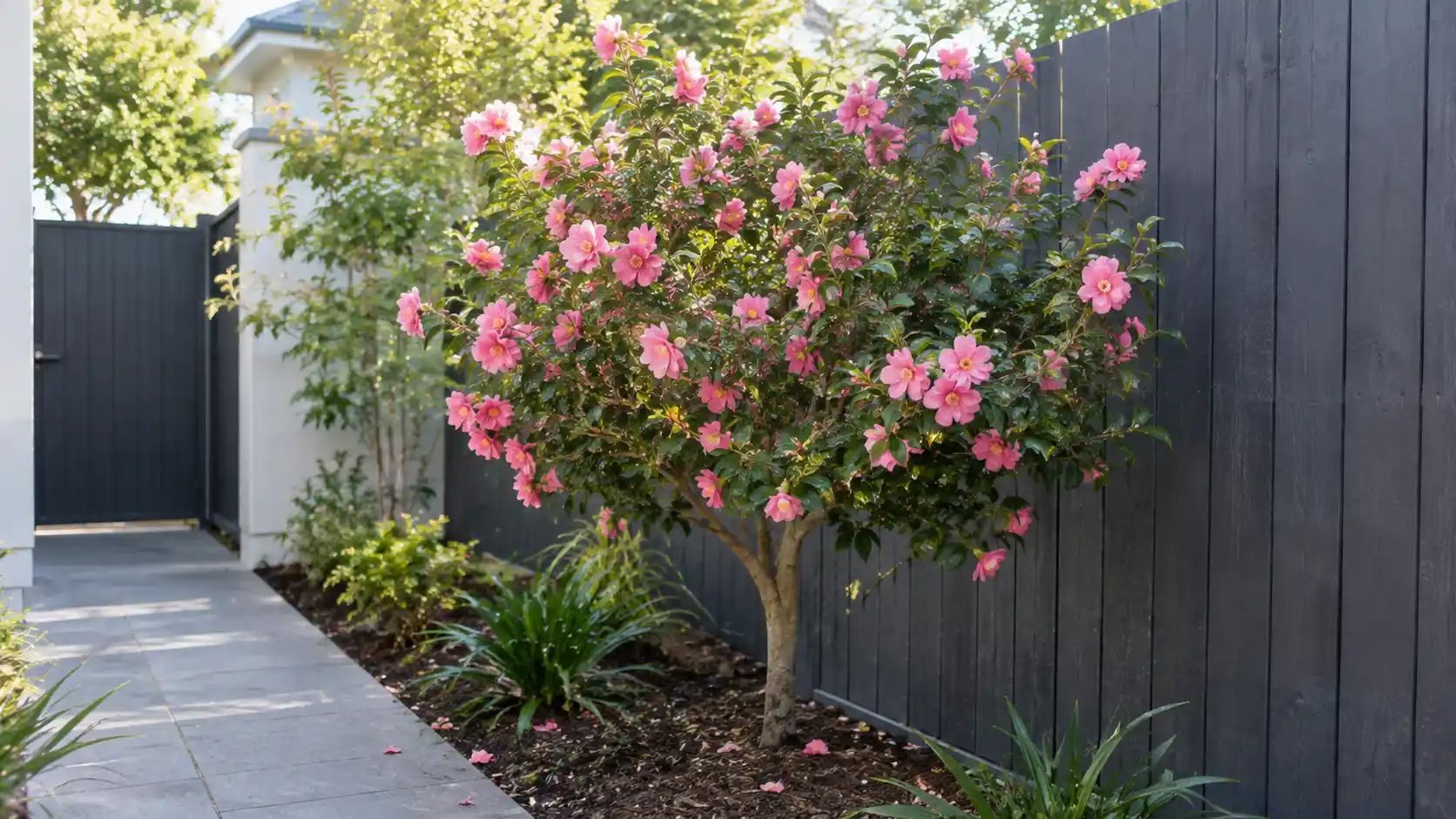
Once climate is settled, the next filter is what the tree needs to do and how much room it actually has.
Small gardens, courtyards and narrow spaces: dwarf and compact varieties are the safer bet here — the Dwarf Forest Pansy Tree, Pink Dwarf Flowering Gum and Pink Silk Tree are all bred or selected for restrained size. Our best flowering trees for small gardens guide goes deeper on this specifically.
Pots and containers: root space is the limiting factor, not just canopy size — dwarf cultivars again do best here, but expect more frequent watering and feeding than an in-ground tree.
Street verges, feature specimens, screening: here you have more room to consider larger growers, and function matters more than compactness — a screening/privacy planting has different priorities to a single feature specimen near an entry.
Quick function checklist:
- Need shade as well as flowers? Look for broader canopy species, not columnar ones
- Need low litter near paving or a pool? Prioritise evergreen, non-messy bloomers
- Need a single “wow” specimen? A strong seasonal bloomer earns its keep even with a short flowering window
- Need year-round screening? Evergreen ornamentals outperform deciduous ones here
Deciduous vs Evergreen: Design Asset or Mess Problem?
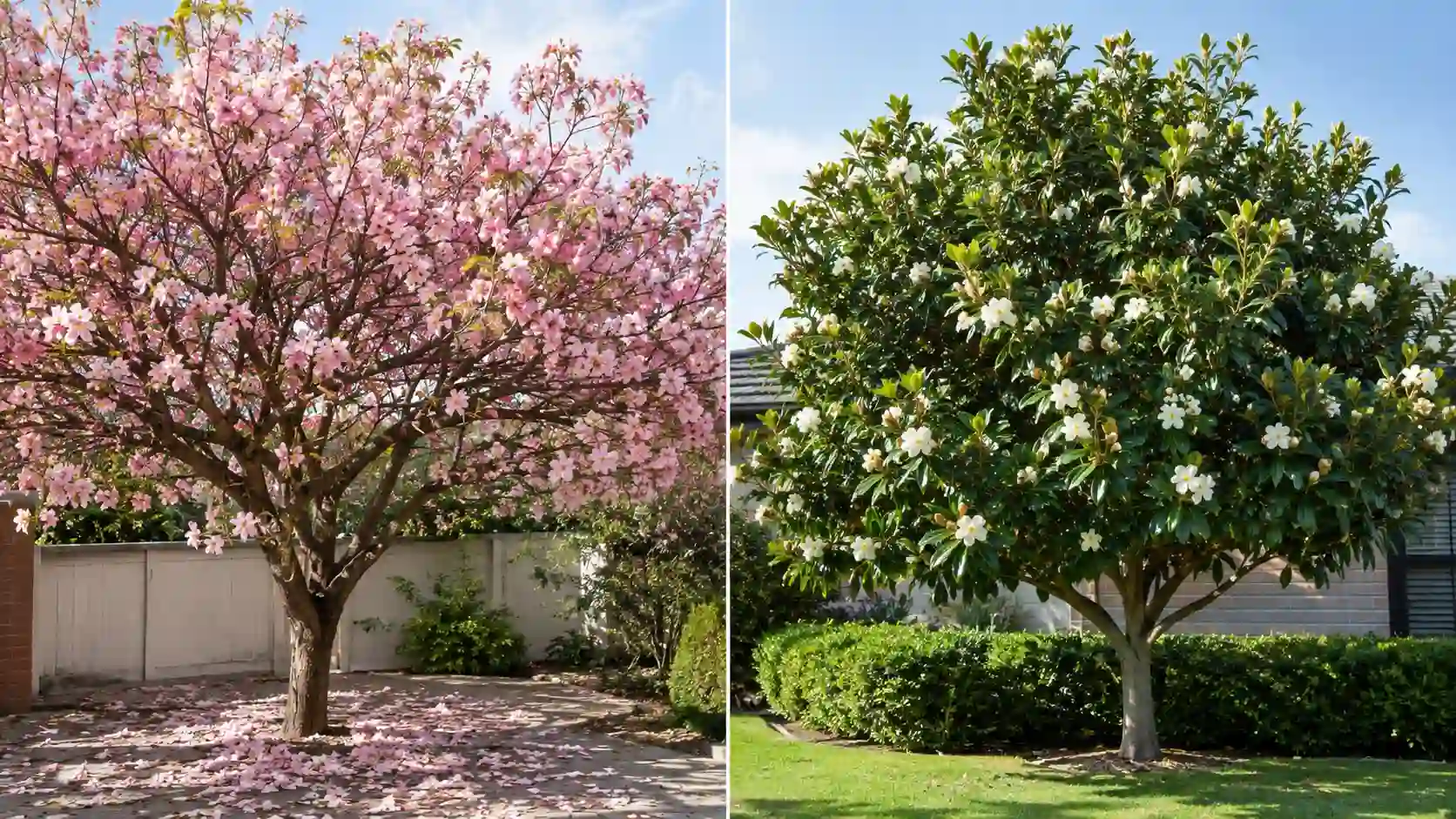
Deciduous trees drop their leaves (and often their spent flowers) seasonally. Whether that’s a design feature or a clean-up burden depends entirely on where the tree is planted.
Evergreen species like Camellia Setsugekka and the Japanese Camellia hold their foliage year-round, giving consistent screening and minimal litter — a safer choice near pools, entertaining areas or paving. The Dwarf Cherry Blossom Tree, by contrast, is deciduous with a heavy petal drop — spectacular for two to three weeks, then a genuine clean-up job on paving or pool surfaces.
| Factor | Deciduous | Evergreen |
| Litter level | High (seasonal leaf + flower drop) | Low, ongoing minimal drop |
| Seasonal interest | Strong — distinct seasonal display | Consistent, less dramatic |
| Maintenance | Seasonal clean-up required | More consistent light upkeep |
| Best near pools/paving | Only if drop is manageable | Generally safer |
Native vs Exotic Ornamental Trees
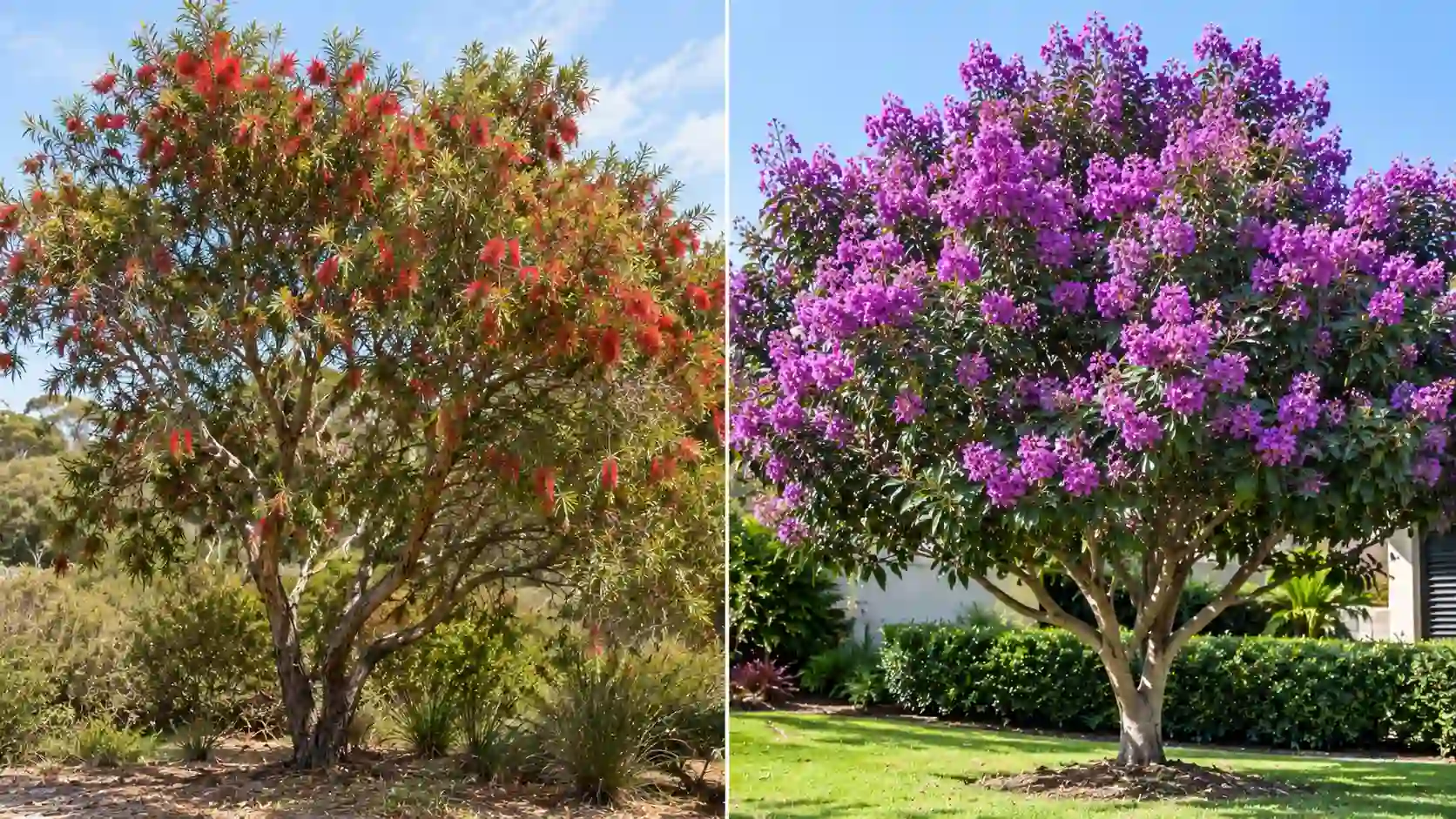
This is one of the most under-covered comparisons in Australian gardening content, and it’s a real trade-off, not a clear winner either way.
Natives and near-natives — like the Queensland Fire Wheel Tree and New Zealand Christmas Bush — generally use less water once established and support local birds and pollinators. Exotics — Michelia Figo (Port Wine Magnolia), Tibouchina Alstonville, and the Rare Blue Bougainvillea — often deliver a bolder, longer, or more unusual bloom, and are typically easier to source at mainstream nurseries.
| Factor | Native / Near-Native | Exotic |
| Water needs | Lower once established | Often higher |
| Wildlife value | High (birds, pollinators) | Variable, often lower |
| Mess/litter | Generally moderate | Varies by species |
| Longevity | Often long-lived, climate-adapted | Variable, climate-dependent |
| State availability | Can be regional/harder to source | Widely available |
Flowering Season and Bloom-Succession Planning
A single flowering tree gives you one burst of colour a year. Combining two or three species with different bloom windows gives you colour across multiple seasons — something almost no competing guide addresses directly.
| Species | Typical Bloom Season | Colour |
| Dwarf Cherry Blossom | Late winter–spring | Pink/white |
| Tibouchina Alstonville | Summer–autumn | Purple |
| Michelia Figo | Spring | Cream, port-wine edge |
| Camellia (Setsugekka/Japanese) | Autumn–winter | White/pink/red |
| Queensland Fire Wheel Tree | Spring–summer | Red |
| Bougainvillea (blue) | Warm months, extended | Blue/purple |
7. Colour Round-Up (By Popular Search Colour)
If you already know the colour you want, these guides go deeper on that shade specifically:
- Pink flowering trees: Trees with Pink Flowers, Pink Dwarf Flowering Gum, Pink Silk Tree
- Purple flowering trees: Purple Flower Tree Australia, Tibouchina Alstonville
- Blue flowering trees: Rare Blue Bougainvillea
Safe Planting Distances From Pools, Paving, Driveways and Foundations
The right distance depends on root habit and mature canopy/root spread — not the trunk size at planting time, which is what catches most people out.
Species with aggressive or shallow spreading root systems need more clearance from paving, pools and foundations; compact, fibrous-rooted dwarf varieties are generally safer close in. As a rule of thumb, plan clearance in line with expected mature canopy width, and lean toward dwarf cultivars (Forest Pansy, Pink Dwarf Flowering Gum) within a few metres of pools or paving.
Signs a species is pool/paving-safe:
- Sold or bred specifically as a dwarf/compact cultivar
- Fibrous rather than aggressive lateral root system
- Low natural leaf/flower litter (evergreen, small-leafed)
Signs it’s a higher-risk choice close to structures:
- Marketed primarily by mature size/vigour rather than compactness
- Known for a heavy seasonal leaf or flower drop
- Naturally large surface-root habit
Why Isn’t My Flowering Tree Blooming?
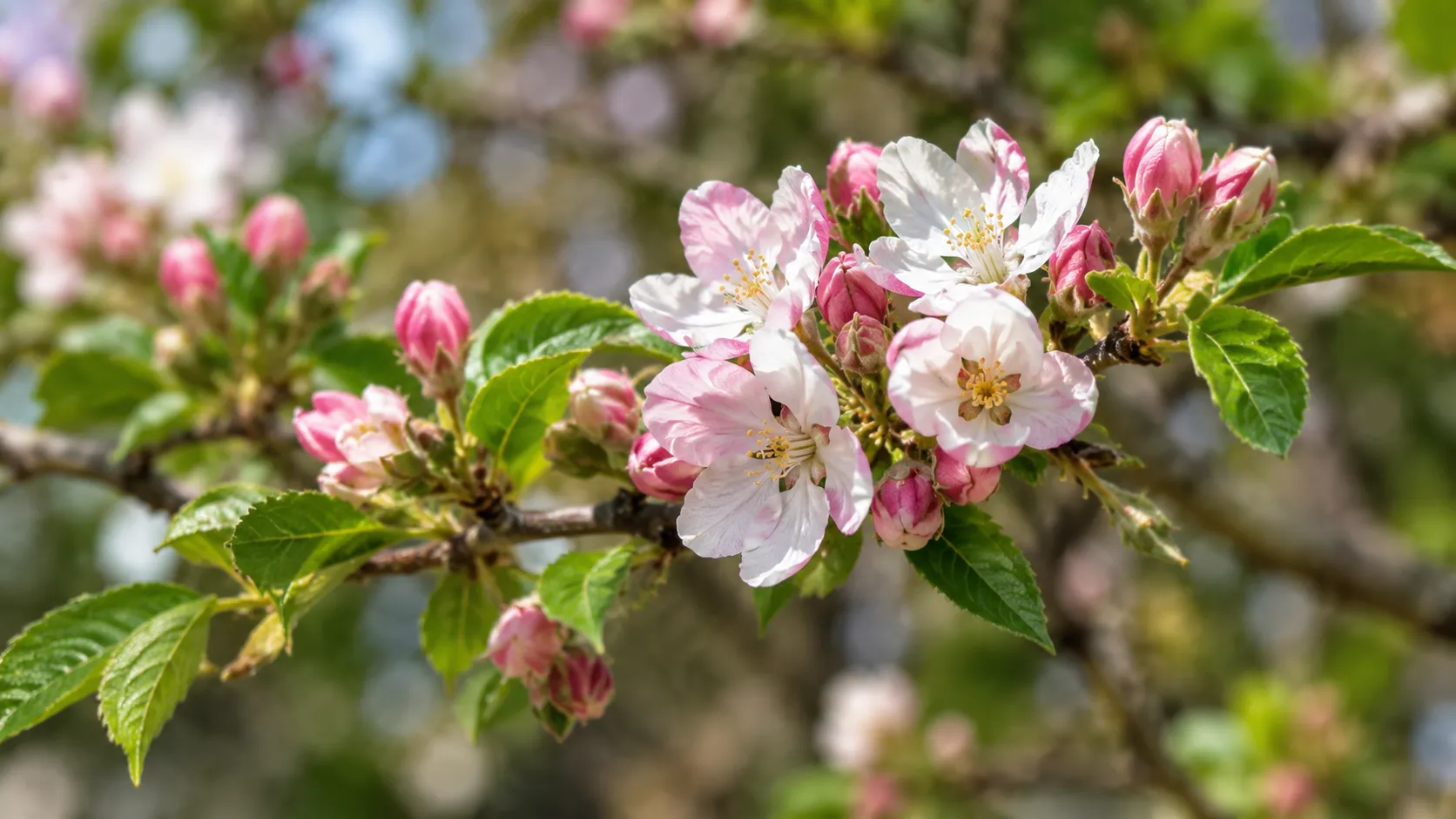
If an established tree isn’t flowering, the cause is usually one of five things — and all of them are fixable.
Tree still juvenile. Many flowering trees, especially grafted or seed-grown ornamentals, simply need to mature before they bloom reliably — sometimes 2–4 years. Patience is the fix.
Pruned at the wrong time. Pruning a spring-flowering tree in winter can cut off the very buds that would have flowered. Prune after flowering finishes, not before it starts. Timing is everything here — as Burke’s Backyard’s pruning guide explains, pruning spring-flowering species too early removes the very buds that would have opened, so the safest rule is to prune only once flowering has finished.
Over-fertilised with nitrogen. High-nitrogen feed pushes leafy growth at the expense of flowers. Switch to a lower-nitrogen, higher-phosphorus feed formulated for flowering trees.
Insufficient direct sun. Most flowering trees need several hours of direct sun to set buds. A tree that’s become shaded out by taller neighbours over time will flower less each year.
Transplant shock. A recently relocated or newly planted tree often skips flowering for a season or two while it re-establishes roots. This usually resolves on its own within a year or two.
Common Mistakes to Avoid
- Choosing purely on flower colour without checking mature size or root habit
- Ignoring deciduous litter near a pool or entertaining area
- Planting a shade-loving species in full sun, or a sun-lover in shade
- Skipping the climate-zone check and assuming a tree that thrived interstate will perform the same locally
Conclusion
Choosing a flowering or ornamental tree works best in this order: confirm your climate zone, match the tree to your space and purpose, decide whether deciduous or evergreen suits the spot, then choose the species and colour. Getting this sequence right — rather than picking on colour alone — is what separates a tree that thrives and blooms reliably for decades from one that ends up struggling, making a mess, or getting removed a few years in.
This guide works the other way around. It starts with the decisions that actually determine whether a flowering or ornamental tree succeeds in your garden — climate, space, deciduous vs evergreen — and only then gets to species and colour. For a broader look at tree selection across your whole garden — not just flowering species — see our complete guide to trees and outdoor plants.
FAQs
What is the difference between a flowering tree and an ornamental tree?
A flowering tree is grown primarily for its bloom display, while an ornamental tree is valued for its overall visual contribution — form, bark, foliage — with flowering sometimes a secondary feature.
What is the best flowering tree for a small Australian garden?
Dwarf cultivars such as the Dwarf Forest Pansy Tree or Pink Dwarf Flowering Gum are bred for compact size and suit small gardens, courtyards and pots better than full-size species.
How far should a flowering tree be planted from a pool or paving?
Clearance should be based on the species’ mature canopy and root spread, not its size at planting — dwarf, fibrous-rooted cultivars are generally the safer choice close to structures.
Why has my flowering tree stopped blooming?
The most common causes are juvenile age, incorrect pruning timing, over-fertilising with nitrogen, insufficient direct sun, or recent transplant shock.
Are native or exotic flowering trees better for Australian gardens?
Natives typically use less water and support more local wildlife, while exotics often offer bolder or longer blooms and wider nursery availability — the better choice depends on your priorities.
Can you have a flowering tree in bloom year-round in Australia?
Not from a single tree, but combining species with staggered bloom seasons — such as a spring-flowering cherry blossom with an autumn-flowering camellia — can give colour across most of the year.