
Pink Dwarf Flowering Gum: Size, Care & Varieties Guide
Introduction
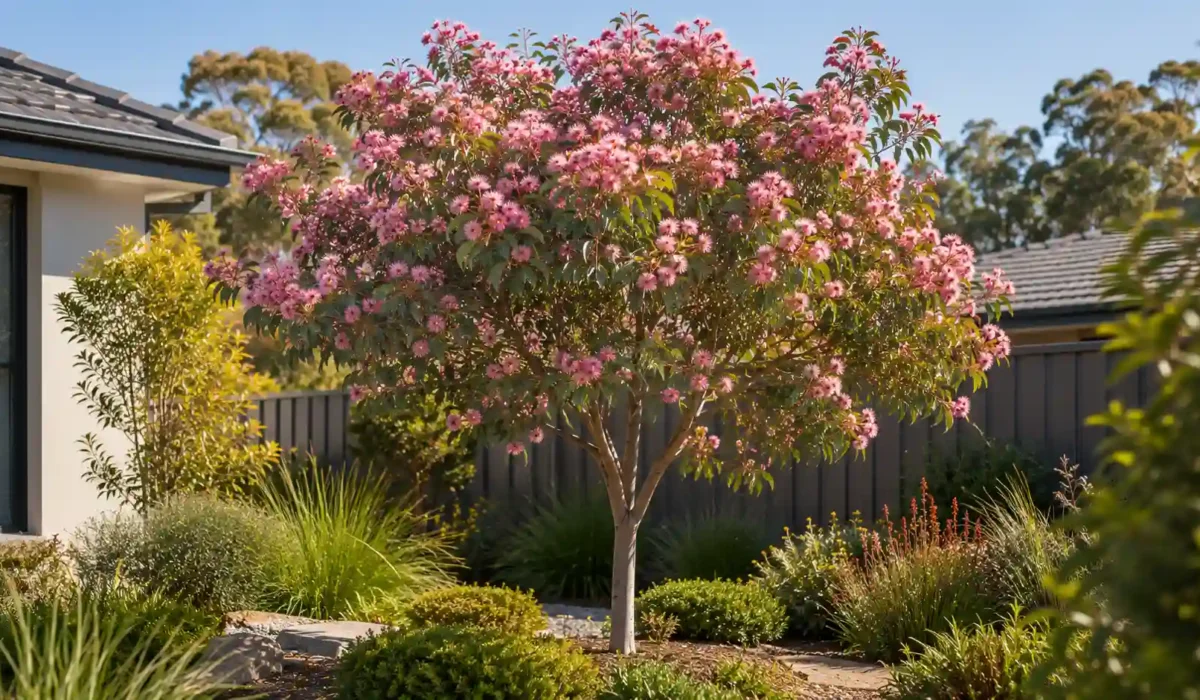
A pink dwarf flowering gum is a compact, grafted cultivar of Corymbia ficifolia (formerly known as Eucalyptus ficifolia) developed to provide the species’ famous summer flower display in a smaller garden-friendly form. Unlike the wild flowering gum, which can naturally reach around 10 m tall and develop a lignotuber, dwarf forms are purpose-bred by grafting selected flowering branches onto dwarfing rootstocks. Popular types such as Corymbia ficifolia ‘Summer Beauty’ and ‘Mini Red’ are designed for suburban gardens where space is limited. A pink dwarf flowering gum is not a naturally miniature tree; it is a carefully produced grafted plant that combines reliable flower colour with controlled growth. These trees are also commonly called dwarf corymbia ficifolia or flowering gum dwarf varieties.
Quick Summary
- Pink dwarf flowering gums are grafted Corymbia ficifolia cultivars bred for compact growth.
- Most dwarf varieties grow between 2.5–7 m tall, compared with 10–15 m or more for standard forms.
- They produce colourful summer flowers that attract nectar-feeding birds.
- Grafting provides predictable flower colour, unlike seed-grown trees with variable results.
- Compact cultivars are suitable for smaller Australian gardens, courtyards, and some container settings.
What Is a Pink Dwarf Flowering Gum?
A pink dwarf flowering gum is a compact ornamental form of Corymbia ficifolia, a species in the Myrtaceae family known for its large clusters of colourful flowers and attractive evergreen foliage. Although historically classified as Eucalyptus ficifolia, modern botanical classification places this species in the genus Corymbia.
The species was previously classified under the Eucalyptus genus before botanical studies moved it into Corymbia; more background on this classification can be found on the Wikipedia page for Corymbia ficifolia.
The term flowering gum refers to several Australian trees within Corymbia and related genera that produce showy nectar-rich flowers. Corymbia ficifolia is particularly valued because it produces some of the brightest flower colours, including pink, red, orange, and salmon shades.
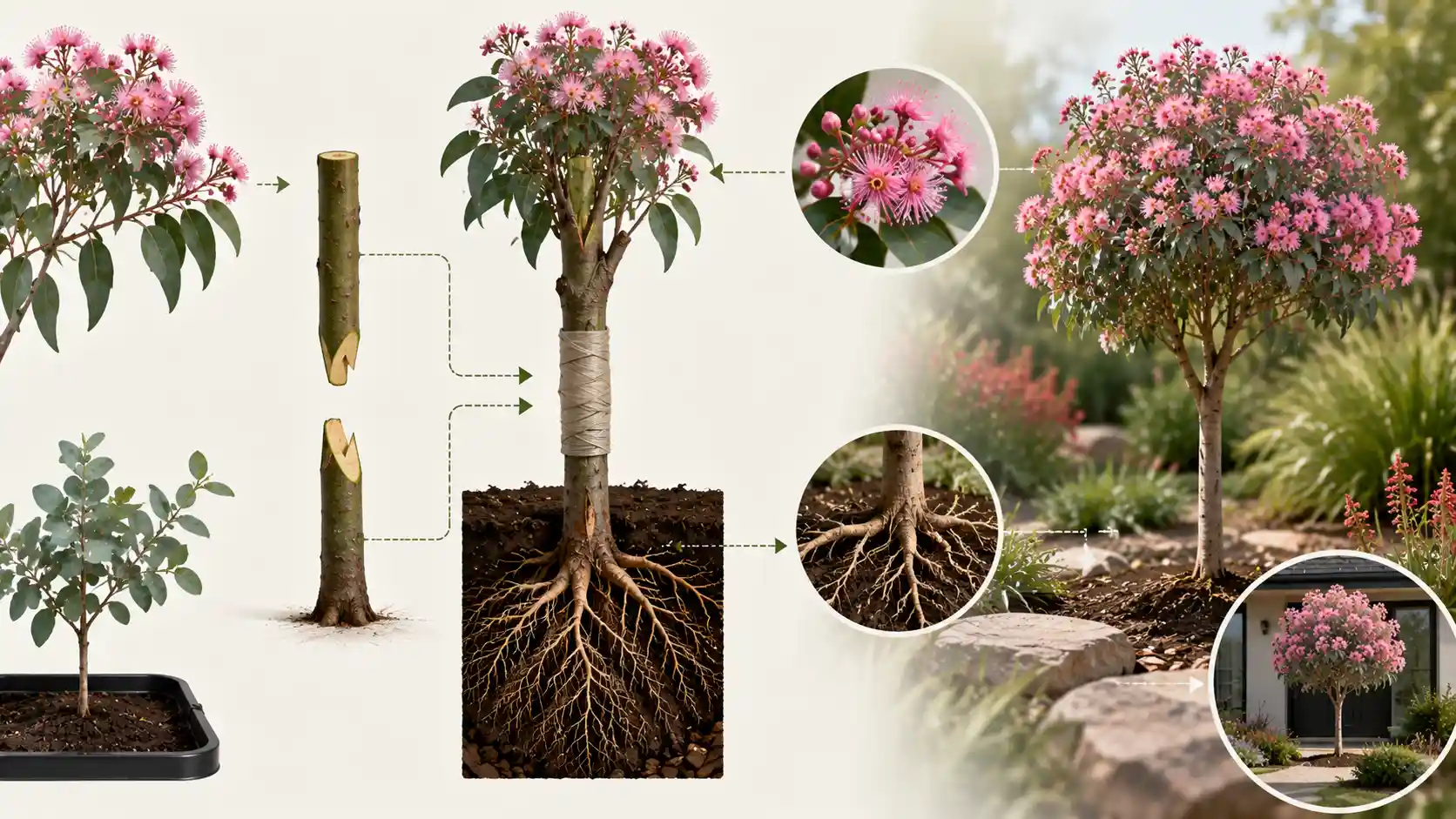
Dwarf flowering gums are created through horticultural grafting rather than natural dwarf genetics. Growers select a desirable flowering form and attach it onto a suitable rootstock that limits overall size while maintaining the original flower characteristics.
Common characteristics include:
- Evergreen foliage throughout the year.
- Large clusters of summer flowers.
- Compact growth compared with wild forms.
- Strong wildlife value due to nectar production.
- Reliable flower colour when purchased as grafted stock.
In our experience growing compact flowering gums in Australian garden settings, choosing the correct grafted cultivar is one of the most important decisions because two trees labelled as “dwarf flowering gum” can have very different mature sizes.
Why “Dwarf” Doesn’t Mean a Different Species
The word “dwarf” describes the growth habit created by the graft combination, not a separate botanical species.
A dwarf flowering gum usually consists of:
- A flowering scion taken from a selected Corymbia ficifolia cultivar.
- A rootstock from a compatible species such as Corymbia maculata or Corymbia ptychocarpa.
- A graft union where the two plant parts are joined.
The scion determines flower colour and many ornamental characteristics, while the rootstock influences vigour, adaptation, and final size.
This distinction is important because seed-grown Corymbia ficifolia trees do not reliably reproduce the same flower colour. A seedling may produce flowers that differ from the parent tree, whereas grafted cultivars are selected to maintain their known appearance.
Is There a Dwarf Flowering Gum? (Popular Pink and Compact Varieties)
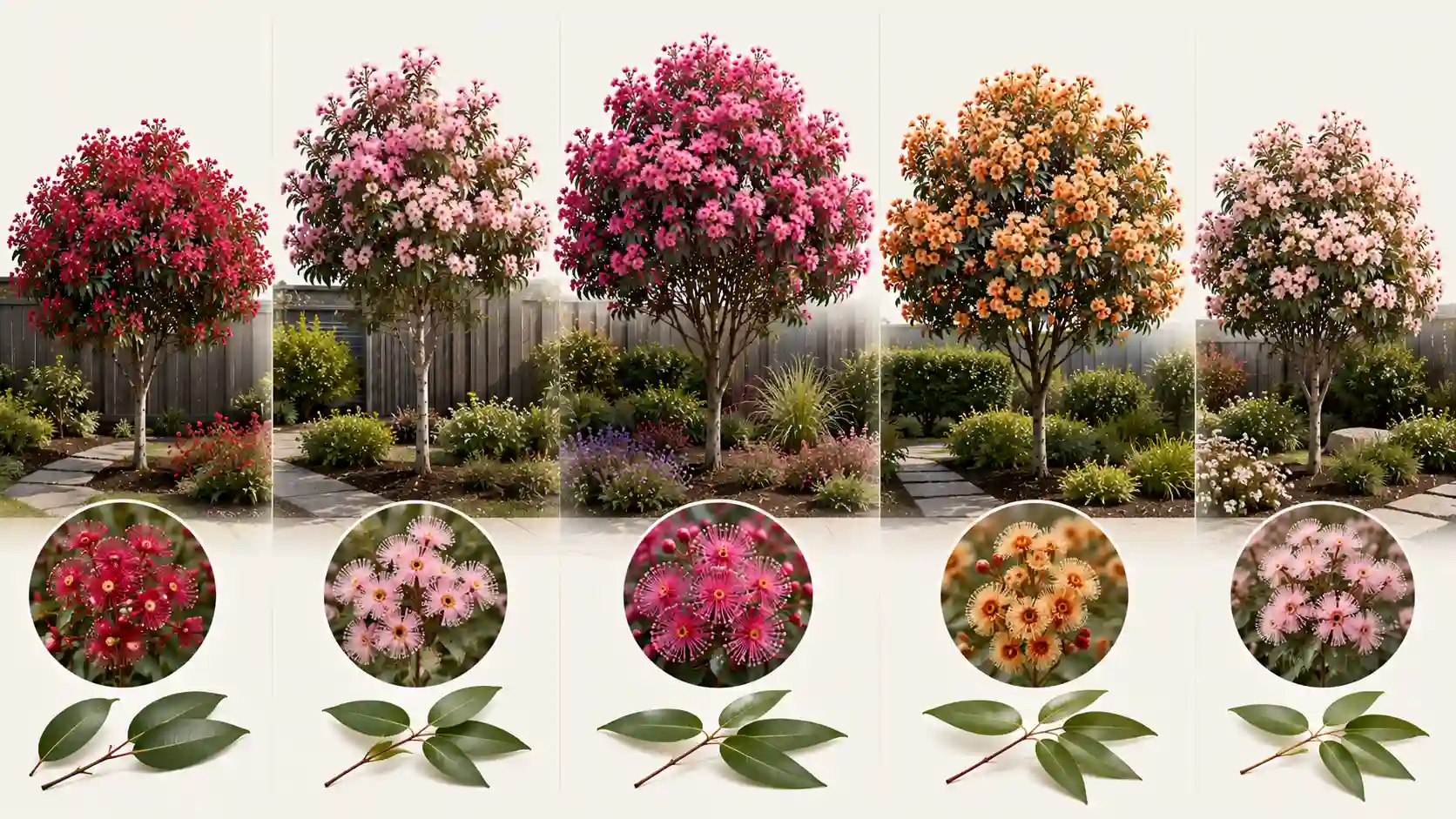
Yes, dwarf flowering gums are available, and several compact Corymbia ficifolia cultivars are specifically bred for smaller gardens. These varieties provide the same spectacular flowering display as larger flowering gums but with more manageable dimensions.
Popular compact cultivars include:
| Variety | Height | Width | Flower Colour |
| Corymbia ficifolia ‘Summer Beauty’ | 5–7 m | 4–6 m | Soft pink with apricot hint |
| Corymbia ficifolia ‘Mini Red’ | 2.5–3 m | 2 m | Bright red |
| Corymbia ficifolia ‘Baby Orange’ | 3 m | 3 m | Orange |
| Corymbia ficifolia ‘Calypso’ | 5 m | — | Deep pink |
| Corymbia ficifolia ‘Fairy Floss’ | 7 m | — | Light pink |
Heights vary depending on supplier information, climate, soil conditions, and growing region.
These cultivars are commonly chosen for:
- Small suburban gardens.
- Front-yard feature planting.
- Native garden designs.
- Bird-friendly landscapes.
- Areas where a full-size flowering gum would become too large.
The popular Corymbia Summer Beauty and Corymbia ficifolia Summer Beauty are especially valued for their soft pink flowers and balanced growth habit. The Corymbia ficifolia Mini Red, also called the Mini Red flowering gum, is one of the smallest options available and suits gardens where space is limited.
What Small Flowering Gums Are Pink?
The best-known small pink flowering gums are Corymbia ficifolia ‘Summer Beauty’ and ‘Calypso’. These compact cultivars produce pink-toned flowers while maintaining a smaller structure than standard flowering gums. If you are exploring other colourful flowering trees, our guide to tree with pink flowers Australia explains popular pink-flowering species and how to identify them in different garden settings.
‘Summer Beauty’ is recognised for its soft pink blooms with subtle apricot tones, while ‘Calypso’ produces deeper pink flowers. Both are grafted cultivars selected for ornamental gardens.
Dwarf Flowering Gum Size and Growth Habits
Dwarf flowering gum size depends heavily on the cultivar, rootstock, climate, and growing conditions. Although described as “dwarf”, these trees are not all miniature plants. Some remain around 2.5 m tall, while others can reach 7 m at maturity. Gardeners looking for faster-growing evergreen options can also compare other species in our fast growing evergreen trees Australia guide, which covers suitable trees for different landscape needs.
Typical mature sizes include:
- Small cultivars: approximately 2.5–3 m tall.
- Medium dwarf cultivars: around 5 m tall.
- Larger compact cultivars: up to 7 m tall.
Width also varies significantly. Trees such as ‘Mini Red’ may stay around 2 m wide, while ‘Summer Beauty’ can develop a broader canopy suitable for larger suburban gardens.
The smallest grafted varieties may also be grown in large containers when provided with adequate drainage, regular watering, and appropriate pruning. Container growth will usually restrict overall size compared with trees planted directly into the ground.
How Tall Do Dwarf Gum Trees Grow?
Dwarf gum trees generally grow between 2.5 m and 7 m tall, depending on the cultivar. Smaller types like Corymbia ficifolia ‘Mini Red’ may remain close to 3 m, while varieties such as ‘Fairy Floss’ can reach around 7 m.
The final height depends on:
- Cultivar genetics.
- Rootstock selection.
- Soil quality.
- Climate conditions.
- Water availability.
- Pruning practices.
Can You Keep a Gum Tree Small?
Yes, gum trees can be managed through pruning, suitable planting conditions, and careful cultivar selection, but dwarf grafted varieties are the most reliable option for maintaining a smaller size.
Size management methods include:
- Choosing a naturally compact grafted cultivar.
- Performing light formative pruning when young.
- Growing smaller varieties in containers.
- Avoiding excessive fertiliser that encourages rapid growth.
Pruning alone cannot reliably transform a large standard flowering gum into a true dwarf tree. Selecting the right cultivar from the beginning provides the best long-term result. Understanding root behaviour is also important when selecting a gum tree for smaller spaces; our gum tree root system guide explains root spread, common concerns, and safe planting distances.
Growth Rate of Dwarf Flowering Gums
Dwarf flowering gums are generally considered moderate growers, although some sources describe Corymbia ficifolia as slow to moderate depending on environmental conditions. Growth speed varies according to soil drainage, rainfall, temperature, and plant establishment.
Young trees usually require consistent care while developing their root system. Once established, many grafted flowering gums become more drought-tolerant and require less maintenance.
Seasonal growth patterns commonly include:
- Faster growth during warm spring and summer conditions.
- Reduced growth during colder months.
- Slower establishment during drought or frost stress.
Environmental factors affecting growth include:
- Poor drainage slowing root development.
- Heavy frost damaging young growth.
- Limited sunlight reducing flowering and vigour.
- High humidity increasing disease risk in some areas.
How Quickly Does a Flowering Gum Grow?
A flowering gum grows at a moderate rate, with growth depending on climate, soil, and care conditions. Grafted dwarf varieties generally establish faster than seed-grown trees because the grafted material comes from mature flowering wood.
Good conditions for faster growth include:
- Full sun exposure.
- Well-drained soil.
- Regular watering during establishment.
- Protection from severe frost when young.
Once established, growth becomes more consistent, with flowering typically occurring earlier in grafted cultivars compared with trees grown from seed.
Caring for a Pink Dwarf Flowering Gum
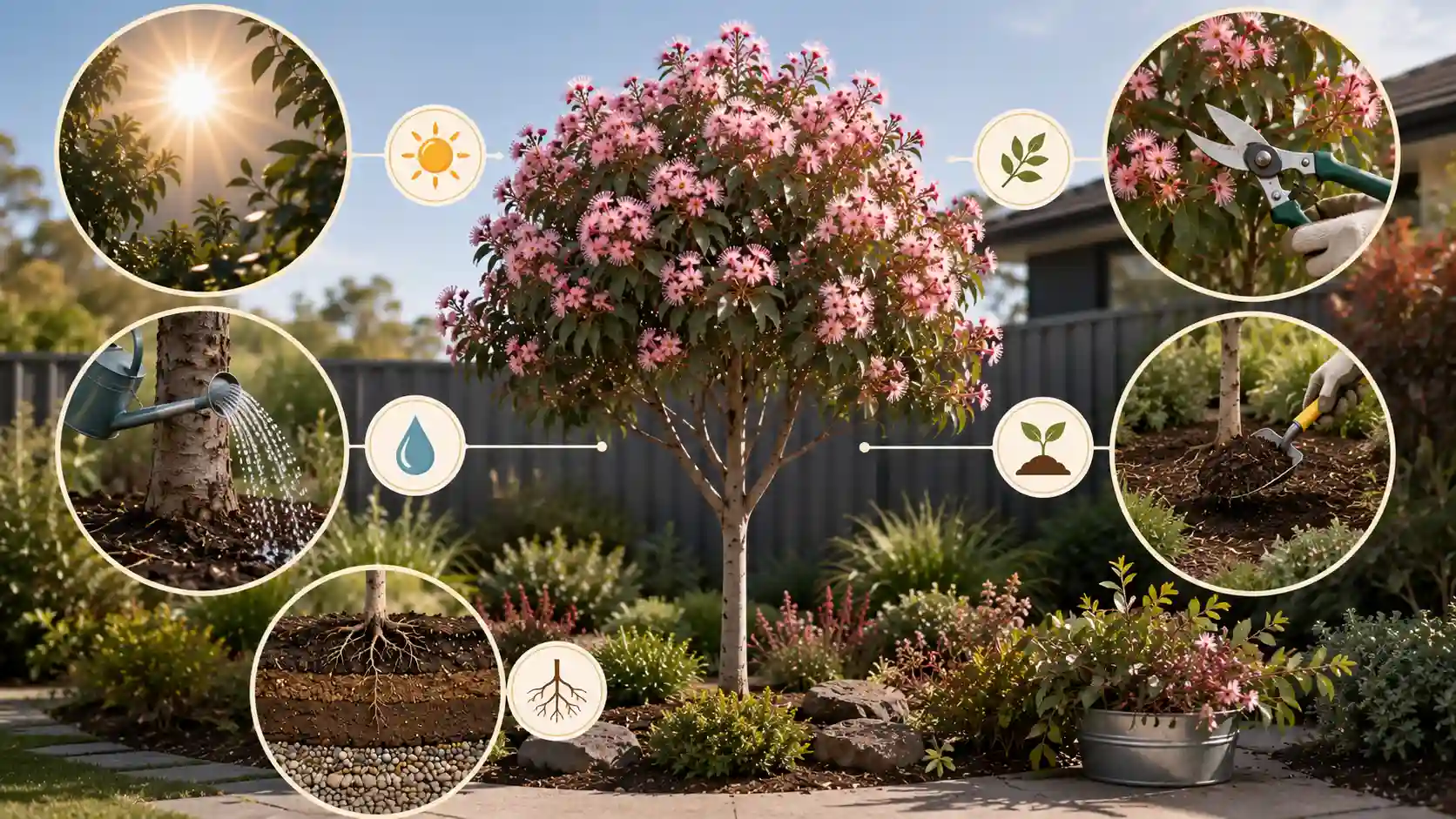
Caring for a pink dwarf flowering gum mainly involves providing full sun, well-drained soil, appropriate watering during establishment, and protection from environmental stress. Although these trees are relatively low-maintenance once established, correct planting conditions are essential because Corymbia ficifolia naturally prefers Australian conditions with good drainage and strong sunlight.
A healthy grafted flowering gum develops a stronger structure and produces better flowering when planted in a suitable position. In our experience growing grafted flowering gums, most problems occur because they are treated like moisture-loving garden plants rather than drought-adapted Australian natives.
Key care requirements include:
- Full sun for maximum flowering.
- Free-draining soil to prevent root problems.
- Deep watering during establishment.
- Minimal pruning to maintain shape.
- Native-friendly fertilisers rather than high-phosphorus products.
Watering Requirements
Young pink dwarf flowering gums require regular watering while their root systems become established. During the first growing seasons, deep watering encourages roots to grow downwards rather than remaining near the surface.
Once mature, these trees are relatively drought-tolerant, but prolonged dry periods can reduce flowering and cause stress symptoms.
Signs of incorrect watering include:
- Yellowing leaves caused by excessive moisture.
- Leaf drop from root stress or drought.
- Poor growth during extended dry periods.
Avoid frequent shallow watering because it encourages weak surface roots. Instead, water deeply and allow the soil to partially dry between watering sessions.
Light Requirements
Pink dwarf flowering gums perform best in full sun. Direct sunlight encourages stronger growth, denser foliage, and the heavy summer flowering display that makes Corymbia ficifolia popular.
The tree can tolerate light shade, but reduced sunlight may result in:
- Fewer flowers.
- Less vigorous growth.
- A thinner canopy.
For the best flowering performance, plant the tree where it receives at least six hours of direct sunlight daily.
Soil Requirements
Well-drained soil is one of the most important requirements for dwarf flowering gums. They prefer sandy or loamy soils that allow excess water to drain away quickly.
Suitable soil conditions include:
- Sandy native soils.
- Loamy soils with good drainage.
- Slightly acidic to neutral soil conditions.
They do not perform well in heavy clay soils that remain wet for long periods. If drainage is poor, planting on a raised mound or improving soil structure can help prevent root problems.
Fertilising Requirements
Dwarf flowering gums generally need minimal fertilising once established. Excessive fertiliser, especially high-phosphorus products, can damage Australian native plants.
A suitable approach includes:
- Applying a balanced native fertiliser during spring.
- Following product instructions carefully.
- Avoiding overfeeding to force rapid growth.
Spring feeding supports active growth and flower development before the warmer flowering season.
Pruning Requirements
Pink dwarf flowering gums require only light pruning to maintain shape or remove damaged branches. They naturally develop an attractive form when grown in suitable conditions.
Pruning can be used for:
- Removing dead or damaged wood.
- Maintaining a balanced canopy.
- Encouraging a stronger young structure.
A critical rule with grafted flowering gums is to avoid removing growth below the graft union. Shoots emerging from the rootstock can be vigorous and may eventually dominate the desired flowering variety.
Climate Tolerance
Established dwarf flowering gums tolerate a range of Australian climates, but young plants require more protection.
They generally tolerate:
- Warm temperate climates.
- Mild drought conditions after establishment.
- Light frost once mature.
They may struggle with:
- Heavy frost when young.
- Constantly humid conditions.
- Poor air circulation.
- Waterlogged soils.
As of 2026, growers continue to recommend selecting cultivars suited to local climate conditions, particularly in humid coastal areas where some grafted varieties may require better airflow and drainage.
The term euky dwarf flowering gum is sometimes used commercially, but it is important to note that some “dwarf eucalypt” varieties belong to different species. For example, some dwarf forms may come from Eucalyptus leucoxylon rather than Corymbia ficifolia. This distinction matters because flowering behaviour, size, and climate suitability can differ.
The broader term dwarf eucalyptus may refer to many compact eucalyptus-related plants, not specifically dwarf flowering gums.
Do Flowering Gums Need Full Sun?
Yes, flowering gums need full sun for the best flowering performance. While they can tolerate some light shade, reduced sunlight usually leads to fewer flowers and weaker growth.
A sunny position helps:
- Increase flower production.
- Maintain healthy foliage.
- Improve overall tree structure.
Planting in an open position away from large structures or competing trees usually provides the best results.
Can You Prune a Dwarf Flowering Gum?
Yes, you can prune a dwarf flowering gum with light formative pruning, but heavy pruning is usually unnecessary. The main purpose of pruning is to remove damaged branches, maintain shape, and improve structure.
When pruning grafted trees:
- Do not cut below the graft union.
- Remove rootstock suckers promptly.
- Avoid excessive canopy removal.
Removing the wrong branches can allow the rootstock to become dominant and reduce the ornamental value of the tree.
Common Problems With Dwarf Flowering Gums
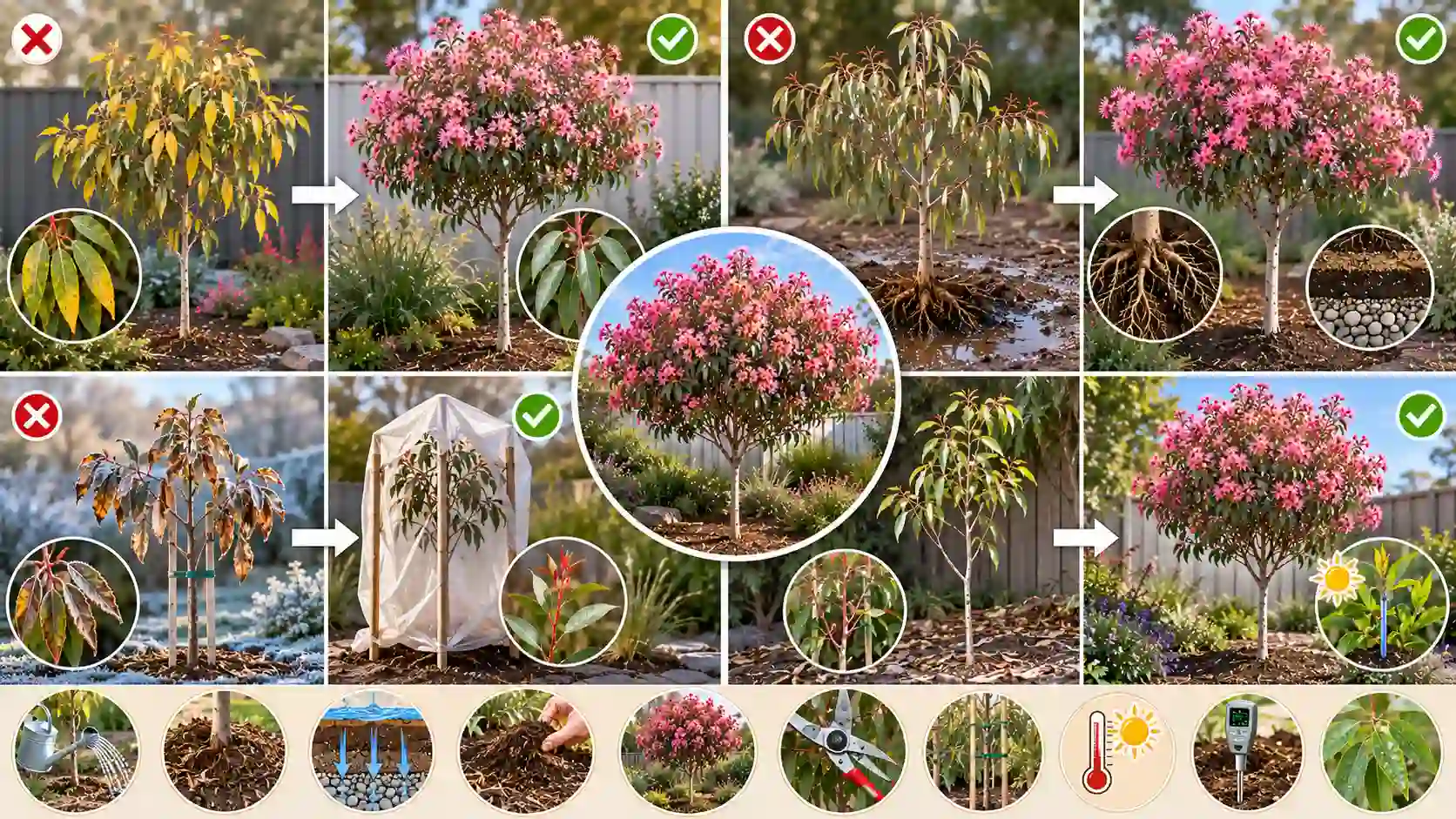
Dwarf flowering gums are generally hardy, but several problems can occur when growing conditions are unsuitable. Most issues are related to water management, soil conditions, climate stress, or incorrect maintenance.
Yellowing Leaves and Leaf Drop
Yellow leaves and leaf drop are commonly caused by overwatering or poor drainage. Although flowering gums need water during establishment, their roots dislike sitting in constantly wet soil.
Possible causes:
- Waterlogged soil.
- Frequent shallow watering.
- Poor drainage.
- Root stress.
Solutions:
- Reduce watering frequency.
- Improve soil drainage.
- Check that irrigation is not keeping the soil constantly wet.
- Allow the root zone to dry slightly between watering.
Root Rot
Root rot develops when roots remain exposed to excessive moisture for long periods. Poor drainage reduces oxygen around the roots and creates conditions where fungal pathogens can damage the root system.
Prevention methods:
- Plant in free-draining soil.
- Avoid low-lying wet areas.
- Use raised planting areas if necessary.
- Avoid overwatering established trees.
Slow or Stunted Growth
Slow growth may occur when a dwarf flowering gum lacks suitable growing conditions.
Common causes include:
- Insufficient sunlight.
- Nutrient deficiency.
- Poor soil drainage.
- Lack of water during establishment.
Improving sunlight, correcting soil issues, and providing appropriate care can help restore healthier growth.
Frost Damage in Young Trees
Young dwarf flowering gums are more vulnerable to frost damage than established trees. Cold temperatures can damage leaves, shoots, and graft unions.
Protection methods include:
- Using hessian wrapping during severe frost periods.
- Planting in sheltered locations.
- Avoiding exposed frost pockets.
Established trees usually tolerate light frost better as their root systems mature.
Fungal Issues Including Marri Canker
Some fungal diseases can affect related Corymbia species. One example is marri canker, caused by Quambalaria coyrecup, which is associated with wounds and damaged plant tissue.
Symptoms may include:
- Bark damage.
- Cracks in branches or trunks.
- Kino (tree sap) exudation.
Prevention includes:
- Avoiding unnecessary trunk damage.
- Maintaining healthy growth conditions.
- Monitoring stressed trees.
Gumnut Drop Hazard
Flowering gums produce large woody seed capsules, commonly called gumnuts. When these fall, they can create practical problems in some locations.
Consider avoiding planting directly beside:
- Walkways.
- Driveways.
- Outdoor entertaining areas.
Fallen gumnuts can become a slip or trip hazard and may require regular cleaning.
What Problems Do Flowering Gums Have?
The most common flowering gum problems include yellowing leaves, root rot from poor drainage, slow growth, frost damage in young plants, fungal issues, and falling gumnuts. Most problems can be prevented by selecting the correct planting position and following suitable watering practices.
Healthy trees usually have fewer issues when grown in full sun with well-drained soil.
Do Gum Trees Fall Over Easily?
Dwarf grafted flowering gums are generally less likely to experience wind-throw problems than large wild gum trees because their canopies are smaller and more controlled.
However, young trees may still require support while establishing.
Helpful practices include:
- Staking young trees in exposed areas.
- Planting in suitable soil.
- Avoiding waterlogged conditions that weaken roots.
Poor drainage and damaged root systems are more significant contributors to instability than normal growth.
Dwarf Flowering Gum vs Standard Flowering Gum
Dwarf flowering gums and standard flowering gums belong to the same general plant group, but they differ significantly in size, reliability, and garden suitability. The main difference is that dwarf cultivars are usually grafted, while standard trees are often grown from seed.
| Feature | Dwarf/Grafted Cultivars | Standard Seedling-Grown |
| Height | 2.5–7 m | Up to 10–15 m |
| Flower colour reliability | Guaranteed (grafted) | Variable |
| Garden suitability | Small/suburban gardens, containers | Large properties, streetscapes |
| Time to flower | Faster (grafted maturity) | Often 5–10 years from seed |
Grafted dwarf cultivars provide predictable colour and manageable size, making them better suited to smaller gardens. Standard flowering gums are better choices where there is enough space for a larger tree.
Where to Buy Dwarf Flowering Gums
When buying a dwarf flowering gum, the most important factor is confirming that the tree is a grafted cultivar rather than a seed-grown plant. Grafted trees provide predictable flower colour and a more reliable mature size, which is especially important when planting in smaller Australian gardens.
Before purchasing, consider the following:
- Check the graft union: A quality grafted flowering gum should have a clear graft point where the flowering scion joins the rootstock.
- Confirm the cultivar name: Varieties such as ‘Summer Beauty’, ‘Mini Red’, ‘Calypso’, and ‘Fairy Floss’ have different mature sizes.
- Review mature dimensions: Do not assume all trees labelled “dwarf” will remain small. Some compact cultivars can still reach 7 m tall.
- Choose healthy plants: Look for strong foliage, no signs of disease, and a well-developed root system.
The terms grafted flowering gum for sale and dwarf flowering gum trees for sale are commonly used by nurseries and online plant suppliers. Availability of specific cultivars, including varieties sometimes searched for through retailers such as Bunnings, can change depending on season, location, and supplier stock.
When selecting a plant, always prioritise the botanical name and cultivar rather than relying only on general labels like “pink flowering gum” or “dwarf gum tree”.
What Is the Native Flowering Gum in Australia?
The native flowering gum most commonly associated with pink and red blooms is Corymbia ficifolia. This species is native to a small region of south-west Western Australia, particularly around the coastal areas near Albany. Corymbia ficifolia is one of many Australian flowering trees valued for ornamental planting, and our flowering trees Australia guide covers additional species suitable for gardens and landscapes.
Although widely planted throughout Australia, Corymbia ficifolia is not naturally distributed across the entire country.
Its popularity comes from its:
- Bright summer flower clusters.
- Attractive evergreen foliage.
- Ability to attract nectar-feeding birds.
- Ornamental value in gardens and streetscapes.
The species was previously classified as Eucalyptus ficifolia, but botanical research moved it into the genus Corymbia. This is why both names are still encountered in gardening references.
Unlike many eastern Australian gum species, Corymbia ficifolia naturally occurs in a relatively restricted area. However, grafted cultivars have allowed gardeners across many regions to grow flowering gums with improved flower colour and more manageable forms.
What to Plant Under a Dwarf Flowering Gum
Plants growing beneath a dwarf flowering gum should tolerate sunny conditions, competition from tree roots, and relatively dry soil once the tree is established. Suitable companion plants are usually low-growing natives or drought-tolerant species that do not compete heavily for moisture. For gardeners planning a complete native landscape, our guide to best trees and shrubs for Australian gardens explores complementary planting choices, garden structure, and suitable species combinations.
Good planting choices include:
- Native groundcovers.
- Low-growing grasses.
- Drought-tolerant shrubs.
- Plants with similar drainage requirements.
Examples of suitable companion planting styles include:
- Creeping native groundcovers for soil coverage.
- Compact Australian shrubs for layered planting.
- Ornamental grasses that tolerate dry conditions.
Avoid planting aggressive species with dense root systems close to the trunk because they may compete with the flowering gum for water and nutrients.
When planting underneath a young tree, maintain some clear space around the trunk to avoid moisture buildup and allow good airflow.
Beginner Mistakes With Dwarf Flowering Gums
Many problems with dwarf flowering gums occur because gardeners misunderstand their growth habits or requirements. Avoiding common mistakes helps the tree establish successfully and maintain reliable flowering.
Planting in Poorly Drained Soil
One of the most common mistakes is planting a flowering gum in heavy, wet soil. Although young trees need regular water, their roots require oxygen and do not tolerate prolonged waterlogging.
Better approach:
- Improve drainage before planting.
- Use raised planting areas if necessary.
- Avoid low spots where water collects.
Overwatering Established Trees
Once established, dwarf flowering gums are relatively drought-tolerant. Continuing frequent watering after establishment can lead to yellowing leaves, root stress, and fungal problems.
Water deeply when required rather than keeping the soil constantly moist.
Planting Too Close to Paths and Driveways
Gardeners sometimes underestimate the impact of falling gumnuts. Although dwarf varieties are smaller, they can still produce woody seed capsules.
Avoid planting directly beside:
- High-traffic pathways.
- Driveways.
- Outdoor seating areas.
Assuming All Dwarf Cultivars Are the Same Size
The term “dwarf” can be misleading. A ‘Mini Red’ flowering gum may remain around 3 m tall, while ‘Fairy Floss’ can reach approximately 7 m.
Always check:
- Mature height.
- Mature width.
- Local growing conditions.
Ignoring Frost Protection in Young Trees
Young grafted flowering gums are more sensitive to frost than established trees. Planting in a sheltered position and providing temporary protection during cold periods improves survival.
Conclusion
Pink dwarf flowering gums, including popular cultivars such as Corymbia ficifolia ‘Summer Beauty’ and ‘Calypso’, provide the iconic flowering gum display in a size suitable for smaller Australian gardens. These trees are not naturally miniature species but carefully grafted cultivars created by combining selected flowering varieties with suitable rootstocks.
Choosing the correct grafted cultivar is essential because dwarf flowering gum sizes vary significantly, from compact 2.5 m forms to larger 7 m selections. For the healthiest growth, plant in full sun, use well-drained soil, provide regular water during establishment, and avoid overwatering mature trees.
A well-selected pink dwarf flowering gum can become a long-lasting feature plant that supports native wildlife, adds seasonal colour, and fits comfortably into suburban landscapes.
Frequently Asked Questions
Is there a dwarf flowering gum?
Yes, dwarf flowering gums are available as grafted cultivars of Corymbia ficifolia. They are bred by attaching selected flowering varieties onto dwarfing rootstocks to create smaller trees with reliable flower colours.
Popular examples include:
- Corymbia ficifolia ‘Summer Beauty’.
- Corymbia ficifolia ‘Mini Red’.
- Corymbia ficifolia ‘Calypso’.
- Corymbia ficifolia ‘Fairy Floss’.
What small flowering gums are pink?
The best-known small pink flowering gums are Corymbia ficifolia ‘Summer Beauty’ and ‘Calypso’. ‘Summer Beauty’ produces soft pink flowers with apricot tones, while ‘Calypso’ produces deeper pink blooms.
These cultivars are suitable choices for gardens where a full-size flowering gum would be too large.
How tall do dwarf gum trees grow?
Dwarf gum trees usually grow between 2.5 m and 7 m tall depending on the cultivar. Smaller varieties such as Corymbia ficifolia ‘Mini Red’ may remain around 3 m, while larger compact forms such as ‘Fairy Floss’ can reach around 7 m.
Final size depends on:
- Cultivar.
- Climate.
- Soil conditions.
- Water availability.
- Maintenance.
Can you prune a dwarf flowering gum?
Yes, dwarf flowering gums can be lightly pruned to maintain shape, remove damaged branches, or improve structure. However, heavy pruning is generally unnecessary.
For grafted trees, avoid removing growth below the graft union because rootstock shoots can take over and affect the desired flowering variety.
How quickly does a flowering gum grow?
A flowering gum generally grows at a moderate rate. Grafted dwarf varieties often establish and flower earlier than seed-grown trees because the grafted flowering material comes from mature plants.
Growth speed depends on:
- Sunlight exposure.
- Soil drainage.
- Water availability.
- Climate conditions.
What is the lifespan of a gum tree?
The lifespan of a gum tree varies widely depending on species, environment, and growing conditions. Many Australian gum trees can live for several decades, while some larger species may survive for well over 100 years.
The lifespan of a dwarf flowering gum depends on factors such as:
- Cultivar health.
- Graft compatibility.
- Soil conditions.
- Climate suitability.
- Ongoing care.
Do gum trees fall over easily?
Gum trees do not naturally fall over easily when healthy and planted in suitable conditions. Dwarf grafted flowering gums generally have smaller canopies than large wild gum trees, which can reduce wind stress.
However, young trees may require staking, and poor drainage or root damage can increase instability risks.
Proper planting, healthy root development, and suitable site selection are the best ways to reduce the chance of tree failure.
1 Comment