

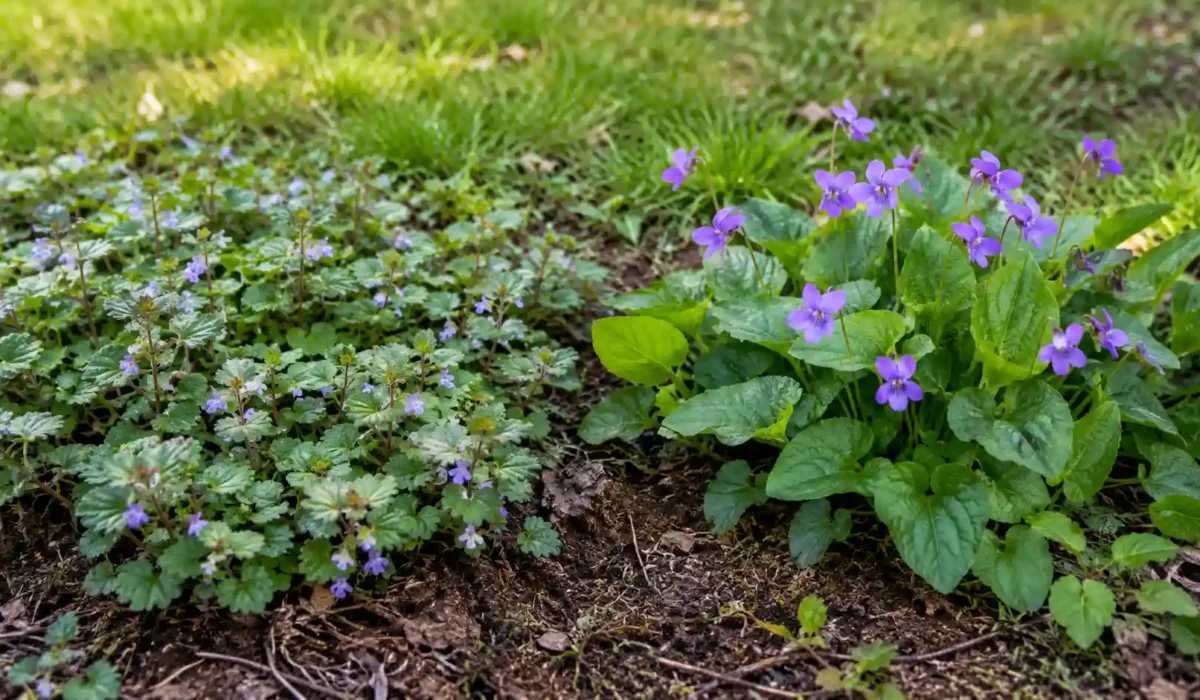
Creeping Charlie vs Wild Violet: ID & Control Guide
According to Elemo Baker, creeping charlie (Glechoma hederacea) is a mint-family weed with square stems, round scalloped leaves, a minty scent when crushed, and small purple flowers spreading via rooting stolons, while wild violet (Viola sororia) has round stems, heart-shaped serrated leaves, and larger purple, blue, or white flowers spreading from a central taproot.
Creeping charlie, native to Europe and Asia, resists many standard broadleaf herbicides, so hand-pulling or targeted treatment is often needed since any missed stem fragment can re-root. Wild violet’s waxy leaf coating requires an oil-based surfactant for effective herbicide uptake, and autumn applications work best, translocating down into the taproot for longer-lasting control.
By Elemo Baker | Plant Care & Gardening Expert
Last Updated: August 2026
Quick Summary
- Creeping Charlie spreads through creeping stolons and has scalloped kidney-shaped leaves with a mint-like scent when crushed.
- Wild Violet grows from a taproot and produces heart-shaped leaves with larger purple, blue, or white flowers.
- Creeping Charlie belongs to the mint family with square stems, while Wild Violet belongs to the violet family with round stems.
- Both weeds require targeted management because many general lawn weed killers do not provide reliable control.
- Correct identification is the first step before choosing removal or herbicide methods.
What Is Creeping Charlie?
Creeping Charlie (Glechoma hederacea) is a low-growing perennial weed from the mint family (Lamiaceae) that spreads aggressively through creeping stems called stolons. It is also known as ground ivy and is native to Europe and parts of Asia but has become naturalised in many regions worldwide.
Creeping Charlie, scientifically known as Glechoma hederacea, is a member of the mint family and is widely recognised as ground ivy. More botanical background is available through its Wikipedia reference.
This creeping charlie weed commonly appears in lawns, garden beds, and shaded areas with moist or poorly drained soil. Its ability to root at stem nodes allows it to quickly form dense mats that compete with grass and other plants.
The plant prefers:
- Shady or partially shaded locations
- Moist soil conditions
- Compacted or poorly drained ground
- Thin lawns with weak turf growth
The purple flowers of creeping Charlie are small but noticeable, often appearing in spring. These blooms are why it is sometimes searched for as “creeping charlie purple flowers” or “creeping charlie purple”.
How to Identify Creeping Charlie
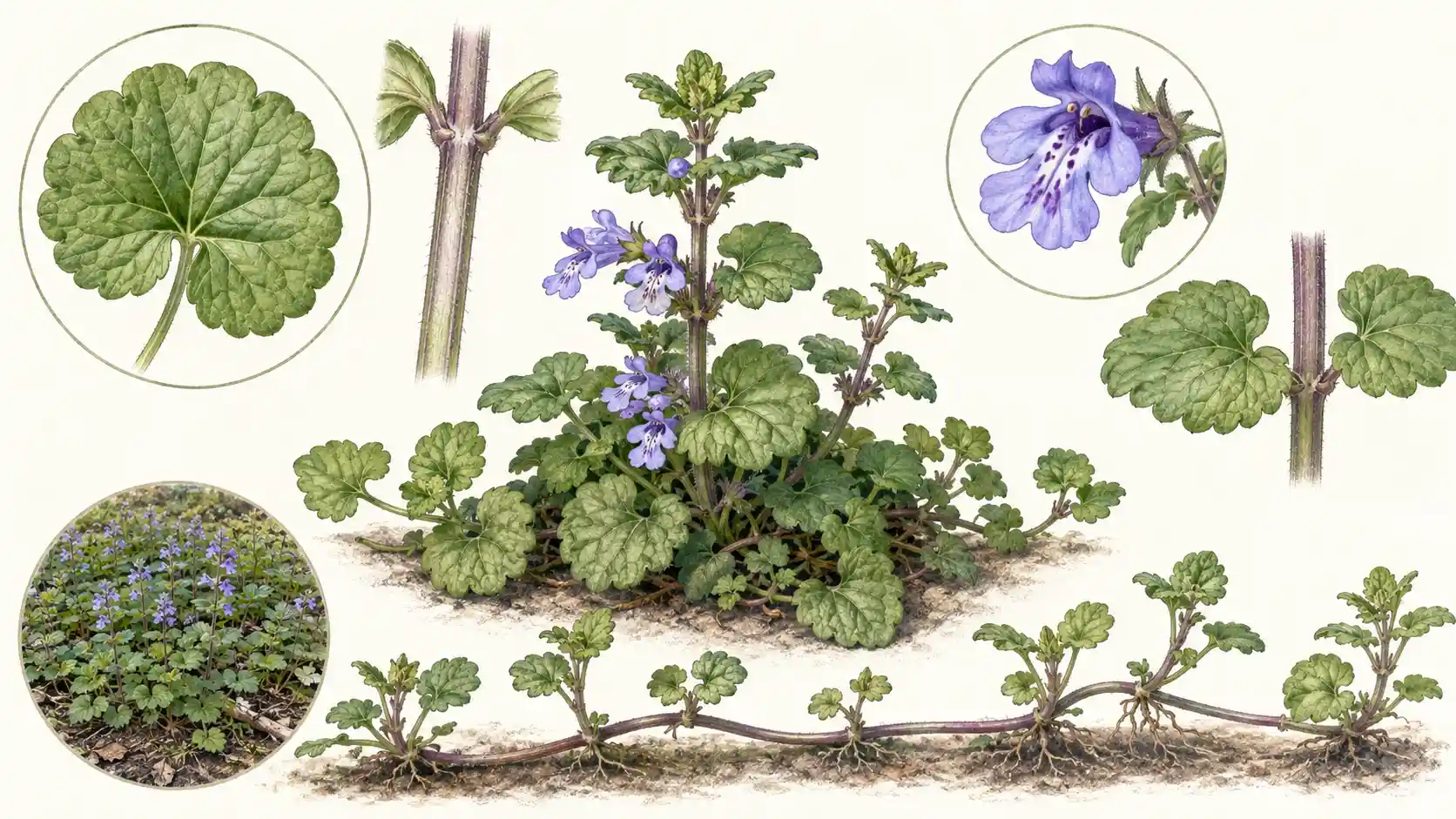
Creeping Charlie can be identified by several key features that separate it from similar lawn weeds:
- Leaves: Rounded or kidney-shaped leaves with scalloped edges arranged in opposite pairs along the stem.
- Stems: Square stems, which are a typical characteristic of plants in the mint family.
- Flowers: Small bluish-purple, funnel-shaped flowers that usually appear in clusters during spring.
- Smell: Crushed leaves release a strong minty or bitter aroma.
A simple identification test is checking the stem shape. If the stem feels square rather than round, the plant is likely a mint-family species such as Creeping Charlie.
What Does Creeping Charlie Tell You About Your Soil?
Creeping Charlie often indicates that growing conditions are favouring moisture-loving plants rather than healthy turf. Its presence commonly suggests shady conditions, compacted soil, poor drainage, or thin grass coverage.
Improving garden conditions often involves choosing plants suited to the available light, moisture, and soil type. Evergreen landscape plants can also influence shade levels and garden structure, as discussed in our Fast Growing Evergreen Trees Australia Guide.
It is not usually the original cause of lawn problems. Instead, it takes advantage of existing weaknesses such as:
- Excess shade reducing grass growth
- Overwatering keeping soil consistently wet
- Compacted soil limiting root development
- Bare patches allowing weeds to establish
Improving these underlying conditions is important because removing Creeping Charlie without correcting the environment often leads to reinfestation.
What Is Wild Violet?
Wild Violet (Viola sororia) is a clump-forming perennial plant native to North America. Unlike Creeping Charlie, it grows from a strong taproot system and belongs to the violet family (Violaceae). It is commonly found in lawns, woodland edges, and shaded gardens.
Wild violets are valued by some gardeners because they tolerate conditions where many grasses struggle, especially areas with shade and moderate moisture. However, their ability to spread through underground structures and self-seeding can make them difficult to remove from lawns.
The term “creeping violets” is sometimes used incorrectly when people search for wild violet, but it is generally referring to Wild Violet rather than a separate plant species.
Wild Violet commonly grows in:
- Partial shade to full morning sun
- Moist, fertile soils
- Woodland-style gardens
- Low-maintenance lawn areas
How to Identify Wild Violet
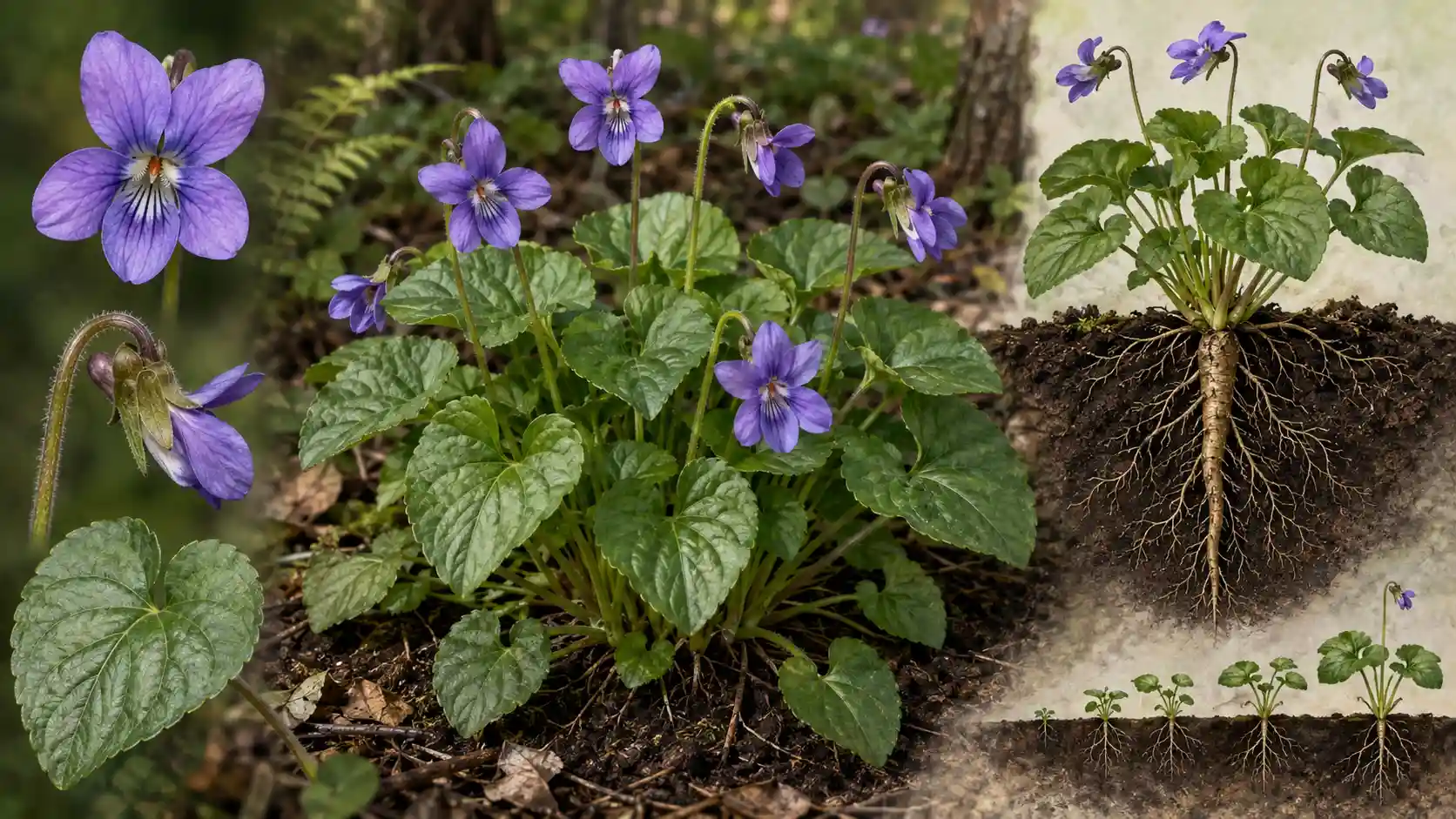
Wild Violet has several features that distinguish it from Creeping Charlie:
- Leaves: Heart-shaped leaves that grow from a central crown, often with slightly serrated edges.
- Stems: Round stems that may have a slightly hairy texture.
- Flowers: Larger and more noticeable than Creeping Charlie flowers, usually appearing individually rather than in clusters.
- Flower colours: Purple, blue, or white flowers are common.
The biggest identification difference is growth habit. Wild Violet forms clumps from a central point, while Creeping Charlie spreads outward in a creeping mat.
What Month Do Wild Violets Bloom?
Wild Violets typically bloom during spring, usually from March through May depending on climate zone and local weather conditions. In some regions, they may produce lighter repeat flowering during autumn when conditions become favourable.
Flowering time can vary based on:
- Winter temperatures
- Spring rainfall
- Sun exposure
- Regional climate
Their early spring flowers make them one of the first food sources available for some pollinators after winter.
Creeping Charlie vs Wild Violet — Key Differences (Comparison Table)
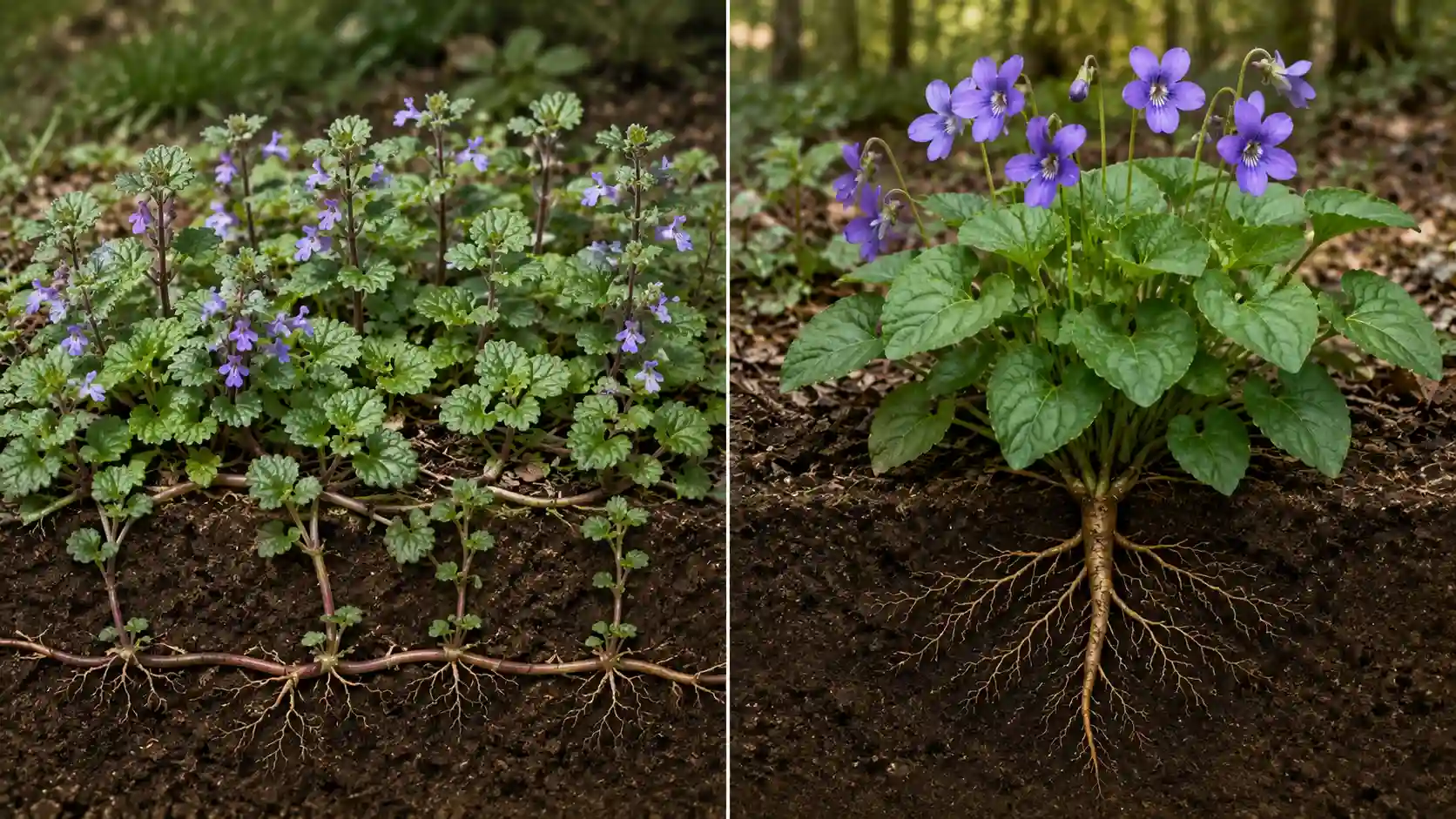
| Feature | Creeping Charlie | Wild Violet |
| Scientific name | Glechoma hederacea | Viola sororia |
| Plant family | Mint family (Lamiaceae) | Violet family (Violaceae) |
| Leaf shape | Kidney-shaped with scalloped edges | Heart-shaped with serrated edges |
| Stem type | Square stems | Round stems |
| Growth habit | Creeping stolons forming mats | Clumping growth from taproot |
| Flowers | Small bluish-purple funnel-shaped flowers | Larger purple, blue, or white flowers |
| Smell | Minty scent when crushed | Little to no strong scent |
| Native status | Introduced/naturalised in many regions | Native to North America |
| Spread method | Stolons and seeds | Rhizomes, roots, and seeds |
Identification tip: Creeping Charlie spreads horizontally like a groundcover, while Wild Violet grows upward from compact clumps.
What Looks Like Creeping Charlie But Isn’t? (Look-Alike Plants)
Several low-growing plants can be confused with Creeping Charlie because they share similar leaf colours, growth habits, or purple flowers. Correct identification is important because each plant responds differently to control methods.
Common Creeping Charlie look-alikes include:
- Wild Violet (Viola sororia)
- Purple Dead Nettle (Lamium purpureum)
- Henbit (Lamium amplexicaule)
- Creeping Jenny (Lysimachia nummularia)
- Swedish Ivy (Plectranthus species)
- Speedwell (Veronica species)
Checking leaf shape, stem structure, flower arrangement, and growth pattern helps separate these plants.
Is Purple Dead Nettle the Same as Creeping Charlie?
No, Purple Dead Nettle (Lamium purpureum) is not the same as Creeping Charlie. Although both belong to the mint family and may have purple flowers, they have different growth patterns and leaf characteristics.
Purple Dead Nettle typically has:
- Upright rather than creeping growth
- More pointed leaves with less-rounded edges
- A purplish colour near the upper leaves
- Square stems typical of mint-family plants
Creeping Charlie forms a low mat through stolons, while Purple Dead Nettle usually grows vertically and behaves more like a short annual weed.
Are Swedish Ivy and Creeping Charlie the Same Plant?
No, Swedish Ivy (Plectranthus species) and Creeping Charlie are different plants. The confusion comes from overlapping common names, as some ornamental Swedish Ivy varieties are sold under names that include “Creeping Charlie”.
Swedish Ivy is generally grown as a decorative hanging-basket or container plant, while true Creeping Charlie (Glechoma hederacea) is a lawn and garden weed that spreads aggressively through stolons.
Key differences include:
- Swedish Ivy is mainly cultivated as an ornamental plant.
- Creeping Charlie is commonly considered a lawn weed.
- Their leaf shapes and growth habits are different despite the similar common name.
Is Speedwell the Same as Creeping Charlie?
No, Speedwell (Veronica species) is a separate group of plants and is not Creeping Charlie. Some low-growing Speedwell varieties can resemble ground ivy because they spread close to the soil surface and produce small blue flowers.
Speedwell differs because:
- Leaves are usually smaller and shaped differently.
- Flowers often have visible petal markings or veining.
- It does not produce the strong minty smell associated with Creeping Charlie.
Identifying the plant correctly prevents using an ineffective weed-control approach.
How to Get Rid of Creeping Charlie
Creeping Charlie can be difficult to remove because its creeping stems root at multiple points along the ground. Effective control usually requires a combination of physical removal, lawn improvement, and targeted treatment.
The main control approaches include:
- Removing small patches manually
- Improving soil and turf conditions
- Reducing excessive shade and moisture
- Using suitable broadleaf herbicides when necessary
Can You Dig Out Creeping Charlie?
Yes, you can dig out Creeping Charlie from small areas, but removing established patches can be challenging. The main difficulty is that any remaining stolon fragment can produce new roots and restart growth.
For manual removal:
- Loosen the soil around the plant.
- Remove the entire root system and creeping stems.
- Collect all plant fragments from the area.
- Monitor the location for regrowth.
Hand removal works best for small infestations. Large mats usually require repeated control methods because underground and surface stems can regenerate.
What Naturally Kills Creeping Charlie?
Natural control methods can reduce Creeping Charlie populations, but they usually require consistency rather than a single treatment.
Helpful approaches include:
- Improving drainage: Reducing excessive moisture makes conditions less favourable.
- Increasing sunlight: Pruning nearby vegetation can reduce heavy shade.
- Strengthening turf: Dense, healthy grass competes more effectively against weeds.
- Smothering: Cardboard and mulch can block light and suppress growth.
- Vinegar-based treatments: These may damage exposed foliage but often provide limited control against established plants because roots and stolons can survive.
Natural methods are most effective when combined with changes to the growing environment.
What Kills Creeping Charlie Permanently, Naturally?
No natural method can guarantee permanent elimination of Creeping Charlie because it can regrow from remaining stolon pieces and seeds. Long-term control depends on preventing the conditions that allow it to return.
The most reliable natural strategy combines:
- Improving drainage
- Increasing turf density
- Reducing excessive shade
- Removing new growth early
- Repeating treatments when necessary
A healthy lawn or garden environment is the strongest long-term defence.
Best Time to Get Rid of Creeping Charlie
The best time to control Creeping Charlie is usually autumn because the plant is actively moving stored energy into its roots before winter. During this period, treatments are more likely to reach the root system.
Spring treatment can also work, especially before flowering, but summer applications are often less effective due to heat stress and reduced plant activity.
For best results:
- Apply treatments during active growth.
- Avoid periods of drought.
- Follow product instructions carefully.
- Allow enough time for symptoms to appear.
Broadleaf Herbicide for Creeping Charlie
Creeping Charlie is difficult to control with many standard lawn weed killers because some common broadleaf herbicides, especially simple 2,4-D-only products, often provide poor results.
Products containing active ingredients such as triclopyr or combinations containing triclopyr and other broadleaf herbicides are commonly used for better control.
When selecting a Creeping Charlie weed killer:
- Choose products labelled for ground ivy or Creeping Charlie.
- Apply during active growth periods.
- Avoid spraying stressed grass or plants.
- Follow local regulations and label directions.
Targeted herbicide selection is important because the wrong product may only weaken the plant temporarily rather than controlling it.
How to Get Rid of Wild Violets
Wild Violets require different management compared with Creeping Charlie because they grow from strong roots and underground structures. Control methods usually involve repeated removal, improving lawn density, and using suitable herbicides when necessary.
Best Herbicide for Wild Violets
The best herbicides for Wild Violets are usually broadleaf weed killers containing triclopyr, which can provide effective control while being selective for many grass types.
Triclopyr-based products are commonly recommended because Wild Violets can be resistant to many general lawn weed treatments.
For improved results:
- Apply during active growth.
- Ensure the leaves are fully covered.
- Repeat applications may be required.
- Check that the product is suitable for your grass species.
When and How to Apply
Autumn is generally the most effective time to treat Wild Violets because the plant transfers energy into its root system before winter. This movement helps herbicides reach deeper parts of the plant.
Spring applications can also work, but multiple treatments may be needed.
Important application tips include:
- Avoid spraying during extreme heat or drought.
- Use a suitable oil-based surfactant if recommended because Wild Violet leaves have a waxy surface.
- Apply when plants are actively growing.
- Follow product instructions carefully.
How Do You Keep Wild Violets From Spreading?
Preventing Wild Violet spread is easier than removing a large established population.
Helpful prevention methods include:
- Removing plants before seed capsules mature.
- Digging out roots where practical.
- Maintaining thick, healthy turf.
- Reducing excessive moisture and shade where possible.
- Overseeding thin lawn areas.
Because Wild Violets can spread through underground growth and seeds, prevention requires ongoing lawn maintenance rather than one-time removal.
What Kills Creeping Charlie and Wild Violets? (Combined Infestations)
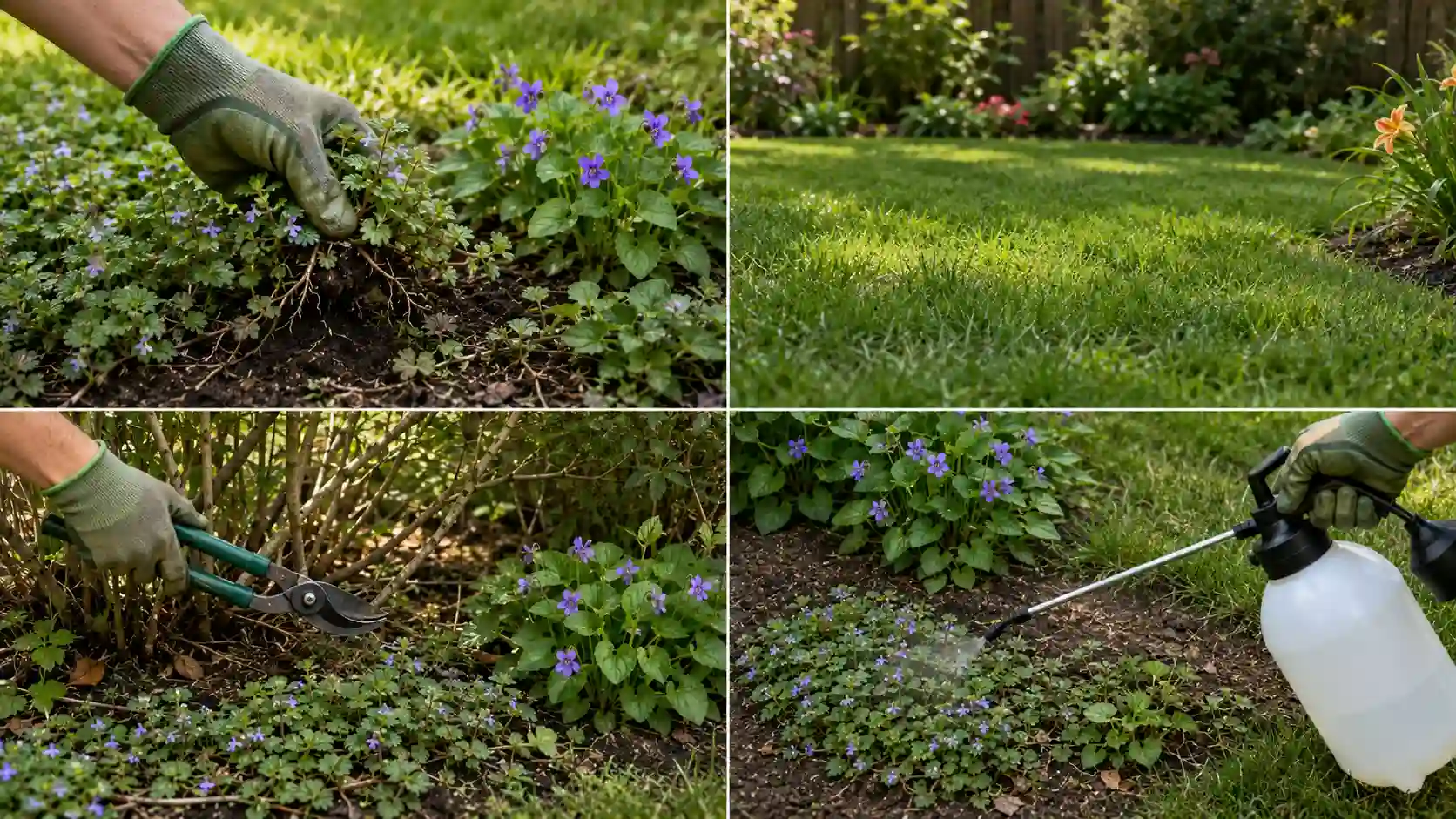
When Creeping Charlie and Wild Violets grow together, the best approach is to identify that both weeds are present and choose a treatment strategy that works against each plant. Many standard lawn weed killers may reduce Wild Violets but often provide weaker control of Creeping Charlie.
A targeted broadleaf herbicide containing triclopyr is commonly used because it can be effective against both plants when applied correctly. Autumn is usually the preferred treatment period because both weeds are actively moving nutrients into their root systems.
For combined infestations:
- Identify both plants before treatment.
- Apply suitable broadleaf control products during active growth.
- Repeat applications may be necessary.
- Improve lawn health after removal to reduce future outbreaks.
Cultural improvements are equally important. Increasing turf density, correcting drainage problems, and reducing excessive shade can prevent both weeds from returning.
Should You Leave Them, or Remove Them? (Pros, Cons & Garden Use)
Creeping Charlie and Wild Violet are often treated as lawn weeds, but both plants also provide ecological benefits. Whether they should be removed depends on their location, growth level, and the purpose of the garden.
Understanding how different plants behave in Australian gardens can help you decide whether a species should be removed, managed, or used intentionally as part of your landscape design. Our Australian Plants Guide: Indoor Houseplants & Garden Design explains how to choose suitable plants for different garden conditions and growing environments.
A plant growing in a formal lawn may be unwanted, while the same plant may be useful as a low-maintenance groundcover in a shaded garden area.
The decision depends on:
- Whether the plant is spreading into unwanted areas.
- Whether biodiversity and pollinator support are priorities.
- Whether the area needs a traditional grass lawn.
- Whether the plant is competing with more desirable species.
Are Wild Violets Bad for Your Yard? / What Are the Benefits of Wild Violets?
Wild Violets are not automatically harmful to a garden. In many situations, they provide environmental benefits and can be valuable native plants.
Benefits of Wild Violets include:
- Pollinator support: Early spring flowers provide food for bees and other insects when few plants are blooming.
- Erosion control: Their spreading growth can help stabilise soil on slopes and difficult areas.
- Shade tolerance: They grow well where traditional lawn grasses may struggle.
- Wildlife value: They act as a larval host plant for some fritillary butterfly species.
Wild Violets are generally not classified as invasive because Viola sororia is native to North America. However, they can spread aggressively in thin lawns and become a nuisance when they compete with turf.
The main issue is usually not ecological invasion but their ability to dominate poorly maintained grass areas.
Do Wild Violets Make a Good Ground Cover? / Violets as Ground Cover
Yes, Wild Violets can make a good groundcover in shaded, low-traffic areas where grass performs poorly.
They are suitable for:
- Woodland-style gardens.
- Naturalised landscapes.
- Areas where low maintenance is preferred.
- Shaded spaces beneath trees.
However, they may not be ideal for homeowners wanting a uniform lawn because they spread naturally and create a mixed planting environment. If a low-maintenance alternative is needed for difficult garden spaces, choosing the right plants for the location can reduce weed pressure. Our guide on Low-Maintenance Plants for Fence Line in Australia covers suitable screening and ground-cover options.
Using Wild Violets intentionally as groundcover can turn a perceived weed problem into a garden design choice.
What Are the Uses and Benefits of Creeping Charlie?
Creeping Charlie has historically been used as a groundcover because it grows well in shaded areas and forms a dense green carpet. It has also appeared in traditional folk practices as an edible and medicinal plant, although these historical uses should not be considered medical advice or recommendations.
Potential benefits include:
- Providing ground coverage in difficult shaded areas.
- Offering flowers that can attract bees and other pollinators.
- Historically being used in traditional plant practices.
However, its aggressive spreading habit makes it problematic in lawns and managed garden beds. Because it spreads through stolons, it can quickly move beyond areas where it was intentionally planted.
Are Violets Invasive? / Are Wild Violets Invasive?
Wild Violets are generally not considered invasive because Viola sororia is a native North American species. However, they can spread quickly through rhizomes and self-seeding, causing problems in lawns.
Creeping Charlie is different because it is an introduced, naturalised species in many regions outside its original range and is considered invasive or highly problematic in some areas.
The distinction is important:
- Wild Violet: Native plant that can become a lawn nuisance.
- Creeping Charlie: Introduced spreading plant that often behaves aggressively outside its native range.
Will Wild Violets Outcompete Creeping Charlie? / Which Plant Wins in a Turf Battle?
Creeping Charlie generally has an advantage in consistently moist, shady conditions because its stolons allow it to spread rapidly across open ground. Wild Violet can compete strongly in thin, poorly maintained turf areas where its clumping growth and underground structures allow it to establish.
Neither plant reliably eliminates the other without intervention.
Competition depends on:
- Soil moisture.
- Shade levels.
- Lawn density.
- Available nutrients.
- Maintenance practices.
A healthy, dense lawn reduces opportunities for both plants to dominate.
What Plants Choke Out Creeping Charlie?
Dense, vigorous plants and healthy turf can reduce Creeping Charlie growth over time, but no single plant can reliably eliminate an established infestation without additional control methods.
Plants and lawn strategies that can compete include:
- Dense shade-tolerant grasses such as suitable fescue varieties.
- Healthy turf maintained with proper fertilisation.
- Vigorous groundcovers suited to local conditions.
The best approach is combining competitive planting with improved growing conditions rather than relying on one replacement plant. Dense, well-selected groundcovers can help reduce weed establishment by creating stronger competition for space and resources. For example, plants such as Mondo Grass are commonly used in Australian landscapes, as explained in our Mondo Grass Garden: Care Guide for Australian Gardens.
Will Wild Violets Choke Out Grass?
Yes, Wild Violets can gradually crowd out grass in shaded areas where turf is already weak. However, their spread is often a symptom of poor lawn conditions rather than the only cause of decline.
Wild Violets commonly increase where:
- Grass receives insufficient sunlight.
- Soil remains moist.
- Lawn density is low.
- Maintenance is inconsistent.
Improving grass health, increasing suitable sunlight, and maintaining proper mowing practices can reduce Wild Violet dominance.
Beginner Mistakes & Troubleshooting
Many weed-control failures happen because the plant is incorrectly identified or the treatment does not match the weed’s biology.
Similar to weed management, many plant problems are caused by environmental factors such as moisture imbalance, soil conditions, or incorrect placement. Our Woolly Bush Problems: Causes, Solutions and Care Guide explains how to diagnose and correct common plant issues.
Common mistakes include:
- Misidentifying the weed: Creeping Charlie and Wild Violet require different control approaches.
- Using the wrong herbicide: Standard broadleaf products may not work well against Creeping Charlie.
- Treating during unsuitable weather: Heat, drought, or plant stress can reduce herbicide effectiveness.
- Expecting one application to solve the problem: Established weeds often require repeated treatments.
- Ignoring underlying causes: Shade, drainage problems, and weak turf allow weeds to return.
- Pulling Creeping Charlie without removing stolon fragments: Small remaining pieces can regenerate.
Successful long-term control focuses on both removing existing weeds and improving the conditions that allowed them to spread. Weed problems are often only one part of wider garden health issues. For better plant management, gardeners can also learn how to identify common insects and damage symptoms through our Garden Pest Identification Guide for Australian Gardens.
Conclusion
Creeping Charlie vs Wild Violet identification is essential because these two plants may look similar but differ significantly in growth habit, botanical family, and control requirements. Creeping Charlie has square stems, kidney-shaped scalloped leaves, and spreads through stolons, while Wild Violet has heart-shaped leaves, round stems, and grows from a clumping root system.
The correct approach is to identify the plant first, then choose the right strategy. Cultural improvements such as healthier turf, better drainage, and suitable light conditions help prevent reinfestation. When removal is necessary, targeted triclopyr-based treatments and consistent management usually provide better results than general weed-control methods.
Whether you remove them or keep them as groundcovers depends on your garden goals. Both plants have ecological value, but understanding their behaviour allows gardeners to make informed decisions.
FAQs
What is creeping Charlie and how do I get rid of it?
Creeping Charlie (Glechoma hederacea) is a spreading mint-family weed with scalloped leaves and creeping stolons. It can be controlled through manual removal, improving lawn conditions, and targeted broadleaf herbicides containing ingredients such as triclopyr.
Is creeping Charlie bad to have in your yard?
Creeping Charlie is not always harmful, but it can become problematic when it spreads through lawns and garden beds. It competes with grass and other plants by forming dense mats.
Is purple dead nettle the same as creeping Charlie?
No, Purple Dead Nettle (Lamium purpureum) is a different mint-family plant. It usually grows upright with pointed leaves and purple-tinted upper foliage, while Creeping Charlie grows as a low creeping mat.
What eats wild violets?
Wild Violets may be eaten by garden wildlife such as rabbits, deer, and some insects. Slugs and snails may also feed on young growth in moist garden conditions.
How do wild violets spread?
Wild Violets spread through underground growth structures such as rhizomes and through seeds. Their seed capsules can release seeds explosively, allowing new plants to establish nearby.
Should I leave wild violets in my garden?
You can leave Wild Violets if you want a low-maintenance, shade-tolerant groundcover that supports pollinators. If they are spreading into lawns or areas where they are unwanted, removal and prevention methods may be needed.