

Curry Leaf Benefits: Uses, Safety & Growing in Australia
Curry leaves (Murraya koenigii) are a nutritious aromatic herb, but the strongest health claims made online go beyond the available human evidence. Small human studies have investigated curry-leaf powder for blood glucose and lipid measures, while much of the broader research remains laboratory- or animal-based. Fresh and dried curry leaves are also chemically different: drying changes the volatile-oil profile responsible for much of the characteristic aroma, although that does not prove that fresh leaves deliver greater medical benefits.
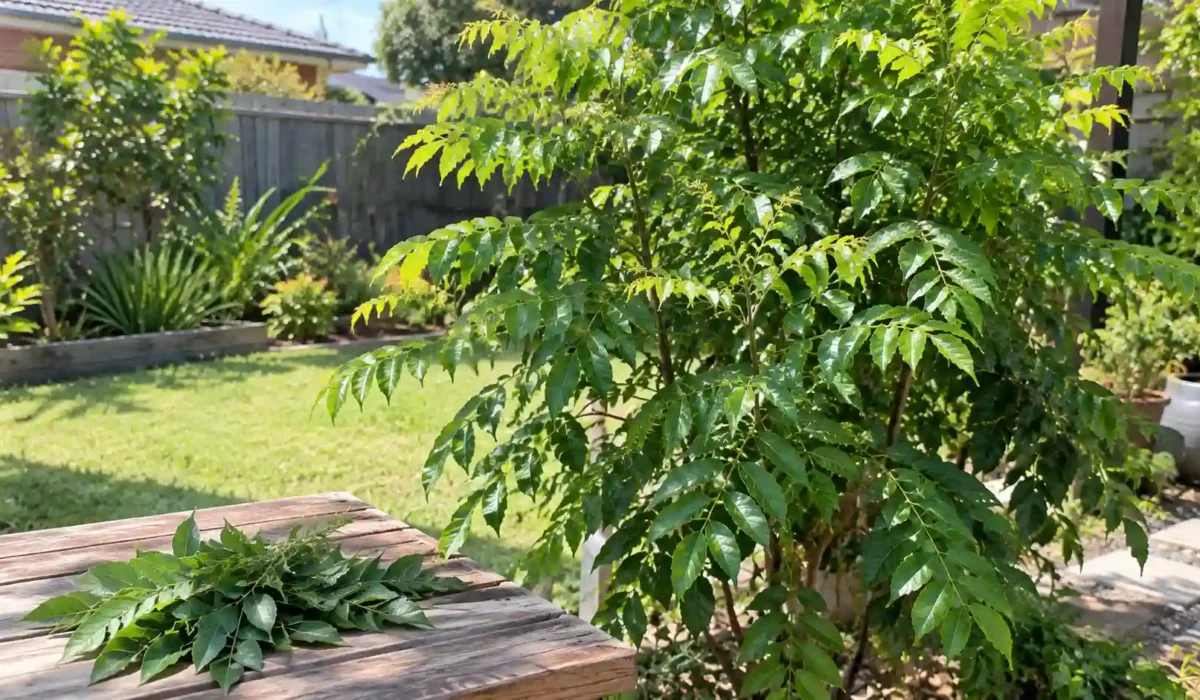
For Australian gardeners, there is another practical question: growing your own can make sense when you cook with curry leaves regularly, particularly in warm climates where the plant can provide repeated fresh harvests. In cooler areas, container growing offers a useful way to move the plant into shelter during cold weather.
Quick Summary
- Curry leaves (Murraya koenigii) are linked to blood sugar support, cholesterol management, digestion, and hair/skin health — but most evidence comes from small or animal studies, not large human trials.
- Fresh leaves carry a different and generally more vivid volatile-aroma profile than dried leaves, which matters most for flavour; it should not be interpreted as proof of greater medical benefit.
- There is no established evidence-based daily dose. A practical culinary amount is a small handful, roughly 5–10 individual leaflets in a meal, rather than treating curry leaves as a supplement.
- In warm Australian climates, growing your own gives repeated access to fresh leaves; in cooler or frost-prone areas, pot culture and winter protection are more practical.
What Are Curry Leaves, Exactly? (Clearing Up the Confusion)
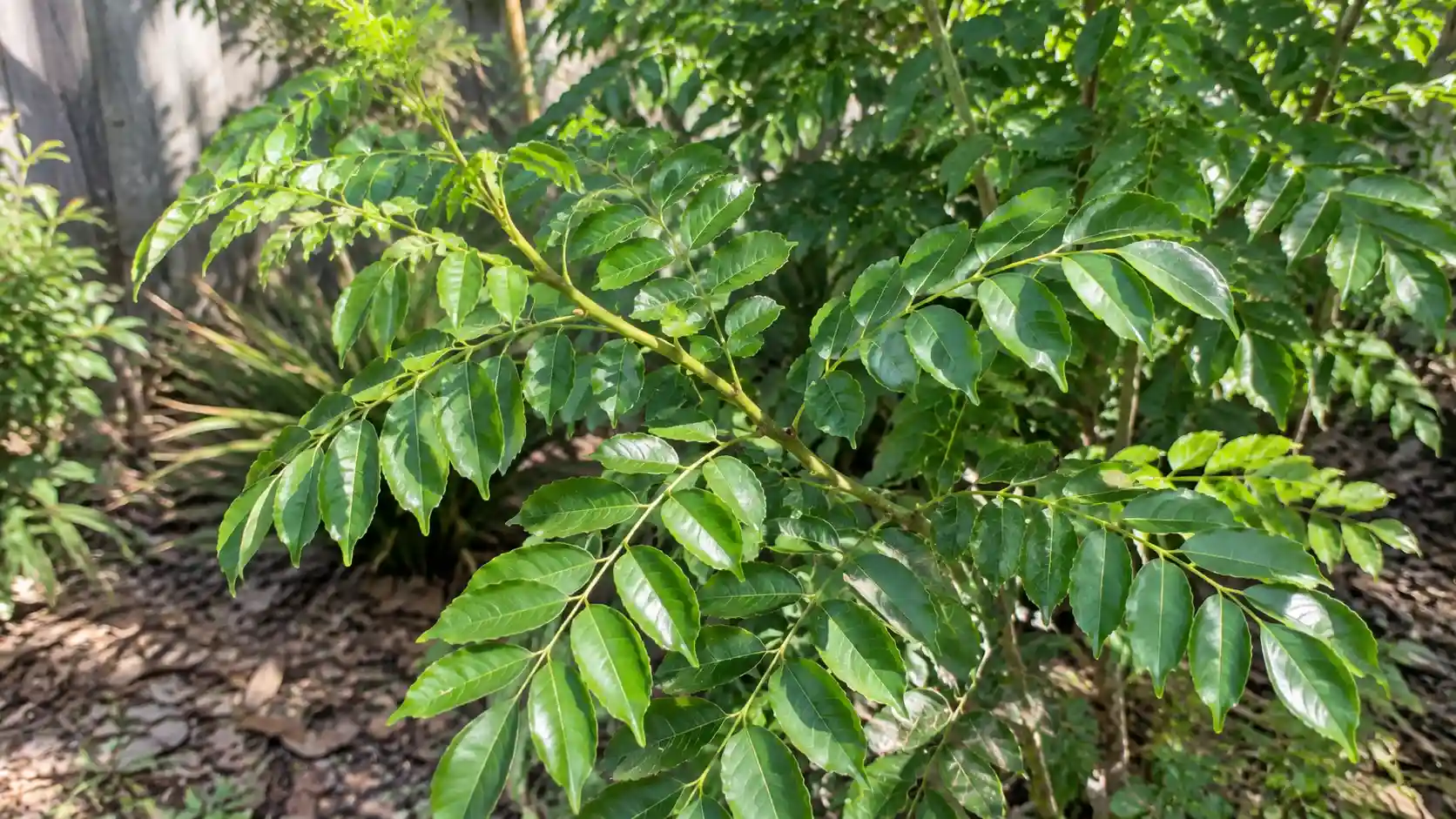
Curry leaves come from the aromatic curry-leaf tree, traditionally identified as Murraya koenigii. Kew currently treats Bergera koenigii as the accepted botanical name, while Murraya koenigii remains an extremely common name in horticulture, food literature and Australian use. The species is native across the Indian Subcontinent into parts of Southeast and mainland Asia. For the current accepted name, synonymy and native distribution, see Kew’s current botanical classification for curry leaf.
The leaves are small, pinnate and highly aromatic. They are commonly used fresh in tempering, curries, lentil dishes, rice preparations, chutneys and vegetable dishes. The leaves themselves are a culinary herb; they are not the same thing as commercially labelled curry powder.
Australian regulatory information also distinguishes curry leaves from bay leaves, listing curry leaves as Murraya koenigii and bay leaves as Laurus nobilis.
Curry leaf ≠ bay leaf ≠ curry powder
- Curry leaf: the leaf of Murraya koenigii (also called Bergera koenigii in current Kew taxonomy), with a distinctive citrusy, spicy, savoury aroma.
- Bay leaf: usually Laurus nobilis in Australian culinary use; it has a different flavour profile and is not a substitute for curry leaf.
- Curry powder: a prepared spice blend whose ingredients vary; it is not dried curry leaf.
For gardeners building a productive edible garden, curry leaf belongs in the same broad conversation as other useful edible plants rather than being treated as a generic “curry spice.” LeafyHeaven’s Fruit Trees for Australian Gardens guide provides a wider framework for matching productive plants to Australian climates.
The Health Benefits, Explained (Layer 1 → Layer 3)
Blood Sugar and Diabetes Support
Curry leaves may have effects on blood glucose, but current evidence is not strong enough to treat curry leaves as a diabetes therapy.
One small human study gave 12 g of curry-leaf powder daily for one month to 30 people with non-insulin-dependent diabetes. The researchers reported a transient reduction in fasting and post-meal blood glucose at day 15, but did not find appreciable changes in serum lipids or several longer-term glycation measures during the study.
What might explain the interest? Curry leaves contain fibre and a wide range of plant compounds, including carbazole alkaloids, flavonoids and phenolic compounds. Laboratory and animal studies suggest several possible pathways involving glucose metabolism and oxidative stress, but those mechanisms cannot automatically be translated into a meaningful effect from the handful of leaves used in cooking.
What the evidence actually supports: There is preliminary human evidence worth researching, but not enough to recommend curry leaves as a treatment for diabetes or as a replacement for medication. Concentrated powders and extracts also should not be treated as equivalent to culinary use.
Cholesterol and Heart Health
The evidence for curry leaves and cholesterol is mixed and still too limited to establish a reliable cholesterol-lowering effect.
The same 1990 human trial found no appreciable changes in serum lipids or lipoprotein cholesterol during its one-month curry-leaf powder intervention.
There are later human studies that look more promising, but some used curry leaves together with other ingredients, making it impossible to isolate the contribution of curry leaf itself. One pilot study involving 31 people, for example, investigated a mixture of fenugreek and curry-leaf powder rather than curry leaf alone.
That distinction matters. “Curry leaves for cholesterol” is a reasonable research question, but it is not the same as saying curry leaves have been proven to lower LDL cholesterol in the general population.
For heart health, the more defensible conclusion is that curry leaves are a flavourful plant food containing fibre and phytochemicals, while their independent clinical effect on cardiovascular outcomes remains uncertain.
Digestion
Curry leaves have a long history of traditional use for digestion, flatulence, nausea and digestive discomfort, but direct clinical evidence for ordinary curry-leaf consumption remains limited.
Reviews of Murraya koenigii describe traditional digestive and antiemetic uses and identify digestive effects among the plant’s historical medicinal applications.
There has also been a controlled human study of an Ayurvedic formulation for diarrhoea-predominant IBS containing curry leaf plus pomegranate and turmeric. Because the formulation contained several plants, the trial does not prove that curry leaves alone improved IBS symptoms.
So the practical takeaway is modest: curry leaves can be part of a varied, fibre-containing diet and are traditionally associated with digestive support, but they should not be presented as a proven treatment for digestive disease.
Hair and Skin
Curry leaves have a strong traditional reputation for hair care, but there is not convincing clinical evidence that simply eating curry leaves causes measurable hair growth.
Traditional medicine sources describe curry leaves cooked with oil as a hair tonic, and laboratory research has investigated compounds from the plant for a range of biological activities.
That is different from demonstrating that eating several curry leaves each day causes new hair growth in humans. At present, that claim remains unproven.
The same distinction applies to curry leaves benefits for skin. A small controlled cosmetic study evaluated a topical formulation containing a Murraya koenigii extract in 45 women with visible facial skin ageing and sagging. That is evidence about a specific topical extract and formulation — not proof that eating curry leaves produces the same skin effect.
So:
- Eating curry leaves: nutritious culinary herb, but no strong human evidence for hair growth.
- Topical curry-leaf preparations: scientifically interesting, with limited early cosmetic research.
- DIY concentrated oils or extracts: not automatically equivalent to studied formulations.
LeafyHeaven takes the same evidence-aware approach in other plant-benefit articles, including its Leaf of Life plant benefits guide.
Antioxidant Content
Curry leaves contain polyphenols and other phytochemicals with measurable antioxidant activity in laboratory testing. Research has demonstrated antioxidant capacity in extracts and identified numerous potentially bioactive compounds.
That is useful nutritional context, but “has antioxidant activity in a laboratory assay” is not the same as proving prevention or treatment of a particular human disease. Antioxidant findings are best viewed as one reason curry leaves are scientifically interesting, not as a standalone medical claim.
Nutrition Facts Snapshot
A national Indian food-composition dataset reports curry leaves at about 65.3 g moisture, 7.4 g protein, 1.1 g fat, 16.8 g dietary fibre and 4.5 g carbohydrate per 100 g, with energy around 266 kJ (64 kcal). These figures are based on composite samples and should not be treated as an exact value for every cultivar, harvest or growing condition.
| Nutrient | Approx. amount per 100 g fresh curry leaves* |
| Energy | 266 kJ / ~64 kcal |
| Protein | 7.4 g |
| Total fat | 1.1 g |
| Carbohydrate | 4.5 g |
| Dietary fibre | 16.8 g |
| Potassium | ~584 mg |
| Phosphorus | ~83 mg |
| Vitamin C | ~6 mg |
That last point is important: an impressive number on a 100 g nutrition table does not mean you will consume 100 g of curry leaves with an ordinary meal. For a broader comparison of curry leaf with other aromatic culinary plants, see the Curry Leaf Related Aromatic Plant Reference.
Fresh vs Dried Curry Leaves — Does It Actually Matter? (Original Contribution)
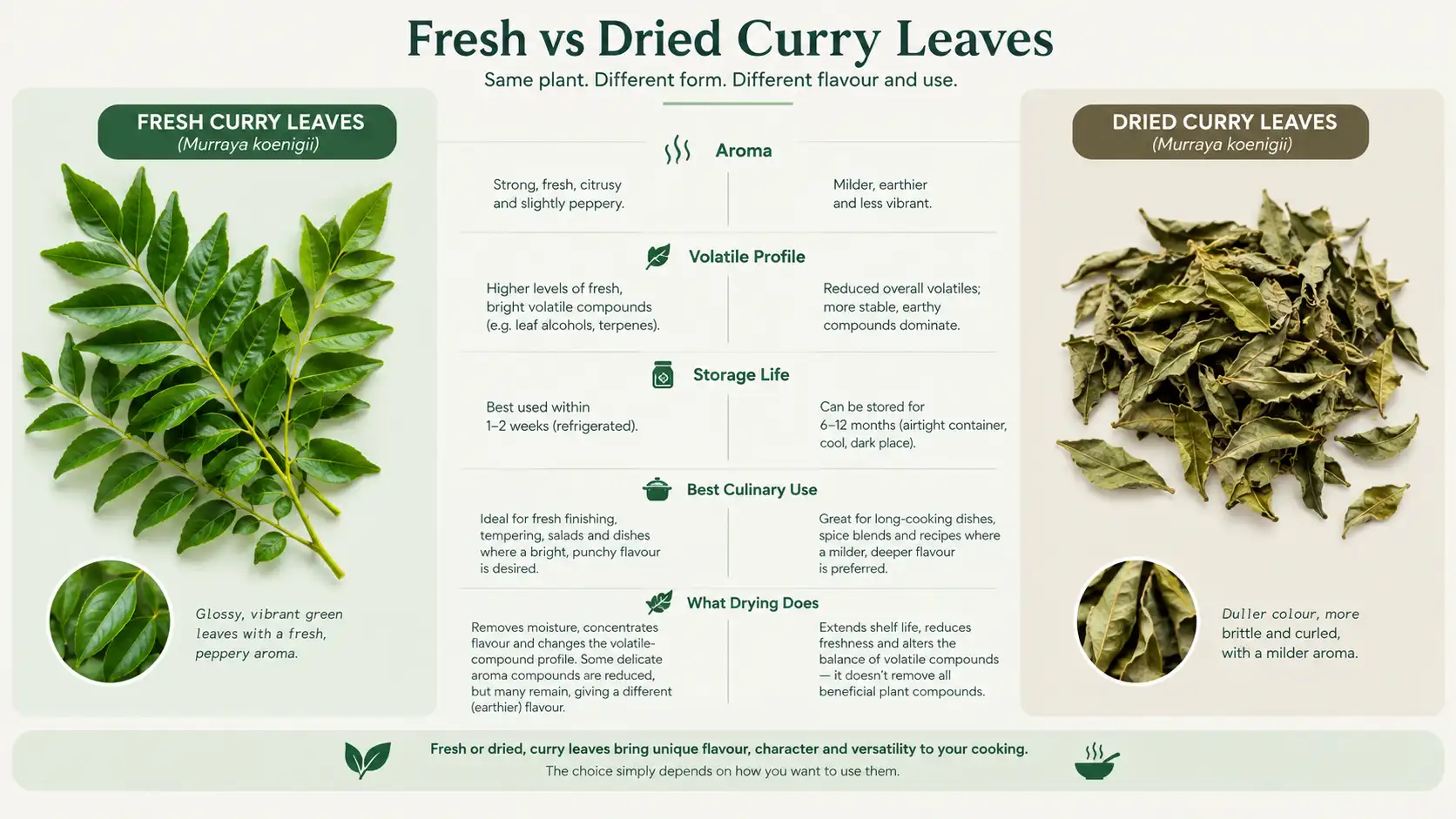
Yes — mainly for aroma and culinary quality, and possibly for the profile of volatile compounds, but not as proof that fresh leaves have greater medical effects.
Research comparing fresh and shade-dried Murraya koenigii leaves found clear changes in volatile-oil composition after drying. For example, the proportion of α-pinene increased in the dried sample while trans-caryophyllene decreased, showing that drying changes the chemical profile rather than simply “locking everything in.”
The practical result is easy to notice: fresh curry leaves generally have the brighter, more complex aroma that cooks value most. Dried leaves remain useful, particularly when fresh leaves are unavailable, but their aroma tends to be different and more muted.
| Characteristic | Fresh curry leaves | Dried curry leaves |
| Flavour | Bright, layered, highly aromatic | More muted and concentrated in a different way |
| Volatile compounds | Closest to the original fresh-leaf profile | Drying changes the relative volatile composition |
| Typical home shelf life | Days to around a week refrigerated; longer if frozen | Usually months when sealed, dry and protected from light |
| Best culinary use | Tempering, dhal, curries, chutneys and dishes where aroma matters | Pantry cooking when fresh leaves are unavailable |
| Health interpretation | No proven therapeutic advantage simply because they are fresh | No proof that drying removes all beneficial compounds |
The science therefore supports a narrower claim than many health articles make: fresh is usually better for flavour and aroma, while drying changes the volatile profile. It does not establish that fresh leaves are medically superior.
How to Eat Curry Leaves (Raw, Cooked, and How Many)
Can You Eat Curry Leaves Raw?
Yes. Curry leaves are edible and can be eaten raw, although their flavour is much stronger and more resinous than many people expect.
In everyday cooking, they are often fried briefly in oil or ghee at the beginning of a dish. That releases their volatile compounds into the cooking fat and spreads the aroma through the meal.
You can also finely chop tender leaves into chutneys, sambals, rice dishes or other preparations. There is no requirement to remove the leaves after cooking — although many traditional recipes leave them intact, so diners may or may not eat them.
How Many Curry Leaves Should You Eat Per Day?
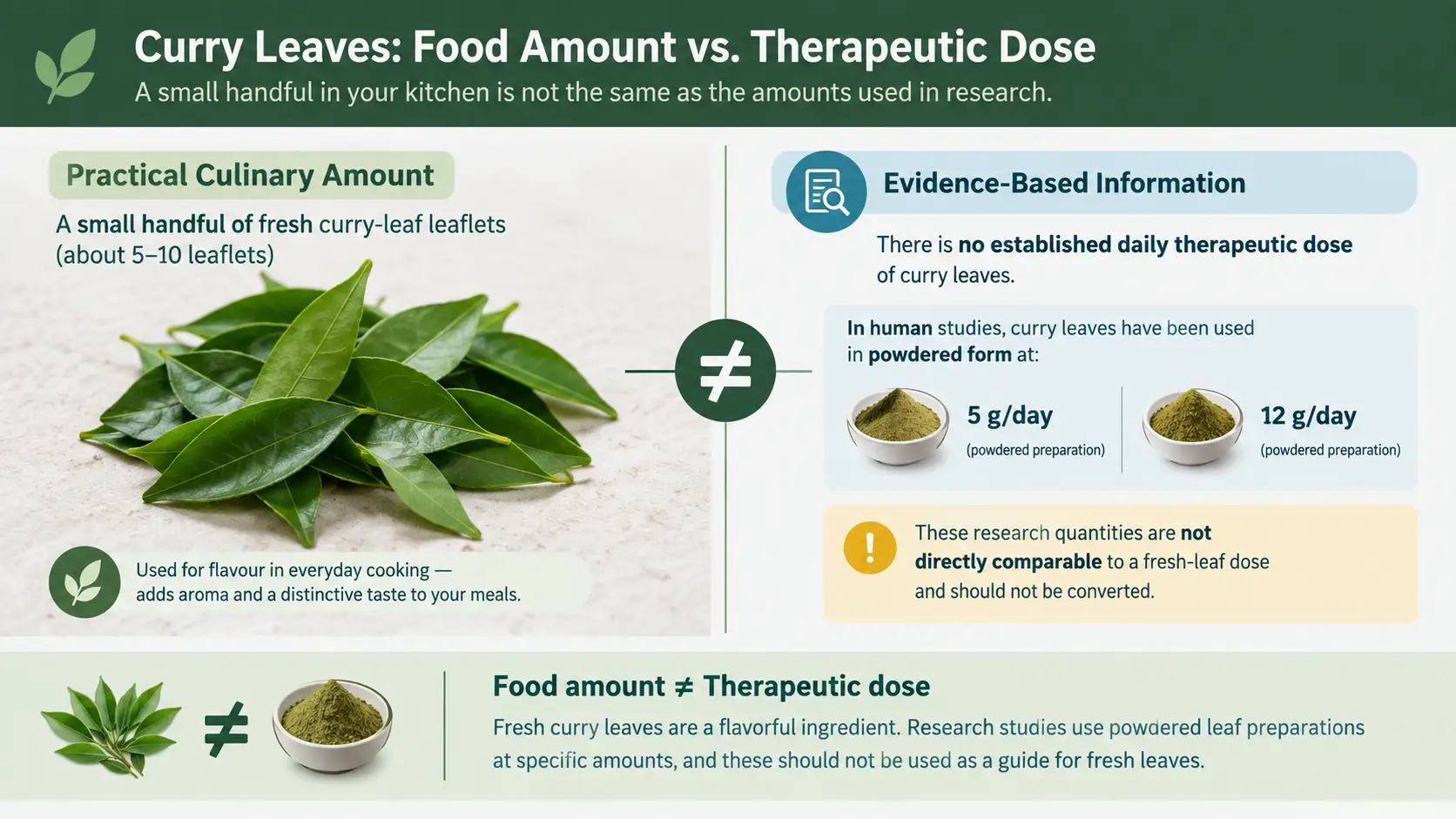
There is no established evidence-based daily dose of fresh curry leaves for general health.
That is one of the most important corrections to make to online articles that confidently recommend a fixed number every morning.
A sensible food-first approach is to use roughly 5–10 individual leaflets in a meal when you want to eat the leaves themselves. That is a practical culinary range, not a therapeutic dose.
Human studies have used very different preparations and quantities, including 5 g/day of curry-leaf powder for 45 days in one safety-focused study and 12 g/day of powder in the small diabetes trial. Those amounts cannot be translated directly into an equivalent number of fresh leaves because powder removes water and changes the form of the plant material.
For most people, the better question is not “What is the maximum number I should eat?” but “How can I use curry leaves regularly as a normal culinary herb without pretending they are a medicine?”
Safety First — Pregnancy and Medication Interactions
Curry leaves are commonly eaten as a food, but pregnancy is the point where food use and concentrated herbal use should be clearly separated.
There is not enough pregnancy-specific evidence to establish the safety of concentrated curry-leaf powders, extracts, medicinal preparations or herbal teas. Australian pregnancy guidance also warns that many herbal preparations have limited safety data and can potentially interact with medicines.
For that reason:
- Using a small amount of curry leaf as part of normal cooking is a different situation from taking concentrated curry-leaf powder or extracts.
- During pregnancy, avoid assuming that “natural” means proven safe.
- Anyone considering medicinal doses, concentrated powders, teas or extracts should discuss them with a doctor or pharmacist first.
What about medication interactions?
There is not a well-established clinical interaction list for ordinary culinary curry leaves.
The more important caution is with concentrated preparations in people taking medicines that already affect blood glucose or blood pressure. Curry-leaf preparations have been studied for effects on these measures, although the evidence is not strong enough to establish a predictable interaction. That makes it sensible to discuss supplements or medicinal amounts with the treating clinician rather than experimenting alongside prescription therapy.
Curry leaves should not be used as a substitute for prescribed diabetes, cholesterol or cardiovascular medication.
Growing Your Own Curry Leaf Plant in Australia (The Gardening-Authority Angle)
For Australians who cook with curry leaves frequently, growing your own is primarily a freshness and convenience decision, not a medically proven way to increase the plant’s health benefits.
You get immediate access to leaves when you need them, avoid relying on old supermarket stock, and can harvest only what the recipe requires.
But climate matters considerably.
Which Australian Climates Suit Curry Leaf?
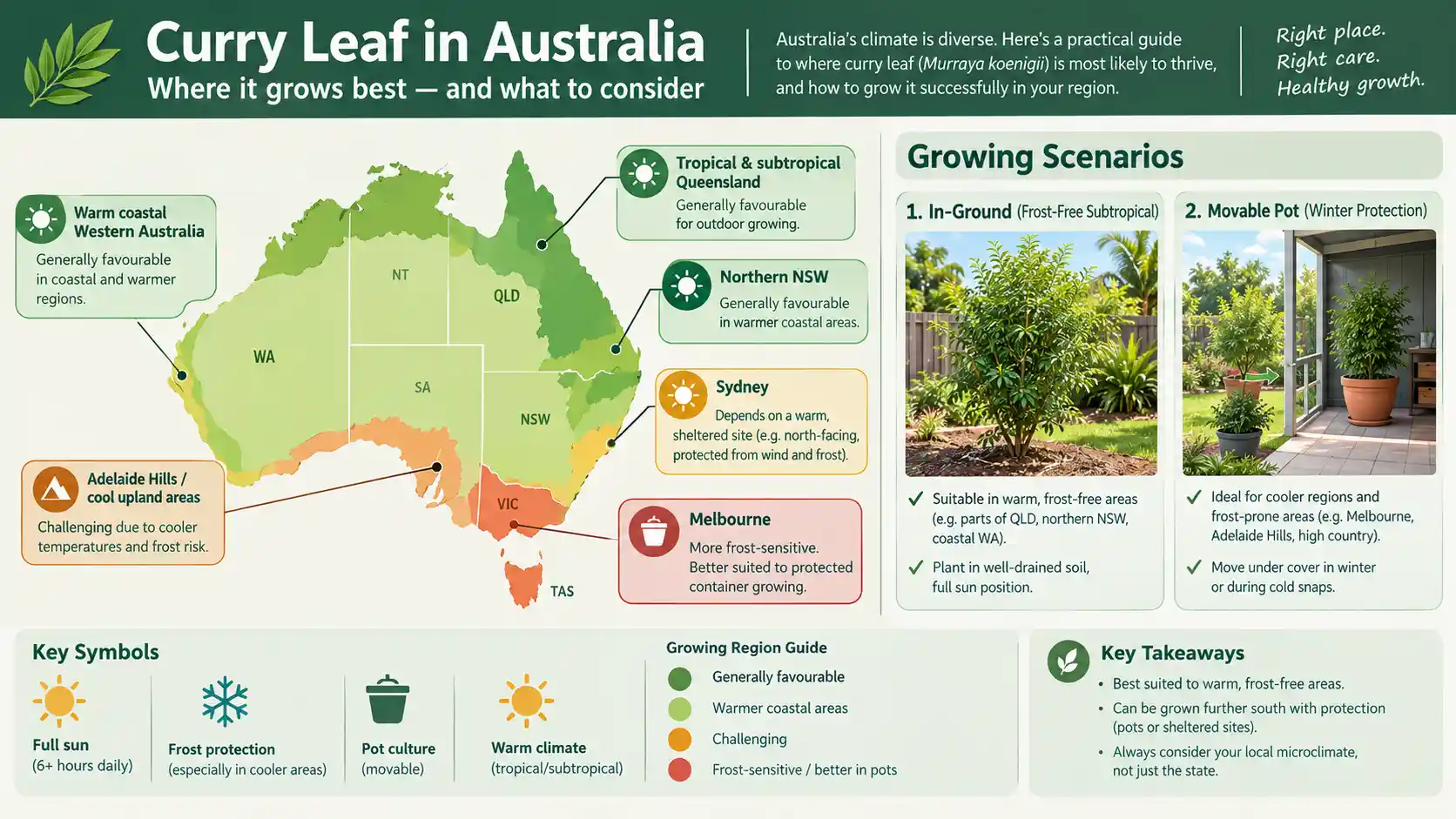
Curry leaf is fundamentally a warm-climate plant. It performs particularly well in tropical and subtropical Australia, including Brisbane and warmer parts of Queensland. Gardening Australia has highlighted its rapid growth in Brisbane and its tendency to produce heavy seed crops in suitable warm conditions.
A useful Australian climate guide is:
| Region | Practical outlook |
| Tropical QLD / Darwin | Very suitable, but manage spread and seed set |
| Brisbane / SE QLD | Very suitable; strong growth, but weed-management matters |
| Northern NSW | Generally suitable in warm sheltered positions |
| Perth / warm coastal WA | Suitable with sun, drainage and appropriate winter shelter |
| Sydney | Possible in warm, sheltered gardens; local frost and microclimate matter |
| Melbourne | Possible in sheltered positions, particularly in a pot; protect from frost when young |
| Adelaide Hills / frost-prone uplands | Challenging; container culture with winter protection is the safer strategy |
Gardening Australia has specifically shown curry leaf being grown in Sydney and has also documented its much greater difficulty in colder Adelaide Hills conditions, where moving the plant under cover for winter was recommended.
Melbourne is not necessarily impossible either. A Melbourne community-garden source reports curry tree growing in a sheltered position and tolerating occasional light frost, which reinforces the importance of microclimate rather than assuming the whole city behaves the same way. For a standalone practical reference covering curry leaves, their uses, safety considerations and Australian growing context, see Curry Leaves: A Practical Reference Guide.
Pot vs In-Ground Growing
In-ground: Best where winters are mild and the plant has enough room. It can grow into a substantial shrub or small tree and, in warm regions, can spread by seed and suckering.
Pot: Better for cooler regions, small courtyards and gardeners who want winter mobility. A large container lets you move the plant beside a warm wall, into a sheltered courtyard or under cover during severe cold.
For container planning, our Growth Rate, Root Spread & Plant Sizing Guide explains why pot volume, eventual size and root development need to be considered together rather than choosing a container based only on the plant’s current size.
Growing in the ground also comes with an Australian environmental consideration: in tropical and subtropical regions, curry leaf can produce abundant fruit and spread beyond the garden. Gardening Australia has specifically warned about its weed potential and recommends active management of seed and suckers.
Basic Care Snapshot
- Light: Full sun to light shade; stronger light generally supports better growth and leaf production.
- Water: Keep young plants consistently watered while establishing, then adjust to soil and weather rather than keeping the root zone permanently wet.
- Soil: Free-draining soil is preferable. Avoid waterlogged ground.
- Feeding: Use a balanced fertiliser during active growth and follow the label rather than overfeeding.
- Cold: Protect young plants from frost. Pot culture is particularly useful where winter temperatures are marginal.
Before correcting nutrient symptoms, LeafyHeaven’s Australian Garden Soil & Fertiliser Guide is useful because soil structure and drainage often matter more than adding another fertiliser product.
For broader productive-garden planning, the Fruit Trees for Australian Gardens guide also shows why climate, space and sun should be considered together.
Do Home-Grown Leaves Differ From Commercial Ones?
Possibly, but there is not enough direct evidence to claim a universal nutritional advantage.
Curry-leaf composition varies with factors including climate, soil, plant material and processing. Published analyses already show meaningful differences between samples and drying methods.
What home growing clearly gives you is control over freshness, harvest timing and storage. You can pick leaves immediately before cooking rather than relying on leaves that may already have spent days in transport or refrigeration.
That is a real quality advantage.
It is not evidence that your garden-grown leaves contain dramatically more vitamins or medicinal compounds than a fresh commercial batch.
Harvesting and Storing Curry Leaves to Preserve the Benefits (Original Contribution)
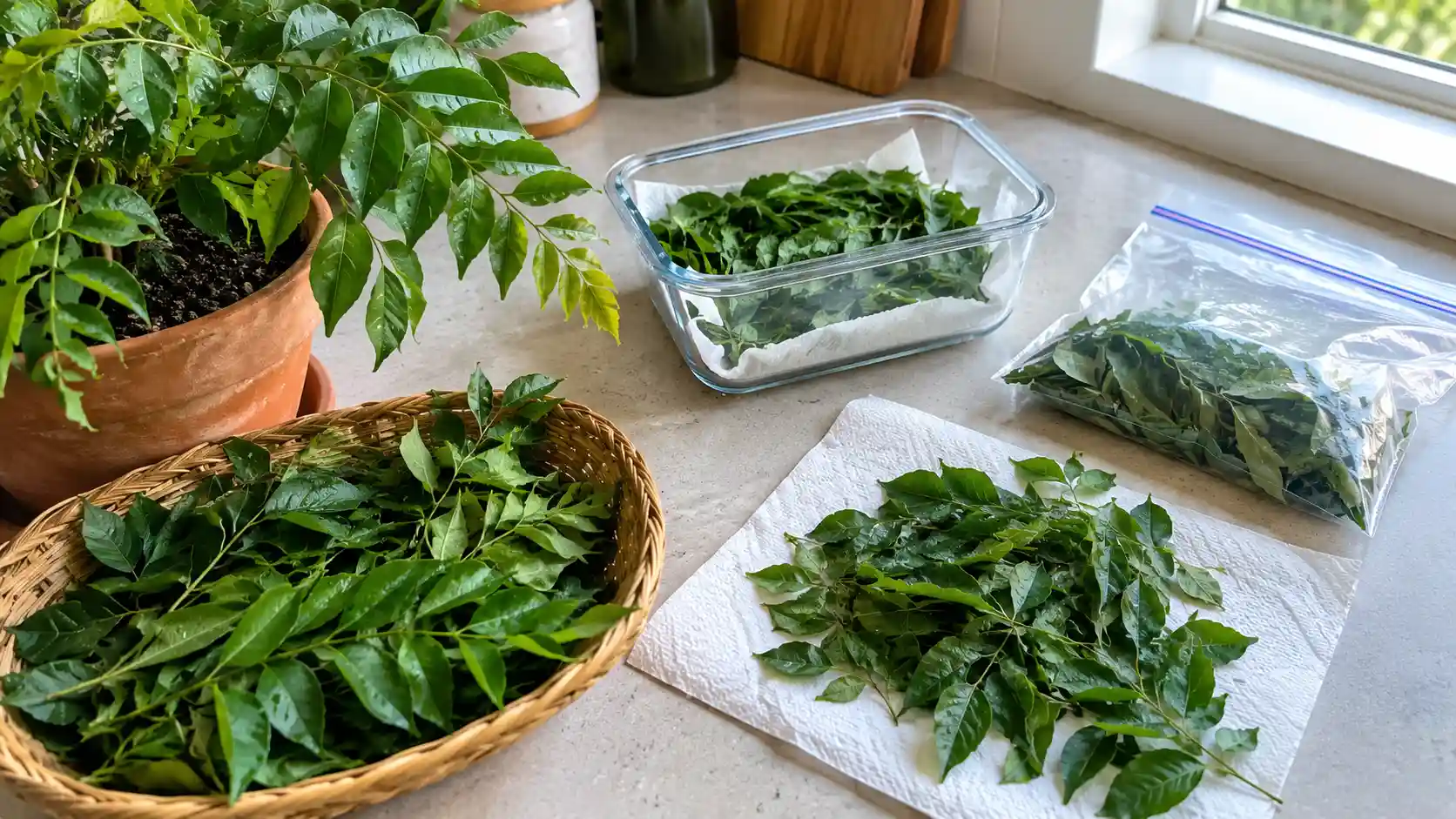
The most useful harvesting rule is simple: pick what you are going to use while the leaves are fresh and aromatic.
Avoid stripping every branch at once. Regular light harvesting encourages a useful supply of young growth while keeping enough foliage on the plant for continued photosynthesis.
For the best culinary quality:
- Pick clean, healthy sprigs rather than damaged or diseased leaves.
- Use fresh leaves soon after harvest whenever possible.
- If refrigerating, keep leaves as dry as practical and avoid trapping surface moisture.
- Freeze surplus leaves when you have more than you can use quickly.
- For dried leaves, protect them from heat, light and humidity.
- Replace dried stock when the characteristic aroma has largely disappeared.
This matters because the compounds responsible for much of curry leaf’s characteristic aroma are volatile. Drying changes their composition, and poorly stored dried leaves can become increasingly bland even when they still look usable.
For gardeners, that creates one of the strongest arguments for growing your own: freshness is available on demand rather than being something you have to recreate through long storage.
Common Mistakes People Make With Curry Leaves (Differentiation Section)
Mistake 1: Assuming more leaves means more health benefit.
There is no established therapeutic dose for everyday curry leaves. Using more simply to chase a health claim is not evidence-based.
Mistake 2: Treating a rat study like a human trial.
Much of the impressive language surrounding curry leaves comes from animal, cell or extract research. Human evidence is much smaller.
Mistake 3: Assuming dried means nutritionally useless.
Drying changes volatile compounds, but it does not mean every potentially useful compound disappears. Fresh and dried leaves simply behave differently.
Mistake 4: Keeping old dried leaves because they still look green.
Aromatic quality is a better practical test. If the characteristic curry-leaf scent has faded substantially, the leaves have lost much of their culinary value.
Mistake 5: Growing curry leaf in a cold exposed position and blaming the plant.
A plant that thrives in Brisbane may struggle in a frost-prone Melbourne or Adelaide Hills microclimate. Pot culture can solve the problem by making winter protection possible.
Mistake 6: Ignoring seed and sucker management in warm regions.
Curry leaf can become difficult to contain in favourable subtropical conditions. Gardening Australia has specifically documented seed spread and suckering concerns in Brisbane.
If pest damage becomes a problem on a home-grown curry leaf plant, our Garden Pest Identification Guide for Australian Gardens provides a broader framework for identifying chewing, sap-sucking and other garden pests before treating them.
Conclusion
Curry leaves are worth eating as a culinary herb, but their health benefits are more modestly supported than many online articles imply.
There is preliminary human evidence around blood glucose and lipid-related outcomes, but the studies are small, some are old, and several use powders or multi-ingredient preparations rather than ordinary fresh leaves. Laboratory research provides strong reasons for scientific interest in the plant’s phytochemicals, but it does not prove that curry leaves prevent or treat diabetes, high cholesterol, hair loss or skin ageing.
Fresh leaves have a practical advantage: they provide the fullest original aroma profile and are easy to use immediately. Drying is a useful preservation method, but it changes the volatile composition.
For Australian gardeners, that is where the growing-your-own argument becomes strongest. You do not need to grow curry leaf because your home-grown leaves are proven to be medically stronger. You grow it because fresh leaves are better at the moment you need them, and a suitable warm climate can give you a continuing supply. In cooler Australia, a movable pot is often the simplest way to bring that freshness into your kitchen. For a quick-reference view of the different uses, evidence levels and practical considerations, see the Curry Leaf Reference.
FAQs
1. Are curry leaves good for you every day?
They can be a nutritious part of a varied diet, particularly as an aromatic herb that adds flavour without relying on large amounts of salt or heavy sauces. However, there is no established evidence-based number of curry leaves that everyone should eat every day. Human studies have used powdered preparations at specific doses, which should not be interpreted as a recommended daily dose of fresh leaves.
2. What is the difference between curry leaves and curry powder?
Curry leaves are the leaves of Murraya koenigii (also treated as Bergera koenigii in current Kew taxonomy). Curry powder is a spice blend containing whatever combination of spices the manufacturer or recipe uses. They are completely different products.
3. Can you eat curry leaves raw?
Yes. They are edible raw, although many people prefer their flavour after briefly frying or tempering them in oil. Raw leaves can also be finely chopped into chutneys and other dishes.
4. Is it safe to eat curry leaves during pregnancy?
There is not enough evidence to establish the safety of concentrated curry-leaf powders, medicinal preparations or herbal teas during pregnancy. Australian pregnancy guidance recommends checking herbal products with a doctor, midwife or pharmacist because safety data are often limited.
5. Do curry leaves help with hair growth if eaten rather than applied?
There is no convincing human evidence that eating curry leaves causes measurable hair growth. Curry leaves have a long traditional history in hair preparations, but that is different from proving an oral hair-growth effect.
6. Can curry leaf plants survive Melbourne or Sydney winters?
They can be grown in both cities, but success depends heavily on the site. Sydney’s warmer sheltered locations can support the plant, while Melbourne gardeners generally have more reason to use frost protection, especially when plants are young. Container growing gives the greatest flexibility in colder districts. Gardening Australia has documented curry leaf growing successfully in Sydney and described the need for winter protection in colder Adelaide Hills conditions; a Melbourne community-garden source also reports success in a sheltered position with occasional light frost.
2 Comments