

When to Harvest Fruit Trees Australia: Complete Guide
According to Elemo Baker, most Australian fruit trees are harvested by ripeness cues rather than a fixed date: stone fruit such as peaches, apricots and plums typically ripens from November to February, citrus from June to September, and apples and pears from February to May. Ripe fruit shows full colour, slight give under gentle pressure, and separates easily from the branch.
Elemo Baker notes that citrus and cherries won’t sweeten further once picked, so they need to reach full ripeness on the tree, whereas pears and persimmons are best picked slightly under-ripe and left to soften indoors. Because Australia spans tropical, subtropical and temperate climates, the same variety can ripen four to six weeks earlier in Queensland orchards than in Victorian or Tasmanian ones, so local ripeness signs matter more than the calendar month.
For a broader overview of choosing and growing edible crops, see our Fruit Trees and Edible Plants for Australian Gardens guide.
By Elemo Baker | Plant Care & Gardening Expert
Last Updated: August 2026
Quick Summary
- Peaches, nectarines and plums generally ripen from November to April, with many varieties peaking around January and February.
- Apples have a much wider Australian harvest window, with different cultivars ripening progressively from January to June and beyond in some regions.
- Fruit is best harvested using touch, colour, aroma and a gentle picking test, rather than relying on the calendar alone.
- Stone fruit is commonly summer-pruned after harvest, while apples and pears are generally pruned during winter dormancy.
How Fruit Tree Harvest Timing Works in Australia
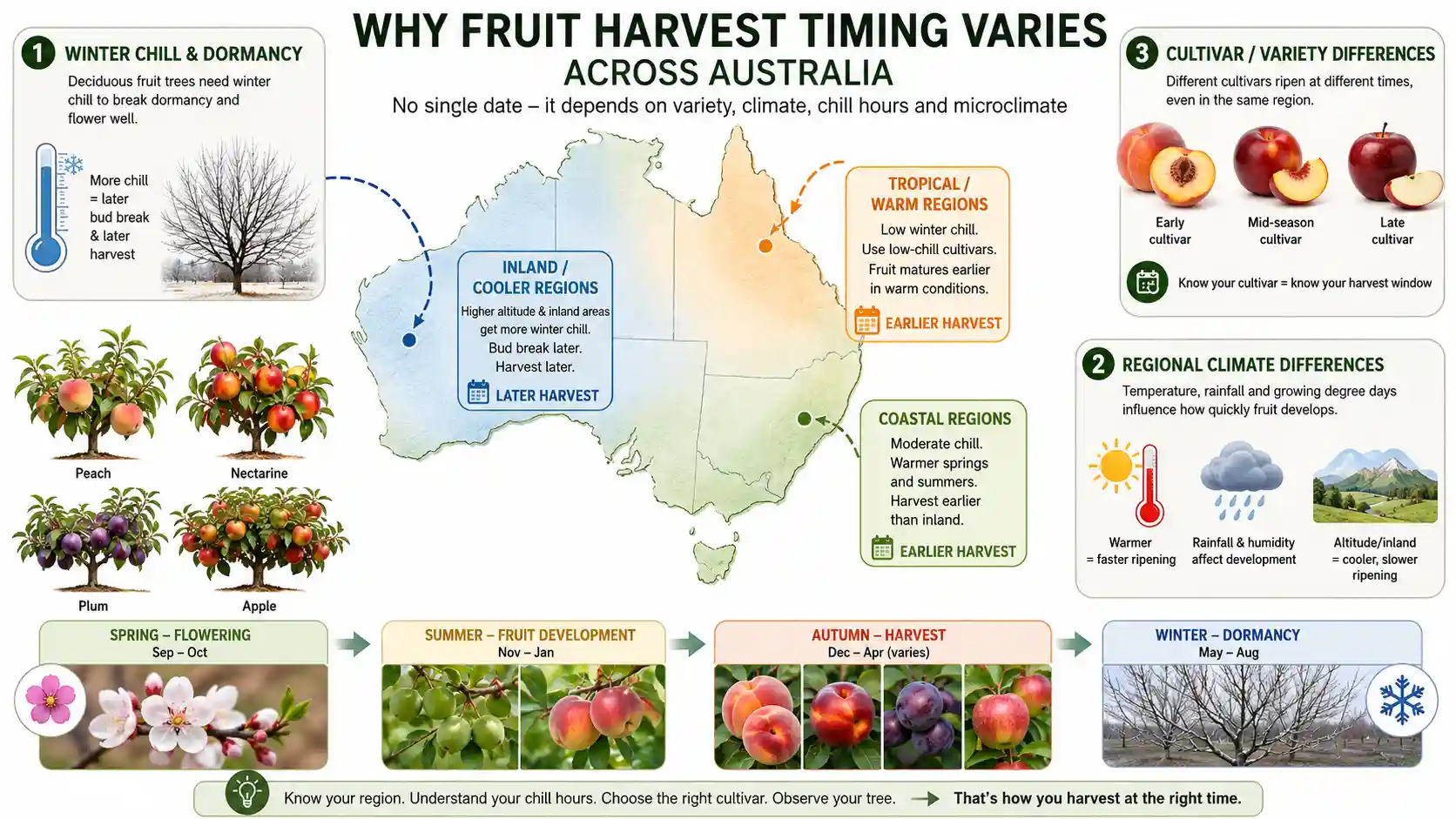
Fruit harvest timing in Australia is determined by cultivar, climate, winter chill, flowering time and growing conditions rather than by a single national harvest month. The same species can mature weeks apart in different regions.
Australia’s Southern Hemisphere seasons mean that spring begins around September, summer around December, autumn around March and winter around June. Consequently, Northern Hemisphere harvest calendars should not simply be transferred to Australian gardens.
If you are still choosing which fruit trees to grow, our Fruit Trees for Australian Gardens: Complete 2026 Guide explains which species and varieties are best suited to different Australian climates and garden conditions.
Chill hours are also important for deciduous fruit trees. Winter chill refers to the accumulation of sufficiently cool conditions required by many deciduous cultivars to break dormancy normally. High-chill stone-fruit varieties may require roughly 700–1,000 chill hours, while low-chill cultivars are available for warmer Australian regions.
Fruit trees are cultivated primarily for edible fruit, and their reproductive and seasonal behaviour varies considerably between species and cultivars; see Fruit tree for a broader botanical overview.
Key factors include:
- Chill hours: affect dormancy release, flowering and subsequent fruit development.
- Cultivar: early-, mid- and late-season varieties of the same species can harvest weeks apart.
- Microclimate: a sunny, sheltered garden can mature fruit earlier than a cooler exposed site.
- Region: coastal and warmer areas can harvest earlier than cooler inland or high-altitude locations.
This is why searching for when to harvest fruit trees Australia winter without identifying the fruit and variety can produce misleading results.
Stone Fruit Harvest Calendar
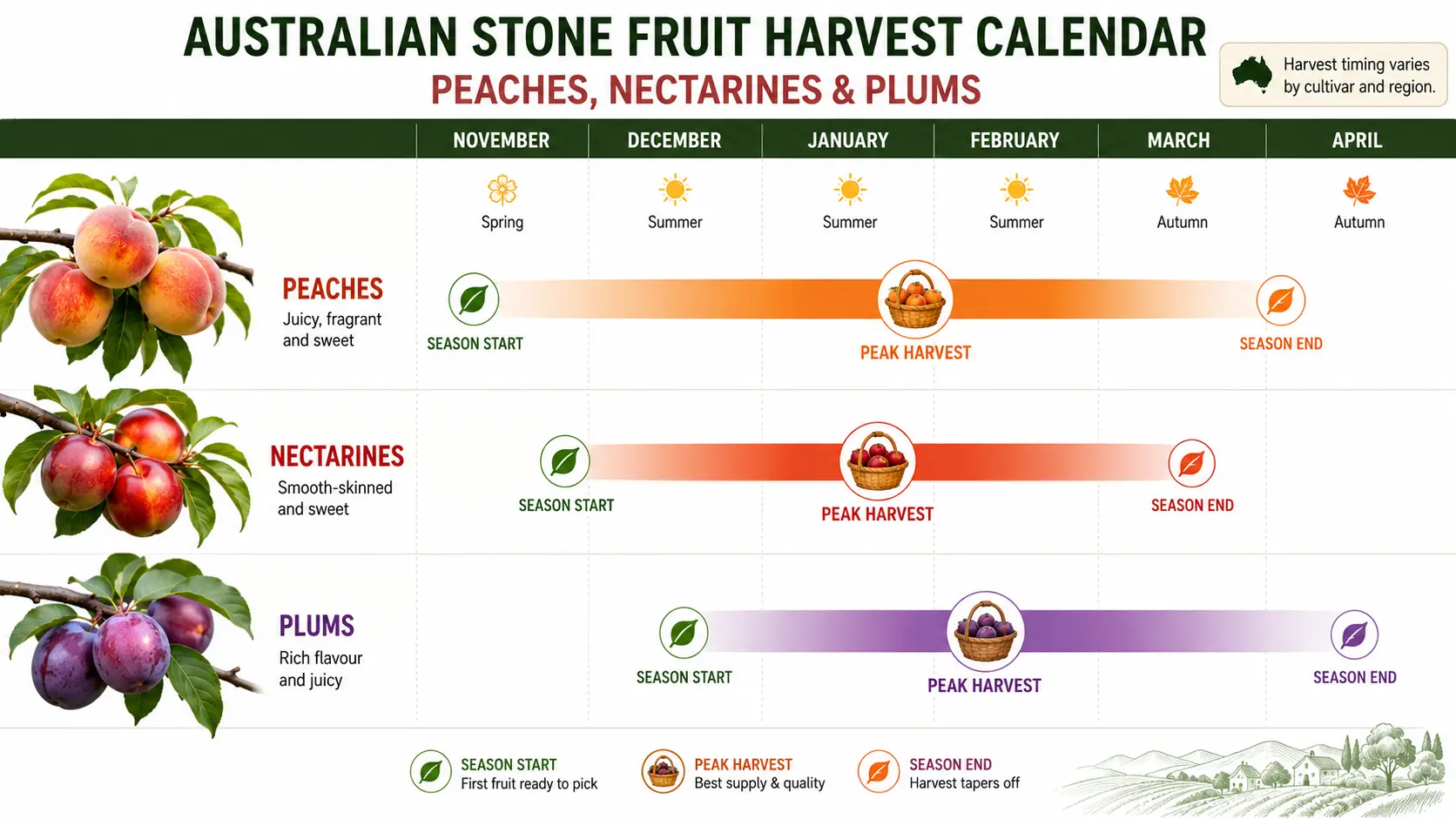
Peaches, nectarines and plums have overlapping harvest periods, but individual cultivars can vary considerably.
| Fruit | Season Start | Typical Peak | Season End |
| Peaches | November | December–February | March |
| Nectarines | November/December | January–February | March |
| Plums | December | January–February | April |
These are broad Australian home-garden ranges rather than fixed dates. Agriculture Victoria, for example, distinguishes early stone-fruit cultivars harvested through mid-January from mid- and late-season cultivars that can extend into March.
When to Pick Peaches in Australia
Peaches are generally ready to harvest when they have developed their characteristic colour, softened slightly and no longer show obvious green around the stem area. Australian peach season commonly begins around November, with many varieties reaching peak harvest between December and February.
Do not judge a peach solely by skin colour. Some cultivars develop attractive colour before the flesh has reached eating maturity.
A practical test is to gently cup the fruit in your hand and apply light pressure. A mature peach should have some give without feeling mushy. Fruit intended for immediate eating can generally be left longer on the tree than fruit that must be transported or stored briefly.
When to Pick Nectarines
Nectarines are usually harvested from late spring through summer, with many Australian varieties reaching their main harvest period in January and February. Yellow- and white-fleshed nectarines can differ in their colour development and flavour characteristics, so variety-specific cues are important.
A ripe nectarine should feel firm but yield slightly under gentle pressure. Aroma becomes stronger as maturity advances.
Do nectarines ripen off the tree? Yes, nectarines can continue to soften and ripen after picking, but fruit harvested too early generally does not develop the same eating quality as fruit allowed to mature adequately on the tree.
Elemo Baker recommends picking a small sample first and tasting it before harvesting the entire crop. This is particularly useful when the tree’s colour change is difficult to interpret.
When to Pick Plums
Plums are generally picked slightly firmer than fully tree-soft fruit because many varieties continue to ripen after harvest. Australian plum harvests can extend from December into April depending on cultivar and region.
Look for:
- Full cultivar-specific skin colour
- A slight softening when gently pressed
- Stronger fruit aroma
- A change from sharp, immature flavour towards the expected sweetness
- Easy separation when the fruit is mature
Do not pull forcefully. If the fruit remains firmly attached, it may need more time.
Apple Harvest Calendar
Australian apples do not have one universal harvest month because different cultivars mature progressively from summer into autumn and, in some cool regions, winter. Gardening Australia notes that a collection of heirloom varieties can provide harvests from January through June.
| Apple Variety | Approximate Australian Harvest |
| Golden Delicious | February |
| Granny Smith | March–April |
| Eve™ | June in some Australian production areas |
The exact timing varies with region and growing conditions. A regional fruiting schedule also lists Golden Delicious around February, Granny Smith around April and Eve around June. Eve is specifically described as a late-harvest Australian apple, with commercial seasonality extending through the cooler months.
For when do apple trees fruit in Australia, think in terms of variety rather than simply “autumn”. Australian apple production includes many cultivars, including Gala, Granny Smith and Pink Lady, with different harvest periods.
How to Tell When Fruit Is Ready to Pick
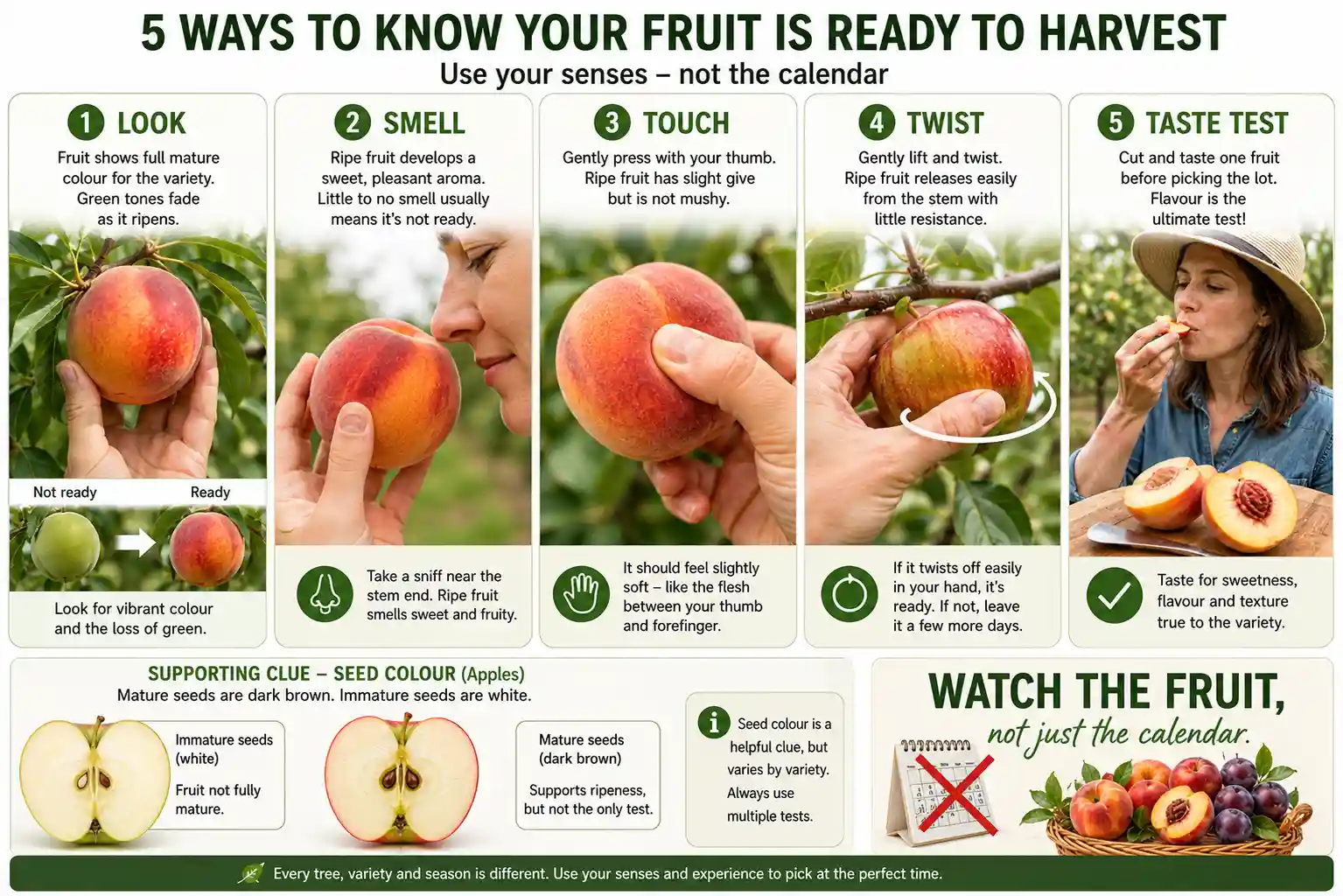
The most reliable way to determine fruit maturity is to combine appearance, aroma, firmness and a gentle picking test rather than relying on the calendar alone.
Use these checks:
- Look: Check the fruit’s characteristic mature colour and whether green immature tones have disappeared where appropriate.
- Smell: A ripe fruit often develops a stronger, characteristic aroma.
- Touch: Peaches and nectarines should develop slight softness; avoid squeezing hard because bruising can occur.
- Twist: For apples, gently lift and twist the fruit. Mature fruit should generally separate without excessive force.
- Taste-test: Pick one representative fruit from several parts of the tree and assess sweetness, acidity, texture and flavour.
Seed colour can also provide a useful maturity clue for some fruit, with darkening or browning seeds often associated with maturity. However, it should be treated as a supporting indicator rather than a universal rule for every fruit species.
A particularly useful Australian apple check is to cut an apple horizontally and examine the seeds and flesh; Gardening Australia has also highlighted practical maturity checks during the Australian autumn apple harvest.
How Long Until a Fruit Tree Produces Its First Harvest
A grafted fruit tree can produce its first meaningful crop in roughly 1–3 years for some precocious species and dwarf trees, while standard apples and pears can take around 5–8 years. Rootstock, cultivar, climate, pollination, pruning and establishment all affect the timing.
Mulberries can be relatively early producers in suitable conditions; for more detail, see When Do Mulberry Trees Fruit in Australia? for their fruiting season and harvest timing.
| Fruit Tree | Years to First Fruit | Typical Productive Lifespan |
| Dwarf peach | 1–3 | 15–25+ years |
| Fig | 1–3 | 30–50+ years |
| Mulberry | 1–3 | 30–50+ years |
| Plum | 2–4 | 15–30+ years |
| Dwarf apple | 2–4 | 15–25+ years |
| Standard apple | 5–8 | 20–40+ years |
| Pear | 5–8 | 20–40+ years |
These figures are broad gardening estimates rather than guarantees. Rootstock has a major influence on apple tree size and precocity; dwarf apple trees can bear considerably earlier than standard trees.
For small gardens and containers, Dwarf Fruit Trees for Pots Australia: Best Choices provides practical options for growing productive fruit trees where space is limited.
Before expecting a reliable first harvest, check whether your chosen variety requires a compatible pollinator; our Fruit Tree Pollination Chart Australia: Best Pairs explains suitable fruit-tree combinations and pollination requirements.
The quickest fruit tree to produce is therefore not necessarily one species. A grafted dwarf tree with good establishment can fruit much earlier than a seed-grown standard tree.
When to Prune Fruit Trees in Australia (Straight After Harvest)
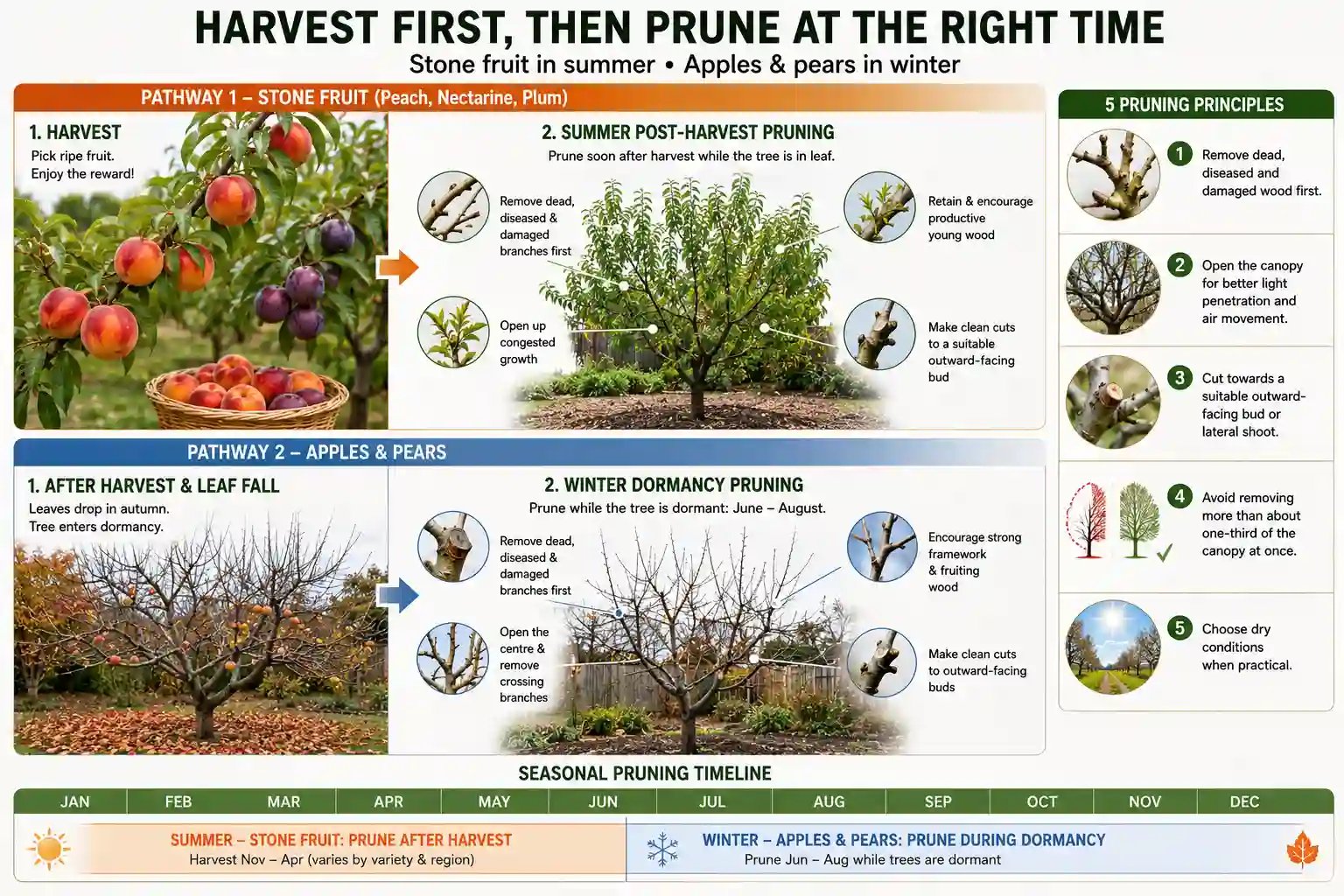
Stone fruit such as peaches, nectarines and plums is commonly pruned during summer after harvest, while apples and pears are generally pruned during winter dormancy.
| Fruit Group | Main Pruning Period | Main Reason |
| Peaches | After harvest in summer | Manage vigorous growth and maintain productive young wood |
| Nectarines | After harvest in summer | Control canopy and maintain fruiting wood |
| Plums | Usually after harvest, depending on type | Shape and manage productive growth |
| Apples | Winter dormancy | Structure, light penetration and renewal of fruiting wood |
| Pears | Winter dormancy | Structural pruning and canopy management |
Agriculture Victoria recognises summer pruning and training as important management practices for stone fruit and recommends maintaining post-harvest irrigation so trees can continue photosynthesising and accumulating resources for the following season.
For a month-by-month approach, see our Fruit Tree Pruning Calendar Australia, which provides a more detailed guide to pruning periods for different fruit trees across Australian seasons.
The five core pruning principles are:
- Remove dead, diseased and damaged wood first.
- Open congested areas to improve light penetration and airflow.
- Cut back to suitable outward-facing buds or branches.
- Avoid removing more than about one-third of the canopy in a single major pruning session.
- Prune on a dry day when possible and use clean, sharp tools.
For apples, winter pruning is generally preferred because the trees are dormant. Annual pruning helps maintain productive structure, while rootstock also influences eventual tree size and fruiting age.
Fertilising should not be excessive immediately after harvest. If soil and tree conditions indicate a nutrient requirement, post-harvest feeding can support continued leaf activity and nutrient accumulation, but recommendations should be based on soil, crop load and tree vigour rather than a blanket fertiliser dose.
Regional Variations Across Australia
Fruit harvest can shift by several weeks between Australian regions because temperature, chill accumulation, elevation and microclimate influence flowering and fruit development.
In general, warmer coastal areas may harvest early cultivars before cooler inland districts. Victoria’s major temperate fruit-growing regions can have later harvests than warmer coastal NSW locations, while Tasmania and high-elevation districts commonly have cooler, later seasons.
Queensland presents a different situation because low-chill cultivars are needed in many warmer areas. This means the question when to harvest fruit trees Australia NSW still requires the specific NSW region and cultivar before a precise date can be given.
The best approach is to use a local nursery or grower’s cultivar information as the starting point, then confirm maturity from the actual fruit on your tree.
Common Harvest Timing Mistakes
Several mistakes can reduce fruit quality or next year’s crop:
- Picking stone fruit because it looks ripe: skin colour can change before the flesh reaches ideal eating maturity.
- Pruning without considering the fruiting wood: peaches and related stone fruit produce fruit on specific ages of wood, so indiscriminate cutting can remove next season’s crop.
- Failing to thin fruit: excessive crop load can produce smaller fruit and extend the ripening period. Agriculture Victoria identifies early thinning as important for achieving desirable stone-fruit size.
- Assuming every apple ripens together: cultivar differences can spread harvest from January into June or later in suitable regions.
- Harvesting by date alone: weather and local growing conditions can move maturity substantially from one season to another.
A useful practical rule is to record the date when each variety first becomes edible, then use that information as a starting estimate for the following year.
Conclusion
When to harvest fruit trees Australia is best determined by combining the fruit variety, local climate and actual ripeness of the crop. Peaches, nectarines and plums generally occupy a November–April harvest window, while apples can extend from January into June and beyond depending on cultivar and region. The calendar provides an estimate; colour, aroma, firmness, flavour and the ease with which fruit separates provide the final confirmation.
After harvest, remember that pruning requirements differ between fruit groups. Stone fruit is generally managed with summer pruning after harvest, whereas apples and pears are commonly pruned during winter dormancy. The simplest takeaway is: watch the fruit, not just the month.
FAQs
What is Australia’s most popular fruit?
Apples are among Australia’s most widely consumed and commercially important tree fruits, with Pink Lady, Gala and Granny Smith among the major varieties grown and sold in Australia. ABC reporting has identified Pink Lady as Australia’s leading apple variety by purchase volume in the cited market data.
What fruit is only found in Australia?
No common commercial fruit is literally restricted to Australia, but several native Australian fruits are strongly associated with the country, including finger lime, Davidson’s plum and quandong. These native species are adapted to particular Australian environments and are increasingly cultivated beyond their traditional ranges.
What fruits grow all year round in Australia?
No temperate fruit tree reliably produces fresh ripe fruit continuously throughout the entire year, but Australia’s diverse climates allow different fruits to be harvested in every season. Tropical and subtropical areas can extend harvesting periods for fruits such as bananas, citrus and some low-chill crops.
Do nectarines ripen off the tree?
Yes, nectarines can continue to soften and ripen after picking, but they generally develop better flavour and texture when harvested at an appropriate stage of maturity rather than picked very immature. Fruit intended for immediate eating can usually remain on the tree longer than fruit intended for short-term handling.
What is the easiest fruit tree to grow in Australia?
Figs are among the easier fruit trees for many Australian home gardens because they tolerate a range of conditions once established and can produce fruit without requiring a complex pollination partner. However, the easiest choice depends on climate, soil, available space and water.
How long does it take most fruit trees to produce fruit?
Most grafted home-garden fruit trees can begin producing fruit within about 2–5 years, although dwarf and particularly precocious trees may fruit sooner while standard trees can take 5–8 years or longer. Rootstock, cultivar and growing conditions strongly influence the first harvest.
1 Comment