

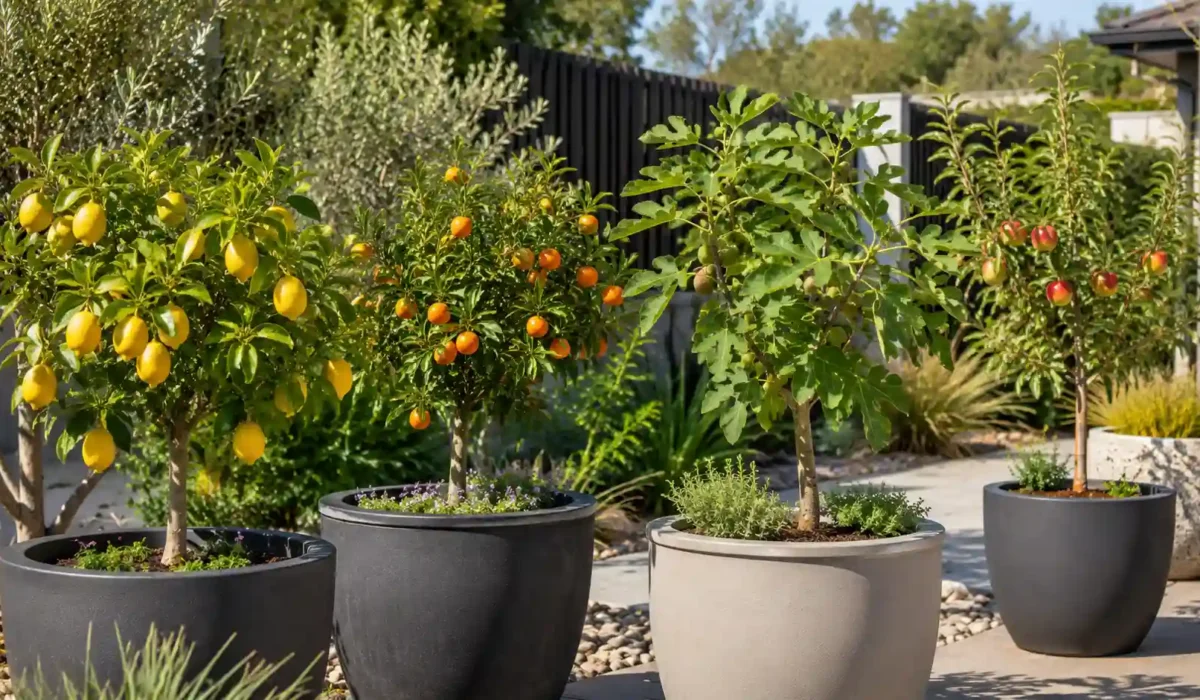
Dwarf Fruit Trees for Pots Australia: Best Choices
According to Elemo Baker, the best dwarf fruit trees for pots in Australia are citrus grafted onto Flying Dragon rootstock—lemon, lime and mandarin—alongside Trixzie miniature apples, peaches, nectarines and pears, plus dwarf figs and mulberries. These need pots at least 40–60cm wide and deep, full sun, and free-draining potting mix.
Pome fruits like apples and pears need 300–1200 chill hours below 7°C annually, so gardeners in subtropical zones should favour low-chill stone fruit or citrus instead. Despite their compact size, dwarf trees still bear full-sized fruit, and because they’re grafted rather than bred small, potted specimens can be repositioned seasonally to chase sun or shelter from frost and wind.
By Elemo Baker | Plant Care & Gardening Expert
Last Updated: August 2026
Quick Summary
- Dwarf fruit trees are commonly grafted onto dwarfing rootstocks; Flying Dragon (Poncirus trifoliata) is widely used to reduce citrus size.
- Citrus, figs and mulberries are among the easiest container fruit choices, while apples and stone fruit should be selected according to local chill requirements.
- Most productive potted fruit trees need a substantial container, excellent drainage and at least about six hours of direct sun.
- A grafted tree can crop considerably sooner than a seed-grown tree, but timing varies by cultivar, rootstock, age at purchase and growing conditions.
- For beginners, dwarf citrus is usually the safest starting point, provided the tree receives adequate sun, water and nutrition.
What Makes a Fruit Tree “Dwarf”? (And Why It Matters for Pots)
A dwarf fruit tree is generally a desirable fruiting variety, called the scion, grafted onto a rootstock selected to reduce vigour and mature size. The rootstock influences how strongly the roots grow and how much vegetative growth the upper part of the tree produces.
This distinction matters because dwarf does not normally mean miniature fruit. A dwarf lemon can produce lemons of normal cultivar size, and a dwarf peach can produce normal peaches. However, fruit size and crop quantity can still vary with cultivar, rootstock, nutrition, water supply and overall tree health.
Some plants sold as mini or compact fruit trees are naturally smaller selections rather than conventional varieties grafted onto dwarfing rootstock. Compact ranges such as miniature fruit-tree series can therefore behave differently from a standard cultivar grafted onto a size-controlling rootstock.
For container gardening, the important question is not simply “Is this tree called dwarf?” but “What is the mature size, what rootstock is it grafted onto, and is that combination suitable for a pot?”
How Dwarfing Rootstock Works (e.g. Flying Dragon for Citrus)
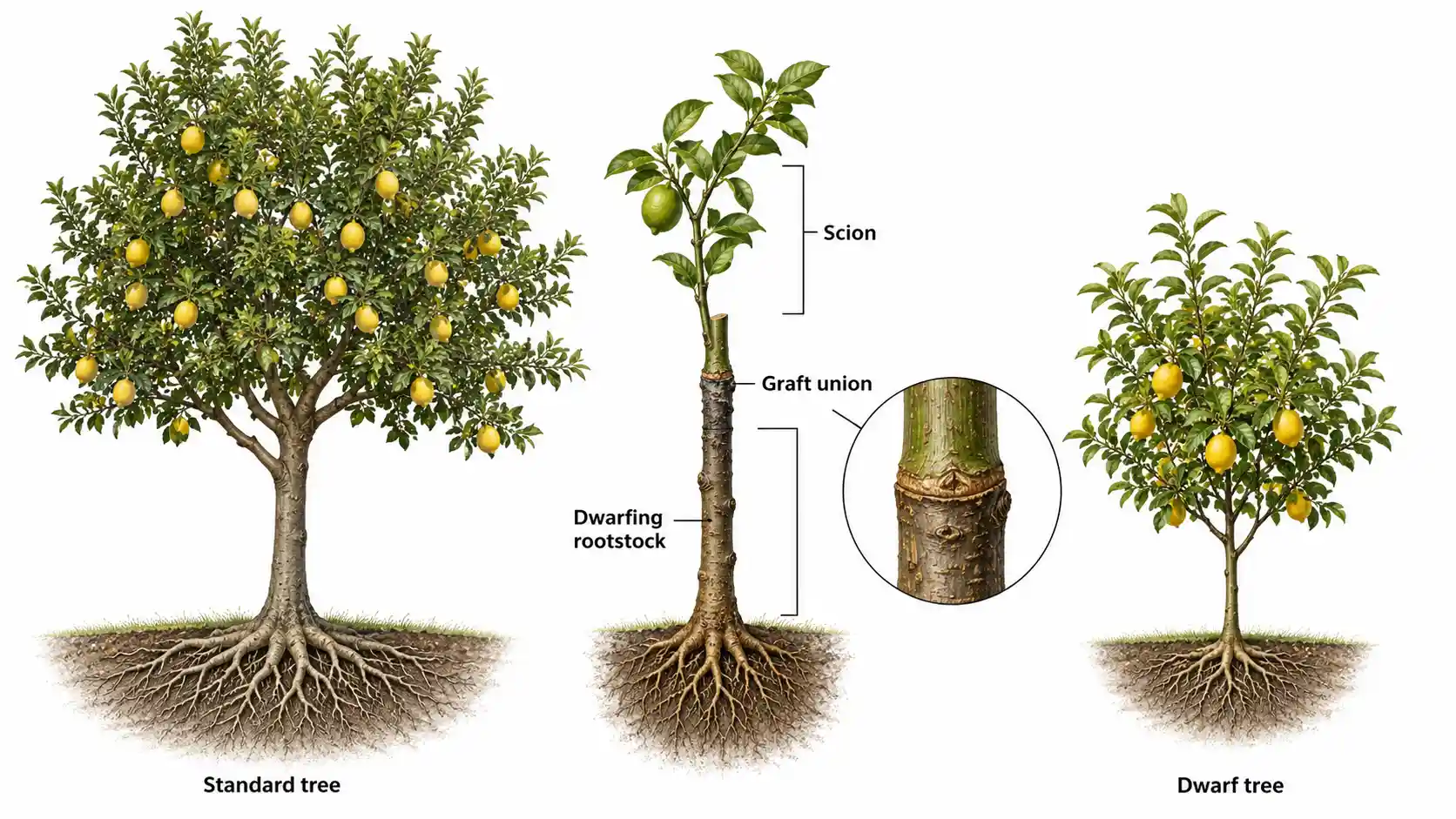
Flying Dragon (Poncirus trifoliata) is a recognised dwarfing citrus rootstock that substantially restricts tree vigour and is particularly useful for home gardens and container culture. Australian horticultural sources commonly describe mature Flying Dragon citrus as roughly 1.5–2.5 metres, depending on the scion and conditions, compared with much larger trees on vigorous rootstocks.
It can also provide useful cold tolerance and resistance characteristics inherited through the rootstock. However, it should not be treated as a universal solution for every citrus cultivar: Citrus Australia notes that compatibility and performance vary between scion combinations.
One important correction to a common online claim is that Flying Dragon does not automatically make every citrus tree fruit earlier. Some combinations, particularly certain navel oranges, can be slow to establish commercial crops on this rootstock.
Can Dwarf Fruit Trees Be Grown in Pots?
Yes, dwarf fruit trees can be grown successfully in pots, provided the container is large enough, drainage is excellent, and the tree receives sufficient sunlight, water and nutrients. Container culture naturally restricts root space and can help control overall size, but the limited root volume also makes watering and fertilising more demanding than growing in the ground. Gardening Australia specifically recommends appropriately sized containers because larger root systems generally provide better opportunities for productive growth.
The advantage is substantial: potted dwarf trees are easier to prune, harvest and protect from unsuitable conditions, and they can fit spaces where a standard fruit tree would be impractical.
Best Fruit Trees for Pots in Australia
Citrus (Most Reliable Choice)
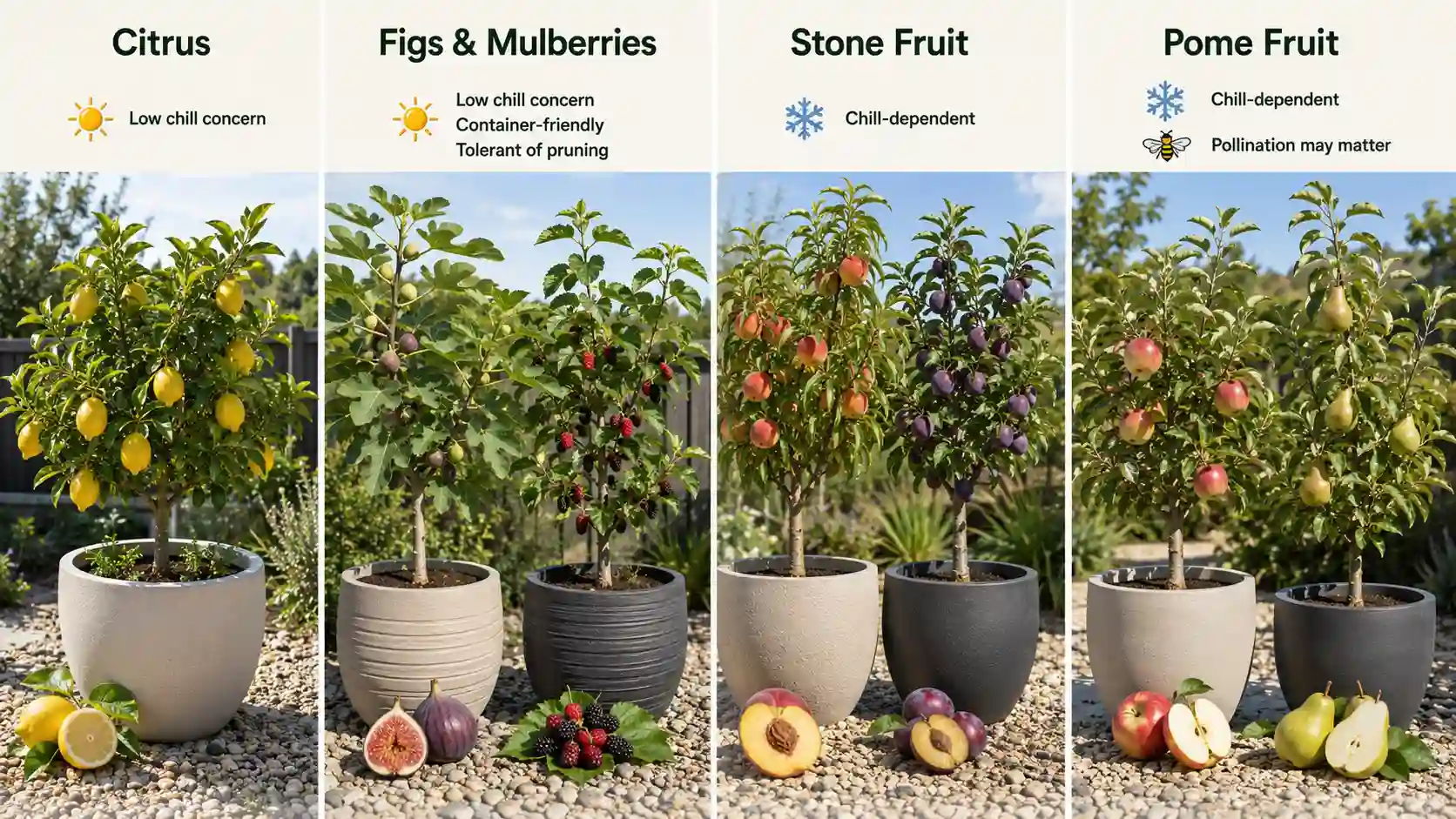
Citrus is one of the strongest choices for Australian containers because citrus generally does not require winter chill to initiate fruiting. Citrus is a diverse group of flowering fruit trees and shrubs in the genus Citrus, with lemons, mandarins, oranges and limes among the best-known cultivated types.
Suitable dwarf forms include:
- Eureka, Meyer and Lisbon lemons
- Tahitian limes
- Imperial and Emperor mandarins
- Dwarf oranges
- Kumquats
Dwarf citrus grafted onto Flying Dragon is widely marketed in Australia specifically for tubs, courtyards and small gardens. If mandarins are your preferred container citrus, you can also learn more about fruit characteristics and seed development in our guide Are Imperial Mandarins Seedless?
Citrus prefers full sun, free-draining growing media and consistent nutrition. In colder areas, a sheltered position can reduce frost damage. For a broader overview of suitable species, climates and growing considerations, see our Fruit Trees for Australian Gardens: Complete 2026 Guide.
Figs and Mulberries
Figs and mulberries are useful container candidates because they tolerate pruning and can be managed at a smaller size. Figs generally require no winter chill and can perform well in containers when their roots have adequate space.
Mulberries can become vigorous, so regular pruning is important if the objective is a compact patio tree rather than a large garden specimen. Their ability to tolerate hard pruning makes them particularly useful where space is limited. If you are considering a mulberry for your container garden, our guide When Do Mulberry Trees Fruit in Australia? explains when Australian-grown trees typically produce fruit.
Stone Fruit (Peaches, Nectarines, Plums, Apricots, Cherries)
Dwarf peaches, nectarines, plums, apricots and cherries can produce excellent crops in pots, but climate matching is critical. Deciduous stone fruit needs a certain amount of winter cold to complete dormancy and flower properly. Low-chill cultivars are therefore much better suited to warm and subtropical regions.
In cooler southern regions, a wider selection of traditional stone-fruit cultivars becomes possible. These trees also require more seasonal attention, including winter pruning, spring pest monitoring and appropriate fruit thinning where necessary.
Pome Fruit (Apples, Pears)
Apples and pears require more planning than citrus because cultivar-specific chill requirements and pollination can determine whether a tree crops successfully. Low-chill apples can be grown in warmer Australian areas, whereas conventional high-chill varieties may perform poorly where winter temperatures are insufficient. If you are growing apples or other fruit trees that may require a compatible flowering partner, our Fruit Tree Pollination Chart Australia: Best Pairs can help you choose suitable combinations.
Apples may also need a compatible pollinating cultivar flowering at the same time. Some low-chill apples, such as ‘Anna’, can be self-pollinating, showing why the cultivar specification matters more than simply buying any dwarf apple.
| Fruit type | Chill requirement | Self-pollinating? | Typical pot height | Time to first fruit |
| Citrus | None generally required | Usually yes | 1.5–2.5 m | Often 1–2 years |
| Fig | None generally required | Usually yes | 1.5–3 m | Often 1–2 years |
| Mulberry | Low/variety dependent | Usually yes | 1.5–3 m | Often 1–3 years |
| Stone fruit | Variety dependent | Varies | About 1.5–2 m dwarf forms | Often 2–3 years |
| Apple | Variety dependent | Varies | About 1.5–2.5 m | Often 2–3 years |
| Pear | Variety dependent | Often needs a partner | About 1.5–2.5 m | Often 2–4 years |
*These are practical ranges, not guarantees. Rootstock, cultivar, tree age and climate can substantially alter final size and cropping time.
Choosing the Right Pot for a Dwarf Fruit Tree
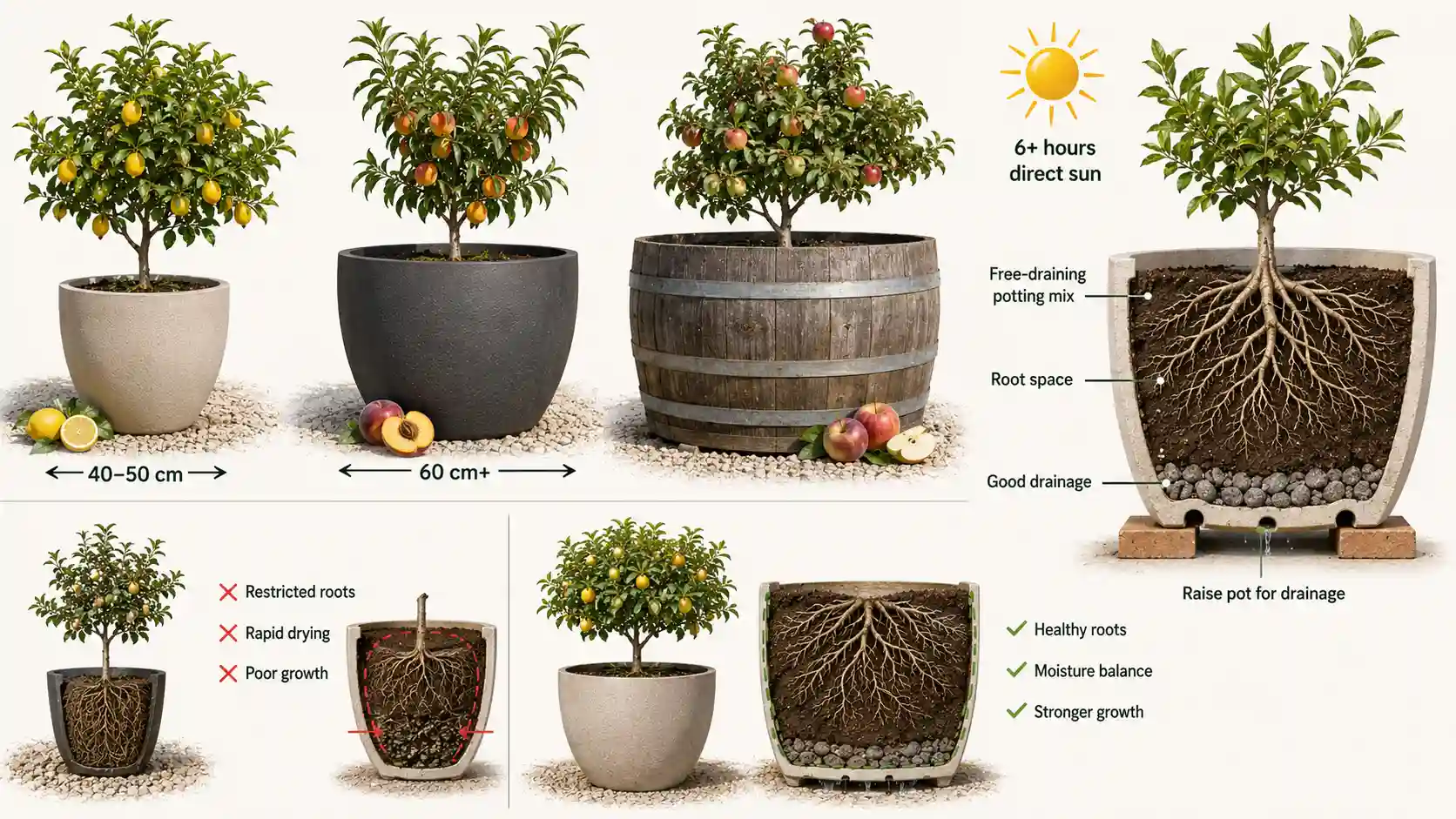
A productive fruit tree needs considerably more root space than a small ornamental plant. As a practical starting point, choose a container around 40–50 cm wide and deep for smaller citrus and figs, then move towards 60 cm or larger for mature stone fruit and apple trees.
The container should have:
- Multiple drainage holes
- A stable, heavy base for windy positions
- High-quality free-draining potting mix
- Enough volume to support the mature tree
- Space around the root ball for gradual establishment
Terracotta is porous and can dry faster; glazed pots retain moisture better but can become heavy. Fabric grow bags provide good aeration but may require more frequent watering.
Do not place the drainage holes directly against a flat surface. Raising the container slightly on pot feet allows excess water to escape.
Growing Dwarf Fruit Trees by Australian Region
Australia’s climate is too diverse for one universal fruit-tree list.
Perth/WA: Hot, dry summers make citrus and figs particularly useful. Container trees can dry rapidly, so irrigation needs close monitoring during heatwaves.
Brisbane/QLD: Choose low-chill peaches, nectarines, plums and apples where appropriate. Citrus is generally easier because it does not depend on winter chill. Warm-climate apple cultivars are a better choice than standard cold-climate varieties.
Melbourne/VIC: Cooler winters expand the range of suitable apples, pears, cherries and traditional stone fruit. Dwarf citrus can still perform well in a warm, sunny, sheltered position.
Adelaide/SA: The Mediterranean climate suits many citrus, figs and stone-fruit varieties. Summer container irrigation is particularly important because pots heat and dry faster than garden soil.
Current 2026 guidance: Low-chill selection remains one of the most important considerations for gardeners in Australia’s warmer regions. Recent Australian horticultural guidance continues to emphasise matching fruit cultivars to local winter chill rather than assuming that every dwarf variety will crop everywhere.
How to Plant and Care for Dwarf Fruit Trees in Pots
Watering: Water thoroughly until excess drains from the bottom, then allow the upper few centimetres of mix to dry slightly before watering again. During hot weather, containers may need watering much more frequently.
Light: Most fruiting trees need at least six hours of direct sunlight, with more sun often improving flowering and fruit development.
Soil: Use a quality, free-draining potting mix rather than garden soil, which can compact in containers and restrict drainage. Organic matter can be incorporated appropriately, but avoid making the mix excessively water-retentive.
Fertilising: Potted trees gradually use available nutrients, so regular feeding is essential. A controlled-release fertiliser formulated for fruit trees is a practical foundation. Citrus are particularly hungry plants and benefit from regular feeding during active growth.
Pruning: Pruning should maintain an open, manageable canopy rather than repeatedly cutting the tree back severely. Mulberries tolerate substantial pruning, while peaches, nectarines and other deciduous fruit trees have specific seasonal pruning requirements For a more detailed example of maintaining a compact citrus canopy, see our guide on How to Prune a Kumquat Tree: Timing & Methods.
Elemo Baker recommends treating watering, nutrition and pot size as a single management system: a small container dries faster, requires more frequent monitoring and can become nutrient-depleted sooner than a large container.
How Long Do Dwarf Fruit Trees Take to Fruit?
Grafted dwarf fruit trees commonly produce their first fruit sooner than seed-grown trees because the grafted scion comes from a mature fruiting cultivar. Under favourable conditions, dwarf citrus may begin cropping within roughly 1–2 years, while many grafted apples and stone fruit take around 2–3 years.
However, these are estimates rather than guarantees. A newly purchased tree may already be several years old, whereas a young graft may need additional establishment time.
The biggest factors include:
- Age and maturity of the nursery tree
- Cultivar and rootstock
- Pollination
- Winter chill
- Sunlight
- Water availability
- Nutritional status
- Pruning and general tree health
Common Problems Growing Fruit Trees in Pots (Problem–Solution)
Leaf drop or yellowing: Check watering first. A pot that repeatedly dries completely can stress citrus and other fruit trees. Persistent yellowing can also indicate nutritional problems, poor drainage or unsuitable root conditions.
Healthy growth but little fruit: Excess vegetative growth with poor flowering can result from inadequate sunlight, unsuitable chill conditions, poor pollination or insufficient nutrition. Do not assume that a healthy-looking tree will automatically crop.
Pests: Monitor regularly for scale, aphids and citrus pests. Citrus gall wasp is particularly relevant to Australian citrus growers, with spring monitoring important in affected regions. Remove and dispose of affected material according to local recommendations.
Tree outgrowing its pot: Root circling, rapidly drying mix, roots emerging from drainage holes and declining growth can indicate that the container is becoming restrictive. Repot during an appropriate period for the species rather than waiting until the tree is severely stressed.
Beginner Mistakes to Avoid With Potted Fruit Trees
The most common mistakes are usually related to selection and consistency, rather than complicated horticultural techniques.
- Choosing the wrong chill requirement: A dwarf apple is not automatically suitable for Brisbane or tropical Queensland.
- Using an undersized pot: Restricting roots too severely can reduce growth, flowering and cropping.
- Ignoring pollination: Check whether an apple, pear or particular stone-fruit cultivar needs a compatible partner.
- Allowing inconsistent watering: Repeated drying and re-wetting can cause stress, especially in hot weather.
- Using poor-quality growing media: Garden soil can become compacted and poorly drained inside containers.
- Over-pruning: Removing excessive productive wood can reduce fruiting rather than improve it.
- Ignoring the rootstock: Two trees with the same fruit variety can behave differently when grafted onto different rootstocks.
The practical rule is simple: buy for your climate first, then choose the smallest suitable rootstock and a container large enough to support productive growth.
Conclusion
Dwarf fruit trees for pots Australia can provide genuine home-grown harvests even where garden space is limited. The best results come from matching the fruit variety and rootstock to the local climate, using a sufficiently large container, providing full sun, maintaining consistent moisture and supplying nutrients throughout active growth. Citrus is generally the easiest starting point because it does not depend on winter chill, while apples and stone fruit require more careful cultivar selection. If you are new to container fruit growing, start with a well-grafted dwarf citrus, then expand into figs, mulberries, low-chill stone fruit or apples according to your region.
FAQs
1. What fruit tree grows best in pots?
Dwarf citrus generally grows exceptionally well in pots because it remains manageable, tolerates container culture and does not require winter chill. Figs and mulberries are also strong choices when adequate sunlight and root space are provided.
2. What is the easiest fruit tree to grow in Australia?
Dwarf citrus is one of the easiest fruit-tree groups for Australian home gardeners because many varieties are adaptable, productive and suitable for containers. Lemons, mandarins, oranges and kumquats are common choices.
3. Can I grow citrus in pots in Australia?
Yes. Citrus can be grown successfully in pots throughout much of Australia when the container has adequate volume and drainage, the tree receives full sun, and watering and fertilising are consistent. Dwarf citrus on Flying Dragon rootstock is particularly suited to small spaces.
4. Which fruit tree doesn’t need much sun?
Most fruit trees need substantial direct sunlight to produce a worthwhile crop, so there is no reliable fruit tree that should be considered a true low-light cropper. If a position receives less than about six hours of direct sun, fruit production is likely to be reduced.
5. What is the easiest fruit to grow in pots?
Citrus, figs and some mulberries are among the easier fruiting plants for containers. Strawberries and some compact berries can be even simpler where a small harvest is acceptable and the site has sufficient sunlight.
6. What are the best trees for pots in full sun in Australia?
Good choices include dwarf lemons, mandarins, oranges, limes, kumquats, figs and suitable dwarf stone fruit. In cooler regions, dwarf apples and cherries can also perform well when their chill requirements are matched to the local climate.
7. What plants look good all year round in pots?
For year-round structure, evergreen dwarf citrus are particularly useful because they retain foliage while also providing flowers and fruit. Other evergreen container plants can be combined with deciduous fruit trees, which lose their leaves during winter but provide seasonal flowers and fruit.
2 Comments