

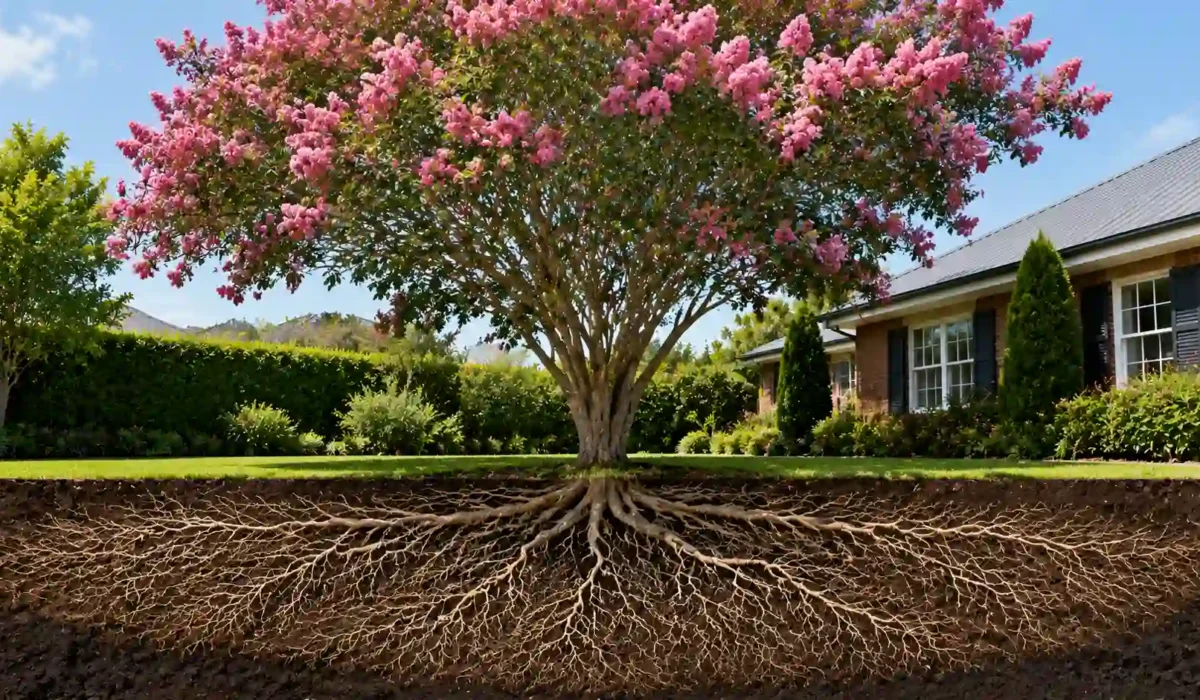
How Deep Are Crepe Myrtle Roots? Root Depth Guide
Introduction
Crepe myrtles are popular ornamental trees and shrubs valued for their colourful summer flowers, attractive bark, and adaptability. One of the most common questions gardeners ask is how deep are crepe myrtle roots and whether those roots can damage nearby structures. In most situations, crepe myrtle roots are relatively shallow compared to many large landscape trees. Their root systems spread outward more than downward and are generally considered low risk. Understanding root depth, root spread, invasiveness, and safe planting distances helps homeowners choose the best location for long-term growth and healthy development. Crepe myrtles belong to the genus Lagerstroemia, a group of flowering trees and shrubs widely cultivated in warm climates worldwide.
Quick Summary
- Crepe myrtle roots are typically 30–60 cm deep but can spread widely beyond the canopy.
- The root system is fibrous and lateral-spreading rather than deeply penetrating.
- Crepe myrtles are generally not considered invasive compared to willows or eucalypts.
- Root depth and spread vary based on soil type, climate, watering, and plant size.
- Planting a safe distance from foundations, pipes, and septic systems is still recommended.
How Deep Do Crepe Myrtle Roots Grow?
Crepe myrtle roots typically grow 30–60 cm deep in most landscape settings. While some roots may extend deeper in favourable conditions, the majority of the root system remains within the upper soil layers where oxygen, moisture, and nutrients are most available.
Root depth is influenced by several factors:
- Soil structure
- Water availability
- Variety size
- Climate conditions
- Drainage quality
Because most roots occupy the upper soil profile, crepe myrtles are generally considered shallow to moderately deep-rooted plants.
Crepe Myrtle Roots in the Ground
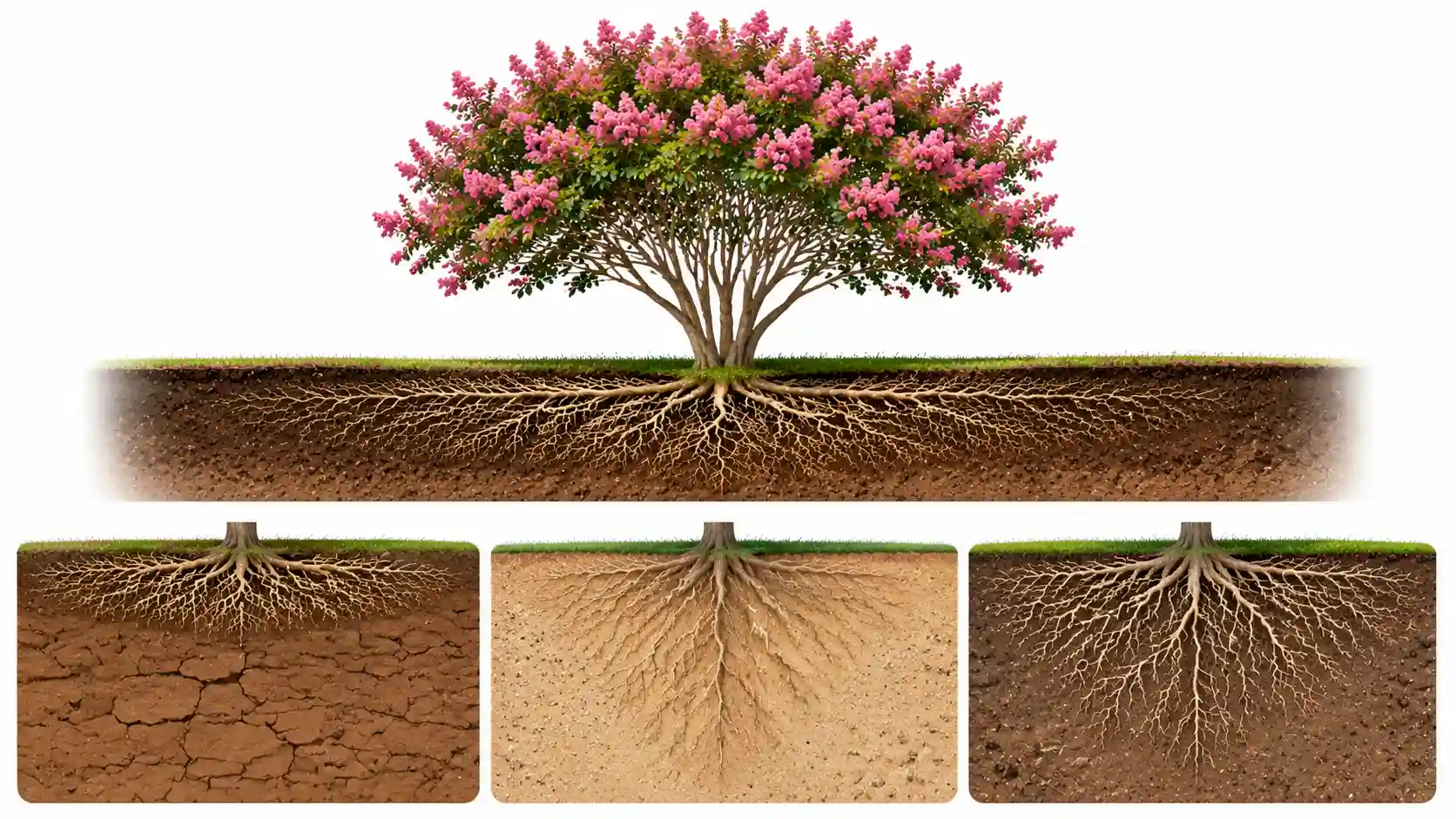
In garden soil, most crepe myrtle roots remain within the top 30–60 cm of soil. Healthy roots spread outward from the trunk and establish a broad network of feeder roots.
Soil type affects rooting depth:
| Soil Type | Typical Root Behaviour |
| Clay Soil | Shallower, wider spread |
| Sandy Soil | Slightly deeper penetration |
| Loam Soil | Balanced depth and spread |
Factors that increase or limit root depth include:
- Compacted soil limiting downward growth
- High water tables reducing deep rooting
- Consistent irrigation encouraging shallow roots
- Good drainage promoting stronger root development
- Mulching helping maintain moisture and root health
Crepe Myrtle Roots in Pots and Containers
Container-grown crepe myrtles develop shallower root systems because pot size restricts growth. Instead of growing deeply, roots often circle the container walls.
Common signs of a root-bound crepe myrtle include:
- Roots emerging from drainage holes
- Reduced growth
- Rapid drying of potting mix
- Frequent wilting despite watering
In our experience growing container crepe myrtles, repotting every few years helps maintain healthy root development. When repotting, choose a container only slightly larger than the existing root ball to avoid waterlogging.
Crepe Myrtle Root Depth in Australian Conditions
Australian growing conditions often influence root behaviour significantly. Heavy clay soils, extended drought periods, and hot summers can alter root growth patterns.
In many Australian gardens, roots tend to spread outward rather than penetrate deeply. During dry periods, feeder roots frequently develop near the surface where irrigation and rainfall are most readily available.
As of 2026, many Australian growers continue using mulch layers around crepe myrtles to reduce moisture loss and encourage healthier root systems during summer heat.
What Does a Crepe Myrtle Root System Look Like?
A crepe myrtle root system consists of a dense network of fibrous roots extending outward from the trunk. Unlike tap-rooted trees, crepe myrtles rely on a broad lateral root system for stability and nutrient uptake.
Root System Type (Fibrous and Lateral-Spreading)
Crepe myrtles develop a fibrous root structure with numerous small roots branching from larger lateral roots.
The typical structure includes:
- Central trunk base
- Lateral roots radiating outward
- Fine feeder roots near the soil surface
- Dense root hairs absorbing water and nutrients
This design allows efficient moisture collection without requiring extremely deep roots.
Root Spread vs Root Depth
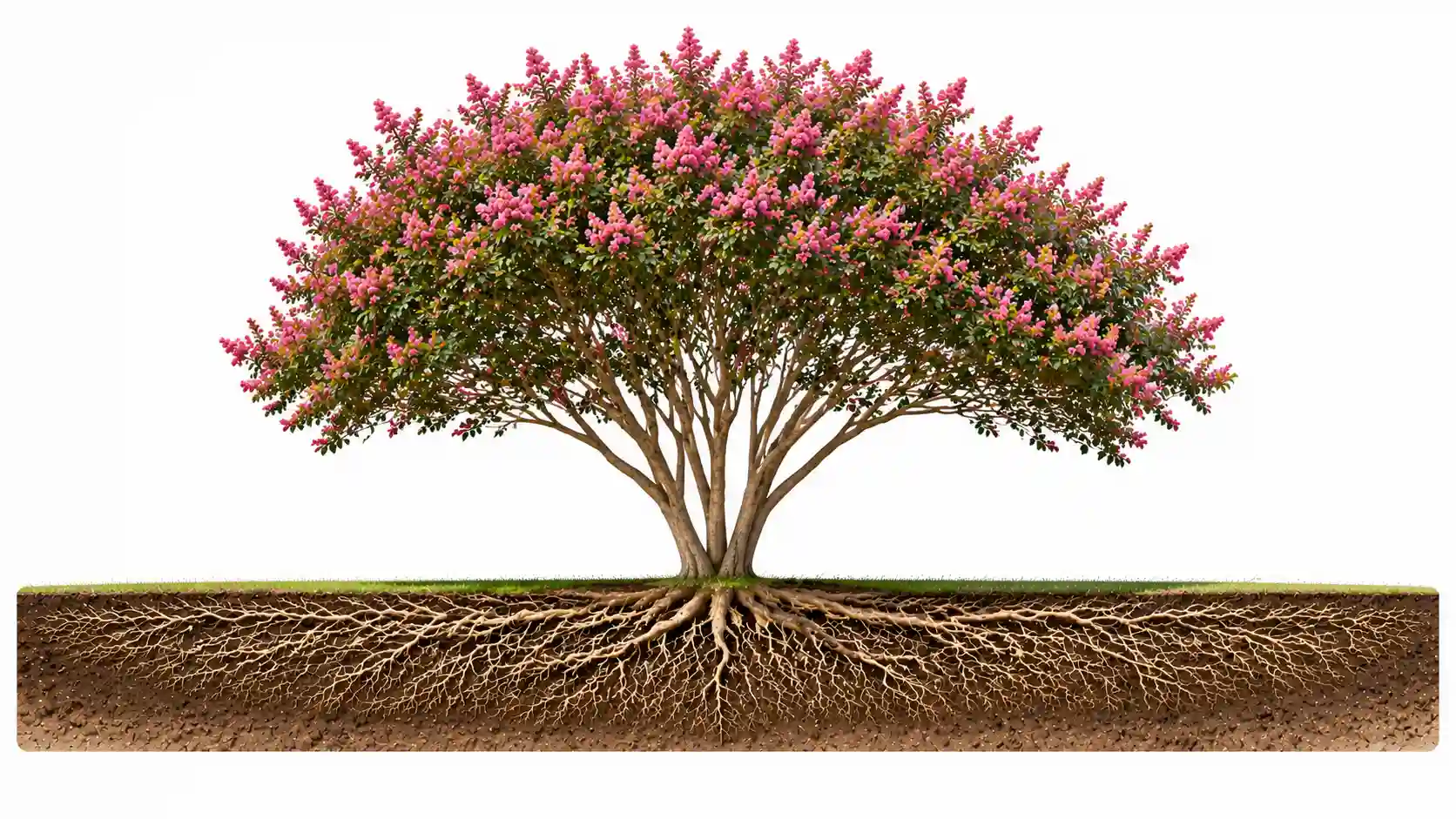
Crepe myrtle roots generally spread much farther than they grow deep.
In many cases:
- Root spread equals or exceeds canopy width
- Most roots remain within the upper soil layers
- Horizontal growth exceeds vertical growth
This “wide, not deep” growth pattern is typical of many ornamental flowering trees. Homeowners comparing ornamental trees may also find our Teddy Bear Magnolia Root System guide useful for understanding how root behaviour differs between popular landscape species.
Dwarf Crepe Myrtle Root System vs Standard/Tree Form
Different crepe myrtle varieties develop different root systems.
| Type | Mature Height | Typical Root Depth | Typical Root Spread |
| Dwarf | 1–3 m | 20–45 cm | Moderate |
| Standard Shrub | 3–6 m | 30–60 cm | Wide |
| Tree Form | 6–10+ m | 45–90 cm | Very Wide |
Elemo Baker recommends considering mature size before planting, as root spread usually increases alongside canopy growth. Similar considerations apply when selecting compact landscape trees, as explained in our Dwarf Forest Pansy Tree Size, Care & Growth Guide.
Are Crepe Myrtle Roots Invasive?
No, crepe myrtle roots are generally not considered invasive.
In landscaping, “invasive roots” usually refers to root systems capable of aggressively damaging structures, lifting foundations, or invading pipes. Crepe myrtles do not typically display these characteristics.
Compared with many larger trees, they are classified as low-risk. Compared to many Australian natives, crepe myrtles are generally considered low-risk, especially when contrasted with larger species discussed in our Gum Tree Root System: Root Spread, Problems & Safe Distances guide.
However, minor issues may occasionally occur when:
- Trees are planted extremely close to paving
- Soil is heavily compacted
- Topsoil is very shallow
- Irrigation encourages surface rooting
Although crepe myrtles develop extensive roots, they rarely create the severe problems associated with highly aggressive species.
Crepe Myrtle Roots Compared to Other Common Trees
| Tree | Root Invasiveness | Root Depth | Root Spread |
| Crepe Myrtle | Low | Shallow to Moderate | Moderate to Wide |
| Willow | Very High | Moderate | Extremely Wide |
| Eucalyptus | Moderate to High | Deep and Wide | Extensive |
| Oak | Moderate | Deep | Wide |
This comparison highlights why crepe myrtles are often selected for residential gardens where root risk is a concern.
Can Crepe Myrtle Roots Damage Pipes, Foundations, or Septic Systems?
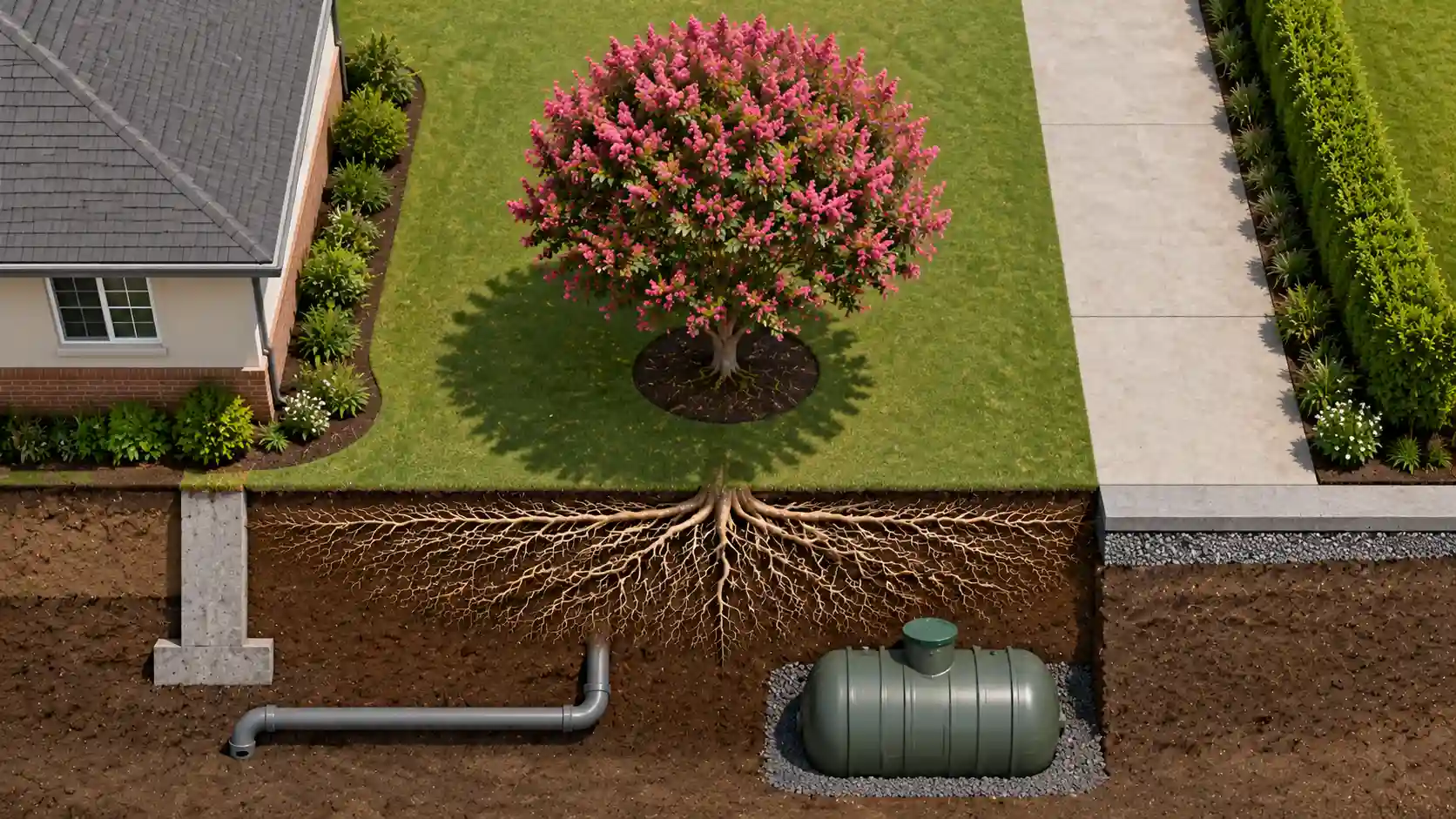
In most situations, crepe myrtle roots pose a relatively low risk to underground infrastructure. However, placement still matters.
Crepe Myrtle Roots and Underground Pipes
Healthy pipes are unlikely to be damaged by crepe myrtle roots.
Roots are far more likely to enter:
- Existing cracks
- Faulty joints
- Damaged drainage systems
Fine fibrous roots naturally seek moisture, but they generally lack the aggressive force associated with highly invasive species.
Crepe Myrtle Roots and Building Foundations
Crepe myrtle roots rarely damage properly constructed foundations.
Potential concerns are usually related to soil movement rather than direct root pressure. In clay-rich soils, moisture changes can contribute to shrink-swell cycles around foundations.
A practical guideline is to plant crepe myrtles several metres away from structures to minimise long-term risks.
Crepe Myrtle Roots Near Septic Systems
Crepe myrtles are generally safer near septic systems than many larger landscape trees.
Even so, roots may still be attracted to moisture-rich areas around:
- Septic tanks
- Leach fields
- Drainage trenches
Avoid planting directly adjacent to these systems.
Recommended Planting Distances From Structures
| Structure Type | Minimum Recommended Distance | Reason |
| House Foundation | 3–5 m | Reduces root and moisture-related issues |
| Driveway | 2–3 m | Prevents future surface disruption |
| Water Pipes | 2–3 m | Limits root interaction |
| Septic Tank | 5 m+ | Reduces moisture-seeking root growth |
| Leach Field | 8–10 m+ | Protects drainage performance |
Where to Plant a Crepe Myrtle Safely (Avoiding Common Mistakes)
Choosing the right planting location prevents most future root-related problems. For hedge plantings where root management and spacing are important, see our Photinia Fraseri Robusta: Growth, Care & Hedge Guide.
Safe Distance From the House and Driveways
A location that allows for mature canopy and root spread is ideal. Similar spacing recommendations are often used for screening plants such as those covered in our Pittosporum Silver Sheen Growth Rate Guide.
When planning placement:
- Consider mature size rather than nursery size
- Leave room for root expansion
- Account for nearby hard surfaces
- Avoid extremely confined planting areas
Similar spacing principles apply when planting magnolias, as outlined in our Teddy Bear Magnolia Landscaping Guide for Australian Gardens.
Common Beginner Mistakes When Choosing a Planting Spot
Common mistakes include:
- Planting too close to paving
- Ignoring mature canopy spread
- Choosing a location based on current size
- Underestimating differences between dwarf and tree forms
- Planting directly over underground services
In our experience, improper spacing is one of the most frequent causes of avoidable landscape issues.
Digging Up, Transplanting, and Removing Crepe Myrtle Roots
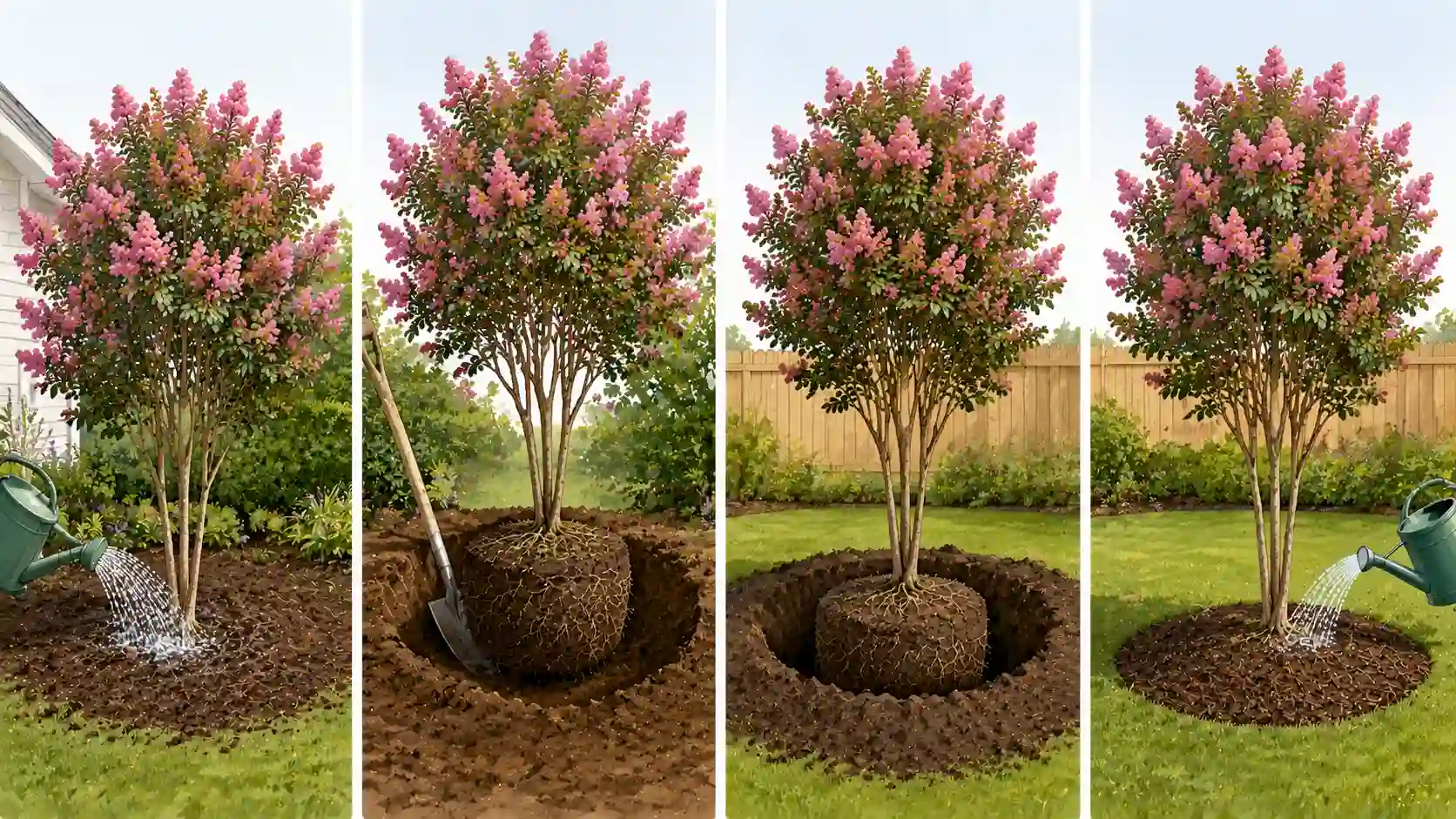
Crepe myrtles can usually be transplanted successfully when proper techniques are followed.
How to Dig Up a Crepe Myrtle Without Damaging the Root Ball
Follow these steps:
- Water the tree thoroughly one day before digging.
- Mark a root ball appropriate to tree size.
- Dig carefully around the root zone.
- Retain as much soil as possible around roots.
- Lift and transport promptly.
Dormant-season digging generally produces the best results.
Transplanting a Crepe Myrtle Successfully
The best time to transplant a crepe myrtle is during dormancy, typically from late autumn through winter.
After transplanting:
- Water deeply and consistently
- Apply mulch
- Avoid excessive fertiliser initially
- Monitor for transplant shock
Elemo Baker recommends maintaining even soil moisture during the first growing season after relocation.
How to Remove Crepe Myrtle Roots Completely
Crepe myrtles may resprout if roots remain alive.
Removal methods include:
| Method | Description |
| Manual Removal | Digging out stump and major roots |
| Mechanical Removal | Stump grinding equipment |
| Root-Killing Methods | Used to prevent regrowth after cutting |
Complete removal generally requires addressing both the stump and significant root sections.
Common Crepe Myrtle Root Problems and How to Fix Them
Surface Roots Lifting Nearby Paving
Why it happens:
- Shallow soil
- Compacted ground
- Restricted rooting area
Fix:
- Improve surrounding soil conditions
- Redirect future planting locations
- Repair affected paving
Prevention:
- Provide adequate rooting space
Root Suckers Sprouting Around the Base
Why it happens:
- Stress
- Damage
- Vigorous growth habits
Fix:
- Remove suckers promptly at their origin
Prevention:
- Maintain healthy growing conditions
Stump or Root Regrowth After Removal
Why it happens:
- Living roots remain underground
Fix:
- Remove remaining root material
- Monitor for regrowth
Prevention:
- Complete stump removal
Slow Root Establishment After Transplanting
Why it happens:
- Root shock
- Water stress
Fix:
- Deep watering schedule
- Mulching
- Reduced stress
Prevention:
- Careful handling during transplanting
Factors That Influence Crepe Myrtle Root Growth
Several environmental factors affect root development.
Soil and Watering
Watering patterns strongly influence root growth.
Frequent shallow watering often encourages surface roots, while deeper watering can promote stronger root establishment.
Good drainage remains essential for healthy root systems.
Climate and Seasonal Patterns
Root growth slows during dormancy and increases during active growing periods.
Australian climate variation can influence:
- Growth rates
- Water requirements
- Root spread
- Seasonal activity
Roots remain most active when soil temperatures are favourable.
Mature Size and Growth Rate’s Effect on Roots
Larger crepe myrtles generally develop wider root systems. Fast-establishing top growth often corresponds with increased lateral root expansion as the plant supports greater canopy development. Tree size and growth speed often influence root spread, a relationship also discussed in our Tuckeroo Tree Growth Rate: Size, Height & Care Guide.
Crepe Myrtle Root System vs Other Ornamental Trees
Compared with many ornamental trees, crepe myrtles offer a favourable balance between beauty and manageable root growth.
Gardeners seeking alternative screening or shade trees can also explore our Fast Growing Evergreen Trees Australia Guide for additional landscape options.
Common ornamental alternatives include:
- Flowering cherry
- Magnolia
- Ornamental pear
- Japanese maple
Many dwarf crepe myrtle cultivars provide an especially good option for small gardens where root space is limited. For homeowners concerned about root-related issues, dwarf varieties typically present a lower-risk choice while still delivering attractive seasonal flowers. If you are choosing between flowering landscape trees, our Magnolia Teddy Bear vs Little Gem: Key Differences Explained comparison highlights important differences in growth habits and garden suitability. If you are comparing crepe myrtle with other flowering landscape options, see our Flowering Trees Australia: Best Species Guide for species, climate suitability, flowering seasons, sizes, and root considerations.
Conclusion
Understanding how deep are crepe myrtle roots helps gardeners make better planting decisions. Most crepe myrtle roots occupy the upper 30–60 cm of soil and spread outward more than downward. Their fibrous root systems are generally considered non-invasive and pose a relatively low risk to pipes, foundations, and septic systems when planted responsibly. The most important consideration is allowing adequate space for root spread rather than focusing solely on canopy size. With proper placement and care, crepe myrtles remain one of the most reliable and landscape-friendly ornamental trees for Australian gardens.
FAQ
How deep do crepe myrtle roots actually go?
Most crepe myrtle roots grow within the top 30–60 cm of soil. Some roots may extend deeper under favourable conditions, but the majority remain relatively shallow.
Are crepe myrtle roots invasive enough to damage a driveway?
Generally, no. Crepe myrtle roots are considered low-risk and far less aggressive than willow or eucalyptus roots. Minor surface disruption is possible if planted too close to paving.
Can I plant a crepe myrtle close to my house?
Yes, but maintaining a distance of approximately 3–5 metres from foundations is recommended to allow for future growth and minimise potential issues.
How far do crepe myrtle roots spread from the trunk?
Root spread often equals or exceeds canopy width. Mature trees may develop roots extending several metres beyond the trunk.
Can crepe myrtle roots come back after the tree is removed?
Yes. Remaining roots and stumps can produce new shoots or suckers if not completely removed.
Do dwarf crepe myrtles have smaller root systems than standard ones?
Yes. Dwarf varieties generally develop shallower and less extensive root systems than standard or tree-form crepe myrtles, making them suitable for smaller spaces.
1 Comment