
Poinciana Tree Root System: Growth, Problems & Care Guide
Introduction
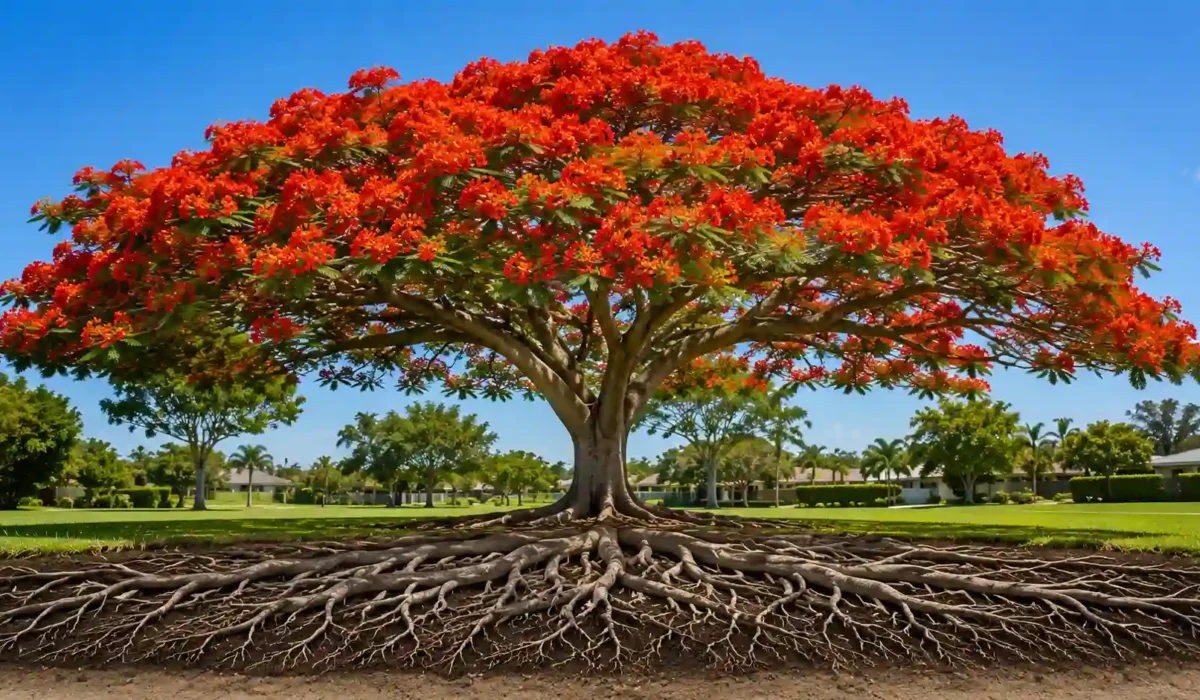
The poinciana tree root system is one of the most important factors to understand before planting this iconic ornamental tree. Delonix regia, commonly known as the royal poinciana or flamboyant tree, is admired throughout Australia for its spectacular red-orange flowers, broad shade canopy, and rapid growth. However, its impressive size above ground is matched by an extensive root system below the surface. Homeowners in Brisbane, Perth, and other warm Australian regions often ask whether poinciana roots are invasive and how close they can safely plant the tree to houses, driveways, or underground services. This guide explains the tree’s root behaviour, potential problems, growth habits, and practical care considerations to help you make informed planting decisions. If you’re researching root behaviour in landscape trees, you may also find our Gum Tree Root System: Root Spread, Problems & Safe Distances guide useful for comparing common Australian species.
Quick Summary
- The poinciana tree develops a shallow, wide-spreading root system that often extends beyond the canopy.
- Roots are considered moderately to highly invasive around buildings and underground infrastructure.
- Fast growth means both the canopy and root system establish quickly in Australian climates.
- Proper planting distance is the best way to avoid future damage to pipes, paving, and foundations.
What Is a Poinciana Tree?
The poinciana tree (Delonix regia) is a large deciduous ornamental tree native to Madagascar and widely cultivated throughout tropical and subtropical Australia. It is commonly known as the royal poinciana, flamboyant tree, or simply poinciana.
The poinciana tree (Delonix regia) is a flowering tree native to Madagascar and belongs to the legume family. Readers interested in its botanical classification and natural history can learn more on Wikipedia’s Delonix regia page.
The tree is famous for its spectacular display of vivid red-orange flowers, although yellow-flowering cultivars also exist. Its broad umbrella-shaped canopy, delicate bipinnate foliage, and long woody seed pods make it one of Australia’s most recognisable shade trees.
Unlike small ornamental garden plants, a mature poinciana can become a substantial landscape tree with a canopy spreading up to 15 metres wide. Because of this size, its underground root system also occupies a significant area and requires careful planning before planting. Poinciana is one of the spectacular exotic flowering trees grown in warm parts of Australia; see our guide to Flowering Trees Australia for more species, colours, flowering seasons, and climate recommendations.
Poinciana Tree in Australia
Poincianas thrive throughout Australia’s tropical and subtropical regions, particularly in Queensland cities such as Brisbane and Cairns, as well as suitable coastal areas around Perth in Western Australia.
Although Delonix regia is not native to Australia, it has become a familiar feature of streets, parks, schools, and large residential gardens. It performs best in frost-free climates with long warm summers.
In some tropical regions the species has naturalised, but it is not listed as a nationally declared weed.
Poinciana vs Jacaranda — Key Differences
Although both trees produce spectacular seasonal flowers, they differ in appearance, growth habits, and root behaviour.
| Feature | Poinciana | Jacaranda |
| Botanical name | Delonix regia | Jacaranda mimosifolia |
| Flower colour | Red-orange or yellow | Purple-blue |
| Canopy spread | Up to 12–15 m | Up to 10–12 m |
| Root invasiveness | Moderate to high | Moderate |
| Climate preference | Tropical and subtropical | Subtropical and temperate |
| Native origin | Madagascar | South America |
While jacarandas can also produce surface roots, poincianas generally develop broader lateral root systems that require greater clearance from structures. If you’re choosing between flowering landscape trees, also compare magnolia varieties in our Magnolia Teddy Bear vs Little Gem: Key Differences Explained guide.
Understanding the Poinciana Tree Root System
The poinciana tree root system is characterised by extensive lateral roots that spread close to the soil surface rather than growing deeply underground.
Instead of relying on a dominant taproot throughout its life, mature poincianas develop strong horizontal roots that efficiently collect moisture and nutrients from the upper soil layers. These roots often extend as far as, or even beyond, the canopy.
Because they remain relatively shallow, the roots can lift paving, crack concrete, and interfere with underground infrastructure when planted too close to buildings.
In our experience growing poincianas in Australian landscapes, the majority of root-related problems are caused by poor initial placement rather than defects in the tree itself.
How Deep Do Poinciana Roots Grow?
Poinciana roots are generally shallow.
Most active feeder roots occur within the top 30 to 90 centimetres of soil, although some structural roots may extend deeper where soil conditions allow.
Root depth depends on several factors, including:
- Soil texture
- Moisture availability
- Drainage
- Soil compaction
- Irrigation patterns
In heavy clay soils, roots often remain even closer to the surface, while well-drained sandy soils may encourage slightly deeper development.
How Far Do Poinciana Roots Spread?
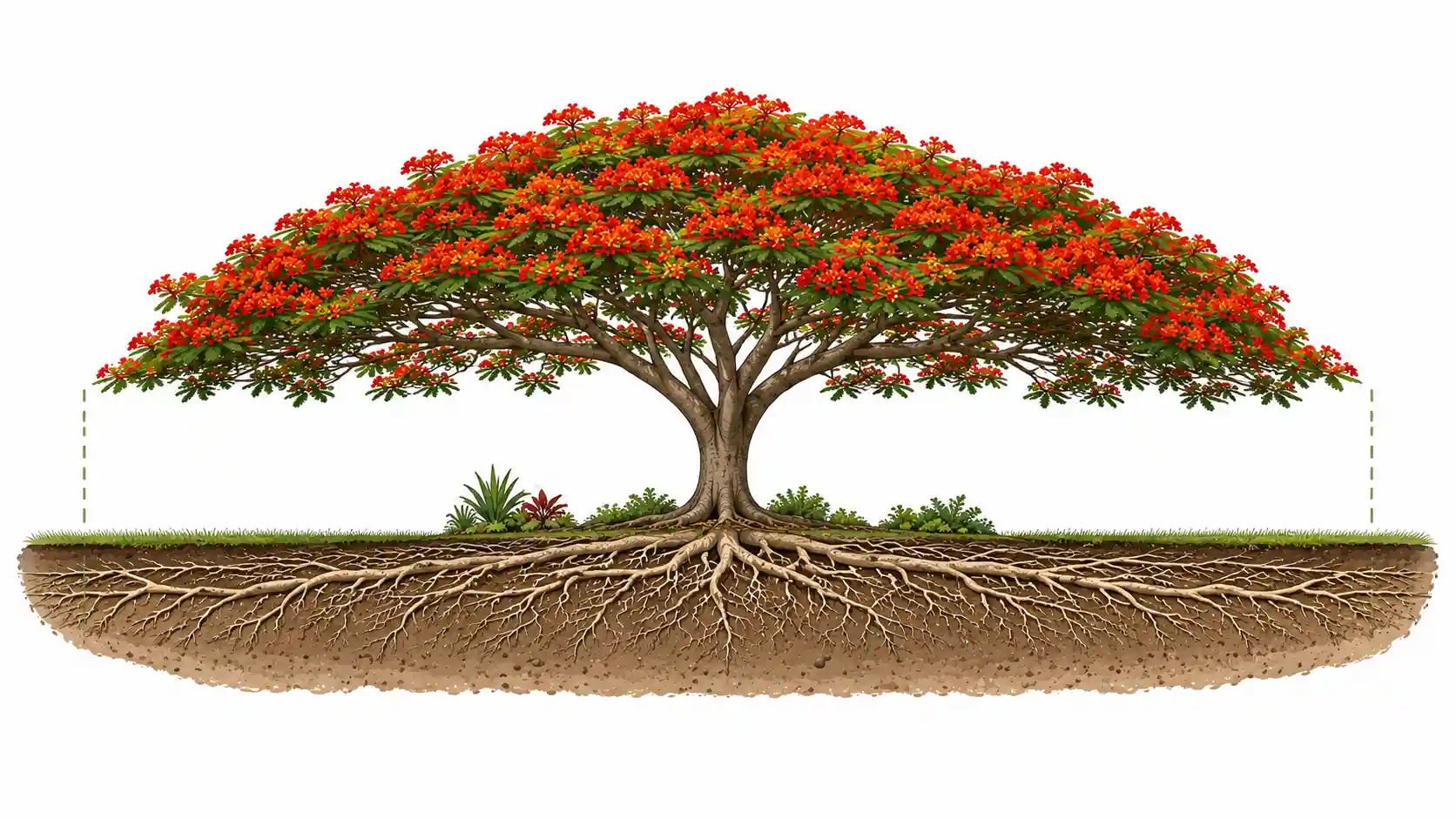
Mature poinciana roots commonly spread 10–15 metres or more from the trunk.
In many cases, the root system extends beyond the canopy edge as it searches for water and nutrients. This is why arborists recommend generous planting distances from buildings, swimming pools, retaining walls, and underground services.
As a general guideline, planting at least 10–15 metres away from permanent structures significantly reduces future risks.
Poinciana Root System Facts
- Root type: Wide-spreading lateral roots
- Typical depth: Approximately 30–90 cm for most active roots
- Spread: Up to 15 metres or more
- Growth habit: Surface-oriented
- Moisture behaviour: Roots actively seek water sources
- Best soils: Well-drained sandy or loamy soils
- Risk level: Moderate to high around built infrastructure
Are Poinciana Tree Roots Invasive?
Yes. Poinciana roots are generally considered moderately to highly invasive in suburban environments because of their extensive horizontal spread and moisture-seeking behaviour.
While they present few issues in parks or large open spaces, problems become much more likely when the tree is planted close to houses, paved surfaces, or underground utilities.
Roots naturally follow paths of least resistance and often exploit existing cracks in pipes or concrete.
Poinciana Root Damage to Pipes and Foundations
Potential damage includes:
- Lifted footpaths
- Cracked driveways
- Damaged patios
- Root intrusion into stormwater pipes
- Sewer pipe invasion where cracks already exist
- Pressure against retaining walls
- Foundation movement in some situations
Roots do not normally break intact pipes. Instead, they enter through existing joints, leaks, or cracks where moisture is available.
Safe Planting Distance from Structures
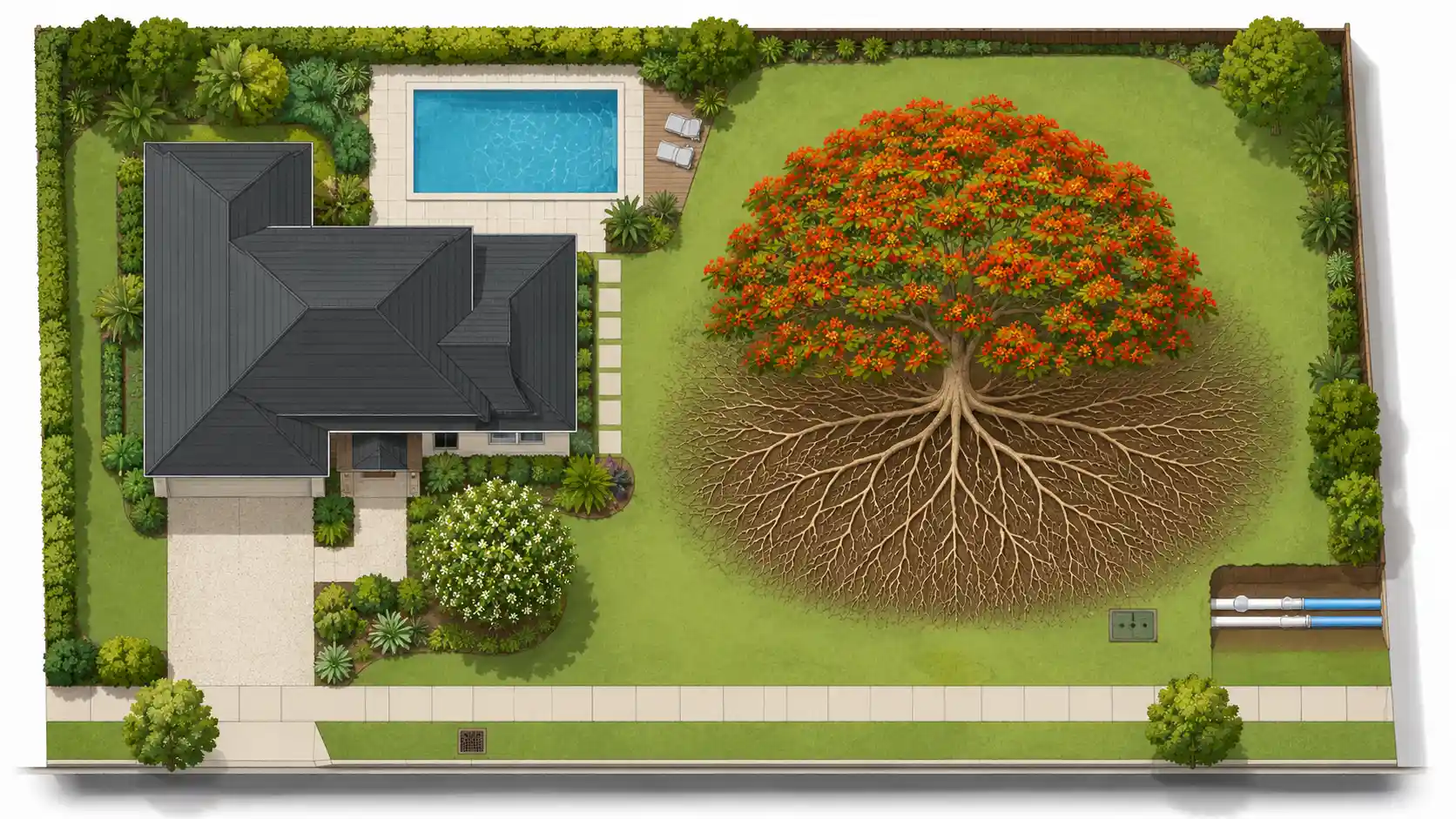
Elemo Baker recommends allowing plenty of room for mature growth rather than planting according to the tree’s nursery size.
As a practical guideline, maintain a minimum distance of 10–15 metres from:
- Houses
- Swimming pools
- Underground pipes
- Concrete slabs
- Retaining walls
- Driveways
- Large paved areas
Consulting a qualified arborist before planting near infrastructure is strongly recommended.
What Trees Have the Worst Root Systems?
Several ornamental trees have more aggressive root systems than most garden species.
These include:
- Fig trees
- Willows
- Running bamboo
- Liquidambar
- Poinciana
Compared with these species, poincianas rank among the more aggressive ornamental shade trees, particularly in suburban gardens where space is limited.
Poinciana Tree Root System Problems in Australia
Australia’s warm climate allows poinciana trees to grow vigorously, but it also increases the likelihood of root-related issues in residential areas. Clay soils, compact suburban blocks, ageing underground pipe networks, and extended dry periods can all encourage roots to spread aggressively in search of moisture.
In Queensland and parts of Western Australia, mature poincianas are valued for their shade and seasonal colour. However, without adequate planting space, their expanding root systems may interfere with nearby structures over time.
As of 2026, Australian arborists continue to recommend selecting planting locations carefully to minimise long-term conflicts between tree roots and infrastructure.
Common Poinciana Root Problems in Brisbane
Brisbane’s humid subtropical climate provides ideal growing conditions for Delonix regia. Trees often develop rapidly, producing broad canopies and equally extensive root systems.
Common root-related issues reported in Brisbane include:
- Lifted garden paths and footpaths
- Cracked driveways
- Root intrusion into ageing stormwater or sewer pipes
- Competition with nearby lawns and garden plants
- Surface roots creating mowing hazards
Many older Brisbane suburbs contain clay soils and ageing underground services, making proper tree placement especially important. Before removing a mature poinciana, homeowners should check local council requirements, as significant trees may be protected under local planning regulations.
Poinciana Tree in Perth — What to Know
Poincianas can grow successfully in Perth’s warmer coastal suburbs, although conditions differ considerably from Queensland.
Perth experiences hot, dry summers and mild, wet winters. During prolonged dry periods, established roots often extend towards irrigated lawns, garden beds, or underground water sources.
Gardeners in Perth should consider:
- Planting only in frost-free locations.
- Providing deep watering while young.
- Avoiding planting near irrigation systems and underground pipes.
- Choosing well-drained sandy or loamy soils.
- Allowing generous space for mature canopy and root development.
Trees growing on the Swan Coastal Plain generally perform well when given sufficient water during establishment, but inland areas with regular frost are less suitable.
Poinciana Tree Growth Rate
Poincianas are considered fast-growing ornamental trees. Under favourable tropical and subtropical Australian conditions, they commonly grow between 1 and 1.5 metres each year during their early development. For another fast-growing Australian landscaping tree, see our Tuckeroo Tree Growth Rate: Size, Height & Care Guide.
This rapid above-ground growth is matched by equally vigorous root expansion. As the canopy enlarges, lateral roots spread outward to support the increasing demand for water and nutrients.
Growth is most active during the warmer months and the wet season, while cooler temperatures slow development considerably. You may also like our Pittosporum Silver Sheen Growth Rate Guide if you’re comparing fast-growing screening and shade trees.
In our experience growing poincianas, establishing the correct planting location during the first few years is far easier than attempting to manage mature roots later.
Poinciana Tree Size at Maturity
A mature poinciana becomes a substantial landscape tree.
Typical mature dimensions include:
| Feature | Typical Size |
| Height | 8–12 metres |
| Maximum height | Up to 15 metres in ideal climates |
| Canopy spread | 12–15 metres |
| Root spread | Often equal to or greater than canopy width |
Container-grown specimens remain considerably smaller but are not suitable as permanent potted trees because of their vigorous root systems.
Brisbane trees generally achieve larger mature sizes than those grown in Perth due to consistently warmer growing conditions.
How Tall Is a Poinciana Tree After 10 Years?
In tropical and subtropical Australia, a healthy poinciana can reach approximately 8–10 metres within its first decade.
Actual growth depends on:
- Climate
- Soil quality
- Water availability
- Sunlight exposure
- Overall maintenance
Trees grown from seed may initially establish roots before producing rapid top growth, while nursery-grown specimens often establish more quickly.
Poinciana Tree Problems and Disadvantages
Although poincianas are among Australia’s most spectacular flowering trees, they are not suitable for every landscape. Their size, vigorous roots, and seasonal maintenance requirements should be carefully considered before planting. If you’re considering alternative ornamental trees, our Dwarf Forest Pansy Tree Size, Care & Growth Guide covers another colourful landscape option.
Common disadvantages include:
- Invasive surface roots
- Heavy leaf litter
- Large seed pod accumulation
- Broad canopy requiring significant space
- Risk of limb drop during severe storms
- Delayed flowering in young trees
- Unsuitability for small suburban gardens
- Mild toxicity concerns for pets
Elemo Baker recommends reserving poincianas for large properties, parks, schools, and open landscapes where their size can be appreciated without creating infrastructure problems.
Poinciana Leaves — Seasonal Drop and Litter
Poincianas are semi-deciduous to deciduous depending on local climate.
During late autumn and winter they shed large quantities of their fine, fern-like leaves before producing new foliage in spring.
In addition to leaf fall, mature trees also drop:
- Woody seed pods
- Flowers
- Small twigs
This seasonal litter can increase garden maintenance and may require regular cleaning from lawns, gutters, and paved surfaces.
Poinciana Tree Not Flowering — Common Causes
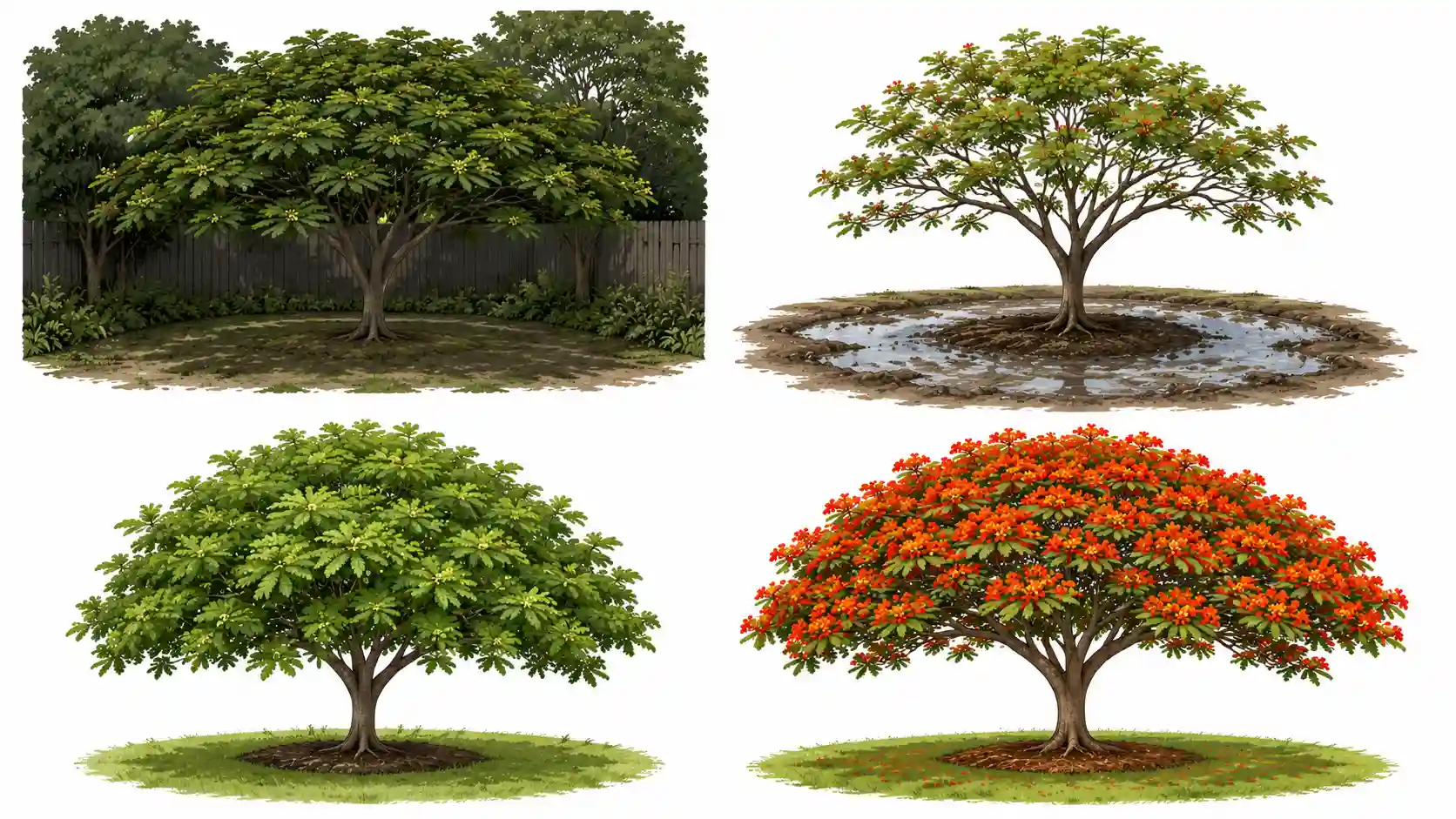
A poinciana that fails to flower usually has an identifiable cause.
Common reasons include:
- Tree is too young (often 5–10 years from seed before flowering)
- Insufficient sunlight
- Excessive nitrogen fertiliser
- Waterlogged soil
- Cool growing conditions
- Heavy shade
Encouraging healthy flowering involves planting in full sun, maintaining well-drained soil, and avoiding excessive nitrogen, which promotes leafy growth instead of flowers.
Are Poinciana Trees Toxic to Dogs?
Yes, the seeds and seed pods of Delonix regia may cause mild gastrointestinal upset if consumed in significant quantities by dogs.
Possible symptoms include:
- Vomiting
- Diarrhoea
- Stomach discomfort
Although the tree is not considered highly toxic, fallen seed pods should be removed from areas where curious pets regularly play. If ingestion is suspected, contact a veterinarian promptly.
What to Plant Under a Poinciana Tree
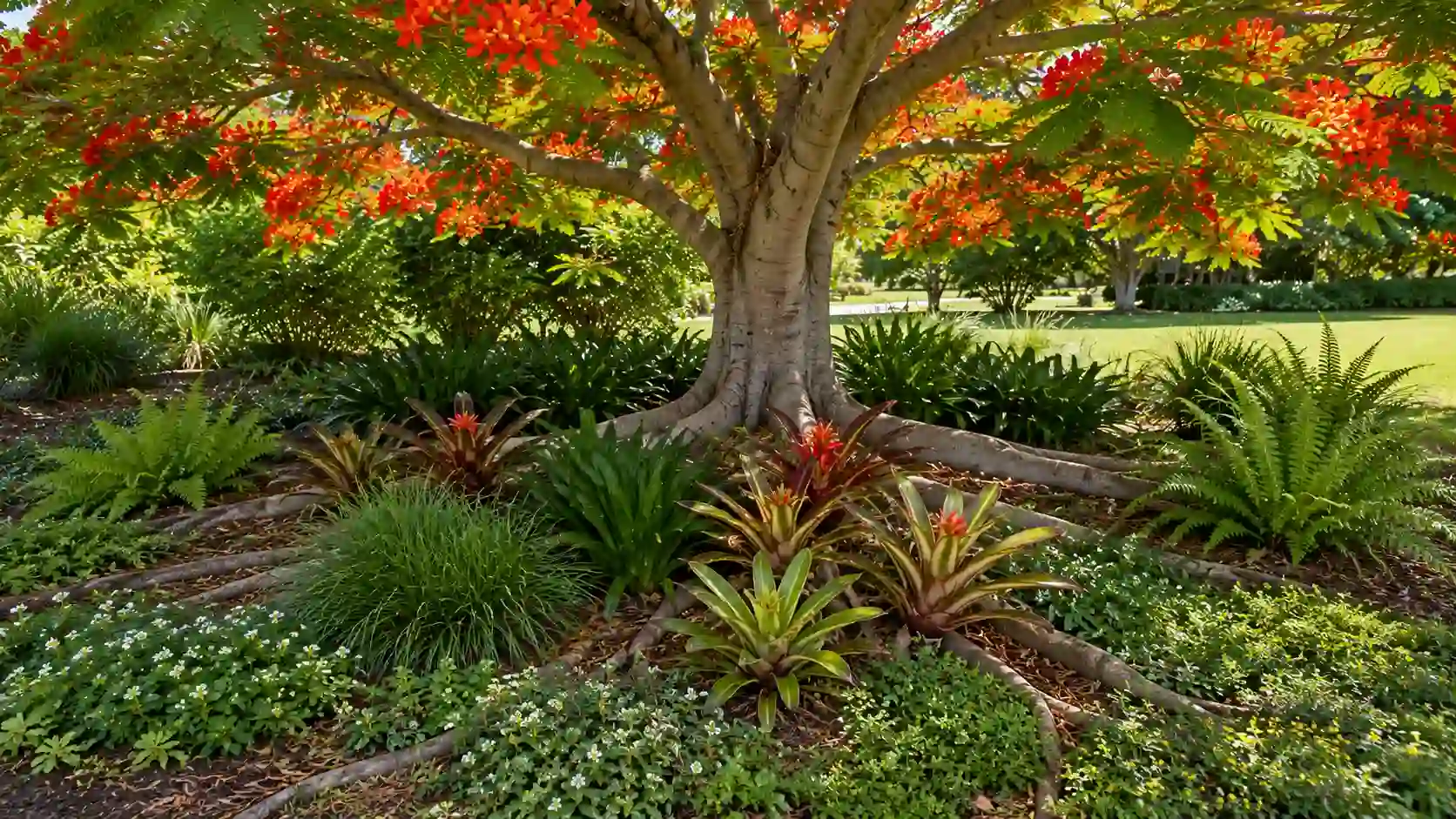
The best plants to grow under a poinciana tree are species that tolerate dry shade, shallow soil, and competition from surface roots. Because the tree develops a dense canopy and an extensive lateral root system, many moisture-loving or deep-rooted plants struggle to establish beneath it.
Suitable plants include:
- Bromeliads
- Cast iron plant (Aspidistra elatior)
- Mondo grass (Ophiopogon japonicus)
- Native Australian ground covers
- Drought-tolerant ferns
- Lomandra species
- Dianella (Flax Lily)
These plants perform well because they require relatively little water once established and can grow in limited soil depth.
Avoid planting:
- Vegetables
- Large shrubs
- Water-hungry perennials
- Fruit trees
- Plants requiring frequent cultivation
Adding a layer of organic mulch helps retain moisture while reducing competition between surface roots and underplantings. For more ideas on selecting flowering landscape trees, explore our Purple Flower Tree Australia: Native & Popular Species Guide.
Poinciana Tree Care Guide
A healthy poinciana tree requires full sun, well-drained soil, moderate fertilisation, and occasional pruning. Although mature trees are relatively low-maintenance, proper care during the first few years encourages strong growth and a healthier root system.
Watering Requirements
Young poinciana trees require regular watering while establishing.
General watering recommendations include:
- Water deeply once or twice each week during the first growing season.
- Reduce watering frequency after establishment.
- Mature trees tolerate extended dry periods but benefit from occasional deep watering during prolonged drought.
- Avoid constantly wet soils, particularly heavy clay, as excessive moisture may contribute to root diseases.
Gardeners in Perth often need to provide supplementary irrigation during hot, dry summers, whereas established trees in Brisbane usually rely more on seasonal rainfall.
Soil and Fertiliser
Poincianas perform best in:
- Sandy soils
- Loamy soils
- Well-drained garden beds
Poor drainage is one of the few conditions the species dislikes.
Use a balanced, slow-release fertiliser during spring to support healthy growth and flowering.
Avoid fertilisers high in nitrogen because they encourage excessive leafy growth while reducing flower production and potentially stimulating more vigorous root development.
How to Prune a Poinciana Tree
Pruning helps maintain tree structure and removes damaged or unsafe branches.
The best time to prune is during late winter or early spring before vigorous new growth begins.
Recommended pruning practices include:
- Remove dead, diseased, or damaged branches.
- Eliminate crossing limbs.
- Maintain adequate clearance above driveways and buildings.
- Avoid removing large amounts of healthy foliage at one time.
- Hire a qualified arborist for mature trees.
Heavy pruning can stress the tree, reduce flowering, and encourage weak regrowth.
Climate Tolerance
Poincianas thrive in frost-free tropical and subtropical climates.
Ideal growing conditions include:
- Full sun
- Warm summers
- Mild winters
- USDA Zones 10–12 equivalent
Young trees are particularly sensitive to frost. While coastal Perth generally provides suitable growing conditions, inland areas with frequent winter frost may experience slower growth or cold damage. If you’re looking for species suitable for privacy planting, our Fast Growing Evergreen Trees Australia Guide highlights excellent alternatives.
As of the current growing season, protecting young trees during unusually cold winters remains one of the most effective ways to improve establishment. Homeowners creating screening hedges may also benefit from our Photinia Fraseri Robusta: Growth, Care & Hedge Guide.
Poinciana Tree Root System — SERP Gap Coverage
Many root problems develop because homeowners underestimate the mature size of the tree rather than misunderstanding the species itself.
Common beginner mistakes include:
Planting Too Close to the House
Young nursery trees appear compact, leading many homeowners to plant them only a few metres from buildings. Within several years, both the canopy and root system can greatly exceed the available space.
Assuming Common Street Trees Are Safe Everywhere
Just because poincianas are widely planted throughout Australian suburbs does not mean every property is suitable. Public plantings usually have significantly more underground space than residential gardens.
Confusing the Flame Tree with the Poinciana
The Australian flame tree (Brachychiton acerifolius) is a completely different species from Delonix regia.
Although both produce spectacular red flowers, they differ in:
- Botanical classification
- Root structure
- Growth habit
- Environmental requirements
Understanding the difference helps homeowners choose the most appropriate tree for their landscape.
Underestimating Early Root Growth
One of the biggest misconceptions is that root problems occur only after several decades.
In reality, vigorous lateral roots begin establishing within the first three to five years, particularly in warm Australian climates with regular irrigation.
Planning for the tree’s mature size from the beginning is far easier than attempting expensive root management later.
Removing Mature Trees Without Professional Advice
Large poincianas may be protected under local council regulations depending on location.
Before removing an established tree:
- Check local council requirements.
- Arrange a professional arborist assessment.
- Consider potential impacts on neighbouring properties.
- Evaluate whether root pruning or management is a suitable alternative.
Conclusion
The poinciana tree root system is broad, shallow, and highly effective at searching for water and nutrients. While this characteristic allows Delonix regia to thrive across tropical and subtropical Australia, it also makes the tree unsuitable for planting close to houses, driveways, swimming pools, and underground services.
When provided with adequate space, poincianas become magnificent shade trees that enhance parks, large gardens, and public landscapes with spectacular seasonal flowering. However, successful long-term growth depends on careful site selection from the outset. Before selecting a feature tree, it’s worth comparing different landscape options in our Teddy Bear Magnolia Landscaping Guide for Australian Gardens.
In our experience, the best results come from treating the tree as a large landscape specimen rather than a standard backyard tree. Before planting, assess your available space, locate underground utilities, and allow sufficient clearance for both the canopy and root system. If uncertainty exists, consulting a qualified arborist is the safest approach.
Frequently Asked Questions
Do poincianas have invasive roots?
Yes. Poinciana roots are generally considered moderately to highly invasive in suburban environments. Their shallow, wide-spreading root system can damage paths, driveways, pipes, and foundations if the tree is planted too close to infrastructure.
How quickly do poincianas grow?
Poincianas are fast-growing trees that commonly add between 1 and 1.5 metres of height each year under favourable tropical and subtropical Australian conditions. Their root systems expand rapidly during the same period.
What are the disadvantages of Royal Poinciana?
The main disadvantages include invasive roots, heavy leaf and seed pod litter, large mature size, delayed flowering in young trees, occasional limb drop during storms, and mild toxicity concerns for pets that chew the seeds or seed pods.
What is the difference between a poinciana and a jacaranda?
Poincianas produce bright red-orange flowers, have wider canopies, and generally develop more aggressive surface roots. Jacarandas produce purple-blue flowers, tolerate slightly cooler climates, and usually have less invasive root systems.
What to plant under a poinciana tree?
Choose drought-tolerant, shade-loving plants such as bromeliads, cast iron plants, mondo grass, lomandra, native ground covers, and dry-shade ferns. These species cope well with shallow surface roots and reduced soil moisture.
Are poinciana trees toxic to dogs?
The seeds and seed pods may cause mild gastrointestinal upset if eaten by dogs. Although severe poisoning is uncommon, fallen pods should be removed from areas accessible to pets, and veterinary advice should be sought if ingestion occurs.
Is the poinciana tree native to Australia?
No. Delonix regia is native to Madagascar. It has become widely cultivated across tropical and subtropical Australia because of its spectacular flowers and broad shade canopy, but it is not an Australian native species.
3 Comments