

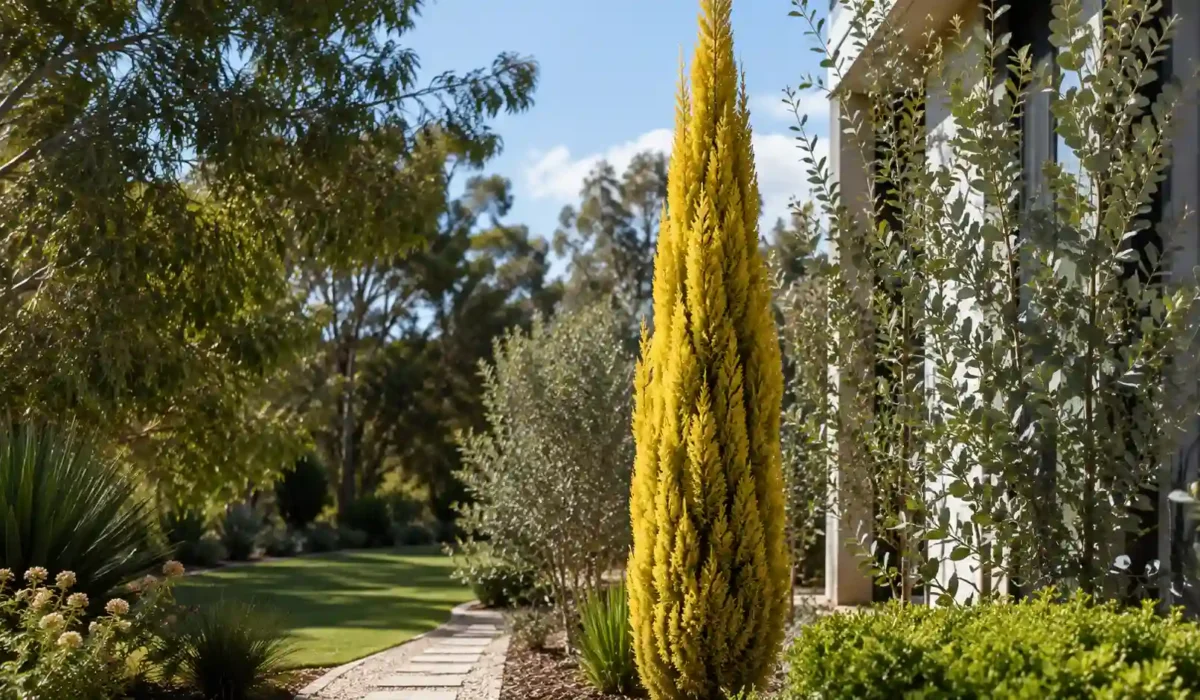
Swanes Golden Cypress: Size, Care & Growing Guide
Swane’s Golden Cypress (Cupressus sempervirens ‘Swane’s Golden’) is a narrow, columnar evergreen conifer bred at Swane Brothers Nursery in New South Wales in 1944. According to Elemo Baker, it grows slowly to 4.5–6m tall and 0.6–0.9m wide, with dense golden-yellow new foliage that holds its colour in full sun year-round.
The cultivar originated as a seedling of Cupressus sempervirens ‘Stricta’ and was patented in the United States in 1976. Its gold tone fades in shaded positions and can take on an orange cast through cold winters below USDA Zone 8a, though established plants tolerate drought and poor soil with minimal upkeep. Small brown female cones persist on the branches for several years after ripening.
By Elemo Baker | Plant Care & Gardening Expert
Last Updated: August 2026
Quick Summary
- Swanes Golden Cypress grows approximately 5–6m tall and around 1m wide, creating a narrow vertical shape.
- It has a slow-to-medium growth rate and develops the strongest golden colour when grown in full sun.
- The cultivar was bred in Australia by Swane Bros Nursery, New South Wales, in 1944.
- It is low-maintenance once established and has a non-invasive fibrous root system.
- It suits narrow gardens, formal landscapes, screening areas, and spaces near paths or fences.
What Is Swanes Golden Cypress?
Swanes Golden Cypress (Cupressus sempervirens ‘Swane’s Gold’) is a golden-leaved cultivar of the Italian cypress tree. It is recognised for its tall, narrow fastigiate growth habit, dense branching, and bright yellow-gold new foliage that creates a strong architectural feature in Australian landscapes.
Swanes Golden Cypress is a cultivar of Italian Cypress (Cupressus sempervirens), a species widely recognised for its tall, narrow Mediterranean growth form.
Unlike many broad evergreen trees, Swanes Golden Cypress maintains a naturally slim column shape without requiring regular heavy pruning. Its upright form makes it suitable for narrow garden beds, driveways, entrances, courtyards, and formal garden designs where height is desired without excessive width.
The plant was developed by Swane Bros Nursery in New South Wales in 1944. It became popular because it combined the classic vertical appearance of Italian cypress with distinctive golden foliage.
Key characteristics include:
- Botanical name: Cupressus sempervirens ‘Swane’s Gold’
- Plant family: Cupressaceae
- Common names: Swanes Golden Cypress, Golden Pencil Pine, Swan Tree
- Growth habit: Narrow columnar or fastigiate evergreen tree
- Foliage colour: Golden-yellow to yellow-green
In our experience growing narrow cypress varieties, the strongest colour development occurs when plants receive consistent direct sunlight. Trees grown in shaded areas often become greener and may lose much of their golden appearance.
Swanes Gold vs Standard Italian Cypress
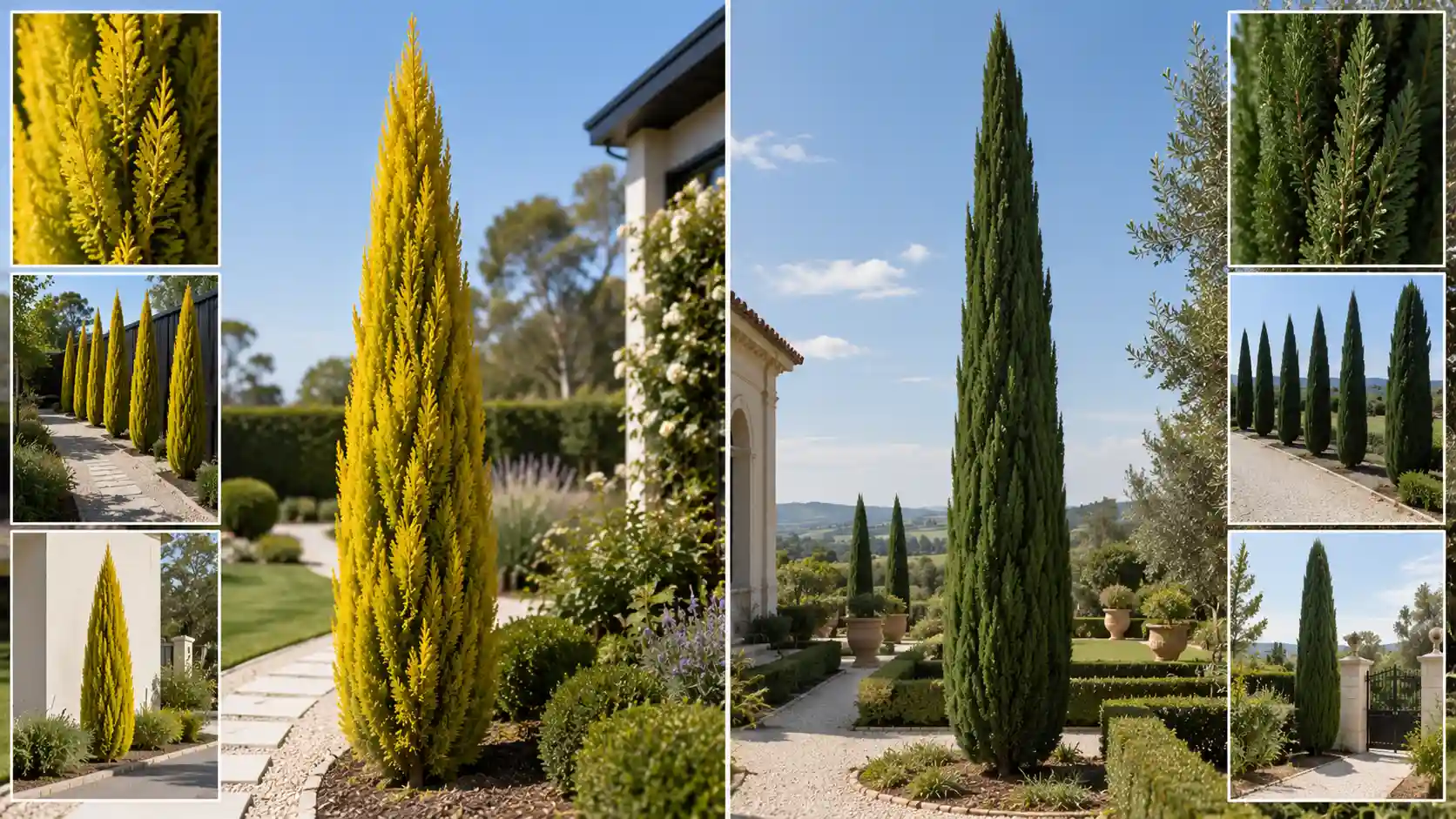
Swanes Golden Cypress and standard Italian Cypress (Cupressus sempervirens) share the same upright growth pattern, but their appearance and landscape uses differ.
| Feature | Swanes Golden Cypress | Standard Italian Cypress |
| Foliage colour | Golden-yellow new growth | Dark green foliage |
| Growth habit | Narrow columnar form | Narrow columnar form |
| Height | Around 5–6m commonly | Often 10–20m depending on conditions |
| Growth rate | Slow to moderate | Moderate |
| Best use | Feature tree, narrow spaces, colour contrast | Formal screening, Mediterranean-style gardens |
Swanes Gold is often chosen where gardeners want the elegance of Italian cypress but with additional colour impact and a more manageable mature size.
Is It the Same as “Golden Pencil Pine”?
Yes, “Golden Pencil Pine” is commonly used as a trade name for Swanes Golden Cypress. The names “Golden Pencil Pine” and “Swan Tree” are often used interchangeably by nurseries and gardeners, although the correct botanical name is Cupressus sempervirens ‘Swane’s Gold’.
The term “pencil pine” refers to the tree’s narrow pencil-like shape rather than a true pine species. Swanes Golden Cypress is a cypress belonging to the Cupressaceae family, not the Pinaceae pine family.
How Tall Does Swanes Golden Cypress Grow?
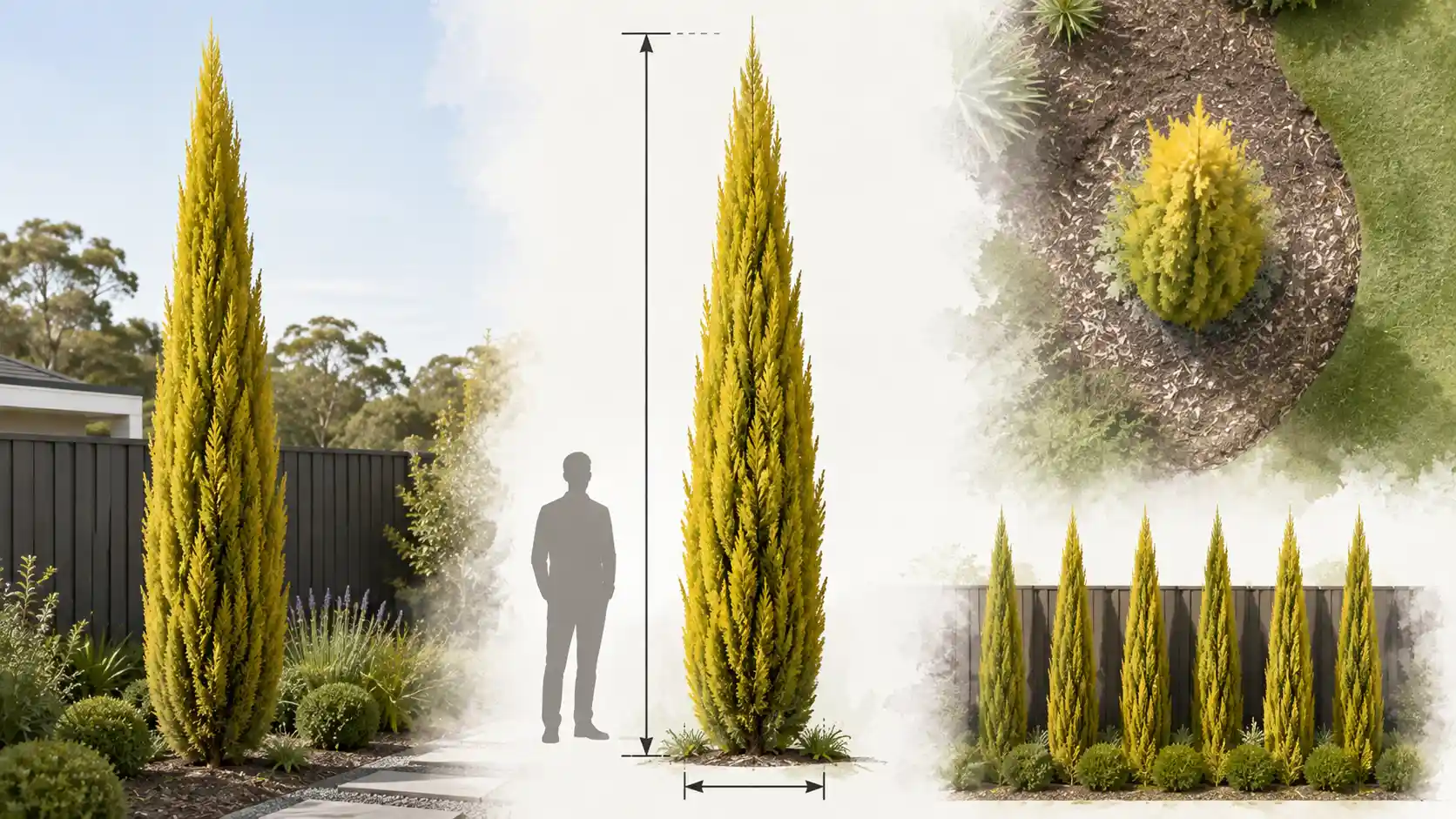
Swanes Golden Cypress typically reaches a mature height of about 5–6 metres with a narrow width of approximately 1 metre. Some nursery references list a wider height range of around 4–8 metres because final size depends on climate, soil quality, sunlight, and growing conditions.
Its naturally columnar structure allows it to gain height while keeping a small footprint. This makes it suitable for gardens where wider trees would take up too much space.
The mature size of Swanes Golden Cypress is influenced by:
- Amount of sunlight received
- Soil drainage and fertility
- Climate conditions
- Water availability during establishment
- Competition from nearby plants
Mature Size Reference Table
| Feature | Details |
| Mature Height | Approximately 5–6m |
| Mature Width | Approximately 1m |
| Growth Habit | Narrow columnar / fastigiate evergreen |
| Time to Maturity | Several years depending on climate and care |
Elemo Baker recommends allowing enough vertical space when planting Swanes Golden Cypress because its natural growth form is designed to create height rather than remain as a small shrub.
Indoor Pot Growth vs Garden Growth
Swanes Golden Cypress can be grown in large containers, but pot growth significantly limits its final size. A container-grown plant will usually remain shorter and narrower because restricted root space reduces overall growth.
For small courtyards or balconies, container planting can work when:
- A large pot with drainage holes is used
- The plant receives full sun
- Watering is monitored carefully
- Root restriction is managed through occasional repotting
Garden-grown trees generally achieve their full height potential because their roots have more access to moisture and nutrients.
Growth Rate — How Fast Does It Grow?
Swanes Golden Cypress has a slow-to-moderate growth rate, usually growing around 30cm (1 foot) per year once established under favourable conditions. It is slower than fast-growing screening trees such as Leyland cypress but provides a more controlled shape with less maintenance.
Gardeners looking for quicker landscape coverage can also compare it with other options in our guide to Fast Growing Evergreen Trees Australia Guide.
Growth is generally strongest during spring and summer when temperatures and sunlight levels support active plant development. During colder months, growth naturally slows.
Factors affecting growth rate include:
- Sun exposure: Full sun improves both growth and golden foliage intensity.
- Water availability: Regular moisture during establishment encourages stronger growth.
- Soil quality: Well-drained soil supports healthier root development.
- Competition: Nearby trees and shrubs can reduce available nutrients and water.
When gardeners ask, “Are pencil pines fast growing?”, the answer depends on the variety. Swanes Golden Cypress is not considered a fast-growing tree, but its narrow habit allows it to create a tall feature without becoming difficult to manage.
How to Plant Swanes Gold Cypress
Swanes Gold Cypress grows best when planted during autumn or early spring in most Australian regions because moderate temperatures allow roots to establish before extreme summer heat or winter cold. Planting during peak summer is generally less ideal because young trees require consistent moisture while their root systems are developing.
For narrow boundaries and screening areas, Swanes Golden Cypress can be considered alongside other selections featured in our guide to Low-Maintenance Plants for Fence Line in Australia.
Before planting, prepare the site by improving drainage and ensuring the tree receives enough sunlight. Although Swanes Golden Cypress adapts to various soil types, including sandy and clay soils, heavy clay should be improved with organic matter or drainage amendments to prevent waterlogging.
Planting steps include:
- Choose a sunny location: Select an area with full sun exposure for the best golden foliage colour.
- Prepare the soil: Loosen the surrounding soil and ensure excess water can drain away.
- Dig the planting hole: Make the hole wider than the root ball but no deeper than the existing root level.
- Position the tree: Place the cypress upright and keep the top of the root ball level with surrounding soil.
- Backfill and water deeply: Firm the soil gently around the roots and water thoroughly after planting.
- Maintain moisture during establishment: Water regularly during the first year, especially during dry Australian summers.
The best time to plant a cypress tree depends on local climate conditions, but avoiding periods of extreme heat gives young plants the strongest start.
Spacing Guidelines
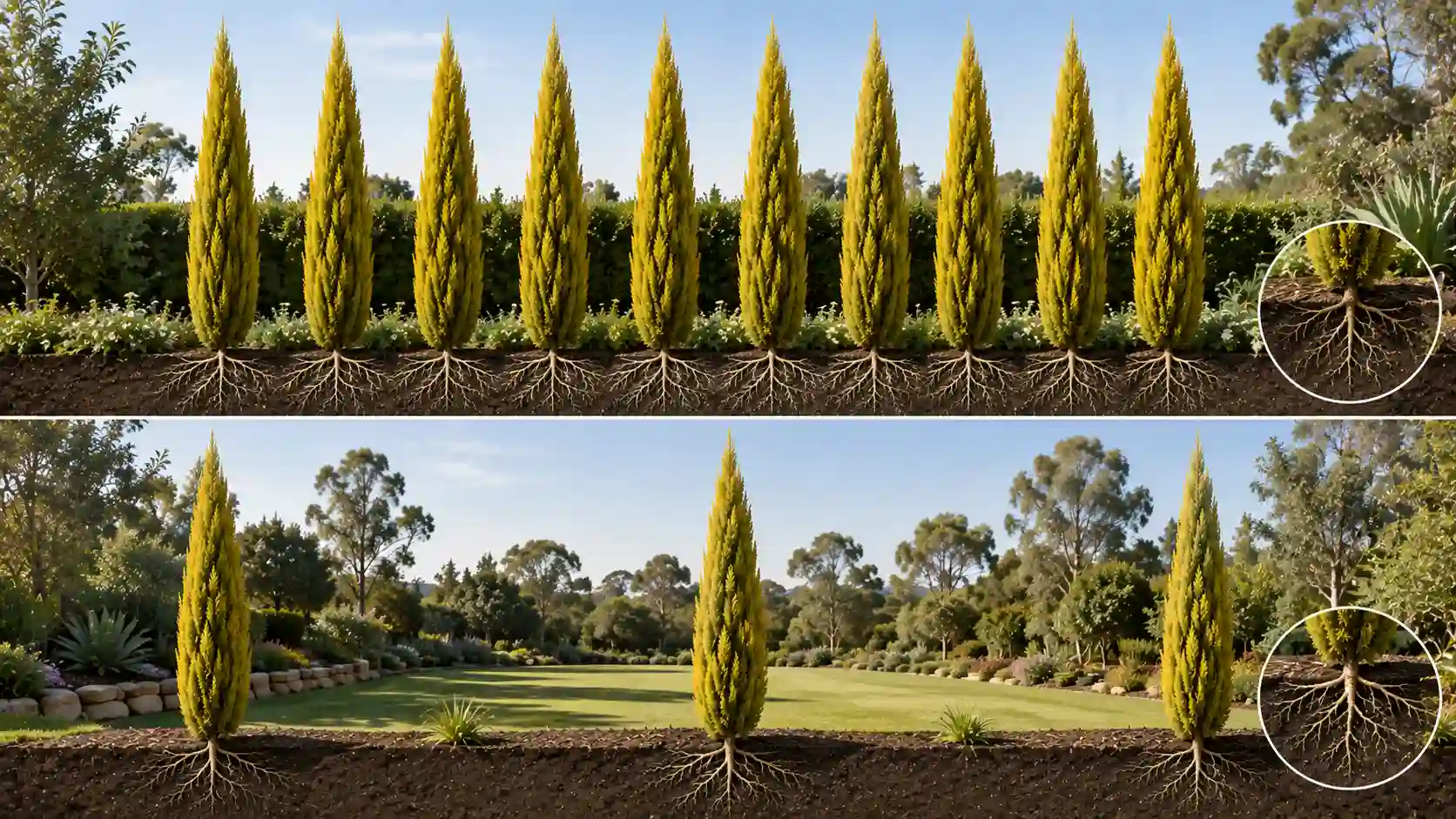
Swanes Golden Cypress spacing depends on whether the trees are planted as a hedge, screen, or individual feature plant. Because this cultivar remains narrow, it can be planted closer together than many wider evergreen trees.
For gardeners comparing different hedge plants, options such as Ficus Hillii ‘Flash’ provide an alternative screening solution where a denser hedge is preferred.
Recommended spacing:
- For a formal hedge or narrow screen: Plant approximately 80cm–1m apart for a dense vertical effect.
- For individual specimen planting: Allow around 1.5m or more between trees to highlight their natural column shape.
- Near pathways or structures: Maintain enough room for airflow and maintenance access.
Correct spacing improves air circulation and reduces competition for water and nutrients. Planting pencil pines too closely together may create crowded growth and increase the chance of fungal issues in humid conditions.
Can You Plant It Close to a House?
Yes, Swanes Golden Cypress can generally be planted near a house because it develops a relatively non-invasive, shallow fibrous root system. However, maintaining a sensible buffer distance from foundations, pipes, and drainage systems is still recommended as a general landscaping precaution.
Understanding root behaviour is important when selecting trees near structures, and gardeners can compare different species through our guide on Gum Tree Root System: Root Spread, Problems & Safe Distances.
Cypress trees do not typically produce the aggressive surface roots associated with some large tree species. Their roots mainly spread outward through fine feeder roots rather than forming large invasive structural roots.
When planting near buildings:
- Keep a reasonable distance from foundations.
- Avoid planting directly over underground drainage lines.
- Consider the mature height before selecting the location.
- Maintain access for future pruning or maintenance.
The question “Do cypress trees have invasive roots?” is usually answered with no for Italian cypress varieties, but responsible placement remains important for long-term garden planning.
Care Guide
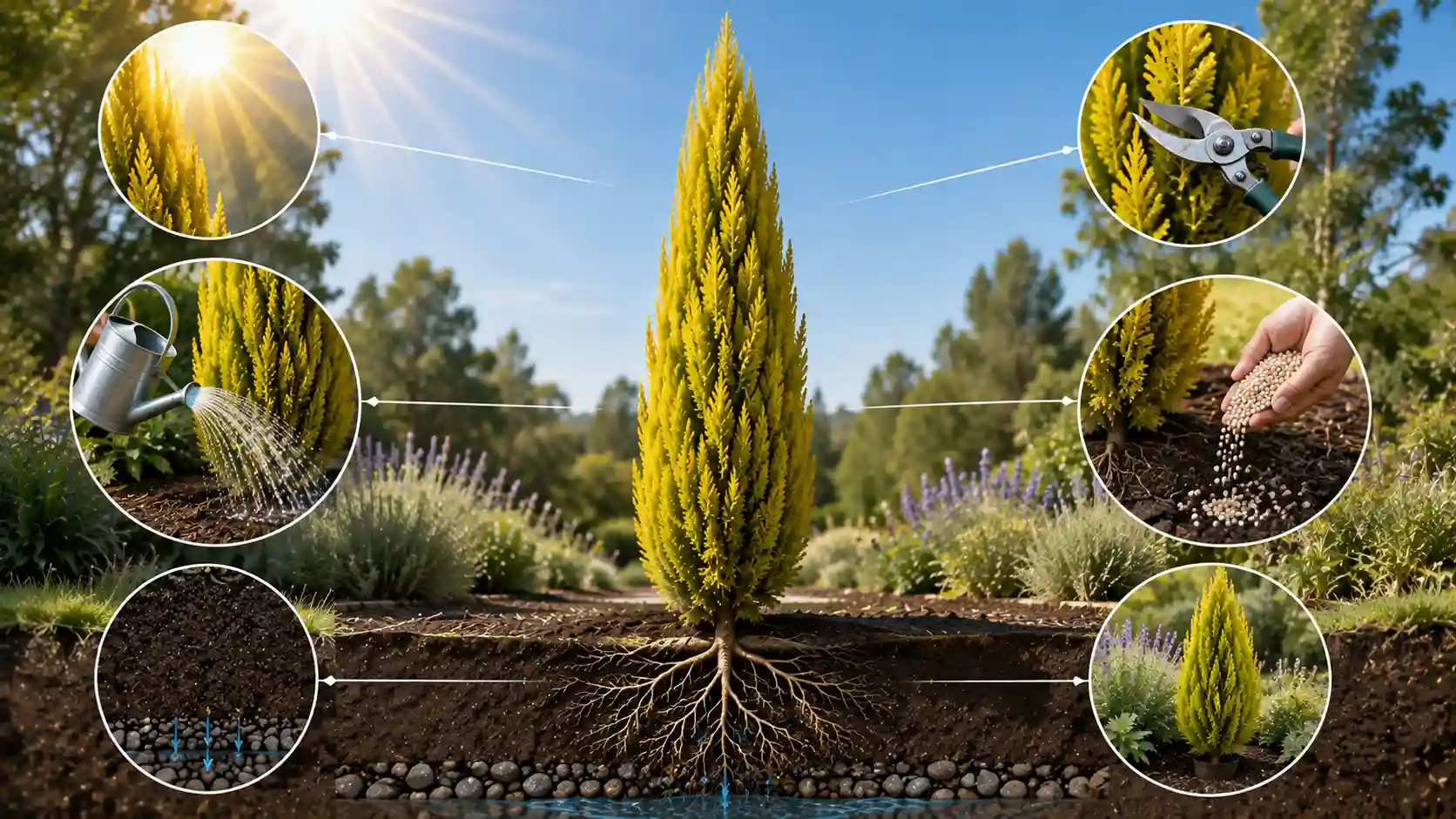
Swanes Golden Cypress is considered an easy-care evergreen once established. Its main requirements are adequate sunlight, good drainage, and appropriate watering during early growth. With suitable conditions, it maintains its narrow form naturally with minimal maintenance.
Watering
Young Swanes Golden Cypress trees need regular watering during their first year while roots establish. Deep watering encourages stronger root development compared with frequent shallow watering.
Established trees are relatively drought tolerant and usually require only low-to-moderate watering depending on rainfall and soil conditions.
Practical watering guidance:
- Water deeply during dry periods.
- Allow the soil surface to dry slightly between watering.
- Avoid constant wet soil, which can contribute to root problems.
Light Requirements
Full sun is essential for maintaining the strongest golden colour. Trees grown in partial shade may survive but often develop greener foliage and slower growth.
For the brightest golden appearance, plant Swanes Golden Cypress where it receives several hours of direct sunlight each day.
Soil Requirements
Swanes Golden Cypress adapts to a range of soils as long as drainage is good. It can tolerate sandy soils and moderately clay soils, but poorly drained areas should be improved before planting.
Ideal soil conditions include:
- Well-drained structure
- Moderate fertility
- Slightly acidic to neutral pH
- Good airflow around roots
Fertilising
A slow-release fertiliser applied in spring can support healthy growth and maintain foliage colour. Avoid excessive fertilising because rapid soft growth can reduce the plant’s natural compact structure.
Pruning
Minimal pruning is usually required because Swanes Golden Cypress naturally maintains its upright shape. Light trimming can be used to remove damaged branches or maintain a formal appearance.
Heavy pruning into old wood should be avoided because cypress trees may not regenerate well from areas without active green growth.
Climate Tolerance
Swanes Golden Cypress is well suited to many Australian climates. Once established, it tolerates drought conditions and moderate frost. Protection may be helpful for young plants during periods of severe cold or extreme weather.
As of 2026, gardeners are increasingly selecting narrow evergreen trees like Swanes Golden Cypress for smaller Australian properties because they provide vertical greenery without requiring large planting areas.
Pruning — Can You Cut the Top Off?
You can cut the top off an Italian cypress, but topping is generally discouraged because it damages the tree’s natural columnar form. Removing the central leader can create an unnatural appearance and may encourage uneven branching.
Instead of topping, use light shaping when necessary.
Better pruning practices include:
- Remove dead, damaged, or crossing branches.
- Trim lightly to maintain the natural shape.
- Avoid reducing the height dramatically.
- Prune during suitable growing periods rather than extreme heat.
If you want to keep an Italian cypress small, selecting a naturally compact cultivar like Swanes Golden Cypress is usually a better approach than repeatedly cutting the top.
Common Problems and How to Fix Them
Although Swanes Golden Cypress is low-maintenance, incorrect growing conditions can lead to foliage problems, slow growth, or pest issues. Most problems are linked to watering, drainage, sunlight, or planting mistakes.
Yellowing or Browning Foliage
Yellow or brown foliage is usually caused by environmental stress rather than a natural colour change.
Common causes include:
- Overwatering: Constantly wet soil reduces oxygen around roots and can lead to decline.
- Poor drainage: Heavy clay or compacted soil may cause root stress.
- Winter cold stress: Young plants may show temporary browning after cold exposure.
Solutions:
- Improve drainage where water remains around roots.
- Reduce watering frequency in wet conditions.
- Apply mulch to protect roots from temperature changes.
- Remove severely damaged branches if necessary.
Some golden foliage variation is normal, but sudden widespread browning requires investigation.
Slow or Stunted Growth
Slow growth is often caused by insufficient sunlight, poor soil conditions, or competition from nearby plants.
Possible causes include:
- Too much shade
- Compacted soil
- Limited nutrients
- Nearby trees competing for water
Fixes include:
- Move young container plants to a sunnier location.
- Improve soil structure before planting.
- Apply appropriate slow-release fertiliser.
- Reduce competition around the root zone.
Pest and Wildlife Issues
Swanes Golden Cypress is generally resistant to many common garden problems, but some pests can occasionally affect plant health. Issues are usually more common when plants are stressed by poor drainage, drought, or overcrowding.
Potential problems include:
- Cypress aphids: These sap-sucking insects can weaken new growth and may cause discolouration.
- Scale insects: Small infestations can reduce plant vigour if left untreated.
- Spider mites: These may appear during hot, dry conditions.
Management methods include:
- Maintaining healthy growing conditions through correct watering and sunlight.
- Removing heavily affected branches where practical.
- Using appropriate horticultural treatments if infestations become severe.
Swanes Golden Cypress is also considered relatively deer resistant. The question “Do deer eat golden cypress?” depends on local conditions, but deer generally avoid many aromatic cypress species compared with softer-leaved plants. However, no plant can be considered completely deer-proof when food sources are limited.
Swanes Gold vs Similar Cypress Varieties
Swanes Golden Cypress belongs to a group of narrow evergreen cypress plants that are often compared because of their similar upright growth habits. However, each variety differs in size, colour, and landscape purpose.
Another popular narrow cypress option is the Glauca Pencil Pine, which offers a different blue-green foliage colour and growth habit compared with the golden tones of Swanes Golden Cypress.
Understanding these differences helps gardeners choose the right cypress for their available space and desired appearance.
| Variety | Height | Width | Foliage Colour | Growth Rate |
| Swane’s Gold | 5–6m | About 1m | Golden-yellow | Slow to moderate |
| Tiny Tower Italian Cypress | Around 3–5m | Narrow, often under 1m | Dark green | Slow |
| Stricta (Cupressus sempervirens ‘Stricta’) | 10–15m+ | About 1–2m | Deep green | Moderate |
| Glauca (Blue Italian Cypress) | 10–20m | About 1–3m | Blue-green/silver | Moderate |
| Lemon Cypress (Cupressus macrocarpa ‘Goldcrest Wilma’) | 2–4m commonly | Around 1m | Bright lime-yellow | Moderate |
Swane’s Gold vs Tiny Tower Italian Cypress
Tiny Tower Italian Cypress is a more compact option designed for smaller gardens. It maintains a narrow shape but generally stays shorter than Swanes Golden Cypress.
Choose:
- Swanes Golden Cypress for taller golden screening and architectural impact.
- Tiny Tower for restricted spaces where height must remain more controlled.
Swane’s Gold vs Stricta Italian Cypress
Stricta is the classic tall green Italian cypress variety. It provides a strong Mediterranean appearance but can eventually become much taller than Swanes Gold.
The main differences are:
- Stricta has green foliage.
- Swanes Gold has golden-yellow foliage.
- Stricta is better suited to larger landscapes.
- Swanes Gold is more suitable where height and width need to be balanced.
Blue Italian Cypress vs Italian Cypress
Blue Italian Cypress refers to forms with blue-grey foliage, while standard Italian Cypress usually has deep green foliage. Both share the same narrow upright habit but create different colour effects in garden designs.
Blue varieties are often selected for cooler-toned landscapes, while Swanes Gold provides a warmer golden contrast.
Lemon Cypress vs Golden Cypress
Lemon Cypress (Cupressus macrocarpa ‘Goldcrest Wilma’) is sometimes confused with golden cypress because of its yellow foliage. However, they are different plants.
Key differences:
- Lemon Cypress usually stays shorter.
- Swanes Golden Cypress develops a taller columnar form.
- Lemon Cypress is commonly grown in pots and ornamental gardens.
- Swanes Gold is better suited as a landscape tree or narrow screen.
The commonly used name “Wilma Goldcrest” refers to Lemon Cypress, not Swanes Golden Cypress.
Beginner Mistakes to Avoid
Swanes Golden Cypress is easy to grow when planted correctly, but several common mistakes can reduce its performance and appearance.
Planting in Shade
One of the biggest mistakes is placing Swanes Golden Cypress in an area without enough direct sunlight.
Low light can cause:
- Reduced golden colouring
- Slower growth
- Less dense foliage
For the best appearance, choose an open sunny position.
Overwatering Established Trees
Because Swanes Golden Cypress becomes drought tolerant after establishment, excessive watering can create problems.
Common signs of overwatering include:
- Yellowing foliage
- Poor growth
- Root stress
Allow the soil to dry slightly between watering and avoid planting in areas where water remains after rainfall.
Planting Too Close Together for Hedges
Although Swanes Golden Cypress is narrow, planting trees too closely together can reduce airflow and increase competition.
Poor spacing may result in:
- Crowded branches
- Reduced sunlight penetration
- Higher humidity around foliage
Follow recommended spacing guidelines to create a healthy screen.
Skipping Soil Drainage Checks in Clay-Heavy Australian Soils
Heavy clay soils can hold water around roots and create long-term stress. Before planting, check how quickly water drains and improve the soil if necessary.
Simple improvements include:
- Adding organic matter
- Creating raised planting areas
- Improving drainage pathways
Correct soil preparation is one of the most important steps for long-term success.
Conclusion
Swanes Golden Cypress is a low-maintenance, narrow columnar evergreen tree that suits many Australian gardens where space is limited. With a mature height of around 5–6m and a width of approximately 1m, it provides strong vertical structure without taking over smaller garden areas.
This golden Italian cypress cultivar performs best in full sun, well-drained soil, and with appropriate watering during establishment. Its non-invasive fibrous root system makes it suitable near paths, fences, and carefully planned areas close to homes.
For gardeners wanting a formal feature tree, narrow screening plant, or architectural accent with golden foliage, Swanes Golden Cypress is a reliable choice when planted in the right conditions.
Swanes Golden Cypress is one of many evergreen landscape choices suitable for Australian gardens, and gardeners can explore more options in our guide to Best Trees and Shrubs for Australian Gardens.
FAQs
How tall does a Cupressus Swanes Gold tree grow?
A Cupressus Swanes Gold tree typically grows around 5–6 metres tall and approximately 1 metre wide. Some plants may vary depending on climate, soil quality, sunlight, and growing conditions.
Is Swanes Golden Cypress the same as a golden pencil pine?
Yes, Swanes Golden Cypress is commonly sold as Golden Pencil Pine. The name refers to its narrow pencil-like shape, but the correct botanical name is Cupressus sempervirens ‘Swane’s Gold’.
Do Swanes Gold cypress trees have invasive roots?
No, Swanes Gold cypress trees generally do not have invasive roots. They develop a shallow fibrous root system rather than aggressive structural roots, although sensible planting distances from foundations and pipes are still recommended.
Can you plant Swanes Golden Cypress close to a house?
Yes, Swanes Golden Cypress can be planted near a house when adequate spacing is maintained. Keeping a reasonable buffer from foundations, drainage lines, and structures helps avoid future maintenance issues.
Is Swanes Golden Cypress easy to care for?
Yes, Swanes Golden Cypress is considered easy to care for once established. It requires full sun, well-drained soil, occasional deep watering during dry periods, and minimal pruning.
How far apart should you space Swanes Gold cypress trees for a hedge?
For a hedge or narrow screen, Swanes Gold cypress trees are generally spaced around 80cm to 1 metre apart. Wider spacing can be used when a more open architectural effect is preferred.