
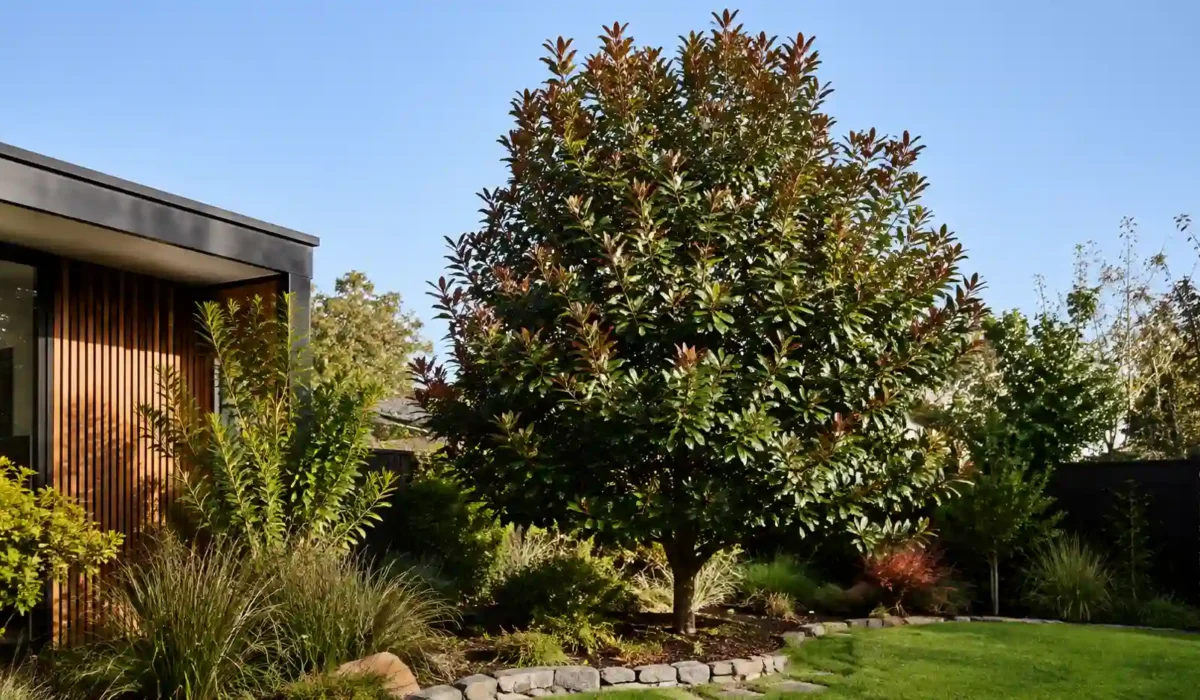
Elaeocarpus Eumundi Growth Rate, Height & Care Guide
Elaeocarpus eumundi (Eumundi quandong) grows at a slow-to-moderate rate, according to Elemo Baker, with growth accelerating as the tree matures. In Australian gardens it typically reaches 8–12 metres in cultivation, though wild specimens can exceed 20 metres. Consistent watering during the roughly 12-week establishment period supports early growth.
Position markedly shapes form: full sun encourages a denser, more compact tree, while shaded positions produce a taller, thinner habit at a slower pace. Regular light pruning while young helps restrict size and build density, and in rich, consistently moist soil the tree can turn surprisingly vigorous, developing a root system too large for small gardens or sites near buildings and drains.
By Elemo Baker | Plant Care & Gardening Expert
Last Updated: August 2026
Quick Summary
- Elaeocarpus eumundi grows approximately 60–90 cm per year once established, with a slow-to-moderate growth rate.
- Mature trees typically reach 5–15 metres in cultivation but may exceed 25 metres in natural rainforest environments.
- Most cultivated trees develop a canopy 3–6 metres wide, making spacing important for hedges and privacy screens.
- The species is not considered to have invasive roots, although mature trees develop an extensive root system that requires adequate planting space.
- Regular watering, fertile well-drained soil, and full sun to partial shade encourage the healthiest growth.
What Is Elaeocarpus Eumundi?
Elaeocarpus eumundi is an evergreen Australian rainforest tree native to the coastal and sub-tropical forests of south-east Queensland and north-eastern New South Wales. Commonly called the Eumundi Quandong or Smooth-leaved Quandong, it belongs to the Elaeocarpaceae family and is valued for both ornamental landscaping and native habitat planting.
Unlike many fast-growing screening trees, Elaeocarpus eumundi combines steady growth with an elegant appearance that remains attractive throughout the year. Its naturally upright form makes it suitable for residential gardens, streetscapes, parks, and larger landscapes.
One of its most distinctive features is the flush of bronze to deep red new foliage, which gradually matures into glossy dark green leaves. This seasonal colour contrast provides visual interest even when the tree is not flowering.
During late spring to early summer (typically November to December in Australia), mature trees produce clusters of small cream-coloured flowers with a light, pleasant fragrance. These flowers are followed by small blue drupes that attract birds and other native wildlife.
Although the fruit is technically edible, it has a strong acidic flavour and is not commonly grown as a food crop. Instead, the tree is primarily valued for its ornamental qualities and ecological benefits.
It is also important to distinguish Elaeocarpus eumundi from other members of the genus. For example, Blue Quandong (Elaeocarpus reticulatus) is a different species with smaller mature dimensions, different flowering characteristics, and its own growth habit. Gardeners searching for information about Blue Quandong should avoid assuming that growth rates or mature sizes are identical across all Elaeocarpus species.
Experience Insight: In our experience growing Australian native screening trees, Elaeocarpus eumundi develops its best foliage density when planted where it receives several hours of direct sunlight while still benefiting from protection against prolonged hot afternoon winds during establishment.
Elaeocarpus Eumundi Growth Rate Explained
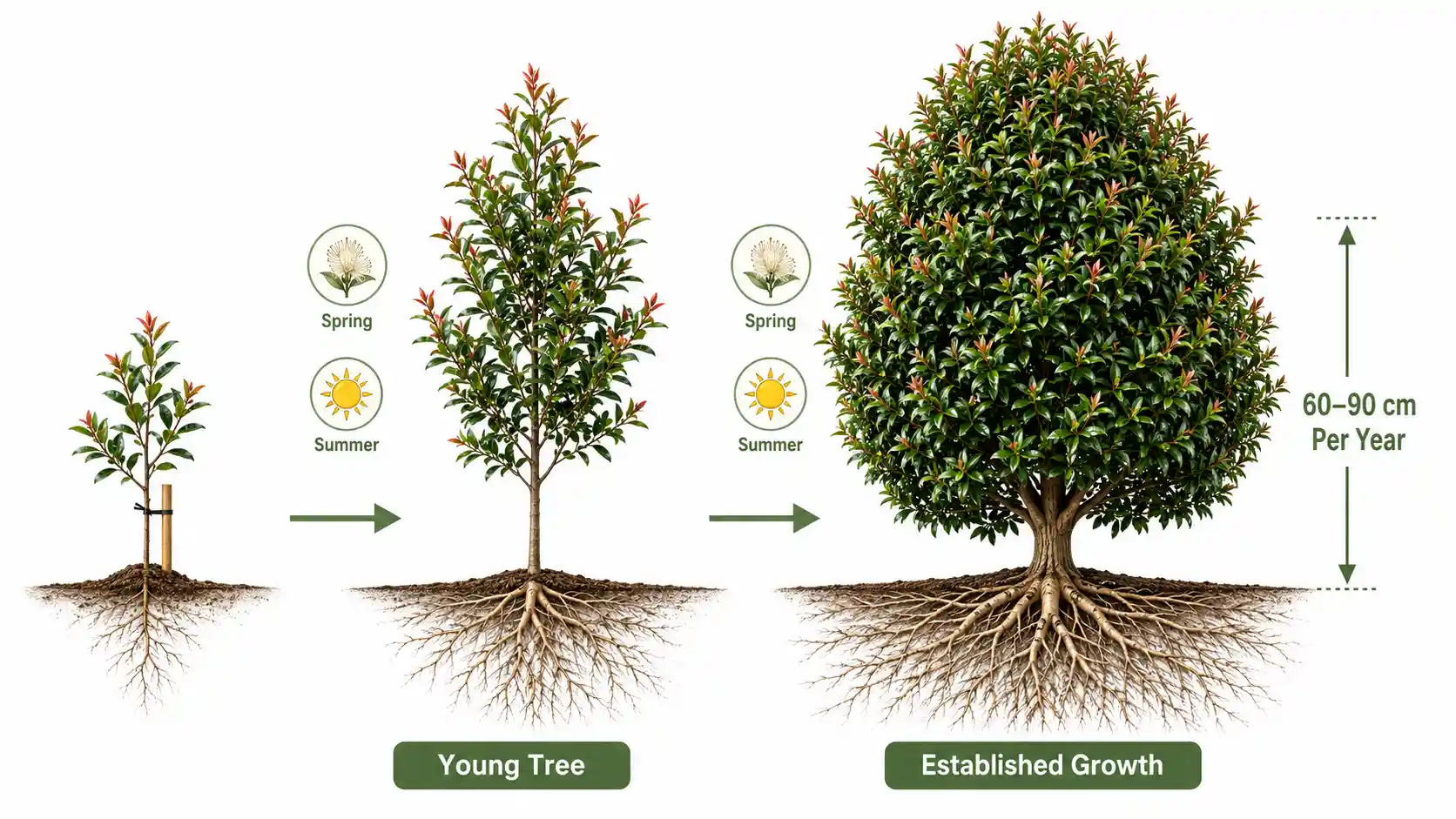
Elaeocarpus eumundi grows at a slow-to-moderate rate, averaging around 60–90 cm of new growth per year after it becomes established. Growth is naturally slower during the establishment phase because the tree prioritises root development before producing vigorous canopy growth.
Growth Rate Per Year
During the first year after planting, growth is often modest. Most young trees focus on establishing a strong root system capable of supporting future development.
Once established, healthy trees commonly produce:
- 60–90 cm of annual growth
- Consistent evergreen foliage throughout the year
- Faster extension growth during spring and summer
- Slower growth during winter in cooler regions
Exceptional growing conditions—including fertile soil, regular moisture, warm temperatures, and adequate sunlight—may result in slightly faster annual growth. Conversely, drought, nutrient deficiencies, or heavy shade can noticeably reduce growth.
Elemo Baker recommends allowing young trees sufficient time to establish rather than applying excessive fertiliser in an attempt to accelerate growth. Healthy root development almost always produces stronger long-term performance than forcing rapid top growth.
Growth Rate in Pots
When grown in containers, Elaeocarpus eumundi grows considerably more slowly than plants established in garden soil.
Restricted root space naturally limits:
- Overall height
- Canopy spread
- Annual growth rate
- Water and nutrient availability
Container-grown specimens are therefore easier to maintain at smaller sizes, making them suitable for patios, courtyards, and larger balconies where full-sized trees would be impractical.
Regular watering becomes more important in pots because container media dries much faster than garden soil, particularly during Australian summers.
Factors That Affect Growth Speed
Several environmental factors determine how quickly an Eumundi Quandong grows.
Conditions that encourage faster growth
- Full sun or bright partial shade
- Deep, fertile, well-drained soil
- Consistent watering during establishment
- Organic mulch that conserves soil moisture
- Balanced fertiliser applied during the active growing season
- Good air circulation
Conditions that slow growth
- Heavy clay with poor drainage
- Extended drought
- Compacted soil restricting root development
- Deep shade
- Nutrient-deficient soils
- Root disturbance after planting
As of 2026, Australian horticultural best practice continues to recommend improving soil structure before planting rather than relying heavily on fertilisers afterwards. Healthy soil biology and consistent moisture generally produce stronger, more sustainable growth over the life of the tree.
Elaeocarpus Eumundi Height and Width
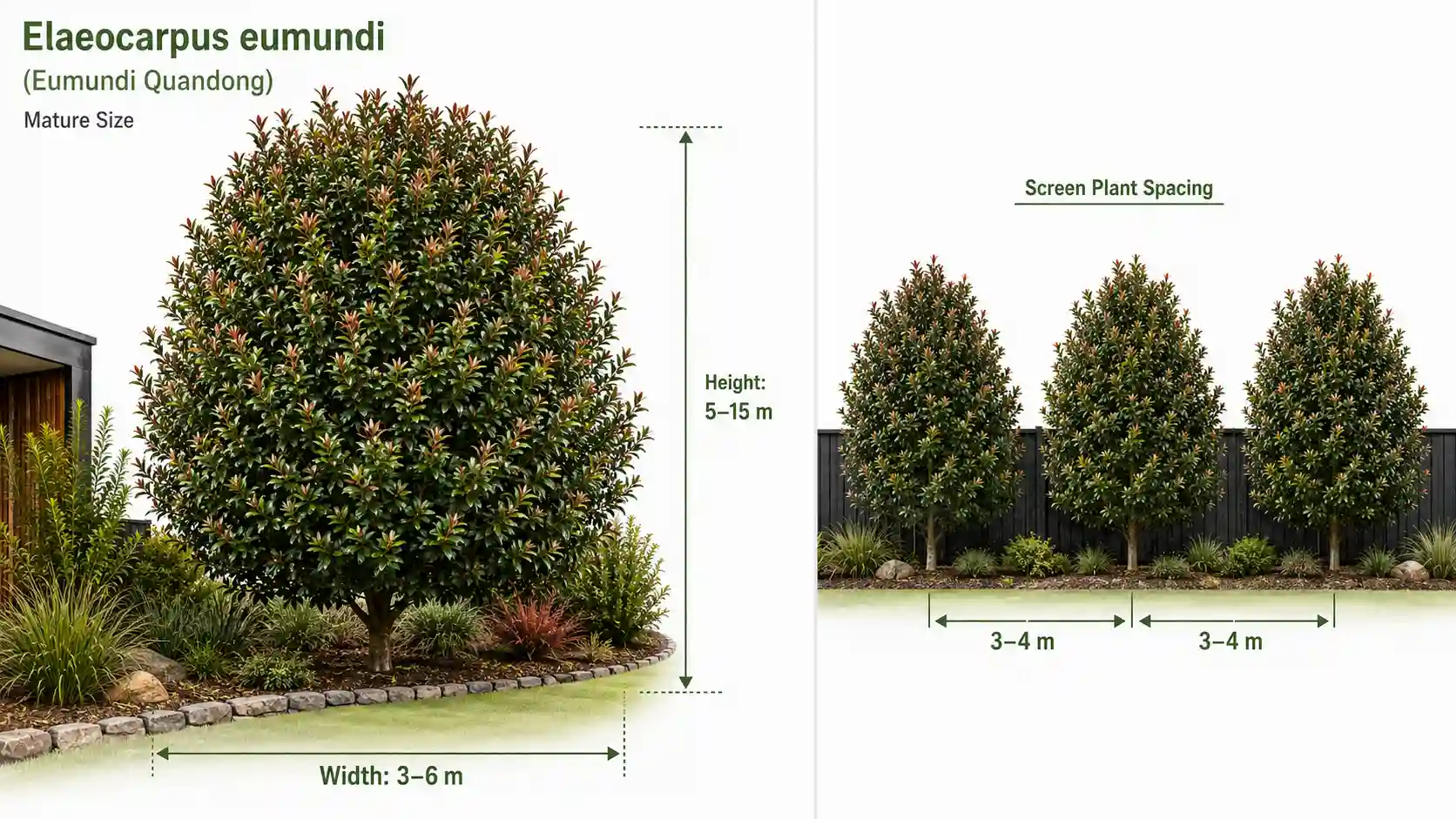
Elaeocarpus eumundi develops into a medium to large evergreen tree whose mature size varies according to climate, available space, soil conditions, and pruning practices.
Mature Height in Cultivation
In cultivated gardens, most trees reach between 5 and 15 metres tall.
Several factors influence final height:
- Local climate
- Soil fertility
- Rainfall
- Irrigation
- Available root space
- Pruning frequency
Trees maintained as hedges are usually kept well below their natural mature height through regular trimming.
In cooler parts of Australia, growth may remain slightly slower, resulting in smaller mature specimens than those growing in warm coastal climates.
Under ideal rainforest conditions, mature trees can exceed 25 metres, although this size is rarely seen in residential landscapes.
Mature Width
Most cultivated trees develop a canopy spread of approximately 3–6 metres.
This moderate width explains why the species performs well as:
- Privacy screens
- Boundary plantings
- Windbreaks
- Feature trees
- Native habitat gardens
When designing a landscape, gardeners should consider both mature height and mature width rather than planting solely according to the tree’s current nursery size.
Height and Width Comparison
| Growing Environment | Mature Height | Mature Width |
| Home gardens (cultivated) | 5–15 m | 3–6 m |
| Managed hedge | 2–5 m (pruned) | Variable |
| Natural rainforest | 20–25+ m | 6–10+ m |
Experience Insight: In our experience, gardeners often underestimate the mature canopy spread when planting screening trees. Allowing adequate spacing from the beginning reduces future pruning requirements and helps each tree develop a fuller, healthier canopy.
Elaeocarpus Eumundi as a Hedge or Screen
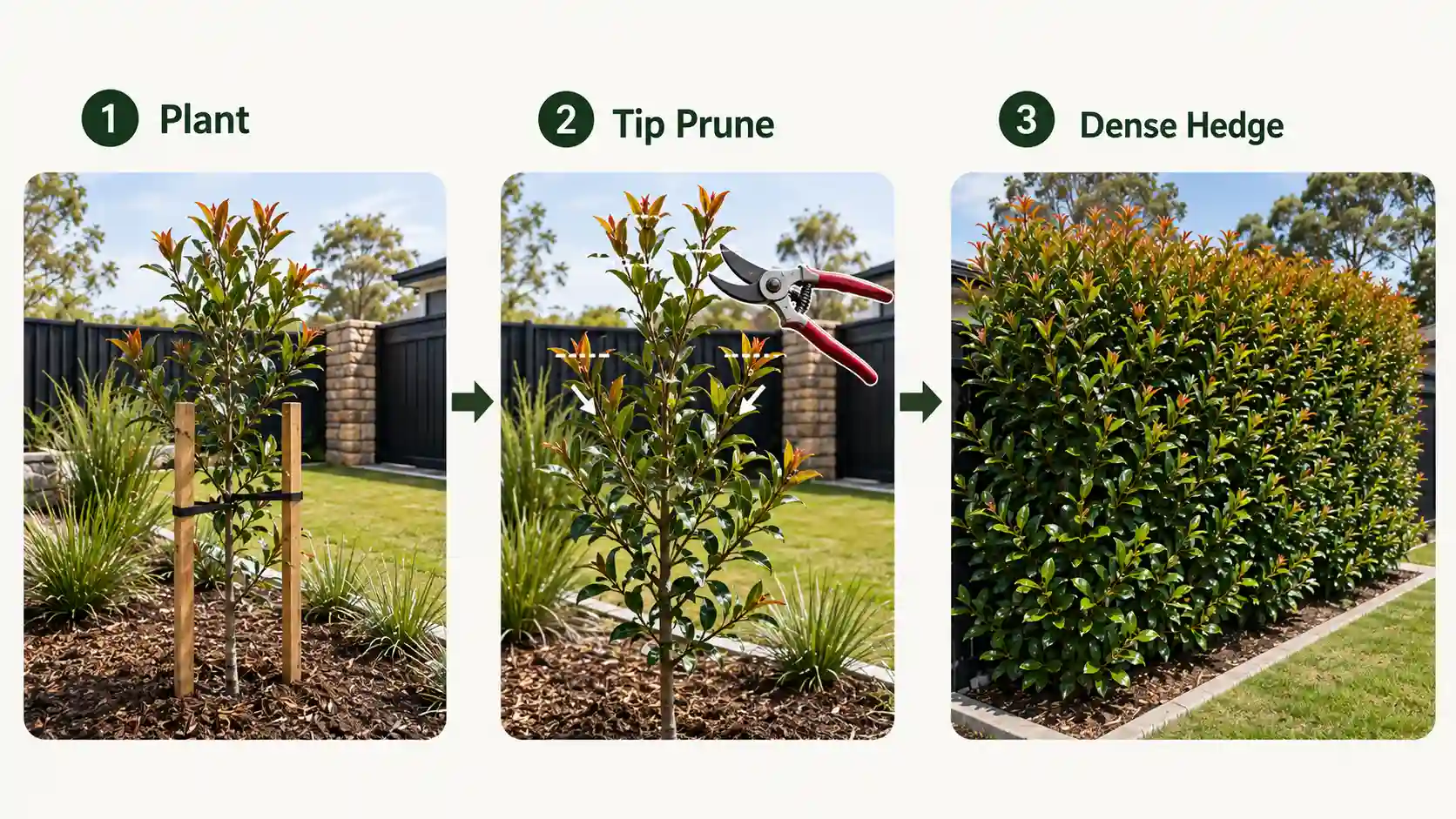
One of the most popular uses for Elaeocarpus eumundi is as an evergreen hedge or privacy screen. If you are designing a low-maintenance boundary planting, our guide to Low-Maintenance Plants for Fence Line in Australia provides more suitable options for Australian gardens. For gardeners planning a larger privacy barrier, our guide to Fast Growing Trees for Screening in Australia explains alternative trees suitable for creating quick-growing garden screens. Its dense foliage, attractive new growth, and tolerance of pruning make it an excellent long-term alternative to many fast-growing exotic screening species.
Unlike extremely vigorous hedging plants that require constant trimming, Eumundi Quandong offers a balance between manageable maintenance and dependable privacy once established. Gardeners looking for quicker privacy solutions can also compare other species in our guide to Fast Growing Evergreen Trees Australia, which covers faster-growing options for screens and boundaries.
For the best screening results:
- Plant trees 1.5–2 metres apart for a dense hedge.
- Space them 2.5–4 metres apart when creating a more natural screen where individual crowns can develop.
- Leave sufficient room from fences and buildings to allow healthy canopy development and maintenance access.
This spacing encourages the crowns to gradually knit together while reducing excessive competition for water and nutrients.
How to Prune Elaeocarpus Eumundi for Hedging
Elaeocarpus eumundi responds well to pruning and can be shaped into a dense formal hedge or maintained as a more natural screening tree. Light pruning from an early age encourages branching and creates a fuller structure.
Recommended pruning practices include:
- Tip-pruning young plants to encourage side branching and thicker foliage.
- Removing damaged or crossing branches to maintain good structure.
- Reducing height gradually rather than removing large amounts of growth at once.
- Trimming once or twice yearly depending on the desired hedge shape.
The best pruning period is generally after active growth periods, such as late spring or early autumn, avoiding severe pruning during extreme heat or frost conditions.
Heavy pruning is usually tolerated once the tree is well established, but maintaining a regular pruning routine produces a denser and more attractive screen with less stress on the plant.
Planting an Eumundi Quandong Tree
Planting Elaeocarpus eumundi correctly during the early stages has a major impact on future growth rate, canopy development, and overall health. A well-positioned tree establishes faster and requires less maintenance over time.
For successful planting, choose a location with:
- Well-drained soil
- Protection from strong winds
- Full sun to partial shade
- Adequate space for mature growth
- Consistent moisture during establishment
Although this species naturally grows in rainforest environments, it adapts well to many Australian garden conditions when soil moisture and drainage are managed correctly.
When planting:
- Dig a hole approximately twice as wide as the root ball but no deeper than the existing soil level.
- Place the tree at the same depth it was growing in its nursery container.
- Backfill with existing soil improved with organic matter if needed.
- Apply a layer of mulch around the root zone while keeping mulch away from the trunk.
- Water deeply after planting to remove air pockets and encourage root contact.
Young trees generally require regular watering during their first one to two years, especially through hot and dry Australian summers.
Is Elaeocarpus Eumundi Frost Tolerant?
Elaeocarpus eumundi has some frost tolerance once mature but young trees are more sensitive to cold temperatures. Established specimens can usually handle light frost, while newly planted trees may suffer leaf damage or slowed growth in colder areas.
To protect young trees:
- Plant in a sheltered position.
- Use organic mulch to protect soil temperature.
- Provide temporary frost cloth protection during severe cold events.
- Avoid planting young specimens in exposed frost pockets.
With age, the tree develops greater resilience as its root system becomes deeper and more established.
Does Elaeocarpus Eumundi Have Invasive Roots?
No, Elaeocarpus eumundi is not classified as an invasive-rooted tree; however, like all large evergreen trees, it develops an extensive root system as it matures.
Its roots generally spread to support the size of the canopy rather than aggressively damaging surrounding structures. Understanding root behaviour is important when choosing larger landscape trees; our guide on Gum Tree Root System: Root Spread, Problems & Safe Distances explains how mature Australian trees interact with surrounding structures. Problems usually occur when any medium-to-large tree is planted too close to buildings, paving, or underground services.
For best results:
- Plant several metres away from house foundations.
- Avoid placing large trees directly above drainage lines or underground pipes.
- Allow enough open soil space for natural root expansion.
- Consider mature canopy size when selecting a planting position.
A practical planting distance depends on site conditions, soil type, and nearby structures. In smaller gardens, regular pruning and appropriate spacing are important for long-term management.
Common Elaeocarpus Eumundi Problems
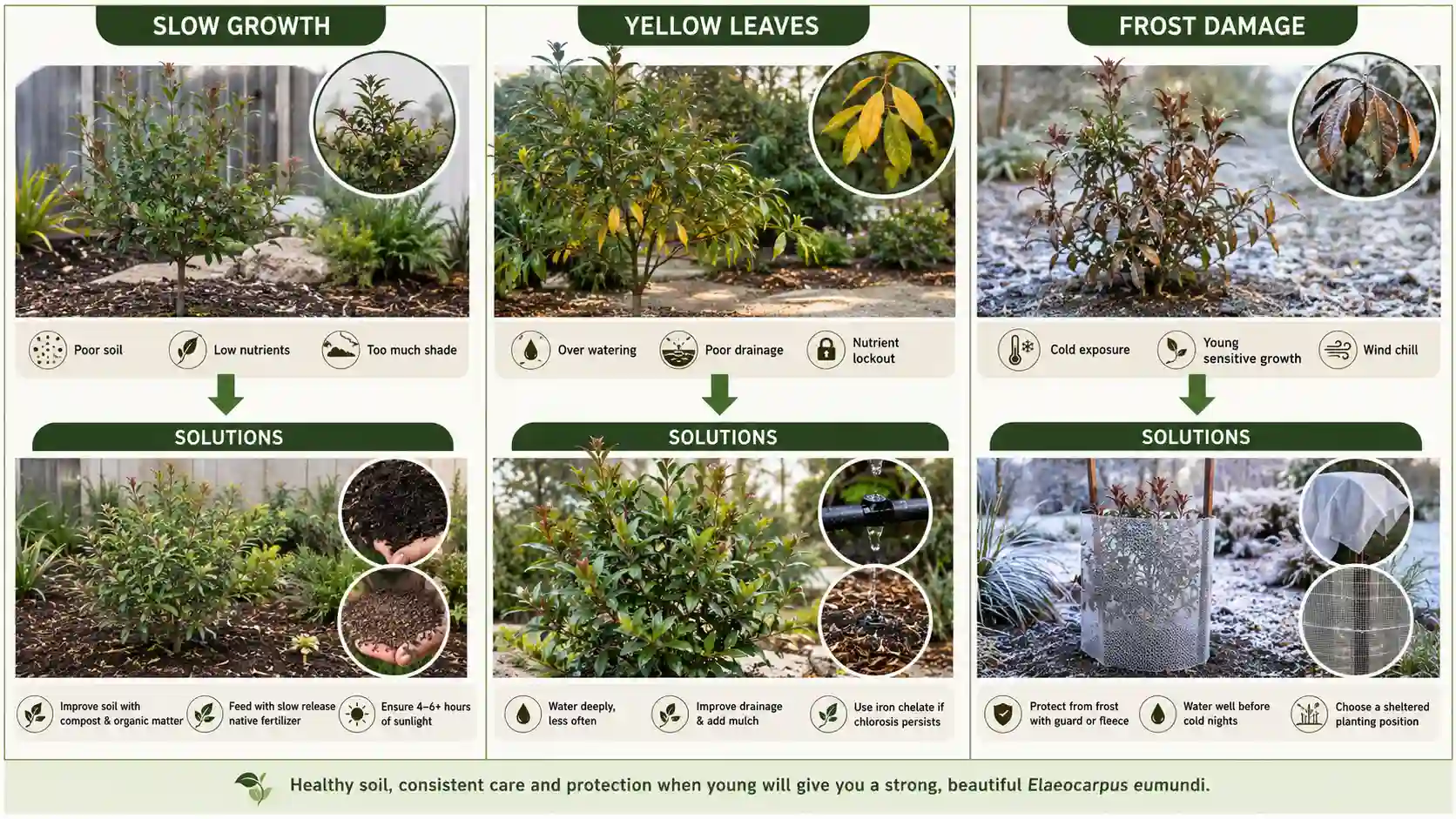
Although Elaeocarpus eumundi is considered a reliable native tree, it can experience problems when growing conditions do not match its natural preferences. Most issues are related to moisture management, soil conditions, light exposure, or temperature stress.
Slow or Stunted Growth
Slow growth in Elaeocarpus eumundi is usually caused by poor growing conditions rather than the tree’s natural growth habit alone.
Common causes include:
- Insufficient sunlight
- Compacted soil
- Lack of water during establishment
- Poor soil fertility
- Root disturbance
How to fix it:
- Improve soil structure with organic matter.
- Ensure the tree receives adequate sunlight.
- Apply a suitable native plant fertiliser during active growth.
- Maintain consistent watering until roots are established.
How to prevent it:
Choose the correct planting location from the beginning and avoid moving established trees unnecessarily.
Yellowing Leaves
Yellow leaves on an Eumundi Quandong are often linked to water-related stress, particularly poor drainage or inconsistent watering.
Possible causes include:
- Waterlogged soil
- Overwatering
- Root stress
- Nutrient imbalance
How to fix it:
- Check whether water drains freely after rainfall.
- Reduce irrigation if the soil remains constantly wet.
- Improve drainage where necessary.
- Remove affected leaves and monitor new growth.
A healthy Elaeocarpus eumundi should generally maintain glossy green foliage, although older leaves naturally yellow and drop as part of normal renewal.
Frost Damage in Young Trees
Young Eumundi Quandongs can experience leaf browning or temporary damage after frost exposure.
Why it happens:
Young plants have less developed protective structures and are more vulnerable to sudden temperature drops.
Solutions include:
- Protecting young plants during frost events.
- Using mulch to stabilise soil temperatures.
- Avoiding exposed planting locations in cold climates.
Most mature trees recover well after minor frost damage when provided with suitable growing conditions.
What Makes Elaeocarpus Eumundi Different From Similar Trees?
Elaeocarpus eumundi is often compared with other native screening trees, particularly other quandong species. Understanding the differences helps gardeners select the right plant for their landscape.
| Feature | Elaeocarpus eumundi | Elaeocarpus reticulatus (Blue Quandong) | Common Australian Screening Trees |
| Growth rate | Slow to moderate (60–90 cm/year) | Moderate, varies by location | Often faster depending on species |
| Mature height | 5–15 m cultivated | Usually smaller to medium-sized | Highly variable |
| Foliage | Glossy green with bronze-red new growth | Glossy foliage with blue fruit | Depends on species |
| Fruit | Small blue acidic drupes | Blue ornamental fruit | Varies |
| Frost tolerance | Moderate once established | Moderate depending on climate | Species dependent |
| Hedge suitability | Excellent with pruning | Good in suitable locations | Depends on plant choice |
Compared with many fast-growing screening plants, Elaeocarpus eumundi grows more slowly but offers better long-term structure, evergreen foliage, and a more natural native appearance. Another popular Australian native screening option is Lilly Pilly, particularly Syzygium australe, which is commonly grown for dense hedges and responds well to regular pruning.
Conclusion
Elaeocarpus eumundi growth rate is classified as slow to moderate, with established trees typically producing around 60–90 cm of growth per year under suitable conditions. While it is not one of the fastest screening trees available, its evergreen foliage, manageable growth habit, and attractive appearance make it a valuable choice for Australian gardens.
The Eumundi Quandong commonly reaches 5–15 metres in cultivation with a 3–6 metre canopy spread, so correct spacing is essential. It performs best in well-drained soil, consistent moisture, and full sun to partial shade.
Elaeocarpus eumundi is one of many Australian native trees that can provide long-term structure and biodiversity benefits in gardens. For more ideas on selecting suitable species, explore our guide to Best Trees and Shrubs for Australian Gardens.
For gardeners wanting a dense, low-maintenance native screen or feature tree, Elaeocarpus eumundi offers a reliable long-term solution. Patience during establishment is rewarded with a healthy, attractive tree that provides privacy, structure, and habitat value for many years.
Frequently Asked Questions
How fast do Elaeocarpus eumundi grow?
Elaeocarpus eumundi grows approximately 60–90 cm per year once established, making it a slow-to-moderate growing Australian native tree. Growth is usually slower during the first year while the root system develops.
Does the Elaeocarpus eumundi have invasive roots?
No, Elaeocarpus eumundi is not considered an invasive-rooted tree, but it develops a broad root system as it matures. Planting with adequate space prevents most root-related issues.
How do I prune Elaeocarpus eumundi?
Prune Elaeocarpus eumundi by lightly trimming growing tips and removing unwanted branches to encourage dense foliage. Regular pruning once or twice per year helps maintain a compact hedge or screen.
Is Elaeocarpus eumundi frost tolerant?
Elaeocarpus eumundi is lightly frost tolerant when mature but young plants are more vulnerable to frost damage. Protection is recommended during severe cold events.
What kind of fruit does the Elaeocarpus eumundi tree produce?
Elaeocarpus eumundi produces small blue drupes after flowering, but the fruit is strongly acidic and the tree is mainly grown as an ornamental native species.
How big does a quandong tree grow in a pot vs the ground?
A potted Elaeocarpus eumundi remains significantly smaller than a tree planted in the ground because root space limits growth. Container plants are easier to maintain at compact sizes, while in-ground trees can reach 5–15 metres in cultivation.